Occasional thoughts of an Anglican Episcopal priest

Category: Ministry (Page 42 of 59)

The Lord Helps Those . . . . — Sermon for the 15th Sunday after Pentecost, Proper 17C — September 1, 2013

====================

This sermon was preached on the Fifteenth Sunday after Pentecost, September 1, 2013, at St. Paul’s Episcopal Church, Medina, Ohio, where Fr. Funston is rector.

(Revised Common Lectionary, Pentecost 15 (Proper 17, Year C): Jeremiah 2:4-13; Psalm 81:1,10-16; Hebrews 13:1-8,15-16; and Luke 14:1, 7-14. These lessons can be read at The Lectionary Page.)

====================

Portrait of Benjamin FranklinFinish this verse: “The Lord helps those . . . .”

Congregation responds: “. . . . who help themselves.”

Do you know where to find that in Scripture?

You won’t. It’s not there. But a lot of people think it is. A survey done by the Barna organization within the past few years showed that at least 80% of American Christians believe that old saying is a biblical verse! It’s not.

“God helps those who help themselves” is probably the most often quoted piece of “Scripture” not found in the Bible. This saying is usually attributed to Ben Franklin because it was quoted in Poor Richard’s Almanac in 1757. In reality it predates Franklin by several centuries! One of the earliest forms of this saying goes back to Aesop’s fable, Hercules and the Waggoner, where the moral of the story is “the gods help them that help themselves.” The modern variant, “God helps those who help themselves,” was first coined by the English political theorist Algernon Sydney in a posthumous essay published in 1698 entitled Discourses Concerning Government. It is not a religious sentiment at all; it comes from moralistic politics! And it carries with it an implied negative corollary – that God will refuse to help those who (for whatever reason) don’t help themselves!

It also demands that we consider the truth of what happens to those who do help themselves . . . those who help themselves to too much . . . those who, as Jeremiah put it, “go after worthless things, and become worthless themselves.”

But for now let us consider, instead, the simple and straightforward statement we find in the Letter to the Hebrews: “The Lord is my helper; I will not be afraid. What can anyone do to me?” The writer of the Letter is quoting from Psalm 118. In the prayer book this declaration is phrased: “The Lord is at my side, therefore I will not fear; what can anyone do to me?” This is a theme we find again and again in the Psalms: the nearness and unconditional nature of God’s aid.

When my mother planned her funeral (something I encourage everyone to think about doing; it is a real gift to your survivors!) she chose Psalm 121 to be read; that psalm is also appointed for the Feast of St. Francis of Assisi, and so for two reasons it is one of my favorites. That psalm reads:

1 I lift up my eyes to the hills; *
from where is my help to come?
2 My help comes from the Lord, *
the maker of heaven and earth.
3 He will not let your foot be moved *
and he who watches over you will not fall asleep.
4 Behold, he who keeps watch over Israel *
shall neither slumber nor sleep;
5 The Lord himself watches over you; *
the Lord is your shade at your right hand,
6 So that the sun shall not strike you by day, *
nor the moon by night.
7 The Lord shall preserve you from all evil; *
it is he who shall keep you safe.
8 The Lord shall watch over your going out and your coming in, *
from this time forth for evermore.

The graphic on the front of our bulletin this morning is a quotation from the King James version of another psalm, Psalm 46. In the prayer book, the first few verse are rendered:

1 God is our refuge and strength, *
a very present help in trouble.
2 Therefore we will not fear, though the earth be moved, *
and though the mountains be toppled into the depths of the sea;
3 Though its waters rage and foam, *
and though the mountains tremble at its tumult.
4 The LORD of hosts is with us; *
the God of Jacob is our stronghold.

Psalm 46 was the inspiration for Martin Luther’s great hymn, a favorite of this congregation, A Mighty Fortress Is Our God.

Nowhere in these psalms, nor anywhere else in the Bible will you find anything that provides a Judaic or Christian basis for the sentiment that “God helps those who help themselves” and its negative corollary that God refuses to assist those who don’t. In fact, the Bible teaches the opposite. God helps the helpless, the poor, the weak, the needy! The Prophet Isaiah, for example, declares, “For you have been a refuge to the poor, a refuge to the needy in their distress, a shelter from the rainstorm and a shade from the heat. When the blast of the ruthless was like a winter rainstorm, the noise of aliens like heat in a dry place, you subdued the heat with the shade of clouds; the song of the ruthless was stilled.” (Isa. 25:4-5) In the Letter to the Romans, St. Paul declares, “For while we were still weak, at the right time Christ died for the ungodly.”

Jesus once told a parable that underscored the unconditional nature of God’s help:

Which one of you, having a hundred sheep and losing one of them, does not leave the ninety-nine in the wilderness and go after the one that is lost until he finds it? When he has found it, he lays it on his shoulders and rejoices. And when he comes home, he calls together his friends and neighbors, saying to them, “Rejoice with me, for I have found my sheep that was lost.” (Luke 15:4-6)

We human beings are the lost sheep of this parable, the completely helpless sheep, in need of God’s saving help.

God does not help those who can help themselves, simply because no one can do so! We cannot help ourselves; we cannot free ourselves from slavery to sin and death. Our own power fails us when we rely on it, rather than God.

As another psalm (Psalm 118) says:

16 There is no king that can be saved by a mighty army; *
a strong man is not delivered by his great strength.
17 The horse is a vain hope for deliverance; *
for all its strength it cannot save.
18 Behold, the eye of the Lord is upon those who fear him, *
on those who wait upon his love,
19 To pluck their lives from death, *
and to feed them in time of famine.

To believe that God’s help is conditioned on our helping ourselves is foolish. It is not only unbiblical, it is prideful! Pride and arrogance motivate us to believe that we can do everything through our own effort and with our own merit, that we can pick ourselves up by our own spiritual and moral bootstraps. However, the clear warrant of Scripture is that “God opposes the proud, but gives grace to the humble.” (James 4:6)

I got to thinking about the contrast between that popular aphorism and the teaching of Scripture because of the Gospel lesson. In the Gospel lesson for today in which Jesus gives the advice:

When you are invited [to a banquet], go and sit down at the lowest place, so that when your host comes, he may say to you, “Friend, move up higher”; then you will be honored in the presence of all who sit at the table with you. For all who exalt themselves will be humbled, and those who humble themselves will be exalted.

It occurred to me that Jesus is, indeed, addressing that second corollary of the old aphorism, that question I suggest at the beginning of this sermon: what happens to those who do help themselves . . . those who help themselves to too much? “All who exalt themselves will be humbled” is a pretty clear answer.

We live in a world dominated by those who have helped themselves to quite a bit. We live in a world where there are a few (“the 1%” we have come to call them), who have helped themselves to much, much more than they will ever be able to use, to the detriment of those who could make very good use of it. The writer of the Letter to the Hebrews clearly counseled against such acquisitiveness: “Keep your lives free from the love of money, and be content with what you have; for he has said, ‘I will never leave you or forsake you.’” And he said, “Do not neglect to do good and to share what you have, for such sacrifices are pleasing to God.”

Trust in God. Everything else will fade; everything else will let you down. Over and over again the Bible teaches this lesson that we humans have a hard time understanding. Our tendency is to put our trust in and help ourselves to things, money, stuff. Somebody once asked John Rockefeller how much was enough; he answered, “Just a little bit more.”

I hate to say it, but we are all like that. We accumulate stuff at an incredible rate. We can’t seem to let go of what we have and we are always gather just a little bit more. We build extra garages for our stuff. I read recently that there are now more than 35,000 self-help storage facilities in the United States, with something like 1-1/2 billion square feet of extra storage because our houses and apartments can’t contain it all. I confess – Evelyn and I rent one of those units: it’s full of stuff we haven’t visited in a couple of years. I don’t really know why we keep it! I guess because we’re just like other people. The more we have, the more we need; the more we have, the more we worry about it. We have become like those against whom Jeremiah prophesied, like those who “went after worthless things, and became worthless themselves.”

But, says the Letter to the Hebrews, “be content with what you have; for [God] has said, ‘I will never leave you or forsake you.’” And Jesus, continuing the imagery of the banquet, said to his host in today’s Gospel story (and to us):

When you give a luncheon or a dinner, do not invite your friends or your brothers or your relatives or rich neighbors, in case they may invite you in return, and you would be repaid. But when you give a banquet, invite the poor, the crippled, the lame, and the blind. And you will be blessed, because they cannot repay you, for you will be repaid at the resurrection of the righteous.

Give the stuff away. Give it to those who need it. Help yourself by divesting yourself of all that stuff.

If there is any truth in that old saying that “God helps those who help themselves” it is in this, that God will repay those who give their stuff to the poor, the crippled, the lame, and the blind; that God will help those who help others. God will help those who help themselves by getting rid of the accumulated possessions we have but do not need, the accumulated wealth that can be of use to others. We don’t need it! And we needn’t be afraid of losing it. “The Lord is my helper; I will not be afraid. What can anyone do to me?”

“Do not neglect to do good and to share what you have, for such sacrifices are pleasing to God.” Those with whom you share may not be able to repay you, but “you will be repaid at the resurrection of the righteous.”

So now, let’s finish that verse differently: “The Lord helps those . . . who help others!”

Amen.

====================

A request to my readers: I’m trying to build the readership of this blog and I’d very much appreciate your help in doing so. If you find something here that is of value, please share it with others. If you are on Facebook, “like” the posts on your page so others can see them. If you are following me on Twitter, please “retweet” the notices of these meditations. If you have a blog of your own, please include mine in your links (a favor I will gladly reciprocate). Many thanks!

====================

Father Funston is the rector of St. Paul’s Episcopal Church, Medina, Ohio.

Facebook friends with God – From the Daily Office – August 19, 2013

From the Second Book of Samuel:

Now Absalom had set Amasa over the army in the place of Joab. Amasa was the son of a man named Ithra the Ishmaelite, who had married Abigal daughter of Nahash, sister of Zeruiah, Joab’s mother.

(From the Daily Office Lectionary – 2 Samuel 17:24 (NRSV) – August 19, 2013.)

Social Media IconsReading a verse like this one from the Second Book of Samuel makes me feel like I’m sitting at my in-laws’ kitchen table, or even in my grandmother’s kitchen. Up until very recently, this is the way people connected with other people. I can hear my late father-in-law reminding my wife of someone in the small town where she was born and raised:

“Oh, you know Sally! She was married to Bob, Jim’s brother, and her uncle Fred was your second grade teacher’s (Mrs. Jones’s) husband’s brother-in-law, Bill. Mr. Jones’s sister Margaret was his first wife.”

Often as I listened to conversations like this I would find myself lost in the tangled web of interpersonal relationships, trying desperately to trace the connections between spouses, siblings, cousins, friends-of-the-family, business associates, church members, and the-people-we-don’t-know-but-talk-about that defined a person’s identity in the society of that small town and within my spouse’s extended community of family and friends.

With the advent of the internet, Facebook, Tumblr, Pinterest, Linked-In, Google+, and the list goes on . . . With the advent of social media and these means of connecting that are at once more direct but more tenuous, more easily understood but less well defined, how do we now understand personal identity or personhood?

Personhood is a social construct that entails the very relationships the writer of Second Samuel sought to portray, the relationships my father-in-law used to recall to my wife who Sally was. The ability to be in those relationships is one way to understand what it means to be a person. Personhood is defined by a human being’s ability to have relationships with other human beings and, from a theological standpoint, to enter into the special relationship human beings have with God.

Contemporary social media now allows me to be in relationship with more people more immediately than has ever been possible in the past. Some years ago in a course in pastoral practice, I read that the greatest number of close interpersonal relationships a clergy person can sustain is about fifty. We may “know” many more people, but the limit on the number of people with whom our face-to-face relationships can be meaningful in any particular sense is about fifty – maybe a little lower for an introvert like myself, possibly a little higher for an extrovert.

But now I have over 800 “friends” on Facebook and “know” maybe a similar number of additional Facebook users through discussion group pages . . . . “Oh, you know Eric! He’s friends with Michael, who’s in that glass collecting Facebook group started by Brad, who follows Sid on Twitter.”

We Christians are supposed to understand God through the metaphor of personhood — the Holy Trinity, a unity of three Persons (Father, Son, and Holy Spirit). When our understanding of personhood is stretched (and some might say “warped”) by new technologies of relationship, does our concept of God change? How do we understand God and God’s Personhood in this new digital age?

I don’t know. I don’t have an answer. But I know this: I’m not just Facebook friends with God.

====================

A request to my readers: I’m trying to build the readership of this blog and I’d very much appreciate your help in doing so. If you find something here that is of value, please share it with others. If you are on Facebook, “like” the posts on your page so others can see them. If you are following me on Twitter, please “retweet” the notices of these meditations. If you have a blog of your own, please include mine in your links (a favor I will gladly reciprocate). Many thanks!

====================

Father Funston is the rector of St. Paul’s Episcopal Church, Medina, Ohio.

The Stones of Zion: the Hardscape of Salvation – From the Daily Office – August 16, 2013

From the Psalter:

You will rise up and have compassion on Zion,
for it is time to favor it;
the appointed time has come.
For your servants hold its stones dear,
and have pity on its dust.

(From the Daily Office Lectionary – Psalm 102:13-14 (NRSV) – August 17, 2013.)

Rocky PathMy parish is currently undertaking a building renovation which will include redoing some of the concrete pathways and landscaping. In the process of overseeing this work, I’ve learned a new word – hardscape – which means the area of a designed landscape made up of hard wearing materials such as stone, concrete, and similar construction materials. I’ve been thinking about rocks and stones for the better part of a month. That’s why I haven’t written one of these meditations . . .

I got hung up on an image from the Old Testament reading for July 22, 2013, which included this verse: “Saul took three thousand chosen men from all Israel and went to seek David and his men in front of the Rocks of the Wild Goats.” I couldn’t get that description, “the Rocks of the Wild Goats,” out of my mind. I’ve read the Daily Office lessons everyday, but as I thought about them, I kept coming back to “the Rocks of the Wild Goats.” And then, this morning’s Psalm has this bit about the stones of Zion and something clicked.

The Stones of Zion: the Hardscape of Salvation

Slipping from my hand
The looking glass falls to the rocky path
In a glittering crescendo
It shatters into shards of shimmering shine
And crashing crystalline cacophony

Saul went in the direction
Of the Rocks of the Wild Goats
In a dark and stony cavern
David silently snipped the corner of his cloak
And saved the king

Jesus walked the way of weary tears
Up the stony slope of an escarpment shaped like a skull
On that dark and windswept hillside
Soldiers tossed dice for a seamless tunic
And killed a king

The women gathered grieving in the garden
Beside a boulder that had blocked a burial vault
On a dark and cheerless morning
Magdalen turned from an empty shroud
And beheld her king

Slipped from my hand
The shattered mirror of my life fallen on a path
Strewn with goat rocks, gravelly skulls, and tombstones
The glittering, shimmering shards lovingly gathered
And saved by a king

====================

A request to my readers: I’m trying to build the readership of this blog and I’d very much appreciate your help in doing so. If you find something here that is of value, please share it with others. If you are on Facebook, “like” the posts on your page so others can see them. If you are following me on Twitter, please “retweet” the notices of these meditations. If you have a blog of your own, please include mine in your links (a favor I will gladly reciprocate). Many thanks!

====================

Father Funston is the rector of St. Paul’s Episcopal Church, Medina, Ohio.

Be Dressed for Action — Sermon for the 12th Sunday after Pentecost (Proper 14C) — August 11, 2013

====================

This sermon was preached on the Twelfth Sunday after Pentecost, August 11, 2013, at St. Paul’s Episcopal Church, Medina, Ohio, where Fr. Funston is rector.

(Revised Common Lectionary, Pentecost 12 (Proper 14, Year C): Isaiah 1:1,10-20; Psalm 50:1-8,23-24; Hebrews 11:1-3,8-16; and Luke 12:32-40. These lessons can be read at The Lectionary Page.)

====================

Children in British Slum, circa 1955We are used to thinking of the Book of Isaiah as the work of a single prophet, but it is really three books: First Isaiah, comprising chapters 1-39; Second Isaiah, made up of chapters 40-55; and Third Isaiah, chapters 56-66. These three prophets did their work in three different and distinct periods in Jewish history: the late 8th Century BCE; the mid-6th Century BCE, and the late 6th Century BCE, respectively. This is clear from evidence in their writings: their themes vary and each prophet speaks from a different location. First Isaiah is clearly set in pre-exilic Jerusalem; Second Isaiah was obviously written in Babylon; Third Isaiah speaks from post-exilic Jerusalem. Nonetheless, there is a sense of unity in the writings that make up this book. Phrases and themes recur, and there are linkages later and earlier passages. Today’s reading is from First Isaiah and introduces a topic which will be taken up again by Second and Third Isaiah: what constitutes proper worship?
Ritual worship in First Isaiah’s day was centered at the Temple in Jerusalem. Prof. James T. Dennison, Jr., of Northwest Theological Seminary, in an article about today’s reading from Isaiah describes the cultic activity:

At the temple, there were throngs of people. Multitudes trampled the courts of the temple – hustle and bustle, service upon service, activity upon activity. On the Sabbath; at the monthly new moon service; at the appointed feasts – Passover, Pentecost, Yom Kippur, Tabernacles. Why you couldn’t keep the good folks away. And offerings – did they bring offerings! Burnt offerings, peace offerings, grain offerings – why what more could you ask? All that Moses prescribed, they brought. Piety by the bushel; holiness by the herd; sanctity by the sheepfold. And the fellowship – oh, the friends they met and the people they talked to, the news they caught up on and the gossip they passed on. And the motions – why they spread out their hands in prayer. They lifted their arms to the sky – what a pious sight, the smoke of their offerings ascending and the ascension of these holy hands. What ecstasy! What piety! What religiosity! (A Tale of Two Cities: Isaiah and Worship)

“What liturgical hypocrisy!” cries Isaiah. Isaiah condemns this worship as so much theater in the absence of care for the weakest in society; God, he says, rejects liturgical activities devoid of the pursuit of justice and righteousness. The stinging critique of worship that we heard in today’s Old Testament lesson is not an indictment of worship in general. Rather, the prophet tells us that God takes no joy in the pomp and circumstance when it is accompanied by unjust behavior, when in fact it covers up injustice:

When you stretch out your hands, I will hide my eyes from you; even though you make many prayers, I will not listen; your hands are full of blood. Wash yourselves; make yourselves clean; remove the evil of your doings from before my eyes; cease to do evil. (Isa. 1:15-16)

It is a cry his successor, Third Isaiah, will take up two centuries later condemning hollow, hypocritical ritual fasting: the fast that God chooses, he says, is “to loose the bonds of injustice, to undo the thongs of the yoke, to let the oppressed go free, and to break every yoke.” (Isa. 58:6) The worship offered those whose hands are full, metaphorically, with the blood of the oppressed will not be accepted; the blood of animals offered in sacrificial worship will not atone for the injustice in the community. The emptiness of the ritual reminds the Divine Judge of society’s crimes against its weaker and less fortunate members.

Isaiah calls on his listeners, the worshipers of ancient Judah and worshipers in modern America, to hear the word of the Lord, the torah of God: “Learn to do good; seek justice, rescue the oppressed, defend the orphan, plead for the widow.” (Isa. 1:17)

This is precisely what Jesus says in today’s Gospel lesson: “Sell your possessions, and give alms. Make purses for yourselves that do not wear out, an unfailing treasure in heaven, where no thief comes near and no moth destroys. For where your treasure is, there your heart will be also.” (Lk. 12:33-34) And then he gives his famously imprecise warning of the Second Coming: “Be alert, be ready, be dressed for action, because you don’t when it will be.” How does one do this? By doing the things Jesus has already mentioned. As Lutheran pastor John Petty puts it:

If one’s treasure has been kept to one’s self, one’s treasure is always at risk. If one’s treasure has been given to the poor, it is “unfailing.” If your treasure is with yourself, your heart is directed toward yourself. If your treasure has been given to the poor, your heart is with the poor — or, in other words, with God. (Progressive Involvement)

“And why do you worry about clothing? Consider the lilies of the field, how they grow; they neither toil nor spin, yet I tell you, even Solomon in all his glory was not clothed like one of these.” (Matt. 6:28-29) If you have clothed the naked, you are dressed and ready to go. It’s like Jesus said at another time:

I was hungry and you gave me food, I was thirsty and you gave me something to drink, I was a stranger and you welcomed me, I was naked and you gave me clothing, I was sick and you took care of me, I was in prison and you visited me. * * * Just as you did it to one of the least of these who are members of my family, you did it to me. (Matt. 25:35-36,40)

The answer to the “how” question begs the next inquiry . . . when? That the tough one because we are dealing with what has been called “the uncertain certainty of Christ’s return.” Remember, Jesus said no one, including himself, would know when that day would come; like the old television show Candid Camera, it will happen when we least expect it. A ministerial colleague of mine in a more conservative evangelical tradition once commented, “We have focused so much emotional energy on the expectation that we have not done the work to be done before Jesus returns.” It’s just so much theater in the absence of care for the weakest in society. God takes no joy in ritual liturgy or any worship unaccompanied by righteous behavior and justice.

In the late 19th and early 20th Centuries, our own Anglican tradition was divided between those who favored a more ceremonial, ritual style of liturgy, commonly called Anglo-Catholics, and those who favored far less ritual in worship. The latter, generally referred to as Evangelicals or as “the Low Church Party” would have said that liturgy such as we usually celebrate now is “hollow and unsatisfying, ceremonial . . . in place of the life-giving Word.” In an Evangelical Australian publication it was denounced in terms nearly as prophetic as Isaiah’s:

We never read once of Paul, or Peter, or of any of the other apostles having lights and swinging censers and vestments and copes and mitres and chasubles, and elaborate processions, and so forth. * * * Seen in the clear light of the Word of God, [ritual worship] is not only blasphemous, but idolatrous. It is absolutely opposed to Scriptural teaching. (The Signs of the Times, August 27, 1923)

Eventually, as common Prayer Book liturgy makes clear, we Anglicans arrived (as is our wont) at a compromise encompassing many styles of worship and settling into the broad liturgical practices of today. But the concern of Isaiah for ritual worship accompanied by social justice was not lost on the Anglo-Catholics.
At the Second Anglo-Catholic Congress held in London in 1923, the Bishop of Zanzibar, the Right Reverend Frank Weston, closed the meeting with an address entitled Our Present Duty. The last words of Bishop Weston’s address, which could as easily be spoken to 21st Century Americans, are these:

I say to you, and I say it to you with all the earnestness that I have, that if you are prepared to fight for the right of adoring Jesus in his Blessed Sacrament, then you have got to come out from before your Tabernacle and walk, with Christ mystically present in you, out into the streets of this country, and find the same Jesus in the people of your cities and your villages. You cannot claim to worship Jesus in the Tabernacle, if you do not pity Jesus in the slum.

Now mark that — this is the Gospel truth. If you are prepared to say that the [Christian] is at perfect liberty to rake in all the money he can get no matter what the wages are that are paid, no matter what the conditions are under which people work; if you say that the [Christian] has a right to hold his peace while his fellow citizens are living in hovels below the levels of the streets, this I say to you, that you do not yet know the Lord Jesus in his Sacrament. You have begun with the Christ of Bethlehem, you have gone on to know something of the Christ of Calvary — but the Christ of the Sacrament, not yet. Oh brethren! if only you listen to-night your movement is going to sweep [this nation]. If you listen. I am not talking economics, I do not understand them. I am not talking politics, I do not understand them. I am talking the Gospel, and I say to you this: If you are Christians then your Jesus is one and the same: Jesus on the Throne of his glory, Jesus in the Blessed Sacrament, Jesus received into your hearts in Communion, Jesus with you mystically as you pray, and Jesus enthroned in the hearts and bodies of his brothers and sisters up and down this country. And it is folly — it is madness — to suppose that you can worship Jesus in the Sacraments and Jesus on the Throne of glory, when you are sweating him in the souls and bodies of his children. It cannot be done.

There then, as I conceive it, is your present duty; and I beg you, brethren, as you love the Lord Jesus, consider that it is at least possible that this is the new light that the Congress was to bring to us. You have got your Mass, you have got your Altar, you have begun to get your Tabernacle. Now go out into the highways and hedges where not even the Bishops will try to hinder you. Go out and look for Jesus in the ragged, in the naked, in the oppressed and sweated, in those who have lost hope, in those who are struggling to make good. Look for Jesus. And when you see him, gird yourselves with his towel and try to wash their feet.

(Our Present Duty, slightly amended. Bishop Weston said “Anglo-Catholic” rather than “Christian” and “England” rather than “the nation” – but with those simple amendments this statement applies as well to church members in the contemporary United States as it did to Anglo-Catholics in the England of a century ago.)

Another Anglican a century and a half earlier summarized the Christian duty somewhat more succinctly. Although it is disputed that John Wesley ever actually uttered what is now known as “John Wesley’s Rule,” it certainly accords with his preaching, with today’s lesson from Isaiah’s prophecy, and with the Gospel:

“Do all the good you can,
by all the means you can,
in all the ways you can,
in all the places you can,
at all the times you can,
to all the people you can,
as long as ever you can.”

This understanding and appreciation for the meaning behind Isaiah’s prophecy, his condemnation of worship not connected to a ministry of social justice has been a part of our Anglican ethos from the very beginning. Shortly after the Church of England separated from Rome, when Archbishop Thomas Cranmer and his collaborators produced the first English Book of Common Prayer in 1549, they included at the end of the rite of Holy Communion a closing prayer which included this petition:

We therfore most humbly beseche thee, O heavenly father, so to assist us with thy grace, that we may continue in that holy felowship, and doe all suche good woorkes, as thou hast prepared for us to walke in.

That prayer, or one very much like it, has been used to end Anglican services of the Holy Eucharist for nearly 500 years. In our current American Prayer Book we have a descendent of that prayer in contemporary English which includes the modern version of that petition:

And now, Father, send us out to do the work you have given us to do, to love and serve you as faithful witnesses of Christ our Lord.

Floating around the internet recently, being “tweeted” on Twitter and “shared” on Facebook, is a “meme” which also echoes Isaiah. A “meme” is a photograph over which has been superimposed, using Photoshop or some other graphics application, a caption. (Often the caption may seem to have nothing to with the picture.) This particular “meme” shows a man sitting on the floor of a work bay in an auto repair facility. The caption reads: “Sitting in church for an hour on Sunday morning doesn’t make you a Christian any more than sitting in a garage makes you a car.” A bit snarky, perhaps, but the message is clearly the same as First Isaiah’s.

Whether that prophet eight centuries before Christ, or Third Isaiah two centuries later, or Christ himself in the First Century, Cranmer in the 16th, Wesley in the 18th, the Evangelicals or Bishop Weston in the early 20th Century, or a snarky Facebook “meme” in the 21st, the message is the same: worship devoid of social justice and righteousness is unacceptable!

“Sell your possessions, and give alms.” (Luke 12:33)

“Sell your possessions, and give alms.” (Luke 12:33)

“Wash yourselves; make yourselves clean. * * * Learn to do good; seek justice, rescue the oppressed, defend the orphan, plead for the widow. ” (Isaiah 1:16-17)

“Be dressed for action and have your lamps lit.” (Luke 12:35)

Amen.

====================

A request to my readers: I’m trying to build the readership of this blog and I’d very much appreciate your help in doing so. If you find something here that is of value, please share it with others. If you are on Facebook, “like” the posts on your page so others can see them. If you are following me on Twitter, please “retweet” the notices of these meditations. If you have a blog of your own, please include mine in your links (a favor I will gladly reciprocate). Many thanks!

====================

Father Funston is the rector of St. Paul’s Episcopal Church, Medina, Ohio.

Passing On the Stories – From the Daily Office – July 22, 2013

From the Psalter:

We have heard with our ears, O God, our forefathers have told us,
the deeds you did in their days, in the days of old.

(From the Daily Office Lectionary – Psalm 44:1 (BCP Version) – July 22, 2013.)

Bible Title PageI am often complimented on my knowledge of biblical history, especially the lesser known stories of the Old Testament. Some members of my parish tell me how much they enjoy it when I make an exegetical digression in a sermon to explain the background of some bit of text. Yesterday, a retired clergy colleague extended the compliment to “your seminary professors,” who, he was sure, did a much better job of teaching the Scriptures than had his own mentors.

Responsibility for what I know of the Bible (and I consider my depth of knowledge shallow and inadequate) cannot be laid at the feet of my seminary professors. As many know, I read for Holy Orders rather than attend seminary and obtain the typical three year Master of Divinity degree. After being ordained a deacon, I went to a seminary for one academic year, during which I took only a New Testament survey course and a Greek language course which used the Epistle of James as its principal text. No . . . what little knowledge of Scripture I have is not a result of a seminary education.

There is one person who can claim the credit, my grandfather Charles Edgar Funston, Jr. My grandfather was a Methodist layman who spent nearly fifty years teaching Sunday School to all age groups in his local parish. During the summers of my childhood, which my four cousins and I spent living with our grandparents, he drilled his grandchildren in bible study. We heard with our ears what our grandfather told us, the deeds God did in the days of old.

One ritual, in particular, which committed bible verses to memory during those summer sojourns in our grandparents’ home was grace at the evening meal. Each morning before he went to work and we went to do whatever chore or mischief was on our agenda, C.E. (as my grandfather was called) would give us each a verse to contemplate and memorize during the day, and he would tell us something of its context. At supper, he would call upon one of us to offer a grace which was to incorporate the verse; we were not simply to parrot back the Scripture, but to use it or paraphrase it in a thanksgiving prayer of our own creation. We never knew whom he might call upon, so all of us had to be prepared. If you weren’t, there was no penalty . . . except Granddad’s disappointment, and no one wanted to risk that!

I suspect that that sort of familial instruction in the Holy Scriptures was rare enough at that time, and that it is practically nonexistent in today’s world. Few folks in my generation, or our children’s and grandchildren’s cohorts, will have received biblical education in the church, let alone at the feet of a grandparent. I find that most congregations to whom I preach are, as a result, largely biblically illiterate. Reciting Psalm 44 today for most people will not be a statement of their personal reality, merely an historical curiosity out of the Hebrew past. That’s a tragedy, I think.

I’ve long forgotten the exact words of many (indeed, nearly all) of those verses of the King James Bible memorized during those childhood summers, but a general knowledge of the stories of Scripture remains. More importantly, my grandfather provided me with a foundation on which to build the structure of faith, a knowledge of the past from which to move into the future. Sometimes I wonder, how is the faith community to move into the future? How is it to transmit the faith if children do not hear with their ears, from their forebears, the deeds of God did in days of old? How are children do develop the same sort of foundation if they do not learn those stories? And how can they hear those tales if their parents and grandparents themselves don’t know them?

The church’s task of Christian formation and Christian education gets more and more difficult with each passing year, each passing generation, as fewer and fewer people know the stories of faith. Those who do know them have an enormous responsibility to become storytellers and pass them on, so that recitation of this psalm becomes a reflection of reality, not merely an historical, liturgical curiosity.

====================

A request to my readers: I’m trying to build the readership of this blog and I’d very much appreciate your help in doing so. If you find something here that is of value, please share it with others. If you are on Facebook, “like” the posts on your page so others can see them. If you are following me on Twitter, please “retweet” the notices of these meditations. If you have a blog of your own, please include mine in your links (a favor I will gladly reciprocate). Many thanks!

====================

Father Funston is the rector of St. Paul’s Episcopal Church, Medina, Ohio.

The One Thing Needful in a Market Economy – Sermon for the 9th Sunday after Pentecost (Proper 11C) – July 21, 2013

====================

This sermon was preached on the Ninth Sunday after Pentecost, July 21, 2013, at St. Paul’s Episcopal Church, Medina, Ohio, where Fr. Funston is rector.

(Revised Common Lectionary, Pentecost 9 (Proper 11, Year C): Amos 8:1-12; Psalm 52; Colossians 1:15-28; and Luke 10:38-42. These lessons can be read at The Lectionary Page.)

====================

Fruit BasketIn last week’s sermon I talked about the first three prophetic visions God reveals to Amos: a plague of locusts devouring the crops of ancient Israel, a catastrophic fire destroying everything in the nation, and the plumb line set in the midst of the nation’s people demonstrating that they were not upright. This week Amos is shown a fourth prophetic vision.
The eighth chapter of this prophet opens with God showing Amos a basket of summer fruit, such things as peaches, apricots, nectarines, plums, and figs. We aren’t told the condition of the fruit, but some commentators suggest that it may be fruit that is over-ripe, maybe on the verge of going bad. They suggest this because God tells Amos that this vision means that “the end has come upon my people Israel; I will never again pass them by.” God’s explanation continues with visions of dead bodies in the street, wailing and lamentation in the temples, the nation destroyed, and the survivors wandering lost.

Well, it may be that the fruit is going bad, but in truth what God is doing is making a pun in Hebrew, a play on words that simply doesn’t translate into English. In Hebrew, the word for “summer fruits” is qayits; the word for “the end” is qets. The are spelled differently, but pronounced almost identically. Qayits . . . qets . . . God is making it clear that with respect to Israel, God is calling it quits! The finality of the passage is clear; Israel has no recourse.

And why has it come to this? Again, God is very clear, it’s because of economic injustice. God will punish the nation because its upper class, its wealthy merchants “trample on the needy.” They can’t wait Sabbaths and holy days to get over so they can resume their fraudulent business practices. They sell partial measures of wheat weighed on false scales that are overbalanced so that what is shown as a sheckel of wheat is far less. They measure ephahs of grain that are less than the regulation 35 liters. They “buy the poor for silver and the needy for a pair of sandals.” That they are described as “selling the sweepings of the wheats” suggests either that they are selling chaff as if it were good grain, or that they are selling even the gleanings which are required by the Law of Moses to be left for the homeless and the beggars. In short, God is more than a little unhappy about the disparity between the wealthy merchants and the poor who must buy from them.

In our world, as in ancient Israel, the overriding organizing principle of society is the market economy, profit at the bottom line: the measure for nearly everything is profit and how it can be increased. It is a principle which works on paper, yet it is not helpful when we encounter the most pressing issues in our society. By “society” I do not mean simply our nation, I mean our entire global society, but we do see this played out in our local and national communities.

We are concerned when our local superintendent of schools seems to abuse his financial privileges because we see our education system not keeping up in a world market. We complain about the cost of salaries and benefits for those who teach our children, and yet paradoxically use the superintendent’s apparent misuse of funds as an excuse to vote against school levies or otherwise reduce school budgets, as if cutting costs will improve our children’s education.

We have all witnessed the damage done to our environment by the continuing use of fossil fuels, and there is plenty of good scientific research indicating that it has resulted in man-made global climate change that is costing billions of dollars in storm damage, and disrupting (if not ending) the lives and livelihoods of millions of people. However, when solutions are proposed, the objection is always that it may impact the profitability of business.

The truth is that profitability is the wrong measure, that the market is unable to deal with these issues. The gap between rich and poor, between haves and have-not is huge when measured in dollars-and-cents; it is even more staggering when measured in education and quality of life, and it is continuing to grow.

Are we able to hear God’s word of justice spoken to Amos as applying to us? Do we even understand how clearly it applied to the ancient Israelites? Do we even remember that what was prophesied by Amos against them did, in fact, come to pass?

God’s word was given by Amos in approximately the year 750 BCE during the reign of Jeroboam II of the Kingdom of Israel. This is not the united monarchy of Saul, David, and Solomon; this is the northern kingdom which rebelled against Solomon’s son Rehoboam in about the year 930 BCE and set up Jeroboam I as a separate monarch in the region we now know as Samaria. These rebels included the tribes of Reuben, Simeon, Issachar, Zebulun, Dan, Naphtali, Gad, Asher, Ephraim, and Manasseh, ten of the twelve tribes. Only the tribes of Benjamin and Judah remained loyal to the House of David.

Ten tribes. Ten tribes. That ought to ring some bells; that ought to tickle something in your memory. These ten tribes are legendary, known to history as “the ten lost tribes of Israel.” Lost because less than twenty years after Amos prophesied that “dead bodies shall be cast out in every place,” it came to pass. Less than twenty years after God told them through Amos that their end would be bitter and that any survivors would “wander from sea to sea and from north to east . . . seeking the word of the Lord” and never finding it, that is exactly what happened. The Assyrian Empire invaded the northern Kingdom of Israel in 732 BCE and wiped . . . it . . . out . . .

Are we able to hear God’s word of economic justice spoken through Amos as applying to us? Not us the nation, but us the global economic society which cannot seem to divorce itself from the organizing principle of profit no matter what the issue may be, even when that organizing principle cannot address the issue. If we believe the witness of Holy Scripture, the ten lost tribes were lost, utterly destroyed, wiped from human history because God will not tolerate economic injustice!

Let’s leave that question for a moment and turn our attention to the Gospel lesson which seems at first glance to have little if any relationship to our Old Testament lesson. It is the familiar story of Jesus visiting his friends Mary and Martha of Bethany. He arrived and, like good friends and hosts, they held a dinner party. Luke does not tell us that others were present, but it would have been very much out of the ordinary for Jesus to have been alone with these women, so we can assume that others, at least their brother Lazarus, were there for the meal.

Martha, anxious for the comfort of their guest, busied herself with all the details of hospitality — setting the table, cooking, filling the glasses, bustling about will all of that sort of thing. Her sister Mary, however, did not pitch in to help. Instead, she sat with the other guests at Jesus feet, a student attentive to her teacher, listening to his words.

Martha, seeing Mary seeming not to care, became annoyed and ungracious. A word to her sister would probably have been sufficient to secure her help, but rather than do that Martha impatiently complained to Jesus: “Lord, do you not care that my sister has left me to do all the work by myself? Tell her then to help me.”

Jesus answered her, “Martha, Martha, you are worried and distracted by many things; there is need of only one thing. Mary has chosen the better part, which will not be taken away from her.” This text is commonly understood to contrast Mary’s attention to Jesus words — good — with Martha’s busy distraction — bad. But that’s overly simplistic and isn’t true to the spirit of Jesus teaching.

Martha has done the right thing; she has invited Jesus into her home and busied herself with the obligations of hospitality, something that Jesus values. The problem is that, as a hostess, she hasn’t been gracious; she hasn’t spent time with Jesus, her other guests, or even with her sister. She has let these tasks distract her. And worse, rather than speak with Mary directly and ask Mary directly for help, Martha did what we are all warned against; she dragged someone else into her tiff with her sister. It’s called “triangulation.” Like a school girl angry with a friend, she won’t talk directly to Mary, even when she’s in the same room: “Jesus, tell Mary (who was right there in the same room) to help me.” It’s a contentious move; it creates conflict.

It isn’t her busyness with hospitality and hosting, or her sister’s attention to his conversation, that Jesus referred to when he said, “There is need of only one thing.” Putting Mary to work at Martha’s task wasn’t what was required. It was something else. And to understand what it was, we have to step back from the gospel lesson and see this episode in context.

This visit with Mary and Martha happens immediately after Jesus has told the story we heard last week, the parable of the Good Samaritan. Remember that that story came in response to a question from a lawyer, “What must I do to inherit eternal life?”

In answer to that question, Jesus asked the lawyer what the Law of Moses says, to which the lawyer answered, “You shall love the Lord your God with all your heart, and with all your soul, and with all your strength, and with all your mind; and your neighbor as yourself. ”

Jesus told the lawyer that his answer was correct and then said, “Do this, and you will live.” The lawyer had given a two-part answer: love God — love your neighbor. But to Jesus it was not two things, but one. He did not say, “Do these.” He did not say, “Do those two thing.” He said, “Do this” — singular — one thing. Love God, love your neighbor. To Jesus, it’s one thing, one needful thing. (And, please, remember! This is not sloppy, emotional romantic love! This is Biblical love – chessed in Hebrew; agape in Greek – love which respects the dignity of human being, which promotes peace, and fosters justice.)

For Jesus, love is above and beyond all else. It takes precedence over every other consideration, every other organizing principle, every other motive. He will live by, and die because of, this one needful thing. He will stay true to this one thing even though it will mean his sacrifice on the cross of Calvary. “Through him,” writes Paul to the Colossians, and through the fullness of God, which is Love, which dwelt in him, “God was pleased to reconcile to himself all things, whether on earth or in heaven, by making peace through the blood of his cross.” Love is the one thing needful.

And that one thing is the answer to the economic injustice against which the prophet Amos railed. The answer does not and cannot lie within the context of the market economy itself. Just as taking Mary away from the conversation and putting her to work at Martha’s tasks would not really have answered Martha’s complaints and reconciled what had become the bitterness between them, simply taking money away from the rich and giving it to the poor will not correct economic injustice; it simply perpetuates it, giving the money a new owner, and making a new non-owner filled with resentment. Revolution, elevating the working proletariat above the rich merchant class, switching Mary for Martha, also is not the answer; it simply perpetuates the disparities by reversing the roles. The answer does not and cannot lie within the market economy; it must be found in a different context.

Reducing people to commodities — “buying the poor for silver and the needy for a pair of sandals” — being eager to sell on the Sabbath, shorting measures, and cutting corners were commonplace, if not integral, to the economy of ancient Israel; they are commonplace, if not integral, to all market economies. But these practices and attitudes of markets, like Martha’s bustling busyness, lack one thing needful. They lack love — love which respects dignity, promotes peace, and fosters justice. And because they lacked love, the ten tribes of the northern kingdom became lost, utterly destroyed, wiped from the human history because God will not tolerate economic injustice!

We must come to the realization as a society, as a global economic society, that we are no different from the lost tribes of Israel. That for many aspects of our modern life — health, education, clean air and water, public safety — profitability is the wrong measure, just as it was for them. The market was and is unable to deal with these issues; it was and is the wrong context within which to solve these and many other of society’s ills. As the Psalm for today says, we must stop trusting in great wealth; we must stop relying upon wickedness; we must, instead, trust in the mercy of God. In these areas of our common life, we need to change society’s organizing principle from market economics to gospel values, from profit as the bottom line to biblical love – dignity, peace, justice – as the bottom line.

It is the one thing needful. Amen.

====================

A request to my readers: I’m trying to build the readership of this blog and I’d very much appreciate your help in doing so. If you find something here that is of value, please share it with others. If you are on Facebook, “like” the posts on your page so others can see them. If you are following me on Twitter, please “retweet” the notices of these meditations. If you have a blog of your own, please include mine in your links (a favor I will gladly reciprocate). Many thanks!

====================

Father Funston is the rector of St. Paul’s Episcopal Church, Medina, Ohio.

Tribalism and an Illustration of Compromise – From the Daily Office – July 18, 2013

From the Gospel according to Mark:

The Pharisees went out and immediately conspired with the Herodians against [Jesus], how to destroy him.

(From the Daily Office Lectionary – Mark 2:6 (NRSV) – July 18, 2013.)

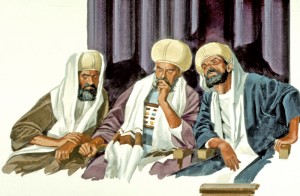
Three Elders ConspiringJesus had healed someone on the sabbath; that’s the simple back ground to the Pharisees and Herodians conspiracy against Jesus. This alliance is an interesting one since in generally the two groups hated one another! But their fear of Jesus apparently was enough to get them to work together against him.

It’s an odd alliance, particularly if looked at from the view point of the Pharisees. Their name is taken from the Hebrew word parash meaning “to separate;” they adhered to a strict piety and disciplined adherence to the Torah. They refused to associate with Gentiles or any “unclean” person or thing. They exhibited all of the characteristics of what, in our modern world politics, has come to be called “tribalism.”

Recently a friend and colleague bemoaned what she called “the tyranny of liberalism” noting that those on the political left were “wasting precious energy and time beating each other up.” I suggested to her that the problem is not with liberalism (nor, indeed, with conservatism). Rather the issue in modern society is the “tribalism” that seems to have taken over all of American social thought and civic behavior (including behavior in the church).

Tribes (like the Pharisees) group around and define membership on the basis of some type of purity – purity of thought, purity of belief, purity of blood, purity of precious bodily fluids, purity of whatever. Stray even a little bit from that purity and, like white blood cells, other members of the tribe will attack. A liberal voicing illiberal opinions, a conservative embracing a liberal point . . . they will be pilloried by their co-tribalists much faster than by the “opposition.”

This kind of tribal thinking has infected both political parties, many churches, the liberal and conservative political camps . . . name some segment of current American society and you can identify its tribal attributes. There are Pharisees of all stripes in our national community today. Both houses of our nation’s legislature have succumbed to a deeply seated “us versus them” mentality of political tribalism that goes beyond even traditional partisanship; nothing is getting done and so long as this persists nothing is likely to get done.

Not a single one of us is immune to tribalism; none of us avoids it entirely. However, we can do something about it. We can become aware of it. We can identify our own biases and question our own motivation. We can confess our own sinfulness in this regard and repent, turning away from it in favor of a more constructive way of working together.

In the second chapter of his catholic epistle, James addresses the issue of favoritism:

If a man comes into your assembly with a gold ring and dressed in fine clothes, and there also comes in a poor man in dirty clothes, and you pay special attention to the one who is wearing the fine clothes, and say, “You sit here in a good place,” and you say to the poor man, “You stand over there, or sit down by my footstool,” have you not made distinctions among yourselves, and become judges with evil motives? (James 2:2-4)

He then condemns this favoritism as sinful: “If you show partiality, you are committing sin and are convicted by the law as transgressors.” (v. 9) It is, he says, a violation of what Christ called the second great commandment: Love your neighbor as yourself. Partisan tribalism, I would suggest, is simply a political form of the favoritism scripture here condemns.

I remember reading once that Christians are called to pledge unwavering allegiance to the Lamb, not to the donkey or the elephant. We are bidden by scripture to pray for our governments and our leaders without regard to their politics or our own. If we will do that, while becoming aware of our own motives and biases, we can eschew tribalism and model a way of doing social business, of being community that will benefit all.

The alliance between the Herodians and the Pharisees, even though it was against Jesus, demonstrates that even those with the most tribal of instincts can compromise and work together. We should foster and encourage such behavior, even if this example might not the best illustration to use.

====================

A request to my readers: I’m trying to build the readership of this blog and I’d very much appreciate your help in doing so. If you find something here that is of value, please share it with others. If you are on Facebook, “like” the posts on your page so others can see them. If you are following me on Twitter, please “retweet” the notices of these meditations. If you have a blog of your own, please include mine in your links (a favor I will gladly reciprocate). Many thanks!

====================

Father Funston is the rector of St. Paul’s Episcopal Church, Medina, Ohio.

The Worms of Pride – From the Daily Office – July 17, 2013

From the Book of Acts:

Now Herod was angry with the people of Tyre and Sidon. So they came to him in a body; and after winning over Blastus, the king’s chamberlain, they asked for a reconciliation, because their country depended on the king’s country for food. On an appointed day Herod put on his royal robes, took his seat on the platform, and delivered a public address to them. The people kept shouting, “The voice of a god, and not of a mortal!” And immediately, because he had not given the glory to God, an angel of the Lord struck him down, and he was eaten by worms and died.

(From the Daily Office Lectionary – Acts 12:20-23 (BCP Version) – July 17, 2013.)

Parasitic HookwormOccasionally when studying Scripture I have thought, “This can’t possibly have happened.” I’m sure that what I am reading is meant to be an allegory or a metaphor, or that it is simply pious legend that the biblical author has incorporated into his story. This strange little story of the death of Herod Agrippa I was one of those passages. It’s just a little weird.

It turns out, however, that this story is verified by an extrabiblical source. The Roman Jewish historian Flavius Josephus recounts almost the same series of events. In Josephus’s telling, Herod wears a robe of silver rather than purple, but the meaning is the same: royal pride. In addition, Josephus adds the details that Herod sees an owl perch overhead during the daytime, a negative omen, and that Herod suffered severe and disabling abdominal pain for five days before dying, suggesting that the “worms” may have been intestinal parasites.

Where Josephus and the author of Acts (Luke) most agree is with regard to royal pride. Not only do they both portray Herod in that splendid purple or silver robe, Josephus parallels Luke saying, “Presently his flatterers cried out, one from one place, and another from another, (though not for his good) that he was a god . . . . Upon this the king neither rebuked them nor rejected their impious flattery.” (Antiquities 19.8.2)

I don’t know whether Herod’s parasites, suffering, and death were, in fact, a divine punishment for pride; they may simply have been the result of his prideful behavior. Sometimes out of vanity, we humans can do things that are not good for our health. I’ve been guilty of that myself. Indeed, even during the past few days.

We are undertaking a remodeling project at my parish, expanding the parish hall and rebuilding the street-side entrance of one wing of our building. It is work necessitated by the deterioration of the foundation of a 1960s addition to the church building. That deterioration has been most evident inside a basement storage area we affectionately refer to as “the mushroom farm.” Dark, damp, dank, and smelly, this large closet has suffered most from seepage of ground water through the concrete and cinder block of the foundation. It has been, for a long time, a place of mold and mildew.

Another place where these have grown is in the plenum between the cinder block exterior walls and the interior drywall affixed to them through use of 1″ x 3″ wooden furring strips. Over the years, as water has leaked through the walls, the wood has been stained, has rotted, and has been a medium for growth of mold.

As the workers demolishing these structures in preparation for our new construction have done their work, they have kicked up mold-laden concrete and wood dust. Each day during their labors, I have been walked through the site several times taking photographs of their progress. I want to document the need for and the progress of this renovation. This may be, I will admit, a matter of vanity or pride that I do so.

It’s also rather stupid of me!

One of the earliest instructions that was deeply impressed upon me as a child was to instruct medical people that I am allergic to penicillin. Whenever I do, I am asked, “What happens when you take it?” I have to answer honestly, “I don’t know. I’ve just always been told that I am allergic to it.” Being allergic to penicillin might, you would imagine, suggest to one that there might be an issue of sensitivity to other molds . . . . But I grew up in the desert! Molds were not an issue!

Until I moved to the midwest . . . Twenty or so years ago when I moved to the Missouri River valley (in the Kansas City area) and the high humidity of northeastern Kansas, I discovered seasonal molds play havoc with my health. Then ten years ago I moved to northeastern Ohio – more of the same.

Knowing this, I should be staying completely away from the demolition of the mushroom farm and the moldy drywall furring, shouldn’t I? But I insist on documenting this project . . . so my allergy, like Herods “worms,” is having a field day.

A few years ago, the indie rock group Chaotica put out a tune called Mr. Vanity. Among its lyrics are these words:

Why must you hide
Way inside, Mr. Vanity?
Why do you try to deny
Your own humanity?

So who died? Made you king?
You’re not god of anything.
What are you? Just a man!
Who on Earth gave you
The master plan?
Get a life. Get a clue.
Someone here should humble you.

* * *

Feed your greed
And your pride…
Hope it eats you up inside.

Those lyrics could almost have been written based on the story of the death of King Herod Agrippa I! That story from Acts, which Josephus’s testimony shows to be an historic one, reads like an allegory. It certainly could be one. His pride (in the form of those worms, those intestinal parasites) ate him up inside! Mine is making me sneeze my fool head off!

Pride is destructive. The worms of pride do eat you up inside!

But . . . confession time . . . I plan to keep on visiting the work site and taking photographs. I will put up with the sneezing and coughing! Mea culpa, mea culpa, mea maxima culpa!

====================

A request to my readers: I’m trying to build the readership of this blog and I’d very much appreciate your help in doing so. If you find something here that is of value, please share it with others. If you are on Facebook, “like” the posts on your page so others can see them. If you are following me on Twitter, please “retweet” the notices of these meditations. If you have a blog of your own, please include mine in your links (a favor I will gladly reciprocate). Many thanks!

====================

Father Funston is the rector of St. Paul’s Episcopal Church, Medina, Ohio.

A Pew Poll, A Praying Mantis, And A Toad – From the Daily Office – July 16, 2013

From the Psalter:

As for me, I will live with integrity;
redeem me, O Lord, and have pity on me.
My foot stands on level ground;
in the full assembly I will bless the Lord.

(From the Daily Office Lectionary – Psalm 26:11-12 (BCP Version) – July 16, 2013.)

Praying MantisLast week, The Pew Forum on Religion and Public Life published the results of a survey testing the esteem in which Americans hold members of ten professions.
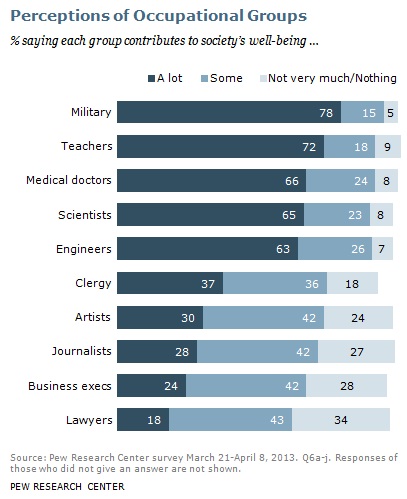
Respondents where asked say to what extent each group contributes to the well-being of American society: the possible responses ranged from “a lot” to “not at all.”

The professions were then ranked by the percentage of respondents who said they contributed “a lot” to our societal welfare. Topping the list were members of the military; at the bottom, lawyers. The graphic below shows the rankings of the ten professions (clipped from the Pew Forum article).

Pew Poll

A retired colleague reading the article commented that he had concluded in his personal career that clergy made a low impact on people’s lives and that that contributed to his decision to retire (or, as he put it, “give up”). “I’m told I’m a great preacher,” he said, “but my preaching didn’t seem to change people’s lives. Near as I could tell they were just indifferent.” I sympathize, in fact I often identify with my friend’s comments. There are days when being a clergy person is awful; there are times when one feels (and even worse times when one is told in no uncertain terms) that not only is one not contributing to society’s welfare, one is making it worse!

On the other hand, I rather enjoyed the fact that my current profession ranks above my former career as a lawyer!

Sunday after church I mowed the lawn. I didn’t want to mow the lawn, but I really had no choice. It has rained here quite a bit during the past three weeks and that rain had both encourage the grass to grow and prevented me from mowing the grass. So my one-third of an acre (on a steep hillside, by the way) was beginning to look like native grass pasture land rather than a suburban lawn. Normally, I can cut the grass in about an hour and, if I have to do it, I can get the “weed whacking” and edging done in another thirty minutes. On Sunday, because I had to mow twice (once with the mower deck at high setting followed by another pass at a lower level, both passes going relatively slowly), it took a bit longer. I started at 2:30 p.m. and finished at 6:19 p.m.

On my first pass through the back yard I noticed a bright, lime-green praying mantis struggling through the grass; the insect seemed to be injured, but I couldn’t tell. He (or she) was in the section I would mow on my next pass, so I kept an eye out and, sure enough, there it was in front of the mower when I pushed it back that direction. I stopped and let the mantis move out of the way, headed for the bushes at the edge of the lawn.

A couple of hours later, string trimmer in hand, I was whacking the tall growth around the stone-edged planters, the mail box, and the fire hydrant in the tree lawn, when I came across a small brown-green toad in among the plants I was about the decimate with .93 “fishing line.” I nudged the toad away with my toe (I was going to say I “toed away the toad” but that would be too cute, wouldn’t it?), moving it to safety before I continued trimming the grass.

Earlier in the day I had preached about a familiar parable. The gospel lesson appointed in the Revised Common Lectionary for the day was the story of the Good Samaritan, the story of a man on a journey, a man with a purpose of his own to accomplish, stopping to aid a fellow traveler in distress. Stopping to let an insect move out of danger or encouraging a toad to move out of harm’s way is not, I don’t think, equivalent, but the spirit is the same. And as I spent time in meditation trudging along behind the lawn mower, it occurred to me that all three actions provide a response to the Pew Research poll.

Clergy don’t, generally, make a big splash in the world, and the ones who do usually, it seems, do so to the detriment of our collective reputations! Sure, there are the exceptional clerics like Pope Francis, or Archbishop Desmond Tutu, or the Dalai Lama, but in general most clergy do small things in small congregations in small communities. We don’t make a difference in society at large; if we make any sort of contribution at all, it is in the lives of individual people – sitting at a hospital bedside, baptizing an infant, counseling two people about to get married, celebrating a teenager’s graduation from high school. The church as a whole is supposed to make a contribution to society; the clergy’s job is make a difference in the lives of the people who make up the church.

So, although I do understand my friend-and-colleague’s angst about indifference in society and that low 37% rating by the Pew Research folks, I’d encourage him and other clergy not to give it too much attention. Attend to the praying mantises and the toads, to the poor beggars in the roadside ditches, to the hospital patients and the babies and the newlyweds and the new graduates; do your best to make a difference in the lives of individuals. Do that and you’ll have lived with integrity and you’ll have something to tell about in the great congregation, something about which to bless the Lord in midst of full assembly. Then send the assembly out to contribute to the well-being of society: “Go in peace to love and serve the Lord!” It’s really their job!

====================

A request to my readers: I’m trying to build the readership of this blog and I’d very much appreciate your help in doing so. If you find something here that is of value, please share it with others. If you are on Facebook, “like” the posts on your page so others can see them. If you are following me on Twitter, please “retweet” the notices of these meditations. If you have a blog of your own, please include mine in your links (a favor I will gladly reciprocate). Many thanks!

====================

Father Funston is the rector of St. Paul’s Episcopal Church, Medina, Ohio.

Who Is My Neighbor? And Who Is the Good Samaritan? – Sermon for the 8th Sunday after Pentecost (Proper 10C) – July 14, 2013

====================

This sermon was preached on the Eighth Sunday after Pentecost, July 14, 2013, at St. Paul’s Episcopal Church, Medina, Ohio, where Fr. Funston is rector.

(Revised Common Lectionary, Pentecost 8 (Proper 10, Year C): Amos 7:7-17; Psalm 82; Colossians 1:1-14; and Luke 10:25-37. These lessons can be read at The Lectionary Page.)

====================

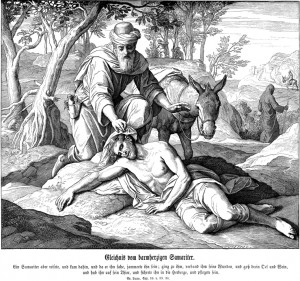
The Good Samaritan, engraving by Julius Schnorr von CarolsfeldThe nation’s legal system is corrupt; justice is for sale to the highest bidder. The guilty go free while the innocent suffer and die. The rich are crushing the poor. The affluent, the 1%-ers, are living a lavish life, with their costly perfumes and cosmetics, and their vacation homes with expensive furnishings, pleasure palaces where they can throw extravagant parties with music in every room. They revel in sexual debauchery of all sorts, but try to enforce a puritanical moral code on the rest of society. The poor are at the mercy of predatory lenders who exploit vulnerable families. The rich have more than enough to eat and to waste, while the poorest in the society go hungry. And government and religious leaders not only allow this to happen, they help it happen.

Just a brief summary of Chapters 1 through 6 of the Prophet Amos.

Some of you probably thought, “There he goes again, spouting his liberal politics from the pulpit.” But I’m not; as I said, it’s simply a paraphrase the Prophet Amos’s critique, of God’s critique, of ancient Israel at the time of King Jeroboam II. We just heard most of chapter 7 beginning at verse 7, in which Amos tells of the third of three prophetic visions. In verses 1 through 6, Amos tells of God showing him locusts devouring all the crops of the land and then another vision of fire destroying everything in the nation. Amos pleads with God not to let that happen. Most scholars interpret those visions as omens of what God might do to the nation, but I think perhaps they might instead be striking visions of prophetic judgment against the wealthy of ancient Israel and the rulers and religious leaders of the time. These are not visions of what God might do; they are visions of what those in power will do if not stopped. And God’s judgment spoken twice to Amos is, “This will not happen!” (vv. 3, 6)

So God shows Amos a vision of a plumb line. Do you know what a plumb line is? There’s a picture of a plumb line on the cover of the bulletin this morning. A plumb line is a string with a metal weight, or “plumb bob,” at one end which, when suspended, points directly towards the earth’s center of gravity so that the string hangs perpendicular to the plane of the earth’s surface; it is used to test the verticality of structures, how true to straight up-and-down they are. It sets the standard for up-rightness. God tells Amos that God is setting a metaphorical plumb line in the midst of God’s People and if they don’t measure up to the standard, “the high places of Isaac shall be made desolate, and the sanctuaries of Israel shall be laid waste, and [God] will rise against the house of Jeroboam with the sword.”

Well, you say, that’s ancient Israel. What’s that got to do with us?

Let me read you a news item from the past week. This is from the July 9, 2013, issue of the Florence, Alabama, Times-Daily:

Police Chief Lyndon McWhorter said Monday morning’s bank robbery [in Moulton, Alabama] was among the most unusual of his law enforcement career.

“I’ve been involved with several over the years, but none like this,” McWhorter said. “It’s one for the books.”

McWhorter said Rickie Lawrence Gardner, 49, of 7667 Alabama 33, Moulton, was arrested Monday morning while sitting on a bench outside the Bank Independent branch on Court Street in Moulton, minutes after he supposedly walked in and robbed the bank.

“When the officers got there, he was just sitting on the bench, waiting on them,” McWhorter said. “The money was locked up inside his truck, which was parked in the handicapped spot in front of the bank.

“He had a handicap sticker on his vehicle so he even parked legal.”

McWhorter said Gardner told authorities he robbed the bank because he had hurt his leg and wasn’t able to take care of himself.

“So, he decided to get arrested to have a place to live and someone to take care of him.”

Minutes before the arrest, McWhorter said, Gardner walked into the bank just off Alabama 157 and handed a teller a written note explaining that he had a gun and she was to give him money.

Authorities said no weapon, other than a pocketknife, was found when Gardner was taken into custody.

“The only thing he said to the teller was when he asked her to give him a bag to put the money in,” McWhorter said.

With the money in hand, McWhorter said Gardner walked out of the bank, laid the money inside his vehicle, locked the door and walked back to the bench. The chief said Gardner sat down on the wooden bench in front of the bank and waited on officers.

“When officers got there, he did not offer any kind of resistance. He was just waiting on them,” McWhorter said. “This is the first bank robbery I’ve ever worked where the robber was waiting outside the bank for the police to turn himself in.” (Times-Daily)

The Associated Press later reported that Gardner “mentioned the weapon in the note — even though he didn’t have one — because he thought it would get him a longer sentence;” he thought he’d get more time, which would mean more shelter, more food. (AP Story)

The reason you may have thought my opening paraphrase of Amos sounded like an indictment of our own society is simple. It does. The word of prophecy spoken by Amos to ancient Israel speaks directly to us.

You know the interesting thing about Amos’s prophecy is that we can’t even be sure it was heard by the rulers of the nation to which it was spoken. We know Amos wrote it down; we know that someone told the story of Amos delivering his prophecy to Amaziah (who was the high priest at Bethel the religious center of the northern kingdom), but we are told that Amaziah never delivered it to Jeroboam II, the reigning king.

Amaziah instead told the king that Amos was part of a conspiracy to kill him, and then Amaziah told Amos to return to his home which was in the southern kingdom. “O seer, go, flee away to the land of Judah,” he says, “earn your bread there, and prophesy there; but never again prophesy at Bethel, for it is the king’s sanctuary, and it is a temple of the kingdom.” And this is where Amos speaks one of my favorite lines in Scripture, “I am no prophet, nor a prophet’s son; but I am a herdsman, and a dresser of sycamore trees.”

Amos’s answer was to indicate that he was not a prophet by profession; he was not a member of one of the official “prophecy schools.” Indeed, as part of the official religious establishment, Amos thought those full-time prophets were as much a part of the problem as the priests, the king, and the wealthy! Amaziah proved that he was part of the problem by failing to communicate Amos’s prophecy to King Jeroboam, so our reading today ends with Amos’s personal prophecy against him: “Your wife shall become a . . . and your sons and your daughters shall fall by the sword . . . and you shall die in an unclean land.” A pretty pointed prophecy, if ever there was one!

But we, who hear in Amos’s condemnation of ancient Israel at least a bit of a word of warning to our own society, what are we to make of this prophecy of the plumb line? The standard for the People of God in Israel was the ancient law of Moses, the religious, ethical, and social rules we find in Genesis, Exodus, Leviticus, and Numbers (Deuteronomy was unknown at the time of Amos). What is it for us? How are we (as Paul wrote to the Colossians) to be “be filled with the knowledge of God’s will in all spiritual wisdom and understanding?” How are we to “lead lives worthy of the Lord, fully pleasing to him?” How are we to bear fruit in every good work and . . . grow in the knowledge of God?”

Well, that standard is easily stated. A young lawyer does so in today’s Gospel: “You shall love the Lord your God with all your heart, and with all your soul, and with all your strength, and with all your mind; and your neighbor as yourself.” It’s easily stated; it’s not so easily understood.

The young lawyer says as much when he asks his follow up question, “Who is my neighbor?” He wants to know what we want to know: are there limits? Is it sufficient to love only the people of my community — for him, Israel; for most of us, white descendants of Northern European immigrants? Does it include Mr. Gardner, the bank robber in Moulton, Alabama? Might it also include other undesirables, Samaritans and Gentiles, the Irish, descendants of African slaves, recently immigrated Asians, Hispanics? Does it include women, people with disabilities, lepers, and others frequently excluded from society? Do we get to define who is our neighbor, or does Someone else?

Ultimately, the answer to our question is the answer to another question: “Who does God love?” Jesus answers the question by telling a parable, the oh-so-familiar story of the “Good Samaritan.” In analyzing this story, Lutheran theologian Brian Stoffregen asks an important question: “Why does Jesus make the hero of this story a Samaritan?” In answering this question he writes:

The idea of being a “Good Samaritan” is so common in our culture, that most people today don’t realize that “Good Samaritan” would have been an oxymoron to a first century Jew. Briefly stated, a Samaritan is someone from Samaria. During an ancient Israeli war, most of the Jews living up north in Samaria were killed or taken into exile. However, a few Jews, who were so unimportant that nobody wanted them, were left in Samaria. Since that time, these Jews had intermarried with other races. They were considered half-breeds by the “true” Jews. They had perverted the race. They had also perverted the religion. They looked to Mt. Gerizim as the place to worship God, not Jerusalem. They interpreted the Torah differently than the southern Jews. The animosity between the Jews and Samaritans were so great that some Jews would go miles out of their way to avoid walking on Samaritan territory. Previously in Luke, the Samaritans had refused to welcome Jesus — the “bad” Samaritans. I’m certain that in the minds of many Jews, the only “good” Samaritan was a dead Samaritan. Note that the lawyer never says “Samaritan.” He can’t call him a “good Samaritan” (a phrase that doesn’t occur in the text). Anyway, we are still left with the question, “Why a Samaritan?”

If Jesus were just trying to communicate that we should do acts of mercy to the needy, he could have talked about the first man and the second man who passed by and the third one who stopped and cared for the half-dead man in the ditch. Knowing that they were a priest, Levite, and Samaritan is not necessary.

If Jesus were also making a gibe against clerics, we would expect the third man to be a layman — an ordinary Jew — in contrast to the professional clergy. It is likely that Jewish hearers would have anticipated the hero to be an ordinary Jew.

If Jesus were illustrating the need to love our enemies, then the man in the ditch would have been a Samaritan who is cared for by a loving Israelite.

One answer to the question: “Why a Samaritan?” is that we Christians might be able to learn about showing mercy from people who don’t profess Christ. I know that I saw much more love expressed towards each by the clients at an inpatient alcoholic/drug rehab hospital than I usually find in churches. Can we learn about “acting Christianly” from AA or the Hell’s Angels? (CrossMarks)

But Stoffregen proposes an alternative response: “Another answer to the question: ‘Why a Samaritan?’ is that we are not to identify with the Samaritan. A Jew would find that so distasteful that he couldn’t identify with that person. He wouldn’t want to be like the Priest or Levite in the story, so that leaves the hearer with identifying with the man in the ditch.” And that raises the further question, “Then who is the Samaritan?” to which there can only be one answer, “The Samaritan is God.”

If the Samaritan represents God, that means that God loves the penniless, the stripped naked, the beaten down, the ones left half dead, the ones passed-by by the leaders of society, by the rulers, by the punctiliously correct, and (I’m sorry to say) by the religious. It makes us realize that God is no respecter of position or wealth, God does not care about social class or religion. The man in the ditch had been stripped of everything that might have indicated his social standing, his religious faith, even his nationality; he was simply a person in need. That is who God loves, and that means that God loves everyone. In the human community, every person is potentially a person in need; truth be told, every person is a person in need.

Who is my neighbor? Who does God love? Everyone. No exceptions. No exclusions. That is the standard, the rule, the plumb line by which God judges society. This again and again is what the prophets of old told us; it is what Jesus told us; it is what our own modern prophets have said over and over. For example:

In the 18th Century, Dr. Samuel Johnson’s biographer James Boswell quoted him as saying, “A decent provision for the poor is the true test of civilization.” (Boswell, Life of Johnson)

In her book My Several Worlds (1954), Pearl S. Buck, wrote: “The test of a civilization is the way that it cares for its helpless members.”

In his last political speech, Sen. Hubert Humphrey said, “The moral test of government is how that government treats those who are in the dawn of life, the children; those who are in the twilight of life, the elderly; those who are in the shadows of life; the sick, the needy and the handicapped.”

And Mahatma Gandhi said, “A nation’s greatness is measured by how it treats its weakest members.”

Who is my neighbor? Who does God love? Everyone. No exceptions. No exclusions.

Every person is potentially a person in need, and every person is potentially a caregiver, a supplier of that which is needed. When we conclude our worship this morning, several young people and a few adults accompanying them will depart for Franklin, Pennsylvania, to be suppliers of that which is needed. At this point, they don’t know whose needs they are going to be supplying; they don’t know what those needs will be. All they know is that there are people in need and they are going to care for them, because they are our neighbors.

So at this point, let’s get on with the business of commissioning them for the ministry on which they are about the embark.

====================

A request to my readers: I’m trying to build the readership of this blog and I’d very much appreciate your help in doing so. If you find something here that is of value, please share it with others. If you are on Facebook, “like” the posts on your page so others can see them. If you are following me on Twitter, please “retweet” the notices of these meditations. If you have a blog of your own, please include mine in your links (a favor I will gladly reciprocate). Many thanks!

====================

Father Funston is the rector of St. Paul’s Episcopal Church, Medina, Ohio.

« Older posts Newer posts »