Occasional thoughts of an Anglican Episcopal priest

Category: Ministry (Page 53 of 59)

Majority of One – From the Daily Office – November 7, 2012

From Luke’s Gospel:

Now he was teaching in one of the synagogues on the sabbath. And just then there appeared a woman with a spirit that had crippled her for eighteen years. She was bent over and was quite unable to stand up straight. When Jesus saw her, he called her over and said, “Woman, you are set free from your ailment.” When he laid his hands on her, immediately she stood up straight and began praising God. But the leader of the synagogue, indignant because Jesus had cured on the sabbath, kept saying to the crowd, “There are six days on which work ought to be done; come on those days and be cured, and not on the sabbath day.” But the Lord answered him and said, “You hypocrites! Does not each of you on the sabbath untie his ox or his donkey from the manger, and lead it away to give it water? And ought not this woman, a daughter of Abraham whom Satan bound for eighteen long years, be set free from this bondage on the sabbath day?” When he said this, all his opponents were put to shame; and the entire crowd was rejoicing at all the wonderful things that he was doing.

(From the Daily Office Lectionary – Luke 13:10-17 – November 7, 2012)
 
Jesus Heals the Crippled WomanDoing that which is right in the face of an opposition which has tradition and law on its side. That’s what this gospel story is about. This is not simply another story of Jesus’ healing someone.

This healing occurred on the sabbath, a day when one was not supposed to do work. Treating the sick was considered work. Jesus’ worked on the sabbath. The synagogue ruler was outraged. But Jesus made a comparison. Untying knots was also considered work, but on the sabbath one would do that to untie a farm animal so that it might drink; can one do less for a human being? The synagogue ruler, and the tradition and the law which he represented, were silenced.

President Andrew Jackson is reported to have said, “One man with courage makes a majority.” In an essay entitled Civil Disobedience in 1849, Henry David Thoreau wrote, “Any man more right than his neighbors constitutes a majority of one.” They might have used Jesus in this story as an illustration.

A majority of one is not an isolated individual. The person who is committed to standing for and doing that which is right, even in the face of tradition and law, demonstrates a commitment to a way of thinking and feeling, a spritual depth that influences the consciousness of others. By the force of its truth, Jesus compassion for the crippled woman shamed his opponents and converted the crowd to his way of thinking, to his way of being. A person does need not to be the Son of God to do this; he or she needs only to be a majority of one.

====================

A request to my readers: I’m trying to build the readership of this blog and I’d very much appreciate your help in doing so. If you find something here that is of value, please share it with others. If you are on Facebook, “like” the posts on your page so others can see them. If you are following me on Twitter, please “retweet” the notices of these meditations. If you have a blog of your own, please include mine in your links (a favor I will gladly reciprocate). Many thanks!

====================

Father Funston is the rector of St. Paul’s Episcopal Church, Medina, Ohio.

Unbind Him, and Let Him Go! – Sermon for All Saints Sunday – November 4, 2012

====================

This sermon was preached on Sunday, November 4, 2012, at St. Paul’s Episcopal Church, Medina, Ohio, where Fr. Funston is rector.

(Revised Common Lectionary, All Saints, Year B: Isaiah 25:6-9; Psalm 24; Revelation 21:1-6a; and John 11:32-44. These lessons can be read at The Lectionary Page.)

====================
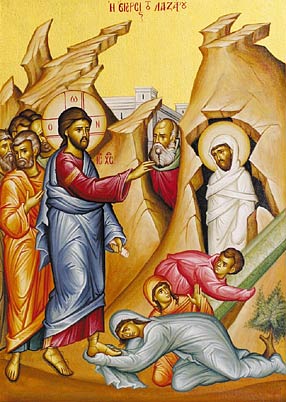
Orthodox Icon of the Raising of LazarusToday, following church tradition, we step away from the calendar of Ordinary Time and, instead, commemorate the Feast of All Saints. That festival is specifically held on November 1, but tradition allows us to celebrate the saints also on the Sunday after that date, so here we are.

Anglicans and Episcopalians for generations have been used to hearing the Beatitudes from Matthew’s gospel (Matt. 5:1-12) or the similar Blessings-and-Woes from Luke’s version (Luke 6:20-26), but since the adoption of the Revised Common Lectionary we also, every three years, hear the story of the raising of Lazarus from the gospel according to John. The listings of who is blessed in the other two gospels make sense as lessons for this day; the story of Lazarus, not so much. It may make us wonder why those who created our new lectionary made that choice.

Unfortunately, there are no easy answers to that question, if there are any answers at all. The development of the lectionary is a creature of time and custom as much as it is of purposeful selection. Lectionaries develop over the centuries. Typically, a lectionary will go through the scriptures in a logical pattern, and also include selections chosen by the community for their appropriateness to particular occasions. The ecumenical scholars who set up our current lectionary looked back over these centuries of development and selected lessons which had the broadest consensus for use on particular days, like today’s celebration of the feasts.

But why that consensus may exist is lost in time. There are no legislative notes indicating why communities thought a particular lesson, like the story of Christ raising Lazarus, fit a particular feast, such as All Saints Day. We who have inherited the tradition must read the lessons and figure out their message for ourselves. On a feast day, the Prayer Book gives us some filters, if you will, to aid in our reflections and our understanding; these are the collect (or prayer) of the day and the “proper preface” said (or chanted) before the Great Thanksgiving. Let’s take a look at the collect again:

Almighty God, you have knit together your elect in one communion and fellowship in the mystical body of your Son Christ our Lord: Give us grace so to follow your blessed saints in all virtuous and godly living, that we may come to those ineffable joys that you have prepared for those who truly love you; through Jesus Christ our Lord, who with you and the Holy Spirit lives and reigns, one God, in glory everlasting. Amen. (BCP Page 245)

The focus of the prayer is the “communion and fellowship” of the saints, the community of the church, which is “knit together . . . in the mystical body” of Christ, which shares in “virtuous and godly living” and together enjoys the “ineffable joys” of eternal life. Likewise the preface focuses on the community:

For in the multitude of your saints you have surrounded us with a great cloud of witnesses, that we might rejoice in their fellowship, and run with endurance the race that is set before us; and, together with them, receive the crown of glory that never fades away. (BCP Page 380)

The emphasis is on the “great cloud of witnesses” (a phrase borrowed from the Letter to the Hebrews 12:1) who rejoice in fellowship and together are crowned with unfading glory.

So in our contemplation of any of the lessons for today, we should look for the ways in which the lesson exemplifies or speaks to the community of faith, and in the raising of Lazarus that comes at the end of the story: “The dead man came out, his hands and feet bound with strips of cloth, and his face wrapped in a cloth. Jesus said to them, ‘Unbind him, and let him go’.” (John 11:44)

“Unbind him, and let him go!” These may be the most powerful words in the story, because with them Jesus not only frees Lazarus, he empowers the community of faith. The community assists in the resurrection; it is the task of the People of God to complete the action of Resurrection. Jesus has called Lazarus out of the tomb, but he is still wearing the clothing of death, his funeral wrappings; the community removes those burial shrouds and dresses him for life.

I love that old Southern Harmony hymn we sang in procession today, especially the chorus which says

As I went down in the river to pray,
Studying about that good ol’ way
And who shall wear the robe and crown?
Good Lord, show me the way.
(“Down in the River to Pray”)

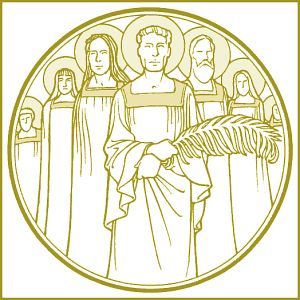
“Who shall wear the robe and crown?” is a reference to the vision of St. John of Patmos recorded in the Book of Revelation, a vision of heaven where “there was a great multitude that no one could count, from every nation, from all tribes and peoples and languages, standing before the throne and before the Lamb, robed in white, with palm branches in their hands.” (Rev. 7:9)

Last Thursday, which was actually All Saints Day, one of the lessons for the Daily Office of Morning Prayer was from the apocryphal book of Second Esdras. In it Ezra reports seeing a similar vision of heaven.

I, Ezra, saw on Mount Zion a great multitude that I could not number, and they all were praising the Lord with songs. In their midst was a young man of great stature, taller than any of the others, and on the head of each of them he placed a crown, but he was more exalted than they. And I was held spellbound. Then I asked an angel, “Who are these, my lord?” He answered and said to me, “These are they who have put off mortal clothing and have put on the immortal, and have confessed the name of God. Now they are being crowned, and receive palms.” Then I said to the angel, “Who is that young man who is placing crowns on them and putting palms in their hands?” He answered and said to me, “He is the Son of God, whom they confessed in the world.” So I began to praise those who had stood valiantly for the name of the Lord. (2 Esdras 2:42-47)

This vision differs from that in Revelation in that the presence of the Son of God is among the crowd, crowning them and putting the palms in their hands. I have to say, I rather prefer this vision to John’s because of that difference. There is something compelling about the Son of God being there with the saints, not high and exalted on a throne, as the Lamb is in the oracle of Revelation, but down with the people. This seems much more like the Jesus described in the Gospels, much more like the God he revealed.

This vision of Christ with the masses, yielding his glory and mixing in with his people, seems somehow quite in keeping with our celebration of all the saints. Today we don’t commemorate only those whose names are known, those who are portrayed in art with golden halos, those in whose particular memory churches and schools are dedicated; today we commemorate those whose names are not known. Ezra’s vision in Second Esdras of Christ mingling with these unknown but godly people appeals to me.

An early 20th Century Roman Catholic Lithuanian archbishop, George Matulaitis, once wrote:

May our model be Jesus Christ: not only working quietly in His home at Nazareth, not only Christ denying Himself, fasting forty days in the desert, not only Christ spending the night in prayer; but also Christ working, weeping, suffering; Christ among the crowds; Christ visiting the cities and villages. (Renovator of the Marians)

This is the Christ of Ezra’s vision; this is the Christ of the saints whom we remember today, Christ among the crowds. Indeed, John of Patmos in our reading from Revelation today describes God among the people: “[God] will dwell with [mortals] as their God; they will be his people, and God himself will be with them; he will wipe every tear from their eyes.” (Rev. 21:3-4)

When Jesus, this Christ among the crowds, this God dwelling with mortals, tells those around him, “Unbind him, and let him go” he is speaking not only to them, but also to us. When we hear those words we should remember another time when he empowered his church to unbind others. In Matthew’s gospel, in conversation with Peter, Jesus said: “I will give you the keys of the kingdom of heaven, and whatever you bind on earth will be bound in heaven, and whatever you loose on earth will be loosed in heaven.” (Matt. 16:19)

And again later to the apostles he said: “Truly I tell you, whatever you bind on earth will be bound in heaven, and whatever you loose on earth will be loosed in heaven.” (Matt. 18:18)

Here the Greek verb luo is translated as “loosen”, but it is the same word in our reading today translated as “unbind”. We have the power and the obligation to unbind and set others free. “Unbind him, and let him go” is Christ’s empowering command to all the saints everyday. It is Christ’s command to us to unbind others and give them their freedom; this is Christ among the crowds, God dwelling with God’s people, showing us the way that we and others can wear the robe and crown.

We unbind others and set them free when we work to alleviate the desperate plight of those who lack material means of survival, whether they are in our own communities, on the Gulf Coast or the eastern seaboard, or in distant countries. We unbind others and set them free when we act to console a brother or sister crushed by loss or fear or despair. We unbind others and set them free when we strive to empower rather than intimidate. We unbind others and set them free when we commit ourselves to justice for all, not merely for ourselves. We unbind others and set them free when we extend to others the mercy we have received from God. Whenever and wherever we find someone bound by sin or system or circumstance, we are to unbind them and set them free, not keep them tangled up in the old affairs, the old clothing, the old funeral wrappings of sin and death; those burial shrouds constrict them and damage everyone. Whenever and wherever we find someone struggling to be free, we are to unbind them and let them go so that we may all wear the robe and crown.

Today we commemorate all the saints, that great cloud of witnesses, that great multitude that no one can count wearing their robes and crowns, the community of the church throughout time and space charged with, committed to, and constantly striving to unbind others and set them free. Amen.

====================

A request to my readers: I’m trying to build the readership of this blog and I’d very much appreciate your help in doing so. If you find something here that is of value, please share it with others. If you are on Facebook, “like” the posts on your page so others can see them. If you are following me on Twitter, please “retweet” the notices of these meditations. If you have a blog of your own, please include mine in your links (a favor I will gladly reciprocate). Many thanks!

====================

Father Funston is the rector of St. Paul’s Episcopal Church, Medina, Ohio.

Hostess Gifts For God – From the Daily Office – November 3, 2012

From the Book of Ben Sira:

Do not appear before the Lord empty-handed,
for all that you offer is in fulfilment of the commandment.
The offering of the righteous enriches the altar,
and its pleasing odor rises before the Most High.
The sacrifice of the righteous is acceptable,
and it will never be forgotten.
Be generous when you worship the Lord,
and do not stint the first fruits of your hands.

(From the Daily Office Lectionary – Sirach 35:6-10 – November 3, 2012)
 
Host and Hostess GiftsIt shouldn’t, but it always surprises me when I preside at a worship service and the offering of alms (cash money) is small. This is especially so at a small-attendance service when there are only a few people but even fewer dollars in the plate. It surprises me, I suppose, because of something I was taught by my grandfather. It shouldn’t surprise me, I suppose, because of the realities of which I am aware.
Those realities include the fact that many of those present have made their weekly or monthly pledge offerings at another time during the week, at a principal service or, perhaps, by mail or by direct deposit. Those realities include the fact that many people no longer carry cash at all and have no small bills or change to put in the alms basin. Those realities include the fact that many who give prefer to do so in a way that can be tracked for tax or other purposes and one cannot do that with “anonymous” cash donations. I know all these realities and yet, because of what my grandfather taught me, I am still surprised at how few alms there are in the offering basin.

What my paternal grandfather taught me accord’s with Ben Sira’s words in today’s lesson. He said, “Never approach the altar of God without a gift of thanksgiving. Even if you’ve already paid your pledge in some way, even if you’ve already attended the week’s principal service and made a major donation, open your wallet and give a little extra.” My grandmother always took a “hostess gift” when my grandparents were invited to dinner or another gathering at someone else’s home; I suppose, in some way, my grandfather’s insistence on an offering at worship was like a “hostess gift” to God. It is a visible act of thanksgiving and is as much a reminder to me as to anyone of my need to be thankful and generous. lt is much more for my benefit that I give than for that of the church or any mission or ministry it may support.

God doesn’t really need our hostess gifts, but we need to give them.

====================

A request to my readers: I’m trying to build the readership of this blog and I’d very much appreciate your help in doing so. If you find something here that is of value, please share it with others. If you are on Facebook, “like” the posts on your page so others can see them. If you are following me on Twitter, please “retweet” the notices of these meditations. If you have a blog of your own, please include mine in your links (a favor I will gladly reciprocate). Many thanks!

====================

Father Funston is the rector of St. Paul’s Episcopal Church, Medina, Ohio.

Christ Among the Crowds – All Saints Day – November 1, 2012

From the Book of Second Esdras:

I, Ezra, saw on Mount Zion a great multitude that I could not number, and they all were praising the Lord with songs. In their midst was a young man of great stature, taller than any of the others, and on the head of each of them he placed a crown, but he was more exalted than they. And I was held spellbound. Then I asked an angel, “Who are these, my lord?” He answered and said to me, “These are they who have put off mortal clothing and have put on the immortal, and have confessed the name of God. Now they are being crowned, and receive palms.” Then I said to the angel, “Who is that young man who is placing crowns on them and putting palms in their hands?” He answered and said to me, “He is the Son of God, whom they confessed in the world.” So I began to praise those who had stood valiantly for the name of the Lord.

(From the Calendar of Saints – 2 Esdras 2:42-47 – November 1, 2012)

The Victorious Saints of GodI have to admit that I’m not sure how to treat the so-called Second Book of Esdras. Although counted among the apocryphal books, it seems more to me to be what is technically called pseudopigrapha (“false writings”). It is not recognized by any western church; neither the Roman church nor the Protestants recognize it, although it is annexed as part of an appendix to the Vulgate. Only the Greek and Russian Orthodox accept it as Scripture. If I recall correctly, it is actually made up of three different writings all from the 2nd or 3rd Centuries of the Christian era; it’s not “Old Testament”or “Hebrew Scripture”, at all! So what does one do with it? Here it is in the lectionary for All Saints Day for obvious reasons, but what does one do with it?

Well, of course, one notes the similarity of this vision with that of John of Patmos set out in Revelation 7:9-17: angel talking to the one having the vision, question about who the crowd is, white robed saints, palms in their hands. What’s different here is the presence of the Son of God among the crowd, crowning them and putting the palms in their hands. And, I have to say, I rather prefer this vision to John’s because of that difference. There is something compelling about the Son of God being there with the saints, not high and exalted on a throne, as the Lamb is in John’s oracle, but down with the crowds. This seems much more like the Jesus described in the Gospels, much more like the God he revealed. I am reminded of a couple of hymns:

All praise to thee, for thou, O King divine,
didst yield the glory that of right was thine,
that in our darkened hearts thygrace might shine.

Thou cam’st to us in lowliness of thought;
by thee the outcast and the poor were sought;
and by thy death was God’s salvation wrought.
(Words by F. Bland Tucker)

and

Not here for high and holy things
we render thanks to thee,
but for the common things of earth,
the purple pageantry
of dawning and of dying days,
the splendor of the sea,

the royal robes of autumn moors,
the golden gates of spring,
the velvet of soft summer nights,
the silver glistering
of all the million million stars,
the silent song they sing….
(Words by Geoffrey Anketel Studdert-Kennedy)

This vision of Christ with the masses, yielding his glory and mixing in with “the common (people and) things of earth,” seems somehow quite in keeping with today’s celebration of all the saints. Today we don’t commemorate only those whose names are known, those who are portrayed in art with golden halos, those in whose particular memory churches and schools are dedicated; today we commemorate those whose names are not known.

I’m particularly fond of the text of Chapter 44 of the Wisdom of Sirach which begins “Let us now praise famous men….” I chose that text to read at the graveside when we buried my older brother in 1993. In it are found these words, “But of others there is no memory; they have perished as though they had never existed; they have become as though they had never been born, they and their children after them. But these also were godly men, whose righteous deeds have not been forgotten….” (Sirach 44:9-10) Ezra’s vision in Second Esdras of Christ mingling with these unknown but godly people appeals to me. An early 20th Century Roman Catholic Lithuanian archbishop, George Matulaitis, once wrote:

May our model be Jesus Christ: not only working quietly in His home at Nazareth, not only Christ denying Himself, fasting forty days in the desert, not only Christ spending the night in prayer; but also Christ working, weeping, suffering; Christ among the crowds; Christ visiting the cities and villages.

This is the Christ of Ezra’s vision; this is the Christ of the saints whom we remember today, Christ among the crowds.

====================

A request to my readers: I’m trying to build the readership of this blog and I’d very much appreciate your help in doing so. If you find something here that is of value, please share it with others. If you are on Facebook, “like” the posts on your page so others can see them. If you are following me on Twitter, please “retweet” the notices of these meditations. If you have a blog of your own, please include mine in your links (a favor I will gladly reciprocate). Many thanks!

====================

Father Funston is the rector of St. Paul’s Episcopal Church, Medina, Ohio.

Light in the Darkness – From the Daily Office – October 30, 2012

From the Gospel of Luke:

Jesus said, “No one after lighting a lamp puts it in a cellar, but on the lampstand so that those who enter may see the light. Your eye is the lamp of your body. If your eye is healthy, your whole body is full of light; but if it is not healthy, your body is full of darkness. Therefore consider whether the light in you is not darkness. If then your whole body is full of light, with no part of it in darkness, it will be as full of light as when a lamp gives you light with its rays.”

(From the Daily Office Lectionary – Luke 11:33-36 – October 30, 2012)

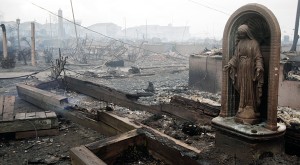
Storm Damage, New York Times photograph, 10/30/2012Last night Hurricane Sandy hit the eastern seaboard of the United States. Atlantic City was hit hard; the iconic boardwalk is gone; and with electrical power failures, the neon lights of the casino signs went dark. In Manhattan, a ConEd transformer station blew up; video of the explosion was quickly posted on Facebook and later shown on national television news programs. The lower third of the island was in darkness. Hundreds of thousands, if not millions, of people are now without electrical power and may not have light or heat for many days.

In this morning’s gospel lesson Jesus makes his point about the spiritual light within each person. The devastation wreaked by this storm, if our experience with prior disastrous such as Katrina, Irene, and many others, is simply the beginning of a very dark period for a lot of people. It will be a time when the light within each will be tested and some will truly shine. It goes without saying that these kinds of events can bring out the worst in some people, but it is also true that they can and do bring out the best in many others.

I have several friends who are volunteers with the Red Cross and other agencies in the affected area, and other friends who are clergy or active lay church members. I know that they will all be hard at work doing what they can to relieve the sufferings of others, even as they themselves have been affected by the storm. Their eyes are clear, they see what has to be done, and the light of Christ shines in and through them.

I thought of them last night as I watched the news of the storm. For them and for all who must now cope with the loss and damage caused by Sandy, I offered this prayer from the Order of Compline:

Keep watch, dear Lord, with those who work, or watch, or weep this night, and give your angels charge over those who sleep. Tend the sick, Lord Christ; give rest to the weary, bless the dying, soothe the suffering, pity the afflicted, shield the joyous; and all for your love’s sake. Amen. (BCP 1979, page 132)

Keep watch, dear Lord, with those who work, or watch, or weep throughout the time of recovery from Hurricane Sandy, and bless especially those who are light in the darkness.

====================

A request to my readers: I’m trying to build the readership of this blog and I’d very much appreciate your help in doing so. If you find something here that is of value, please share it with others. If you are on Facebook, “like” the posts on your page so others can see them. If you are following me on Twitter, please “retweet” the notices of these meditations. If you have a blog of your own, please include mine in your links (a favor I will gladly reciprocate). Many thanks!

====================

Father Funston is the rector of St. Paul’s Episcopal Church, Medina, Ohio.

Keep Your Mouth Shut! – From the Daily Office – October 29, 2012

From the Book of Ben Sira:

One who trusts others too quickly has a shallow mind, and one who sins does wrong to himself. One who rejoices in wickedness will be condemned, but one who hates gossip has less evil. Never repeat a conversation, and you will lose nothing at all. With friend or foe do not report it, and unless it would be a sin for you, do not reveal it; for someone may have heard you and watched you, and in time will hate you. Have you heard something? Let it die with you. Be brave, it will not make you burst!

(From the Daily Office Lectionary – Sirach 19:4-10 – October 29, 2012)

Gossip (Mouth to Ear)Don’t you just love gossip? That juicy little tid-bit that you just can’t wait to pass on to a friend? It’s so wonderfully delicious, that little bit of o-so-salacious information about some mutual acquaintance? C’mon, admit it! You just love it. We all do. It’s human nature.
Gossip is probably the most common problems in human relationships. It is insidious; most people don’t even realize when a discussion turns towards gossip, but gossip can kill a relationship. It happens much more often than we would like to admit. In simple terms, gossip basically is that could be seen as a negative spoken about one person to another when the subject is not there to hear it first hand and respond. It could be something seemingly innocent said without intent to harm, or it could be a harsh, intentional slander or assisination of character.

Gossip has many dangers. Just a few are

  • hurt feelings
  • stress
  • destroys cooperation
  • discourages the sharing of vulnerability
  • creates (or destroys) reputations
  • damages trust

We can all agree with Ben Sira that gossip should be avoided! The British Baptist preacher Alan Redpath is said to have had a rule to avoid gossip. He told himself “Think!” and asked himself five questions:

T – Is it true?
H – Is it helpful?
I – Is it inspiring?
N – Is it necessary?
K – Is it kind?

If what one is about to say does not pass those tests, Redpath said, keep your mouth shut! That’s about as good a paraphrase of Ben Sira’s advice as I can think of. “Be brave, it will not make you burst!”

====================

A request to my readers: I’m trying to build the readership of this blog and I’d very much appreciate your help in doing so. If you find something here that is of value, please share it with others. If you are on Facebook, “like” the posts on your page so others can see them. If you are following me on Twitter, please “retweet” the notices of these meditations. If you have a blog of your own, please include mine in your links (a favor I will gladly reciprocate). Many thanks!

====================

Father Funston is the rector of St. Paul’s Episcopal Church, Medina, Ohio.

Theodicy and Abortion – From the Daily Office – October 27, 2012

From the Book of Ben Sira:

It was he who created humankind in the beginning,
and he left them in the power of their own free choice.
If you choose, you can keep the commandments,
and to act faithfully is a matter of your own choice.
He has placed before you fire and water;
stretch out your hand for whichever you choose.
Before each person are life and death,
and whichever one chooses will be given.

(From the Daily Office Lectionary – Sirach 15:14-17 – October 27, 2012)

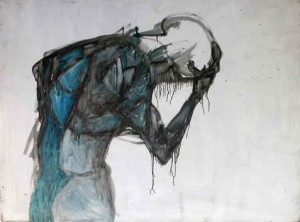
Grief (watercolor wash, artist unknown)Well, there it is! Bigger than life! Free will! Of course, I know that as an Anglican I am not supposed to use this text, or any part of the Deuterocanon, to settle matters of doctrine, but only read them ” for example of life and instruction of manners.” [Articles of Religion, Article VI, BCP 1979, page 868] But come on! There it is!
I probably shouldn’t go there, but the past 48 hours have made it impossible not to think about free will without thinking of Indiana senate candidate Richard Mourdock who stirred up controversy when he said during a debate that “even when life begins in that horrible situation of rape, that is something that God intended to happen.” He tried to explain himself later saying, “God creates life, and that was my point,. God does not want rape, and by no means was I suggesting that he does. Rape is a horrible thing.” He only dug a deeper hole. If it is true that politics and religion don’t mix, it is even more true that politics and the problem of theodicy don’t mix!

“Theodicy” is a little-used word theologians coined to describe what is generally called “the problem of evil.” It posits this rational conundrum:

  1. God is all-powerful.
  2. God is all-good.
  3. God is all-knowing.
  4. Evil exists.

Only three of these four propositions (says the issue of theodicy) can be true; since we know that evil exists, then one of the other three statements must be false. Many philosophers and theologians have wrestled with this issue and I’m not going to get into it in a brief meditation on the daily office lessons, other than to acknowledge that it exists and that one way it is answered is the very subject Jesus son of Sirach brings up in this reading: free will. In other words, in making the universe (and humankind within it) free, the all-powerful, all-loving, all-knowing God allows the possibility that evil may occur.

St. Thomas Aquinas affirmed in the Summa Theologica that God’s ultimate purpose for creation is so good, so great that it involves “allowing” the possibility of evil, but (as Aquinas points out) to “allow” is not the same as to “cause”. Furthermore, the enduring good that allows evil includes the possibility that good can redeem evil; because of this remaining good, a return path to good is always possible. I think this is the theological concept candidate Mourdock was trying to articulate, but doing so badly and causing himself and his party a good deal of trouble.

I can agree with Mr. Mourdock up to a point, but not about the conclusion he ultimately reaches. In his view, apparently, the return to good, the redemption of the evil of rape, is found in the conception of life which may result. For him, that redemption is (apparently) automatic and, thus, a pregnancy resulting from rape is redemptive; it is a good so great that it cannot be aborted. But neither Aquinas nor any theologian has ever argued that the return to good is automatic; it is always and only contingent – it is possible but never guaranteed. Furthermore, there is the counter possibility in the circumstance of a rape that further evil, not good, could result from the pregnancy and later birth. Indeed, the experience of women who have born the children conceived in rape shows a wide variety of outcomes, many extremely negative, many a continuation of the evil done to them.

That is why I cannot come to the theological conclusion reached by candidate Mourdock, nor to the political conclusion to which he comes, i.e., that abortion should be outlawed with no exception provided for conceptions resulting from rape. Indeed, I cannot come to any conclusion which entirely outlaws abortion. To do so denies to women the freedom of will given humankind from the beginning about which Ben Sira writes; this is a matter about which women should decide for themselves “in the power of their own free choice.” Therefore, abortion should be safe. It can only be safe if it is legal and regulated; if it is outlawed, it will nonetheless continue. The choice for our society is not between abortion and no abortion; it is between abortion which is safe and abortion which is deadly.

I cannot say that I would never, as a priest, counsel a woman to undergo an abortion, but I would nearly always argue for an alternative. In the end, however, it would not be my decision; it would be hers. And if she chooses to abort the fetus, then it is her right to have that procedure done in the safest way possible. Years ago, I participated in a panel discussion with an Eastern Orthodox colleague ordained many years longer than me. During the presentations he said, “I would rather console a woman who’s had a safe, legal abortion, than bury one who’s had an illegal abortion. And I’ve done both.” Unlike my colleague, I have not, thank God, buried the victim of an illegal abortion, and certainly I never want to.

We will always wrestle with the problem of theodicy, but we should do so in the context of theological schools and churches. It is not an issue to be solved in the halls of congress, nor in the operating suites of hospitals, nor in the offices of obstetricians, nor with the bodies of women whom God made free to act as a matter of their own choice.

====================

A request to my readers: I’m trying to build the readership of this blog and I’d very much appreciate your help in doing so. If you find something here that is of value, please share it with others. If you are on Facebook, “like” the posts on your page so others can see them. If you are following me on Twitter, please “retweet” the notices of these meditations. If you have a blog of your own, please include mine in your links (a favor I will gladly reciprocate). Many thanks!

====================

Father Funston is the rector of St. Paul’s Episcopal Church, Medina, Ohio.

How Not to Converse – From the Daily Office – October 26, 2012

From the Book of Ben Sira:

Do not find fault before you investigate;
examine first, and then criticize.
Do not answer before you listen,
and do not interrupt when another is speaking.

(From the Daily Office Lectionary – Sirach 11:7-8 – October 26, 2012)

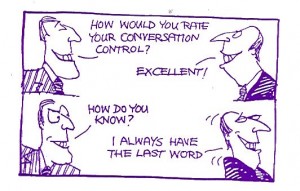
Conversation Skills CartoonJesus son of Sirach offered a lot of good advice in his little book sometimes called Liber Eccesiasticus, a book not included in the canon of inspired Scripture recognized by Protestants, but found in that selection of texts called the Apocrypha. Anglicans decline to use these texts to settle matters of doctrine, but read them ” for example of life and instruction of manners.” (Articles of Religion, Article VI, BCP 1979, page 868)

None of that advice, it seems to me, is better, nor more timely, than these verses from today’s Old Testament reading: investigate before speaking; listen before answering. The so-called “debates” (which were anything but) between the candidates for the presidency and vice-presidency of this country were exercises in how not to have a constructive and productive conversation. In whatever the format, none of which worked, these “debates” were showcases of people whose ears were hardly ever engaged, who weren’t examining things before criticizing and who weren’t listening before answering, and who definitely were interrupting when others were speaking.

I may use YouTube snippets of the debates in my pre-marital counseling of engaged couples! In that counseling, I talk with the couples about effective communication and problem solving and always, always encourage two things: active listening and assertiveness (which is very different from aggressiveness). Active listening means paying attention, not interrupting, and restating what you have heard so that you confirm your understanding; it means taking personal responsibility for getting what you hear from the other person right. Assertiveness means getting what the other hears from you right. It means taking responsibility for your feelings by using “I” statements; it means stating your position clearly and directly, not relying on the other to read your mind.

Obviously, the need for good interpersonal communications skills has been around as long as there have been people and the advice I give these couples is nothing new. Jesus Ben Sira was giving the same advice, how not to converse, a couple of millennia ago!

====================

A request to my readers: I’m trying to build the readership of this blog and I’d very much appreciate your help in doing so. If you find something here that is of value, please share it with others. If you are on Facebook, “like” the posts on your page so others can see them. If you are following me on Twitter, please “retweet” the notices of these meditations. If you have a blog of your own, please include mine in your links (a favor I will gladly reciprocate). Many thanks!

====================

Father Funston is the rector of St. Paul’s Episcopal Church, Medina, Ohio.

The Better Angels of Our Nature – From the Daily Office – October 24, 2012

From the Book of Ben Sira:

Do not seek from the Lord high office,
or the seat of honor from the king.
Do not assert your righteousness before the Lord,
or display your wisdom before the king.
Do not seek to become a judge,
or you may be unable to root out injustice;
you may be partial to the powerful,
and so mar your integrity.
Commit no offense against the public,
and do not disgrace yourself among the people.

(From the Daily Office Lectionary – Ben Sira 7:4-7 – October 24, 2012)

Abraham LincolnThere are a few folks flying all over the U.S. recently (and promising to do so for the next couple of weeks) who have not followed Ben Sira’s advice! Everyday for the past few weeks my mailbox has contained at least one and more commonly three or more expensively produced, glossy, color flyers extolling the virtues of one or the other of the political parties or candidates, or more often tearing down the other guys. Everyday for the past few weeks my voicemail has recorded a robo-call from some politician or political action group. Everyday at any hour of the day that I care to turn on my television set, I am treated to political advertisements and “news” shows. Someone is not following Ben Sira’s advice to “not seek high office or the seat of honor”! And we as a society are, I’m sad to say, disgraced among the nations by the spectacle of our electioneering.

And how could it be otherwise in a society like ours? In a culture in which the People are the sovereign, charged with choosing our leaders by popular vote, how could it be otherwise? We could, I suppose, try to limit the period of campaigning. We could, I suppose, try to limit the amount spent on political advertisements. I’m not sure these or other measures would work, but we could try.

What might work better is for everyone, more the People than the politicians, to remember and meditate upon the closing words of Abraham Lincoln’s first inaugural address:

We are not enemies, but friends. We must not be enemies. Though passion may have strained, it must not break our bonds of affection. The mystic chords of memory, stretching from every battle-field, and patriot grave, to every living heart and hearth-stone, all over this broad land, will yet swell the chorus of the Union, when again touched, as surely they will be, by the better angels of our nature.

If we and those who seek our votes would simply remember that we are not enemies, and let ourselves be touched “by the better angels of our nature,” if we and those who seek our votes would focus on truth and on laying out a vision for our country and our world instead of tearing down the other candidate, if we and those who seek our votes would carry out our democratic processes in humility, then perhaps we would not need Ben Sira’s injunction to “commit no offense against the public,” perhaps we could be assured that our election cycles do not disgrace ourselves among the nations.

Until then, though, Ben Sira’s words are not merely an injunction; they stand as stark indictment of our political campaigns. God grant that when it is all over, the better angels of our nature can unite us again.

====================

A request to my readers: I’m trying to build the readership of this blog and I’d very much appreciate your help in doing so. If you find something here that is of value, please share it with others. If you are on Facebook, “like” the posts on your page so others can see them. If you are following me on Twitter, please “retweet” the notices of these meditations. If you have a blog of your own, please include mine in your links (a favor I will gladly reciprocate). Many thanks!

====================

Father Funston is the rector of St. Paul’s Episcopal Church, Medina, Ohio.

The Fire Inside – From the Daily Office – October 23, 2012

From the Psalms:

So I held my tongue and said nothing;
I refrained from rash words;
but my pain became unbearable.
My heart was hot within me;
while I pondered, the fire burst into flame;
I spoke out with my tongue.

(From the Daily Office Lectionary – Psalm 39:3-4 – October 23, 2012)

FlameThis is from one of today’s psalms for Evening Prayer. What got my attention and caught my imagination is the Psalmist image of unspoken thoughts being painful and bursting into flame demanding to be spoken. While it is intended to be a positive image of trying to not engage with the wicked until one can no longer refrain from doing so, until one’s righteousness is kindled against them, I could not help but be reminded of James’s words:

The tongue is a small member, yet it boasts of great exploits. How great a forest is set ablaze by a small fire! And the tongue is a fire. The tongue is placed among our members as a world of iniquity; it stains the whole body, sets on fire the cycle of nature, and is itself set on fire by hell. (James 3:5-6)

It’s a metaphor of mixed meaning, the unspoken word as a fire bursting from the tongue in burning speech. It can slay the wicked, but it can also destroy the world. The problem is that once those thoughts begin to smolder inside one’s being they can’t be controlled; they can’t be smothered out; they can’t be contained. Bob Seeger has a great song entitled The Fire Inside which includes these lines:

You’re out on the town, safe in the crowd
Ready to go for the ride
Searching the eyes, looking for clues
There’s nowhere you can hide
The fire inside

“There’s nowere you can hide the fire inside!” It’s going to get out; it’s going to known. Our goal should not be to contain the fire or keep it hidden; that’s when we lose control of it. Our goal should be to channel it and use it. Another word for the “the fire inside” is passion. Theologian Frederick Buechner has written that vocation is where our greatest passion meets the world’s greatest need: “The kind of work God usually calls you to do is work (a) that you need most to do and (b) that the world needs most to have done. The place God calls you to is the place where your deep gladness and the world’s deep hunger meet.” (Wishful Thinking: A Seeker’s ABC) Everyone has a vocation. The Psalmist’s was to speak God’s truth in the midst of the wicked. Each of us must discern our own.

What is the fire inside and where can it be used?

====================

A request to my readers: I’m trying to build the readership of this blog and I’d very much appreciate your help in doing so. If you find something here that is of value, please share it with others. If you are on Facebook, “like” the posts on your page so others can see them. If you are following me on Twitter, please “retweet” the notices of these meditations. If you have a blog of your own, please include mine in your links (a favor I will gladly reciprocate). Many thanks!

====================

Father Funston is the rector of St. Paul’s Episcopal Church, Medina, Ohio.

« Older posts Newer posts »