Occasional thoughts of an Anglican Episcopal priest

Category: Politics (Page 14 of 23)

Let the Psalms Do It – From the Daily Office – May 28, 2014

From the Book of Psalms:

Go away from me, you evildoers,
that I may keep the commandments of my God.
— Psalm 119:115 (NRSV)

O that my people would listen to me,
that Israel would walk in my ways!
— Psalm 81:13 (NRSV)

Give justice to the weak and the orphan;
maintain the right of the lowly and the destitute.
Rescue the weak and the needy;
deliver them from the hand of the wicked.
— Psalm 82:3-4 (NRSV)

(From the Daily Office Lectionary – Morning & Evening Psalms – May 28, 2014)

Empty Arched SpaceTwo years ago I wrote a meditation on First Timothy on this blog about our need to pray for our political leadership, especially those with whom we disagree; yesterday, I repeated that same reflection. Really, our need is to pray for everyone, including those we really don’t want to pray for: “Love your enemies and pray for those who persecute you.” (Mt 5:44) I believe that, I really do.

Since the first publication of that reflection in May, 2012, there have been nine mass shootings in this country, including the Sandy Hook tragedy in Newtown, Connecticut, and this week’s killings near UC Santa Barbara in Isla Vista, California:

“Seven people are dead, including a suspect, and seven people are wounded following a series of shootings in Isla Vista. The identities of those who were killed are not being released until next of kin notifications are made. Of the seven people in the hospital, all are being treated for gunshot wounds or traumatic injuries and at least one of the victims has undergone surgery.” — Santa Barbara, California, Sheriff’s Office press release, May 24, 2014

After the UCSB deaths, this father spoke out:

“Why did Chris die? Chris died because of craven, irresponsible politicians and the N.R.A. They talk about gun rights. What about Chris’s right to live? When will this insanity stop? When will enough people say, ‘Stop this madness; we don’t have to live like this?’ Too many have died. We should say to ourselves: not one more.” — Richard Martinez, father of Christopher Martinez, one of the Isla Vista decedents

And these gun-rights advocates responded:

“No idea how my son will die, but I know it won’t be cowering like a bitch at UC Santa Barbara. Any son of mine would have been shooting back.” — Todd Kincannon, North Carolina Tea Party activist, known for thoughtless tweets like this one

“[Y]our dead kids don’t trump my Constitutional rights.” — Samuel Wurzelbacher a/k/a “Joe the Plumber,” brought to national attention during the 2012 presidential campaign

And I wrote this on Facebook (after reading Wurzelbacher’s open letter):

“Between this (and that Kincannon person characterizing the Isla Vista victims as ‘cowering bitches’) we see the moral depravity, the ethical bankruptcy, and the just-plain vileness of those who have elevated the misconstrual of the Second Amendment’s provision of a right to bear arms above all other rights and laws.”

And The Onion published this biting satire:

“ISLA VISTA, CA—In the days following a violent rampage in southern California in which a lone attacker killed seven individuals, including himself, and seriously injured over a dozen others, citizens living in the only country where this kind of mass killing routinely occurs reportedly concluded Tuesday that there was no way to prevent the massacre from taking place. ‘This was a terrible tragedy, but sometimes these things just happen and there’s nothing anyone can do to stop them,’ said North Carolina resident Samuel Wipper, echoing sentiments expressed by tens of millions of individuals who reside in a nation where over half of the world’s deadliest mass shootings have occurred in the past 50 years and whose citizens are 20 times more likely to die of gun violence than those of other developed nations. ‘It’s a shame, but what can we do? There really wasn’t anything that was going to keep this guy from snapping and killing a lot of people if that’s what he really wanted.’ At press time, residents of the only economically advanced nation in the world where roughly two mass shootings have occurred every month for the past five years were referring to themselves and their situation as ‘helpless.’”

I really, really believe in the power of prayer. I really, really believe that we are to pray for those who do wrong. I really, really believe we should pray for those we don’t want to pray for. I really, really believe that we are to pray for our leaders, even when we disagree with them and even when they are failing to lead, failing to protect the people, failing to take action that is needed.

But today I’m finding really, really hard to do that. So I’ll let today’s psalms do it for me.

Let the psalms do it.

====================

A request to my readers: I’m trying to build the readership of this blog and I’d very much appreciate your help in doing so. If you find something here that is of value, please share it with others. If you are on Facebook, “like” the posts on your page so others can see them. If you are following me on Twitter, please “retweet” the notices of these meditations. If you have a blog of your own, please include mine in your links (a favor I will gladly reciprocate). Many thanks!

====================

Father Funston is the rector of St. Paul’s Episcopal Church, Medina, Ohio.

Praying for Leaders – From the Daily Office – May 27, 2014

From the First Letter to Timothy:

First of all, then, I urge that supplications, prayers, intercessions, and thanksgivings should be made for everyone, for kings and all who are in high positions, so that we may lead a quiet and peaceable life in all godliness and dignity.

(From the Daily Office Lectionary – 1 Timothy 2:1-2 (NRSV) – May 27, 2014)

Praying with the BibleThere was a meme circulating the conservative blogosphere and email circuit several months ago in which folks of a certain political persuasion asserted that they were “praying” for President Obama by reciting a verse from Psalm 109: “Let his days be few, and let another take his office.” The psalm continues in the next verse: “Let his children be fatherless, and his wife become a widow.” And the petition get even worse after that. This is not what Paul is admonishing the faithful to do in his letter to the young bishop Timothy. In fact, it is clearly the very opposite.

What would our country and our society be like if everyone did offer “supplications, prayers, intercessions, and thanksgivings … for … all who are in high positions”? One of the things I counsel folks who come to me with issues of unresolved anger toward another is to pray for that other. Not specific intercessions just simply to offer that person’s name before God with the simple request, “In this person’s life, Lord, may your will be done.” The nearly universal experience of my counselees is that over the course of time (the length of time varies from person to person) their anger dissipates; the typical observation is that is impossible to stay angry at someone for whom you are praying.

The purpose of prayer is not to inform God of anything of which we believe God may be unaware, to give God our good advice, or to conform God’s will to ours. Rather, it is to relinquish our own selfish desires in acquiescence to the one “whose power, working in us, can do infinitely more than we can ask or imagine,” as we remind ourselves as the end of the Daily Office (quoting Ephesians 3:20).

What would our society be like if everyone prayed for our leadership, even the leaders with whom we have political disagreements or personal dislikes? What would things be like if I prayed for that jackass in Congress, or that SOB in the state house? I cannot imagine, but Paul assures me that we would all “lead a quiet and peaceable life in all godliness and dignity.” Maybe we (that really means, I) should give it a try.

(The reflection above is a repeat of one written on this blog in May of 2012 when this lesson was last on the lectionary rotation.)

====================

A request to my readers: I’m trying to build the readership of this blog and I’d very much appreciate your help in doing so. If you find something here that is of value, please share it with others. If you are on Facebook, “like” the posts on your page so others can see them. If you are following me on Twitter, please “retweet” the notices of these meditations. If you have a blog of your own, please include mine in your links (a favor I will gladly reciprocate). Many thanks!

====================

Father Funston is the rector of St. Paul’s Episcopal Church, Medina, Ohio.

Memorial Day at Church – Sermon for the Sixth Sunday of Easter (May 26, 2014)

====================

On the Sixth Sunday of Easter, May 25, 2014, this sermon was offered to the people of St. Paul’s Episcopal Church, Medina, Ohio, where Fr. Funston is rector.

(The lessons for the day were: Acts 17:22-31; Psalm 66:7-18; 1 Peter 3:13-22; and John 14:15-21. These lessons can be read at The Lectionary Page.)

====================

Memorial Day Cemetery FlagsI’m going to do something I have never done before! I’m going to read someone else’s sermon. While I was pondering these lessons, doing the usual research, and thinking about what to say, I came upon a superb sermon preached on Memorial Day weekend three years ago when, as today, the lesson from Acts was the story of St. Paul preaching at the Areopagus. The preacher was the Rev. Kurt Wiesner who is the rector of All Saints Episcopal Church in Littleton, New Hampshire, and whom many of us remember from his tenure as curate at our own Trinity Cathedral. This is what Kurt had to say and I earnestly commend his thoughts to you:

[The sermon as originally posted on the internet can be found on Fr. Wiesner’s blog One Step Closer: Religion & Popular Culture.]

Memorial Day in Church — (A sermon preached Sunday of Memorial Day Weekend, 5/29/2011)

Contrary to the assumptions of many, Memorial Day is not officially a celebration of the church. Unlike Independence Day and Thanksgiving Day (both which I have talked about in the past), it is not on our church calendar, and there is no prayer in our Prayerbook to mark this day. It did not come from the church, nor was it formally adopted by it.

Robert Bellah writes that sociologists have suggested that America has a secular “civil religion” –- one with no association with any religious denomination or viewpoint –- that has incorporated Memorial Day as a sacred event. Our American tradition includes an obligation to honor the sacrifices made by our nation to earn our freedom. With the Civil War, a new theme of death, sacrifice and rebirth enters the civil religion. Memorial Day gave ritual expression to these themes, integrating the local community into a sense of nationalism. The American civil religion in contrast to that of France was never anticlerical or militantly secular; in contrast to Britain it was not tied to a specific denomination like the Church of England. Instead, Americans borrowed selectively from different religious traditions in such a way that the average American saw no conflict between the two, thus mobilizing deep levels of personal motivation for the attainment of national goals. (Civil Religion in America, by Robert Bellah, 1967. Used by Wikipedia)

This cannot completely explain why the church has not officially adopted Memorial Day: after all, the church has taken and adapted plenty of public events and celebrations in the past. Perhaps it’s only a matter of time. Then again, one could argue that every day is a Memorial Day in the church.
Regardless, this morning I want to share with you some Memorial Day history, which comes mostly from the Wikipedia Memorial Day entry:

Our tradition of Memorial Day comes from the time after the Civil War, honoring the soldiers who had died by decorating their graves with flags or flowers. By 1865 the practice of decorating soldiers’ graves had become widespread in the North. The first known observance was in Boalsburg, Pennsylvania, on October, 1864, and each year thereafter. Similar events followed around the northern states on various scales.

In Charleston, South Carolina, in 1865, freed enslaved Africans celebrated at the Washington Race Course, today the location of Hampton Park. The site had been used as a temporary Confederate prison camp for captured Union soldiers in 1865, as well as a mass grave for Union soldiers who died there. Immediately after the cessation of hostilities, freedmen exhumed the bodies from the mass grave and reinterred them in individual graves. They built a fence around the graveyard with an entry arch and declared it a Union graveyard. On May 1, 1865, a crowd of up to ten thousand, mainly black residents, including 2800 children, proceeded to the location for events that included sermons, singing, and a picnic on the ground.

Beginning in 1866 the southern states had their own Memorial Days. The earliest Confederate Memorial Day celebrations were simple, somber occasions for veterans and their families to honor the day and attend to local cemeteries.

General John A. Logan may be most responsible for growth of a particular holiday. On May 5, 1868, in his capacity as commander-in-chief of the Grand Army of the Republic -– the organization for Northern Civil War veterans -– Logan issued a proclamation that “Decoration Day” should be observed nationwide. It was observed for the first time on May 30 of the same year; the date was chosen because it was not the anniversary of a battle.

There were events in 183 cemeteries in 27 states in 1868, and 336 in 1869. The northern states quickly adopted the holiday; Michigan made “Decoration Day” an official state holiday in 1871 and by 1890 every northern state followed suit. The ceremonies were sponsored by the Women’s Relief Corps, which had 100,000 members.

The Decoration Day speech became an occasion for veterans, politicians and ministers to commemorate the war -– and at first to recall the atrocities of the enemy. They mixed religion and celebratory nationalism and provided a means for the people to make sense of their history in terms of sacrifice for a better nation, one closer to their God. People of all religious beliefs joined together, and the point was often made that the German and Irish soldiers had become true Americans in the “baptism of blood” on the battlefield.

By the end of the 1870s the rancor was gone and the speeches praised the soldiers of both the Union and Confederacy. In 1882, the name of Decoration Day was formally changed to Memorial Day in “memory” and ‘honor” of those who gave their lives fighting for a common cause, America.

This name, however, did not become more common until after World War II and was not declared the official name by Federal law until 1967.

Many Americans observe Memorial Day by visiting cemeteries and memorials. A national moment of remembrance takes place at 3 p.m. local time. Another tradition is to fly the flag of the United States at half-staff from dawn until noon local time. The half-staff position remembers the more than one million men and women who gave their lives in service of their country. At noon their memory is raised by the living, who resolve not to let their sacrifice be in vain, but to rise up in their stead and continue the fight for liberty and justice for all. The National Memorial Day Concert takes place on the west lawn of the United States Capitol the Sunday before Memorial Day. The concert is broadcast on PBS and NPR. Music is performed, and respect is paid to the men and women who died in war.

There have, however, been a number of the historical problems concerning Memorial Day. Many of the celebrations have included a demonization of whatever is the perceived other side: not just concerning the Civil War, but the world conflicts that have followed. Certain ideologies have upended Memorial Day at different times. Continuing from Wikipedia:

In many southern locations in the 1890s from the consolatory emphasis of honoring soldiers to public commemoration of the Confederate “Lost Cause”. Changes in the ceremony’s hymns and speeches reflect an evolution of the ritual into a symbol of cultural renewal and conservatism in the South.
By the 1950s, the theme of Memorial Day had become more geared towards American exceptionalism and understood duty to uphold freedom in the world.

There have also been challenges beyond nationalism. The tradition has become permanently linked to sporting events. One of the longest-standing traditions is the running of the Indianapolis 500, the auto race has been held in conjunction with Memorial Day since 1911, run on the Sunday preceding the Memorial Day holiday. The Coca-Cola 600 stock car race has been held later the same day since 1961. The Memorial Tournament golf event has been held on or close to the Memorial Day weekend since 1976.

On June 28, 1968, the Congress passed the Uniform Holidays Bill which moved three holidays from their traditional dates to a specified Monday in order to create a convenient three-day weekend. The holidays included Washington’s Birthday, Veterans Day, and Memorial Day. The change moved Memorial Day from its traditional May 30 date to the last Monday in May. The law took effect at the federal level in 1971. This change is still controversial. The VFW stated in a 2002 Memorial Day Address:

Changing the date merely to create three-day weekends has undermined the very meaning of the day. No doubt, this has contributed a lot to the general public’s nonchalant observance of Memorial Day. (David Mechant, April 28, 2007, “Memorial Day History”, in the Wikipedia entry)

While the actual significance of the original date is debatable, it is pretty clear that Memorial Day Weekend’s role as the unofficial start of summer has come to dominate the observance. And I don’t think it’s a stretch to say that, in the vocabulary of many, the phrase “Memorial Day” include the word “sale.”

As I said at the beginning, Memorial Day is not officially a day marked by the Episcopal Church. Certainly remembering those who have given their lives in service is appropriate for church communities to do, and explains why plenty of individual churches celebrate the day.

Perhaps some of what the church has to offer Memorial Day can be found in Paul’s insightful preaching in the Book of Acts this morning (Acts 17:22-31). Paul observes the many religious practices of the Athenians. He does not spend it time condemning what is wrong with their practice. Instead, he lifts up the Athenians pursuit of religious understanding, and building on their creativity and passion, preaches about God “…in whom we live and move and have our being”. (Acts 17:28)

Perhaps it is the role of the church to not only help remember what is good in Memorial Day … honoring those who died in service to their country … but to also lift up the day as something more: articulating a vision of a world that so values peoples’ lives as dwelling in God, that violence towards others becomes unacceptable.

Perhaps this is why I find the [hymn from the United Methodist Hymnal], A Song of Peace, so appropriate:

This is my song, O God of all the nations,
A song of peace for lands afar and mine;
This is my home, the country where my heart is;
Here are my hopes, my dreams, my holy shrine:
But other hearts in other lands are beating
With hopes and dreams as true and high as mine.

My country’s skies are bluer than the ocean,
And sunlight beams on clover leaf and pine;
But other lands have sunlight too, and clover,
And skies are everywhere as blue as mine;
O, hear my song, Thou God of all the nations,
A song of peace for their land and for mine.

This is my song, O God of all the nations,
A song of peace for (people) in every place;
And yet I pray for my beloved country
The reassurance of continued grace:
Lord, help us find our oneness in the Savior,
In spite of differences of age and race.
[From the United Methodist Hymnal (Stanzas 1 & 2 by Lloyd Stone, Stanza 3 by Georgia Harkness)]

========================

That is Kurt’s sermon…. to which I want to add just a brief postscript, beginning with a personal story:

From 1972 to 1974, I was the youth minister at St. Peter’s Episcopal Church in Del Mar, California, where Fr. Tally Jarrett, a former military chaplain who had served in Germany, was the rector. Fr. Tally had absolutely no musical talent or skill, and seldom used hymns in his sermons, so (unlike me) he did not select the hymns for worship; he left that up to the Choir Director. (I select the hymns, but I leave the selection of preludes, postludes, voluntaries, and anthems up to Bertie.)

One Sunday we had a guest preacher, the local Reformed Jewish rabbi, and I was on the schedule as the chalice bearer for the service. As we lined up in the back of the church for the procession, the organist struck the opening notes of the first hymn, Glorious Things of Thee Are Spoken. The words were written by John Newman, the same man who wrote Amazing Grace, but the hymn is set to the tune Austria by Franz Joseph Haydn. That tune is also the music for Das Lied der Deutschen, the German national anthem. Fr. Tally heard that tune start up, looked at the rabbi, and turned beet red with embarrassment; the rabbi just laughed and said, “Don’t worry about it! It’s a lovely tune.”

Thursday evening I was here in the church and heard the choir practicing their anthem . . . which turns out to be a choral arrangement of that hymn. I chuckled remembering that Sunday morning back in Del Mar and it occurred to me how similar to that event the singing of that tune, the melody of the national anthem of our sworn World War II enemy, on Memorial Day is. Some of us who fought against Germany in WW2 ourselves or whose fathers fought in that theatre, as did mine, might find it odd to do so. I find it particularly appropriate; a reminder that we have gotten past that conflict and that our former enemy is now our ally.

I would ask you to pay particular attention to the final verse that the choir will sing:

Savior, since of Zion’s city
I through grace a member am,
Let the world deride or pity,
I will glory in your name.
Fading are the worldlings’ pleasures
All their boasted pomp and show;
Solid joys and lasting treasures
None but Zion’s children know.

This, as Fr. Wiesner suggested, is what the church can lift up and articulate on Memorial Day, a “vision of a world that so values peoples’ lives as dwelling in God, that violence towards others becomes unacceptable,” a vision of a world in which all can enjoy the “solid joys and lasting treasures” of peace and good will.

Let us pray:

O Judge of the nations, we remember before you with grateful hearts the men and women of our country who in the day of decision ventured much for the liberties we now enjoy. Grant that we may not rest until all the people of this and every land share the benefits of true freedom and gladly accept its disciplines. This we ask in the Name of Jesus Christ our Lord. Amen.

====================

A request to my readers: I’m trying to build the readership of this blog and I’d very much appreciate your help in doing so. If you find something here that is of value, please share it with others. If you are on Facebook, “like” the posts on your page so others can see them. If you are following me on Twitter, please “retweet” the notices of these meditations. If you have a blog of your own, please include mine in your links (a favor I will gladly reciprocate). Many thanks!

====================

Father Funston is the rector of St. Paul’s Episcopal Church, Medina, Ohio.

So Many Martyrs – Sermon for the Fifth Sunday of Easter, RCL Year A – May 18, 2014

====================

This sermon was preached on the Fifth Sunday of Easter, May 18, 2014, at St. Paul’s Episcopal Church, Medina, Ohio, where Fr. Funston is rector.

(The lessons for the day were: Acts 7:55-60; Psalm 31:1-5,15-16; 1 Peter 2:2-10; and John 14:1-14 . These lessons can be read at The Lectionary Page.)

====================
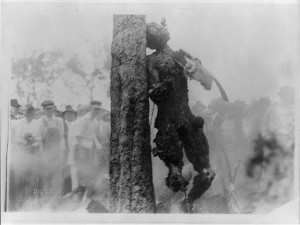
Lynching of Jesse WashingtonDoes the name “Jesse Washington” mean anything to you? It’s unlikely that it does. If I tell you that Jesse Washington died in 1916 in Waco, Texas, would that spark any memory? Have you ever been taught about the incident in which Washington was killed? Have you ever heard of what came to be called “The Waco Horror?”

Probably not. It’s not one of the incidents of American history that gets regularly taught in our schools. If I hadn’t taken a course in African American history when I was a college sophomore in 1970, I wouldn’t know anything about the death of Jesse Washington on May 15, 1916. It’s not the sort of story that makes a white person comfortable. But I do know about it, and the fact that its anniversary falls during the week when I was preparing a sermon on, among other passages from Scripture, Luke’s description of the martyrdom of Stephen in the Book of Acts struck me as significant. Both Stephen and Jesse Washington were murdered by mobs because they were different.

Jesse Washington was a 17-year-old African American farmhand. On May 8, 1916, he was accused of raping and murdering Lucy Fryer, the wife of his white employer in Robinson, Texas, not far from Waco. Jesse and his entire family (his parents and a brother) were questioned; the others were released, but Jesse was not. He was taken to Dallas, where he eventually signed a confession which some legal historians believed was coerced. There was little, if any, evidence that he was actually guilty.

Washington was tried for murder in Waco, in a courtroom filled with locals who had been provoked by local newspaper reports which included lurid, and demonstrably false, details about the crime. His defense counsel entered a guilty plea and Washington was quickly sentenced to death, but he had no opportunity to appeal.

After his sentence was pronounced, the teenager was dragged out of the courtroom and lynched in front of city hall. Over 10,000 spectators, including city officials and police, gathered to watch. Members of the mob castrated the boy, cut off his fingers, and hung him (still alive) over a bonfire. He was repeatedly lowered into the fire and raised again to prolong his agony and death. After he finally succumbed, the fire was extinguished and Jesse Washington’s charred torso was dragged through the town; parts of his body were actually sold as souvenirs. A professional photographer took pictures as the lynching progressed; these were printed and sold as postcards in Waco.

As a Christian society, we remember Stephen as the first Christian martyr and as a hero of our faith; his is a unique story told in the Book of Acts. As a Christian society, we don’t remember Jesse Washington, at all; he’s just one of thousands who were lynched. Historical reports indicate that between 1882 and 1968 there were over 4,700 lynchings in the United States. One history text estimates that between 1882 and 1930 in America at least one black person was lynched every week. (Tolnay, S., & E.M. Beck, A Festival of Violence, University of Illinois Press, 1992, p. ix) We know the numbers, but we don’t know their names.

We Americans, however, aren’t even in the minor leagues when it comes to martyring people for being different. Writing about Stephen’s death, Professor Daniel Clendenin reminds us that there have been so many more martyrs, that martyrdom is not ancient history. It is a very contemporary and present reality:

Millions more have been martyred for reasons other than religion — for their ethnicity (Jews, Armenians, Tutsis), for economic ideology (farmers, land holders), social prejudice (intellectuals, artists), race (American blacks), and gender (women around the world like the inspirational Malala Yousafzai of Pakistan).

Christians are just one group among many that honors their martyrs. Very few times, places or peoples have been spared mass murder.
If you can bear to read it, I recommend the book by Daniel Jonah Goldhagen, Worse Than War; Genocide, Eliminationism, and the Ongoing Assault on Humanity (2009). Goldhagen estimates that between 127–175 million people were “eliminated” in the last century.

These people came from all regions of the world, and from all social, economic and political groups. The vast majority of these victims were killed in their own countries, by their fellow citizens, by willing and non-coerced murderers, and almost never with any substantial dissent. Eliminationism is thus “worse than war.”

The numbers are mind-numbing, and therein lies our challenge. They bring to mind the infamous remark by [Joseph] Stalin in 1947 about the famine in Ukraine that was killing millions: “If only one man dies of hunger, that is a tragedy. If millions die, that’s only statistics.” (The Stoning of Stephen)

Clendenin concludes, “The martyrdom of Stephen disabuses us of a sentimental gospel. It roots us in the real world of industrial scale slaughter. The one man Stephen helps us to remember the individual humanity of the millions of people we might otherwise forget.”

Now I want to draw our attention away from mass murder and martyrdom, and focus instead, for a moment, on one another. I’d like you for just a few seconds to look around the room, and just take note of who and what you see here. (A short, silent pause)

What did you see? A bunch of living stones? The members of a holy priesthood? A chosen race? A royal priesthood? A people chosen and named by God? This is what Peter says we should see, the building material for a spiritual house, eternal in the heavens, not made with hands, that mansion in which there are many rooms where Jesus assures his disciples there is a place for all of us. But is that how we see one another?

Philip asked Jesus to show them the Father and Jesus replied, “Have I been with you all this time, Philip, and you still do not know me? Whoever has seen me has seen the Father. How can you say, ‘Show us the Father’?” I sometimes wonder if Jesus’ answer would perhaps have been different if Philip had asked, “Show us God.”

In the creation story in the first chapter of Genesis we are told, “God created humankind in his image, in the image of God he created them; male and female he created them.” (Gen 1:27) If Philip had asked Jesus, “Show us God,” might Jesus not have said, “Look around you, Philip.” Archbishop Desmond Tutu is fond of reminding people of those words from Genesis and suggesting that we should genuflect to one another! In a paper entitled Religious Human Rights and the Bible, he wrote:

The life of every human person is inviolable as a gift from God. And since this person is created in the image of God and is a God carrier a second consequence would be that we should not just respect such a person but that we should have a deep reverence for that person. The New Testament claims that the Christian person becomes a sanctuary, a temple of the Holy Spirit, someone who is indwelt by the most holy and blessed Trinity. We would want to assert this of all human beings. We should not just greet one another. We should strictly genuflect before such an august and precious creature. The Buddhist is correct in bowing profoundly before another human as the God in me acknowledges and greets the God in you. This preciousness, this infinite worth is intrinsic to who we all are and is inalienable as a gift from God to be acknowledged as an inalienable right of all human persons. (Emory International Law Review, Vol. 10 (1996): 63-68)

Which brings me back to Stephen and Jesse Washington, and to a strange little short story by the author Shirley Hardie Jackson entitled The Lottery that was first published in The New Yorker in June, 1948.

Set in a small, contemporary American town, a small village of about 300 residents, the story concerns an annual ritual known as “the lottery” which is practiced to ensure a good harvest; one character quotes an old proverb, “Lottery in June, corn be heavy soon.” As the story opens, the locals are excited but a bit anxious on the eve of the lottery. Children are gathering stones as Mr. Summers and Mr. Graves make the paper slips for the drawing and draw up a list of all the families in town.

When they finish the slips and the list, the men put them into a black box, which is locked up in the safe at a local coal company. The next morning the townspeople gather at 10 a.m. in order to have everything done in time for lunch. First, the eldest male of each family in town draws a slip; there’s one for every household. Bill Hutchinson gets the one slip with a black spot, meaning that his family has been chosen. In the next round, each member of the Hutchinson family draws a slip, and Bill’s wife Tessie gets the black spot. Each villager then picks up a stone and they surround Tessie, and the story ends as Mrs. Hutchinson is stoned to death while the paper slips are allowed to fly off in the wind.

Shortly after it was published, Ms. Jackson said of her story that she had hoped that by setting the particularly brutal ancient rite of stoning (the same thing that was done to Stephen) in the present she would shock her readers with “a graphic dramatization of the pointless violence and general inhumanity in [our] own lives.” (San Francisco Chronicle, July 22, 1948.) Her story suggests that we human beings are more capable of honoring our rituals and our preconceptions than we are of honoring one another.

I think the true stories of Stephen of Jerusalem, of Jesse Washington of Waco, Texas, and of those millions of martyrs who have been “eliminated” amply demonstrate that she was right. Not only are we more capable of honoring our rituals and prejudices that we of honoring one another, we are demonstrably willing to murder one another to protect them.

We are because when we look around at our fellow human beings we do not see one another as divine; we do not see living stones; we do not see members of a royal priesthood. Blinded, or perhaps just numbed, by familiar ritual, by preconception, by the simple human need to conform, we do not appreciate one another as fellow citizens of a holy nation, “chosen and precious in God’s sight,” as bearing the image of God.

“Have I been with you all this time, Philip, and you still do not know me?” Jesus asked. I’m not the least bit surprised in Philip, however; we human beings, made in the image of God, have been with each other for a long, long time, and we still do not know each other. Dr. Clendenin suggested that the martyrdom of Stephen helps us to remember the individual humanity of the millions of unnamed martyrs we might otherwise forget; may it also help us to remember the divinity of each of them and of each other.

Let us pray:

O God, you made us in your own image and redeemed us through Jesus your Son: Look with compassion on the whole human family; take away the arrogance and hatred which infect our hearts; break down the walls that separate us; unite us in bonds of love; and work through our struggle and confusion to accomplish your purposes on earth; that, in your good time, all nations and races may serve you in harmony around your heavenly throne; through Jesus Christ our Lord. Amen. (For the Human Family, Book of Common Prayer, Episcopal Church, 1979, page 815)

====================

A request to my readers: I’m trying to build the readership of this blog and I’d very much appreciate your help in doing so. If you find something here that is of value, please share it with others. If you are on Facebook, “like” the posts on your page so others can see them. If you are following me on Twitter, please “retweet” the notices of these meditations. If you have a blog of your own, please include mine in your links (a favor I will gladly reciprocate). Many thanks!

====================

Father Funston is the rector of St. Paul’s Episcopal Church, Medina, Ohio.

Lust and Sepulchres – From the Daily Office – May 16, 2014

From Matthew’s Gospel:

Jesus said, “You have heard that it was said, ‘You shall not commit adultery.’ But I say to you that everyone who looks at a woman with lust has already committed adultery with her in his heart.”

(From the Daily Office Lectionary – Matthew 5:27-28 (NRSV) – May 16, 2014)

Private MausoleumIt has been almost 40 years since presidential candidate Jimmy Carter admitted to Playboy magazine, “I’ve looked on many women with lust. I’ve committed adultery in my heart many times. God knows I will do this and forgives me.” Caused quite a stir and, some say, marked the beginning of the erosion of presidential privacy, the start of an era of leadership toxicity in American politics when partisan reporters feel free to reveal any fact or rumor, no matter how irrelevant, if it will hurt a politician of the opposite party or position. I’m not sure that that’s the case; a good argument can be made that the current polarized, hyper-partisan atmosphere started building during the Nixon, or even Johnson, years. That, however, is not what I’m thinking about this morning.

I’m thinking about the impossibility of Jesus’ hyperbolic morality! To be honest, I think Mr. Carter was overstating the “looking with lust” thing. As I understand the Greek used here, epithumeo, what Jesus is talking about is passionate, heated, covetous desire. I can’t imagine that just looking at someone other than one’s life partner, appreciating their attractiveness, and acknowledging one’s own attraction (even with a little wistful wondering….) would rise to the level of “lust.” If it does, then I guess we’re all in trouble, because no one can live up to such a standard.

That Jesus is being hyperbolic is made clear by the fact that he goes on to counsel his followers to cut off their hands and pluck out their eyes if those members cause them to sin! I mean — come on, folks! — does anyone not suffering from a mental illness think Jesus was doing anything more than making a rhetorical point? I certainly don’t. But his rhetorical point, hyperbolic though it may be, needs to be taken seriously.

Thoughts and attitudes are as important as actions, for even if they do not directly control our actions they give them flavor and nuance. A husband may not often be “lustful” towards other women, one may never be unfaithful, but a regular habit of giving thought to the notion is a form of disrespect for one’s wife and may lead to more outright, more visible, and more damaging forms of disrespect. Further, such a regular habit and the attitude from which it springs cheapen the intimacy between spouses. Motives and motivations, and their authenticity, give substance and meaning to our actions; spousal intimacy that is not truly respectful of the spouse has little substance or meaning.

One of my favorite of Jesus’ similes is spoken to the scribes and the Pharisees later in Matthew’s Gospel, and I like it best in the Authorized translation: “Woe unto you, scribes and Pharisees, hypocrites! for ye are like unto whited sepulchres, which indeed appear beautiful outward, but are within full of dead men’s bones, and of all uncleanness.” (Mt 23:27, KJV) When inner motivation and outward action are not in harmony, when the action is inauthentic because the motivation dishonest, the action . . . no, the actor is a “whited sepulchre,” lovely in outward appearance but filled with rot.

I believe that Jesus’ hyperbolic language about lust makes the same point, and it applies not just to marriages, but to all human interactions and relationships. It may be hyperbole and it may be (indeed, it is) impossible to live up to it. Nonetheless, we must examine our thoughts and attitudes, our motives and motivations; we must look inside and work on our mindset so that our outward actions are authentic. Why? Well, one reason, as Jesus will shortly remind his listeners in a different context, is that our Father “who is in secret . . . sees in secret.” (Mt 6) A more important reason, however, is that anything less violates the second of the two great commandments: “You shall love your neighbor as yourself.” (Mt 22:39)

====================

A request to my readers: I’m trying to build the readership of this blog and I’d very much appreciate your help in doing so. If you find something here that is of value, please share it with others. If you are on Facebook, “like” the posts on your page so others can see them. If you are following me on Twitter, please “retweet” the notices of these meditations. If you have a blog of your own, please include mine in your links (a favor I will gladly reciprocate). Many thanks!

====================

Father Funston is the rector of St. Paul’s Episcopal Church, Medina, Ohio.

Ancestor Abraham – From the Daily Office – May 6, 2014

From the Gospel according to Matthew:

Do not presume to say to yourselves, “We have Abraham as our ancestor”; for I tell you, God is able from these stones to raise up children to Abraham.

(From the Daily Office Lectionary – Matthew 3:9 (NRSV) – May 6, 2014.)

StonesJohn the Baptizer is speaking to the Pharisees and the Sadducees, warning them against the very common human practice of relying upon the piety of our forebears instead of practicing our own faith. Relying on the religion of our ancestors is weakens and attenuates our own spirituality. One might as well be rocks lying by the roadside.

A few days ago, in what I consider a badly reasoned decision, Town of Greece v. Galloway, the U.S. Supreme Court upheld the practice of beginning secular legislative body meetings (in the particular case, a city council) with sectarian prayer. Justice Anthony M. Kennedy, writing for the majority, reasoned: “Legislative prayer has become part of our heritage and tradition, part of our expressive idiom, similar to the Pledge of Allegiance, inaugural prayer, or the recitation of ‘God save the United States and this honorable Court’ at the opening of this Court’s sessions.” He might as well have said, “We have Abraham as our ancestor.”

I’ve no problem with public prayer. I lead it on a pretty regular basis. I have a problem with prayer offered in a secular legislative body in a nation that is supposed to have a separation of church and state. The First Amendment to our Constitution includes two clauses which work that separation. One is known as “the establishment clause” and provides that government “shall make no law respecting an establishment of religion.” The other is called the “free exercise clause” and provides that government shall do nothing “prohibiting the free exercise” of religion.

A legislative body’s rule of procedure requiring prayer at the opening of its sessions violates at least the first of these clauses; it is a law establishing a religious practice. Arguably, it also violates the second clause although (as Kennedy and others have noted) no one is forced to participate in the prayer and, one supposes, could absent oneself from the session until the prayer was concluded.

My concern, in light of today’s reading from Matthew, is not with the Constitutional issue of public governmentally-sponsored prayer. Rather, it is with the notion that somehow the religiosity of our nation is dependent upon practices of government and the (mistaken) notion that our Founders (our equivalent of Abraham) intended this to be a “Christian nation.” This is the argument often made and now being repeated in innumerable online discussions of this ruling.

I can find no difference between “The Founders intended this to be a Christian nation” and “We have Abraham as our ancestor.” Both rely upon the supposed faith of long-dead forebears rather than the lively faith of living people. Any number of prayers may be recited at city council meetings or in state or national legislative chambers; unless and until the people of the nation begin actually living and practicing whatever religion they claim to hold — actually participating in religious events and, more importantly for Christians, feeding the hungry, clothing the naked, and housing the homeless — those prayers are no better than the protest of the Pharisees and Sadducees, “We have Abraham as our ancestor.”

This is especially true when Christian prayer opens a legislative session in which the legislators proceed to enact legislation which flies in the face of Jesus’ commands — when funds are stripped from feeding programs, when homelessness is made a crime, when public assets are diverted to the benefit of the rich at the expense of the poor. The prayer and the faith which it represents are rendered meaningless, with as little life as a pile of rocks.

There is a place for prayer, but it is not in the halls of government and it is not in the historic and attenuated traditions of long-dead forebears. It is in the hearts and lives of living persons acting out their faith. Relying on government-sponsored prayer is nothing more than claiming Abraham as our ancestor, nothing more than being dead stones.

====================

A request to my readers: I’m trying to build the readership of this blog and I’d very much appreciate your help in doing so. If you find something here that is of value, please share it with others. If you are on Facebook, “like” the posts on your page so others can see them. If you are following me on Twitter, please “retweet” the notices of these meditations. If you have a blog of your own, please include mine in your links (a favor I will gladly reciprocate). Many thanks!

====================

Father Funston is the rector of St. Paul’s Episcopal Church, Medina, Ohio.

Compartmentalization – From the Daily Office – April 2, 2014

From the First Letter to the Corinthians:

Now there are varieties of gifts, but the same Spirit; and there are varieties of services, but the same Lord; and there are varieties of activities, but it is the same God who activates all of them in everyone. To each is given the manifestation of the Spirit for the common good. To one is given through the Spirit the utterance of wisdom, and to another the utterance of knowledge according to the same Spirit, to another faith by the same Spirit, to another gifts of healing by the one Spirit, to another the working of miracles, to another prophecy, to another the discernment of spirits, to another various kinds of tongues, to another the interpretation of tongues. All these are activated by one and the same Spirit, who allots to each one individually just as the Spirit chooses.

(From the Daily Office Lectionary – 1 Corinthians 12:4-11 (NRSV) – April 2, 2014.)

Compartmented BoxThe genius of Paul is his holistic approach to understanding the gifts of the Spirit, the talents and skills of human beings. Yes, he says, there are all sorts of talents and skills, but they all come from the same source – God the Spirit – and they are all to be used for the same purpose – building up the community. It is a genius that is lost in the modern world, I’m sorry to say.

I spend some time on social media sites such as Facebook and I see people posting the silliest of comments (including some surprisingly stupid quotations from some otherwise intelligent people) which lay down hard-and-fast, black-and-white assertions about things that are clearly false. For example, on Facebook recently the philosophy Bertrand Russell, famously an atheist, was quoted as saying, “So far as I can remember, there is not one word in the Gospels in praise of intelligence.” I don’t know the accuracy or source of the quotation, but there it is. It’s a ridiculous statement on several levels, not the first of which is that it is clearly inaccurate.

Although Jesus or the gospel writers may never have specifically said or written, “Intelligence of good” or something of that nature, Jesus often praises those who understand his parables, or expresses frustration with those who don’t, which is a way of praising intelligence. Further, to limit the Christian message to the Gospels alone leaves out the greater part of the New Testament, including Paul who (as here) praises wisdom and knowledge as gifts of God.

In any event, the posting of that quotation led to a discussion in which one person asserted that “faith and reason are two entirely different things and have nothing to do with one another.” If the writer had been an atheist, I’d have chalked that up to polemic . . . . but the writer claimed to be a Christian! As a Christian, I would debate that proposition fully; faith and reason are neither different nor separate! I would not be alone, either. The late Pope John Paul II began one of his many encyclicals with these words:

Faith and reason are like two wings on which the human spirit rises to the contemplation of truth; and God has placed in the human heart a desire to know the truth – in a word, to know himself – so that, by knowing and loving God, men and women may also come to the fullness of truth about themselves. (Fides et Ratio, 14 Sept. 1998)

Another participant who self-identified as an American citizen asserted in the conversation that “religion has no place in public politics.” Coming from someone whose country’s foundational document, the Declaration of Independence, asserts “that all men are created equal, that they are endowed by their Creator with certain unalienable Rights, that among these are Life, Liberty and the pursuit of Happiness,” a clearly religious sentiment in a public political document, the participant’s argument was not only ridiculous, it could be considered hypocritical! Religion may have no place in government (the U.S. Constitution’s First Amendment is based on that premise), but that is a different thing from saying it has no place in politics.

I tried to suggest that these black-and-white generalizations were inaccurate and did not help to further rational consideration of Bertrand Russell’s assertion, the quotation which had started the conversation. Unfortunately, the discussion became so heated and counterproductive (what at one time back in the days of email list-serves would have been called a “flame war”) that I discontinued participation. Eventually, the original poster closed the discussion and deleted the entire thread.

Finally, this morning, I read a news report in which the first paragraph asserted: “Religion has never fully accepted the LGBT community. It goes against their doctrine, which in and of itself is an issue.” That’s so broad a generalization as to be laughable. “Religion” encompasses every faith system ever adopted by human beings and there is no common “doctrine” amongst them! Furthermore, as an Episcopalian whose church has elected and ordained gay and lesbian bishops, who works regularly with LGBT colleagues both lay and ordained, and whose denomination has come down squarely in favor of marriage equality, I can point to at least one religion about which this generalization is false.

Would that people who write for publication, who produce “content” for the internet, and who take part in the “flame wars” that erupt in social media could adopt St. Paul’s more holistic approach! Instead, we see the tendency to compartmentalize and separate, to insist on a division of public from private, politics from religion, faith from reason, gay from straight, black from white, this from that, whatever from something else, and on and on and on.

The world, however, isn’t black and white; it’s all sorts of grays and other colors. The world isn’t compartmentalized and neither are human beings. The world and the people in it are a fascinating mix of talents, skills, gifts, abilities, positions, attitudes, beliefs, and opinions that cross our arbitrary lines and divisions, that spill from one compartment to the next. We Christians believe all of this flows from one source and all of it has one purpose, to build up community. When we try to compartmentalize and separate, community suffers.

====================

A request to my readers: I’m trying to build the readership of this blog and I’d very much appreciate your help in doing so. If you find something here that is of value, please share it with others. If you are on Facebook, “like” the posts on your page so others can see them. If you are following me on Twitter, please “retweet” the notices of these meditations. If you have a blog of your own, please include mine in your links (a favor I will gladly reciprocate). Many thanks!

====================

Father Funston is the rector of St. Paul’s Episcopal Church, Medina, Ohio.

The Prisoner’s Groaning – From the Daily Office – March 24, 2014

From the Psalter:

Let the sorrowful sighing of the prisoners come before you,
and by your great might spare those who are condemned to die.

(From the Daily Office Lectionary – Psalm 79:11 (BCP Version) – March 24, 2014.)

Icon of Archbishop Oscar RomeroThis verse is from the optional additional evening psalm for today. I chose to focus on it because today is the commemoration (on the Episcopal Church’s sanctoral calendar) of the martyred Roman Catholic Archbishop of San Salvador, Oscar Romero. Today is the 34th anniversary of his assassination; he was shot to death while celebrating a private funeral mass for the mother of a friend.

Romero was a relatively conservative priest before being appointed a bishop in 1970. When he was made auxiliary bishop of San Salvador, he was not welcomed by the more radical progressives among the clergy; until his appointment as archbishop seven years later, he did not distinguish himself as any sort of social activist. He was made Bishop of the Diocese of Santiago de María in 1975 and then Archbishop of San Salvador in 1977. His appointment met with approval in Salvadoran government circles, who felt he would be a “safe” bishop, but was met with surprise and dismay by some clergy. They feared that with his conservative reputation he would put the brakes on liberation theology and their commitment to the poor.

However, a month after this elevation to archbishopric, a progressive Jesuit priest and personal friend, Rutilio Grande, was assassinated. Grande had been creating self-reliance groups (“base communities”) among the poor campesinos, a program seen as a threat to the right wing military supported government. His death had a profound impact on Romero who later stated “When I looked at Rutilio lying there dead I thought ‘if they have killed him for doing what he did, then I too have to walk the same path.” For the next three years, until his assassination, Romero’s theology became increasingly radicalized as he spoke out for the poor in his country.

Later that same year, on New Year’s Eve, Romero preached a sermon of which the today’s evening psalm, with its plea that God hear the groaning of suffering prisoners, reminded me:

For the church, the many abuses of human life, liberty, and dignity are a heartfelt suffering. The church, entrusted with the earth’s glory, believes that in each person is the Creator’s image and that everyone who tramples it offends God. As holy defender of God’s rights and of his images, the church must cry out. It takes as spittle in its face, as lashes on its back, as the cross in its passion, all that human beings suffer, even though they be unbelievers. They suffer as God’s images. There is no dichotomy between man and God’s image.

Whoever tortures a human being, whoever abuses a human being, whoever outrages a human being, abuses God’s image, and the church takes as its own that cross, that martyrdom. (Homily by O. Romero, December 31, 1977)

====================

A request to my readers: I’m trying to build the readership of this blog and I’d very much appreciate your help in doing so. If you find something here that is of value, please share it with others. If you are on Facebook, “like” the posts on your page so others can see them. If you are following me on Twitter, please “retweet” the notices of these meditations. If you have a blog of your own, please include mine in your links (a favor I will gladly reciprocate). Many thanks!

====================

Father Funston is the rector of St. Paul’s Episcopal Church, Medina, Ohio.

Life Isn’t a Game – From the Daily Office – March 19, 2014

From the First Letter to the Church in Corinth:

In fact, to have lawsuits at all with one another is already a defeat for you.

(From the Daily Office Lectionary – I Corinthians 6:7a (NRSV) – March 19, 2014.)

Judge with GavelThis may be the simplest, truest, most profound thing Paul ever wrote. No flowery language, no showing of his erudition and knowledge of the Hebrew Scriptures or of Greek philosophy, no convoluted logic, no run-on sentences. Just a simple declaration: if you are in litigation, you’ve already lost.

For nearly 20 years I was involved in a litigation law practice. First as a paralegal, then as a law office administrator, then (after going to law school myself) as an associate and later partner of one of the largest personal injury and malpractice defense firms in the state of Nevada. Somewhere along the line I learned a statistic that 95% of all such claims are settled before any complaint or petition is filed in a court of law, and of those cases were litigation is instituted only about 3% ever end up actually going through a trial, and of trials that begin at least 50% are settled before being submitted to the judge or jury for a decision. (Those statistics are at least 20 years old and, of course, 47% of all statistics are simply made up, so don’t quote me on this.)

Only a tiny fraction of personal injury or malpractice claims are litigated. I don’t know of the statistics regarding civil suits for breach of contract or other transactional litigation, but I suspect that it is the same. Nearly all disputes are settled in some faction before a lawsuit is initiated. If a complaint, information, or petition is filed, it means that other, less disruptive means of resolution have failed; it means that the relationship between the parties is almost irretrievably broken; it means that both have lost something precious.

This (I believe) is Paul’s point: litigation demonstrates the defeat of relationship. Modern psychologists have discovered that the end of a relationship, especially a romantic linkage or deep friendship, affects the human psyche in much the same way as a death. Years ago, Elizabeth Kübler-Ross identified the five stages of grieving a death: denial, anger, bargaining, depression, and acceptance. Movement through these stages is not neat and clean – different stages may take longer than others, some may be repeated, they may be experienced in a somewhat different order – but this progression is predictable. The same process occurs when a relationship ends. Litigation, which signals the irrefutable breakage of a relationship, is like death: to have lawsuits at all with one another is a defeat.

What relationship is deeper or more important than one’s brotherhood or sisterhood with another member of the church, someone to whom one is related as the parts of the body are related? To have lawsuits between church members is like the cutting off of body parts! (Jesus’ hyperbolic parable of cutting off body parts which cause one to sin has no application here.)

We live in a litigious society; lawyer advertising encourages lawsuits. Every perceived wrong, however slight, is portrayed as reason to seek redress in the courts. Where I live, I see at least five personal injury lawyers’ advertisements on television every evening, including one whose annoying slogan is “I’ll make them pay.” I suspect that a larger percentage of disagreements and grievances are litigated now than when I was in practice. I am convinced that our politics have become more fractious and hostile and that our social fabric is fraying, and that this is symptomatic of the same ill that increased litigation points to. Our society is losing, has already lost, a cohesion it cannot afford to lose.

It is one of the callings of the church to demonstrate the needlessness of this, to be a sign that reconciliation is not only possible but desirable, to witness to Paul’s simple profound truth that ” to have lawsuits at all with one another is already a defeat.” The Catechism of the Episcopal Church says as much:

Q. What is the mission of the Church?
A. The mission of the Church is to restore all people to unity with God and each other in Christ.
(BCP 1979, page 855)

I loved courtroom work! To be in a trial was great fun; it was a game and I was very good at it. Life, however, isn’t a game, and to the extent it may seem like one, to be in a trial is conclusive evidence that we have already lost it.

====================

A request to my readers: I’m trying to build the readership of this blog and I’d very much appreciate your help in doing so. If you find something here that is of value, please share it with others. If you are on Facebook, “like” the posts on your page so others can see them. If you are following me on Twitter, please “retweet” the notices of these meditations. If you have a blog of your own, please include mine in your links (a favor I will gladly reciprocate). Many thanks!

====================

Father Funston is the rector of St. Paul’s Episcopal Church, Medina, Ohio.

Why Everyone’s Irish Today – From the Daily Office – March 17, 2014

From the Book of Genesis:

When all the land of Egypt was famished, the people cried to Pharaoh for bread. Pharaoh said to all the Egyptians, “Go to Joseph; what he says to you, do.” And since the famine had spread over all the land, Joseph opened all the storehouses, and sold to the Egyptians, for the famine was severe in the land of Egypt. Moreover, all the world came to Joseph in Egypt to buy grain, because the famine became severe throughout the world.

(From the Daily Office Lectionary – Genesis 41:55-57 (NRSV) – March 17, 2014.)

Orthodox Icon of St. PatrickIs it just coincidence that we read in Genesis of a famine on St. Patrick’s Day? This day of international Irish pride, when “everyone is Irish,” would just be the feast of another insignificant local saint but for the Irish diaspora, especially the Irish emigration to the United States in the mid-19th Century. And that would not have happened then and in such large numbers but for an Gorta Mór, the “Great Hunger,” the Irish potato famine.

The famine was the result of two things: a fungus-like organism called Phytophthora infestans, which killed off the potatoes throughout Ireland, and human indifference. It is estimated that at least a million people starved to death and two million more left the island. And it needn’t have happened. (My great-great-grandfather John Henry Funston came to America from Ireland during the Great Famine, so this is a personal story for me.)

At the time, the poor of Ireland had come to depend on the potato as a food staple. A single type, the “Irish lumper,” was grown throughout the country. It grew rapidly, produced large crops, and was loaded with nutrients. Humans could do quite nicely on a diet of potatoes and milk. But when the potato plants died off and the crop failed, there was nothing for the poor famers and their families to eat. Or so the story goes. In fact, the country was still producing and exporting more than enough grain crops and beef to feed the population; more than thirty shiploads of food grain (in addition to beef and several other food crops) where shipped daily out of Ireland bound for England during the famine years!

But the English governors would not make that food available to the lower class population. In deciding how to address the Famine, British administrators applied the popular economic theory of the day, laissez-faire capitalism (the French means “let it be”), which was based on a belief that the market would eventually solve all problems through “natural means.” It was not unlike the notions of today’s libertarians and those who insist that privatized public services will improve society. In fact, the language of “avoiding a culture of dependence” spoken by some modern critics of our social welfare “safety net” is a direct repetition of comments made by the British overseers of famine “relief” in Ireland at the time.

Those administrators made great efforts to avoid any interference with the perceived private property rights of British landlords. Throughout the entire Famine period, the British government would never provide the massive food aid Ireland needed because they believed that the business interests of English landowners and private businesses would be unfairly harmed by food price fluctuations.

What might have happened of they had considered the story of Joseph and Pharaoh, who opened their grain stores to the poor people of Egypt, and not just to them but to the Hebrews, as well?

For the most part, addressing the needs of famine ravaged Ireland was left to the church chairities and religious communities, as some now suggest relief of the poor should be done in our time and country; they were overwhelmed with the task. Some, to be quite frank, undertook it with grossly inappropriate attitudes and goals, requiring Irish Catholics to abandon their ancestral faith and “convert” to their particular Protestant dissenter sect. (Anglicans and Quakers decried the practice, but it was widespread.)

Some today suggest that our welfare and healthcare systems for the poor should be given over to churches and charities, that they are not the responsibility of the government. Plenty of economic and financial studies have shown that private and religious charities are inadequate to the task, that their resources are orders of magnitude below what would be needed. Furthermore, the story in today’s Genesis reading is one in which it is the government which comes to the aid of its people, not just its own citizens but “all the world.”

It may be just coincidence, but on this day when “everyone is Irish” I think we should stop and give thought to why that is; we need to understand that if the example of Pharaoh and Joseph in today’s Daily Office reading, the example of opening the grain stores to the hungry had been followed in 19th Century England and Ireland, we probably wouldn’t be celebrating St. Patrick as widely today.

====================

A request to my readers: I’m trying to build the readership of this blog and I’d very much appreciate your help in doing so. If you find something here that is of value, please share it with others. If you are on Facebook, “like” the posts on your page so others can see them. If you are following me on Twitter, please “retweet” the notices of these meditations. If you have a blog of your own, please include mine in your links (a favor I will gladly reciprocate). Many thanks!

====================

Father Funston is the rector of St. Paul’s Episcopal Church, Medina, Ohio.

« Older posts Newer posts »