Occasional thoughts of an Anglican Episcopal priest

Category: Politics (Page 17 of 23)

The One Thing Needful in a Market Economy – Sermon for the 9th Sunday after Pentecost (Proper 11C) – July 21, 2013

====================

This sermon was preached on the Ninth Sunday after Pentecost, July 21, 2013, at St. Paul’s Episcopal Church, Medina, Ohio, where Fr. Funston is rector.

(Revised Common Lectionary, Pentecost 9 (Proper 11, Year C): Amos 8:1-12; Psalm 52; Colossians 1:15-28; and Luke 10:38-42. These lessons can be read at The Lectionary Page.)

====================

Fruit BasketIn last week’s sermon I talked about the first three prophetic visions God reveals to Amos: a plague of locusts devouring the crops of ancient Israel, a catastrophic fire destroying everything in the nation, and the plumb line set in the midst of the nation’s people demonstrating that they were not upright. This week Amos is shown a fourth prophetic vision.

The eighth chapter of this prophet opens with God showing Amos a basket of summer fruit, such things as peaches, apricots, nectarines, plums, and figs. We aren’t told the condition of the fruit, but some commentators suggest that it may be fruit that is over-ripe, maybe on the verge of going bad. They suggest this because God tells Amos that this vision means that “the end has come upon my people Israel; I will never again pass them by.” God’s explanation continues with visions of dead bodies in the street, wailing and lamentation in the temples, the nation destroyed, and the survivors wandering lost.

Well, it may be that the fruit is going bad, but in truth what God is doing is making a pun in Hebrew, a play on words that simply doesn’t translate into English. In Hebrew, the word for “summer fruits” is qayits; the word for “the end” is qets. The are spelled differently, but pronounced almost identically. Qayits . . . qets . . . God is making it clear that with respect to Israel, God is calling it quits! The finality of the passage is clear; Israel has no recourse.

And why has it come to this? Again, God is very clear, it’s because of economic injustice. God will punish the nation because its upper class, its wealthy merchants “trample on the needy.” They can’t wait Sabbaths and holy days to get over so they can resume their fraudulent business practices. They sell partial measures of wheat weighed on false scales that are overbalanced so that what is shown as a sheckel of wheat is far less. They measure ephahs of grain that are less than the regulation 35 liters. They “buy the poor for silver and the needy for a pair of sandals.” That they are described as “selling the sweepings of the wheats” suggests either that they are selling chaff as if it were good grain, or that they are selling even the gleanings which are required by the Law of Moses to be left for the homeless and the beggars. In short, God is more than a little unhappy about the disparity between the wealthy merchants and the poor who must buy from them.

In our world, as in ancient Israel, the overriding organizing principle of society is the market economy, profit at the bottom line: the measure for nearly everything is profit and how it can be increased. It is a principle which works on paper, yet it is not helpful when we encounter the most pressing issues in our society. By “society” I do not mean simply our nation, I mean our entire global society, but we do see this played out in our local and national communities.

We are concerned when our local superintendent of schools seems to abuse his financial privileges because we see our education system not keeping up in a world market. We complain about the cost of salaries and benefits for those who teach our children, and yet paradoxically use the superintendent’s apparent misuse of funds as an excuse to vote against school levies or otherwise reduce school budgets, as if cutting costs will improve our children’s education.

We have all witnessed the damage done to our environment by the continuing use of fossil fuels, and there is plenty of good scientific research indicating that it has resulted in man-made global climate change that is costing billions of dollars in storm damage, and disrupting (if not ending) the lives and livelihoods of millions of people. However, when solutions are proposed, the objection is always that it may impact the profitability of business.

The truth is that profitability is the wrong measure, that the market is unable to deal with these issues. The gap between rich and poor, between haves and have-not is huge when measured in dollars-and-cents; it is even more staggering when measured in education and quality of life, and it is continuing to grow.

Are we able to hear God’s word of justice spoken to Amos as applying to us? Do we even understand how clearly it applied to the ancient Israelites? Do we even remember that what was prophesied by Amos against them did, in fact, come to pass?

God’s word was given by Amos in approximately the year 750 BCE during the reign of Jeroboam II of the Kingdom of Israel. This is not the united monarchy of Saul, David, and Solomon; this is the northern kingdom which rebelled against Solomon’s son Rehoboam in about the year 930 BCE and set up Jeroboam I as a separate monarch in the region we now know as Samaria. These rebels included the tribes of Reuben, Simeon, Issachar, Zebulun, Dan, Naphtali, Gad, Asher, Ephraim, and Manasseh, ten of the twelve tribes. Only the tribes of Benjamin and Judah remained loyal to the House of David.

Ten tribes. Ten tribes. That ought to ring some bells; that ought to tickle something in your memory. These ten tribes are legendary, known to history as “the ten lost tribes of Israel.” Lost because less than twenty years after Amos prophesied that “dead bodies shall be cast out in every place,” it came to pass. Less than twenty years after God told them through Amos that their end would be bitter and that any survivors would “wander from sea to sea and from north to east . . . seeking the word of the Lord” and never finding it, that is exactly what happened. The Assyrian Empire invaded the northern Kingdom of Israel in 732 BCE and wiped . . . it . . . out . . .

Are we able to hear God’s word of economic justice spoken through Amos as applying to us? Not us the nation, but us the global economic society which cannot seem to divorce itself from the organizing principle of profit no matter what the issue may be, even when that organizing principle cannot address the issue. If we believe the witness of Holy Scripture, the ten lost tribes were lost, utterly destroyed, wiped from human history because God will not tolerate economic injustice!

Let’s leave that question for a moment and turn our attention to the Gospel lesson which seems at first glance to have little if any relationship to our Old Testament lesson. It is the familiar story of Jesus visiting his friends Mary and Martha of Bethany. He arrived and, like good friends and hosts, they held a dinner party. Luke does not tell us that others were present, but it would have been very much out of the ordinary for Jesus to have been alone with these women, so we can assume that others, at least their brother Lazarus, were there for the meal.

Martha, anxious for the comfort of their guest, busied herself with all the details of hospitality — setting the table, cooking, filling the glasses, bustling about will all of that sort of thing. Her sister Mary, however, did not pitch in to help. Instead, she sat with the other guests at Jesus feet, a student attentive to her teacher, listening to his words.

Martha, seeing Mary seeming not to care, became annoyed and ungracious. A word to her sister would probably have been sufficient to secure her help, but rather than do that Martha impatiently complained to Jesus: “Lord, do you not care that my sister has left me to do all the work by myself? Tell her then to help me.”

Jesus answered her, “Martha, Martha, you are worried and distracted by many things; there is need of only one thing. Mary has chosen the better part, which will not be taken away from her.” This text is commonly understood to contrast Mary’s attention to Jesus words — good — with Martha’s busy distraction — bad. But that’s overly simplistic and isn’t true to the spirit of Jesus teaching.

Martha has done the right thing; she has invited Jesus into her home and busied herself with the obligations of hospitality, something that Jesus values. The problem is that, as a hostess, she hasn’t been gracious; she hasn’t spent time with Jesus, her other guests, or even with her sister. She has let these tasks distract her. And worse, rather than speak with Mary directly and ask Mary directly for help, Martha did what we are all warned against; she dragged someone else into her tiff with her sister. It’s called “triangulation.” Like a school girl angry with a friend, she won’t talk directly to Mary, even when she’s in the same room: “Jesus, tell Mary (who was right there in the same room) to help me.” It’s a contentious move; it creates conflict.

It isn’t her busyness with hospitality and hosting, or her sister’s attention to his conversation, that Jesus referred to when he said, “There is need of only one thing.” Putting Mary to work at Martha’s task wasn’t what was required. It was something else. And to understand what it was, we have to step back from the gospel lesson and see this episode in context.

This visit with Mary and Martha happens immediately after Jesus has told the story we heard last week, the parable of the Good Samaritan. Remember that that story came in response to a question from a lawyer, “What must I do to inherit eternal life?”

In answer to that question, Jesus asked the lawyer what the Law of Moses says, to which the lawyer answered, “You shall love the Lord your God with all your heart, and with all your soul, and with all your strength, and with all your mind; and your neighbor as yourself. ”

Jesus told the lawyer that his answer was correct and then said, “Do this, and you will live.” The lawyer had given a two-part answer: love God — love your neighbor. But to Jesus it was not two things, but one. He did not say, “Do these.” He did not say, “Do those two thing.” He said, “Do this” — singular — one thing. Love God, love your neighbor. To Jesus, it’s one thing, one needful thing. (And, please, remember! This is not sloppy, emotional romantic love! This is Biblical love – chessed in Hebrew; agape in Greek – love which respects the dignity of human being, which promotes peace, and fosters justice.)

For Jesus, love is above and beyond all else. It takes precedence over every other consideration, every other organizing principle, every other motive. He will live by, and die because of, this one needful thing. He will stay true to this one thing even though it will mean his sacrifice on the cross of Calvary. “Through him,” writes Paul to the Colossians, and through the fullness of God, which is Love, which dwelt in him, “God was pleased to reconcile to himself all things, whether on earth or in heaven, by making peace through the blood of his cross.” Love is the one thing needful.

And that one thing is the answer to the economic injustice against which the prophet Amos railed. The answer does not and cannot lie within the context of the market economy itself. Just as taking Mary away from the conversation and putting her to work at Martha’s tasks would not really have answered Martha’s complaints and reconciled what had become the bitterness between them, simply taking money away from the rich and giving it to the poor will not correct economic injustice; it simply perpetuates it, giving the money a new owner, and making a new non-owner filled with resentment. Revolution, elevating the working proletariat above the rich merchant class, switching Mary for Martha, also is not the answer; it simply perpetuates the disparities by reversing the roles. The answer does not and cannot lie within the market economy; it must be found in a different context.

Reducing people to commodities — “buying the poor for silver and the needy for a pair of sandals” — being eager to sell on the Sabbath, shorting measures, and cutting corners were commonplace, if not integral, to the economy of ancient Israel; they are commonplace, if not integral, to all market economies. But these practices and attitudes of markets, like Martha’s bustling busyness, lack one thing needful. They lack love — love which respects dignity, promotes peace, and fosters justice. And because they lacked love, the ten tribes of the northern kingdom became lost, utterly destroyed, wiped from the human history because God will not tolerate economic injustice!

We must come to the realization as a society, as a global economic society, that we are no different from the lost tribes of Israel. That for many aspects of our modern life — health, education, clean air and water, public safety — profitability is the wrong measure, just as it was for them. The market was and is unable to deal with these issues; it was and is the wrong context within which to solve these and many other of society’s ills. As the Psalm for today says, we must stop trusting in great wealth; we must stop relying upon wickedness; we must, instead, trust in the mercy of God. In these areas of our common life, we need to change society’s organizing principle from market economics to gospel values, from profit as the bottom line to biblical love – dignity, peace, justice – as the bottom line.

It is the one thing needful. Amen.

====================

A request to my readers: I’m trying to build the readership of this blog and I’d very much appreciate your help in doing so. If you find something here that is of value, please share it with others. If you are on Facebook, “like” the posts on your page so others can see them. If you are following me on Twitter, please “retweet” the notices of these meditations. If you have a blog of your own, please include mine in your links (a favor I will gladly reciprocate). Many thanks!

====================

Father Funston is the rector of St. Paul’s Episcopal Church, Medina, Ohio.

Tribalism and an Illustration of Compromise – From the Daily Office – July 18, 2013

From the Gospel according to Mark:

The Pharisees went out and immediately conspired with the Herodians against [Jesus], how to destroy him.

(From the Daily Office Lectionary – Mark 2:6 (NRSV) – July 18, 2013.)

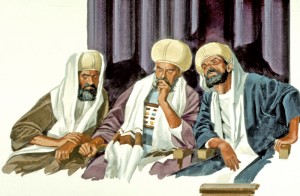
Three Elders ConspiringJesus had healed someone on the sabbath; that’s the simple back ground to the Pharisees and Herodians conspiracy against Jesus. This alliance is an interesting one since in generally the two groups hated one another! But their fear of Jesus apparently was enough to get them to work together against him.
It’s an odd alliance, particularly if looked at from the view point of the Pharisees. Their name is taken from the Hebrew word parash meaning “to separate;” they adhered to a strict piety and disciplined adherence to the Torah. They refused to associate with Gentiles or any “unclean” person or thing. They exhibited all of the characteristics of what, in our modern world politics, has come to be called “tribalism.”

Recently a friend and colleague bemoaned what she called “the tyranny of liberalism” noting that those on the political left were “wasting precious energy and time beating each other up.” I suggested to her that the problem is not with liberalism (nor, indeed, with conservatism). Rather the issue in modern society is the “tribalism” that seems to have taken over all of American social thought and civic behavior (including behavior in the church).

Tribes (like the Pharisees) group around and define membership on the basis of some type of purity – purity of thought, purity of belief, purity of blood, purity of precious bodily fluids, purity of whatever. Stray even a little bit from that purity and, like white blood cells, other members of the tribe will attack. A liberal voicing illiberal opinions, a conservative embracing a liberal point . . . they will be pilloried by their co-tribalists much faster than by the “opposition.”

This kind of tribal thinking has infected both political parties, many churches, the liberal and conservative political camps . . . name some segment of current American society and you can identify its tribal attributes. There are Pharisees of all stripes in our national community today. Both houses of our nation’s legislature have succumbed to a deeply seated “us versus them” mentality of political tribalism that goes beyond even traditional partisanship; nothing is getting done and so long as this persists nothing is likely to get done.

Not a single one of us is immune to tribalism; none of us avoids it entirely. However, we can do something about it. We can become aware of it. We can identify our own biases and question our own motivation. We can confess our own sinfulness in this regard and repent, turning away from it in favor of a more constructive way of working together.

In the second chapter of his catholic epistle, James addresses the issue of favoritism:

If a man comes into your assembly with a gold ring and dressed in fine clothes, and there also comes in a poor man in dirty clothes, and you pay special attention to the one who is wearing the fine clothes, and say, “You sit here in a good place,” and you say to the poor man, “You stand over there, or sit down by my footstool,” have you not made distinctions among yourselves, and become judges with evil motives? (James 2:2-4)

He then condemns this favoritism as sinful: “If you show partiality, you are committing sin and are convicted by the law as transgressors.” (v. 9) It is, he says, a violation of what Christ called the second great commandment: Love your neighbor as yourself. Partisan tribalism, I would suggest, is simply a political form of the favoritism scripture here condemns.

I remember reading once that Christians are called to pledge unwavering allegiance to the Lamb, not to the donkey or the elephant. We are bidden by scripture to pray for our governments and our leaders without regard to their politics or our own. If we will do that, while becoming aware of our own motives and biases, we can eschew tribalism and model a way of doing social business, of being community that will benefit all.

The alliance between the Herodians and the Pharisees, even though it was against Jesus, demonstrates that even those with the most tribal of instincts can compromise and work together. We should foster and encourage such behavior, even if this example might not the best illustration to use.

====================

A request to my readers: I’m trying to build the readership of this blog and I’d very much appreciate your help in doing so. If you find something here that is of value, please share it with others. If you are on Facebook, “like” the posts on your page so others can see them. If you are following me on Twitter, please “retweet” the notices of these meditations. If you have a blog of your own, please include mine in your links (a favor I will gladly reciprocate). Many thanks!

====================

Father Funston is the rector of St. Paul’s Episcopal Church, Medina, Ohio.

Who Is My Neighbor? And Who Is the Good Samaritan? – Sermon for the 8th Sunday after Pentecost (Proper 10C) – July 14, 2013

====================

This sermon was preached on the Eighth Sunday after Pentecost, July 14, 2013, at St. Paul’s Episcopal Church, Medina, Ohio, where Fr. Funston is rector.

(Revised Common Lectionary, Pentecost 8 (Proper 10, Year C): Amos 7:7-17; Psalm 82; Colossians 1:1-14; and Luke 10:25-37. These lessons can be read at The Lectionary Page.)

====================

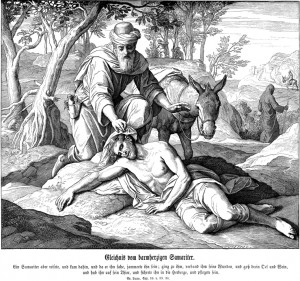
The Good Samaritan, engraving by Julius Schnorr von CarolsfeldThe nation’s legal system is corrupt; justice is for sale to the highest bidder. The guilty go free while the innocent suffer and die. The rich are crushing the poor. The affluent, the 1%-ers, are living a lavish life, with their costly perfumes and cosmetics, and their vacation homes with expensive furnishings, pleasure palaces where they can throw extravagant parties with music in every room. They revel in sexual debauchery of all sorts, but try to enforce a puritanical moral code on the rest of society. The poor are at the mercy of predatory lenders who exploit vulnerable families. The rich have more than enough to eat and to waste, while the poorest in the society go hungry. And government and religious leaders not only allow this to happen, they help it happen.

Just a brief summary of Chapters 1 through 6 of the Prophet Amos.

Some of you probably thought, “There he goes again, spouting his liberal politics from the pulpit.” But I’m not; as I said, it’s simply a paraphrase the Prophet Amos’s critique, of God’s critique, of ancient Israel at the time of King Jeroboam II. We just heard most of chapter 7 beginning at verse 7, in which Amos tells of the third of three prophetic visions. In verses 1 through 6, Amos tells of God showing him locusts devouring all the crops of the land and then another vision of fire destroying everything in the nation. Amos pleads with God not to let that happen. Most scholars interpret those visions as omens of what God might do to the nation, but I think perhaps they might instead be striking visions of prophetic judgment against the wealthy of ancient Israel and the rulers and religious leaders of the time. These are not visions of what God might do; they are visions of what those in power will do if not stopped. And God’s judgment spoken twice to Amos is, “This will not happen!” (vv. 3, 6)

So God shows Amos a vision of a plumb line. Do you know what a plumb line is? There’s a picture of a plumb line on the cover of the bulletin this morning. A plumb line is a string with a metal weight, or “plumb bob,” at one end which, when suspended, points directly towards the earth’s center of gravity so that the string hangs perpendicular to the plane of the earth’s surface; it is used to test the verticality of structures, how true to straight up-and-down they are. It sets the standard for up-rightness. God tells Amos that God is setting a metaphorical plumb line in the midst of God’s People and if they don’t measure up to the standard, “the high places of Isaac shall be made desolate, and the sanctuaries of Israel shall be laid waste, and [God] will rise against the house of Jeroboam with the sword.”

Well, you say, that’s ancient Israel. What’s that got to do with us?

Let me read you a news item from the past week. This is from the July 9, 2013, issue of the Florence, Alabama, Times-Daily:

Police Chief Lyndon McWhorter said Monday morning’s bank robbery [in Moulton, Alabama] was among the most unusual of his law enforcement career.

“I’ve been involved with several over the years, but none like this,” McWhorter said. “It’s one for the books.”

McWhorter said Rickie Lawrence Gardner, 49, of 7667 Alabama 33, Moulton, was arrested Monday morning while sitting on a bench outside the Bank Independent branch on Court Street in Moulton, minutes after he supposedly walked in and robbed the bank.

“When the officers got there, he was just sitting on the bench, waiting on them,” McWhorter said. “The money was locked up inside his truck, which was parked in the handicapped spot in front of the bank.

“He had a handicap sticker on his vehicle so he even parked legal.”

McWhorter said Gardner told authorities he robbed the bank because he had hurt his leg and wasn’t able to take care of himself.

“So, he decided to get arrested to have a place to live and someone to take care of him.”

Minutes before the arrest, McWhorter said, Gardner walked into the bank just off Alabama 157 and handed a teller a written note explaining that he had a gun and she was to give him money.

Authorities said no weapon, other than a pocketknife, was found when Gardner was taken into custody.

“The only thing he said to the teller was when he asked her to give him a bag to put the money in,” McWhorter said.

With the money in hand, McWhorter said Gardner walked out of the bank, laid the money inside his vehicle, locked the door and walked back to the bench. The chief said Gardner sat down on the wooden bench in front of the bank and waited on officers.

“When officers got there, he did not offer any kind of resistance. He was just waiting on them,” McWhorter said. “This is the first bank robbery I’ve ever worked where the robber was waiting outside the bank for the police to turn himself in.” (Times-Daily)

The Associated Press later reported that Gardner “mentioned the weapon in the note — even though he didn’t have one — because he thought it would get him a longer sentence;” he thought he’d get more time, which would mean more shelter, more food. (AP Story)

The reason you may have thought my opening paraphrase of Amos sounded like an indictment of our own society is simple. It does. The word of prophecy spoken by Amos to ancient Israel speaks directly to us.

You know the interesting thing about Amos’s prophecy is that we can’t even be sure it was heard by the rulers of the nation to which it was spoken. We know Amos wrote it down; we know that someone told the story of Amos delivering his prophecy to Amaziah (who was the high priest at Bethel the religious center of the northern kingdom), but we are told that Amaziah never delivered it to Jeroboam II, the reigning king.

Amaziah instead told the king that Amos was part of a conspiracy to kill him, and then Amaziah told Amos to return to his home which was in the southern kingdom. “O seer, go, flee away to the land of Judah,” he says, “earn your bread there, and prophesy there; but never again prophesy at Bethel, for it is the king’s sanctuary, and it is a temple of the kingdom.” And this is where Amos speaks one of my favorite lines in Scripture, “I am no prophet, nor a prophet’s son; but I am a herdsman, and a dresser of sycamore trees.”

Amos’s answer was to indicate that he was not a prophet by profession; he was not a member of one of the official “prophecy schools.” Indeed, as part of the official religious establishment, Amos thought those full-time prophets were as much a part of the problem as the priests, the king, and the wealthy! Amaziah proved that he was part of the problem by failing to communicate Amos’s prophecy to King Jeroboam, so our reading today ends with Amos’s personal prophecy against him: “Your wife shall become a . . . and your sons and your daughters shall fall by the sword . . . and you shall die in an unclean land.” A pretty pointed prophecy, if ever there was one!

But we, who hear in Amos’s condemnation of ancient Israel at least a bit of a word of warning to our own society, what are we to make of this prophecy of the plumb line? The standard for the People of God in Israel was the ancient law of Moses, the religious, ethical, and social rules we find in Genesis, Exodus, Leviticus, and Numbers (Deuteronomy was unknown at the time of Amos). What is it for us? How are we (as Paul wrote to the Colossians) to be “be filled with the knowledge of God’s will in all spiritual wisdom and understanding?” How are we to “lead lives worthy of the Lord, fully pleasing to him?” How are we to bear fruit in every good work and . . . grow in the knowledge of God?”

Well, that standard is easily stated. A young lawyer does so in today’s Gospel: “You shall love the Lord your God with all your heart, and with all your soul, and with all your strength, and with all your mind; and your neighbor as yourself.” It’s easily stated; it’s not so easily understood.

The young lawyer says as much when he asks his follow up question, “Who is my neighbor?” He wants to know what we want to know: are there limits? Is it sufficient to love only the people of my community — for him, Israel; for most of us, white descendants of Northern European immigrants? Does it include Mr. Gardner, the bank robber in Moulton, Alabama? Might it also include other undesirables, Samaritans and Gentiles, the Irish, descendants of African slaves, recently immigrated Asians, Hispanics? Does it include women, people with disabilities, lepers, and others frequently excluded from society? Do we get to define who is our neighbor, or does Someone else?

Ultimately, the answer to our question is the answer to another question: “Who does God love?” Jesus answers the question by telling a parable, the oh-so-familiar story of the “Good Samaritan.” In analyzing this story, Lutheran theologian Brian Stoffregen asks an important question: “Why does Jesus make the hero of this story a Samaritan?” In answering this question he writes:

The idea of being a “Good Samaritan” is so common in our culture, that most people today don’t realize that “Good Samaritan” would have been an oxymoron to a first century Jew. Briefly stated, a Samaritan is someone from Samaria. During an ancient Israeli war, most of the Jews living up north in Samaria were killed or taken into exile. However, a few Jews, who were so unimportant that nobody wanted them, were left in Samaria. Since that time, these Jews had intermarried with other races. They were considered half-breeds by the “true” Jews. They had perverted the race. They had also perverted the religion. They looked to Mt. Gerizim as the place to worship God, not Jerusalem. They interpreted the Torah differently than the southern Jews. The animosity between the Jews and Samaritans were so great that some Jews would go miles out of their way to avoid walking on Samaritan territory. Previously in Luke, the Samaritans had refused to welcome Jesus — the “bad” Samaritans. I’m certain that in the minds of many Jews, the only “good” Samaritan was a dead Samaritan. Note that the lawyer never says “Samaritan.” He can’t call him a “good Samaritan” (a phrase that doesn’t occur in the text). Anyway, we are still left with the question, “Why a Samaritan?”

If Jesus were just trying to communicate that we should do acts of mercy to the needy, he could have talked about the first man and the second man who passed by and the third one who stopped and cared for the half-dead man in the ditch. Knowing that they were a priest, Levite, and Samaritan is not necessary.

If Jesus were also making a gibe against clerics, we would expect the third man to be a layman — an ordinary Jew — in contrast to the professional clergy. It is likely that Jewish hearers would have anticipated the hero to be an ordinary Jew.

If Jesus were illustrating the need to love our enemies, then the man in the ditch would have been a Samaritan who is cared for by a loving Israelite.

One answer to the question: “Why a Samaritan?” is that we Christians might be able to learn about showing mercy from people who don’t profess Christ. I know that I saw much more love expressed towards each by the clients at an inpatient alcoholic/drug rehab hospital than I usually find in churches. Can we learn about “acting Christianly” from AA or the Hell’s Angels? (CrossMarks)

But Stoffregen proposes an alternative response: “Another answer to the question: ‘Why a Samaritan?’ is that we are not to identify with the Samaritan. A Jew would find that so distasteful that he couldn’t identify with that person. He wouldn’t want to be like the Priest or Levite in the story, so that leaves the hearer with identifying with the man in the ditch.” And that raises the further question, “Then who is the Samaritan?” to which there can only be one answer, “The Samaritan is God.”

If the Samaritan represents God, that means that God loves the penniless, the stripped naked, the beaten down, the ones left half dead, the ones passed-by by the leaders of society, by the rulers, by the punctiliously correct, and (I’m sorry to say) by the religious. It makes us realize that God is no respecter of position or wealth, God does not care about social class or religion. The man in the ditch had been stripped of everything that might have indicated his social standing, his religious faith, even his nationality; he was simply a person in need. That is who God loves, and that means that God loves everyone. In the human community, every person is potentially a person in need; truth be told, every person is a person in need.

Who is my neighbor? Who does God love? Everyone. No exceptions. No exclusions. That is the standard, the rule, the plumb line by which God judges society. This again and again is what the prophets of old told us; it is what Jesus told us; it is what our own modern prophets have said over and over. For example:

In the 18th Century, Dr. Samuel Johnson’s biographer James Boswell quoted him as saying, “A decent provision for the poor is the true test of civilization.” (Boswell, Life of Johnson)

In her book My Several Worlds (1954), Pearl S. Buck, wrote: “The test of a civilization is the way that it cares for its helpless members.”

In his last political speech, Sen. Hubert Humphrey said, “The moral test of government is how that government treats those who are in the dawn of life, the children; those who are in the twilight of life, the elderly; those who are in the shadows of life; the sick, the needy and the handicapped.”

And Mahatma Gandhi said, “A nation’s greatness is measured by how it treats its weakest members.”

Who is my neighbor? Who does God love? Everyone. No exceptions. No exclusions.

Every person is potentially a person in need, and every person is potentially a caregiver, a supplier of that which is needed. When we conclude our worship this morning, several young people and a few adults accompanying them will depart for Franklin, Pennsylvania, to be suppliers of that which is needed. At this point, they don’t know whose needs they are going to be supplying; they don’t know what those needs will be. All they know is that there are people in need and they are going to care for them, because they are our neighbors.

So at this point, let’s get on with the business of commissioning them for the ministry on which they are about the embark.

====================

A request to my readers: I’m trying to build the readership of this blog and I’d very much appreciate your help in doing so. If you find something here that is of value, please share it with others. If you are on Facebook, “like” the posts on your page so others can see them. If you are following me on Twitter, please “retweet” the notices of these meditations. If you have a blog of your own, please include mine in your links (a favor I will gladly reciprocate). Many thanks!

====================

Father Funston is the rector of St. Paul’s Episcopal Church, Medina, Ohio.

Honor Upon the Lawgiver – From the Daily Office – July 4, 2013

From the Book of Sirach:

A wise magistrate educates his people,
and the rule of an intelligent person is well ordered.
As the people’s judge is, so are his officials;
as the ruler of the city is, so are all its inhabitants.
An undisciplined king ruins his people,
but a city becomes fit to live in through the understanding of its rulers.
The government of the earth is in the hand of the Lord,
and over it he will raise up the right leader for the time.
Human success is in the hand of the Lord,
and it is he who confers honor upon the lawgiver.

(From the Daily Office Lectionary – Sirach 10:1-5 (NRSV) – July 4, 2013.)

American FlagIndependence Day is one of the few secular holidays to have lessons of its own in both the Eucharistic and Daily Office Lectionaries of the Episcopal Church. There is a set of lessons in the regular Daily Office schedule of readings for today, as well, and I am intrigued that the way the calendar falls this year the Gospel for that set is the unjust trial of Jesus. One could meditate for hours on the meaning to be drawn from that juxtaposition.

However, the reading from the apocryphal book The Wisdom of Jesus, Son of Sirach (a book also called “Ecclesiasticus”) has caught my attention because of a recent (and unfortunately repeated) incident at my church. The lines of particular import are: “As the ruler of the city is, so are all its inhabitants;” and “It is [God] who confers honor upon the lawgiver.”

In every form of the Prayers of the People in the American Book of Common Prayer (1979) there is a petition included for our civil leaders. According to the rubric in the service of Holy Communion (page 359 of the BCP), we are bidden to pray for “the Nation and all in authority.” At my church, we do so by name, listing our president, state governor, and city mayor, and conclude with a general petition for other elected legislators, judges, and executive department officials.

At my church, as well, we share leadership of the prayers. A single person reads the major biddings of the various forms, but additional petitions are read by members of the congregation. As worshipers arrive, our ushers and greeters ask if they would like to read a sentence or two of additional intercessions. Most readily agree.

However, from time to time someone will decline to do so and occasionally someone will specifically (and sometimes venomously) refuse to read the petition naming the president. This has only happened since the election of the current incumbent. My heart sinks when I hear these refusals or when I am told about them later. It’s an indication of how poorly I have taught the Christian ethos to this congregation.

“As the ruler of the city is, so are all its inhabitants.” If Jesus ben Sirach is correct, then we should very definitely be praying for our rulers and leaders, for they set the example and the tone for the entire populace. And yet people decline to do so . . . .

My parish is dedicated to St. Paul, the writer of most of the New Testament, and Paul was very clear on the duty Christian folk have with respect to secular authorities and civic leaders. He wrote to the young bishop, Titus of Crete, instructing him to teach his congregation to respect civil rulers:

Remind them to be subject to rulers and authorities, to be obedient, to be ready for every good work, to speak evil of no one, to avoid quarreling, to be gentle, and to show every courtesy to everyone. For we ourselves were once foolish, disobedient, led astray, slaves to various passions and pleasures, passing our days in malice and envy, despicable, hating one another. But when the goodness and loving kindness of God our Savior appeared, he saved us, not because of any works of righteousness that we had done, but according to his mercy, through the water of rebirth and renewal by the Holy Spirit. (Titus 3:1-5)

He wrote to the Romans in a similar vein:

Let every person be subject to the governing authorities; for there is no authority except from God, and those authorities that exist have been instituted by God. Therefore whoever resists authority resists what God has appointed, and those who resist will incur judgment. For rulers are not a terror to good conduct, but to bad. Do you wish to have no fear of the authority? Then do what is good, and you will receive its approval; for it is God’s servant for your good. But if you do what is wrong, you should be afraid, for the authority does not bear the sword in vain! It is the servant of God to execute wrath on the wrongdoer. Therefore one must be subject, not only because of wrath but also because of conscience. For the same reason you also pay taxes, for the authorities are God’s servants, busy with this very thing. (Romans 13:1-6)

And with regard to praying for our secular leadership, he was very clear in his instructions to another young bishop, Timothy of Ephesus:

First of all, then, I urge that supplications, prayers, intercessions, and thanksgivings be made for everyone, for kings and all who are in high positions, so that we may lead a quiet and peaceable life in all godliness and dignity. This is right and is acceptable in the sight of God our Savior, who desires everyone to be saved and to come to the knowledge of the truth. (1 Timothy 2:1-4)

I quite understand disliking secular authorities; I don’t understand disliking one so much that we refuse to follow the clear mandate of Holy Scripture and the tradition of our church! Anyone who has ever had even the shortest political conversation with me knows that, in my opinion, George W. Bush was the worst president in U.S. history. Nonetheless, every day of his eight years in office I prayed for him by name, twice a day. (I even pray for the vice-president by name and during those years that was an even more difficult thing to do!) I prayed for Bill Clinton even though his sexual pecadillo with Monica Lewinsky was more than a little off-putting. I pray for Barack Obama even though I am very disappointed with many aspects of his performance as president.

The point is that my prayers have nothing to do with my personal dislike or approval of any of these politicians. My prayers have nothing to do with them at all! My prayers have everything to do with me and my discipline as a follower of Jesus Christ. I am pretty sure that Jesus had some personal problem with the political authorities of his day, with Caiaphas the High Priest, with Herod the Tetrarch, with Pilate the Roman governor, and yet he prayed for them: “Father, forgive them; for they do not know what they are doing.” (Luke 23:34) As a disciple of Christ, I can do no less than to pray for the civil authorities in power over me!

“As the ruler of the city is, so are all its inhabitants.” If Jesus ben Sirach is correct, and I think he is, our prayer for our leaders is a prayer for ourselves. Any prayer is, in truth, a prayer for ourselves. We do not pray to bring to God’s attention something God has overlooked, nor do we pray to change God’s mind about something, to get God to do what we want. We pray to conform our wills to God’s Will; we pray that we might have what Paul called “the mind of Christ.” (1 Cor. 2:16) We pray that we might be like him who, on the cross, prayed for the civil authorities who hung him there.

On this day especially, let us pray for the Nation and all in authority; let us pray for them by name! For “human success is in the hand of the Lord, and it is he who confers honor upon the lawgiver.”

====================

A request to my readers: I’m trying to build the readership of this blog and I’d very much appreciate your help in doing so. If you find something here that is of value, please share it with others. If you are on Facebook, “like” the posts on your page so others can see them. If you are following me on Twitter, please “retweet” the notices of these meditations. If you have a blog of your own, please include mine in your links (a favor I will gladly reciprocate). Many thanks!

====================

Father Funston is the rector of St. Paul’s Episcopal Church, Medina, Ohio.

Leopards Changing Spots – From the Daily Office – July 1, 2013

From the Book of Acts:

They dragged [Stephen] out of the city and began to stone him; and the witnesses laid their coats at the feet of a young man named Saul.

(From the Daily Office Lectionary – Acts 7:58 (NRSV) – July 1, 2013.)

LeopardThis is the first appearance in the Christian story of the man who will become the early church’s greatest evangelist and the author of most of the New Testament. We are told that as he witnessed the martyrdom of the first deacon, “Saul approved of their killing him.” (Acts 8:1)
Saul would take the Gentile form of his name, Paul, when baptized and under that name would spread the Christian faith among non-Jews. One assumes that, from time to time, he might have told the story of witnessing Stephen being killed – it would make a powerful sermon illustration, don’t you think? He obviously told it to someone because eventually it got to Luke, who included it in his little history of the church.

This story of a public execution brought to mind a conversation I had with a parishioner just a few days ago. Texas recently executed its 500th death-penalty convict since resuming executions in 1980s; that news led us into a discussion of the death penalty. I am opposed to the death penalty on several grounds; my parishioner favors it. In the course of our conversation he put forth the argument that execution rids society of criminals who will kill again. He’s convinced that killers don’t change: “The leopard never changes his spots,” he said.

He certainly has the Bible (or at least the the Old Testament on his side. This old shibboleth comes from word of God spoken through the prophet Jeremiah! Lamenting the sinfulness of God’s People, the Lord asks: “Can Ethiopians change their skin or leopards their spots?”(Jer. 13:23, NRSV). Of course, the message of the prophet would suggest that the answer to that question is “Yes” else why call the people to repentance? And therein lies the theological and ethical issue I have with the death penalty. (I have legal, economic, and practical issues with it, as well.)

The death penalty denies the power of God in Christ to redeem, restore, and transform human existence. It precludes any possibility of repentance and amendment of life. When the capital punishment is imposed, the life of the convicted person is devalued and all possibility of change is ended. When the government undertakes capital punishment on behalf of the people (on my behalf), the people are implicated in that judgment and we are made to share in an ethic we may not accept (one which I do not accept). An ethic which says, as my congregant put it, that “leopards cannot change their spots.”

But that is not the Christian ethic (nor is it the ethic of the Old Testament in which that image is first spoken). The Christian ethic says that repentance is always possible. It is, in a very real sense, the whole message of Christ: “Repent, for the kingdom of heaven has come near.” (Matthew 3:2) The leopard can change its spots and the Christian hope is always that it will.

After all, Saul – who held the cloaks of the executioners and approved their killing of Stephen – changed his!

====================

A request to my readers: I’m trying to build the readership of this blog and I’d very much appreciate your help in doing so. If you find something here that is of value, please share it with others. If you are on Facebook, “like” the posts on your page so others can see them. If you are following me on Twitter, please “retweet” the notices of these meditations. If you have a blog of your own, please include mine in your links (a favor I will gladly reciprocate). Many thanks!

====================

Father Funston is the rector of St. Paul’s Episcopal Church, Medina, Ohio.

Bullshit, You F—–g Fundamentalist! – From the Daily Office – June 7, 2013

From the Psalter:

Sacrifice and offering you do not desire, but you have given me an open ear.

(From the Daily Office Lectionary – Psalm 40:6 (NRSV) – June 7, 2013.)

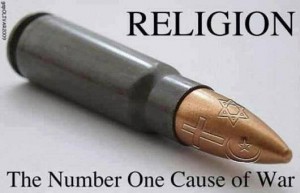
Religion BulletIn the Psalter in the Episcopal Church Book of Common Prayer this verse (numbered “7” there) is rendered: “In sacrifice and offering you take no pleasure (you have given me ears to hear you).” I rather prefer the NRSV’s translation because the “open ear” can hear more than God, and that open-eared hearing of others is much on my mind this morning.

Earlier this morning I was surfing around on Facebook when up popped a “meme” — one of those pictures over which a caption of some sort has been superimposed — from one of the liberal political pages I “follow.” (Yes, I follow liberal political pages. I also follow conservative political pages. And I follow pages with cute pictures of kittens and puppies. You can find just about everything on Facebook.)

The meme features a cartridge. I’m no expert, but I believe it to be a Russian 7.62x39mm round, or possible a 308 Win cartridge. In any event, on the bullet are inscribed three religious symbols: Judaism’s Star of David, a Christian Latin cross, and the Star-and-Crescent of Islam. The superimposed caption reads: “Religion. The Number One Cause of War.”

I commented that the meme reflected an historically invalid assertion and that there are many mixed causes of war, some of which (e.g., economics, nationalist politics, famine or natural disaster) may be more causative than religious belief. The first response to my comment was, “Bullshit!” Some other less scatological responses told me I was wrong. What followed was a fairly reasonable discussion with some commenters agreeing with me and arguing my point further, and others disagreeing but arguing their position rationally. The discussion came to an abrupt end when a dissenter called me a “f—–g fundamentalist.”

Although there was that brief rational discussion between the first response and the last one, it is those two replies — together with the nature of the meme itself — that frame my thoughts about the Psalm verse. In addition, my meditation this morning is informed by the gospel lesson from Luke:

Jesus told this parable to some who trusted in themselves that they were righteous and regarded others with contempt: “Two men went up to the temple to pray, one a Pharisee and the other a tax collector. The Pharisee, standing by himself, was praying thus, ‘God, I thank you that I am not like other people: thieves, rogues, adulterers, or even like this tax collector. I fast twice a week; I give a tenth of all my income.’ But the tax collector, standing far off, would not even look up to heaven, but was beating his breast and saying, ‘God, be merciful to me, a sinner!’ I tell you, this man went down to his home justified rather than the other; for all who exalt themselves will be humbled, but all who humble themselves will be exalted.” (Luke 18:9-14)

It seems to me that too much of our civic discourse is not civil discourse. Too often conversations, particularly political or religious discussions, are framed in obstinate, polarizing absolutes. These absolutes plug the ears of the participants, to use the Psalm’s image. The Pharisee in the parable represents this closed-minded, plugged-ear way of thinking: he is so certain and self-assured as to brook no contradiction. “Thank God I am not like other people. In everything I do and think, I am right; nothing anyone can ever say will change my opinion or belief.” The ears of the Pharisee are not open; he is impervious to inputs from outside his own mind. He inhabits a world of absolutes in which he is the paragon of virtue and rectitude. This is not someone one can talk to.

The tax-collector, on the other hand, represents a different approach. “I am a sinner. Something in my life and in the world which I inhabit is not right, and I cannot make it so. I need the help of someone or something other than myself.” The tax-collector is not self-assured; his ears are open and listening for the inputs of others, especially from God but also from others in the society around him. He is willing to admit (and does admit) his own fallibility. Not only might he be wrong, he is willing to accept already that he is. This is someone with whom one can converse.

The discussion of the meme on Facebook, insofar is it involved me and two others (and, to a lesser extent, the other participants, as well), can be cast as a conversation between the two characters of this parable:

Pharisee – “Religion is the cause of war.”
Tax-collector – “I think there may be other causes.”
Pharisee – “Bullshit, you f—–g fundamentalist.”

End of discussion.

I can’t really debate the assertion that religion is a cause of war. (It is, but not its principal source.) However, I believe that a “glittering generality,” an absolutist assertion like the meme — an unconditional statement that is not susceptible of historical validation — is not helpful to a reasoned discussion of war’s causes and, more importantly, its solution.

How have we arrived at this highly polarized state of civic discourse? I don’t know and that’s really not the issue either. The issue is how can we back away from it? How can we unplug the “open ear” that God has given us? How can the church, which once fostered and encouraged open debate of issues (that’s how the Reformation got started, for example) promote civil debate?

Many congregations across several denominations sponsor forums and workshops on the issues of the day. This is a step in the right direction but, more often than not, the participant audiences at these debates are merely our own people. My question (and I have no answers to it) is how to begin to dialog with the Pharisees of the day: what does one say in response to “Bullshit, you f—–g fundamentalist” that will allow the conversation to continue?

Jesus once told Peter to forgive someone “seventy times seven times” (Matt. 18:22). I struggle with finding one productive response to “Bullshit, you f—–g fundamentalist”! Coming up with 490 of them is going to be really, really difficult!

====================

A request to my readers: I’m trying to build the readership of this blog and I’d very much appreciate your help in doing so. If you find something here that is of value, please share it with others. If you are on Facebook, “like” the posts on your page so others can see them. If you are following me on Twitter, please “retweet” the notices of these meditations. If you have a blog of your own, please include mine in your links (a favor I will gladly reciprocate). Many thanks!

====================

Father Funston is the rector of St. Paul’s Episcopal Church, Medina, Ohio.

Entering the Kingdom by Force? – From the Daily Office – May 31, 2013

From the Gospel according to Luke:

[Jesus said,] “The law and the prophets were in effect until John came; since then the good news of the kingdom of God is proclaimed, and everyone tries to enter it by force.”

(From the Daily Office Lectionary – Luke 16:16 (NRSV) – May 31, 2013.)

Medieval Battering RamThe 16th chapter of Luke’s Gospel keeps pulling me up short with these weird little “What did Jesus mean by that” moments. There’s that “dishonest wealth” comment and now this one about entering the kingdom of God by force . . . .

There are alternative translations, but they aren’t much help in making sense of this. The Douay-Rheims translation, for example, is “The law and the prophets were until John. From that time the kingdom of God is preached: and every one useth violence towards it.” The notes to the New Revised Standard translation (quoted above) suggest this alternative which is truly different, “The law and the prophets were in effect until John came; since then the good news of the kingdom of God is proclaimed, and everyone is strongly urged to enter it.” That does make more sense, but it’s not a generally accepted rendering of the Greek, so we really do have to read this as “everyone tries to enter it by force.” What can we make of that?

Not quite a generation and a half or so ago (a “generation” is something like 30 years they tell me) I was a college drop-out working as an orderly in a small Southern California hospital. Nearby was one of the earliest start-up nondenominational conservative evangelical churches that eventually became a mega-church and is now the mother church of what might be called a “denomination.” A young member of that church was injured very seriously in an automobile accident and was brought to the hospital where I worked. Brain damaged and nearly dead he was put on life support. He was in our facility about three weeks before being transferred to a long-term care facility. During those 21 or so days, there was never a time during which members of the congregation were not present with him. 24 hours a day for three weeks at least a half-dozen church members were in his room praying. They told us they were “storming the gates of heaven” with intense, incessant prayer. (I have no idea if their intercession was effective. In general, I believe in the efficacy of intercessory prayer, but that is not to say that I expect God to work miracles in cases such as that boy’s horrendous injuries. I know that his condition had not changed when he was transported from that hospital to a long-term care facility, and I heard through the grapevine several months later that he was still there, so my suspicion is that his condition never improved.)

When I read of entering the kingdom of God “by force” I think of those folks “storming the gates of Heaven.” And I truly wonder, negatively, if that’s what Jesus ever had in mind in this or any other of his parables, proverbs, actions, or commandments — the two parables about incessant prayer come immediately to mind (the neighbor who gets out of bed to answer the door and the unjust judge who finally responds to the widow’s complaint) but even with those, I don’t believe Jesus ever meant that that is the proper attitude of intercessory prayer. Storming the gates of Heaven just seems some how wrong, as does entering the kingdom of God by force. I have this mental image of folks breaking down the Pearly Gates with a medieval battering ram — just not a great picture of prayer in my opinion.

Nonetheless, it seems to me that this is a prevailing attitude in some religious and political circles, and that it takes the form of “say something loud enough and often enough in enough venues and you’ll get your way” whether one is petitioning the Almighty or stating a partisan position.

Today is the Feast of the Visitation of the Blessed Virgin Mary, celebration on the church calendar since the mid-13th Century when the Franciscans began observing it. It commemorates the visit Mary made to her cousin Elizabeth, mother of John the Baptist, and if it celebrates anything, it celebrates their joy in being pregnant. As is my custom on feast days, I read various devotional texts dealing with the feast this morning, including some on the internet. After reading one of those, I skimmed the comments of other readers. I found in one the assertion that this ancient feast of the church is “the most important church holiday for pro-life forces.”

Now on this issue of abortion and its regulation, I am (I guess) in the politically liberal camp. I believe that abortion should be legal, regulated, and safe. I am also in the theologically conservative camp. If asked as a priest for my guidance and counsel on whether a woman should get an abortion, my advice is nearly always going to be “No.” But in the end it is not my decision. It is the woman’s and her physician’s and no one else’s. Years ago an older colleague and I took part in a discussion panel presentation about legal abortion. In answer to some participant’s question, he said words I’ve never forgotten: “I would rather counsel a woman who’s had a safe, legal abortion than bury one who’s had an illegal abortion. And I’ve done both.” Because of our current laws, I’ve not had to do the latter and I hope I never do!)

That said, I must admit that I am just tired of the way the so-called “pro life” advocates turn every (and I do mean every conversation into an abortion debate. They truly are “storming the gates” on this issue. Frankly, it is tedious and irritating; it does not further their cause; it is counterproductive. Like them, I would like to see the number of abortions reduced, but their way is not going to do that. Good sex education in the public schools, readily available contraception, parenthood training, and better moral education in churches and homes . . . those stand a much better chance than this constantly entering into the issue by force!

And their point is especially misplaced on this holy feast day! One of the most important theological aspects of Mary’s pregnancy, which this feast celebrates, is her choice! Nothing could have happened if she had not said, “Be it to me according to your word.” Her conception and pregnancy were not forced upon her; she chose them. One of my favorite paintings of the Annunciation is this one by Sando Botticelli in which Gabriel seems almost fearful that Mary will say “No” and Mary seems almost on the verge of doing so! If the feasts of the Blessed Virgin are about anything, they are about choice! This is not a “pro-life” holiday! And no amount of polemic, or prayer, will make it so. It really isn’t necessary to push the anti-abortion agenda, or any political or religious point of view, at every opportunity in every venue.

Annunciation of the Blessed Virgin Mary by Sandro Botticelli

So what are we to make of Jesus’ statement that “everyone tries to enter the kingdom of God by force?” I think it is a condemnation of the sort of prayer and the sort of politics that storms the gates of Heaven (or of public opinion) with incessant, tiresome, counterproductive petition or polemic. After uttering these words, he reminded his listeners that “it is easier for heaven and earth to pass away, than for one stroke of a letter in the law to be dropped.” Elsewhere he had summarized the law: “You shall love the Lord your God with all your heart, and with all your soul, and with all your strength, and with all your mind; and your neighbor as yourself.”

The law of love trumps force any day. Loving will accomplish more than storming!

====================

A request to my readers: I’m trying to build the readership of this blog and I’d very much appreciate your help in doing so. If you find something here that is of value, please share it with others. If you are on Facebook, “like” the posts on your page so others can see them. If you are following me on Twitter, please “retweet” the notices of these meditations. If you have a blog of your own, please include mine in your links (a favor I will gladly reciprocate). Many thanks!

====================

Father Funston is the rector of St. Paul’s Episcopal Church, Medina, Ohio.

Mystery and Community: Trinity Sunday and Memorial Day – Sermon for May 26, 2013

====================

This sermon was preached on the Feast of the Holy Trinity, May 26, 2013, at St. Paul’s Episcopal Church, Medina, Ohio, where Fr. Funston is rector.

(Revised Common Lectionary, Trinity (Year C): Proverbs 8:1-4,22-31; Canticle 13 (Song of the Three Young Men, 29-34); Romans 5:1-5; and John 16:12-15. These lessons can be read at The Lectionary Page.)

====================

Andrei Rublev Icon of the Holy TrinityI’d like you to take out a pen (there are some in the pew racks if you don’t have one of your own) and on a blank piece of paper, or an empty spot on your service bulletin, I’d like you write down these numbers:

1,016,823
116,516
405,399
36,516
58,209
2,031
4,487
22
3

They are, respectively:

1,016,823 – the estimated number of war dead from the American civil war (the figures, especially for Confederate dead, are notoriously untrustworthy)
116,516 – the number of Americans who died in World War I
405,399 – the number of Americans who died in World War II
36,516 – the number of Americans who died in the Korean conflict
58,209 – the number of Americans who died in Vietnam
2,031 – the number of Americans who so far have died in Afghanistan during our so-called “war on terror”
4,487 – the number of Americans who so far have died in Iraq during our so-called “war on terror”
22 – the average number of U.S. Armed Forces veterans and active duty personnel who commit suicide every day because of combat-related PTSD
3 – the number of Persons in the One, Holy, Blessed, and Glorious Trinity

Today, our church asks us to focus our attention on the last of these numbers. Tomorrow, our country asks us to remember all the others. It is merely fortuitous that the calendar, this year, conflates the Feast of the Blessed Trinity with Memorial Day weekend, but it seems to me that the two speak to us with a united voice drawing our attention to common themes.

Memorial Day has its origins in a proclamation by General John A. Logan, commander-in-chief of the Grand Army of the Republic, the organization for Union Civil War veterans. On May 5, 1868, he called for an annual, national “Decoration Day.” It was observed for the first time that year on May 30; the date was chosen because it was not the anniversary of any particular battle and because it was the optimal date for flowers to be in bloom in most areas of the country. It was observed, that first year, in 27 states. A similar day of remembrance was held in the states of the former Confederacy on June 3, which was the birthday of Jefferson Davis, first and only President of the Confederate States of America. Beginning in the 1880s the name “Memorial Day” began to be used for these commemorations and it gradually became the more common term. For the first hundred years, these holidays were matters of state law, although in 1950 Congress issued a joint resolution requesting the President to issue a proclamation calling for a national observance on May 30 and every year since the presidents have done so. In 1967, by act of Congress, “Memorial Day” was declared the official name and May 30 the official date under Federal law. The following year, Congress passed the Uniform Monday Holiday Act, which moved Memorial Day, together with Washington’s birthday, Labor Day, Columbus Day, and Veterans Day, from their traditional dates to specified Mondays in order to create convenient three-day weekends.

The Veterans of Foreign Wars, by the way, opposed that change and has publicly stated its position that, “Changing the date merely to create three-day weekends has undermined the very meaning of the day.” Throughout his career in the Senate, the late Senator from Hawaii Daniel Inouye, a World War II veteran, annually introduced a measure to return Memorial Day to its traditional date of May 30. Obviously, his efforts proved unsuccessful.

The Solemnity, or Principal Feast, of the Most Holy Trinity has a somewhat longer history. The Sacramentary of St. Gregory the Great (who was pope from 590 to 604) contained prayers and a Preface for a celebration of the Trinity, but specified no date. Documents from the pontificate of Gregory VII (pope from 1073 to 1085) indicate that by that time an Office of the Holy Trinity was recited on the Sunday after Pentecost in some places, but it was not a universal practice. In 1162, Thomas á Becket (1118–70) was consecrated Archbishop of Canterbury on the Sunday after Pentecost, and his first act was to proclaim that the day of his consecration should be commemorated as a new festival in honor of the Holy Trinity. This observance spread from England throughout the western Catholic world until Pope John XXII in 1334, the last year of his 18-year papacy, ordered the feast observed by the entire Church on the first Sunday after Pentecost.

I want to suggest to you today that these two observances, one secular and one religious, share two common themes, and that this year’s fortuitous coincidence of Trinity Sunday and Memorial Day weekend allows us to explore them. Those themes are community and mystery.

There is a humorous video on YouTube made by a group calling themselves Lutheran Satire in which two Irishman engage St. Patrick in a dialog about analogies for the Holy Trinity. Although at first pronouncing themselves simple and unsophisticated, the two proceed to demonstrate considerable theological acumen as they condemn Patrick as a heretic each time he tries an analogy. The famous water-ice-steam analogy, they condemn as Modalism; the analogy of the sun, with its light and heat, they denounce as Arianism; when Patrick tries to liken the Trinity to a shamrock, they stop him and criticize him for preaching Partialism. Finally, Patrick gives up and asserts:

The Trinity is a mystery which cannot be comprehended by human reason, but is understood only through faith and is best confessed in the words of the Athanasian Creed which states that we worship one God in Trinity, and Trinity in Unity, neither confusing the Persons nor dividing the Substance, that we are compelled by the Christian truth to confess that each distinct Person is God and Lord, and that the deity of the Father, the Son and the Holy Spirit is One, equal in glory, co-equal in majesty.

The two Irishman, after a moment of stunned silence, respond, “Well, why didn’t you just say that?”

So there you have it: the Trinity is a mystery and every analogy by which we try to explain how God can be one-in-three fails, every attempt to comprehend the unity in which the Father, the Son, and the Holy Spirit together are one God ends up in heresy, and every sermon about the Doctrine of the Trinity either confuses the heck out of us or bores us to tears.

Therefore, rather than try to explain or comprehend the mystery that is the Trinity, let’s focus instead on the community that is the Trinity: the paradigm and model of all human community. The early Church Fathers explored in their writings how many aspects of our humanity reveal the divine image: our ability to perceive God’s presence; our apparently innate knowledge of the spiritual realm; our intellect; our ability to freely choose; and our capacity to live lives of goodness and love. These characteristics, they taught, belong to every human being and reveal much about God.

In the twentieth-century theologians have explored the concept of human personhood. To be made in the image of God is not to be made in the image of the Father only; it is to be made in the image of the Holy Trinity, to be made in the image of the Father, and of the Son, and of the Holy Spirit. Human beings are persons intended to be, like the Persons of the Blessed Trinity, in relationship with other persons. This means that participation in community is at the heart of our humanity; our relatedness to other persons is at the very core of who we are. The three Divine Persons are forever united with each other in mutual love. They dwell within one another; they collaborate and share in all their activities; they always act in harmonious accord. This is the model for the ideal human community, the paradigm of corporate human existence.

Human beings are supposed to work together in harmony in ways that preserve and respect the equality and dignity of every person. The English Orthodox bishop and theologian Kallistos Ware put it this way in an article in the journal of the Fellowship of St Alban & St Sergius:

Each social grouping — family, parish, diocese, church council, school, office, factory, nation — has as its vocation to be transformed by grace into a living icon of [the Holy Trinity], to effect a reconciling harmony between diversity and unity, human freedom and mutual solidarity, after the pattern of the Trinity. (The Human Person as an Icon of the Trinity, Sobornost 8, 17-18)

He also wrote in a later essay:

Belief in a God who is three-in-one, whose characteristics are sharing and solidarity, has direct and practical consequences for our Christian attitude toward politics, economics, and social action, and it is our task to work out these consequences in full detail. Each form of community — the family, the school, the workplace, the local eucharistic center, the monastery, the city, the nation — has as its vocation to become, each according to its own modality, a living icon of the Holy Trinity. (The Trinity: Heart of Our Life, in Reclaiming the Great Tradition: Evangelicals, Catholics and Orthodox in Dialogue, James S. Cutsinger, ed., InterVarsity:1997, 142)

On Friday, as has been customary in this country since 1950, the president issued a proclamation designating Memorial Day tomorrow as “a day of prayer for permanent peace.” In his proclamation, President Obama said:

On Memorial Day, we remember those we have lost not only for what they fought for, but who they were: proud Americans, often far too young, guided by deep and abiding love for their families, for each other, and for this country. Our debt to them is one we can never fully repay. But we can honor their sacrifice and strive to be a Nation equal to their example. On this and every day, we must meet our obligations to families of the fallen; we must uphold our sacred trust with our veterans, our service members, and their loved ones.

Above all, we can honor those we have lost by living up to the ideals they died defending. It is our charge to preserve liberty, to advance justice, and to sow the seeds of peace. With courage and devotion worthy of the heroes we remember today, let us rededicate ourselves to those unending tasks, and prove once more that America’s best days are still ahead. Let us pray the souls of those who died in war rest in eternal peace, and let us keep them and their families close in our hearts, now and forever. (Presidential Proclamation, May 24, 2013)

In other words, Memorial Day, like Trinity Sunday, is a day whose theme is community, the nation as community, the military services as community, the family as community. Bishop Ware’s description of Trinitarian community as embracing “diversity and unity, human freedom and mutual solidarity” could as easily have been used by the president to describe the community which celebrates Memorial Day; President Obama’s words of courage and devotion, sacrifice and trust, justice and eternal peace could as easily have been used to describe the community which is an icon of the Trinity.

There is also a mystery about Memorial Day, and the mystery is this: Why must young men and now young women go to war and die? One of my favorite Celtic folk songs reflects on this mystery. It was written in 1976 by the Scottish folksinger Eric Bogle and originally entitled No Man’s Land, but it is more commonly called The Green Fields of France or Willie McBride. It is the musing of a man stopping by a grave in a World War I cemetery and wondering about the man buried there. These are the last two verses:

Ah the sun now it shines on these green fields of France,
The warm summer breeze makes the red poppies dance,
And look how the sun shines from under the clouds;
There’s no gas, no barbed wire, there’re no guns firing now.
But here in this graveyard it’s still No Man’s Land,
The countless white crosses in mute witness stand
To man’s blind indifference to his fellow man,
To a whole generation that was butchered and damned.

Ah, young Willie McBride, I can’t help wonder why,
Did all those who lay here really know why they died?
And did they believe when they answered the call,
Did they really believe that this war would end war?
For the sorrow, the suffering, the glory, the pain,
The killing and dying were all done in vain,
For, young Willie McBride, it all happened again,
And again and again and again and again.

The mystery of Memorial Day is the mystery of war. No one wants it to happen, and yet it does, again, and again, and again, and again . . . The mystery of Memorial Day is . . . why?

The mystery of the Trinity is expressed in that number 3: How can God who is One be Three? It’s a mystery which we cannot comprehend. It can be understood only through faith; it can be lived out only in community.

The mystery of Memorial Day is expressed in those other numbers: 1,016,823 — 116,516 — 405,399 — 36,516 — 58,209 — 2,031 — 4,487 — 22. It’s a mystery we must comprehend and, through our faith and in our communities, bring to an end. Please take home the paper on which you wrote those numbers and tomorrow . . . think about that.

Let us pray:

Almighty God our heavenly Father, guide the peoples and nations of the world into the way of justice and truth, and establish among them that peace which is the fruit of righteousness, that the community of humankind may become more and more an image of the community of the Holy Trinity; through our Lord and Savior Jesus Christ. Amen.

====================

A request to my readers: I’m trying to build the readership of this blog and I’d very much appreciate your help in doing so. If you find something here that is of value, please share it with others. If you are on Facebook, “like” the posts on your page so others can see them. If you are following me on Twitter, please “retweet” the notices of these meditations. If you have a blog of your own, please include mine in your links (a favor I will gladly reciprocate). Many thanks!

====================

Father Funston is the rector of St. Paul’s Episcopal Church, Medina, Ohio.

Life Is Like Time Magazine – From the Daily Office – May 20, 2013

From the Book of Ruth:

In the days when the judges ruled, there was a famine in the land, and a certain man of Bethlehem in Judah went to live in the country of Moab, he and his wife and two sons. The name of the man was Elimelech and the name of his wife Naomi, and the names of his two sons were Mahlon and Chilion; they were Ephrathites from Bethlehem in Judah. They went into the country of Moab and remained there. But Elimelech, the husband of Naomi, died, and she was left with her two sons. These took Moabite wives; the name of one was Orpah and the name of the other Ruth. When they had lived there for about ten years, both Mahlon and Chilion also died, so that the woman was left without her two sons or her husband.

(From the Daily Office Lectionary – Ruth 1:1-5 (NRSV) – May 20, 2013.)

Time Magazine cover, December 23, 1929And there you have it, ten years in the lives of six people, and the deaths of three of them, put to rest in five short Bible verses. As Antonio said to Sebastian, “What’s past is prologue” (The Tempest, Act 2, Scene 1) and for the author of Ruth apparently not very interesting prologue. The storyteller is (pardon the pun) ruthlessly efficient in his introduction (I assume the author was “he” – maybe not). He clears away the unnecessary detail of sixty “person-years” of life to set the stage for what is to follow.

When I realized that, it hit me pretty hard. I’m sixty years old! Could the sum-total of my life be as easily summarized and shuffled off simply as prologue for something else? I suppose it could, but I would hope not.

Recently I was at a gathering with a bunch of other clergy and at some point during our deliberations comments were made about the use and organization of time; someone else made a remark about how we compartmentalize the different areas of our lives; and then I heard someone say something about a magazine. I have to be honest and admit that (a) I wasn’t paying close attention and (b) I don’t know if these comments were all made in the context of the same conversation. In my head, though, they merged into a rumination about Time magazine as a metaphor for a human life.

I used to be a very faithful subscriber to and reader of Time magazine. I took out my first subscription when I was in high school (1967) and didn’t stop subscribing until I attended seminary in 1991. And before that, my parents and my brother had been subscribers, so I’d been reading that magazine for a long time. It didn’t change much in all those years and I suppose it still hasn’t, at least insofar as the magazine is organized.

The classic issue of Time magazine is a study in compartmentalization. There are “departments” for all the areas of news, or if you prefer the areas of life (although Life is a different, if related publication): U.S., World, Politics, Sports, Lifestyle, Religion, Fashion, Tech, Science, and so forth. Which departments appeared in a given weekly issue depended on what was making news that week. There were always overlaps between these departments, of course, and I suppose the editors would have to determine if a story about regulation of new oil technologies fit better under Politics or Tech or Science; one would guess that the decision would be based on which subject predominates.

Life (life, not Life magazine) is a lot like a Time magazine. We have “departments” – Family, Job, School, Church, Friends, Hobbies, Politics, and so forth – and somehow, like the editors of Time magazine, we decide how all the stories of our lives get organized. We decide what order they are put in and how, like the magazine, they are arranged; we put some things closer to the front cover of our lives, where the public is most apt to see them, and other things we bury in the back pages. Then stories are neatly bound for our presentation of self to the world.

Time magazines were held together with staples through the spines. Sometimes, the pages would come loose from the staples. First, the four center pages would come away. You’d put them back in and hope the magazine would hang together until you finished reading all the articles of interest, but it wouldn’t always work out that way. Sometimes someone would take the magazine apart because they needed a picture for a school report, or wanted to send an article to someone in a letter, or whatever . . . sometimes the staple would get pulled out or work its way out on its own, and then all the pages would be loose. If you weren’t careful, the pages would get mixed up in a mishmash. As you were sitting out by the pool, a breeze would come along and blow them away, and you’d chase them across the yard hoping to gather them all. Some would blow into the pool and get soaking wet; some would blow into the neighbor’s yard on the other side of the fence and you couldn’t get them because of the vicious dog; some would take flight and get caught in the branches of trees. The articles would be all jumbled and some pages would be missing and the stories would be incomplete and not make sense.

And sometimes life can be a lot like that unstapled, jumbled, blown apart, partly missing, chaotic Time magazine, too.

Suppose someone actually did report on everything you did everyday for a week, on every work related task, about every friend or co-worker or family member with whom you talked, on every school assignment, every leisure activity, every television program you watched, on everything. Suppose they wrote it all out, organized it into departments, bound it with a staple, and produced a magazine of your week. Suppose they did that every week. Suppose those magazines were stacked week after week, month after month, year after year. Can you visualize those stacks? Can you see the piles and piles of magazines with your face and your name on the cover like the Time magazine Person of the Year?

Now think about this . . . if Antonio was right that “what’s past is [simply] prologue” and some storyteller were going to summarize what’s in those stacks of magazines, those piles of stories as foreword to a new story, would five verses be enough? Do you think it could even be done in a way that would honor your existence? I don’t.

I think life is a lot more like Time magazine and a lot less like the introduction to the Book of Ruth! And I believe the Author of life is a lot more interested in the stories of our lives than the author of Ruth was in the stories of Elimelech, Mahlon, and Chilion. And for that, I’m grateful.

====================

A request to my readers: I’m trying to build the readership of this blog and I’d very much appreciate your help in doing so. If you find something here that is of value, please share it with others. If you are on Facebook, “like” the posts on your page so others can see them. If you are following me on Twitter, please “retweet” the notices of these meditations. If you have a blog of your own, please include mine in your links (a favor I will gladly reciprocate). Many thanks!

====================

Father Funston is the rector of St. Paul’s Episcopal Church, Medina, Ohio.

Economic Excrement, Financial Feces – From the Daily Office – May 13, 2013

From the Prophet Ezekiel:

[God said to Ezekiel] “You shall eat it as a barley-cake, baking it in their sight on human dung.”

(From the Daily Office Lectionary – Ezekiel 4:12 (NRSV) – May 13, 2013.)

Dung FireToday’s Old Testament reading is a disturbing piece in which the Prophet Ezekiel is instructed to lie down for several days (in fact, for more than a year) as a sign of the number of years Israel and then Judah will be punished.

While lying down, he is to make grain cakes from specific measures of spelt, millet, wheat, barley, lentils, and beans, and he is to drink specific measures of water each day. This is to symbolize that during their punishments, the Israelites and the Judeans will lack bread and water; they will experience poverty and deprivation, and “look at one another in dismay, and waste away under their punishment.” (v. 17)

The selected verse is from God’s instructions to Ezekiel on how he is to prepare and bake his grain cakes, representative of the way in which the soon-to-be-exiled People of God will have to cook their food during their banishment.

The very thought of cooking with excrement must have been shocking to Ezekiel who objected and was given leave to use cow dung rather than human excreta. It would have been shocking in the extreme to people whose God had commanded them to cover their bodily wastes immediately after defecation because the very sight of it was offensive to God:

You shall have a designated area outside the camp to which you shall go. With your utensils you shall have a trowel; when you relieve yourself outside, you shall dig a hole with it and then cover up your excrement. Because the Lord your God travels along with your camp, to save you and to hand over your enemies to you, therefore your camp must be holy, so that he may not see anything indecent among you and turn away from you.

The “designated area outside the camp,” though initially commanded as the latrine, was where everything unclean was to be disposed: the offal of sacrificed animals, warriors’ garments soiled with the blood the enemy, the stones of houses in which plague has been found, and the idols and altars of other nations are all commanded in the Law to be taken there. Persons deemed unclean because of leprosy, menstruation, issue of semen, or slaughter of animals were sent outside the camp. The “designated area outside the camp” was a place of defilement, uncleanness, impurity, corruption, dirtiness, filthiness, pollution, contamination, condemnation, punishment, rejection, castigation, and reproach. It is where disease, dung, and death were. To cook one’s food over excrement wasn’t simply distasteful, it was to imbue one’s nourishment with everything foul and unholy from the “designated area.” The smoke from a cooking fire of whatever fuel flavors anything cooked upon it; the smoke from a fire of human feces would pollute everything cooked over it.

In modern kitchens where we cook on electric burners or over clean natural gas flames, we no longer appreciate how the cooking fuel affects the flavor of the food. Many years ago, the summer of 1969 to be exact, I went to study in Florence, Italy. Upon arrival, I discovered that my pensione (boarding house) would not have a room for me until the next day. So, I checked into a small bed-and-breakfast hotel where I was offered an evening meal of chicken cacciatore. Having no other plans, I accepted. Unfortunately, the hotel kitchen used a kerosene stove. Chicken cacciatore cooked over kerosene is inedible; so too (I discovered the next morning) is coffee.

On the other hand, several years later, I had occasion to rent a cottage near the River Shannon in Ireland. It was heated by a peat stove and on that stove I could also boil water for my breakfast tea. Although I prefer coffee, one does want to be traditional occasionally when living in a 200-year-old, turf-fire-heated Irish farm cottage. My tea tasted of peat, which was an odd flavor, but not an inedible one (like kerosene). By the end of my month there everything I owned – my luggage, my books, all my clothing – smelled of peat. A couple of weeks later, touring a whisky distillery on the Isle of Skye, I discovered that good Scotch whisky (the malt for which is toasted over open peat fires) reminds me of my Irish cottage and, especially, of my morning tea.

I cannot imagine what food cooked over human feces might taste like, and I certainly do not want to find out! Apparently I’m not alone: a couple of years ago, a Japanese scientist perfected a method of making a vegan meat substitute using proteins extracted from human waste. Of over 12,500 who responded to an internet survey, 76% said there was no way they would even try the substance and another 11% said they were unsure whether they would. We can be very sure that the Israelites and the Judeans would not have wanted to; even the thought (or the threat) of eating food cooked over excrement was a religious affront to them.

However it might have tasted, the prophetic meaning is clear: food cooked over human feces is a symbol of abject poverty and want. It is a symbol of something unclean and contaminated to be avoided, not only for ourselves but for everyone. Poverty and deprivation are an abomination; any system which creates them should be viewed as corrupt and filthy, as economic excrement, as financial feces. It does not matter what name we may give such systems — capitalist or communist, socialist or fascist — if the success of the financial institutions created by those systems depends upon human beings being made destitute, those institutions and the system which creates them should be relegated to the “designated area outside the camp.” Like the smoke from a cooking fire of human dung, they pollute everything they touch. They are, simply put, shit not fit for human society.

====================

A request to my readers: I’m trying to build the readership of this blog and I’d very much appreciate your help in doing so. If you find something here that is of value, please share it with others. If you are on Facebook, “like” the posts on your page so others can see them. If you are following me on Twitter, please “retweet” the notices of these meditations. If you have a blog of your own, please include mine in your links (a favor I will gladly reciprocate). Many thanks!

====================

Father Funston is the rector of St. Paul’s Episcopal Church, Medina, Ohio.

« Older posts Newer posts »