Occasional thoughts of an Anglican Episcopal priest

Category: Politics (Page 21 of 23)

Radical Preaching – From the Daily Office – October 10, 2012

From the Prophet Micah:

Alas for those who devise wickedness
and evil deeds on their beds!
When the morning dawns, they perform it,
because it is in their power.
They covet fields, and seize them;
houses, and take them away;
they oppress householder and house,
people and their inheritance.
* * *
“Do not preach” – thus they preach –
“one should not preach of such things;
disgrace will not overtake us.”
* * *
If someone were to go about uttering empty falsehoods,
saying, “I will preach to you of wine and strong drink”,
such a one would be the preacher for this people!
* * *
The one who breaks out will go up before them;
they will break through and pass the gate, going out by it.
Their king will pass on before them,
the Lord at their head.

(From the Daily Office Lectionary – Micah 2:1-2,6,11,13 – October 10, 2012)

Bible Lighted by Votive CandleMicah condemns those who plot to do wrong “on their beds” and then carry out their plans when they rise; he prophesies God’s retribution against them. But then he is told not to do so; those to whom he preaches not only reject his prophecy, they tell him not to preach such things at all. He concludes that they only want to hear their preachers tell them of pleasant things, the things they enjoy; they want preachers who will utter “empty falsehoods” and preach of “wine and strong drink.”

I’m sure that every preacher has at one time or another felt like Micah. I remember early in my ordained career being told by a congregant that all she wanted from church was to spend Sunday morning with her friends singing songs she knew and hearing “an uplifting message.” But not every bible text lends itself to an “uplifting message” and from time to time there are social ills that need to be addressed! The early 20th Century Swiss theologian Karl Barth insisted that theology and preaching had to be done with the Bible in one hand and the newspaper in the other. Another theologian, Reinhold Niebuhr is often credited with saying that the role of the preacher is to “comfort the afflicted and afflict the comfortable.” (Interestingly enough, the originator of that idea was newspaper humorist Finley Peter Dunne who said it was the role of newspapers to do so.)

Micah, Barth, and Niebuhr thus call the preacher to view contemporary culture, especially the news of the day, though scriptural lenses and view the Word of God through cultural lenses, to call out and condemn that in the culture which does not accord with the word of God, even if the preacher is, in turn, condemned for doing so. The witness of Micah reminds us that doing so will result in criticism from at least some of those to whom one preaches. The thin-skinned preacher would do well to be safe and conservative and always preach that pleasant, uplifting message. In my opinion, he or she would not be faithful, but he or she would be likely never hear “Do not preach of such things” from his or her congregation.

Preachers, as Micah makes clear, and as Barth and Niebuhr intimated, are not called to play it conservatively safe. Preachers are called to be (as Micah puts it) “the one who breaks out”, the one who leads his or her people out of their comfortable culturally-bound lives through the gate of Scripture so that they may follow “the Lord at their head.” It isn’t always, or even often, an easy-to-hear, uplifting message that breaks down those cultural walls. It is been said that the word of God is radical and so it is; Scripture gets to the root, the radix, of human existence and good preaching should do the same. Although Barth was speaking in a political context, something else he is reported to have said is also true of preaching: “The radical is probably wrong but has a chance of being right; the conservative is always wrong.”

====================

A request to my readers: I’m trying to build the readership of this blog and I’d very much appreciate your help in doing so. If you find something here that is of value, please share it with others. If you are on Facebook, “like” the posts on your page so others can see them. If you are following me on Twitter, please “retweet” the notices of these meditations. If you have a blog of your own, please include mine in your links (a favor I will gladly reciprocate). Many thanks!

====================

Father Funston is the rector of St. Paul’s Episcopal Church, Medina, Ohio.
Why Do You Call Me “Lord, Lord”? – From the Daily Office – October 8, 2012

From the Gospel of Luke:

Jesus said: “Why do you call me “Lord, Lord,” and do not do what I tell you? I will show you what someone is like who comes to me, hears my words, and acts on them. That one is like a man building a house, who dug deeply and laid the foundation on rock; when a flood arose, the river burst against that house but could not shake it, because it had been well built. But the one who hears and does not act is like a man who built a house on the ground without a foundation. When the river burst against it, immediately it fell, and great was the ruin of that house.”

(From the Daily Office Lectionary – Luke 6:46-49 – October 8, 2012)

Jesus Teaching the CrowdsIt’s a darn good question, “Why do you call me “Lord, Lord,” and do not do what I tell you?” As we come to the last month of the 2012 political campaign, it is one which needs to be carefully considered by many Christians on all sides of the political divide. Are the values on which Christian voters are making their decisions those taught by Jesus, or are they cultural values dressed up in Christian clothing? One-issue voters in particular should take a broader look at their choices; just because a candidate supports your position on a question of particular importance to you does not mean his or her overall platform conforms well to the values of the Gospel, or does what Jesus told us to do.
Yesterday, evangelical preachers and churches around the country broke the law by engaging in something called “Pulpit Freedom Sunday”. They claimed to be the victims of “religious discrimination” because of a provision in American tax law which prohibits churches which claim religious tax exemption from endorsing political candidates and preachers from making campaign speeches from their pulpits. In this blog, I will not debate the law or the legality of what these churches and preachers did, but I do want to suggest that they have lost their way. Christ’s church was never intended to be a political party; Jesus is not a Republican, nor is he a Democrat; he is not a Green, or a Libertarian. Preaching politics from the pulpit undermines the Gospel message which is for all regardless of their political affiliation or their voting decisions. Preaching partisan politics from the pulpit is not doing what Jesus told us to do!

When the Gospel of Christ is equated with a particular party’s platform or a particular candidate’s position, the person or institution preaching that equivalence is not doing what Jesus told us to do. In fact, I believe they have even stopped calling Jesus “Lord, Lord” – they have given their allegiance to something or someone else!

The Gospel should impact our political decisions; I’m not suggesting otherwise. But churches and preachers should not be endorsing political nominees nor telling their congregations how to vote. Instead, they should be encouraging their members to give food to the hungry and something to drink to the thirsty, to welcome the stranger, to give clothing to the naked, to care for the sick and those in prison (see Matthew 25), and ask themselves how their political decisions best accomplish those goals. Because that is what Jesus told us to do!

====================

A request to my readers: I’m trying to build the readership of this blog and I’d very much appreciate your help in doing so. If you find something here that is of value, please share it with others. If you are on Facebook, “like” the posts on your page so others can see them. If you are following me on Twitter, please “retweet” the notices of these meditations. If you have a blog of your own, please include mine in your links (a favor I will gladly reciprocate). Many thanks!

====================

Father Funston is the rector of St. Paul’s Episcopal Church, Medina, Ohio.

Doers of the Word – From the Daily Office – September 23, 2102

From the Letter of James:

Be doers of the word, and not merely hearers who deceive themselves. For if any are hearers of the word and not doers, they are like those who look at themselves in a mirror; for they look at themselves and, on going away, immediately forget what they were like. But those who look into the perfect law, the law of liberty, and persevere, being not hearers who forget but doers who act – they will be blessed in their doing.

(From the Daily Office Lectionary – James 1:22-25 – September 23, 2012)
 
Bla Bla Bla - Act NowIt is said that Martin Luther hated the Letter of James; he called it an “epistle of straw” and didn’t believe it should be in the Bible. Why? Some folks will tell you it is because this epistle doesn’t support Luther’s theology of justification by grace through faith; James insists that works are necessary and the reformer just didn’t like that. However, that’s not really the case. Luther had doubts about the epistle’s apostolicity; he didn’t think it was really written by James the Apostle. He was probably right.
Nonetheless, in his preface to the New Testament, Luther praised the Letter of James and said he considered it a good book “because it sets up no doctrine of men but vigorously promulgates the law of God.” According to Luther’s biographer, Roland Bainton, “Once Luther remarked that he would give his doctor’s beret to anyone who could reconcile James and Paul. Yet he did not venture to reject James from the canon of Scripture, and on occasion earned his own beret by effecting reconciliation. ‘Faith,’ he wrote, ‘is a living, restless thing. It cannot be inoperative. We are not saved by works; but if there be no works, there must be something amiss with faith.’ ” (Here I Stand: A Life of Martin Luther)

Earlier this year, President Barack Obama addressed a prayer breakfast and took this passage as his text. Among other things, this is what he said:

The Bible teaches us to “be doers of the word and not merely hearers.” We’re required to have a living, breathing, active faith in our own lives. And each of us is called on to give something of ourselves for the betterment of others – and to live the truth of our faith not just with words, but with deeds.

So even as we join the great debates of our age – how we best put people back to work, how we ensure opportunity for every child, the role of government in protecting this extraordinary planet that God has made for us, how we lessen the occasions of war – even as we debate these great issues, we must be reminded of the difference that we can make each day in our small interactions, in our personal lives.

As a loving husband, or a supportive parent, or a good neighbor, or a helpful colleague – in each of these roles, we help bring His kingdom to Earth. And as important as government policy may be in shaping our world, we are reminded that it’s the cumulative acts of kindness and courage and charity and love, it’s the respect we show each other and the generosity that we share with each other that in our everyday lives will somehow sustain us during these challenging times.

That’s pretty good Christian theology, Mr. President!

====================

Father Funston is the rector of St. Paul’s Episcopal Church, Medina, Ohio.

It’s A Puzzlement! – From the Daily Office – September 19, 2012

From Psalms:

Give the king your justice, O God,
and your righteousness to a king’s son.
May he judge your people with righteousness,
and your poor with justice.
May the mountains yield prosperity for the people,
and the hills, in righteousness.
May he defend the cause of the poor of the people,
give deliverance to the needy,
and crush the oppressor.

(From the Daily Office Lectionary – Psalm 72:1-4 (NRSV) – September 19, 2012)
 
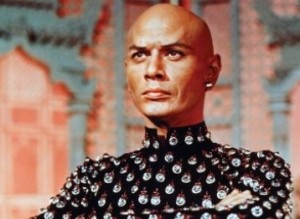
Yul Brynner as the King of Siam in The King and IIt’s a puzzlement!

In a recent online discussion of economic issues, a participant commented: “Government should not be charged with solving societal issues such as poverty, and this should be a society’s efforts to solve these problems through programs, charities, etc. sought by a willing group of individuals.” (I quote the comment as written; no editing.)

I don’t understand this compartmentalization of reality, this distinction of “government” as somehow separate from and different from “society”. I especially don’t understand it in a country whose founding document begins,

We the People of the United States, in Order to form a more perfect Union, establish Justice, insure domestic Tranquility, provide for the common defence, promote the general Welfare, and secure the Blessings of Liberty to ourselves and our Posterity, do ordain and establish this Constitution for the United States of America.

What is “society” if it is not “We the People”? And in our system of governance, the government, the sovereign, is also “We the People”. So how is it that “government” is distinct and different from “society” in the context of the United States of America? We the People decide by our votes who serves in “the government”. If we like the job they do, we vote them in again; if not, we vote them out. (There are a lot of people employed by “the government” who are not elected to it; but they are not “the government” — they are “government employees”. We can get rid of them, too, by voting out their elected bosses who are answerable to us.)

OK . . . so there’s that political framework puzzlement, but there’s also a religious puzzlement. Christian folk, especially conservative evangelical American Christian folk, love to pray the Psalms. Some of our most conservative brothers and sisters will allow no music in their worship other than the Psalms. So here we have a Psalm praying to God to give “the king” the power to “judge [God’s] poor with justice,” to “defend the cause of the poor,” to “give deliverance to the needy.” Later in the Psalm, “the king” is praised because he “delivers the needy when they call” (v. 12), he “has pity on the weak and the needy” and saves their lives (v. 13), he redeems their lives from oppression and violence (v. 14). In other words, he does all the things the participant in that conversation said the government shouldn’t do.

But the king was the government at the time the Psalms were written! We might be tempted to change king to president in an attempt to contextualize and modernize this Psalm to fit our American circumstance, but president would be the wrong word to substitute. The right word would be government. And an even more correct substitution would be We the People . . . for the king named in this Psalm was the sovereign and in our country We the People are the sovereign.

If we wish to pray this Psalm in our context, that would be the way to do it:

Give We the People your justice, O God,
and your righteousness to our children.
May We the People judge your people with righteousness,
and your poor with justice.
May the mountains yield prosperity for the people,
and the hills, in righteousness.
May We the People defend the cause of the poor of the people,
give deliverance to the needy,
and crush the oppressor.

Why the compartmentalization of life? Why the separation of government from society? Why the failure to see that what we revere in Holy Scripture, the righteousness prayed for the government in ancient Israel, ought to be our prayer for the government in modern America? Why the failure to see that it should be a prayer for ourselves? Why the refusal, as a society, as a nation, as the sovereigns of our nation’s government, to deliver the needy when they call, to have pity on the weak and the needy and save their lives, to redeem the lives of the poor from oppression and violence?

We the People are the society. We the People are the sovereign. We the People are the government. We the People are the ones called by this Psalm and charged by Holy Scripture with “solving societal issues such as poverty.” Why is this so difficult to comprehend?

As another king (a fictional one) was wont to say, “It’s a puzzlement!”

====================

Father Funston is the rector of St. Paul’s Episcopal Church, Medina, Ohio.

God’s in Control – From the Daily Office – September 18, 2012

From John’s Gospel:

The next day the great crowd that had come to the festival heard that Jesus was coming to Jerusalem. So they took branches of palm trees and went out to meet him, shouting,
“Hosanna! Blessed is the one who comes in the name of the Lord – the King of Israel!.”

(From the Daily Office Lectionary – John 9:12-13 – September 18, 2012)
 
2008 Electoral MapWe are living through a presidential election campaign in the United States. It seems to have been going on for ever, and the political ads and the news coverage of the candidates are increasing in intensity and in frequency. Pollsters take the public’s political pulse; commentators analyze the polls; the public reacts to the analysis; the pollsters re-poll the public. It’s a system of pendulum swings that feeds upon itself and oscillates back and forth. Flip-flopping candidates are matched by a flip-flopping electorate, and the candidates, their surrogates, and the commentators all decry the fickleness of the crowd.
But there is nothing new in a vacillating crowd, just look at today’s story of Jesus’ triumphal entry into Jerusalem. In just a few days, without the help of 24/7 television news and the internet, the same crowd will be whipped into a frenzy demanding Jesus’ execution. In their eyes, Jesus will go from king to criminal in less than a week! They will move from “Hosanna!” to “Hang him!” in four days’ time! Talk about a rapidly swinging electoral pendulum!

Of course, at this point in the American electoral process opinions are pretty much hardened; our electoral choices are probably rock-solid by now. The candidates are courting a small portion of voters, the so-called “undecided”. This group makes up under 10% of the voting public: a recent Wall Street Journal poll says only 3% of voters haven’t decided who they will vote for, while Gallup places the number at 8% at the highest. In physics terms, I suspect, the “amplitude” of the political pendulum’s oscillations is very small.

It was larger in Jesus’ time. As told in the Gospels, the swing involved nearly the whole crowd of visitors (and residents) in Jerusalem, not just a small (under 10%) group of “undecided” Jews.

Here’s what I take away from a comparison of the Jerusalem crowd and the American electorate, and the outcome of their and our decisions . . . in the long run, they were not in control and, frankly, neither are we. That’s not to say that we shouldn’t care, shouldn’t decide as carefully and prayerfully as we can, shouldn’t take part in the electoral process, shouldn’t vote. We should do all those things! But we should do so in the faithful assurance that, in the long run, God is and will be in control. The “Jerusalem electorate” chose badly; God redeemed that decision and used its result for the salvation of the world. However we choose, whatever the short term result, in the long term God will use it.

Archbishop William Temple, archbishop of Canterbury during the Second World War, once said:

“While we deliberate, God reigns.
When we decide wisely, God reigns.
When we decide foolishly, God reigns.
When we serve God in humble loyalty, God reigns.
When we serve God self-assertively, God reigns.
When we rebel and seek to withhold our service God reigns –
The Alpha and the Omega, which is and which was,
And which is to come, the Almighty.”

So we should do our homework. We should study the issues, review the candidates, take part in the process, vote in the election. We should do so hopefully and, regardless of the outcome, we should not despair. In the end, whatever decision we make, God’s in control!

====================

Father Funston is the rector of St. Paul’s Episcopal Church, Medina, Ohio.

Wonderfully and Marvelously Made – From the Daily Office – September 15, 2012

From the Psalms:

For you yourself created my inmost parts;
you knit me together in my mother’s womb.
I will thank you because I am marvelously made;
your works are wonderful, and I know it well.
My body was not hidden from you,
while I was being made in secret
and woven in the depths of the earth.

(From the Daily Office Lectionary – Psalm 139:12-14 (BCP Versification) – September 15, 2012)
 
I wasn’t sure whether I wanted to tackle what this portion of the evening Psalm for today brings to mind. After all, I love the Old Testament reading for today which is (as many have recently been) from the Book of Job; it is that wonderful chapter where God, having had enough of Job’s whining, finally answers him saying:

Who is this that darkens counsel by words without knowledge?
Gird up your loins like a man,
I will question you, and you shall declare to me.
Where were you when I laid the foundation of the earth?
Tell me, if you have understanding.

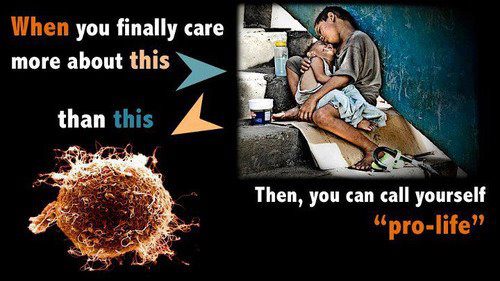
I just love God’s reply which basically says, “Who the Hell are you?” But as I was reading this lesson, I came upon this question that God asks, “Who shut the sea with doors when it burst out from the womb?” and that mention of a womb took me back to the evening Psalm and that took me back to a conversation I was part of earlier in the week. The conversation had to do with abortion, opposition to abortion, and what it means to be pro-life.

The conversation was sparked by this picture:

“Jesus,” said one party to the conversation, “commands us to care about both?”

“Where,” asked another party, “does Jesus command us to care about fetuses.”

Of course, Jesus does not; Jesus never made much mention of pregnancy or childbirth or care for the unborn. However, today’s Psalm might be read to lay the foundation for an understanding of God’s care for the unborn. The other party to the conversation didn’t go there, however. Instead, that person referred to Jesus’ citation of the second great commandmant: “Love your neighbor as yourself.” (Matt. 22:39) He continued with this assertion: “Since a baby in utero is a person and a child of God, the baby is your neighbor.” This statement is a logical as well as a theological stretch, I’m afraid, and here is where I started giving the issue some thought.

The reference to “a baby in utero” is fraught with issues. There is considerable debate today as to when a fertilized egg achieves the status of “baby”. It is not, however, at the moment of conception. Technically, from a medical point of view, a baby isn’t a baby until it’s born; “baby”, medically, refers to an infant, a newborn. From two months after conception until birth the child in utero is considered a fetus. During the first two months after conception, it is an embryo. (And then there are the theological issue of “ensoulment”, which is said to happen at “quickening”, and the legal issue of “viability”, which is the ability of the fetus to live outside the womb. Neither time nor space allow exploration of those issues.)

The second issue with the statement is in referring to whatever it is that is in utero as a “person”. Personhood is a legal concept and, in law, personhood is achieved at birth. (I’m not going to get into the currently hot political issue of whether corporations are people; that’s a whole other legal question.) Legally, a person is an autonomous being, a natural born man, woman, or child. The fertilized egg, embryo, or fetus in utero may be a person-in-potential, but is not yet a person-in-actuality. There are, of course, a number of proposed bills or constitutional amendments in several states that would change this legal definition, but as of now this is where American law stands.

Now, having said that, there are good reasons for being opposed to abortion, but basing that opposition on the supposed personhood of the in utero embryo or fetus, and stretching that personhood to neighbor status, and attaching Jesus’ “second great commandment” to that supposed neighbor just is not one of them. I’m opposed to abortion because I truly do believe, as this Psalm says, that God is involved in the procreative and developmental processes, that the development of the embryo into a fetus and the growth of the fetus are not simply mindless biological operations, that there is a mystical, spiritual “knitting” taking place, that we human beings are wonderfully and marvelously made by God. Abortion interferes with God’s work whereby we are “made in secret and woven in the depths of the earth.”

But I am also opposed to the outlawing of abortion because I hold what I believe is a fully consistent “pro-life” philosophy. I believe that one who is opposed to abortion must also be in favor of safeguarding the health and welfare of mothers before, during, and after giving birth. I believe that one must be in favor of improving the lives of children after they are born. A truly pro-life position would promote child and maternal welfare and health programs, feeding programs, education programs, and (I believe) access to safe and legal abortion in those circumstances where the life, health and safety of the mother are at risk, where the pregnancy results from rape or incest, or where there is medical reason to believe that the person-in-potential will be born with severe physical or mental developmental handicaps which would make life an intolerable burden. To be truly pro-life is to be pro-choice, because the choice is not between abortion or a baby; the choice is between a safe, legal abortion and an unsafe, deadly one. No woman should ever have to choose the latter!

To oppose abortion without supporting infant and maternal health programs, child welfare programs, good education, and access to safe and legal abortion when needed, is not a pro-life stance. It is simply to be pro-birth, but there is so much more to life after birth!

We are wonderfully and marvelously made, knit and woven together by God in our mother’s wombs, not just to be born but to have a life, a good life. That’s why, as opposed to abortion as I may be, I hold to a pro-life pro-choice position in favor of the availability of legally regulated, medically safe, accessible abortion for women who need to choose that path.

====================

Father Funston is the rector of St. Paul’s Episcopal Church, Medina, Ohio.

Playing My Harp in the Voting Booth – From the Daily Office – August 25, 2012

From the Book of Psalms:

By the rivers of Babylon —
there we sat down and there we wept
when we remembered Zion.
On the willows there
we hung up our harps.
For there our captors
asked us for songs,
and our tormentors asked for mirth, saying,
“Sing us one of the songs of Zion!”
How could we sing the Lord’s song
in a foreign land?

(From the Daily Office Lectionary – Psalm 137:1-4 – August 24, 2012)
 
This is one of my favorite psalms, not so much for its own import, but because of the reggae song Rivers of Babylon which is based on it. Here’s a YouTube recording of the Melodians singing the song. (My favorite version is a live performance by Jimmy Cliff, but I couldn’t find a good video of it.)

It is the plaint of the refugee: how can we sing the Lord’s song in a foreign land? How can we do anything that is normal to us? How can we be the people we are meant to be in a context not our own?

This is the life of the Christian according to St. Paul! We who are members of the Body of Christ are not in our “native land”; we are not at home in this world. To the Philippians he wrote, “Our citizenship is in heaven.” (Philip. 3:20) And to the Ephesians, “You are citizens with the saints and also members of the household of God.” (Eph. 2:19)

This is difficult for us to accept. We like to think that the context in which we find ourselves, our worldly situation, is where we are supposed to be! I was born and reared in the United States of America; I was educated in its schools, worked in its industry, worship in its churches, vote in its elections. I am an American! And yet Paul and Psalm 137 insist that I am a “stranger in a strange land”, that I am a citizen of somewhere else, that my values are not necessarily those of the world and the society in which I find myself, leaving me with the question asked in the Psalm: How can I sing the Lord’s song in this foreign land? How can I apply the values of the gospel in my daily life in this place-other-than-heaven? How do those values influence the way I vote, the choices I make, the activities i do, the way I spend money?

And let’s be honest and take a step back to an earlier question . . . . Do gospel values influence my daily life, my vote, my choices, my activities? Or have I hung up my harp on the willows and given up trying to sing God’s song in this strange place? I hope that I have not, and I hope over the next several weeks to tune my harp and take it with me into the voting booth in November.

====================

Father Funston is the rector of St. Paul’s Episcopal Church, Medina, Ohio.

Preaching Like Stephen, Making People Angry – From the Daily Office – August 20, 2012

From the Acts of the Apostles:

When they heard these things, they became enraged and ground their teeth at Stephen. But filled with the Holy Spirit, he gazed into heaven and saw the glory of God and Jesus standing at the right hand of God. “Look,” he said, “I see the heavens opened and the Son of Man standing at the right hand of God!” But they covered their ears, and with a loud shout all rushed together against him. Then they dragged him out of the city and began to stone him; and the witnesses laid their coats at the feet of a young man named Saul. While they were stoning Stephen, he prayed, “Lord Jesus, receive my spirit.” Then he knelt down and cried out in a loud voice, “Lord, do not hold this sin against them.” When he had said this, he died. And Saul approved of their killing him.

(From the Daily Office Lecionary – Acts 7:54-8:1 – August 20, 2012)

Martyrdom of Saint StephenSaint Stephen, one of the first deacons of the church, has just preached a sermon in which he has reminded his hearers, Jewish authorities in Jerusalem, that the Jews had a history of mistreatment of prophets, Their ancestors, he has said, “killed those who foretold the coming of the Righteous One, and now [his listeners] have become his betrayers and murderers.” No wonder they were angry with him.

I’m increasingly coming to the opinion that Christian preaching ought to anger those who hear it. If it doesn’t make them angry at the preacher, it should make them angry at someone or something else, angry enough to do something . . . though maybe not a fatal stoning.

We who preach the gospel of Jesus Christ should have the courage and conviction of Stephen, if not that of Jesus himself. There is a lot in our society that needs to be “called out” – the obvious racism of the way Ohio’s voting hours are being limited, for example, or the obvious sexism of a senate candidate in another state who can conceive of something he labels “legitimate rape” or the callous disregard for the needs of poor children deprived of nutrition be the defunding of school meal programs. These are not merely political issues; these are moral, ethical, and spiritual issues about which the church – and the church’s preaches – need to speak out. There are no “merely political” issues; every issue has moral, ethical, and spiritual dimensions, and of those the gospel has much to say. It will not say it to our world, however, unless preachers address the issues. And if that makes someone angry, so much the better.

A 19th Century Chicago journalist named Finley Peter Dunne wrote under the pseudonym of an Irish bartender named Mr. Dooley. One of Mr. Dooley’s observations concerned the role of the press:

Th’ newspaper does ivrything f’r us.
It runs th’ polis foorce an’ th’ banks,
commands th’ militry,
controls th’ ligislachure,
baptizes th’ young,
marries th’ foolish,
comforts th’ afflicted,
afflicts th’ comfortable,
buries th’ dead,
an’ roasts thim aftherward.

In the 1960 movie Inherit the Wind, Gene Kelly played an H.L. Mencken-like newspaper editor saying, “It is the duty of a newspaper to comfort the afflicted and afflict the comfortable.” Clare Booth Luce used a variation of this sentiment in her eulogy for Eleanor Roosevelt and numerous churchmen, including Reinhold Niebuhr, have applied similar words to the Christian faith, arguing that the preacher’s job, indeed the very nature of the gospel, is to comfort the afflicted and afflict the comfortable. Our job as ministers of the gospel is to offer hope and consolation to those who are hurting, while standing strong against the evils of injustice and oppression and selfish pursuit. And if that makes someone angry, so much the better.

The first deacon, Stephen, should be the patron saint of this kind of preaching, of which there should be much, much more.

====================

Father Funston is the rector of St. Paul’s Episcopal Church, Medina, Ohio.

Citizenship and Prayer – From the Daily Office – August 11, 2012

From the Acts of the Apostles:

Now the whole group of those who believed were of one heart and soul, and no one claimed private ownership of any possessions, but everything they owned was held in common. With great power the apostles gave their testimony to the resurrection of the Lord Jesus, and great grace was upon them all. There was not a needy person among them, for as many as owned lands or houses sold them and brought the proceeds of what was sold. They laid it at the apostles’ feet, and it was distributed to each as any had need.

(From the Daily Office Lectionary – Acts 4:32-35 – August 10, 2012)

This short passage from the Book of Acts describes the sort of world Jesus intended. Not just the sort of church . . . . the sort of world, the sort of human society, a complete community in which no one claims private ownership (it’s all God’s remember) and where there are no needy persons because what is needed is distributed equitably.

Dream world, right? Never gonna happen, you say? Then what do we mean when we say (some of us everyday, but a lot of at least once a week), “Our Father in heaven . . . your kingdom come”? If we don’t mean it, if we don’t want God’s kingdom to come, why do we keep asking for it? (Jesus taught this petition to his disciples when they asked him to teach them to pray. See Matthew 6:9–13 and Luke 11:2–4.)

I got into a beef in an on-line recently because another person attributed Massachusetts Senator Scott Brown’s criticism of his state’s Department of Transitional Assistance to his Christianity. Brown was upset because the department had mailed voter registration materials to some 400,000 welfare recipients; he interpreted this as a pro-Democratic-Party action by the department. (In fact, it was in compliance with a court order regarding the state’s failure to comply with “motor voter” regulations.) Nowhere in the article to which my correspondent referred was there any mention of Brown’s Christian faith (he is reportedly a member of the conservative Christian Reformed Church) by either Brown or the reporter. I objected to this person’s statement as a gratuitous and groundless comment, and a lengthy conversation ensued. (It was eventually and abruptly terminated by my correspondent.)

It got me thinking, though, about how we characterize the actions (political or otherwise) of other people and how in modern America we seldom hear positive actions (other than those expressly undertaken by the church) characterized as Christian! Programs which aid the poor, the elderly, the very young, or others in need are criticized as “socialist” even though that is precisely what the apostles set up in their first century community (long before, it should be noted, any western European economics theorist coined the term “socialist”). They are referred to as “entitlements”, a word often said with a sneer. If they are defended, it is on the grounds not of Christian practice but of some theory of economics or general ethics. The Constitutional separation of church and state, I suppose, is at work here. But for those who do support them and are Christians, if we really mean what we pray in the Lord’s Prayer (or any prayer of intercession for the poor and the needy for that matter), shouldn’t we applaud such programs as consonant with our faith? Shouldn’t we be giving and working toward their success because they are, in fact, elements of that world Jesus intended?

My staunchly Methodist grandfather taught me a number of things. A couple of them come to mind today. He taught me to never approach the altar of God without a gift of thanksgiving. Even if you’ve already made your weekly tithe (and he insisted that one give a tithe, a tenth of income), if you attend another prayer service give another offering. Those offerings, he said, are means by which God’s church carries out God’s work and answers at least some of our prayers. He taught me the same thing about taxes. I don’t know if he was familiar with Justice Oliver Wendell Holmes’s famous statement, “Taxes are the price we pay for a civilized society,” but that was certainly his attitude. He taught me that paying one’s taxes is the way the citizen enables the government to do the work it is created to do: the Preamble to our Constitution says that that is, among other things, to “establish justice, insure domestic tranquility, provide for the common defence, promote the general welfare, and secure the blessings of liberty to ourselves and our posterity.” Providing for the poor, the elderly, the very young, and other needy persons sure seems to me to fit in there.

Another thing he taught me was never to pray for something I was not willing to work for. If you pray for someone to be healed, be willing (and available when called upon) to care for that person. If you pray for war to be ended, be willing (and available when called upon) to do the work of creating peace.

That’s what prayer was to my grandfather: giving and working. I think that’s what citizenship was to him, as well. If everyone who prays “your kingdom come” actually gave and worked toward the kingdom’s appearance, if everyone also looked at their citizenship that way, I suspect that we’d hear a lot less criticism of “entitlements” and that the world would look a lot like what is described in that short bit from the Book of Acts.

====================

Father Funston is the rector of St. Paul’s Episcopal Church, Medina, Ohio.

Missing Millennials – From the Daily Office – August 7, 2012

From the Psalms:

He gave his decrees to Jacob
and established a law for Israel, *
which he commanded them to teach their children;
That the generations to come might know,
and the children yet unborn; *
that they in their turn might tell it to their children;
So that they might put their trust in God, *
and not forget the deeds of God,
but keep his commandments.

(From the Daily Office Lectionary – Psalms 78:5-7 (1979 BCP Version) – August 7, 2012)

Just a few days ago the Public Religion Research Institute issued a new report entitled A Generation in Transition: Religion, Values, and Politics among College-Age Millennials. A “millennial” is somone currently 18 to 24 years of age, the youngest cohort of adults. (From my point of view at nearly 60 years of age these are children; my son and daughter are both older than this group!) According to the report, these young adults are more likely then the general population to be religiously unaffiliated; one-quarter of them so identify themselves. Interestingly, most of those who do so were reared in religiously affiliated households. The greatest movement away from religious affiliation was seen among those raised in Catholic and white mainline Protestant families. It would appear that we have not been doing a very good job of teaching our children “that they in their turn might tell it to their children”!

Exactly what the causes of this movement are is anyone’s guess. A lot of author’s have made suggestions. Ross Douthat in his recent book Bad Religion blames it on the churches’ movement away from conservative dogma toward a liberal agenda. Diana Butler Bass in Christianity After Religion, on the other hand, suggests a failure of religious institutions to continue an awakening begun in the mid-20th century, falling instead into a reactive fundamentalism reinforcing conservative dogma in the last quarter of the century. Local pastors give anecdotal evidence of parishioners drifting away from Sunday church services to other alternatives including youth soccer and little league, major league sports offerings, Sunday morning TV programs, or spending the morning with the New York Times; they say American families have become “over programmed” and have relegated religion to the hopper of optional activities. Everybody has a different story to tell about what’s gone wrong with American religion; everybody has a different story to tell about how someone else has gotten it wrong.

I don’t know which of these and many other suggestions is most accurate, which story truly tells the tale of the American church. I suspect that to some extent they are all correct and that for every person, millennial or older, who has left “organized religion” behind there is a mix of stories reinforcing one another. And what this means for the church is that the answer to attracting the millennials is not going to be a single program, a single style of worship, a single ministry style, a single outreach, a single anything. There is no silver bullet, no quick and easy answer.

I nearly wrote “attracting the millennials back” in that last paragraph and then stopped myself, because a lot them were never here in the church to begin with. They represent a new mission field, not a lost membership group. They claim to be “spiritual but not religious” because, truly, they’ve never been a part of religion. They may be spiritual; all human beings are if St. Augustine of Hippo was right that “our hearts are restless till they find their rest in” God. If we in the church are to attract them to a religious expression of that spirituality, it is going to take hard work, time, and most of all its going to take integrity.

The past half-century has seen the church lose its integrity. Various parts of the church have taken up competing political and societal positions, so that the church has fractured even beyond the denominational divides of the Reformation. Instead of focusing upon the core values and teachings of the undivided church, we have taken up social causes that, though important, have divided us. Each faction seems to be telling a different story, so that the church can no longer claim (as it once could despite denominational differences) to be one. Because of the differing stories, the church can no longer lay claim to a unity based on shared moral and ethical principles. The church needs to recover that, to stop fighting with itself, to stop telling these contradictory stories.

If we could just do that, we’d be a much more attractive venue where the millennials (and everyone) could explore the spirituality they claim and clearly have. Just that . . . if we could just stop the internal bickering and fighting, stop telling stories about each other and, instead, tell stories of God. Wouldn’t that be novel?

Well, no . . . as the psalm suggests, it’s an idea that’s been around for a few years. “He commanded them to teach their children, so that they might put their trust in God, and not forget the deeds of God.”

====================

Father Funston in the rector of St. Paul’s Episcopal Church, Medina, Ohio.

« Older posts Newer posts »