Occasional thoughts of an Anglican Episcopal priest

Category: Prayer (Page 14 of 47)

What is Jesus up to? – Sermon for Palm Sunday (Yr C) – 20 March 2016

====================

A sermon offered by the Rev. Dr. C. Eric Funston on Palm Sunday, March 20, 2016, to the people of St. Paul’s Episcopal Church, Medina, Ohio, where Fr. Funston is rector.

(The lessons for the day are as follows:
At the Blessing and Distribution of the Palms: Zechariah 9:9-12 and Psalm 118:1-2,19-29
At the Eucharist: Isaiah 50:4-9a; Philippians 2:5-11; Psalm 31:9-16; and St. Luke 19:28-40
At the Reading of the Passion Narrative following Communion: St. Luke 22:14-23:56
Most of these lessons may be found at The Lectionary Page.)

====================
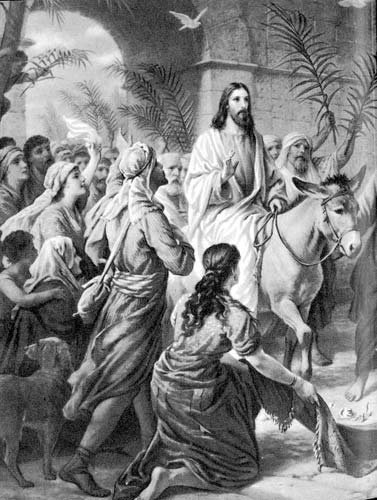
Jesus Triumphal EntryWhat is Jesus up to? Why is he doing this?

Many of us are old enough to remember when the musicals Godspell and Jesus Christ Superstar made their first appearances. I wasn’t that big a fan of Godspell, but I really liked Superstar … and one of my favorite songs from it is Hosanna sung as Jesus enters Jerusalem, the scene which today specifically commemorates.

In Superstar, as in the Bible, as Jesus makes his way into the city, the crowds sing “Hosanna”. Unlike the biblical text, the hosannas sung in Superstar are a refrain for a duet, a musical conversation between Caiaphas, the high priest, and Jesus. In each iteration of the refrain, one line is changed. The first time, the crowd sings “Hey, JC, JC, won’t you smile at me.” The second time, “Hey JC, JC you’re alright by me.” The third, “Hey JC, JC won’t you fight for me?” And finally, “Hey JC, JC won’t you die for me?” These one-line changes in the hosanna refrain foreshadow the progress of Holy Week and the events leading to Good Friday and the cross. There’s a sermon in that, but not the one I want to offer you today.

Today, I want to focus not on what the crowd is singing but on what Jesus is saying by what he does and what he says. Listen to the words Caiaphas says to Jesus in the Superstar song:

Tell the rabble to be quiet,
we anticipate a riot.
This common crowd,
is much too loud.
Tell the mob who sing your song
that they are fools and they are wrong.
They are a curse.
They should disperse.

Tim Rice, the lyricist of Superstar, is elaborating here on the Lukan text: “Some of the Pharisees in the crowd said to him, ‘Teacher, order your disciples to stop.'” (Luke does not identify the speaker as the high priest Caiaphas; that is artistic license on the playwrights’ part.) Jesus’ reply, “I tell you, if these were silent, the stones would shout out,” is rendered by lyricist Rice in this way:

Why waste your breath moaning at the crowd?
Nothing can be done to stop the shouting.
If every tongue were stilled
The noise would still continue.
The rocks and stone themselves would start to sing.

This conversation gives us a clue as to Jesus’ intent, his motive for doing what he did on that day riding into Jerusalem.

Way back in Jewish history, Joshua the son of Nun, the successor of Moses, when he led the people of Israel into the promised land swore them to their covenant with God and he had his men set up a stone monument as a testimony to the covenant. He said to the people, “See, this stone shall be a witness against us; for it has heard all the words of the Lord that he spoke to us; therefore it shall be a witness against you, if you deal falsely with your God.” (Josh. 24:27) Later, the prophet Habakkuk condemned the ruling classes, the conquerors of nations who, in his colorful and disturbing words, “build towns by bloodshed.” (Hab 2:12) In his prophecy, Habakkuk proclaimed: “The very stones will cry out from the wall, and the plaster will respond from the woodwork.” (Hab 2:13)

Jesus was recalling these ancient words, the covenant promise of Joshua and the justice prophecy of Habakkuk, when he said to the complaining Pharisees, “The stones would shout out.” They claimed to be the guardians of the covenant and they were the ruling class of their day, trained in the Law of Moses and the history of their people, and they knew what Jesus was saying.

They knew, too, what Jesus had done riding into the city on a donkey’s colt. He was acting out the prophecy of Zechariah: “Lo, your king comes to you; triumphant and victorious is he, humble and riding on a donkey, on a colt, the foal of a donkey.” Jesus was making a bold statement of his identity, a claim that could not be ignored. He was staking his claim on the kingship of Israel, on the role of the one who sits in judgment of the injustice against which the stones cry out and the plaster on the walls responds. He was telling them in no uncertain terms that they, the ruling class of his day, had built their empire by bloodshed.

That is what Jesus was up to then . . . and it is what Jesus is up to now! When the church re-enacts this drama each year, when we read the story of Jesus’ entry into Jerusalem, when we wave our palms and sing our hosannas, we who “are the body of Christ and individually members of it” are making the same prophetic claim. We are saying to the ruling elites of our day that the rules by which they profit and benefit are unjust, that the society over which they preside is an empire built by bloodshed, that the stones are crying out from the wall, and the plaster is responding from the woodwork, that God’s creation is bearing witness against them.

And in one of those twists of meaning that God frequently pulls on us, we recognize that even as we “are the body of Christ and individually members of it,” even as we are both Jesus riding into Jerusalem and the crowds, the stones, crying out for justice . . . we are also the ruling elites against whom we cry. It is our own unjust acts, our own oppression of others, our own sinful exploitations that we are prophetically protesting.

If we do not understand that, if we do not appreciate that that is what we are saying and doing, then our Palm Sunday liturgy is hollow and meaningless. If what we are doing is not a reiteration of Jesus’ message, not a repetition of the prophecy he enacted and proclaimed, then what we are doing is a mockery of his life, his ministry, and his self-sacrifice. If in our waving of palms and singing of hosannas we are not proclaiming his gospel, if we are not announcing “good news to the poor . . . release to the captives . . . recovery of sight to the blind [and freedom to] the oppressed” (Lk 4:18), then all that we do today and during this Holy Week is nothing more than a burlesque, a charade, “a tale told by an idiot, full of sound and fury, signifying nothing.” (Macbeth, Act V, Scene V)

But . . . but . . . I do not believe that it is. I believe that what we do bears witness to the truth of the gospel story, that what we do makes a difference in the world in which we live. I believe that what we do proclaims to the powers of this world the almighty power of the God and Father of our Lord Jesus Christ. I believe that when we wave our palms and sing our hosannas we are, like the prophet Isaiah, standing up and saying, “Who will contend with [us]? Let us stand up together. Who are [our] adversaries? Let them confront [us]. It is the Lord God who helps [us]; who will declare [us] guilty?” (Is 50:9)

We are proclaiming to the powers of this world, even (or even especially) those that reside within us, that they are defeated, that “in Christ, there is a new creation: everything old has passed away; see, everything has become new!” (2 Cor 5:17) We are saying, “Our God reigns!” and that “in Christ God [has] reconcile[ed] the world to himself.” (2 Cor. 5:18)

That’s what Jesus is up to! That’s what we are up to!

At the end of the Hosanna! song in Jesus Christ Superstar, Jesus sings to the crowd:

Sing me your songs,
But not for me alone.
Sing out for yourselves,
For you are bless-ed.
There is not one of you
Who cannot win the kingdom.
The slow, the suffering,
The quick, the dead.

So wave your palms! Sing your hosannas! Be the stones who cry out judgment against the ruling elites! Be the plaster that answers from the woodwork! Be ambassadors for Christ! Be the voices of God’s ministry of reconciliation! Be the righteousness of God! (2 Cor 5) For there is not one of you who cannot win the kingdom! Amen!

====================

A request to my readers: I’m trying to build the readership of this blog and I’d very much appreciate your help in doing so. If you find something here that is of value, please share it with others. If you are on Facebook, “like” the posts on your page so others can see them. If you are following me on Twitter, please “retweet” the notices of these meditations. If you have a blog of your own, please include mine in your links (a favor I will gladly reciprocate). Many thanks!

====================

Father Funston is the rector of St. Paul’s Episcopal Church, Medina, Ohio.
Standing on Holy Ground (Sermon for Lent 3, RCL Year C) – 28 February 2016

====================

A sermon offered by the Rev. Dr. C. Eric Funston on the Third Sunday in Lent, February 28, 2016, to the people of St. Paul’s Episcopal Church, Medina, Ohio, where Fr. Funston is rector.

(The lessons for the day are Exodus 3:1-15; Psalm 63:1-8; 1 Corinthians 10:1-13; and St. Luke 13:1-9. These lessons may be found at The Lectionary Page.)

====================

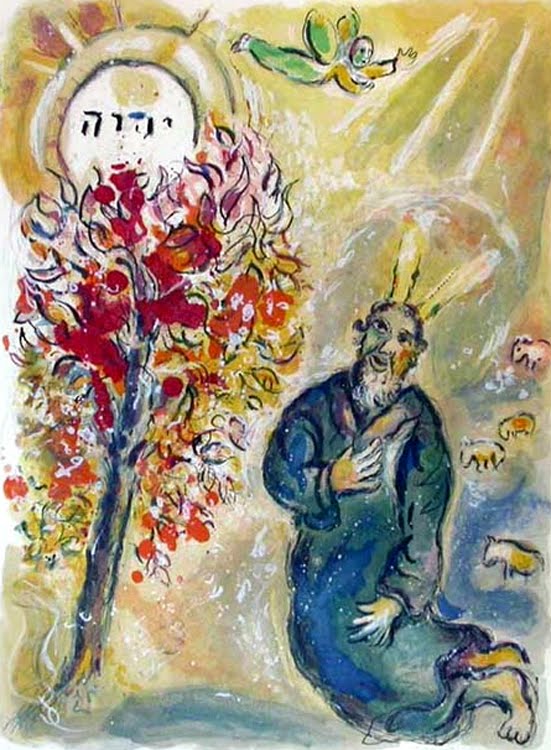
Moses and the Burning Bush by Marc ChagallMoses is told to remove his sandals as he stands before the Burning Bush: “Come no closer! Remove the sandals from your feet, for the place on which you are standing is holy ground.” (Ex 3:5)

Draw away the covering that has protected you. Clear away the barrier between yourself and the earth so that your bare feet may touch and sink and take root in this holy ground. Let this living soil coat your skin. Dig in, feel your way, and find your balance here upon this mountain, so that its life becomes your life, its fire your fire, its sacred sand and loam and rock the ground of your seeing, speaking, and calling. (Anathea Portier-Young, Assoc Prof, Old Testament, Duke Divinity School, Durham, NC)

Those of us taking part in the Growing a Rule of Life Lenten study program were asked, in the second week, to consider the “soil” in which our spiritual life is rooted, to think about the people, institutions, situations, and circumstances that form the ground out which the person we are has grown. I didn’t think of it as I was working through that exercise, but perhaps we ought to have thought of metaphorically “removing our sandals” as Moses is instructed to do, of digging our toes into that rich, holy soil of our pasts in which we are planted and from which we draw much of what sustains us.

This is the metaphor that Jesus uses today when he is confronted by some of his followers about the problem known to theologians as “theodicy,” the problem so aptly put in the title of Rabbi Harold Kushner’s popular book of a few decades ago: “Why do bad things happen to good people?” (When Bad Things Happen to Good People)

Let’s back up a few verses and situate ourselves with Jesus and his followers. He has been teaching them about God’s grace (reminding them of the birds of the air and the lilies of the field), about the need for realistic preparation (telling the parable of the foolish rich man who built barns to store his excess not realizing he would soon parish and lose everything, as well as the story of the unfaithful servant caught unawares by the unexpected return of his employer), and about the divisive nature of the gospel (admonishing them that his disciples are likely to find themselves at odds with members of their own families). He has finished this series of teachings with a pointed remark about his listeners’ lack of understanding: “You know how to interpret the appearance of earth and sky, but why do you not know how to interpret the present time? And why do you not judge for yourselves what is right?” (Lk 12:56-57)

Apparently some of them, trying to assert their theological savvy, bring up an incident involving some Galileans who were killed while at worship in the Temple. We don’t actually have any history of this episode, but scholars surmise that these pilgrims were, perhaps, accused of some insurrection and that Pilate had sent troops into the Temple precincts who killed them as they were making their sacrifices thus “mingling” their blood with that of the animals they had offered. Such cruelty and desecration would not have been out of character for Pilate. In any event, these people bring this episode up with Jesus as if to demonstrate their understanding of sin and divine retribution.

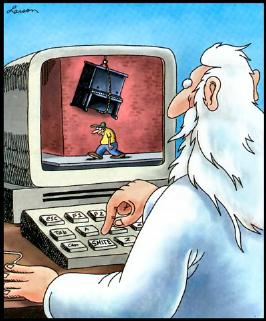
Gary Larsen cartoonSome years ago the cartoonist Gary Larson published a cartoon of an old white-bearded judgmental God sitting at his computer terminal watching the live-streaming video of some feckless and unsuspecting sinner walk under a piano suspended from a crane while God’s finger is poised over a button on the keyboard labeled “Smite”. This seems to be the God these folk are describing to Jesus, a bookkeeper god who keeps a running tally of the good things and bad things we may do and then at some arbitrary point pushes the “Smite” button and puts paid to our cosmic account. This is the god of those who ask “Why me? What have I done to deserve this?” when something bad happens to them. This is the god of those who say “Everything happens for a reason” when something bad happens to someone else. This is the picture of God that Jesus rejects utterly and completely.

Probably to his listeners’ surprise, Jesus does not congratulate them on their understanding. Instead, he challenges them. “What?” he asks, “Do you think those people cut down in the Temple were worse sinners than all other Galileans?” And he ups the ante by mentioning another story that might have been running in the current edition of the local equivalent of the Medina County Gazette, the local tragedy of eighteen people killed with an old and poorly-constructed stone tower fell on them. “What about them?” he asks, “Were they any less righteous than all other Jerusalemites?”

And he answers his own questions, “No, they weren’t. They were no worse than anyone else and, guess what, you’re no better.” If there were bumper stickers in ancient Israel, Jesus might have quoted one that has been popular in our country for several years: in two words it says, sort of, “Stuff happens.” That is Jesus’ message to his listeners, the consoling news that when bad stuff happens, it is not punishment for our sins or for anyone else’s. Of course, that carries with it the corollary that when good stuff happens, it is not a reward for our righteousness. Stuff – good, bad, and indifferent stuff – just happens. And we need to be ready for it . . . that, I think, is the meaning of Jesus’ less-than-consoling follow-up comment: “Unless you repent, you will all perish as they did.”

Is Jesus threatening them or us with a suddenly collapsing roof or homicidal security forces? I don’t think so. Rather, he is encouraging us, as he had in the conversation which led up to this discussion, to prepare, to repent, to get ready, else like those who died in the Temple or under the falling tower, we will die (in the words of the Great Litany) “suddenly and unprepared.” We will die, not because of our sinfulness, but still mired in it, still not ready for whatever it is that will come after. “Stuff happens; be ready for it,” is Jesus’ message.

The consolation Jesus offers is in the parable of the fig tree which he then adds. It’s a parable we are all familiar with and one which, I’m sure, we’ve heard interpreted in the way in which Professor R. Alan Culpepper summarizes the teaching of many Christian interpreters who “have been quick to see allegorical meanings in the parable. The fig tree and the vineyard represent Israel, the owner is God, the gardener is Jesus, and the three years refer to the period of Jesus’ ministry.” (New Interpreter’s Bible, Abingdon:Nashville, 1995, Vol. IX, p 271) In fact, I found just such an interpretation in the commentary of a Baptist theologian who wrote:

We can surmise that the barren fig tree represents the people of God, including Jesus’ listeners, who are not bearing the fruit of repentance. *** God is frustrated with the lack of repentance that characterizes his people, and he is losing patience with them. Jesus may take on the role of the gardener who urges forbearance and one more chance for change and growth. His presence among them, including his teachings and miraculous works, are like the extra attention the gardener gives to the tree by digging around its base and spreading manure to nourish the soil and the roots. However, even the gardener recognizes time is limited. (Dr. Angela Reed, Asst Prof, Practical Theology, George W. Truett Theological Seminary, Waco, TX)

That’s certainly the sort of understanding of this parable that I learned in Sunday school, and if we divorce it from its context, if we don’t take into account the conversation that preceded it, that interpretation sort of makes sense. But Jesus’ has just finished telling us that God doesn’t operate that way, that God doesn’t cut down fruitless trees, that God doesn’t crush unproductive vines, that God doesn’t keep accounts and pay back sinfulness or lack of righteousness with calamities as punishment. So, I don’t think that allegorical reading makes any sense.

So who might the owner, the gardener, and the tree be . . . ?

When Lent began, we were reminded of this claim of ownership: “And the devil said to [Jesus], ‘To you I will give their glory and all this authority; for it has been given over to me, and I give it to anyone I please.’” (Lk 4:6) Now, granted, the devil is “the father of lies” (Jn 8:44) and we can’t trust a thing he says, but the author of the Second Letter to the Corinthians seems to confirm Satan’s claim when he calls him “the god of this world [who] has blinded the minds of the unbelievers.” (2 Cor 4:4)

There’s your vineyard owner: Satan. It’s Satan, not God, who is the bookkeeper. It was that wily old serpent in the Garden who suggested to Adam and Eve that it wasn’t fair that only God should have the knowledge of good and evil, that they should balance things out by eating the fruit and becoming like God. It was Satan, going to and fro in the world, who argued that Job would answer calamities with curses, balance books between him and God. It is Satan who convinces humankind that the universe should make sense, or . . . if you don’t need that personification of evil, it’s our own human desire for the cosmos to balance on scales of our own creation. We want the world to make sense on our terms. Cancer kills innocent children and we demand that there be a reason for that: it’s not comfortable to face the chaotic and unpredictable reality that “Stuff happens.” Religious fanatics bomb innocent civilians out of their homes and the world is awash in refugees and we want someone to pay the price. Playground bullies grow up to be successful real estate tycoons and powerful politicians, and we want that to make sense.

We long for a universe in which the cosmic spreadsheet tallies up the good and adds up the bad and somehow comes out at least balanced or, preferably, maybe a little bit to the good. It is our own sense of fairness, our own need for equilibrium that owns the garden. But a world of equilibrium, where everything balances according to our human sense of fairness or good bookkeeping would not be the natural world. At best, it would be a mechanistic cosmos, a machine churning out rewards and retributions, a universe fit for automata but not for flesh-and-blood human beings. I was reminded recently of a poem by D.H. Lawrence entitled The Healing:

I am not a mechanism; an assembly of various sections.
And it is not because the mechanism is working wrongly, that I am ill.
I am ill because of wounds deep to the soul, to the deep emotional self
and the wounds to the soul take a long, long time, only time can help
And patience, and a certain difficult repentance,
Long difficult repentance, realization of life’s mistake, and the freeing oneself
from the endless repetition of the mistake
Which mankind at large has chosen to sanctify.

We are all ill from wounds to the soul and we have all sanctified that same mistake: the self-destructive mistake of yearning for and trying to create the balance-sheet world of “fairness.” To paraphrase cartoonist Walt Kelly’s Pogo the possum, “We have met the bookkeeper, and he is us.”

We are the ones who would chop down the fruitless tree and uproot the unproductive vine. The tragedy is that we are also the tree! Standing there with our account books in hand, it is our own lives over which we stand in judgment: “Why me? What did I do to deserve this? Everything happens for a reason!” So disappointed are we in the stuff that happens (or doesn’t happen) that we are so often ready to uproot everything, chop it all down, start over in hopes that next time the accounts will show a profit, or at least be in balance. That’s when God the gardener steps in and says to the garden owner in us, “Hold on! Give it another year.” That’s when God says to the tree in us, “Take off your sandals; you are standing on holy ground. Dig your toes into the soil of your life. I’ll add some things here to nourish you: people who love you, a church community that supports you, a natural environment to sustain you. Take root; be nurtured; bear fruit!”

That’s when we realize that, indeed, our souls thirst for God, our flesh faints for God, that we have been like trees in a barren and dry land where there is no water. (Ps 63:1) But, with our shoes removed, our toes digging into the soil of God’s holy place, finding our balance upon God’s holy mountain, we realize that, in the midst of all the stuff that happens, the great I AM, God who is who God is, the Lord, the God of our ancestors, the God of Abraham, the God of Isaac, and the God of Jacob, will be with us, not just for a year or three years, but for all generations. (Ex 3:15) “God is faithful, and he will . . . provide the way [for us] to endure.” (1 Cor 10:13) In the midst of all the stuff that happens, God will dig into the soil of our lives, and put nutrients on our roots, and we will bear fruit.

“Remove the sandals from your feet, for the place on which you are standing is holy ground.” (Ex 3:5) Amen.

====================

A request to my readers: I’m trying to build the readership of this blog and I’d very much appreciate your help in doing so. If you find something here that is of value, please share it with others. If you are on Facebook, “like” the posts on your page so others can see them. If you are following me on Twitter, please “retweet” the notices of these meditations. If you have a blog of your own, please include mine in your links (a favor I will gladly reciprocate). Many thanks!

====================

Father Funston is the rector of St. Paul’s Episcopal Church, Medina, Ohio.
Beloved Insecurity (Sermon for Lent I, RCL Year C) – 14 February 2016

====================

A sermon offered by the Rev. Dr. C. Eric Funston on the First Sunday in Lent, February 14, 2016, to the people of St. Paul’s Episcopal Church, Medina, Ohio, where Fr. Funston is rector.

(The lessons for the day are Deuteronomy 26:1-11; Psalm 91:1-2, 9-16; Romans 10:8b-13; and St. Luke 4:1-13. These lessons may be found at The Lectionary Page.)

====================

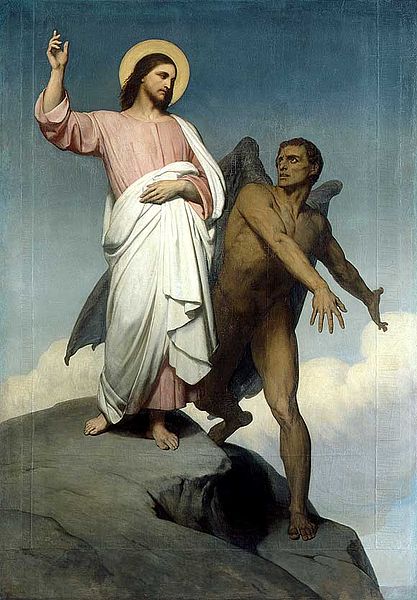
417px-Temptation_of_Christ

If you would enter
into the wilderness,
do not begin
without a blessing.

Do not leave
without hearing
who you are:
Beloved,
named by the One
who has traveled this path
before you.

Do not go
without letting it echo
in your ears,
and if you find
it is hard
to let it into your heart,
do not despair.
That is what
this journey is for.

I cannot promise
this blessing will free you
from danger,
from fear,
from hunger
or thirst,
from the scorching
of sun
or the fall
of the night.

But I can tell you
that on this path
there will be help.

I can tell you
that on this way
there will be rest.

I can tell you
that you will know
the strange graces
that come to our aid
only on a road
such as this,
that fly to meet us
bearing comfort
and strength,
that come alongside us
for no other cause
than to lean themselves
toward our ear
and with their
curious insistence
whisper our name:

Beloved.
Beloved.
Beloved.

That is the poem Beloved Is Where We Begin by Jan Richardson from her collection of verse entitled Circle of Grace. It speaks to us of the gospel story we have just heard; it speaks to us as we begin our Lenten journey. We know the story – we know that this “whispered name” is what Jesus heard right before, “full of the Spirit,” he was led into the desert: “You are my Son, my Beloved. In you I am well pleased.”

Today’s Old Testament lesson from the Book of Deuteronomy was clearly chosen to make the connection between the Hebrews’ forty years of wandering and Jesus’ forty days in the desert, between their celebration by feasting and his time of fasting. In Year A of the Lectionary cycle, however, we are asked to consider Genesis 3 and the “fall” of Adam and Eve, their giving into the serpent’s temptation to eat of the fruit of the tree of knowledge. I suspect that, when most of us think of temptation, it is that story we most often recall.

You may remember a few weeks ago, when we heard the story of Jesus’ baptism, that I read you the genealogy which Luke places between that story and this tale of his time in the desert. That Luke closed the baptism story and introduces the temptations by tracing Jesus’ descent from Adam, suggests that Luke is thinking of the Garden of Eden story, as well. Perhaps Luke is making the point that, like the temptation of Adam and Eve, the temptations put before Jesus had very little to do with a power grab by Satan and almost everything to do with playing on human feelings of insecurity and mistrust.

This is also true, however, of the Hebrews’ forty-years journey through the wilderness of Sinai. They, too, faced desert insecurities during those four decades and those temptations were parallel to those offered Jesus. Like Adam and Eve, the first temptation offered Jesus is one of food, playing human insecurity around nourishment and food, both physical and spiritual. The wandering Hebrews, too, faced that anxiety. Remember that they complained of Moses: “If only we had died by the hand of the Lord in the land of Egypt, when we sat by the fleshpots and ate our fill of bread; for you have brought us out into this wilderness to kill this whole assembly with hunger.” (Ex 16:3)

The second temptation of Jesus, the offer of lordship over all the kingdoms of the earth, is less about being a ruler and more about simply being recognized; it is the insecurity of identity, of being known to one’s fellow human beings. In the wilderness of Sinai, the Israelites again railed against Moses, “Why did you bring us out of Egypt, to kill us and our children and livestock with thirst?” (Ex 17:3) They were afraid that they would all parish and that no one would remember them, that their existence and their identity would be forgotten.

The third temptation addresses the human insecurity of support, the human need for reassurance that God cares. “If you are the Son of God, throw yourself down from the pinnacle of the Temple; surely God will command his angels will save you!” says Satan. The Hebrews at the foot of Mt. Sinai, when Moses was delayed for 40 days and 40 nights, began to feel that same insecurity; they begged Aaron to make them a god. He did, a Golden Calf, before which they danced and felt reassured. (Ex 32)

Forty days and nights on the mountain, forty years on the desert journey, forty days in the desert . . . Why the forty days? I’ve read that whenever we see “forty” in the Holy Scriptures what it is really saying to us is “this lasts as long as it takes for us to figure this thing out.” It means “as long as it takes for you to hear that word, ‘Beloved,’” “as long as it takes for you to know that the one who loves you will not abandon you, will not leave you without nourishment, will not let you cease to be as if you had never existed, will not fail to care for you and support you.” As long as it takes.

The 17th Century French philosopher Blaise Pascal described human beings as having what he called a “God-shaped hole,” not a flaw, but rather a natural yearning, “the empty print and trace” of a true happiness that once was there, an “infinite abyss” that can only be filled by God. (Pensees, 10:148) Similarly, St. Augustine of Hippo, the 4th Century African bishop, in the first lines of his Confessions, wrote that “our hearts are restless till they find their rest in God.” (1.1.1) Based on such insights, Lutheran theologian David Lose has suggested that before there was “original sin” there is “original insecurity.” He writes, “Adam and Eve are tempted to overcome that original insecurity not through their relationship with God but through the fruit of the tree of the knowledge of good and evil, fruit that in that moment looks to be shaped just like their hole.” The Hebrews in the desert of Sinai thought that the soup kettles and stew pots of Egypt would fill the hole, or that water from a desert spring would fill the hole, or that a Golden Calf cast from their earrings and necklaces would fill the hole. Satan tried to convince Jesus that bread made from stones, or rulership of the world’s nations, or the ability to fly like Superman, held up by the angels, would fill that hole.

Over and over again in human life, the devil attempts to sow mistrust: you may go hungry; you may not be recognized and appreciated; you cannot trust God to sustain and care for you. In the wilderness, Jesus replies with Scripture, not because life’s challenges can be answered by remembering or quoting Bible verses but because Jesus finds in Scripture, as we can, the words to give voice to his trust in the Father. At the core of each reply is Jesus’ absolute trust in God for spiritual and physical nourishment, for identity and ministry, for support and care.

And where does Jesus find that? Just where the Hebrews ultimately found it. For them, the nourishment, identity, and support were not, ultimately, found in a homeland; they were found where God had put them, in their hearts. Looking for security outside themselves, they failed to see it inside. Over and over again the security they longed for was offered to them, well before they entered the Promised Land. Manna falling from the sky, miraculous springs of water opening to assuage their thirst, rules to live by offered on Mt. Sinai – these weren’t just sign-posts pointing to the promise. They were and are the promise! The Hebrews were looking for a home, a Promised Land which would sustain and support them. But they had that all along. God was their home, their sustenance, their support.

Unlike the Israelites, Jesus knew that all along. Luke drops this short phrase into the story – “full of the Holy Spirit.” Jesus is filled with the Holy Spirit and, thus, able to respond with steadfast sureness and faith when tempted by the Devil. Every one of us knows how hard it is to resist temptation; the world (if not the Devil) plays on our insecurities all the time! Jesus being filled with the Holy Spirit in the desert was not an isolated or special thing, a temporary truth for him alone; it is a promise for us. It is a promise that has been for all of God’s People since the beginning and will always be, for Adam and Eve, for Moses and the Israelites, for you, and for me.

That insecure, yearning hole in the middle of our existence is already filled, we just need to realize that! For the next forty days, or the next forty years, or as long as it takes, we need to come to the recognition that that “God-shaped hole” is already “filled with the Holy Spirit,” that the Lord has always been our refuge, to come to the knowledge that the Most High has always been our habitation, to understand that we are filled with the Holy Spirit, and to know those

strange graces
that come to our aid . . . .
that fly to meet us
bearing comfort
and strength,
that come alongside us
for no other cause
than to lean themselves
toward our ear
and with their
curious insistence
whisper our name:
Beloved.
Beloved.
Beloved.

Amen.

====================

A request to my readers: I’m trying to build the readership of this blog and I’d very much appreciate your help in doing so. If you find something here that is of value, please share it with others. If you are on Facebook, “like” the posts on your page so others can see them. If you are following me on Twitter, please “retweet” the notices of these meditations. If you have a blog of your own, please include mine in your links (a favor I will gladly reciprocate). Many thanks!

====================

Father Funston is the rector of St. Paul’s Episcopal Church, Medina, Ohio.

Transfiguration and Conversation: Sermon for the Last Sunday after Epiphany (7 February 2016)

====================

A sermon offered on the Last Sunday after the Epiphany, February 7, 2016, to the people of St. Paul’s Episcopal Church, Medina, Ohio, where Fr. Funston is rector.

(The lessons for the day are Exodus 34:29-35, Psalm 99, 2 Corinthians 3:12-4:2, and St. Luke 9:28-43a. These lessons may be found at The Lectionary Page.)

====================

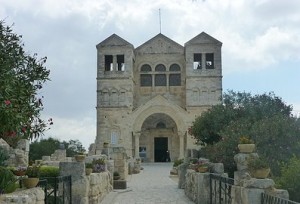
mttaborchurchAs many of you know, Evie and I were privileged to make a pilgrimage to the holy places of Palestine summer before last and one of the sites we visited was Mt. Tabor, the traditional “Holy Mountain” on which the Transfiguration is believed to have taken place.

Mt. Tabor is quite tall and quite steep. It is what’s called an inselberg or isolated “island mountain” rising nearly 2,000 feet above the Kfar Tavor plain which it dominates. To get to the top, you have to get out of your large tour coach and board smaller (and quite dilapidated) eight-passenger mini-vans piloted by maniacal Bedouins who drive you at break-neck speeds up a road with several sharp switch-back turns to the Franciscan monastery and church at the summit. (Making that ascent “transfigured” Jesus in my mind’s eye from the rather scrawny figure we often see on crucifixes into a very fit, muscular mountaineer! He and his disciples must have been in really good shape to make that climb!)

The Church of the Transfiguration is one of several in the Holy Land built for the Franciscans by the early 20th Century architect Antonio Barluzzi, who accomplished there what Peter sought to do in the story we heard from Luke’s gospel. As one comes to the entrance of the church, before actually entering the main church, one finds to one’s left a separate chapel dedicated to Moses, and to one’s right, a chapel dedicated to Elijah. There is no direct communication between the chapels and the main church. As much as I admire the architecture of Barluzzi, and think some of his churches in Palestine are wonderful, I think he got this one wrong, because I have come to believe that communication is what the Transfiguration is all about. Before I get to that, however, I need to talk about time and eternity, for they form the backdrop of the communication in question.

I have, a few times in the past several months, shared with you the poetry of an English priest named Malcolm Guite, and want to do so again this morning. This is his sonnet entitled Transfiguration:

For that one moment, ‘in and out of time’,
On that one mountain where all moments meet,
The daily veil that covers the sublime
In darkling glass fell dazzled at his feet.
There were no angels full of eyes and wings
Just living glory full of truth and grace.
The Love that dances at the heart of things
Shone out upon us from a human face
And to that light the light in us leaped up,
We felt it quicken somewhere deep within,
A sudden blaze of long-extinguished hope
Trembled and tingled through the tender skin.
Nor can this this blackened sky, this darkened scar
Eclipse that glimpse of how things really are.
(Transfiguration: a glimpse of light before Lent)

I love Guite’s first two lines: “For that one moment, ‘in and out of time,’ on that one mountain where all moments meet . . . .”

In the ancient Greek language and in the Greek of the New Testament, there are two words both translated into English as “time.” The first is chronos; this is measurable time with, as one writer has put it, “the future passing through the present and so becoming the past.” This word is the root of such English words as chronic, chronicle, and chronology. Chronos is characterized by the itemized, studied measurement of time. The word is used 54 times in the New Testament. When Luke, for example, uses it, it is in the context of measurable time, as when he says a traveler went away for a “long time” (Lk 20:9). Interestingly, when Satan tempts Jesus with all the kingdoms of the world “in a moment of time,” it is this measurable form of time that Luke names (Lk 4:5).

Perhaps picking up on Luke’s implication, Fr. Patrick Reardon, an Orthodox pastor and theologian, has said of chronos:

Because it is made up of some things that don’t exist anymore [the past] and other things that don’t yet exist [the future], [chronos] is a true image of non-existence, a veritable icon of death. In fact, only dead time can be measured. Moreover, chronos is, in this respect, rather ghoulish. Even dead, it continues to feed on us. We may speak of “killing time,” but it invariably ends up killing us. Chronos is, therefore, an image of everlasting death, what the Bible calls the “bottomless pit,” or hell. What is hell but the reign of death in ongoing, unending sequence? (Orthodoxy Today)

The alternative to measurable time, chronos, is kairos, a word used 81 times in the New Testament, almost always to refer to “the proper time,” to signify a chosen moment as when, in Luke’s gospel, the angel of the annunciation tells Zechariah, father of John the Baptist, that events will be “fulfilled in their proper time.” (Lk 1:20) Kairos is “time as a moment, time as occasion, time as qualitative rather than quantitative, time as significant rather than dimensional.” (Reardon) Kairos is always a “now.” Says Fr. Reardon:

Kairos, because it is present, is an icon of eternal life. To experience the now, after all, one must be alive. The dead know nothing of now. Therefore, the now, the kairos, is an icon of the life of heaven. Indeed, eternal life is an everlasting now, in which there is no sequence, no before and after.

It is to kairos, to eternity, that Guite refers, I believe, when he describes the Transfiguration taking place in “one moment, ‘in and out of time,’ on that one mountain where all moments meet.”

In the Transfiguration, eternity irrupts into time. The Lutheran Greek scholar Rob Myallis reminds us that the Greek for “brilliant” “has tucked within it the word ‘astra’ [as in] ‘astronomy.’ Jesus is bright like the stars. Interestingly, the only other place this word appears in the whole Bible is [in the Greek Septuagint translations of] Ezekial and Daniel, perhaps a reminder that transfiguration has an eschatological bent – it is the future breaking in and not simply the past catching up!” (Lectionary Greek)

What Peter and James and John saw on that mountain top, what we are privileged to see with them through the evangelists’ reports, is a vision of the climax of history, of the end of chronos time, and in its place a vision of the eternal now of kairos. Eternity, longed for by prophets, seers, and visionaries, is realized in the Transfiguration of Jesus. Heaven and earth meet in the Transfiguration; past, present, and future meet without dissolving the distinction between them.

Baptist theologian Alan Culpepper in his commentary on Luke in The New Interpreter’s Bible says, “The transfiguration is like a composite of the whole Gospel tradition. In one scene we hear echoes of the baptism of Jesus, Jesus’ passion predictions, Jesus’ fulfillment of the Law and prophets, the death and resurrection of Jesus, and his ascension and future coming.” (Vol. IX, p 207) From his birth and baptism to his ascension and his expected return, Jesus’ Incarnation is summed up in the Transfiguration which allowed his disciples, and allows us, to see him clearly.

The pieces all fall into place in this remarkable moment of kairos when the past, present, and future meet. In that moment, eternity irrupts into time, kairos overwhelms chronos, and past, present, and future are crystal clear. Little wonder the disciples are bedazzled by star-bright brilliance!

And what happens in this moment of eternity is a conversation. Luke, adding to the stories of Matthew and Mark who also report the Transfiguration, is very careful to tell us that this event took place in the context of prayer. In the very first sentence of his tale he says, “Jesus took with him Peter and John and James, and went up on the mountain to pray.” Prayer, as we all know, is conversation with God. St. Ignatius Loyola, founder of the Society of Jesus, often used the Spanish word conversar to describe prayer. Conversar means “to converse,” “to talk with.” Its simplest meaning in English is sincere talk between persons, the kind of comfortable, satisfying conversation in which we truly get to know the other person. It is in this conversational context that the Transfiguration takes place.

It is exemplified by the appearance of Moses and Elijah with whom Jesus discusses his departure. It is often said that they represent the Law and the prophets and their fulfillment in Jesus. Jewish New Testament scholar Amy-Jill Levine, however, suggests otherwise. In her footnotes to Luke in The Jewish Annotated New Testament, she says this is unlikely, that instead they probably represent the elect, all the righteous people of God. (p. 120) They are human beings in intimate conversation with God Incarnate in Jesus the Christ.

How often do we imagine prayer to be nothing more than us talking to God? We who are formed in the Anglican tradition of “common prayer,” of saying together words from a book, often fall into this trap. I know a lot of Episcopal clergy who freeze up when asked to pray in public without a Prayer Book close at hand: “I don’t know how to pray extemporaneously; I don’t know the words to say,” they will explain in moments of candor. But if our prayer is truly to be the kind of comfortable, satisfying conversation in which we truly get to know the one with whom we are conversing, then our prayer should be at least as much listening as it is speaking. If God were to say nine words to us, what would they be? I suspect they would be the same ones said to Peter and James and John, “This is my Son, my Chosen; listen to him!”

We cannot all have experiences like the Transfiguration in our prayer lives, nor should we expect to do so. But the Transfiguration challenges us to seek something higher in prayer than speaking mere words in the hope that God might possibly somehow listen to us. Our daily prayer should include not so much talking and more listening, more communicating in hopes of hearing, of sensing, of knowing the powerful presence of God in our lives.

And that is where Peter got it wrong when he blurted out, not knowing what he was saying, “Let us make three dwellings, one for you, one for Moses, and one for Elijah.” That is where Antonio Barluzzi, brilliant architect that he was, got it wrong when he realized Peter’s ambition and built those chapels, separate and apart and not communicating with the nave of the Church of the Transfiguration. If the Transfiguration teaches anything, it is that dramatic experiences of Christ’s glory, glimpses of eternity, instances of kairos come in the dynamic reality of communication. Experiences of the glory of God are only possible if lived together, in community. Nobody, not even Jesus, could shine alone! The Transfiguration shows that it is only when we are together that God’s radiance can light ours and others lives. It is only in the intimacy of holy conversation with God and with one another that we find that “one moment, ‘in and out of time’,” that place “where all moments meet,” where we get “that glimpse of how things really are.”

Amen.

====================

A request to my readers: I’m trying to build the readership of this blog and I’d very much appreciate your help in doing so. If you find something here that is of value, please share it with others. If you are on Facebook, “like” the posts on your page so others can see them. If you are following me on Twitter, please “retweet” the notices of these meditations. If you have a blog of your own, please include mine in your links (a favor I will gladly reciprocate). Many thanks!

====================

Father Funston is the rector of St. Paul’s Episcopal Church, Medina, Ohio.

Sermon for the 199th Annual Meeting: Conversion of Paul (24 January 2016)

====================

A sermon offered on the Feast of the Conversion of St. Paul, January 24, 2016, to the 199th Annual Meeting of the members of St. Paul’s Episcopal Church, Medina, Ohio, where Fr. Funston is rector.

(The lessons for the day are Acts 26:9-21; Psalm 67; Galatians 1:11-24; and St. Matthew 10:16-22. These lessons may be found at The Lectionary Page.)

====================

An enemy whom God has made a friend,
A righteous man discounting righteousness,
Last to believe and first for God to send,
He found the fountain in the wilderness.
Thrown to the ground and raised at the same moment,
A prisoner who set his captors free,
A naked man with love his only garment,
A blinded man who helped the world to see,
A Jew who had been perfect in the law,
Blesses the flesh of every other race
And helps them see what the apostles saw;
The glory of the lord in Jesus’ face.
Strong in his weakness, joyful in his pains,
And bound by love, he freed us from our chains.
(Apostle by poet and priest Malcolm Guite)

A lovely sonnet getting at the contradictions and paradoxes of Saul the Pharisee, dedicated persecutor of the church, who became Paul the Apostle, greatest promoter of the church’s gospel. In lyrically detailing those polarities, Malcolm Guite gives us a hint at what is meant by “conversion.”

If we look up “conversion” on the internet, we find (in Wikipedia, for example) that there are definitions pertaining to its use in law, in finance and economics, in linguistic and computing, in sports and entertainment, and (of course) in religion. However, I think the Wikipedia article on religious conversion gets it sadly wrong.

We read there that religious conversion is “the adoption of a set of beliefs identified with one particular religious denomination to the exclusion of others. Thus ‘religious conversion’ would describe the abandoning of adherence to one denomination and affiliating with another.” (Wikipedia) That’s wrong. Conversion has nothing to do with “sets of beliefs;” adopting one of those in place of another is simply changing one’s mind. And it isn’t about abandoning one denomination for another; that’s simply changing clubs.

Conversion has to do with something much, much more. And I would suggest to you that it is something over which the person converting has really very little control. We do not convert; we are converted.

Certainly that is the case with Saul. His conversion as he describes it here to King Agrippa (and as Luke, the author of Acts, describes it earlier in Chapter 9), this is not conversion over which Saul has any control at all! I’m sure, though, that he was open to it. I’m sure that, as a faithful Jew, Saul prayed the daily Amidah (or “Standing Prayer”) which includes this petition: “You graciously bestow knowledge upon man and teach mortals understanding. Graciously bestow upon us from you, wisdom, understanding and knowledge. Blessed are you Lord, who graciously bestows knowledge.” (chabad.org) I rather doubt, however, that he expected it to be answered in quite so dramatic a fashion.

Religious conversion is a matter of being; it implies a new reference point for the convert’s self-identity, a complete change of direction. Whatever had been the pole star of the convert’s moral compass, another utterly replaces it. While there is a moment of conversion, an experience of being turned toward the new reference point, conversion is not complete unless it is appropriated, adopted, lived into by the convert; it is after the moment of conversion that “the adoption of a set of beliefs” or the affiliating with a new religious community takes place. Thus, conversion is never a one-and-done. Conversion does not end in the moment; it continues for a lifetime.

Saul became Paul, his baptismal name taken as token of that change in his being, that reorientation toward a new pole star, Jesus the Christ. We can see his living into all that that entails as he works out his new theology in his letters to the churches.

His example is for us. Each of us is, like Paul, living into a conversion. We may have come to our Christian faith by our upbringing rather than through a distinct moment of conversion. We may have been baptized as infants never to have known a moment when the direction of our life was changed. We may have come to faith slowly, perhaps we are not even sure we are there yet! Nonetheless, as members of the Christian community, like Paul, we are called to grow into the implications of conversion.

As the great Presbyterian story teller Frederick Buechner has written in his book Beyond Words: Daily Readings in the ABC’s of Faith, Scripture is filled with many examples unlike the great conversions such as Paul’s:

There are a number of conversions described in the New Testament. You think of Paul seeing the light on the road to Damascus (Acts 9:1-19), or the Ethiopian eunuch getting Philip to baptize him on the way from Jerusalem to Gaza (Acts 8:28-40). There is also the apostle Thomas saying, “My Lord and my God!” when he is finally convinced that Jesus is alive and whole again (John 20:26-29), not to mention the Roman centurion who witnessed the crucifixion saying, “Truly this man was the Son of God” (Luke 23:47). All these scenes took place suddenly, dramatically, when they were least expected. They all involved pretty much of an about-face, which is what the word conversion means. We can only imagine that they all were accompanied by a good deal of emotion.

But in this same general connection there are other scenes that we should also remember. There is the young man who, when Jesus told him he should give everything he had to the poor if he really wanted to be perfect as he said he did, walked sorrowfully away because he was a very rich man. There is Nicodemus, who was sufficiently impressed with Jesus to go talk to him under cover of darkness and later to help prepare his body for burial, but who never seems to have actually joined forces with him. There is King Agrippa, who, after hearing Paul’s impassioned defense of his faith, said, “Almost thou persuadest me to be a Christian” (Acts 26:28, KJV). There is even Pontius Pilate, who asked, “What is truth?” (John 18:38) under such circumstances as might lead you to suspect that just possibly, half without knowing it, he really hoped Jesus would be able to give him the answer, maybe even become for him the answer.

Like the conversions, there was a certain amount of drama about these other episodes too and perhaps even a certain amount of emotion, though for the most part unexpressed. But of course in the case of none of them was there any about-face. Presumably all these people kept on facing more or less the same way they had been right along. King Agrippa, for instance, kept on being King Agrippa just as he always had. And yet you can’t help wondering if somewhere inside himself, as somewhere also inside the rest of them, the “almost” continued to live on as at least a sidelong glance down a new road, the faintest itching of the feet for a new direction.

We don’t know much about what happened to any of them after their brief appearance in the pages of Scripture, let alone what happened inside them. We can only pray for them, not to mention also for ourselves, that in the absence of a sudden shattering event, there was a slow underground process that got them to the same place in the end.

There is another conversion in the story of Paul’s conversion. It is not in our reading today but in Luke’s version in Chapter 9; he tells us of Ananias, to whom the Lord appeared commissioning him to teach Paul. Ananias objects at first; “No way,” he says. The Lord’s words, however, convince him to do as he is bidden and he becomes Paul’s teacher. Paul, after receiving Ananias’s instruction, preaches in the synagogues that Jesus is Lord. These two men, Paul and Ananias, represent two different communities, the new community of the disciples and the old community of the synagogue, both of which are transformed by gospel of Jesus, the risen Lord. The two conversions are a vision, a sign, of how the name of the risen Lord takes shape and unfolds in the lives of believers and communities of believers.

These stories of Paul, of Ananias, of the rich young man, of Nicodemus, and the others, invite us to consider how we look at our own world, who we respond when God takes our “no way,” and our “we’ve never done that before” and transforms them into “yes.” God gives us new vision, God rearranges our ways of seeing, being, and acting. God changes our world.

We know this to be true in our community, St. Paul’s Episcopal Church of Medina, Ohio, a constituent congregation of the Diocese of Ohio, of the Episcopal Church in the United States of America, and (still, despite the demands of some foreign primates) of the Anglican Communion. We have seen this community, this parish grow, change, change directions, build, renew, and adapt, all in response to God’s “yes” even when many of us might have said “no way” and even when many of us did say “we’ve never done it that way before.”

And look where God’s “yes” has brought us. Fourteen youths and adults were confirmed or received this year; five persons were baptized. They represent a 3% growth in the registered membership of the parish. Our weekly attendance in 2015 increased 5% over 2014’s average attendance. There were twice as many marriages last year compared to the year before, 20% more home communion visits, and nearly 70% more weekly prayer services.

Free Farmers’ Market, our largest outreach ministry, fed over 4,000 people, distributing almost 50,000 pounds of food during the year. We helped sustain the Summit-Medina Battered Women’s Shelter with numerous gifts-in-kind including bathroom and kitchen supplies, personal hygiene and laundry items, and new clothing for women and children. We contributed over $1,200 to the United Thank Offering and made a grant (through the Gentlemen’s Cake Auction) to a local elementary school (Garfield) to create a college vision experience for their Fourth Graders. 2015’s 9th Annual Cake Auction, by the way, increased the total for that program to over $18,000 in monies raised for ministries outside the parish.

Our youth group, the Episcopal Youth Community of St. Paul’s Parish, has grown to over twenty young people who have traveled on mission trips, attended diocesan and national youth events, taken part in Happening and other youth retreats, and hosted the annual Homelessness Awareness Sleep-Out and raising hundreds of dollars for the homeless shelter program in our community. St. Paul’s youth program is recognized as one of the premier ministries to, for, and by teens in this diocese.

Financially, this has been a banner year. We began the year thinking we were going to spend over $18,000 more than we would have available through donations and other income. Well, we did end with a deficit, but not nearly so large as we thought: as the Treasurer’s Report will show, it ended up being only $6,000. We made up two-thirds of the anticipated deficit. For the coming year, based on the outstanding charitable generosity of our members and the good financial stewardship of the vestry and the staff, we have seen an increase in anticipated income, a decrease in anticipated expenses, with a deficit of only $8,000 anticipated. If we do as well in the coming year as we have done in the past year, we will overcome that budgetary deficit and end with the year with an operating surplus. Despite this year’s operating surplus, we nonetheless have seen an increase in the parish’s overall financial health. We are almost $55,000 wealthier at year’s end than we were at the beginning; about half of that is a decrease in our indebtedness, the other half is an increase in our savings.

We have seen where God’s “yes” can bring us. Looking to the future, what can we foresee? What do we imagine what God is going to do with St. Paul’s Parish? Where is God leading us? What will be our response when God says to us, as he said to our Patron Saint, “Get up and Go, because I have chosen you and am commissioning you for the life of my community?” What will be our response when Jesus says to us, as he said to the first apostles, “I am sending you out like sheep into the midst of wolves?”

I know what our response will be, because we have already given it many times. It will be the same as St. Paul’s, the same as Ananias’s: “Yes, Lord!” And “God, our own God, [will] give us his blessing, [and] all the ends of the earth [shall] stand in awe of him.” Amen.

====================

A request to my readers: I’m trying to build the readership of this blog and I’d very much appreciate your help in doing so. If you find something here that is of value, please share it with others. If you are on Facebook, “like” the posts on your page so others can see them. If you are following me on Twitter, please “retweet” the notices of these meditations. If you have a blog of your own, please include mine in your links (a favor I will gladly reciprocate). Many thanks!

====================

Father Funston is the rector of St. Paul’s Episcopal Church, Medina, Ohio.

On the Episcopal Church’s “Suspension”

“Any man more right than his neighbors constitutes a majority of one already.” – Henry David Thoreau.

It has been argued that an “overwhelming majority of Anglican Primates believe” that the Episcopal Church has erred in its decision this past summer to open the sacrament of marriage to same-sex couples (and in its earlier actions ordaining gay and lesbian persons to the priesthood and presbyterate). However, what the majority of Primates believe, if it is contrary to the gospel, is irrelevant.

It has also been argued that the Episcopal Church has not done the necessary work to show a Scriptural or theological basis for its actions; contrary to that assertion, a great deal of ink has been spilled, and debate had, about the theology of marriage. The leaders of more “conservative” (I use that word advisedly, I don’t actually believe they are conservative in any proper sense of the word) may not agree with the conclusions this church has reached, but to say the work has not been done merely because they disagree with the outcome of the work is disingenuous.

A colleague of mine when I was in the practice of law used to say, “I have no dog in this race.” Although I am not gay, I cannot say that here. While the question of whether the sacraments of ordination and marriage are opened to our LGBT brothers and sisters will not affect me personally, it nonetheless impacts me . . . to quote another philosopher poet, John Donne . . .

No man is an island,
Entire of itself,
Every man is a piece of the continent,
A part of the main.
If a clod be washed away by the sea,
Europe is the less.
As well as if a promontory were.
As well as if a manor of thy friend’s
Or of thine own were:
Any man’s death diminishes me,
Because I am involved in mankind,
And therefore never send to know for whom the bell tolls;
It tolls for thee.

Just as another’s death diminishes me, so the refusal of justice, the refusal of dignity, the refusal of the sacraments to another member of the church diminishes me.

The Lambeth Conference (decennial gathering of Anglican bishops) of 1988 issued this statement:

“This Conference: 1. Reaffirms the statement of the Lambeth Conference of 1978 on homosexuality, recognising the continuing need in the next decade for “deep and dispassionate study of the question of homosexuality, which would take seriously both the teaching of Scripture and the results of scientific and medical research.” 2. Urges such study and reflection to take account of biological, genetic and psychological research being undertaken by other agencies, and the socio-cultural factors that lead to the different attitudes in the provinces of our Communion. 3. Calls each province to reassess, in the light of such study and because of our concern for human rights, its care for and attitude towards persons of homosexual orientation.” (Resolution 64 of the 1988 Lambeth Conference)

The American Episcopal Church took this statement seriously and has done the required work. We have reassessed our care for and attitude towards the LGBT members of our church and concluded that they should be welcomed to share in all of the church’s sacraments. For this, we are “suspended” from the Anglican Communion for a period of three years, or so say some number of the Primates of the various provinces of the Communion.

We should be fine with that. When did justice, or the gospel, ever come without a price?

I opened with a quotation from Thoreau about the “majority of one.” When push comes to shove in three years’ time, I believe developments will prove that we are not alone. We are not a “majority of one,” although it may feel that way on the currently painful, cutting-edge forward margins of the gospel.

Just Like Adam; Just Like Jesus – Sermon for 1 Epiphany (10 January 2016)

====================

A sermon offered on the First Sunday after Epiphany (The Baptism of our Lord), January 10, 2016, to the people of St. Paul’s Episcopal Church, Medina, Ohio, where Fr. Funston is rector.

(The lessons for the day are Isaiah 43:1-7, Psalm 29, Acts 8:14-17, and Luke 3:15-17,21-22. These lessons may be found at The Lectionary Page.)

====================

James B. Janknegt, Baptism of JesusWe’ve heard this Gospel story before. We all know what happens (at least in the Synoptic Gospels) after Jesus is baptized: a voice is heard from heaven, “You are my Son, the Beloved; with you I am well pleased” (Lk 3:22) and then Jesus goes into the desert for forty days of retreat where he grapples with temptations.

As Matthew and Mark tell the story, they move immediately from the baptism to the desert. But Luke, who tells of the baptism near the end of Chapter 3 and of the desert retreat at the beginning of Chapter 4 of his Gospel, does something unexpected. After the portion we heard this morning, right after the voice of God is heard declaring the Sonship of Jesus, right at the end of Chapter 3, he adds these verses which (for obvious reasons) are almost never read in worship services:

Jesus was about thirty years old when he began his work. He was the son (as was thought) of Joseph son of Heli, son of Matthat, son of Levi, son of Melchi, son of Jannai, son of Joseph, son of Mattathias, son of Amos, son of Nahum, son of Esli, son of Naggai, son of Maath, son of Mattathias, son of Semein, son of Josech, son of Joda, son of Joanan, son of Rhesa, son of Zerubbabel, son of Shealtiel, son of Neri, son of Melchi, son of Addi, son of Cosam, son of Elmadam, son of Er, son of Joshua, son of Eliezer, son of Jorim, son of Matthat, son of Levi, son of Simeon, son of Judah, son of Joseph, son of Jonam, son of Eliakim, son of Melea, son of Menna, son of Mattatha, son of Nathan, son of David, son of Jesse, son of Obed, son of Boaz, son of Sala, son of Nahshon, son of Amminadab, son of Admin, son of Arni, son of Hezron, son of Perez, son of Judah, son of Jacob, son of Isaac, son of Abraham, son of Terah, son of Nahor, son of Serug, son of Reu, son of Peleg, son of Eber, son of Shelah, son of Cainan, son of Arphaxad, son of Shem, son of Noah, son of Lamech, son of Methuselah, son of Enoch, son of Jared, son of Mahalaleel, son of Cainan, son of Enos, son of Seth, son of Adam, son of God. (Lk 3:23-38)

Why does he do that? Mark doesn’t even bother to give a genealogy and Matthew (who gives us a slightly different list of Jesus’ ancestors) put his genealogy right at the beginning in Chapter 1. So why, do you suppose, does Luke give us a genealogy and plop it down here at the end of the story of Jesus’ baptism, interrupting the narrative flow from baptism to desert to temptation? And why does he call Adam “son of God”?

I posed that question in an online clergy discussion group and some of my colleagues’ responses are these:

“All are ‘sons (and daughters) of God.’ The question is to what degree is Jesus uniquely so? A reboot… a second Adam? (That is, of course, a Biblical concept.) A ‘new’ first born? But we all share that heritage – to what degree? Is the giving of the Spirit in fact a third Genesis of sorts?”

“I always thought Luke’s point in tracing Jesus to Adam, rather than to David or Abraham, was to state that Jesus is universal savior, identified as he is as Son of Adam, rather than (merely) Son of David or son of Abraham.”

“It’s the Creation narrative Lite for Gentile readers — the point being that God is the source of all life.

Those are all good answers and they encapsulate pretty much the scholarly and traditional understandings of why Luke plops the genealogy down in this place, between baptism and temptation: Jesus, only begotten son of God, is contrasted with Adam, the first created son of God, and we as created children of God descended from Adam and as adopted children of God baptized into Jesus share in the nature of both!

We definitely share in the nature of Adam and others listed in this genealogy. Phil Ryken, the president Wheaton College who has recently gotten some bad press for his (in my opinion) wrong decision to discharge a professor who suggested that Christians and Muslims worship the same God, has been quoted as writing this about the men listed in Luke’s genealogy of Jesus:

They were guilty of the same kinds of sins as we are. All these men were sinners. It’s nice to think that our ancestors were noble and good, and that they did something heroic. This is one of the reasons people like to study their family trees. Whether they were heroic or not, the people who came before us were just as deeply flawed as we are. We can infer this from the mere fact that they were human beings, but we can also prove it from the pages of the Bible. Consider some of the skeletons in the family closet as recorded in the Old Testament: Terah, the father of Abraham, was an idolater; Abraham was a liar; Jacob was a cheater and a thief; Judah traded slaves and consorted with prostitutes; David was a murderer and an adulterer. We usually remember these men as heroes, but they were also scoundrels, all the way back to Adam. At the tap root of the family tree, like any genealogy, the one in Luke’s Gospel records a long line of sinners. (Citation unknown; quoted in a sermon published on line.)

I think Dr. Ryken was wrong about firing the professor, but I think he’s right about human nature and “the skeletons in [our] family closet.” Just like these ancestors of Jesus, we all are people who make mistakes, make bad decisions (like wrongfully discharging an instructor), do bad things; we share in the nature of Adam.

My friend Mark Sandlin, an ordained Presbyterian elder in North Carolina, yesterday posted online a part of his sermon for today. He is saying to his congregation:

The Jewish and Christian religious stories are stories underlined with the constant reality of seeking out something, searching for something. Adam and Eve seek out knowledge. Noah seeks shelter from the storm. Abraham and Sarah seek out the unknown land God sends them to. Joseph seeks to understand the king’s dreams and bring his family back together. Moses seeks to bring his people to the promised land. David seeks to become the leader God clearly believes he is. The prophets seek to bring the people of God back to God’s ways. Jesus seeks to show us what love looks like and teach us God’s ways. Paul seeks to grow the church in the ways of God. We are seekers. It is our story. We cannot escape it. We should not try. We Christians are seekers. Always have been. Always will be. It’s in our ancestral DNA. (Posted on Mark’s Facebook page)

Mark might disagree with me if I were to say that he and Dr. Ryken are saying the same thing, but the truth is that often in our seeking, we seek in the wrong places, or we seek the wrong things, and we end up making the bad decisions and mistakes Dr. Ryken describes Jesus’ forebears making. Again, it’s that human nature that we all share with Adam as created children of God.

But from the earliest days of the church, it has been the Christian understanding that we also share in the nature of Jesus. In the second century, Irenaeus, bishop of Lyons (c. 130–202) said that God “became what we are in order to make us what he is himself.” (Against Heresies, Book V, Preface) His contemporary, Justin Martyr (c. 100–165) taught that Christians are “children of the Most High” because, in the beginning human beings “were made like God, free from suffering and death” and, therefore, “deemed worthy of becoming gods and of having power to become sons of the highest.” (Dialogue with Trypho, Ch. 124)

Justin was quoting Psalm 82 in calling us “children of the Most High,” but he might have been quoting our Psalm from today, which (unfortunately) the Prayer Book mistranslates. In the first verse of our gradual for today, Psalm 29, the psalmist commands, “Ascribe to the Lord, you gods, ascribe to the Lord glory and strength.” The Hebrew words translated here as “you gods” are “bene Elohim,” more correctly translated as “sons (or children) of the Almighty.” Psalm 29 is believed to be derived from a very early liturgical hymn extolling the Canaanite god Baal or a similar ancient Near Eastern “storm deity,” and thus addressed originally to “heavenly beings” or lesser gods, but we might understand it to be addressed to us, to those whom God describes in today’s reading from Isaiah:

Do not fear, for I am with you;
I will bring your offspring from the east,
and from the west I will gather you;
I will say to the north, “Give them up,”
and to the south, “Do not withhold;
bring my sons from far away
and my daughters from the end of the earth –
everyone who is called by my name,
whom I created for my glory,
whom I formed and made.”
(Isa. 43:6-7)

We were created for glory, descendants of Adam formed by and made children of God, and our original created goodness is renewed by Jesus in whom we are adopted children of the Most High. No wonder that “in the temple of the Lord all are crying, ‘Glory!’ ”

This, I believe, is why Luke interrupts the flow of action in his telling of the Gospel story, why unlike Mark and Matthew, he doesn’t move directly from baptism to temptation. He finishes the story of Jesus’ baptism and then adds, almost as an explanatory footnote, “O, by the way, this is who this guy is. He’s a human being, just like you; descended from a bunch of fallible, flawed human beings, just like you; a descendent of Adam, the original created son of God, just like you.” Only after offering us that reassurance does Luke go on to tell us about the forty days in the desert, a story in which we learn that there’s something about Jesus that isn’t just like us, that he is able to resist temptation. And the rest of the story (as Paul Harvey used to say on radio) is that through his faithfulness and through our faith in him, we can become (by adoption) just like him. Telling the story in this way – baptism-genealogy-temptation – is Luke’s way of saying that God “became what we are in order to make us what he is himself.”

Thus, it is Luke’s way of underscoring the central message of the Gospel, which we hear in our readings today in the Old Testament lesson: “Do not fear, for I have redeemed you.” (Isa. 43:1) If we had to put the Gospel of Jesus Christ into one phrase, it would have to be, “Don’t be afraid.” It’s what Gabriel said to Mary (Lk 1:30); it’s what the angel said to Joseph (Mt 1:20); it’s what the angels said to the shepherds in Bethlehem (Lk 2:10); it’s the first word the angel spoke on Easter morning: “Don’t be afraid” (Mt 28:5). It is what the risen Christ said to his disciples: “Do not be afraid. I am with you always.” (Mt. 28:10,20)

It’s one thing to say it, however, and it’s another thing to believe it. That, too, is part of the human nature we’ve inherited from Adam; we know all about our ancestors, people like Abraham the liar, Jacob the cheat, and David the adulterer; we know all about how badly they screwed up, and we’re afraid we might do it, too. But remember the words of God, “Do not fear, for I have redeemed you; I have called you by name, you are mine.” (Isa 43:1) Remember that we share not only Adam’s nature, but Jesus’ nature as well.

A well-known theologian once confessed that he was plagued many nights by a terrible dream. He dreamed that he was traveling in some distant city, and he ran into someone with whom he had gone to high school. In the bad dream, the person would say, “Henri, Henri, haven’t seen you in years. What have you done with your life?” This question always felt like judgment. He’d done some good things in his life, but there had also been some troubles and struggles. And when the old schoolmate in the dream would say, “What have you done with your life?” he wouldn’t know what to say, how to account for his life. Then one night he had another dream. He dreamed that he died and went to heaven. He was waiting outside the throne room of God, waiting to stand before almighty God, and he shivered with fear. He just knew that God would be surrounded with fire and smoke and would speak with a deep voice saying, “Henri, Henri, what have you done with your life?” But, then, in the dream, when the door to God’s throne room opened, the room was filled with light. From the room he could hear God speaking to him in a gentle voice saying, “Henri, it’s good to see you. I hear you had a rough trip, but I’d love to see your slides.” (Note: this story has been used by many preachers; I’ve not been able to find an original source.)

I think there is truth in that dream. I think that’s exactly what will happen, that God will say to each one of us, “It’s good to see you! You are my child. I hear you’ve had a rough trip, but I’m pleased with you and I’d love to see your pictures.”

So, don’t be afraid. God has redeemed you; God has called you by name; you are God’s. Just like “. . . Nathan, son of David, son of Jesse, son of Obed, son of Boaz, son of Sala, son of Nahshon, son of Amminadab . . .” and all the rest of them. Just like Adam. And just like Jesus. Amen.

====================

A request to my readers: I’m trying to build the readership of this blog and I’d very much appreciate your help in doing so. If you find something here that is of value, please share it with others. If you are on Facebook, “like” the posts on your page so others can see them. If you are following me on Twitter, please “retweet” the notices of these meditations. If you have a blog of your own, please include mine in your links (a favor I will gladly reciprocate). Many thanks!

====================

Father Funston is the rector of St. Paul’s Episcopal Church, Medina, Ohio.

Crossing Borders: A New Passport – Sermon for Christmas Eve, 24 December 2015

====================

A sermon offered on Christmas Eve, December 24, 2015, to the people of St. Paul’s Episcopal Church, Medina, Ohio, where Fr. Funston is rector.

(The lessons for the day are Isaiah 9:2-7; Psalm 96; Titus 2:11-14; and Luke 2:1-20. These lessons may be found at The Lectionary Page.)

====================

identitycards

Where refugees seek deliverance that never comes
And the heart consumes itself, if it would live,
Where little children age before their time,
And life wears down the edges of the mind,
Where the old man sits with mind grown cold
While bones and sinew, blood and cell,
go slowly down to death,
Where fear companions each day’s life,
And Perfect Love seems long delayed,
Christmas is waiting to be born
In you, in me, in all mankind.
(Howard Thurman, Christmas is Waiting to be Born in The Mood of Christmas, Friends United Press, Richmond, IN:1985, p 21)

As many of you know, I have a tradition of keeping my eye open, while doing my Christmas shopping, for something on a store shelf to use as a physical illustration for this annual event, this sermon on the Nativity of Our Lord and Savior Jesus Christ. Over the years, these illustrative objects have included a pair of Christmas stockings, a Christmas banner with the greeting misspelled, a stuffed frog wearing a Santa hat, and last year’s mechanical dancing dachshund. Finding and using the annual “focus object” has become a source of great fun for me and I hope for the congregations who’ve been subjected to my preaching. This year, however, nothing on the shelves spoke to me.

Maybe that’s because I really didn’t do much in the way of Christmas shopping; I did a lot of driving around but not much buying. And while I drove, I listened (as I usually do in my car) to what’s called “talk radio.” This year, the talk was all about refugees, with some commentators claiming it’s too easy to get into this country and some claiming it’s too hard, and all of them describing the process of “vetting” or doing background checks on immigrants. It made me think of my great-great-grandfather, who came to this country a refugee from the township lands of Donegal in the northern part of Ireland during “an Gorta Mor,” the Great Hunger, the so-called Irish potato famine. He came without a single document, with no proof of identity; he got off a ship in the port of New Orleans, made his way up the Mississippi River, settled in sourthern Indiana, married a German girl, and started the family from whence I came, but left no documentary evidence of any of that. He couldn’t have been “vetted” at all.

This is also the time of year, Christmas always is, when the religious press is filled with articles either claiming that the historical existence of Jesus can’t be proved, or answering claims that the historical existence of Jesus can’t be proved. And everyone agrees that there are very few mentions of Jesus outside of the bible; maybe one in a Roman criminal record and one that amounts to little more than a dismissive footnote in a work by the historian Flavius Josephus. Again, I was reminded of my great-great-grandfather. I know quite a bit about John Henry Funston, but I can’t document any of it. Believe me, I’ve tried! If I were asked to prove his existence from public records, I couldn’t do it. Nonetheless, I know he existed; I wouldn’t be here if he hadn’t. I know that Jesus existed; we wouldn’t be here if he hadn’t.

So as I was doing what little shopping I did, listening to talk about “vetting” refugees and contemplating the historical evidence of Jesus (or the lack of thereof), I did finally identify a focus object for tonight . . . or I should say a “focus category” . . . these – my identity papers. My driver’s license, my passport, my bank card, my membership cards for the Bar and various fraternal organizations. You, I’m sure, have a wallet (and perhaps a file or a strong box at home) full of similar papers. Vetting us, proving our existence, moving from place to place, gaining admission to special places, crossing borders from state to state or country to country . . . all these things are easy for us. We have these identity papers.

These papers, especially our driver’s licenses and passports, allow us to do what the refugees cannot, what my great-great-grandfather who had no papers could not do today, what Mary and Joseph could not do today . . . to cross borders and move freely from place to place. And these papers give us a lens through which to appreciate, in a new way, the meaning of Christmas which, once again in our time, “is waiting to be born in you, in me, in all [humankind].”

We heard this evening only a part of the Christmas story – we all know that there is a larger context, more to tell. This is a story that began nine months earlier when the Angel Gabriel surprised a young, teenage girl in the town of Nazareth with the invitation to be the bearer of God’s Child; this is a story that will not end, ever. The angel crossed the border between heaven and earth to make his announcement to Mary, and that set in motion a series of border crossings that is still going on:

  • between the divine and the human when Holy Spirit overshadowed Mary and she conceived
  • between law and grace when Joseph, who could have canceled their engagement and even had her killed, accepted her pregnancy and his fostering of the Child
  • between the tetrarchy of Samaria and Galilee and that of Judea as the Holy Couple made their way from Nazareth to Bethlehem
  • between the Holy Land and countries to the East (and possibly the North and South) when the Magi came to pay homage
  • between Judea and Egypt when the Holy Family became refugees escaping Herod’s slaughter of the Holy Innocents, and then back again when they returned
  • between Gentile and Jew when Jesus healed the Syrophoenician woman’s daughter in the region of Tyre, when he spoke with the Samaritan woman at Jacob’s well, and when he healed the Roman Centurion’s servant
  • between life and death when Christ was crucified and died, when he was buried, and when rose again
  • between earth and heaven again, between human and divine again when he ascended in the sight of his disciples
  • between the bondage of sin and the freedom of risen life in the Redeemer when you and I were baptized

Borders crossed, barriers removed, reconciliation accomplished.

A couple of years ago a rabbi named Irwin Kula wrote an essay entitled Crossing Borders: Jews and Christmas in America. In it he commented

The majority of Americans, including more than 80 percent of those less than 30 years of age, accept marriage across all types of boundaries, including ethnic and racial. We are creating identities and webs of relationships that do not fit our inherited boxes and labels. And so the fixed ways of dividing “us” and “them” are breaking down and not surprisingly people deeply committed to their own groups and creeds are worried.

***

At their best, our ancient religious traditions know this, which is why they all teach we are one global family . . . .

There are no roadmaps, which, paradoxically is the hallmark of a genuine spiritual journey. But the more people love each other, the more people with different inheritances and traditions form intimate relationships, and the more we learn the best of each others insights and wisdom, the more discerning we will be about what we need to bring along with us from our traditions to help create a better world in this next era. (The Wisdom Daily)

Rabbi Kula hits the nail squarely on the head when he speaks of “creating identities and webs of relationship that do not fit inherited boxes.” In the Birth of Jesus, in the life of Jesus, in the death and resurrection of Jesus, and in our baptism into his never-ending story, the Holy Spirit creates in us new identities and new webs of relationship. We are no longer defined by our driver’s licenses, our credit cards, our passports, and all the rest. Christmas gives us new papers, a new passport!

Christmas is, for those who wish to follow the way of Jesus, an invitation to accept a new identity. For us who live comfortable and safe lives, it is an invitation to become the inn-keeper in the story; to open the way for those who, like Mary and Joseph, come from far away, who seem ragged, marginal, or in transition. They may come from the desert wilderness of Syria or from the rain forests of Central America, but they may also come from the streets of Detroit or Cleveland, or from the wasteland of addiction, the outback of unemployment, the deep darkness of depression and mental illness. They may even be members of our own families:

This is how God finds us, at this very dark time of the year, the winter solstice, when the daylight hours have shrunk to their minimal light. He comes knocking at the door, looking for a haven, for a place to rest and recover. (CNN editorial by Jay Parini)

He comes again, as he comes every Christmas, as he comes every day, seeking to cross the borders, the boundaries, the barriers of our lives, asking us to “strive for justice and peace,” to respect the dignity of every human being,” to welcome again the Babe of Bethlehem who is born in all persons and all times. “Every year at Christmas, he comes to us as a child on the run with his impoverished and terrified parents. He knocks at the door of our house and our hearts. And we let him in – or we turn him away.” (Jay Parini)

Christmas is also an invitation to remember that, as St. Paul put it in his letter to the church in Ephesus, we were all once “aliens from the commonwealth of Israel, and strangers to the covenants of promise, having no hope and without God in the world.” But through the Incarnation of Christ, “in his flesh he has made both groups into one and has broken down the dividing wall” and “created in himself one new humanity,” so that none of us are any “longer strangers and aliens, but . . . citizens with the saints and . . . members of the household of God.” (Eph. 2: 12-19) In the birth of Jesus, in the life of Jesus, in the death and resurrection of Jesus, and in our baptism into his story, we have a new identity, a new passport.

The voice of the angels to shepherds on the first Christmas Eve proclaimed God’s promise of peace, of borders crossed and barriers breached, not only in First Century Judea, and not only in the future nor only in heaven, but right here on earth today, if we will but live into the Christmas invitation, into our new identity. Last week, the Most Rev. Justin Welby, Archbishop of Canterbury, offered a meditation in which he said that Christmas invites us to take the risk of reaching out to the other and “see[ing] what happens. As Christians we are called to be people who take that first step, who take the risk of kindness because we believe the other person is a gift to us from God, just as we can be a gift to them.” (Facebook Status, 4th Sunday of Advent)

Striking a similar note, the Quaker philosopher Parker Palmer just yesterday offered a reflection reminding us that we are

called to share in the risk of incarnation. Amid the world’s dangers, [we are] asked to embody [our] values and beliefs, [our] identity and integrity, asked to allow good words to take flesh in [us]. Constrained by fear, [we] often fall short. And yet [we] still aspire to walk [our] heart-and-soul talk, however imperfectly. – Christmas is a reminder that [we are] invited to be born time and again in the shape of [our] God-given self – which means embracing the vulnerability of the Christmas story. (On Being)

Christmas is a reminder and an invitation. Christmas is the passport we receive at our baptism empowering us to cross the borders.

I began this sermon with a meditation entitled Christmas Is Waiting to Be Born by the great African-American theologian Howard Thurman from his book The Mood of Christmas. I’d like to close with another from the same book:

When the song of the angels is stilled,
When the star in the sky is gone,
When the kings and princes are home,
When the shepherds are back with their flock,
The work of Christmas begins:
To find the lost,
To heal the broken,
To feed the hungry,
To release the prisoner,
To rebuild the nations,
To bring peace among others,
To make music in the heart.
(The Mood of Christmas, p 32)

May Christmas be born in us, and may the Birth of Jesus empower us to cross the borders, to breach the barriers, to overcome the boundaries, and to do the work of Christmas: to “see and serve Christ in all persons, loving [our] neighbors as [ourselves].” Amen.

====================

A request to my readers: I’m trying to build the readership of this blog and I’d very much appreciate your help in doing so. If you find something here that is of value, please share it with others. If you are on Facebook, “like” the posts on your page so others can see them. If you are following me on Twitter, please “retweet” the notices of these meditations. If you have a blog of your own, please include mine in your links (a favor I will gladly reciprocate). Many thanks!

====================

Father Funston is the rector of St. Paul’s Episcopal Church, Medina, Ohio.

Save and Deliver: Fourth of a Series – Sermon for Advent 4 (20 December 2015)

====================

A sermon offered on the Fourth Sunday of Advent, December 20, 2015, to the people of St. Paul’s Episcopal Church, Medina, Ohio, where Fr. Funston is rector.

(The lessons for the day are Micah 5:2-5a; Canticle 15 [Luke 1:46-55]; Hebrews 10:5-10; Luke 1:39-45. These lessons may be found at The Lectionary Page.)

====================

hen-with-chicksLanguages and the study of languages fascinate me – if you didn’t know that before this series on the Lord’s Prayer, you probably know it now – and I am therefore always keenly aware of the difficulty of fully appreciating the Holy Scripture if we only consider the meaning of the English translation.

In the 1950s the social scientist Noam Chomsky proposed the idea that the ability to communicate complex data with our fellows is one of the characteristics that distinguishes human beings. He went so far as to propose that all humans, unlike all other animals, are genetically programmed with a limited set of rules for organizing language; this became known as “the Universal Grammar.” Chomsky’s idea became received wisdom and pretty much the basis for all academic study of linguistics despite the fact that there was not a shred of objective, empirical data to support it.

In fact, there is now plenty data contrary to Chomsky’s notion. We now know that a variety of animal species are able to communicate among themselves and convey very complex information to one another. Furthermore, studies of human languages around the world have repeatedly demonstrated that there are no linguistic universals; instead, there is abundant variation at all levels of linguistic organization. For example, there is a language spoken by one small group of people on one of the South Pacific islands in which verbs have no tenses; we would, I suppose, say that the verbs are all in the present tense but that would be misleading because their verbs, in fact, carry no sense of time. That sense is expressed, instead, by adjectives, and specifically by color adjectives; the color variation ascribed to the subject and object of a verb conveys the idea of past, present, or future.

Can you imagine how difficult it is to translate from that language into English, or vice versa? A direct translation

I bring this up because, although the difficulties are not nearly so great in the translation from Greek to English (which we must do to read the New Testament in our own language), such difficulties are nonetheless there, and especially so as we consider the last of the petitions in the Lord’s Prayer: “lead us not into temptation, but deliver us from evil,” in the older liturgical form; “save us from the time of trial and deliver us from evil,” in the newer.

Some of the difficulties that confront us are (a) Greek words which can be translated in more than one way; (b) Greek word order which differs from, and is less important than, word order is in English; and (c) the fact that biblical Greek uses no punctuation, leaving us to guess about phrases and sentences. (I’ll only address the first today, but the others are also present here.) And, then, there is the overarching matter that Jesus, in teaching us to pray, is also teaching us something about God and such teaching is always contingent, partial, and problematic; no human language can encompass the reality of God. Any human attempt to describe God, even Jesus’, is incomplete and may be ultimately misleading.

In today’s Gospel, Mary pregnant with Jesus visits her kinswoman Elizabeth who is pregnant with John the Baptizer. Elizabeth greets her, commenting on how active her own baby becomes at the sound of Mary’s voice and then praising Mary as “blessed” because she “believed that there would be a fulfillment of what was spoken to her by the Lord.” Mary’s answer is the Magnificat, the song which we recited as our Gradual, in which she says of God that God casts down the powerful, scatters the proud, and sends the rich away hungry, but that God lifts up the downtrodden, feeds those in need, and remembers those with whom God has made covenants. This doesn’t mean that God has nothing to do with the rich, nor that God ministers only to the poor, nor that God is not active in the lives of those outside of God’s covenants. It gives us a picture of God’s commitment to justice, but only a partial picture.

The same is true of the Lord’s Prayer. This petition (like all of the petitions in this prayer) is loaded with more meaning than we are aware of. Methodist theologians William Willimon and Stanley Hauerwas in their book Lord, Teach Us, say this about this petition:

Words like “save” and “trial” and “deliver” are words of crisis. They remind us that to pray this prayer means to be thrust into the middle of a cosmic struggle. At this point the temperature rises within the Lord’s Prayer. Things are not right in the world. It is as if something, someone has organized things against God. You pray this prayer faithfully, attempting to align your life to it and the next thing you know, it’s like you are under assault.

How often is salvation presented as some sort of helpful solution to everything that ails us. “Lonely? Come to Jesus and get that fixed.” “Alcoholic? Come to Jesus and be delivered of your addiction.” “Confused? Join the church and find all the answers.” In such a presentation of the gospel, salvation is the resolution of all your problems, the way to fix whatever ails you.

But this petition, in which we ask for salvation, deliverance and help in time of trial reminds us that salvation in Christ is an adventure, a journey, a larger drama. Praying this prayer is the beginning of problems we would never have had had we not met Christ and enlisted with Christ’s people. The forces of evil do not relinquish their territory without a fight and, in being saved, God’s newly won territory is you. (Willimon, Wm. H., and Stanley Hauerwas, Lord, Teach Us, Abingdon, Nashville:1996, ch. 8)

“At this point the temperature rises . . . . ” What a great way to present the tensions of this petition and of the protection for which it asks!

So let’s take a look at some of these “words of crisis,” as Willimon and Hauerwas label them. The first are the words translated in the King James Bible and in the earlier liturgical prayer as “lead us not into,” in the NRSV as “do not bring us into;” this is the Greek phrase me eisenenkes hemas eis, and either translation may be correct. The root verb is eisphero which can mean “lead”, “bring”, “carry”, or even “sustain.”

A problem for many people is not so much in the translation as in the idea that God could or would lead someone into temptation. Walter Kaiser in his book Hard Sayings of the Bible (InterVarsity, Downers Grove, IL:1996, p 366) exclaims, “Why should we ask God not to lead us into this? As if God would do any such thing! ‘God cannot be tempted by evil, nor does he tempt anyone’ (Jas 1:13).” This is why the newer liturgical form paraphrases the Greek as a plea for protection – “Save us from.”

Save us from what? The Greek word is peirasmon. If that is translated as “temptation”, and that in turn is understood to mean an enticement to evil, then it does seems strange and perhaps even offensive to ask God not to do what God would never do. However, “temptation, when the word occurs in the older versions of the Bible, means more than temptation to sin; it has the wider sense of testing.” (Kaiser, 367) A 1st Century Greek physician and natural philosopher named Dioscorides used the word peirasmos to describe medical experimentation (Mat. Med. Praef. 5.12), and a Greek-speaking Indian philosopher of the century before named Syntipas used the word to denote the afflictions of life which tend to crush those who do not possess sufficient inner fortitude. It is in this way that Jesus or the evangelists seem to have used it when he went with the disciples to the Garden of Gethsemane after the Last Supper.

When they arrived at the garden, he went away by himself admonishing his friends, “Pray that you may not come into the time of trial.” (Lk 22:40) When he returned to them, he found them asleep and again he admonished them: “Get up and pray that you may not enter into the time of trial.” (Lk 22:46) In the Greek of the New Testament, the words of Jesus’ admonitions are nearly identical to this petition of the Lord’s Prayer. Thus, the full first half in the new liturgical form is, “Save us from the time of trial.”

The second half of the petition is rendered the same in both liturgical forms, “Deliver us from evil.” Sometimes the Biblical versions are personalized, “Deliver us from the Evil One” on the basis of some Greek variants, which would seem to limit it to being a request for protection from (perhaps) Satan. However, most translators and commentators support the more general understanding, many noting that Jesus seems to be using a Hebrew literary or poetic form known as parallelism. “‘Lead us not into temptation’ and ‘deliver us from evil’ mean just the same thing: Prevent us being brought into temptation too great for us to conquer.” (Palmer, Albert W., Humanity’s Greatest Prayer, in Prayer and Spiritual Living, Vol 2, Kregel, Grand Rapids:1995, p. 10) As Lutheran writer Lois Tverberg says, “[This petition] is an all-encompassing plea for God to protect us from what is outside us, but what is inside as well.”

The Brazilian theologian Leonardo Boff suggests that this petition “presupposes a bitter awareness that human beings are fragile, subject to temptation of betraying their hope, becoming unfaithful to God, actually succumbing to temptation, and consequently being lost.” (The Lord’s Prayer: The Prayer of Integral Liberation, Orbis Books, Maryknoll:1983, p 97) And Franciscan author Michael Crosby observes, “We cannot offer this petition without being aware of how we ourselves might be contributing to the very evil (for others) that we pray to be delivered from ourselves.” (The Prayer That Jesus Taught Us, Orbis Books, Maryknoll:2002, p 171)

With that “better awareness” we know, even as we utter this prayer, that there will be times of trial. I’m sure that even as Mary sang the praises of the God who “casts down the mighty from their thrones,” she knew that she would still have to deal with life in an occupied Israel under the control of Imperial Rome. Even as she thanked God for “lift[ing] up the lowly” and “fill[ing] the hungry with good things,” she knew that she and Joseph would have to work hard earning very little to support themselves and the baby she carried. She knew and we know that there will be times of trial.

This petition, then, is for us, the family of Jesus, who know that despite our best intentions every day we will be faced with and tempted by choices which may be bad and unhealthy for us or for others, who know that left on our own we will give in and make (some of) those choices. This is a petition that God will give us the protection and the resources we need to resist those choices. “Save us from the time of trial and deliver us from evil” is a prayer for God’s protective guidance and strength to endure, because on our own, we cannot resist temptation; we cannot do what is right and good. It is a prayer that what Paul wrote to the church in Rome will be true for us:

[S]ince we are justified by faith, we have peace with God through our Lord Jesus Christ, through whom we have obtained access to this grace in which we stand; and we boast in our hope of sharing the glory of God. And not only that, but we also boast in our sufferings, knowing that suffering produces endurance, and endurance produces character, and character produces hope, and hope does not disappoint us, because God’s love has been poured into our hearts through the Holy Spirit that has been given to us. (Rom 5:1-5)

Endurance, character, hope, and love: these are the protective gifts we ask for when we pray, “Save us from the time of trial and deliver us from evil.”

An oft-repeated alliterative aphorism sometimes attributed to former Archbishop of Canterbury Donald Coggan summarizes the Lord’s Prayer as one for provision, pardon, and protection. We pray for our basic needs; we pray for forgiveness; we pray for safety from evil, both that of others and our own.

Despite the difficulties of translation from Aramaic to Greek to English, despite cultural differences between 1st Century Palestine and 21st Century America, in our world with all of its complications, in our world which is (as Willimon and Hauerwas remind us) a battlefield where the battle may already be won but still must be fought, this prayer reminds us that these three things – provision, pardon, and protection – are ultimately all we need to live for God, whose was, and is, and will be “the kingdom, the power, and the glory . . . now and for ever. Amen.”

====================

A request to my readers: I’m trying to build the readership of this blog and I’d very much appreciate your help in doing so. If you find something here that is of value, please share it with others. If you are on Facebook, “like” the posts on your page so others can see them. If you are following me on Twitter, please “retweet” the notices of these meditations. If you have a blog of your own, please include mine in your links (a favor I will gladly reciprocate). Many thanks!

====================

Father Funston is the rector of St. Paul’s Episcopal Church, Medina, Ohio.

Remember and Rejoice: Sermon for the Funeral of Sheryl Ann King (14 December 2015)

====================

A sermon offered at the Funeral of Sheryl Ann King (12/14/1967-12/09/2015) on Monday, December 14, 2015, to the people of St. Paul’s Episcopal Church, Medina, Ohio, where Fr. Funston is rector.

(The lessons selected by the family were Isaiah 25:6-9 ; Psalm 121; Revelation 21:2-7; and John 14:23-30.)

====================

funeralsprayA Native American proverb instructs us, “When you were born, you cried and the world rejoiced; live your life in a manner that when you die, the world cries and you rejoice.” Today, on what would have been Sheryl Ann King’s 48th birthday, the world (you and me and everyone who knew and loved Sherry) is crying, but Sherry is rejoicing. “If you loved me,” Jesus told his followers, “you would rejoice that I am going to the Father” (Jn 14:28); we who love Sherry, let us rejoice (even through our tears) that she, too, has gone to the Father.

In the Jewish religion going back at least as far as the Babylonian exile it is a tradition that those mourning the death of a loved one recite a prayer called the Mourner’s Kaddish. The prayer begins with these words:

Exalted and hallowed be God’s great name in the world which God created, according to plan. May God’s majesty be revealed in the days of our lifetime and the life of all Israel – speedily, imminently, to which we say Amen. (ReformJudaism.org>

As the prayer continues to its conclusion, there is not a single mention of the loved one, no mention of the loved one’s passing, no mention of the mourner’s grief. The prayer is, in its entirety, a sanctification of God and a petition for peace. The rabbis tell us that this tradition arose to remind us, even in the midst of great sorrow, to rejoice and to give thanks.

Nonetheless, there is a very human need to acknowledge the loss of the one we love and in a prayer book of the Reform Jewish movement entitled New Prayers for the High Holy Days there is this lovely meditation:

At the rising sun and at its going down, we remember them.
At the blowing of the wind and in the chill of winter, we remember them.
At the opening of the buds and in the rebirth of spring, we remember them.
At the blueness of the skies and in the warmth of summer, we remember them.
At the rustling of the leaves and in the beauty of the autumn, we remember them.
At the beginning of the year and when it ends, we remember them.
As long as we live, they too will live,
for they are now a part of us.
As we remember them.
When we are weary and in need of strength, we remember them.
When we are lost and sick at heart, we remember them.
When we have decisions that are difficult to make, we remember them.
When we have joy we crave to share, we remember them.
When we have achievements that are based on theirs, we remember them.
For as long as we live, they too will live,
For they are now a part of us, as we remember them.
(Sylvan Kamens & Rabbi Jack Riemer, We Remember Them, New Prayers for the High Holy Days, Media Judaica, New York:1970, p. 36)

What memories do you have of Sherry? I will always remember three things about her. The first is her competence and her drive. When Sherry was doing volunteer work here at St. Paul’s Church, I knew that if she said she would do something it would get done and it would get done well. (Parish priests really appreciate that and remember with special blessings those members on whom they can rely as one could rely on Sherry.) The second is that she loved to have a good time: she was a great hostess and she enjoyed a good party. I’m sure that she is just as pleased as she can be to be joining the saints in light at God’s great party, the one Isaiah described, that “feast of rich food, . . . of well-aged wines, of rich food filled with marrow, of well-aged wines strained clear” (Is 25:6).

The third thing I will remember is the way she always looked when she came back from her annual trip to Cancun. Sherry was someone who clearly enjoyed the sun! I have to admit to being somewhat amused when I realized that the family had selected a psalm with the verse, “The sun shall not strike you by day” (Ps 121:6)! I’m not sure Sherry would have gone for that, but I am sure she is now enjoying what Malachi prophesied, “For you who revere my name the sun of righteousness shall rise, with healing in its wings. You shall go out leaping like calves from the stall.” (Mal 4:2) Sherry, we believe, is now in that place “where sorrow and pain are no more, neither sighing, but life everlasting.” (BCP 1979, p 499)

And this is where our Christian faith takes us beyond the meditation in the Reform Jewish prayer book. We are assured that more than our memories sustains the lives of our departed loved ones; it is not “as long as we live” that they shall live, but forever. We are assured, because of the birth of Christ which we will celebrate in just a few days, because of his life, his death, his resurrection, and his ascension, that the way to eternal life has been opened to Sherry, to all of our loved ones gone before, and to all of us.

Sometimes when we bury the dead, we also celebrate the Holy Communion. In the Episcopal Church as part of that service, in the introductory preface to the consecration of the bread and wine, the priest presiding at the altar says these words:

Jesus Christ our Lord . . . rose victorious from the dead, and comforts us with the blessed hope of everlasting life. For to your faithful people, O Lord, life is changed, not ended; and when our mortal body lies in death, there is prepared for us a dwelling place eternal in the heavens. (BCP 1979, p 382)

This is our Christian hope and our assurance, that in Christ Jesus God has (as Isaiah prophesied) “swallow[ed] up death forever” (Is 25:8), and as John of Patmos heard the voice in heaven saying, “Death will be no more; mourning and crying and pain will be no more, for the first things have passed away.” (Rev 21:4)

So, our memories are precious and we cherish them, but it is more than our memories which sustain Sherry or any of our departed loved ones: through the love of God and the salvation of Christ, rest eternal has been granted to them, and light perpetual shines upon them. And we honor them with more than our memories; we honor Sherry not by living in the past, not only by remembering her, but by living into the future. When Queen Mother Elizabeth passed away in 2002, this meditation entitled Remember Me by David Harkins was included in the order of service. It seems to me appropriate today as we remember and celebrate Sherry’s life:

Do not shed tears when I have gone
but smile instead because I have lived.
Do not shut your eyes and pray to God that I’ll come back,
but open your eyes and see all that I have left behind.
I know your heart will be empty because you cannot see me,
but still I want you to be full of the love we shared.
You can turn your back on tomorrow
and live only for yesterday,
or you can be happy for tomorrow
because of what happened between us yesterday.
You can remember me and grieve that I have gone
or you can cherish my memory and let it live on.
You can cry and lose yourself,
become distraught and turn your back on the world,
or you can do what I want –
smile, wipe away the tears,
learn to love again and go on.
(See Poetic Expressions.)

The French novelist Marcel Proust once wrote, “Let us be grateful to people who make us happy; they are the charming gardeners who make our souls blossom.” (Pleasures and Days, Hesperus Classics, London:2004, p 116) “Do not let your hearts be troubled,” said Jesus, “and do not let them be afraid.” (Jn 14:27c) Instead, let them blossom, and let us rejoice and be grateful for the life of Sheryl Ann King. Amen.

====================

A request to my readers: I’m trying to build the readership of this blog and I’d very much appreciate your help in doing so. If you find something here that is of value, please share it with others. If you are on Facebook, “like” the posts on your page so others can see them. If you are following me on Twitter, please “retweet” the notices of these meditations. If you have a blog of your own, please include mine in your links (a favor I will gladly reciprocate). Many thanks!

====================

Father Funston is the rector of St. Paul’s Episcopal Church, Medina, Ohio.

« Older posts Newer posts »