Occasional thoughts of an Anglican Episcopal priest

Category: Prayer (Page 17 of 47)

The Youngest Who Serve – From the Daily Office Lectionary

From the Gospel lesson for Thursday in the week of Proper 7b (Pentecost 4, 2015)
Luke 22
25 [Jesus] said to [the disciples], “The kings of the Gentiles lord it over them; and those in authority over them are called benefactors.
26 But not so with you; rather the greatest among you must become like the youngest, and the leader like one who serves.”

Within the next couple of days the Episcopal Church will have a new Presiding Bishop. Yesterday we had something akin to a group job interview in which the four nominees sat on the dais of the House of Deputies and answered questions posed by members of the Joint Nominating Committee speaking on behalf of the church. It was also somewhat like a beauty contest; anyone who has been through an episcopal election as candidate, elector, search committee member, or member of an electing diocese is familiar with the metaphor and the form. The four candidates are all men; one is black, the rest white. All are distinguished churchmen of middle age; the youngest is 56, the eldest 64 (there was plenty of grey hair on that platform). They all had lovely things to say; each said something I could whoop and holler about; each said something that made me unhappy. What none of them said was, “I will become like the youngest;” what none of them said was, “I will be like one who serves.” ~ One of the things I’ve noticed about this General Convention is the number of young deputies. My son and daughter-in-law (who are in their early thirties and late twenties) who are both deputies have many, many colleagues among those who are now governing our church. None of them, of course, is qualified by our canons to become Presiding Bishop. However, I couldn’t help but wonder what it might be like if one of them were to take the helm. How might this church be different if our leadership truly were like these, the youngest who serve among us? ~ I wish the new Presiding Bishop well. Whichever one of these distinguished bishops is chosen to serve, he will be in my daily prayers, one of which will be, “May he be like the youngest, and like one who serves.”

Not “The Will of God” – From the Daily Office Lectionary

From the OT lesson for Thursday in the week of Proper 6B (Pentecost 3, 2015)
1 Samuel 2
33 The only one of you whom I shall not cut off from my altar shall be spared to weep out his eyes and grieve his heart; all the members of your household shall die by the sword.

This is part of a speech delivered to Samuel by a “man of God’ speaking on God’s behalf. I am often dismayed by the violence described in Scripture as the will of God. Even when God incarnate in Jesus Christ refused to engage in violence in self-defense and allows himself to be arrested, scourged, and crucified, we are later told by the church as it develops its theology that this, too, was the will of God, the sacrifice of the Son to satisfy (or at least with the foreknowledge and plan of) the Father. This is one reason I no longer use or encourage the use of the words, “The word of the Lord,” at the end of liturgical readings of Scripture. The Bible is not “the word of the Lord,” nor are the acts of violence it records the “will of God.” The Bible contains the words of human beings trying to make sense of their lives and history, and one way humans have done that is to distance themselves from their own savagery by blaming it on God. ~ I awoke this morning to news that a white suspect shot several people in a predominantly black Christian church in Charleston, SC, last night. According to the Charleston Post and Dispatch, a young white man joined a Bible study group at Emanuel AME Church for a short while, then stood, drew a weapon, and killed the pastor and perhaps nine others. He left one woman alive, telling her that “he was letting her live so she could tell everyone else what happened.” I couldn’t help but think of her when I read this verse. ~ The Charleston police chief is quoted by the paper as saying, “It is unfathomable that somebody in today’s society would walk into a church when people are having a prayer meeting and take their lives.” Really? I thought as I read that. Given the blatant racism that has re-emerged in our country since the election of the current president? Given easy access to firearms and the rush to “open carry” laws in conservative states (including, I believe, South Carolina)? Given the witness of Scripture and human history to bloody violence throughout every age? Violence, racial violence and mass murder unfathomable? Frankly, I find the police chief’s comment unfathomable. ~ In any event, the last thing I hope to hear (but I’m sure I will hear) is someone referring to last night’s horrible events being somehow “the will of God.” That is the “witness of Scripture,” but it is a wrong understanding of Scripture. The will of God is never death; the tellers of ancient stories in the Bible may have thought it was, but it wasn’t. When God speaks for Godself, through the prophets and incarnate in Jesus, God makes that clear: “[God] will swallow up death forever” and “will wipe away the tears from all faces” (Is 25:8) and “I came that they may have life, and have it abundantly.” (Jn 10:10b) ~ These deaths are not the “will of God;” they are the will of one misguided man in a misguided culture. This is not a divine tragedy; it is a human one. May the dead rest in peace and rise in glory, and may those left behind be comforted.

Only the Dead Could See – From the Daily Office Lectionary

From the Gospel lesson for Friday in the week of Proper 5B (Pentecost 2, 2015)
Luke 19
41 As [Jesus] came near and saw the city, he wept over it,
42 saying, “If you, even you, had only recognized on this day the things that make for peace! But now they are hidden from your eyes.”

On the hillside of the Mount of Olives, coming down toward Jerusalem from Bethphage, is a massive graveyard. Stone mausoleums hold, in one huge area, the bodies of dead Jews hoping to be first among the resurrected; in another large area are buried the bodies of dead Muslims also hoping to be first among the resurrected. Just across the Kidron Valley at the foot of the eastern wall of the city is a Christian burial ground filled with more dead hoping to among the first in the general resurrection. Just to the north of the Jewish tombs and overlooking the Muslim graves is a church designed by Antonio Barluzzi known by the Latin name “Dominus Flevit,” which means “The Lord wept.” It stands on the traditional site where Jesus stopped before entering the city, shed the tears Luke reports, and uttered this lament. It is a small church with a few chairs and simple altar; the altar window is plain glass. In the center of that window one sees the Dome of the Rock sitting atop the Temple Mount. When I was there, the vessels of the Holy Eucharist sat on a ledge in front of that window. As I sat in that church looking through the that window, the holy things of three Abrahamic faiths merged into a single picture: dome, mount, communion. The land and city within which they stood was not and never has been at peace, but here the things of peace sat. The only ones enjoying the peace which those things promise were the hopeful dead lying peacefully in their graves awaiting resurrection. The things that make for peace were not hidden; they were there in plain sight, but only the dead, at peace and hidden from our eyes, could see them.

May We Be One: Sermon for Sunday after the Ascension (Easter 7) – 17 May 2015

====================

A sermon offered on the Sunday after the Ascension, the Seventh Sunday of Easter, May 17, 2015, to the people of St. Paul’s Episcopal Church, Medina, Ohio, where Fr. Funston is rector.

(The lessons for the day are Acts 1:15-17,21-26; Psalm 1; 1 John 5:9-13; and John 17:6-19. These lessons can be read at The Lectionary Page.)

====================

Unity in the Community“That they may be one, as we are one.” (Jn 17:11)

Obviously, there is quite a bit more to the “Farewell Discourse” or “High Priestly Prayer” of which today’s gospel lesson is a part, but in the end (I believe) the central petition of Jesus’ last prayer is one for the unity of the church and for God the Father’s protection of that unity.

Perhaps 60 or 70 years had passed since Jesus’ death, resurrection, and ascension when the author or authors of the Fourth Gospel put the finishing touches on this manuscript. Bible historians believe this gospel was written in Roman Asia (what is now Turkey), perhaps in the city of Ephesus, almost 1,100 miles from Jerusalem by land (over 600 miles by sea), sometime between 90 and 100 A.D.

They wrote not from personal experience and witness, but from oral tradition crossing decades of theological development and a great distance of cultural difference. There were many things that they had heard that Jesus had said, and a great deal that they needed Jesus to have said, and when they reached almost the end of their story, they had him say a lot of it in this Farewell Discourse.

Guided (we believe) by the Holy Spirit, the authors of this gospel portray Jesus offering this lengthy prayer to the Father, a prayer which might also be thought of as his last theological instruction to his inner circle, those who came to be called “The Apostles.” At its core is his wish that they stick together, “that they may be one, as we are one,” and that they continue his ministry by teaching the Truth he had sought to teach them.

The Episcopal Church takes this call to unity and ministry seriously, understanding it as a call not to uniformity but to harmony. In 2009, the 76th General Convention of the Episcopal Church declared that a “Biblically-based respect for the diversity of understandings that authentic, truth-seeking human beings have is essential for communal reasoning and faithful living. The revelation of God in Christ calls us therefore to participate in our relationship with God and one another in a manner that is at once faithful, loving, lively, and reasonable. This understanding continues to call Episcopalians to find our way as one body through various conflicts. It is not a unity of opinion or a sameness of vision that holds us together. Rather, it is the belief that we are called to walk together in Jesus’ path of reconciliation not only through our love for the other, but also through our respect for the legitimacy of the reasoning of the other. Respect for reason empowers us to meet God’s unfolding world as active participants in the building of the Kingdom and to greet God’s diverse people with appropriate welcome and gracious hospitality.” (Interreligious Relation Statement – Final Text)

Last Sunday, fifteen members of our congregation, joined by two others from St. Patrick in Brunswick, knelt before Bishop William Persell and, in some manner, reaffirmed the covenant made at their baptism. One was already a confirmed Episcopalian; two were teenagers who’d grown up in this parish. The others came to us from a variety of backgrounds, some actively Christian in other traditions, some not. Whatever their background, however, those fifteen persons apparently found here at St. Paul’s Parish that “appropriate welcome and gracious hospitality,” that unity in ministry to which the High Priestly Prayer compels us.

In his prayer, Jesus refers to his disciples (all of them, not just the Apostles) as “those whom [the Father] gave me from the world.” (v. 6) Earlier during their dinner conversation, he had reminded his followers, “You did not choose me but I chose you.” (Jn 15:16a) We tend to think otherwise of our membership in this or any church; we like to believe that we are autonomous, that we are here by our own decision, and our confirmation service certainly encourages our thinking in that direction.

In that liturgy, the Bishop asks the candidates, “Do you renew your commitment to Jesus Christ?” and they answer, “I do, and with God’s grace I will follow him as my Savior and Lord.” (BCP 1979, page 415) We tend to focus on only the first two words of that response, “I do.” But Jesus’ words at the Last Supper compel us to surrender our autonomy and hear clearly the rest of the answer: “I do … with God’s grace ….”

“I do … with God’s grace ….”

Let’s consider the case of Matthias chosen as replacement Apostle in our reading from the Book of Acts. Peter, having heard Christ’s prayer that the unity of the church might be preserved, knew that Jesus’ plan of a leadership group of twelve followers had to be reconstituted; the unity for which Jesus had prayed had been broken and needed to be restored. “One of these [who have been with us from the beginning] must become a witness with us to [the Lord’s] resurrection.” (Acts 1:21) Peter was well aware that Jesus’ mission had been to restore Israel and that this inner circle was key to that mission; he probably recalled that Jesus had told them that they would “sit on twelve thrones, judging the twelve tribes of Israel” (Mt 19:28), something that could not happen if there were only eleven of them. To restore the embryonic church to its original unity, a replacement apostle was needed.

Two candidates meeting the community’s qualifications are put forward, Matthias and another named Justus, and Matthias is chosen through the casting of lots. It might seem that this is all just a game of chance, but that is not so. Consider what has happened here: the action is taken by the apostles as a group; before casting the lots, the group has studied the Scriptures, prayed together, and discussed what they were about to do. The decision was not that of the leadership only; it clearly was one concurred in by the entire congregation present (about one-hundred and twenty we are told). And one scholar has suggested that there may have been some sort of group affirmation after the lots were cast, as is implied by the words, “and he was added to the eleven apostles.” (v. 26)

The election of Matthias to serve as replacement for Judas gives us a paradigm for our own decision making. The first step, obviously, is the recognition that we are at a decision point: Judas is gone, something must be done. The second is recourse to Scripture. The early followers of Jesus had only the Hebrew Scriptures to which to turn; we have, in addition, the New Testament in which we are taught that there are two great commandments ~ Love God: Love your neighbor.

Every decision we make must honor these; there may be lesser rules within Holy Writ which provide guidance, but in the end, in making our decisions, we must follow these commandments above all else.

Once we have considered the guidance of Scripture, we must pray. My grandfather, the Methodist Sunday school teacher, taught me that the purpose of prayer is not to get what we want, but to make us into instruments for God to do what God wants: he was fond of saying that the Lord taught us to pray, “Thy will be done,” not “Thy will be changed.” The followers of Jesus in that upper room, faced with the monumental task of appointing a new apostle, prayed. So should we. This has been the church’s tradition from the very beginning.

Now, let’s be honest ~ the answer to prayer is often vague and often confusing. I know very few people who have ever received specific directions for their lives and, to be truthful, I view those who claim to have done so with great suspicion. Most of us will never know for certain which is the right choice; I suspect that even those in the upper room that day wondered, when all was said and done, whether Matthias was a better choice than Justus. But they chose, and we choose.

We do not do so blindly, however. As the confirmation response says, we choose “with God’s grace.” We read Scripture; we pray in accordance with church tradition; and we seek the guidance of others, reasoning together, testing our thoughts and our beliefs about prayer’s answers against those of trusted companions. Then we decide. Perhaps the choice to be made is clear; perhaps it is not so clear, but at least one choice seems better or wiser than others; or perhaps, like that first congregation, we come to a point where there are two or more choices that seem equally good and the best we can do is flip a coin and trust God. However we make the decision, we say, “I do … with the grace of God” and trust that that grace will sustain us in the decisions we make.

Sometimes, perhaps most times, our decisions will be wrong; they will be sinful. But Martin Luther once advised his friend Philipp Melanchthon, “Be a sinner, and let your sins be strong (sin boldly), but let your trust in Christ be stronger, and rejoice in Christ who is the victor over sin, death, and the world.” (Letter 99, Paragraph 13) Having studied Scripture, having prayed, having sought the counsel of others, we make our decisions boldly, trusting in the grace of God.

In our individual choices, we may not (indeed, we will not) reach the same decisions, but valuing this process of decision-making we are able to respect our differences of opinion, belief, practice, and action. In our corporate decision-making, by this process, we are able to reach consensus all can accept, as the disciples did in numbering Matthias one of the Twelve. In the end, “we know that all things work together for good for those who love God” (Rom 8:28), even our wrong choices and bad decisions.

Every ten years or so the bishops of the Anglican Communion, including the bishops of the Episcopal Church, gather with the Archbishop of Canterbury in what is called “The Lambeth Conference.” In 1930, Archbishop William Temple preached at the opening of the seventh Lambeth Conference, assuring his colleagues:

While we deliberate, God reigns;
When we decide wisely, God reigns;
When we decide foolishly, God reigns;
When we serve God in humble loyalty, God reigns;
When we serve God self-assertively, God reigns;
When we rebel and seek to withhold our service, God reigns —
the Alpha and the Omega, which is, and which was, and which is to come, the Almighty.

We decide however we decide . . . but Almighty God will always reign!

I do not know why each of those seventeen people last week knelt before the bishop and affirmed their commitment to Christ in the context of the Anglican tradition and in the community of the Episcopal Church. I know why I did (lo, those many years ago): because I found in the Episcopal Church not a uniformity of belief and practice, not a church which claims to know (and thus to dictate) how all of life’s choices and decisions are to be made, but rather a unity of mission, a community of harmony, a church which offers “appropriate welcome and gracious hospitality,” where Christians are encouraged to explore and make life’s decisions in the same way the embryonic Christian community elected Matthias: through reliance on Scripture, prayerful tradition, and reasoned reflection. Perhaps that is also why our newest confirmed members have chosen to join us.

Or, rather, why Jesus chose them, why the Father has given them to Jesus in the context of this community, why we welcome them and join with Christ praying for them and for ourselves as he prayed for his first followers: “May we be one, as he and the Father are one.” Amen.

====================

A request to my readers: I’m trying to build the readership of this blog and I’d very much appreciate your help in doing so. If you find something here that is of value, please share it with others. If you are on Facebook, “like” the posts on your page so others can see them. If you are following me on Twitter, please “retweet” the notices of these meditations. If you have a blog of your own, please include mine in your links (a favor I will gladly reciprocate). Many thanks!

====================

Father Funston is the rector of St. Paul’s Episcopal Church, Medina, Ohio.

Thanks In the Breach ~ From the Daily Office Lectionary

From the OT Lesson for Tuesday in the week of Easter 6
Deuteronomy 8
12 When you have eaten your fill and have built fine houses and live in them, 13 and when your herds and flocks have multiplied, and your silver and gold is multiplied, and all that you have is multiplied, 14 then do not exalt yourself, forgetting the Lord your God . . . .

In the Episcopal Church (in which I am a priest) our standard worship service is the Holy Eucharist (Holy Communion). During the Liturgy of the Word in this service, after the Scriptures have been read, the preacher has preached, and the people have confessed their faith in the words of the Creed, there is a time of intercession called “The Prayers of the People.” Our prayer book rubrics require us to pray for the Universal Church, its members, and its mission; the Nation and all in authority; the welfare of the world; the concerns of the local community; those who suffer and those in any trouble; and the departed. Interestingly, they do not require us to give thanks for our blessings and good fortune, yet every one of the suggested forms of these prayers (there are six in the prayer book) includes an offering of thanks. The forms direct the prayer leader to be silent and allow time for congregants to add their own petitions, intercessions, and thanksgivings. One often hears prayers made for healing or other assistance; one seldom, if ever, hears utterance of thanks for food, houses, herds, silver, or gold. This admonition of Moses is “more honour’d in the breach than the observance.”

Preparing to Practice Resurrection

====================

The following will be published as The Rector’s Reflection in the April 2015 issue of The Epistle, the newsletter of St. Paul’s Episcopal Church, Medina, Ohio, where Fr. Funston is rector.

====================

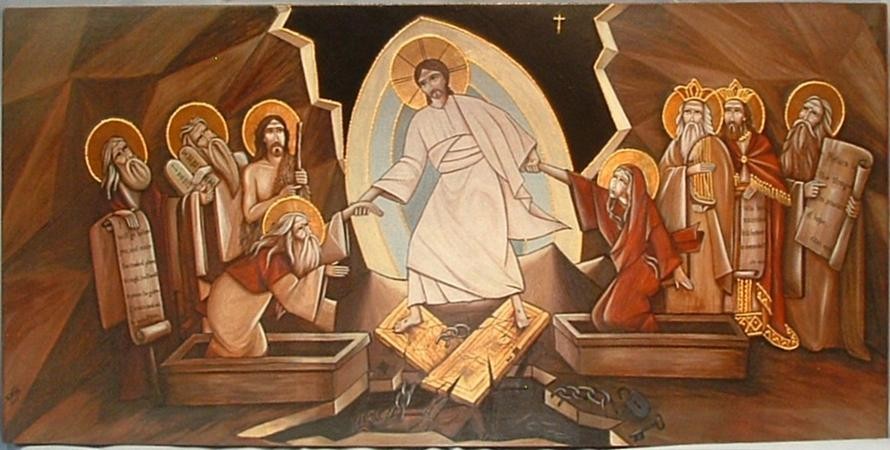
Resurrection Icon

One of my favorite poems is Manifesto: The Mad Farmer Liberation Front by Kentucky farmer and poet Wendell Berry:

Love the quick profit, the annual raise,
vacation with pay. Want more
of everything ready-made. Be afraid
to know your neighbors and to die.
And you will have a window in your head.
Not even your future will be a mystery
any more. Your mind will be punched in a card
and shut away in a little drawer.
When they want you to buy something
they will call you. When they want you
to die for profit they will let you know.

So, friends, every day do something
that won’t compute. Love the Lord.
Love the world. Work for nothing.
Take all that you have and be poor.
Love someone who does not deserve it.
Denounce the government and embrace
the flag. Hope to live in that free
republic for which it stands.
Give your approval to all you cannot
understand. Praise ignorance, for what man
has not encountered he has not destroyed.

Ask the questions that have no answers.
Invest in the millenium. Plant sequoias.
Say that your main crop is the forest
that you did not plant,
that you will not live to harvest.
Say that the leaves are harvested
when they have rotted into the mold.
Call that profit. Prophesy such returns.

Put your faith in the two inches of humus
that will build under the trees
every thousand years.
Listen to carrion – put your ear
close, and hear the faint chattering
of the songs that are to come.
Expect the end of the world. Laugh.
Laughter is immeasurable. Be joyful
though you have considered all the facts.
So long as women do not go cheap
for power, please women more than men.
Ask yourself: Will this satisfy
a woman satisfied to bear a child?
Will this disturb the sleep
of a woman near to giving birth?

Go with your love to the fields.
Lie down in the shade. Rest your head
in her lap. Swear allegiance
to what is nighest your thoughts.
As soon as the generals and the politicos
can predict the motions of your mind,
lose it. Leave it as a sign
to mark the false trail, the way
you didn’t go. Be like the fox
who makes more tracks than necessary,
some in the wrong direction.
Practice resurrection.

I love that poem for its critique of modern society, but mostly I love it for that last line which summarizes the whole poem: “Practice resurrection.”

Another is Gerard Manley Hopkins’ 1918 poem The Wreck of the Deutschland a very long elegy in honor of five Franciscan nuns killed in 1875 when a German passenger liner, the SS Deutschland, sunk off the coast of England. At the end of the poem Hopkins wrote these wonderful lines:

Remember us in the roads,
the heaven-haven of the Reward
Our King back … !
Let him easter in us.

I love that use of easter as a verb? “Let him easter in us.” God eastered Christ after three days. Christ easters in us. It’s the same as Wendell Berry’s admonition to “practice resurrection”! We often say, “Easter isn’t just a day; it’s a season!” These poets show us that it isn’t just a day or a season; it’s a verb! An activity! – Resurrection isn’t just something that happened about 2,000 years ago, or something that will happen sometime in some distant, unknown future; it’s an on-going reality, happening now; a joyful, laughter-producing, cosmic turning of the tables on death in which we are all invited, encouraged, and empowered to participate!

Easter is a verb! “To easter,” to “practice resurrection” is to join in a decision, a decision God took in not giving into the Crucifixion, a decision we can each take every day not giving into the forces of death and despair. To easter is to do all the things Wendell Berry set out in his Mad Farmer Manifesto: loving the Lord, loving the world, working for nothing, planting sequoias, lying down in the shade, willfully losing our minds, and looking forward to the end of the world with laughter!

To easter is to engage in the spiritual process of not giving in . . . not giving in to negation and death . . . not giving in to meaninglessness and despair . . . not giving in to isolation and fear . . . not giving in to powerlessness and incapacitation. Easter is an act of brave human existence. Not just a day-long holiday of bunnies, bonnets, and bluebirds, Easter is an every-day reality, a decision Christ’s Resurrection empowers each of us to take when faced with the inevitable difficulties of life, a decision to “practice resurrection” and refuse to surrender our essential humanity even in the face of death itself.

In the final days of Lent and Holy Week, we look forward to the focused celebration of our God-empowered commitment to practice resurrection as we celebrated the Christ who has eastered in us!

Alleluia! Christ is risen! The Lord is risen indeed! Alleluia!

====================

A request to my readers: I’m trying to build the readership of this blog and I’d very much appreciate your help in doing so. If you find something here that is of value, please share it with others. If you are on Facebook, “like” the posts on your page so others can see them. If you are following me on Twitter, please “retweet” the notices of these meditations. If you have a blog of your own, please include mine in your links (a favor I will gladly reciprocate). Many thanks!

====================

Father Funston is the rector of St. Paul’s Episcopal Church, Medina, Ohio.

Mary Is No Different: Sermon for Advent 4B – December 21, 2014

====================

A sermon offered, on the Fourth Sunday of Advent, Year B, December 21, 2014, to the people of St. Paul’s Episcopal Church, Medina, Ohio, where Fr. Funston is rector.

(The lessons for the day, RCL Advent 4B, were 2 Samuel 7:1-11,16; Canticle 15 [Luke 1:46-55]; Romans 16:25-27; and Luke 1:26-38. These lessons can be read at The Lectionary Page.)

====================
The Episcopal Church is a church of refugees. The majority of Episcopalians were not born into this faith tradition; we came from somewhere else. We are a denomination which attracts refugees from other faith communities, those who’ve had a negative experience somewhere else, or those who can’t stay in their childhood churches because of life circumstances. We often find in our congregations those who were reared in the Roman Catholic tradition but have left that fold because they couldn’t accept the Roman church’s teaching about birth control or abortion, or about the ministry of women in the church, or the several other matters on which we differ with Rome. We also find in Episcopal Church congregations former Roman Catholics who married protestants of one type or another who were unwilling to become Roman Catholic, so we are the church of the marital compromise.

As one of my seminary professors observed, “As long as Methodists keep marrying Roman Catholics, there will be an Episcopal Church.”

I bring this up because today, the Fourth Sunday of Advent, we focus on the Virgin Mary in our gospel readings and whenever I talk with Roman Catholics who are interested in joining our branch of the catholic faith, the subject of Mary always comes up. Do we Episcopalians and other Anglicans revere and venerate the Blessed Virgin in the same way the Church of Rome does? When we consider our Advent 4 gospels, it would certainly seem that we do.

In each of the three years of the Lectionary Cycle, we hear a story about Mary and her pregnancy.

In Year A of the Lectionary (last year) we heard of Joseph’s dream in which an angel says to him, “Joseph, son of David, do not be afraid to take Mary as your wife, for the child conceived in her is from the Holy Spirit. She will bear a son, and you are to name him Jesus, for he will save his people from their sins.” And we are told that Jospeh “took [Mary] as his wife, but had no marital relations with her until she had borne a son; and he named him Jesus.”

In Year B (this year) we hear, as we just have, the story of the angel Gabriel’s Annunciation to Mary.

In Year C we will hear of Mary’s Visitation to her cousin Elizabeth who is “filled with the Holy Spirit and exclaim[s] with a loud cry, ‘Blessed are you among women, and blessed is the fruit of your womb,’” to which Mary replies by singing her famous song of liberation, the Magnificat, which we recited this morning as our Gradual.

So each year on the Fourth Sunday of Advent we consider Christ’s Blessed Mother and contemplate how she is a model for all Christians. But do we revere this holy woman in the same way as the Roman Catholic tradition. The answer is a fairly resounding, “No.”

There are at least two important medieval doctrines about Mary that the Roman tradition holds but that the Anglican tradition generally rejects, although there are Anglicans who adhere to them. (That’s the thing about being an Anglican. It’s practically impossible to say that there are universally accept doctrines or universally rejected doctrines; ours is such a large tent that nearly every variety of Christian belief has found a home under it. But these two doctrines about Mary are pretty generally not the Anglican norm.)

The first is the doctrine of the “Immaculate Conception.” Most non-Roman Catholics think this refers to Jesus’ conception in Mary’s womb by the power of the Holy Spirit. However, it does not. It is, instead, the belief that Mary was conceived by her mother (whom tradition names Anne) and her father (whom tradition names Joachim) without the stain of Original Sin. Although found in the writings of some medieval theologians, particularly among the Franciscans, it was rejected by others, notably Bernard of Clairvaux, Albertus Magnus and Thomas Aquinas. Eventually, however, long after the Reformation, it was made dogma in the Roman tradition. It was not until 1854 that Pope Pius IX decreed “that the Blessed Virgin Mary, at the first instant of her conception, by a singular privilege and grace of the Omnipotent God, . . . was preserved immaculate from all stain of original sin,” and enjoined this belief upon all members of the Roman church. (Ineffabilis Deus, December 8, 1854) While some Anglicans may have accepted this, it is not and never has been a part of official Anglican or Episcopal doctrine.

The point of the doctrine of the “Immaculate Conception” is to set Mary apart from all other women (and men, for that matter) as a holier and more appropriate “vessel” for the incarnation of the Son of God. We may profess, as we do in one of our eucharistic prayers (Prayer C, Book of Common Prayer – 1979, page 370) that, “in the fullness of time [God] sent [God’s] only Son, born of a woman,” but this doctrine declares that she was a woman like no other. Anglican theology, on the other hand, would hold that that turns the whole importance of Mary upside-down; it is precisely because Mary is like other women that her motherhood of Jesus is to be celebrated.

The second of these doctrines about Mary is that of her “perpetual virginity.” Although this idea has been around since the very beginnings of the church, and probably more Anglicans would hold this belief than would accept the “immaculate conception” idea, I believe most Episcopalians would agree with the reformer John Calvin rejected as “unfounded and altogether absurd” the idea that Mary had made a vow or practice of perpetual virginity. In his commentary on Luke’s Gospel, he wrote: “She would, in that case, have committed treachery by allowing herself to be united to a husband, and would have poured contempt on the holy covenant of marriage; which could not have been done without mockery of God.” (Commentary on Luke 1:34, Harmony of Matthew, Mark, and Luke, Vol. 1) On the basis of the clear evidence of Scripture that Jesus had brothers and sisters, Calvin came to the obvious conclusion that Mary had other children. As the 20th Century Anglican New Testament scholar, Canon Leon Morris put it, the “most natural interpretation is that [the un-named ‘brothers of the Lord’] were the children of Joseph and Mary.” (1 Corinthians: Introduction and Commentary, IVP: Leicester, 1958, page 133)

Again the point of this doctrine is to set Mary apart from all other human beings and, again, the Anglican and Episcopal tradition would argue that it is precisely her identity with other human beings, not her difference from us, that makes her so important. Any piety which makes Mary somehow different from you and me misses the point!

Mary is regularly hailed as a model of faith for her acceptance of the role God invites her to play as the mother of Jesus. But what is the very first thing that Gabriel the Angel says to her? “Greetings, favored one! The Lord is with you.” Before Mary accepts anything, before she hears another word, before she consents to God’s notion, she is greeted as “favored,” as one who enjoys the Presence of God. The Greek here is xaritoó which means “to be graced,” “to be blessed.” Mary is blessed even before she accepts her new role; she is blessed because she perceives and believes that God notices her, that God favors her, that God has blessed her, and that God has great things in store for her even before Gabriel tells her what those things may be!

This is important not because Mary is extraordinary or remarkable, not because she is immaculate or perpetually virginal. This is important for precisely the opposite reason. Mary is venerated not because she is an exception, but rather because she is an example of what can happen when anyone believes that God notices, favors, and blesses us, that God has great things in store for every one of us. You are important and so God notices, favors, and blesses you and, like Mary – like plain ol’ ordinary Mary – you may just change the world!

Some of you may now be sitting out there thinking that can’t possibly be the case. If so, by doing so you simply prove my point!

What happens next in this story? Luke specifically tells us that Mary “was much perplexed by [the angel’s] words and pondered what sort of greeting this might be.” Again, if we look at the original Greek we get a much fuller understanding. The word translated here as “perplexed” is dietarachthé. Scholars disagree as to what the root of this adjective might be. Some believe it is diatasso which means “to be puzzled,” while others insist it is diatarasso which mean “to be agitated.”

And Mary’s response to all this puzzlement or agitation is to “ponder,” and here’s where the Greek really gets instructive. The original word is dielogidzeto, which comes from the word dialog. Mary carries on a dialog or debate with herself. Just like any of us, faced with that which puzzles or troubles us, she deliberates over it, facing doubts and uncertainties.

Mary is important not because she is exceptional, but rather because she is just like us. (She was even a refugee – after the birth of her Son, she and her family had to flee to Egypt for a time. Church of refugees that we are, Mary would fit right in!)

In the narthex of St. Gabriel Roman Catholic Church in McKinney, Texas, is a painting of the Annunciation by contemporary artist John Collier. In it Mary is depicted as a young schoolgirl dressed in a blue and white parochial school uniform; she has dark hair pulled into a simple pony-tail; she is wearing white bobby socks and saddle shoes. The angel Gabriel approaches on the threshold of the front door of a modern tract home; it could be the door of any home here in Medina.

Collier’s painting, in my opinion, is brilliant because it emphasizes not merely Mary’s youth, but her utter lack of exceptionality! She is simply an ordinary person. Mary is an ordinary person in an extraordinary circumstance and, thus, she is an example for us. She is like us . . . and we can be like her.

I am indebted to my friend and colleague the Rev. Suzanne Guthrie for reminding me of this observation by the 13th Century German mystic Meister Eckhart:

We are all meant to be mothers of God. What good is it to me if this eternal birth of the divine Son takes place unceasingly, but does not take place within myself? And, what good is it to me if Mary is full of grace if I am not also full of grace? What good is it to me for the Creator to give birth to his Son if I do not also give birth to him in my time and my culture? This, then, is the fullness of time: When the Son of Man is begotten in us.

Each year on this, the Fourth Sunday of Advent, we focus our attention on Mary, not because she is exceptional, but rather because she is just like us. She is like you . . . and you are like her.

Please take a look again at the collect for this morning, the special prayer for the Fourth Sunday of Advent. It’s in the Prayer Book on page 212:

Purify our conscience, Almighty God, by your daily visitation, that your Son Jesus Christ, at his coming, may find in us a mansion prepared for himself; who lives and reigns with you, in the unity of the Holy Spirit, one God, now and for ever. Amen.

“By your daily visitation . . . . ” Every morning an angel of the Lord crosses the threshold of your life . . . every morning, though most mornings you (like me) probably fail to see that angel. And every morning that angel speaks to you . . . every morning, though most mornings you (like me) probably fail to hear that angel. And every morning that angel greets you saying, “Hail! You are graced by the Presence of God” . . . every morning, though most morning you (like me) probably fail to apprehend that greeting. And every morning the angels hold their breath waiting to hear what you (and I) might answer.

Mary is important not because she was conceived immaculately or remained a virgin perpetually. She is important because she is like us and we are like her. It Mary is exceptional, it is because unlike us she saw, and heard, and apprehended, and answered: “Here am I, the servant of the Lord; let it be with me according to your word.” In her exceptionality she is exemplary; she is to be venerated and revered because she demonstrates that we, too, can and should see and hear and apprehend and answer, because this is the fullness of time when the Son of Man is to be begotten in us. Amen.

====================

A request to my readers: I’m trying to build the readership of this blog and I’d very much appreciate your help in doing so. If you find something here that is of value, please share it with others. If you are on Facebook, “like” the posts on your page so others can see them. If you are following me on Twitter, please “retweet” the notices of these meditations. If you have a blog of your own, please include mine in your links (a favor I will gladly reciprocate). Many thanks!

====================

Father Funston is the rector of St. Paul’s Episcopal Church, Medina, Ohio.

Making the Organic Connection: Sermon for Advent 3B – December 14, 2014

====================

A sermon offered, on the Third Sunday of Advent, Year B, December 14, 2014, to the people of St. Paul’s Episcopal Church, Medina, Ohio, where Fr. Funston is rector.

(The lessons for the day, RCL Advent 3B, were Isaiah 66:1-4,8-11; Psalm 8126; 1 Thessalonians 5:16-24; and John 1:6-8,19-28. These lessons can be read at The Lectionary Page.)

====================

Bible and Newspaper “There was a man sent from God, whose name was John. He came as a witness to testify to the light. . . .” (Jn 1:6) The baptism of Jesus is never mentioned in the Gospel of John, so John the forerunner is never called “the Baptist” in this Gospel. He is, instead, the one who testifies, the witness who tells the truth.

Truth telling is risky business, as we all know and as John the witness would find out. He told the truth about Herod Antipas and his adulterous relationship with Herodias, and he lost his head over it. Telling the truth is risky business.

John told the Truth to Power. Dressed like a wild man (according to Mark’s Gospel which we heard last week), he stood in the midst of the People of Israel and interpreted for them the signs of the time in light of the words of the Prophets who had preceded him.

The mid-20th Century theologian Karl Barth is reputed to have advised preachers that they should work the newspaper in one hand and the Bible in the other. Whether he ever actually said that is a matter of some debate, but in a letter to his friend Eduard Thurneysen in November of 1918, he described himself as “brood[ing] alternately over the newspaper and the New Testament” seeking to discern “the organic connection between the two worlds concerning which one should … be able to give a clear and powerful witness.” (Barth to Thurneysen, 11-11-1918) John the testifier of Truth to Power was doing that very thing, making the organic connection between the world of his day and the world of his Scriptures, and giving a clear and powerful witness.

And that is the very thing which you and I and every follower of Jesus Christ are also called to do; it is the ministry not only of the professional theologian, not only of the parish priest and preacher, not only of the prophet; it is the ministry of each and every baptized person to “proclaim by word and example the Good News of God in Christ.” (BCP 1979, page 305) That is the ministry which we promise to undertake when we are baptized, a promise we repeat at every baptism in which we take part.

Today is the second anniversary of the killing of twenty children and six adults at Sandy Hook Elementary School in Newtown, Connecticut. On the Sunday following that awful massacre I stood in this pulpit and told you that I had spent the previous “48 hours following the news reports, weeping, screaming at the television, reading the statements of bishops and other clergy, enraged at the injustice of it, angry because as a society we seem unwilling (not incapable, unwilling) to do anything about the epidemic of gun violence that seems to sweep unchecked across our country.” (2012 Sermon)

I was later advised by a well-meaning member of the congregation suggested that I should turn off the TV, put down the newspaper, disconnect my internet news-feeds, and “just tell the nice parts of the Jesus story.” But I can’t do that, you see, because that wouldn’t be making the organic connection between the world of our day and the world of our Scriptures. That wouldn’t be testifying to the light; that would be lying about the darkness. Psalmist didn’t simply sing about shouldering the sheaves with joy; the Psalmist also paid heed to the fact that that joy follows carrying out the seed with weeping; the harvest of rejoicing comes after the seed is sowed with tears. (Ps 126:6-7)

Rejoicing in the midst of difficulty is the theme of this Third Sunday of Advent! In the tradition of the church, today is known as Gaudete Sunday or “Rejoicing Sunday” because in the medieval church the introit, entrance chant which began the Mass, was Gaudete in Domino semper: iterum dico, gaudete, “Rejoice in the Lord always; again, I say, rejoice,” from Paul’s letter to the Philippians (Phns 4:4), the same message he writes to the Thessalonian church in today’s epistle lesson: “Rejoice always, pray without ceasing, give thanks in all circumstances.” (1 Th 5:16)

This year, as two years ago, it is difficult to focus on that theme of thanks and rejoicing. Although we hold in one hand the Gospel of light, in the other we hold the newspaper coverage of the Senate Intelligence Committee’s executive summary of a report detailing the unspeakable acts of “enhanced interrogation techniques” undertaken by the Central Intelligence Agency as part of the so-called “war on terror.” (See, e.g., Mother Jones) It is difficult to focus on thanksgiving and joy when we read about the things done on our behalf . . . and let’s be honest and not try to distance ourselves from that fact, these things were done on our behalf to gain information to ferret out and punish those who had accomplished, and to protect us from other potential, acts of terrorism.

Let’s also be honest and put to rest the euphemism of “enhanced interrogation techniques” and admit that it is more accurate and truthful to describe the CIA’s actions as torture, as Senator John McCain did in his statement on the Senate floor: “I have long believed some of these practices amounted to torture, as a reasonable person would define it.” (McCain Floor Statement) Unfortunately, the public debate about the CIA’s actions has, in the words of my friend and colleague Tobias Haller, gotten “lost in the utilitarian thicket of ‘did it produce results’ rather than sticking with the basic truth that ‘torture is wrong’.” (Facebook status)

Although it is clear that we, as Americans, can differ on the question of whether torture produces useful information – personally, I agree with Senator McCain “that the abuse of prisoners will produce more bad than good intelligence . . . that victims of torture will offer intentionally misleading information if they think their captors will believe it . . . [and that] they will say whatever they think their torturers want them to say if they believe it will stop their suffering” – although we can differ on that issue, we need to set aside the “utility” question, this red herring about whether torture produces useable intelligence. “Utility” underlies an ends-justifies-means morality which is contrary to, among other things, the Christian faith we claim to hold.

“Utility” is not and never should have been the basis of discussion or consideration of or decision to use torture to gather intelligence. As Christians we believe that God spoke to and through the prophet and commissioned not only him, commissioned not only Jesus who used his words to begin his public ministry, but commissioned all of God’s People

to bring good news to the oppressed,
to bind up the brokenhearted,
to proclaim liberty to the captives, and release to the prisoners;
* * *
to comfort all who mourn. (Isa. 61:1-2)

As Christians who have accepted this as our own ministry in our baptismal promise to “strive for justice and peace among all people, and respect the dignity of every human being,” (BCP 1979, page 305) we must insist that morality, not utility, is and should have been the touchstone for that decision, and that that decision should have been other than it was.

We must speak that Truth to Power. Some of us may feel called to hold signs in marches and protests, though not all of us need do so; some of may feel called to telephone or write our senators and congressmen, though not all of us need do so; some of may feel called to author letters to the editors of national or local publications, though not all of us need do so. What we must all do, however, is witness to the Truth as we know it in our everyday lives: Jesus said to his disciples and says to us today, “You will be my witnesses in Jerusalem, in all Judea and Samaria, and to the ends of the earth.” (Acts 1:8)

We are to witness to and rejoice in the moral truth of the simple command, “Do to others as you would have them do to you.” (Lk 6:31) This, as Jesus made clear, is the heart of the Law and the central message of the Prophets. (Mt 7:12) We witness to this truth when we “love [our] enemies, do good, and [give], expecting nothing in return,” when we are “merciful, just as [our] Father is merciful,” when we refuse to judge, when we forswear condemnation, when we extend forgiveness. (Lk 6:35-37)

There was another story in the news this week, one which initially made me quite sad but in which, in retrospect, I find cause to rejoice.

Last Wednesday there was a funeral in Los Angeles, California. People of faith, from several religious traditions, came together to assist the County of Los Angeles in burying the ashes of nearly 1500 people who had been cremated in 2011 and whose ashes, for a variety of reasons, had been unclaimed by family members for three years. They included over 900 men, over 400 women, and nearly 140 infants and children. They were buried together in one grave with a simple stone bearing only the year, 2011.

According to the report in the L.A. Times, those present decorated the grave with teddy bears and flowers; a cellist played a simple, somber tune. Clergy offer Christian and Jewish prayers; a Hindu chant was intoned. The Lord’s Prayer was said in English, Spanish, Korean and a language from the Fiji Islands. Religious leaders read poems by the late Maya Angelou.

I rejoice that people of faith joined together to pray for the repose of those who had been abandoned, that people of faith took the place of the families who had forgotten them, that people of faith provided for these forsaken dead a human community to mourn their passing.

And this is the relationship between these two otherwise unrelated news stories of the past week. Studies of the survivors of torture demonstrate that they are left with intense feelings of abandonment, with a sense of estrangement from their families and communities, with an inability to form or reform human relationships of dependency and attachments, and with muted and inexpressible rage and grief. Those who are tortured are made to feel like those dead and abandoned ashes.

In concluding his statement on the Senate floor, Senator McCain agreed with me that torture’s immorality, not any concern about its utility, is the reason it should not be used. “In the end,” he said, “torture’s failure to serve its intended purpose isn’t the main reason to oppose its use. I have often said, and will always maintain, that this question isn’t about our enemies; it’s about us. It’s about who we were, who we are and who we aspire to be.”

We Christians stand with our Bible in one hand, with the newspaper in our other, making the organic connection between the world of our day and the world of our Scriptures. Making that connection we must face the question, who do we aspire to be? Who are we called to be? Are we called to be those who, themselves or by delegation to others, make the living feel like dead ashes? Or are we rather called to be those who “comfort [and] provide for those who mourn, [who] give them a garland instead of ashes, the oil of gladness instead of mourning, the mantle of praise instead of a faint spirit?” (Isa 61:2-3)

“Rejoice always, pray without ceasing, give thanks in all circumstances” (1 Th 4:4) that we aspire to the latter calling, the great calling to be Christ’s witnesses, tellers of Truth to Power, to the ends of the earth! Amen.

====================

A request to my readers: I’m trying to build the readership of this blog and I’d very much appreciate your help in doing so. If you find something here that is of value, please share it with others. If you are on Facebook, “like” the posts on your page so others can see them. If you are following me on Twitter, please “retweet” the notices of these meditations. If you have a blog of your own, please include mine in your links (a favor I will gladly reciprocate). Many thanks!

====================

Father Funston is the rector of St. Paul’s Episcopal Church, Medina, Ohio.

The Midterm Zombie Apocalypse – From the Daily Office – November 5, 2014

From the Apocalypse of John of Patmos:

The fifth angel poured his bowl on the throne of the beast, and its kingdom was plunged into darkness; people gnawed their tongues in agony, and cursed the God of heaven because of their pains and sores, and they did not repent of their deeds.

(From the Daily Office Lectionary – Revelation 16:10-11 (NRSV) – November 5, 2014)

The Republicans won control of the Senate. Facebook and other social media this morning are rife with Democrats and other self-styled progressives writhing in agonized self-blaming (or furious finger-pointing). You’d think the fifth angel’s bowl was poured out yesterday on the United States and that we’d been plunged into darkness.

Pah!

Last night my Education for Ministry group did a theological reflection on an image from culture. (EfM folks will have a better understanding of what that means. If you aren’t an EfM participant, I can’t really go into the EfM model of theological reflection here: I recommend you find an EfM group in your area and enroll.)

Our image: Zombies. We talked about the old “voodoo” horror movie model of zombie; the George Romero “living dead” movie version; the AMC television program “The Walking Dead” version; and the new Syfy Channel “Z Nation” version. Zombies, apparently, have changed over the years from living people under the spiritual control of an evil voodoo shaman into dead corpses reanimated by a virus which (I didn’t know this because I don’t watch the television programs) infects everyone! So, everyone dies and everyone comes back as a zombie! Now there’s a metaphor for something; I’m not sure what and I’m not sure it’s spiritually edifying, but there it is.

Zombie Attack

Anyway, we had great fun deeply considering the world of zombies then moving from the culture source into the Christian tradition source, the personal position (belief) source, and the personal experience (action) source. When we reached the end of the evening and came to the application exercise – “How will I apply this reflection? What will I now do?” – one of our thoughts was, “Just go home and shoot myself in the head.” Apparently that prevents one’s coming back as a zombie.

I had no idea I would wake this morning to so many liberal friends and colleagues having that same sort of reaction to the midterm election!

Chill out, folks! The world has not been plunged into a zombie-filled darkness filled with creatures gnawing at their tongues and covered with rotting sores.

One party has taken control of the Congress by a narrow margin in the upper house, but it is a party at war with itself. I think it will actually be fun to see if Mr. McConnell (presumably the new majority leader) can control his caucus any better than Mr. Boehner has controlled his. The split between old line Republicans and the new “Tea Party” Republicans may just grow wider and hamstring the legislative branch even more so than it has done for the past four years. Furthermore, even if they unite, the Democrats hold enough votes to defeat things by fillbuster (an old GOP tactic they will now have to contend with on the receiving end) and a Democratic president still holds the veto power. (See this analysis by the UK’s The Guardian newspaper.)

It’s not John’s end of the world! Nor are Zombies flooding the streets.

I hope that something good can come of this. The New York Times this morning editorializes that there might be greater opportunity for compromise than there has been. Personally, I think they’re wrong; I believe we are in for two-years of mind-numbingly pointless political theater. My prayer is that it is not also spirit-numbing!

The “zombies” in John’s vision did not “repent of their deeds.” My hope and prayer is that we, the “zombies” of the 2014 midterm election, whatever our party or political persuasion, will do so. We are where we are (and we would be here if the Democrats had held onto the Senate, by the way) because, as a nation, we have allowed ourselves to be tribalized and polarized. To a certain extent, when it comes to politics, we are all “zombies,” infected by the unrelenting virus of our political positions and unwilling (perhaps by this time unable) to see any positive in the positions of others.

We need to repent and return to the ways of civility, negotiation, compromise, and actually getting the work of society done.

====================

A request to my readers: I’m trying to build the readership of this blog and I’d very much appreciate your help in doing so. If you find something here that is of value, please share it with others. If you are on Facebook, “like” the posts on your page so others can see them. If you are following me on Twitter, please “retweet” the notices of these meditations. If you have a blog of your own, please include mine in your links (a favor I will gladly reciprocate). Many thanks!

====================

Father Funston is the rector of St. Paul’s Episcopal Church, Medina, Ohio.

Divisive Prayer – From the Daily Office – November 3, 2014

From Luke’s Gospel:

Jesus said, “Do you think that I have come to bring peace to the earth? No, I tell you, but rather division! From now on, five in one household will be divided, three against two and two against three.”

(From the Daily Office Lectionary – Luke 12:51-52 (NRSV) – November 3, 2014)

Ballot BoxThis isn’t what we want or expect to hear from “the Prince of Peace,” but here it is! Jesus is not going to let us “make nice” and “all get along.” He insists that we acknowledge and confront the reality of interpersonal conflict, that we admit that even good news can bring division.

Tomorrow America will go through its regular spasm of national political division and pretend that it is otherwise, that what we do on the first Tuesday of November is a demonstration of unity when we all know it is very much the opposite. In these times of what seems to be ever increasing polarization, families are divided over politics, “father against son and son against father, mother against daughter and daughter against mother, mother-in-law against her daughter-in-law and daughter-in-law against mother-in-law.” (v. 53) We make a joke of it and try to laugh it off, but we all know families (perhaps even our own) where there is discord and disagreement over electoral politics.

Here’s an exercise in frustration: using Google (or whatever your favorite search engine may be) look for the words “election day prayer” on the internet. There are many prayers and many of them begin with lovely words asking God’s blessing upon us as “faithful citizens,” as “brothers and sisters,” but then in amongst the glowing words are the red-flags . . . “cries of children unborn,” “evils of abortion,” “sanctity of marriage,” “Christian nation” on the one side, “reproductive rights,” “marriage equality,” “nation of many cultures” on the other. Prayers ostensibly seeking God’s blessing on national unity phrased in the very terms of division and discord.

I may be prejudiced, but I can think of no better prayer for an election than that found in the Episcopal Church’s Book of Common Prayer

Almighty God, to whom we must account for all our powers and privileges: Guide the people of the United States (or of this community) in the election of officials and representatives; that, by faithful administration and wise laws, the rights of all may be protected and our nation be enabled to fulfill your purposes; through Jesus Christ our Lord. Amen. (BCP 1979, page 822)

“Five in one household will be divided, three against two and two against three.” We are divided by politics and when the votes are counted one side or the other will “win,” at least until the next election. Whichever it may be, let us indeed pray that “the rights of all may be protected.” Amen!

====================

A request to my readers: I’m trying to build the readership of this blog and I’d very much appreciate your help in doing so. If you find something here that is of value, please share it with others. If you are on Facebook, “like” the posts on your page so others can see them. If you are following me on Twitter, please “retweet” the notices of these meditations. If you have a blog of your own, please include mine in your links (a favor I will gladly reciprocate). Many thanks!

====================

Father Funston is the rector of St. Paul’s Episcopal Church, Medina, Ohio.

« Older posts Newer posts »