Occasional thoughts of an Anglican Episcopal priest

Category: Prayer (Page 19 of 47)

Death-Shadow – From the Daily Office – August 2, 2014

From the Psalms:

Though I walk through the valley of the shadow of death, I shall fear no evil;
for you are with me; your rod and your staff, they comfort me.

(From the Daily Office Lectionary [Evening Psalm] – Psalm 23:4 (BCP Version) – August 2, 2014)

Dark ValleyThe 23rd Psalm is so popular, such a familiar and well-loved devotion for so many people, that one is loath to say anything about it. It was something my grandfather (staunch Methodist Sunday School teacher) insisted his grandchildren memorize and recite every night before bed, so I even have personal trepidation about messing with it. But mess with it I will.

I’m critical of the language used by the King James edition interpreters: “the valley of the shadow of death.” It’s not that it’s a bad translation. In fact, it’s almost a verbatim rendering of the Hebrew . . . and that’s the problem! A verbatim rendering misses the point (I think).

My entire life I have personalize “the shadow of death.” I suspect I’m not alone. I’ve always thought of this as a metaphor for the Evil One and, thus, have spiritualized this psalm. I’ve thought it had to do with passing through the some realm in the afterlife like Orpheus seeking Eurydice. But that’s wrong!

The Hebrew is tsalmaveth, a compound word made from tsel meaning “shadow” and maveth meaning “death.” It would best be rendered as “death-shadow,” meaning the deepest, thickest, blackest, gloomiest darkness one can imagine and, figuratively, a place of extreme danger.

The Complete Jewish Bible renders this verse, “Even if I pass through death-dark ravines, I will fear no disaster; for you are with me; your rod and staff reassure me.” Understanding tsalmaveth in this way (as deep darkness and potential extreme danger) makes so much more sense of the “comforted (or reassured) by rod and staff” part!

This isn’t about not going to or through or beyond Hell. It’s about getting through life, through real-life situations of danger, with God’s help.

====================

A request to my readers: I’m trying to build the readership of this blog and I’d very much appreciate your help in doing so. If you find something here that is of value, please share it with others. If you are on Facebook, “like” the posts on your page so others can see them. If you are following me on Twitter, please “retweet” the notices of these meditations. If you have a blog of your own, please include mine in your links (a favor I will gladly reciprocate). Many thanks!

====================

Father Funston is the rector of St. Paul’s Episcopal Church, Medina, Ohio.

Encountering Jesus with Mixed Emotions – From the Daily Office – August 1, 2014

From the Psalms:

When my soul was embittered, when I was pricked in heart, I was stupid and ignorant; I was like a brute beast towards you.

(From the Daily Office Lectionary [Evening Psalm] – Psalm 73:21-22 (NRSV) – August 1, 2014)

Coexist - Religious SymbolsI don’t know what to do about Israel and Palestine. Apparently no one knows what to do about Israel and Palestine. There is so much bitterness and emotion on both sides and from all quarters that no one can even talk about Israel and Palestine.

There’s a Facebook meme that I see from time to time: “How to start an argument online.” The instructions are simple: (1) express an opinion; (2) wait. With regard to the fighting and the deaths in Gaza, this is especially true.

Condemn the government of Israel or the Israeli Defense Force for bombing schools and hospitals . . . one is immediately labeled anti-Semitic.

Express sympathy for the people of Israel who have to deal with Hamas’ rockets . . . get called a Right-wing ideologue.

Vent one’s horror at the deaths of Palestinian women and children . . . you are obviously a supporter of Hamas.

Suggest that maybe the two sides should sit down and work out a way to live together . . . clearly one is naive or, worse, delusional.

So much bitterness and heartsickness on all sides; so much stupid brutishness as a result.

In today’s gospel, Mary Magdalene and the other Mary go to the tomb, find it empty, and encounter an angel. Even though the angel tells them to not be afraid, they are; they leave the tomb “with fear and great joy.” They have, as my late mother was fond of saying about many things, “mixed emotions.” This ought to be, and probably is, what most people have about the situation in Israel and Palestine.

But what we seem incapable of doing is admitting that, that our emotions are mixed. Instead, we latch on to one predominant emotion and let it color every statement and conversation: horror at the death of children and we become passionate defenders of the Palestinians, unable to see that there is some right on the side of the Israelis; fear for the Jewish homeland and we become passionate advocates for the IDF, unable to see that there is good on the Palestinian side, as well. In the thrall of emotion, as the Psalm says, we become stupid and brutish.

The women, with mixed emotions, encountered Jesus.

One of the things we learned on our recent trip to the Holy Land was that there has been a significant, even drastic drop in the percentage of the population which is Christian. Thirty years ago, about 25% of Palestine’s residents were Christian; today, less than 2%. Israel blames “Muslim extremism” for causing the Christian exodus; Palestinians counter that it results from Israeli government policies. It really doesn’t matter, however; the decrease is a fact.

What is also a fact is that, on the ground — not from government or leadership sources, but from people we met on the street, both Israeli Jews and Palestinian Arab Muslims told us in no uncertain terms that they need the Christian presence, that they see in the Christian community the only possibility for peace and reconciliation. They believe that the Christian presence holds the possibility for mediation and a way forward for all.

They made it clear, of course, that by “Christian presence” they mean the traditional churches, the Roman Catholics and the Greek Orthodox, the Lutherans and the Anglicans, not the “Armageddonists,” the fanatics who support the ultra-Orthodox Jews who want to rebuild the Temple, the Dispensationalists who think the recreation of “biblical Israel” will hasten the Rapture, the Tribulation, the final battle, and the return of Christ. The presence of those folks holds only the promise of greater conflict.

No . . . the people we met on the streets and in the shops of Jerusalem, Bethlehem, Nazareth, and elsewhere want, with their mixed emotions, with their bitterness and heartsickness, to encounter Jesus in the people of his church. They want to, as the Lutheran bishop in the Holy Land said yesterday, engage in “interfaith dialogue, a dialogue which seeks the common values of peace, justice, co-existence, and non-violence.” (Bishop Munib Younan)

This is why the traditional Christians of Palestine must stay, and why the traditional Christians of other countries must support them with our prayers and encouragement, our financial contributions, and even our presence. We must not be afraid to go to the Holy Land to stand with them and to greet the other children of Abraham, the Jews and the Muslims, to say to all, as Paul said to the Corinthians, that there is a “still more excellent way.” (1 Cor 12:31)

“Without dialogue between religions, extremism will grow and moderates, including Christians, will be sidelined and marginalized in their own societies. It is time not only for governments to assume their responsibilities, but also people of faith.” (Bishop Younan)

We must not allow mixed emotions, bitterness, or heartsickness to turn us brutish and stupid. Rather, with all of our emotion and our intellects, we must encounter Christ and we must be the Christ others encounter.

====================

A request to my readers: I’m trying to build the readership of this blog and I’d very much appreciate your help in doing so. If you find something here that is of value, please share it with others. If you are on Facebook, “like” the posts on your page so others can see them. If you are following me on Twitter, please “retweet” the notices of these meditations. If you have a blog of your own, please include mine in your links (a favor I will gladly reciprocate). Many thanks!

====================

Father Funston is the rector of St. Paul’s Episcopal Church, Medina, Ohio.

Prayers Not Ended – From the Daily Office – July 30, 2014

From the Psalter:

The prayers of David son of Jesse are ended.

(From the Daily Office Lectionary – Psalm 72:20 (NRSV) – July 30, 2014)

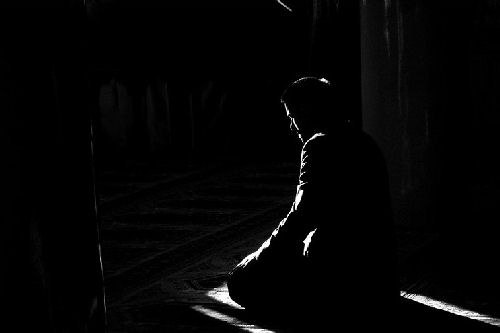
Muslim Man Praying in Sujood“Wait! I’ve never seen that verse.” I probably have, actually, but as with much of Scripture seeing it and paying attention to it are rather different things. In any event, that was my thought as I read the morning psalm today from the Bible instead of from the Book of Common Prayer.

I have read the Psalms four times a year for more than twenty years; I was ordained a deacon in 1990 and began, part of my clergy discipline, the regular round of readings in the Daily Office lectionary including its every-three-month rotation through the Psalter. More than ninety times now, and I cannot recall ever reading, saying, or chanting, “The prayers of David son of Jesse are ended.”

So . . . I turn to page 686 in my Prayer Book and discover . . . it’s not there! Verse 20 simply isn’t there in the Prayer Book version of Psalm 72. Maybe I haven’t ever seen this verse before!

I’m used to not seeing the Psalter’s superscriptions in the BCP, those blocks of information that precede the actual song in many biblical manuscripts, those introductory notes where we find primarily technical, descriptive terms and phrases that relate to the authorship or performance of the psalm to which they are attached. Some are there, but mostly they have been edited away. I presume that the Prayer Book editors considered verse 20 some sort of footnote of similar liturgical or spiritual import to the superscriptions (which is to say none) and, thus, deleted it.

But this morning I find myself drawn to it and intrigued by what it means to say that prayers are “ended,” particularly given alternative translations of the original Hebrew kalah. This word appears frequently in the Hebrew scriptures – over 200 times; it occurs twenty-one times in the Psalms and is variously translated in the psalter and elsewhere.

Here it is given what I take to be the simplest of meanings: Psalm 72 is the last of the psalms (“prayers”) ascribed to David – whatever follows are by other poets. But elsewhere it has been interpreted to mean something quite different.

For example, in Psalm 69 it is used to describe failure of one’s eyesight (for sight to “grow dim” as the NRSV puts it):

I am weary with my crying; my throat is parched. My eyes grow dim with waiting for my God. (Ps. 69:3, NRSV)

I have grown weary with my crying; my throat is inflamed; my eyes have failed from looking for my God. (Ps. 69:4, BCP)

In Psalm 18 it is rendered as “consumed” in the NRSV and as “destroyed” in the BCP:

I pursued my enemies and overtook them; and did not turn back until they were consumed. (Ps. 18:37, NRSV)

I pursue my enemies and overtake them; I will not turn back till I have destroyed them. (Ps. 18:38, BCP)

What if these meanings are what the final, BCP-exluded verse of Psalm 72 is really getting at? What would it mean to end a psalm with the thought, “The prayers of David have failed” or “The prayers of David are consumed” or “The prayers of David are destroyed”? In light of today’s conflicts throughout the world, especially in the Middle East, and most especially in Israel-Palestine, Psalm 72’s petition that the rulers of nations be given righteousness that they may govern with justice and in peace would certainly seem to have failed . . . .

Perhaps the most poignant and fitting alternative translation of kalah is found in Psalm 84, in which it is rendered as expressing deep desire and longing (“yearning”):

My soul longed and even yearned for the courts of the Lord; My heart and my flesh sing for joy to the living God. (Ps. 84:2, NRSV)

My soul has a desire and longing for the courts of the Lord; my heart and my flesh rejoice in the living God. (Ps. 84:1b, BCP)

Given the tenor of the petitions of Psalm 72, I think this may be the best way to understand verse 20. The psalms, the prayers of David are not ended. They are not destroyed or consumed. They have not failed . . . but neither have they not been answered. The world still longs for peace. The world still yearns for justice. The world still desires righteousness.

This is why the church continues, day in and day out, every three months, four times a year, to read, recite, chant, and sing the psalms. They express a deep, a very deep still-unfulfilled yearning for the reign of God. The prayers of David son of Jesse are not ended. Perhaps the Prayer Book editors were right in omitting verse 20 . . . .

====================

A request to my readers: I’m trying to build the readership of this blog and I’d very much appreciate your help in doing so. If you find something here that is of value, please share it with others. If you are on Facebook, “like” the posts on your page so others can see them. If you are following me on Twitter, please “retweet” the notices of these meditations. If you have a blog of your own, please include mine in your links (a favor I will gladly reciprocate). Many thanks!

====================

Father Funston is the rector of St. Paul’s Episcopal Church, Medina, Ohio.

Foundation Stones – From the Daily Office – July 28, 2014

From the Letter to the Romans:

Greet Prisca and Aquila, who work with me in Christ Jesus, and who risked their necks for my life, to whom not only I give thanks, but also all the churches of the Gentiles. Greet also the church in their house. Greet my beloved Epaenetus, who was the first convert in Asia for Christ. Greet Mary, who has worked very hard among you. Greet Andronicus and Junia, my relatives who were in prison with me; they are prominent among the apostles, and they were in Christ before I was. Greet Ampliatus, my beloved in the Lord. Greet Urbanus, our co-worker in Christ, and my beloved Stachys. Greet Apelles, who is approved in Christ. Greet those who belong to the family of Aristobulus. Greet my relative Herodion. Greet those in the Lord who belong to the family of Narcissus. Greet those workers in the Lord, Tryphaena and Tryphosa. Greet the beloved Persis, who has worked hard in the Lord. Greet Rufus, chosen in the Lord; and greet his mother — a mother to me also. Greet Asyncritus, Phlegon, Hermes, Patrobas, Hermas, and the brothers and sisters who are with them. Greet Philologus, Julia, Nereus and his sister, and Olympas, and all the saints who are with them. Greet one another with a holy kiss. All the churches of Christ greet you.

(From the Daily Office Lectionary – Romans 16:3-16 (NRSV) – July 28, 2014)

Foundation StonesPaul often ends his correspondence with these requests that the readers convey his personal greetings to specifically named people. I often find myself skimming those parts of the reading, just passing quickly over them. But, also, I often find myself pausing at these names, wondering about them. Who were they? What did they do in their daily lives? How is it that Paul was personally acquainted with them?

Once upon a time I thought about preaching a series of sermons — or maybe writing some short stories — based on fanciful biographies for these named but now forgotten members of the early church. I gave up on that when I realized I had neither the gift for fiction nor sufficient knowledge of daily life in the First Century to do so credibly. Maybe someone else will do that — I would be among his or her readers if someone did.

When I read these names, I cannot help but think of a passage in the Book of Sirach, a passage read at my late brother’s funeral several years ago:

Let us now sing the praises of famous men, our ancestors in their generations. The Lord apportioned to them great glory, his majesty from the beginning. There were those who ruled in their kingdoms, and made a name for themselves by their valor; those who gave counsel because they were intelligent; those who spoke in prophetic oracles; those who led the people by their counsels and by their knowledge of the people’s lore; they were wise in their words of instruction; those who composed musical tunes, or put verses in writing; rich men endowed with resources, living peacefully in their homes — all these were honored in their generations, and were the pride of their times. Some of them have left behind a name, so that others declare their praise. But of others there is no memory; they have perished as though they had never existed; they have become as though they had never been born, they and their children after them. But these also were godly men, whose righteous deeds have not been forgotten; their wealth will remain with their descendants, and their inheritance with their children’s children. (Sirach 44:1-11)

These friends of Paul are those of whom “there is no memory,” those who “have perished as though they had never existed; they have become as though they had never been born.” Nothing of their lives remains other than these greetings in Paul’s letters. And there are countless others of those early followers of Jesus of whom even less is left . . . .

Except, of course, the church. These forgotten followers of the way are the lowest course of the living stones which are built up into the spiritual house that is the church (1 Pt 2:5), that “house not made with hands, eternal in the heavens.” (2 Cor 5:1) They are the foundation stones lying next to and alongside the Cornerstone.

The church is “their wealth [which] remains with [us] their descendants.” So don’t pass over the names of those to whom Paul sends personal greetings. Pause and give thanks for them. Without them, we wouldn’t be here.

====================

A request to my readers: I’m trying to build the readership of this blog and I’d very much appreciate your help in doing so. If you find something here that is of value, please share it with others. If you are on Facebook, “like” the posts on your page so others can see them. If you are following me on Twitter, please “retweet” the notices of these meditations. If you have a blog of your own, please include mine in your links (a favor I will gladly reciprocate). Many thanks!

====================

Father Funston is the rector of St. Paul’s Episcopal Church, Medina, Ohio.

Parables and Women’s Ordination – Sermon for Pentecost 7, Proper 12A – July 27, 2014

====================

On the Seventh Sunday after Pentecost, July 27, 2014, this sermon was offered to the people of St. Paul’s Episcopal Church, Medina, Ohio, where Fr. Funston is rector.

(The lessons for the day were: 1 Kings 3:5-12, Psalm 119:129-136, Romans 8:26-39, and Matthew 13:31-33,44-52. These lessons can be read at The Lectionary Page.)

====================

Philadelphia 11 Ordination

Tell all the truth but tell it slant,
Success in circuit lies,
Too bright for our infirm delight
The truth’s superb surprise;
As lightning to the children eased
With explanation kind,
The truth must dazzle gradually
Or every man be blind.

That’s a wonderful poem, isn’t it? Tell All The Truth by Emily Dickinson: “Tell all the truth but tell it slant;” come at it obliquely, shaded as it were, because “the truth must dazzle gradually” otherwise everyone will be blinded. But for the fact that she wrote it 1868, I would suspect Jesus of having read it and following her advice in today’s gospel discourse. These several parables are very “slanted”!

Of course, it is very unlikely that Jesus related all of these parables at one time, the two we heard the last two Sundays and these five (or is it six) that are in today’s lesson, but that is the way Matthew presents them. Most probably, these seven or eight metaphors for God’s dominion were things Jesus said at different times, but as the oral tradition transmitted them to and through his followers in the years afterward the specific circumstances of each were forgotten. Just the “slanted” sort of weird imagery was remembered, so Matthew writing his gospel tale a few decades later was left to figure out how to fit them in and decided to just put them all together in one teaching session. So we have these five (or is it six) all lumped together on one Sunday, five ways to understand — I use that word advisedly — to understand God’s sovereignty played out “on earth as it is in Heaven.” The holy domain is

  • like a mustard seed (and the mighty big bush it grows into);
  • like yeast (leaven) in a lot of flour;
  • like a treasure buried in a field;
  • like a pearl of incredible value;
  • like a dragnet gathering in an abundance of fish; and
  • (maybe, I’m not sure of this one counts as a parable)
    like a scribe tossing out a bunch of stuff, old and new.

As one commentator has suggested, “That is probably four [or is it five] images too many for one sermon.” So let’s deal with the first one primarily, the mustard seed and the tree into which Jesus says it grows.

Tree imagery as a metaphor for empire was well-known in Jesus’ time. There are at least three very important instances of it in the Hebrew scriptures, so it was familiar to the scribes, the priests, the rabbis, the Pharisees, and the Sadducees, and those who preached in the synagogues had probably made it fairly well known to their congregations, to folk like those who heard Jesus tell this parable. Those three instances are found in Ezekiel, Daniel, and the Psalms.

In the 17th Chapter of Ezekiel we read:

Thus says the Lord God: I myself will take a sprig from the lofty top of a cedar; I will set it out. I will break off a tender one from the topmost of its young twigs; I myself will plant it on a high and lofty mountain. On the mountain height of Israel I will plant it, in order that it may produce boughs and bear fruit, and become a noble cedar. Under it every kind of bird will live; in the shade of its branches will nest winged creatures of every kind. All the trees of the field shall know that I am the Lord. I bring low the high tree, I make high the low tree; I dry up the green tree and make the dry tree flourish. I the Lord have spoken; I will accomplish it. (Ez 17:22-24)

In the 4th Chapter of Daniel, King Nebuchadnezzar of Bablyon tells Daniel of a dream he has had:

Hear the dream that I saw; tell me its interpretation. Upon my bed this is what I saw; there was a tree at the center of the earth, and its height was great. The tree grew great and strong, its top reached to heaven, and it was visible to the ends of the whole earth. Its foliage was beautiful, its fruit abundant, and it provided food for all. The animals of the field found shade under it, the birds of the air nested in its branches, and from it all living beings were fed. (Dan 4:9-12)

As Daniel interprets the dream, the tree represents Nebuchadnezzar and his kingdom.

And, finally, from Psalm 104, these words would have been sung in the Temple liturgy:

You make grass grow for flocks and herds *
and plants to serve mankind;
That they may bring forth food from the earth, *
and wine to gladden our hearts,
Oil to make a cheerful countenance, *
and bread to strengthen the heart.
The trees of the Lord are full of sap, *
the cedars of Lebanon which he planted,
In which the birds build their nests, *
and in whose tops the stork makes his dwelling.
(vv. 14-18, BCP version)

Yes, metaphors of mighty trees would be part of the spiritual landscape familiar to Jesus’ hearers. But not mustard bushes! The people who first heard Jesus preach this parable must have thought he was crazy, or that he was mocking the prophets, or that he was making a joke at the expense of the priests and the rabbis.

The mustard was not, is not, despite what Jesus said, “the greatest of shrubs [which] becomes a tree, so that the birds of the air come and make nests in its branches.” The white mustard which grows in the Middle East is an invasive weed, a self-propagating, rapidly-growing, garden-ruining, field-destroying weed. Let it get into your growing space and you will never get rid of it. Jesus’ parable is not, like Ezekiel’s prophecy or the psalm’s liturgical praise, a story of a mighty and stately cedar tree. It is a “frightening tale of an invasive plant sowed perhaps in desperation because it grows and therefore might produce something usable quickly, but with it is the threat that because it is so hard to get rid of it may stultify the land and make it unavailable for future better crops. Once it is grown big it will seed itself again and again….” (English clergyman Christopher Burkett) It can’t be controlled!

And that may be the point of Jesus’ metaphor: the domain of God is like the mustard seed, not because from small things great things may come (the usual interpretation of this parable), but rather because the invasive mustard cannot be controlled. It is like the Wind of God which “blows where it chooses, and you hear the sound of it, but you do not know where it comes from or where it goes.” (Jn 3:8) Once it gets started, you cannot control it.

It’s one of those Jesus-turns-the-world-on-its-head things, Jesus-tells-the-truth-in-a-slanted-way things, using a perverse and noxious weed as a metaphor for the reign of God.

The parable of the yeast in the dough makes that same point! Our NRSV translation says that the woman “mixed” it into her flour and we assume that this would be so that the bread would rise. However, the Greek verb Jesus uses is not the word for “mix.” It is the word in Greek is engkrupto — the root of our word “encryption” — it means “to hide” or “to conceal.” Like the tiny mustard seed, the yeast could not be seen — it was hidden in the meal, into “three measures” of the meal, which is an important detail.

Yeast, for us, is a useful ingredient in baking. For First Century Jews, however, yeast was a problem; for Jews of Jesus’ day leaven was a symbol of filth and corruption. Anything that was leavened with yeast was forbidden in the Temple. This woman was playing with fire! As a symbol of God’s dominion, this yeast is fire of the Holy Spirit: wherever it is present, things get changed and transformed. A tiny, hidden bit of it can work major changes — when we understand that that “three measures” of flour is enough to make 150 loaves of bread, we get that point! The growth of the yeast and the changes it makes in a huge amount of dough are as uncontrollable as the invasive mustard weed that takes over the field — and the point is the same: you cannot control the reign of God; once it gets started, look out!

Yet another of those Jesus-turns-the-world-on-its-head things, Jesus-tells-the-truth-in-a-slanted-way things, using the foul corruption of leaven as a metaphor for the reign of God.

The hiddenness of the yeast, the small invisibility of the mustard seed, link these parables with the next two — the treasure hidden in the field and the unexpected discovery of the priceless pearl. The reign of God is not only uncontrollable, it is surprising. Hidden, invisible, unexpected, it comes upon us in surprising ways and, uncontrollable though it may be, the changes it makes in our lives are beyond price, more valuable than we could ever imagine.

Which brings us to the last two metaphors, the dragnet full of fish, some good, some bad, in need of sorting out, and the scribe who is like a master of a household sorting old and new. The metaphor of the fish is yet another image of the final judgment, like the separating of wheat from the darnel in the parable of the weeds, or the sorting of the sheep from the goats in Jesus’ description of the Last Day; it is a warning for the sinful, but also a promise for those who faithfully follow the Lord. What, however, are we to make of the master of the house bringing out things old and things new?

This parable, it has been suggested, authorizes the followers of Christ who have been properly instructed, who have studied our catechisms and who have continued to study scripture and church tradition, who are schooled in the scriptures and in our communities’ histories, to re-interpret that scripture and that tradition, to bring out of our treasure of scripture and tradition that which is new, new insights, new interpretations, new ways of being God’s People even though those may not explicitly have been recorded in any previous text, to tell the truth slanted in a way that no one has slanted it before.

This accords with the ancient presupposition that properly trained scribes had the ability to decipher and interpret sacred texts. Followers of Jesus are to be trained scribes. They — WE — are to continuously study the scriptures, to be educated and trained, to have the ability to invoke tradition (the “something old”) and to contribute novel insights that have not previously offered (the “something new”).

On Tuesday, we celebrate the fortieth anniversary of a small, but remarkable event in the life of the church. On July 29, 1974, eleven women were ordained to the priesthood at Church of the Advocate in Philadelphia, Pennsylvania. Their ordination was not sanctioned by the canons of the church; the ordination of women had been hotly debated in two or three or more meetings of the General Convention, but had not yet been approved. Nonetheless, four bishops decided that they could not wait further parliamentary wrangling on the question.

Newsworks, a Philadelphia news journal, this week published this description of the service:

It was hot that day — July 29, 1974 — and the church was packed with more than 2,000 people — including family, congregants, and media. Not all were friendly.

“There was one protester who was very dramatic and said that these women could offer up nothing but the sight, sound, and smell of perversion,” said [Allison] Cheek [one of the eleven]. “Some in the congregation began to boo and hiss at that moment.”

“On one level it was scary,” said [Nancy] Wittig, another member of the 11. “But it was very clear as we got started that this was not just some vacant daydream by a bunch of women, but indeed a movement that was happening in the church.”

Delivering the sermon was Charles Willie, an African-American professor of education at Harvard University and a member of the Episcopal House of Deputies. He compared the ordination to the civil rights movement.

“This shouldn’t be seen as an act of arrogant disobedience,” said Dr. Willie from the podium. “But an act of tender defiance.” (Newsworks, 24 July 2014)

That “act of tender defiance” changed the church. The next meeting of the General Convention, in 1976, voted to approve the priestly ordination of women and, as Newsworks noted, the decision was “broader than just allowing women to the priesthood — it called for gender equality at all levels of church hierarchy, including bishops.” Today, nearly a third of the priests in our church are women and our current presiding bishop is a woman: the Most Rev. Katharine Jefferts Schori.

If the protestor at the ordination of the Philadelphia 11 was right, if there was about it “the sight, sound, and smell of perversion,” it was the perverseness of the mustard seed; it was the corruption of the yeast hidden in three measures of flour; it was the uncontrollable contrariness of the Holy Spirit and it has changed the church.

And for that we give thanks. Let us pray:

God of surprises, you startle us with truth we do not see, as we do not see the mustard seed; with truth that may be hidden from us, as the yeast is hidden in the dough; with truth that is as surprising as the unexpected treasure and as priceless as the great pearl. We thank you for the ministry of women throughout the church, and especially for the ministry of women ordained to the priesthood; we offer you special thanks for the witness and ministry of the Philadelphia 11 and of the bishops and others who supported them in their discernment of your call to priesthood. Amaze us with your power and grace; call us, empower us, and lead us through your uncontrollable Spirit to bring out of our treasure and into service in your world things new and things old, that your Name may be glorified among all people. All this we ask through your Son our savior Jesus Christ, who is alive and reigns with you and that same Spirit, one God, now and forever. Amen.

====================

A request to my readers: I’m trying to build the readership of this blog and I’d very much appreciate your help in doing so. If you find something here that is of value, please share it with others. If you are on Facebook, “like” the posts on your page so others can see them. If you are following me on Twitter, please “retweet” the notices of these meditations. If you have a blog of your own, please include mine in your links (a favor I will gladly reciprocate). Many thanks!

====================

Father Funston is the rector of St. Paul’s Episcopal Church, Medina, Ohio.

Wringing the Past’s Neck – From the Daily Office – July 24, 2014

From the Gospel according to Matthew:

Now Peter was sitting outside in the courtyard. A servant-girl came to him and said, “You also were with Jesus the Galilean.” But he denied it before all of them, saying, “I do not know what you are talking about.” When he went out to the porch, another servant-girl saw him, and she said to the bystanders, “This man was with Jesus of Nazareth.” Again he denied it with an oath, “I do not know the man.” After a little while the bystanders came up and said to Peter, “Certainly you are also one of them, for your accent betrays you.” Then he began to curse, and he swore an oath, “I do not know the man!” At that moment the cock crowed. Then Peter remembered what Jesus had said: “Before the cock crows, you will deny me three times.” And he went out and wept bitterly.

(From the Daily Office Lectionary – Matthew 26:69-75 (NRSV) – July 24, 2014)

Icon of St PeterTraveling in Palestine recently, I was accompanied by a priest who had formerly been a Benedictine monk. In religious life, he had taken the name “Peter” and adopted St. Peter the Apostle as his patron.
One day in conversation about some icons in a Jerusalem church, he pointed out that there is almost a chiastic relationship between this story (which John also relates, Jn 18:16-27) and a post-resurrection story in the Gospel according to John.

The latter is the story of the grilled fist breakfast on the beach of the Galilean lake. The disciples, out fishing, see a figure on the shore which they then realize is Jesus. Jesus calls to them and invites them to share some fish he is cooking over a fire. As they are eating, he engages Peter in conversation:

Jesus said to Simon Peter, “Simon son of John, do you love me more than these?” He said to him, “Yes, Lord; you know that I love you.” Jesus said to him, “Feed my lambs.” A second time he said to him, “Simon son of John, do you love me?” He said to him, “Yes, Lord; you know that I love you.” Jesus said to him, “Tend my sheep.” He said to him the third time, “Simon son of John, do you love me?” Peter felt hurt because he said to him the third time, “Do you love me?” And he said to him, “Lord, you know everything; you know that I love you.” Jesus said to him, “Feed my sheep.” (John 21:15-17)

Peter’s three-fold denial is answered by Jesus’ three-fold commission to tend to the flock. The denial notwithstanding, Jesus affirms Peter’s on-going position as one of (some would say the chief of) his apostles, those he has sent into the world to continue his work. There is a lovely chiastic symmetry to the stories.

My new friend, the former Benedictine, told me that when he took his vows in the order an icon writer created an icon of Peter for him (not the icon illustrating this reflection). In the icon, Peter is wringing the rooster’s neck! In many ways, that simple bit of artistic license underscores for me the humanity of Peter and also illustrates the truth that Jesus’ forgiveness empowers us to overcome the past.

Most of us — probably all of us — have (or will) in one way or another denied Jesus. I’m confident that Jesus has already forgiven us (many times over) for those denials. Thinking of that icon, I believe Jesus has given us the power to “wring the neck” of the circumstances which may have led us to those denials. We may not be able to change the past, but through the forgiveness of Christ and the grace of God we can change the way the past influences the future.

====================

A request to my readers: I’m trying to build the readership of this blog and I’d very much appreciate your help in doing so. If you find something here that is of value, please share it with others. If you are on Facebook, “like” the posts on your page so others can see them. If you are following me on Twitter, please “retweet” the notices of these meditations. If you have a blog of your own, please include mine in your links (a favor I will gladly reciprocate). Many thanks!

====================

Father Funston is the rector of St. Paul’s Episcopal Church, Medina, Ohio.

Bless [All] the People of Israel – From the Daily Office – July 23, 2014

From the Book of Joshua:

All Israel, alien as well as citizen, with their elders and officers and their judges, stood on opposite sides of the ark in front of the levitical priests who carried the ark of the covenant of the Lord, half of them in front of Mount Gerizim and half of them in front of Mount Ebal, as Moses the servant of the Lord had commanded at the first, that they should bless the people of Israel.

(From the Daily Office Lectionary – Joshua 8:33 (NRSV) – July 23, 2014)

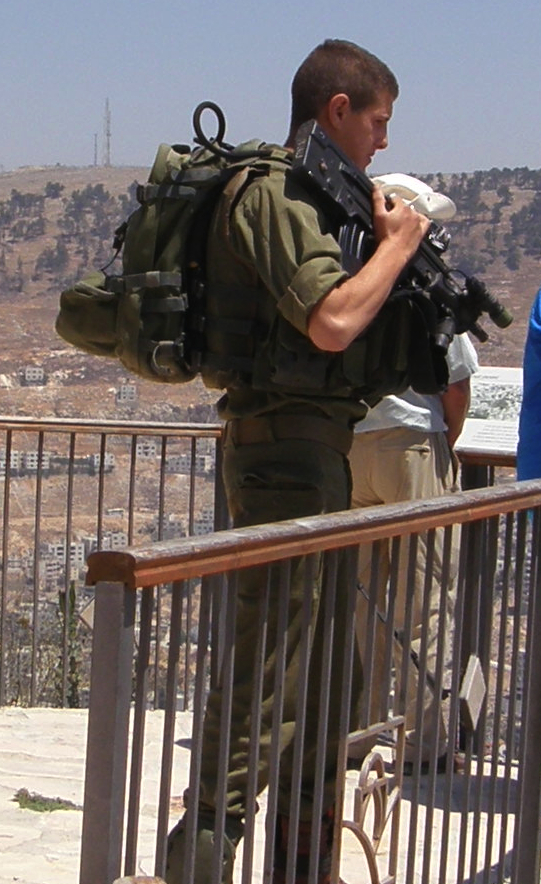
Soldier at Mt GerizimTwo weeks ago, I stood on Mt. Gerizim with 17 friends looking over to Mt. Ebal. We read this text; we read Deuteronomy 27 in which the explicit curses to be read from Mt. Ebal are set forth. We pondered what it means for a people to live in a land divided by blessings and curses. Lost in our thoughts, we were startled when we turned around and found a young Israeli soldier standing behind us in full battle gear, an Uzi loaded and held at the ready.

Some of us found him threatening, but we were told that he was there for our protection. The lookout is a spot where Jewish pilgrims also like to come and remember their heritage; it is in full view of the Arab city of Nablus and a sniper on the city’s outskirts with a high-powered rifle could pick off someone standing at the lookout. I don’t know if that has ever happened, but the young soldier was there to make sure it didn’t or that, if it did, the gunfire would be answered.

I’m sure there might be some radical lunatic who might try such a thing, but in the three days we spent in Nablus, walking its streets, eating in its restaurants, greeting its people, I certainly never met or encountered anyone whom I thought to be such a threat.

In any event, I wonder about that young soldier now. Has he been transferred the fifty or so miles from his outpost on the ancient mountain to the modern battleground on the border with the Gaza Strip? Is he safe? Has he been wounded or killed? Is he preparing for a ground battle in Gaza? I’ll never know, of course, but I wonder.

There was a report recently that in Sderot, an Israeli community less than three miles from the Gaza community of Beit Hanoun, the Jewish residents sat in their lawn chairs watching the bombing of their Palestinian neighbors, laughing and cheering as the bombs exploded. An Australian CNN reporter filmed them doing so.

I couldn’t help but think about that when I read today’s story of Joshua. I couldn’t help but remember standing on Mt. Gerizim and wondering what it must have been like to hear from the mountain across the valley the voices of Joshua and others yelling out the curses. Ancient Jews on a hillside pronouncing curses on the land a couple of miles away; modern Jews on a hillside laughing derision and cheering destruction on the land a couple of miles away. Ancient history come to life in modern Palestine; an ancient ritual now played out as if in some obscene parody with modern weapons of terrible vengeance. Would the residents of Sderot have laughed and cheered if they knew that young soldier might be in danger where those bombs were exploding? Did it matter to them that other young soldiers, not to mention women, children, elderly people, disabled people, and other civilians, were dying where those bombs were exploding?

I don’t ask to imply or suggest any condemnation of them. God knows Americans have no high moral ground to stand on in this regard! It’s a well-known fact of American history that the residents of Washington DC took picnic baskets out to the hillside overlooking Bull Run to watch what became the first Civil War battle at that site. And, more recently, many of us cheered and partied in the streets when we learned of the death of Osama bin Laden. Laughing derision and cheering the destruction of those we consider our enemies is a universal human behavior. We just don’t consider them to be quite like us.

But they are like us. They have lives like ours. As Shakespeare’s Shylock pointed out when contemplating the differences (or lack of differences) between Jew and Gentile:

I am a Jew. Hath not a Jew eyes? Hath not a Jew hands, organs, dimensions, senses, affections, passions? Fed with the same food, hurt with the same weapons, subject to the same diseases, healed by the same means, warmed and cooled by the same winter and summer as a Christian is? If you prick us, do we not bleed? If you tickle us, do we not laugh? If you poison us, do we not die? And if you wrong us, shall we not revenge? If we are like you in the rest, we will resemble you in that. If a Jew wrong a Christian, what is his humility? Revenge. If a Christian wrong a Jew, what should his sufferance be by Christian example? Why, revenge. The villainy you teach me I will execute — and it shall go hard but I will better the instruction. (Merchant of Venice, Act 3, Scene 1)

Is that what is happening now? In unknowingly acting out that bizarre caricature of the curses from Mt. Ebal, in carrying out their “containment” of the Palestinians behind a “security barricade,” in bombing the herded-together densely-packed residents of Gaza (1.8 million people on a piece of land only 139 square miles in size; 13,000 people per square mile) is that what Israel is doing? Bettering the instruction that Gentile society, Christian Europe specifically, has taught the Jews? Is that what is happening? The abused become the abuser and doing it “better”? The accursed become the curser and doing it “better”?

I am commended by Scripture to “bless the people of Israel.” I am commended by Scripture to pray for the peace of Jerusalem. I can only do so if I include in my blessing all the people of Israel, Jew and Arab, Muslim and Christian, secular Jew and Orthodox, Amenians and Greeks, all the people of the land. I can only do so if my prayer is for a peace which is just to all and in which all are secure, “alien as well as citizen.”

Bless the people of Israel and pray for the peace of Jerusalem.

====================

A request to my readers: I’m trying to build the readership of this blog and I’d very much appreciate your help in doing so. If you find something here that is of value, please share it with others. If you are on Facebook, “like” the posts on your page so others can see them. If you are following me on Twitter, please “retweet” the notices of these meditations. If you have a blog of your own, please include mine in your links (a favor I will gladly reciprocate). Many thanks!

====================

Father Funston is the rector of St. Paul’s Episcopal Church, Medina, Ohio.

At the End, There Is God – From the Daily Office – July 22, 2014

From the Letter to the Romans:

We do not live to ourselves, and we do not die to ourselves. If we live, we live to the Lord, and if we die, we die to the Lord; so then, whether we live or whether we die, we are the Lord’s.

(From the Daily Office Lectionary – Romans 14:7-8 (NRSV) – July 22, 2014)

Coffin in GraveThe Book of Common Prayer (1979) lifts these verses and, together with others, uses them in the anthem with which the Burial Office (Rite Two) begins:
I am Resurrection and I am Life, says the Lord.
Whoever has faith in me shall have life,
even though he die.
And everyone who has life,
and has committed himself to me in faith,
shall not die for ever.

As for me, I know that my Redeemer lives
and that at the last he will stand upon the earth.
After my awaking, he will raise me up;
and in my body I shall see God.
I myself shall see, and my eyes behold him
who is my friend and not a stranger.

For none of us has life in himself,
and none becomes his own master when he dies.
For if we have life, we are alive in the Lord,
and if we die, we die in the Lord.
So, then, whether we live or die,
we are the Lord’s possession.

Happy from now on
are those who die in the Lord!
So it is, says the Spirit,
for they rest from their labors.

The first paragraph is from Jesus’ conversation with Martha of Bethany when she met him on the road when he came following her brother Lazarus’s death. (John 11:25-26) The second is from Job; it is part of Job’s reply to Bildad the Shuhite. (Job 19:25-27) The conclusion is from Revelation; John of Patmos is told to write this after seeing the “one hundred forty-four thousand” elect and as the angels of God harvest what Julia Ward Howe called “the grapes of wrath.” (Rev. 14:13)

The 1928 Prayer Book had a similar but rather more resigned opening anthem compiled from Scripture, the first two paragraphs being the same, but a third concluding paragraph was taken from 1 Timothy 6:7 and Job 1:21. Where the newer anthem presents the hope of eternal rest, the older feels like a shrug of the shoulders and a sigh of “Oh well, it’s over – it was fun while it lasted.” I’m sure that’s not the original intent of the drafters, but that’s my reaction to it:

I am the resurrection and the life, saith the Lord: he that believeth in me, though he were dead, yet shall he live: and whosoever liveth and believeth in me, shall never die.

I know that my redeemer liveth, and that he shall stand at the latter day upon the earth: and though this body be destroyed, yet shall I see God: whom I shall see for myself, and mine eyes shall behold, and not as a stranger.

We brought nothing into this world, and it is certain we can carry nothing out. The Lord gave, and the Lord hath taken away; blessed be the name of the Lord.

Although the newer anthem is more positive and comforting in my opinion, the theological import of the two is the same; life ends and at its end, there is God.

Both represent a liturgical model of what I find most attractive about the Anglican approach to Scripture. They are theological statements constructed from a holistic understanding of the Bible. They draw from multiple sources within the holy text, from both Hebrew and Christian scriptures, to fashion a statement which succinctly, but memorably summarizes the Christian hope.

Whether we live or die, we are the Lord’s. At the end, there is God.

====================

A request to my readers: I’m trying to build the readership of this blog and I’d very much appreciate your help in doing so. If you find something here that is of value, please share it with others. If you are on Facebook, “like” the posts on your page so others can see them. If you are following me on Twitter, please “retweet” the notices of these meditations. If you have a blog of your own, please include mine in your links (a favor I will gladly reciprocate). Many thanks!

====================

Father Funston is the rector of St. Paul’s Episcopal Church, Medina, Ohio.

The Hope of the Poor – From the Daily Office – July 14, 2014

From the Psalter:

For the needy shall not always be forgotten, and the hope of the poor shall not perish for ever.

(From the Daily Office Lectionary – Psalm 9:18 (BCP Version) – July 14, 2014)

Palestinian RefugeesOne of the Daily Office versicle-and-response couplets in the suffrages for both Morning Prayer and Evening Prayer is based on this verse of Psalm 9:

V. Let not the needy, O Lord, be forgotten;
R. Nor the hope of the poor be taken away.
(BCP 1979, Morning, page 98; Evening, page 122)

I’ve always liked that couplet, but over the years I’ve come to believe that it is what (back in the 1960s and ’70s) we used to call “a cop out.” Both the Psalm and the versicle-and-response are in the passive voice. They leave open the questions — by whom might the needy be forgotten? by whom might the hope of the poor be taken away? By God? Not likely. By other human beings? Probably. By we who are singing the Psalm and praying the suffrages? Yep, we’re the ones, but we hide behind that passive voice and fail to take responsibility.

I wonder if Jesus had this psalm in mind when Judas objected to Mary of Bethany anointing his feet:

Six days before the Passover Jesus came to Bethany, the home of Lazarus, whom he had raised from the dead. There they gave a dinner for him. Martha served, and Lazarus was one of those at the table with him. Mary took a pound of costly perfume made of pure nard, anointed Jesus’ feet, and wiped them with her hair. The house was filled with the fragrance of the perfume. But Judas Iscariot, one of his disciples (the one who was about to betray him), said, “Why was this perfume not sold for three hundred denarii and the money given to the poor?” (He said this not because he cared about the poor, but because he was a thief; he kept the common purse and used to steal what was put into it.) Jesus said, “Leave her alone. She bought it so that she might keep it for the day of my burial. You always have the poor with you, but you do not always have me.” (Jn 12:1-8)

The Psalm calls upon God to render justice, “Rise up, O Lord, let not the ungodly have the upper hand; let them be judged before you.” (v. 19, BCP) But how does God do that except through us? If we have the poor with us always, it is only because of inaction on the part of the society within which the poor live. If we always have conflict, it is only because the society in conflict fails to find peace. If we always have fear, it is only because the society which fears has failed to find courage. If we always have hate, it is only because the society which hates has refused to love.

It’s time to give up the passive voice. It’s time to take ownership of our failures and do something about them.

Let us not forget the needy, O Lord.
We shall not take away the hope of the poor.
Amen.

====================

A request to my readers: I’m trying to build the readership of this blog and I’d very much appreciate your help in doing so. If you find something here that is of value, please share it with others. If you are on Facebook, “like” the posts on your page so others can see them. If you are following me on Twitter, please “retweet” the notices of these meditations. If you have a blog of your own, please include mine in your links (a favor I will gladly reciprocate). Many thanks!

====================

Father Funston is the rector of St. Paul’s Episcopal Church, Medina, Ohio.

Following Our Own Devices Doesn’t Work – From the Daily Office – July 12, 2014

From the Letter to the Romans:

Of Israel he says, “All day long I have held out my hands to a disobedient and contrary people.”

(From the Daily Office Lectionary – Romans 10:21 (NRSV) – July 12, 2014)

Israeli Security Barricade in BethlehemPaul quotes Isaiah here. His translation was obviously rather different from the rendering in the New Revised Standard Version, but the meaning is the same: “I held out my hands all day long to a rebellious people, who walk in a way that is not good, following their own devices.” (Isa 65:2)

The point cannot be made strongly enough nor forcefully enough nor clearly enough that the modern nation-state of Israel is not the biblical people of Israel, and yet these words of condemnation can be fully understood to apply to the modern country.

Having spent two weeks in the Holy Land, I’ve seen what the nation of Israel is doing to the Palestinian people, and I can fully understand (if not entirely sympathize with) the anger and frustration that have overflowed into violence. I understand the intifadas.

I have walked beside the tall, concrete, barbed-wire-topped, machine-gun-equipped, guard-tower-punctuated, grafitti-defaced wall that Israel has built through the Palestinian homeland. Israel calls it a “security barricade,” and its defenders like to point out that many stretches of it are “simply a fence” (a barbed-wire and chain-link fence, one notes). Whatever one calls it, it has ghettoized Palestinians (both Muslims and Christians), created what are essentially “reservations” of Arabs (not unlike the reservations the United States created for Native Americans), and separated people from their loved ones and their livelihoods (many farmers, herd and flock owners, and orchard owners have been cut off from and denied access to their fields, their pastures, and their orchards). Those who build such things “walk in a way that is not good” and “follow their own devices.”

The barricade is just one part of a much larger social program of oppression being practiced by the Israelis against the original inhabitants of the land they moved onto in 1948 and the lands they have occupied since 1967: poor schools, inadequate social services, intermittent (or non-existent) provision of utilities, segregation, creation of high quality roads on which it is illegal for Palestinians to travel through their own country, denial of import and export rights to Palestinian business, and the list could go on.

Why? As I listened to Israeli Jews defend this state of affairs, the bottom-line justification always seems to come back to the Holocaust. “Never again,” they say. And what they seem to mean is, “Never again to us . . . so we do it to someone else.” That’s what it is, a paying forward of bad stuff, really truly awful stuff!, done to them. When it was done to them, it was the paying forward of bad stuff done to Germany in the aftermath of the First World War. When it was done to Germany, it was a paying forward of bad stuff done to other Europeans. And one could probably trace it all back and back and back to first bad stuff done by someone to someone.

Will it stop here? If (as an Israeli commander is recently quoted as saying) the Israelis “wipe out” people seen as “enemies of God” (they aren’t, by the way) will it end? No, obviously not. Genocide has been tried before and it doesn’t work. No people can “wipe out” another, and in the current context that is painfully obvious. The Palestinian diaspora will still be there and eventually they would pay it back to Israel or pay it forward to someone else.

It will only stop, it will only end if all the people of God, all the children of Abraham — Jewish, Muslim, and Christian — can come together as equals and agree to stop it. So long as we rely on our own devices, so long as we are contrary and disobedient the conflict and the killing will go on. Only by relying on the faithfulness of God can this horror be brought to an end. As the last of today’s evening Psalms says:

Praise the Lord, all you nations;
laud him, all you peoples.
For his loving-kindness toward us is great,
and the faithfulness of the Lord endures for ever.
Hallelujah!
(Ps 117, BCP Version)

Following our own devices doesn’t and won’t work. Only relying on God’s faithfulness can and will.

====================

A request to my readers: I’m trying to build the readership of this blog and I’d very much appreciate your help in doing so. If you find something here that is of value, please share it with others. If you are on Facebook, “like” the posts on your page so others can see them. If you are following me on Twitter, please “retweet” the notices of these meditations. If you have a blog of your own, please include mine in your links (a favor I will gladly reciprocate). Many thanks!

====================

Father Funston is the rector of St. Paul’s Episcopal Church, Medina, Ohio.

« Older posts Newer posts »