Occasional thoughts of an Anglican Episcopal priest

Category: Prayer (Page 24 of 47)

Yeast Infection – From the Daily Office – February 7, 2014

From the Psalter:

When my mind became embittered,
I was sorely wounded in my heart.
I was stupid and had no understanding;
I was like a brute beast in your presence.
Yet I am always with you;
you hold me by my right hand.
You will guide me by your counsel,
and afterwards receive me with glory.

(From the Daily Office Lectionary – Psalm 73:21-24 (BCP Version) – February 7, 2014.)

The Pillsbury Doughboy suffers a massive yeast infectionSeldom has depression been so artfully described as in these few lines of Hebrew poetry. Translated in the Prayer Book as “embittered,” the Hebrew is chamets which refers to yeast. It means “to be leavened” or “to be sour.” Most versions of the Scriptures translate it with some version of “bitterness,” a few use “grieved,” and the Complete Jewish Bible renders the verse, “when I had a sour attitude.” I rather like that last one, closest to the Hebrew, best; it describes depression perfectly.

Several years ago, sixteen to be exact, I went through a severe depressive episode requiring treatment with medication and cognitive therapy. Both of those were helpful but of most value was my work was a spiritual director, really learning the discipline of daily prayer. In the course of that episode, I learned about psychological rumination, how to recognize its early stages, and how to get myself out of it.

The word rumination is borrowed by psychology from biology; it derives from the Latin ruminare meaning “to chew again.” It is the process by which ruminants (animals like cows, goats, sheep, giraffes, yaks, deer, and camels) digest their food. Having consumed and swallowed it, they regurgitate it together with digestive juices, chew it again to thoroughly mix it (“chewing the cud” we call that), and swallow it again.

In psychology, and especially with regard to depression, it refers to the process of returning again and again to replay in one’s mind, think over, regret, and obsess about some small but painful incident. It describes a useless but harmful feedback loop of negative emotion.

The Hebrew language’s and, thus, the psalm’s use of leavening to describe this process is nothing short of brilliant; it is wisdom. The process of rumination is exactly like the process of leavening. As the yeast fills the lump of bread dough, the negative emotions of rumination fill one’s every thought, every moment. The result, as the psalm says, is that one becomes “stupid” (ba`ar — ” brutish”) and “ignorant” (lo-yada — “lacking understanding”). In my own experience, when I would get stuck in a rumination cycle I simply became unable think outside of the feedback loop of negative thoughts; sometimes I couldn’t even think at all — I would simply “zone out.” Talk about “brutish” and “ignorant” — that was me in those ruminant moments!

But as the psalm suggests, there is a way out: God holds me by my right hand; God guides me by God’s counsel. For me, the structures of Prayer Book liturgy provided a way out of the cycle of rumination. If I could just get my hands on a Prayer Book and begin to read the Daily Office, or the prayers and thanksgivings section, the cadences of prayer would break through the obsessive replaying and over-thinking of whatever had triggered the cycle. I found, in fact, that the older language forms of the Rite One liturgies (or the 1928 Book of Common Prayer) were best for this purpose.

Depression is an awful thing. (As I contemplated it this morning — in a non-ruminative fashion — in light of the Hebrew linkage to leavening, I was tempted write something about a “yeast infection of the spirit” . . . but decided not to get there. I’ll just plant that image and leave it for later contemplation.) It is an awful thing, but there are ways to deal with it and ways to get out of it. I know, from personal experience. The best way is the one today’s psalm reminds us of — the guidance and counsel of God.

====================

A request to my readers: I’m trying to build the readership of this blog and I’d very much appreciate your help in doing so. If you find something here that is of value, please share it with others. If you are on Facebook, “like” the posts on your page so others can see them. If you are following me on Twitter, please “retweet” the notices of these meditations. If you have a blog of your own, please include mine in your links (a favor I will gladly reciprocate). Many thanks!

====================

Father Funston is the rector of St. Paul’s Episcopal Church, Medina, Ohio.

Joyful Noise – From the Daily Office – February 2, 2014

From the Psalter:

My heart is firmly fixed, O God, my heart is fixed;
I will sing and make melody.
Wake up, my spirit; awake, lute and harp;
I myself will waken the dawn.

(From the Daily Office Lectionary – Psalm 57:7-8 (BCP Version) – February 3, 2014.)

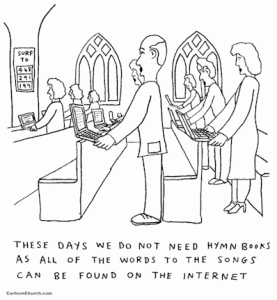
Internet Hymns Cartoon by Dave WalkerI am neither a musician nor a singer. Years ago (in public junior high school) I took instruction on the B-flat clarinet and the bass clarinet, but then I attended a private high school which had a drum-and-bugle corps rather than a full band with woodwinds, so no further playing of the reeds. As an adult, I tried to learn to play the guitar, the piano, and the bassoon, all with the same result: I do not play any instrument.

Although, as a result of all those attempts at music instruction, I can read music, I cannot vocally reproduce what I see on the page. I am in awe of those who can look at a sheet of music and start singing a piece they’ve never heard before! My eyes, brain, and vocal cords just are not connected in that way. I have to hear a piece at least once (usually several times) in order to reproduce it in any recognizable form. And don’t ask me to sing any part other than the melody; if I try to sing something else, I will inevitably wander back to the melody line.

And yet, I love music! I love to sing. I don’t understand people who won’t sing. That tired old excuse, usually put in their heads by some cruel music teacher in grade school, “I can’t carry a tune in a bucket,” should be banned from the church. Everyone can sing! The human voice is the instrument God gave every one of us. Every human being should join the chorus.

We may not all be able, like David or like those talented sight-readers, to “sing and make melody,” but we can all “waken the dawn.” God’s commandment about vocal praise is not “sing beautiful on-key harmonizations pleasing to your neighbor’s ear;” the commandment is “Make a joyful noise unto the Lord!” (Ps. 100:1, KJV) We can all make noise! In the narthex (entryway) of my last parish we hung a sign reading, “If you can’t sing good, sing LOUD!” Mark a joyful noise!

====================

A request to my readers: I’m trying to build the readership of this blog and I’d very much appreciate your help in doing so. If you find something here that is of value, please share it with others. If you are on Facebook, “like” the posts on your page so others can see them. If you are following me on Twitter, please “retweet” the notices of these meditations. If you have a blog of your own, please include mine in your links (a favor I will gladly reciprocate). Many thanks!

====================

Father Funston is the rector of St. Paul’s Episcopal Church, Medina, Ohio.

I Saw the Light! – Sermon for the Feast of the Presentation – February 2, 2014

====================

This sermon was preached on the Feast of the Presentation (“Candlemas”), February 2, 2014, at St. Paul’s Episcopal Church, Medina, Ohio, where Fr. Funston is rector.

(The lessons for the day were: Malachi 3:1-4; Psalm 24:7-10; Hebrews 2:14-18; and Luke 2:22-40. These lessons can be read at The Lectionary Page.)

====================

Simeon's Moment by Ron DiCianni

Lord, now lettest thou thy servant depart in peace, *
according to thy word;
For mine eyes have seen thy salvation, *
which thou hast prepared before the face of all people,
To be a light to lighten the Gentiles, *
and to be the glory of thy people Israel.
(BCP 1979, p. 66)

Some texts just need to be recited in the language of an earlier era. I have said that canticle almost every night since I was 14 years old and first became an Episcopalian, and although I find the truth perhaps better spoken in the more modern translations that we find in the New Revised Standard Version of the Bible and in the modern language of the Rite II Evening Prayer service, there is an elegance to the poetry of the earlier Books of Common Prayer. Simeon’s song is known liturgically as the Nunc Dimittis, and I find it comforting as a bedtime prayer.

Old Simeon had been hanging around the Temple for many years, a devout and orthodox Jew, hoping to see the coming of the Messiah; indeed, he believed he had been promised by God that he would not die before seeing the Messiah. One day, this young couple of poor, country folk came in to perform the sacrifices of purification and redemption, the restoration of Mary to ritual purity following childbirth and the pydion haben or redemption of their first-born male child. As soon as he saw them and the baby they brought, he knew his hope was realized, that God had kept God’s promise.

I’ve always heard behind the older translation, “now lettest thou thy servant depart in peace,” a hint of Simeon’s own death, a sort of “now I can die happy” statement. The more modern translation of the NRSV, however, has none of that dark foreshadowing: “Now you are dismissing your servant” has no hint of death in it, but it lacks the exuberance of the Prayer Book’s Rite II version, “You now have set your servant free to go in peace as you have promised.” In Simeon’s encounter with the Child, he is set free! I can almost hear him breaking into Hank Williams’ joyful country hymn I Saw the Light:

I saw the light; I saw the light;
No more darkness, no more night.
Now I’m so happy, no sorrow in sight.
Praise the Lord! I saw the light!

I can just see him dancing in the Temple holding this Holy Infant! Simeon is not just dismissed; he is set free, not to die, but to live! He can, of course, die happy; but before that he can live free. He is among the first of the redeemed.

In bringing the infant Jesus to the Temple, Mary and Joseph are continuing what they began at his circumcision; they are raising this child to be an observant Jew, they are teaching him to be a child of the Law, a participant in the Covenant from birth on. Mary comes to be restored after giving birth, which according to the Torah, rendered her ritually unable to participate in the religious life of her people. The Law of Moses in the Book of Leviticus, Chapter 12, prescribes:

If a woman conceives and bears a male child, she shall be ceremonially unclean seven days . . . . On the eighth day the flesh of his foreskin shall be circumcised. Her time of blood purification shall be thirty-three days; she shall not touch any holy thing, or come into the sanctuary, until the days of her purification are completed. . . . When the days of her purification are completed . . . she shall bring to the priest . . . a lamb in its first year for a burnt offering, and a pigeon or a turtledove for a sin offering. . . . If she cannot afford a sheep, she shall take two turtledoves or two pigeons, one for a burnt offering and the other for a sin offering.

With this ritual, Luke conflates the ritual of redemption, the pydion haben. In Exodus, Chapter 13, God says, “You shall set apart to the Lord all that first opens the womb. . . . Every firstborn male among your children you shall redeem.” (vv. 12-13) In the third chapter of Numbers, this command is repeated: “All the firstborn are mine; when I killed all the firstborn in the land of Egypt, I consecrated for my own all the firstborn in Israel, both human and animal; they shall be mine. I am the Lord.” (Num. 3:13) The price of redemption is then set at five “shekels of the sanctuary, a shekel of twenty gerahs.” (v. 47) Luke leaves out this detail, but it is very likely that Mary and Joseph carried through as required by the Law.

Joseph and Mary, as my colleague Juan Oliver has noted, “are the embodiment of the majority of Jews, who, illiterate and too poor to offer any sacrifice, lived perennially in a state of ritual defilement or ‘sin.'” We observe in their adherence to these rituals, in their making of these offerings, the lowliness of Jesus’ family and their marginalized position in society, but more importantly their participation in the full life of their faith. It is from that fullness of faith that Jesus’ self-understanding and his mission flows. Because of his parents’ faithfulness to the Law, Simeon sees in this infant “a light to lighten the Gentiles, and to be the glory of [God’s] people Israel.” Hope flows even from places of extreme poverty when those with the least embrace the rituals of an abundant life.

We began our worship this morning with one of our own “rituals of an abundant life.” From very early on in the life of the Christian community, it has been a tradition to carry candles on this day, and to bless the candles that the church will use throughout the coming year. For that reason, an alternative name of this Feast of the Presentation is “Candlemas,” the Mass of the candles. The tradition of blessing the candles dates to the mid-Fifth Century, and the candle procession is first attested to in the Diary of Egeria which describes such a procession in Jerusalem in middle of the Fourth Century.

An 11th Century Cistercian abbot, Blessed Guerric of Igny (c.1070-1157), preached of the symbolism of the Candlemas procession:

Behold then, the candle alight in Simeon’s hands. You must light your own candles by enkindling them at his, those lamps which the Lord commanded you to bear in your hands. So come to him and be enlightened that you do not so much bear lamps as become them, shining within yourself and radiating light to your neighbors. May there be a lamp in your heart, in your hand, and in your mouth: let the lamp in your heart shine for yourself, the lamps in your hand and mouth shine for your neighbors. The lamp in your heart is a reverence for God inspired by faith; the lamp in your hand is the example of a good life; and the lamp in your mouth are the words of consolation you speak.

Go forth then from this place and, like Simeon, speak of the freedom Jesus gives us, speak words of consolation, spread the light of Christ, the light to enlighten the Gentiles. Go forth and sing, “I saw the light! I saw the light! No more sorrow! No more night! Praise the Lord! I saw the Light!” Amen.

====================

A request to my readers: I’m trying to build the readership of this blog and I’d very much appreciate your help in doing so. If you find something here that is of value, please share it with others. If you are on Facebook, “like” the posts on your page so others can see them. If you are following me on Twitter, please “retweet” the notices of these meditations. If you have a blog of your own, please include mine in your links (a favor I will gladly reciprocate). Many thanks!

====================

Father Funston is the rector of St. Paul’s Episcopal Church, Medina, Ohio.

Chaotic Water – From the Daily Office – February 1, 2014

From the Gospel of John:

When evening came, his disciples went down to the lake, got into a boat, and started across the lake to Capernaum. It was now dark, and Jesus had not yet come to them. The lake became rough because a strong wind was blowing. When they had rowed about three or four miles, they saw Jesus walking on the lake and coming near the boat, and they were terrified. But he said to them, “It is I; do not be afraid.” Then they wanted to take him into the boat, and immediately the boat reached the land towards which they were going.

(From the Daily Office Lectionary – John 6:16-21 (NRSV) – February 1, 2014.)

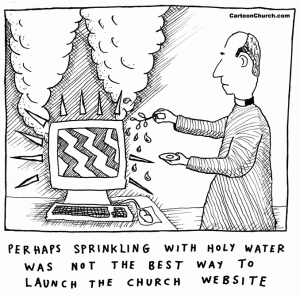
Blessing the Church Computer copyright Dave WalkerToday, February 1, is the ancient Irish feast of Imbolc, considered the beginning of spring and sacred to the goddess Brigid; it has become the commemoration of St. Brigid of Kildare, sometimes called Ireland’s “other patron saint.” (The lesson from John’s Gospel, however, is simply the Daily Office reading, not specific to the saint’s day.) Among the traditions of Imbolc (and, thus, of St. Brigid’s feast) is the visiting of holy wells, walking around them in prayer, and taking some of their water to be used to bless people and things.

For ancient peoples, the sea and other large bodies of water were vast, chaotic, and frightening places. In the ancient middle east, the sea was deified as Tiamat, goddess of primordial chaos and mother of the gods. In Irish mythology, the chaotic and dangerous sea separates the land of the living from the Otherworld, called Tír na nÓg (“Land of Youth”). Holy wells are viewed as places where the chaotic, spiritual dimension breaks into the everyday world.

Jesus’ walking on the water is a story told in three of the Gospels: Mark, Matthew, and John — Matthew adds Jesus inviting Peter to join him. It is a demonstration of the Lord’s mastery over the chaotic; Matthew’s addition of the invitation to Peter and Peter’s being able to do so until, as writer Madeleine L’Engle put it, “he remembered he didn’t know how” is symbolic of the empowerment Christ offers us to do the same.

Quantum Space-TimeIn a sense, we walk on the surface of chaos all the time. One of the learnings from quantum mechanics is that things are not nearly as solid as they seem. The everyday world seems to “float” on what has been called a “quantum foam.” The Greeks posited that if we continue to divide matter we get to atoms; if we divide atoms, we get electrons, neutrons, and other subatomic particles; if we try to divide subatomic particles, eventually we get to get quantum fields and even multidimensional vibrating strings. At the quantum level, reality is a quivering mass of quantum chaos. We walk on the surface of chaos all the time!

The story of Jesus (and Peter) walking on the water and the reality of the quantum chaos beneath our everyday lives should remind us that we do know how to do this. Water as a symbol of blessing is also a reminder of that; when we bless water and then use it to bless other things, like the Irish use the water from holy wells, we are declaring that we have the power and ability to deal with the chaos and to control the chaos in our lives.

====================

A request to my readers: I’m trying to build the readership of this blog and I’d very much appreciate your help in doing so. If you find something here that is of value, please share it with others. If you are on Facebook, “like” the posts on your page so others can see them. If you are following me on Twitter, please “retweet” the notices of these meditations. If you have a blog of your own, please include mine in your links (a favor I will gladly reciprocate). Many thanks!

====================

Father Funston is the rector of St. Paul’s Episcopal Church, Medina, Ohio.

Punctuation and Spirituality – From the Daily Office – January 29, 2014

From the Gospel of John:

[Jesus said:] “Very truly, I tell you, the hour is coming, and is now here, when the dead will hear the voice of the Son of God, and those who hear will live. For just as the Father has life in himself, so he has granted the Son also to have life in himself; and he has given him authority to execute judgment, because he is the Son of Man. Do not be astonished at this; for the hour is coming when all who are in their graves will hear his voice and will come out — those who have done good, to the resurrection of life, and those who have done evil, to the resurrection of condemnation.”

(From the Daily Office Lectionary – John 5:25-29 (NRSV) – January 29, 2014.)

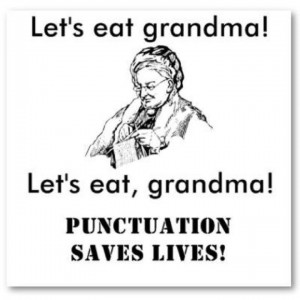
Punctuation Saves LivesThere are times when I’m reading one or another of the Gospels and I am pulled up short; I just have stop and say, “Really? Jesus said that? Really?”

This is one of those times! Did Jesus really say (and I paraphrase), “We’re going to get people up out of their graves just so we can punish them.” That’s what verse 29 is saying with that weird turn of phrase “the resurrection of condemnation”; all the dead will be raised, some to life and some to condemnation. (Whether that means an eternity of punishment or simply annihilation is another issue I’ve dealt with before and won’t address again today.)

Maybe what Jesus said ended before this verse; maybe this is John interpreting what Jesus said. Perhaps the quotation from Jesus should end with the words “because he is the Son of Man” and the part that starts “Do not be astonished” is John’s commentary. Could be. It’s an issue that could be solved by judicious use of punctuation. Unfortunately, John didn’t use punctuation and where to insert quotation marks, periods, commas, etc. is left to the “best guess” of modern translators based on noun declensions, verb tenses, and a colloquial understanding of the original language.

You see, punctuation is a modern invention. So are spaces between the words, although they have been around longer than colons, semi-colons, and full stops. Spaces were the bright idea of Irish monks working in early medieval scriptoria about 1400 years ago; punctuation marks came along about a thousand years later. They weren’t even all that common when the translators of the Authorized (“King James”) version made their estimations of where to put them in the biblical text in 1611.

The lack or improper placement of punctuation can lead to interesting misunderstandings. A popular t-shirt design noting that “punctuation saves lives” demonstrates its point with two similarly worded but radically different sentences:

“Let’s eat Grandma.”

versus

“Let’s eat, Grandma.”

Scripture itself contains an example of a misunderstanding which punctuation might have cleared up. In Mark’s Gospel, the writer applies a prophecy of Isaiah to John the Baptizer saying that his is “the voice of one crying out in the wilderness: ‘Prepare the way of the Lord, make his paths straight,'” (Mk. 1:3) Isaiah, however, seems to have said something slightly different: “A voice cries out: ‘In the wilderness prepare the way of the Lord, make straight in the desert a highway for our God.'” (Isa. 40:3) Matthew and Luke, relying on Mark, repeat his slightly altered quotation — compare Matt. 3:3 and Luke 3:4. Is the voice crying out in the wilderness or is the way of the Lord in the wilderness? The gospellers and the prophet seem to have a disagreement.

So which is it in John’s Gospel? Should the quotation from Jesus be ended a sentence earlier and the bit about getting people out their graves only to condemn them be attributed to the writer instead? To do so would, I admit, fly in the face of centuries of understanding of Jesus’ words to the Jewish authorities when they confronted him in the Temple following the healing of the crippled man at the pool of Bethesda, from which this text is taken. But it’s at least a possibility to consider, and it highlights how carefully one must read scripture.

Punctuation, as the t-shirt says, can save lives. It can also have a significant impact one’s spirituality!

====================

A request to my readers: I’m trying to build the readership of this blog and I’d very much appreciate your help in doing so. If you find something here that is of value, please share it with others. If you are on Facebook, “like” the posts on your page so others can see them. If you are following me on Twitter, please “retweet” the notices of these meditations. If you have a blog of your own, please include mine in your links (a favor I will gladly reciprocate). Many thanks!

====================

Father Funston is the rector of St. Paul’s Episcopal Church, Medina, Ohio.

The Neighbors Can See In! — Sermon for the Annual Parish Meeting — January 26, 2014

====================

This sermon was preached on the Patronal Feast Sunday of St. Paul’s Episcopal Church, Medina, Ohio, where Fr. Funston is rector. It was the Sunday of the Annual Parish Meeting and, as part of the service, a newly built Gallery addition to the parish’s fellowship hall was dedicated.

(The lessons for the day were for the Conversion of St. Paul from the Episcopal Church’s sanctoral calendar: Acts 26:9-21; Galatians 1:11-24; Psalm 67; and Matthew 10:16-22. These lessons can be read at The Lectionary Page.)

====================
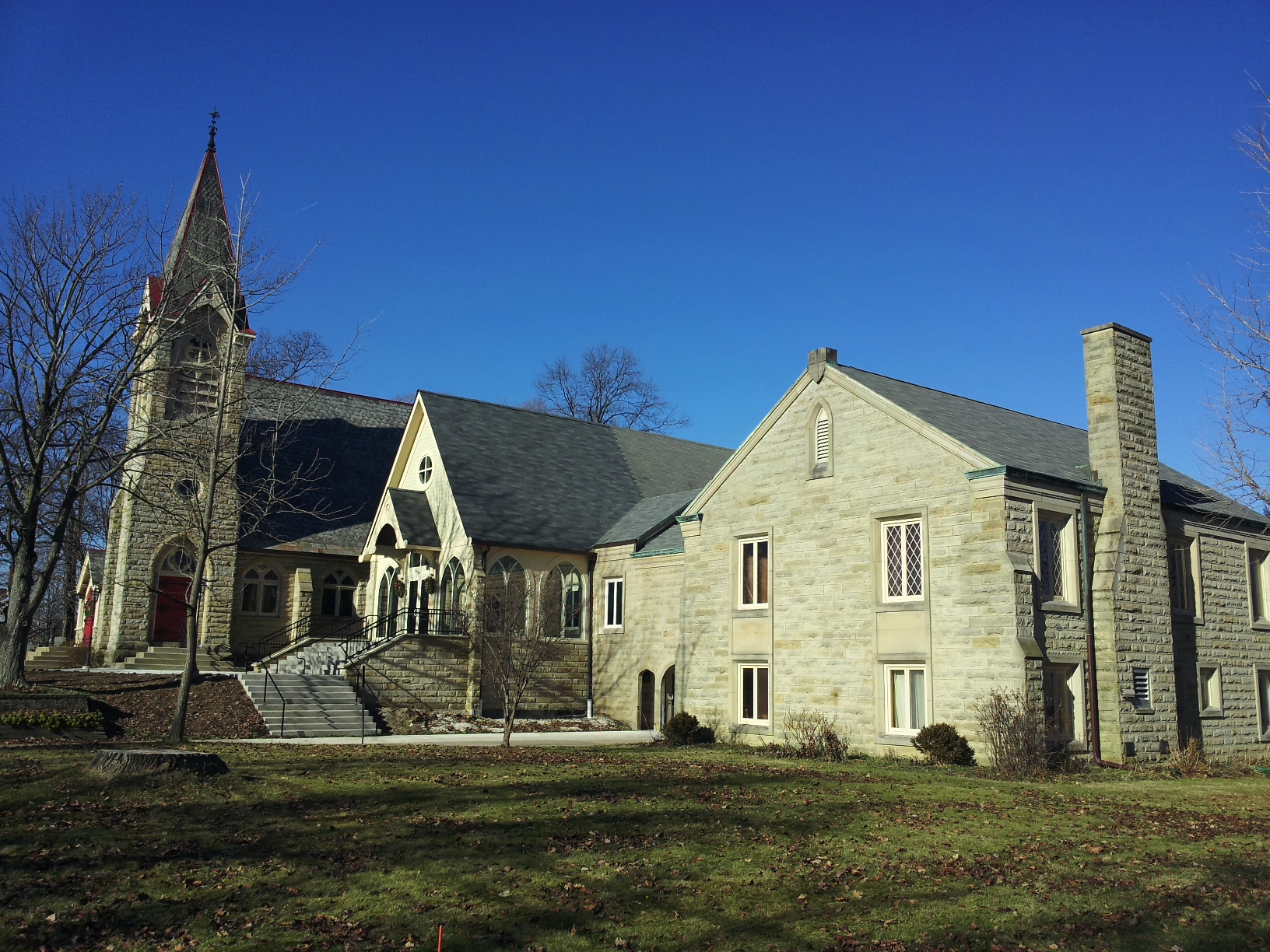
St Paul's Church -- December 2013

A few decades ago when I was studying law I was introduced to the term “officious intermeddler.” In law, an officious intermeddler is someone who, on their own and without any authority either by invitation or pre-existing legal duty, interjects himself into the affairs of another, and then seeks some sort of recompense for doing so. That pretty much describes young Saul of Tarsus and at least his initial quest to rid Judaism of the followers of Jesus of Nazareth. He was simply a rabbinic student, not any sort of priest or religious official when he began his crusade against Peter and James and the others. I don’t think he was doing it for money, but I do think he might have been looking for a pay-off in the form a religious reputation; if he was successful, he would become a powerful rabbi among the Jewish the people.

Saul was born and raised in the Greek city of Tarsus and apparently received a good education both in orthodox Judaism and in Greek philosophy; Tarsus was a center of Stoic teaching and we see a good deal of Stoicism in the letters he wrote after becoming a Christian missionary. While still fairly young, Saul was sent to Jerusalem to receive rabbinic instruction at the Hillel school under Gamaliel, one of the most noted rabbis in Jewish history. This would have exposed the young rabbinic student to a broad range of classical literature, philosophy, and ethics. Not a lot more is known of his background before he decided to make a name for himself dealing with the pesky proclaimers of what he considered to be a pernicious heresy.

Until the destruction of the Jerusalem Temple in 70 A.D. the followers of Jesus of Nazareth were simply one of many subsets of Judaism; there were few, if any, Gentile followers of Jesus and those Gentiles who wanted to be a part of the new group were required to convert to Judaism before being allowed to join the Jesus group. Judaism at the time was much like Christianity is today; there were different “schools,” similar to our denominations.

We are familiar from the Gospel stories with the Pharisees and the Sadducees, two of the competing versions of the faith; we may also be familiar with the Essenes who were part of the mix. In addition, influential rabbis had their groups of followers: John the Baptizer had had his disciples; Gamaliel had his; perhaps Nicodemus, who became a secret follower of Jesus, had his own school; and, of course, Jesus had had his. On the major feasts and liturgical days, all Jews would observe the Temple rituals together, but for their sabbath observance and instruction they would go to the synagogue which adhered to the school they found most convincing, or where their rabbi taught. They recognized each other as Jews; they just didn’t agree on some particulars. No big deal. And, usually, when their rabbi passed away, their group disbanded.

Except for the disciples of Jesus, those people who followed what they called “the Way.” Their rabbi was dead; the whole city had seen him crucified. But unlike the followers of other dead rabbis, these people didn’t disband; they claimed that their rabbi was still alive and they still met to proclaim his teachings. They even went so far as to suggest that he was divine; they were claiming that he had ushered in a new kingdom of God. In the Jewish council, the Sanhedrin, some sought to have them kicked out of the temple, but Saul’s own teacher, Gamaliel, defended them. The Book of Acts reports his words to the Sanhedrin:

Fellow Israelites, consider carefully what you propose to do to these men. For some time ago Theudas rose up, claiming to be somebody, and a number of men, about four hundred, joined him; but he was killed, and all who followed him were dispersed and disappeared. After him Judas the Galilean rose up at the time of the census and got people to follow him; he also perished, and all who followed him were scattered. So in the present case, I tell you, keep away from these men and let them alone; because if this plan or this undertaking is of human origin, it will fail; but if it is of God, you will not be able to overthrow them — in that case you may even be found fighting against God! (Acts 5:35-39)

Apparently Saul did not agree with his teacher. He became an officious intermeddler, a self-appointed — that’s really what “officious” means — a self-appointed policeman protecting the purity of the Temple; he was going to get that Jesus crowd kicked out. In his letter to the Galatians he would confess that prior to his conversion he “was violently persecuting the church of God and was trying to destroy it.” (Gal. 1:13) It is in the description of the martyrdom of the first deacon, Stephen, that we first encounter Saul in the New Testament. We don’t know whether Saul was an instigator of the events that led to Stephen’s death, but we know that he was there.

The 7th Chapter of Acts tells us that Stephen preached a sermon in the presence of the Temple council, an admittedly rather inflammatory homily, after which “with a loud shout [those present] rushed together against him. Then they dragged him out of the city and began to stone him; and the witnesses laid their coats at the feet of a young man named Saul.” (Acts 7:57-58) We are told that “Saul approved of their killing him.” (Acts 8:1) Saul didn’t take part, really; he just stood at the road side looking on.

After that, Saul became more and more openly and actively involved in the persecution of the Jesus movement, “ravaging the church by entering house after house; dragging off both men and women, he committed them to prison.” (Acts 8:3) Eventually, this officious intermeddler received his remuneration — recognition and ratification of his activities by the high priest from whom he sought, and received, letters of warrant empowering him to go to Damascus, “arrest any who belonged to the Way, men or women, [and] bring them bound to Jerusalem.” (Acts 9:2) It was while journeying to Damascus that the events he described to King Agrippa in the reading we heard this morning occurred. It was while on that road to Damascus that the truth of the Gospel of Jesus Christ, which he had been unable to see, was revealed to him. As he wrote to the Galatians, God “was pleased to reveal his Son to me, so that I might proclaim him among the Gentiles.” But in the experience, we are told in Acts, something like scales covered his eyes as if symbolizing the blindness of heart he had suffered, and until he learned the fullness of the Gospel he was unable to see.

I will return to Saul and his conversion in a moment, but before I do I want to review a little bit of our parish history. So for the moment, let’s put Saul aside but keep in mind his story, especially those scales that eventually fell from his eyes.

We are beginning the 197th year of the life of St. Paul’s Parish. Founded in 1817 in Weymouth, the congregation moved to this location in the 1830s. After about 50 years in a wooden Greek revival structure, in 1884 the congregation built the stone church in which we are worshiping today. When weather permitted they would gather for after church fellowship on the lawn, fully open to their neighbors’ view and could invite the neighbors to take part.

In 1903, they built the Parish House in which our present day Parish Hall, kitchen, and dining room are located. It was a separate structure with one of those wide and inviting Victorian front porches. When the congregation gathered after church for fellowship, education, or other activities, they came and went through the front doors of the church, onto that veranda, and in and out the front door of the Parish House, again fully visible to their neighbors whom they continued to invite to participate.

Another fifty or so years later, the congregation built Canterbury House and linked it together with the Parish House and the church building with the concourse that came to be known simply as “the hallway.” The hallway replaced the Victorian veranda with fortress-like stone wall; it cut off the neighbors’ view of the congregation’s comings and goings, and blocked the neighbors’ appreciation of the church’s fellowship and other activities. The hallway incorporated a new entryway off the driveway leading to a parking lot that was built at the rear of the church property, and it was through those doors (and other doors at the rear of the Parish House) that members began entering the church building. The front doors of the Parish House and the church building fell into disuse, and the parishioners stopped invited the neighbors.

If anything was going on inside the Episcopal Church, you couldn’t tell it from the street. Stained glass windows on the church building, opaqued windows on the hallway, that imposing stone wall, and a set of large red doors which could not be opened from the outside blocked the public’s view of whatever it was the Episcopalians were doing.

Interestingly enough, the Episcopalians couldn’t see out, either. But until the new Gallery was built, and the sunshine and view of the street let in, we had failed to notice that! We were simply unaware that when we were inside this church’s physical plant we were visually cut off from the world around us; we just didn’t notice. We sat at here at the road side, but we were disconnected from the world going by on the major trafficway outside.

To be sure, there was plenty going on inside the church. Things were booming. It was the 1960s and the World War II and Korean War generations were coming to church, raising their children, participating in church clubs, holding fundraisers, even reaching out in overseas mission. The Episcopal Church was an active place . . . you just couldn’t tell it from the street.

And that story was true for the Episcopal Church as a whole, as a national institution, as well. We were pretty much a self-contained and self-reliant denomination. Someone not born into the Episcopal Church might occasionally wander through our doors, become fascinated with our peculiar style of being Christian, and join us, but we didn’t go out and encourage that sort of thing. Billy Graham and people like him might go out and evangelize and try to convert people, but that just wasn’t our style. We were doing quite well behind our stone walls and opaque windows, and our understanding of evangelism was that it was something other people did. After all, as one grand dame of the era is supposed to have put it, “Everyone who should be an Episcopalian already is one.” The world outside the Episcopal Church didn’t know much about us, and we were fine with that.

Then came the 1970s and things began to change. Social change was in the air both in the secular world and in the church. It was not comfortable. Women started suggesting that some of them might have a call to ordained ministry, and some of our best theologians supported them and agreed; behind our stone walls and opaque windows we were fighting like cats and dogs about it. The outside world only got a glimpse of it when a few very angry people threw open the red doors and stormed out, proclaiming themselves to be the only real Anglican Christians and the rest of us heretics, doomed to Hell. We got a lot of press, but not the kind of attention we really wanted. As soon as we could, we closed the red doors and regained our composure behind our stone walls.

But then, not very many years later, the General Convention approved a new Prayer Book. The process of revision had been going on for nearly 20 years but most of us hadn’t been paying attention. When the new book was approved in 1976 and then ratified in 1979 it seemed to many that the church was being completely overturned. The outside world got another glimpse of us when some more very angry people threw open the red doors and stormed out, proclaiming that they used the only real Anglican Prayer Book and that the rest of us were heretics, damned to Hell. Again, we got a lot of press, but once again it was not the kind of attention we really wanted. As soon as we could, we got back behind our stone walls.

Things were quiet for a while, but then the people of the Diocese of New Hampshire decided to elect their Archdeacon to be their Bishop and, horror of horrors, it turned out (they had known all along) he was a homosexual living in a committed, long-term relationship with another man. All hell broke loose behind our stone stone walls and opaque windows as we dealt with that. The arguing got so loud that the neighbors could hear us and, again, a group of very angry people threw open the red doors and stormed out, proclaiming themselves to be the only real Anglican Christians and the rest of us heretics, definitely headed straight to Hell. Again, we got a lot of press, and again we tried to regain our composure behind our stone walls. But we couldn’t because, finally, we started noticing something.

We noticed that the church was getting smaller. Fewer people were attending. Fewer children were enrolling in Sunday School. Fewer teens were coming to EYC meetings. Fewer dollars were getting deposited into the bank. And we decided, because we had gotten out of the habit of looking outside, that it was because of something we had done — it was because we ordained women; it was because we’d changed the Prayer Book; it was because we had a gay bishop. We were wrong, however. If we hadn’t been shut up behind our stone walls and opaque windows, we might have noted that the same thing — lower attendance, fewer children, fewer teens, less income — was happening to the Lutherans, and the Methodists, and the Presbyterians, and also to non-church groups like the Masons, and the Elks, and local bowling leagues. There was a societal change going on and, unable to see out through our stone walls and opaque windows, we couldn’t see it. We couldn’t figure out why the church was leaking membership because we weren’t looking in the right place.

And while all of that was going on . . . every time it rained there was water pouring into the church basement. Every time there was a heavy snow and it melted, there was water pouring into the basement. We got used to seeing buckets in the entryway and water stains on the basement ceiling because we couldn’t figure out where the leak was and we couldn’t figure out how to stop it. Physically, as well as metaphorically, we couldn’t figure out why the church was leaking.

We’ve learned a thing or two in the Episcopal Church in the last decade. We’ve learned that the church fails to grow not because of our internal failures; it fails to grow because of our external failures. The church has failed to grow because we have sequestered ourselves behind stone walls and opaque windows, and have failed to engage with our neighbors, who cannot see what we are doing and to whom we have not been paying attention. Out of this have come movements and experiments to get our denomination back out, on the other side of our stone walls, back into public engagement.

We are seeing new ministries such as “Church Without Walls,” an experiment in the Jacksonville, Florida, which calls people from all walks of life into partnership with “the least of these.” “Church Without Walls” describes itself as “a community of presence made up of individuals looking for the spiritual companionship and connection that give meaning to life.” The community seeks to welcome everyone — the homeless and the affluent, the addicted and those in recovery, the churched and the un-churched, the spiritual but not religious, the believer, the doubter and the seeker. They are grounded in the reality that “by opening ourselves to strangers, the despised or frightening or unintelligible other, we will see more and more of the holy.” (Description from the Diocese of Florida website.) And similar communities are being created in San Jose, California; Springfield, Pennsylvania; Bentonville, Arkansas; Milwaukee, Wisconsin; and elsewhere.

We are seeing experiments in public liturgy such as “Ashes to Go” — an effort to give people an opportunity to receive the mark of repentance and encourage them to give thought to their spiritual lives without requiring them to attend a full Ash Wednesday service. The first such public imposition of ashes was offered by the cathedral in Chicago, Illinois, and has since been offered in a variety of locations throughout the country, including some places here in Ohio.

What the Episcopal Church has learned through these and other programs is that we have to tear down the stone walls and break out the opaqued windows that have separated us from our neighbors. When we do that and the church again engages with the world around it, the leaking stops; the church begins to grow again. Like Saul, after the scales fell his eyes when he was baptized and took the name Paul, by which we know him better, we have seen the truth and know that we, too, are “to open [the eyes of those around us] so that they may turn from darkness to light and from the power of Satan to God, so that they may receive forgiveness of sins and a place among those who are sanctified by faith in [Jesus].” (Acts 26:18)

And here we are in a congregation that has quite literally removed its stone wall and its opaqued windows, whose neighbors can now see clearly what is going on in the Episcopal Church, and who can see our neighbors even when we are inside our building. We have opened ourselves to engagement with the world around us. We are not a “Church Without Walls,” but we have become a church that lives in glass house . . . the neighbors can see in and we’d better make sure that what they see is good stuff!

If you have picked up a copy of the 2014 Annual Journal, you will see some interesting data. We are at the beginning a new period of growth. For 2013 we have a mixed bag of membership statistics: 21 new members joined the congregation by baptism, confirmation, reception or transfer; we had larger congregations for both Easter and Christmas services; we had more Sunday services. On the other hand, our average attendance is down slightly. The task before us is to grow both in membership and active commitment. The foundation is here. For 2014, we have a 7% increase in the number of pledging households; total pledging is up (compared to last year) by over 4%. We have a committed membership.

Our outreach to the community is strong. The Free Farmers’ Market, our food pantry, assisted 5,333 individuals during the past year, distributing nearly 50,000 pounds of food. The volunteer effort to accomplish that is phenomenal, and all members of the coordinating committee and all the volunteer workers are to be commended. Our support of the regional Battered Women’s Shelter expanded this year as, in addition to the regular monthly collection of supplies, our new Lenten Rose Chapter of the Daughters of the King oversaw a special drive for personal hygiene items and, through the effort of our Senior Warden, we provided several dozen stuffed toys to the children sheltered there. Our youth group also continued their annual tradition of making and giving away teddy bears to needy children at Christmas time.

Outreach of a different sort is exercised in the monthly Brown Bag Concert program which is entering its seventh year. Our music director is to be commended for the excellent work she does in recruiting performers and hosting our guests at those events. Because of the construction of the new Gallery, we did not hold any “Fridays at St. Paul’s Concerts,” but we are looking forward to the return of that program as early as this coming May when the chamber ensemble of the Cleveland Philharmonic Orchestra will be performing in this sanctuary.

Fellowship continues with the men’s breakfasts, the Episcopal Church Women, the new Daughters of the King chapter, the Sunday morning breakfast group, and the return this month of the Foyer Group dinner program. Christian education for children and youth is going strong with Godly Play and the Episcopal Youth Community; many of our EYC members are recognized leaders in the diocesan youth programs and are to be commended for that. Many of them are not here today because they have spent the weekend in training to lead the next “Happening” retreat for young people. For adults we have a regular weekly bible study and, starting last September, an Education for Ministry seminar group going strong.

By nearly every measure, this is a vibrant and lively parish. This church is no longer leaking! It is not leaking rain water into the basement; it is not leaking membership. Both the literal and the figurative stone walls have fallen away, like the scales that fell from St. Paul’s eyes, and the vibrancy and life of this parish is visible for all to see and for all to be invited into.

We were blinded and confused by our stone walls and our opaque windows, whether figurative or literal, but in the end, we know that we are called, as Paul was, to share the wonderful news that the risen Jesus, the Son of God, is Messiah and his kingdom is here now. Our experience of engaging in the Inviting the Future Project and building our beautiful new Gallery, is our “ Damascus Road ” experience. A new day for St. Paul’s Parish is shining through the windows of the Gallery and our calling is to insure that the neighbors — who can see us once again, just as they could in 1884 and in 1903 and in every year up to 1960, and (more importantly) whom we can now see — our calling is to insure that they can see the kingdom of God shining out, that they are invited to come into it.

Let us pray:

Give us grace, O Lord, to answer readily the call of our Savior Jesus Christ and proclaim to all people the Good News of his salvation, that we and the whole world may perceive the glory of his marvelous works; who lives and reigns with you and the Holy Spirit, one God, for ever and ever. Amen. (Collect for the 3rd Sunday after Epiphany)

====================

A request to my readers: I’m trying to build the readership of this blog and I’d very much appreciate your help in doing so. If you find something here that is of value, please share it with others. If you are on Facebook, “like” the posts on your page so others can see them. If you are following me on Twitter, please “retweet” the notices of these meditations. If you have a blog of your own, please include mine in your links (a favor I will gladly reciprocate). Many thanks!

====================

Father Funston is the rector of St. Paul’s Episcopal Church, Medina, Ohio.

What’s a Cubit? – From the Daily Office – January 18, 2013

From the Book of Genesis:

God said to Noah, “I have determined to make an end of all flesh, for the earth is filled with violence because of them; now I am going to destroy them along with the earth. Make yourself an ark of cypress wood; make rooms in the ark, and cover it inside and out with pitch. This is how you are to make it: the length of the ark three hundred cubits, its width fifty cubits, and its height thirty cubits.”

(From the Daily Office Lectionary – Genesis 6:13-15 (NRSV) – January 18, 2014.)

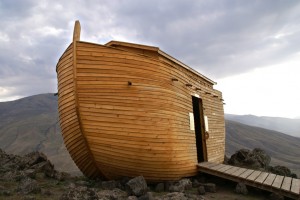
Noah's Ark ReconstructionI read those words and heard Bill Cosby’s voice. I’ll bet I’m not alone. More than 50 years ago (1963), Cosby’s debut comedy album Bill Cosby Is a Very Funny Fellow…Right! included a 3-1/2 minute skit he’d been doing on stage entitled Noah: Right! Ever since, it has colored the story of Noah and the ark for Americans; I know people who wouldn’t be born for another quarter century after that album’s release for whom Cosby’s skit is nonetheless an interpretive filter for the Noah story. Millions read the story and hear Noah asking, in Cosby’s voice, “Lord, what’s a cubit?”

In 1979, the comedy sketch troupe Monty Python released a full length movie entitled Month Python’s Life of Brian, which spoofed the life and ministry of Jesus of Nazareth by telling the story of Brian, the baby born in the stable stall next door and who spends his life being mistaken for the messiah. When he is present at the Sermon on the Mount, Brian is at the edge of the crowd among those who are so far away from Jesus they cannot hear clearly what he says. As they struggle to hear and understand Jesus’ words, they have this conversation:

What did he say?
I think it was “Blessed are the cheesemakers.”
Aha, what’s so special about the cheesemakers?
Well, obviously it’s not meant to be taken literally; it refers to any manufacturers of dairy products.

I cannot read the Beatitudes without that dialog coming to mind; I have to bite my lip to keep from laughing. I’m sure that when it is the appointed Sunday Gospel, my parishioners wonder why I have such a goofy expression while reading it!

Because I’m a child of the television generation, I also cannot read the story of Adam and Eve without seeing in memory Bob Newhart and Ruth Buzzi in beige long underwear playing a Garden-of-Eden skit on the old Laugh-In show, or sometimes Richard Basehart as a shipwrecked, alien space-traveling Adam encountering a similarly shipwrecked Eve (the plot of an old Twilight Zone episode).

I’ve two points in mind this morning in recalling these comedy routines to mind. The first is the difficulty of setting aside preconceptions when reading the scriptures. What we think we know about the text may be helpful as we study and interpret it, but it can also be a barrier to hearing it fresh each time to encounter it. I am convinced that the bible speaks to us anew in each reading, and that what we already “know” can and does interfere with our appreciating that. So I struggle to not hear Cosby’s voice, to not understand peacemakers as cheesemakers, to not see Adam climbing out of his space ship.

The second point is rather the opposite of the first, that these comedic or fanciful takes on the stories of the bible are as helpful as they are distracting. I know a lot of people who have a hard time finding humor about God or Jesus or the bible acceptable. My staunch Methodist grandfather frowned upon any humor about church, Sunday School, or other things religious; he considered them disrespectful and (I’m sure) blasphemous.

I find wisdom in a line by Oscar Wilde (from Lady Windemere’s Fan): “Life is far too important a thing ever to talk seriously about it.” The same can be said of the bible. Theologian and author Madeleine L’Engle once wrote, “I take the Bible too seriously to take it all literally” (a quotation often misattributed to Karl Barth). Finding humor or inspiration for fanciful works of fiction and comedy in scripture is part of both taking it seriously and not talking seriously about it. These comedic or fanciful treatments help us hear the scriptures with new ears.

And the question still remains: “What’s a cubit?”

====================

A request to my readers: I’m trying to build the readership of this blog and I’d very much appreciate your help in doing so. If you find something here that is of value, please share it with others. If you are on Facebook, “like” the posts on your page so others can see them. If you are following me on Twitter, please “retweet” the notices of these meditations. If you have a blog of your own, please include mine in your links (a favor I will gladly reciprocate). Many thanks!

====================

Father Funston is the rector of St. Paul’s Episcopal Church, Medina, Ohio.

Unknown Ailments – From the Daily Office – January 15, 2014

From the Letter to the Hebrews:

Since, therefore, the children share flesh and blood, he himself likewise shared the same things, so that through death he might destroy the one who has the power of death, that is, the devil, and free those who all their lives were held in slavery by the fear of death.

(From the Daily Office Lectionary – Hebrews 2:14-15 (NRSV) – January 15, 2014.)

Low Back PainWhat is fear of death but fear of the unknown? The fear of death and the unknown brings anxiety, despair, and a frantic search for meaning. The fear of death and the unknown distracts us and makes us afraid to truly live. We end up fearing both death and life; we end up not attending to those things which are most important.

Yesterday, I woke up with an aching lower back. As the day progressed, the ache became acute, changing from ache to stabbing pain; it localized itself on the right side of my back. When the stabbing sensations occurred, the pain radiated around my right flank and into my abdomen. They got worse. “Kidney stone,” I thought, “I must have a kidney stone.” I’ve never had a kidney stone, but what I was experiencing seemed to be exactly what others have described as the symptoms of a kidney stone. I decided to seek medical advice.

It turned out to be no help. Diagnostic activities (urinalysis and a CAT scan) said it wasn’t a kidney stone. So what was it? What is it? It’s still here. I woke up with it again today. I’ve taken pain medication and applied heat, and they have helped with the discomfort . . . but the source remains unknown.

So I am concerned. Is my concern “fear?” Yes, to some extent it is. Is it disabling? It’s certainly distracting! Both the pain, which limits my motion, and the concern (or fear) which keeps my attention focused on it, and thus not on . . . my prayers, my work, my regular activities, the things important in my life . . . the distraction holds me in thrall. My imagination runs wild and I envision all sorts of dire and deadly medical conditions to explain my pain, when I know full well it’s probably nothing more than a pulled muscle. To the extent that I focus on the pain and its unknown source, I am a slave to my discomforts, both physical and psychological.

A petition from an old Scottish litany prays: “From ghoulies and ghosties, and long-leggedy beasties, and things that go bump in the night, Good Lord, deliver us!” It is a prayer for release from the fear of the unknown, a release the Letter to the Hebrews assures us we have already been given. The power of the unknown has been destroyed by God in Jesus sharing our flesh and blood, with all of its aches and pains and unknown ailments.

So today, I choose to be free of the pain. I may still feel it, but I won’t let it or fear of its still-unknown source distract me from getting on with life.

====================

A request to my readers: I’m trying to build the readership of this blog and I’d very much appreciate your help in doing so. If you find something here that is of value, please share it with others. If you are on Facebook, “like” the posts on your page so others can see them. If you are following me on Twitter, please “retweet” the notices of these meditations. If you have a blog of your own, please include mine in your links (a favor I will gladly reciprocate). Many thanks!

====================

Father Funston is the rector of St. Paul’s Episcopal Church, Medina, Ohio.

Gimmicks Distract – From the Daily Office – January 11, 2014

From the Psalter:

Hallelujah!
Praise God in his holy temple;
praise him in the firmament of his power.
Praise him for his mighty acts;
praise him for his excellent greatness.
Praise him with the blast of the ram’s-horn; *
praise him with lyre and harp.
Praise him with timbrel and dance;
praise him with strings and pipe.
Praise him with resounding cymbals;
praise him with loud-clanging cymbals.
Let everything that has breath
praise the Lord.
Hallelujah!

(From the Daily Office Lectionary – Psalme 150 (BCP Version) – January 11, 2014.)

Clown Presiding at CommunionThe musical Godspell debuted in 1971 (my junior year in college); in it, Christ is portrayed as a clown. Whether it was an expression of or the catalyst for the phenomenon of offering clown eucharists as an edgy, avant-garde presentation of the Christian Mysteries, I really don’t know. The two are inextricably linked in my memory.
And . . . to be honest, I never cared for either. And . . . being further honest, that may be because I have never like clowns. I find them creepy. On the other hand, a bishop of whom I was very fond and for whom I had great respect, loved Clown Eucharists. He had a set of clown-decorated vestments made; he offered a clown eucharist at least once each year (often at diocesan convention) throughout his episcopate. They may have resonated for him because, unlike me, he loved clowns.

But I didn’t (and don’t) and so the clown eucharist was, for me, a distraction. I couldn’t get passed the gimmick, the clown images and the circus music, to the Christ at the center of mass. The clown gimmick, not the foolishness of God to which it was supposedly pointing, took over and seemed to be the point of the whole thing.

Some years later, when the music of U2 became popular and new generation were finding spiritual meaning in the band’s lyrics, someone put together a celebration of the Holy Mysteries in which that music played a part — the major part — it was the only music — and promoted the event as a U2charist.

“Right,” I thought. “The clown eucharist in a new guise.” Again, for me, the gimmick (the U2 music) distracts from the principal focus. I attended a U2charist and, for me, all I heard was the band’s music; I didn’t hear the gospel. That’s not to say it wasn’t there; it may have been. I just couldn’t hear it through the distraction of the soundtrack.

Since then I have heard of (but not attended) celebrations of Holy Communion in which the music was all from the Beatles canon, or all “oldies” from the 1960s, or all Broadway show tunes . . . and I wouldn’t be surprised if there have been other similar “thematic” eucharists. All, I think, the descendants of the clown masses of the 1970s — attempts to package the Christian Mysteries in edgy and avant-garde ways to present them to a target audience, to sneak the gospel message in under the guise of entertainment.

Now, don’t get me wrong. Let me hasten to say that I think entertainment is fine. If clowns float your boat, go the circus! If you like the music of U2 (and I do), listen to it! If you like Broadway musicals (and I do), go to the theater! And if you find something of spiritual import in those entertainments (and I do), great! Make use of it in your spiritual life and, even, in church services and celebrations.

The last of the psalms encourages the people of God to make use of many forms of entertainment, symbolized by musical instruments — trumpets and horns (the ram’s horn), stringed instruments, percussion, wood winds — and dance, in their worship. So I believe it’s fine to make use of clowns, to use of U2’s music, to sing the Beatles’ lyrics, to offer the tunes from Broadway shows as part of the liturgy.

But when these things become the reason for the service, when we name the service for the clowns or the bands or the theater district, the tool meant to be used for praising God has become the object of praise. The psalm says, “Praise God with strings and pipe,” not “Praise the strings and pipe;” “Praise God with resounding cymbals,” not “Praise the cymbals.”

Others, I am quite certain, will have found the U2charists a path to God. Other, I know, will have found in the Beatles mass and in the Broadway eucharists the truth of the gospel. After all, that bishop whom I really did love found Christ in clowns no matter how creepy I may have found them!

But for me, these feel “gimmicky” — one or two Beatles songs might be used to good effect, but nothing but Beatles music through the whole service? Not so much. U2’s Gloria could certainly stand as a liturgical piece, but all U2 music throughout the mass? Too much of a good thing. I’m not sure that I can say anything positive about clowns . . . but someone might, perhaps. My point is that themed eucharists like these, in which the theme predominates, feel like gimmicks. It feels to me like we have stopped praising God with the clowns and have started praising the clowns; the gimmick distracts. Praise God with the gimmick, but don’t praise the gimmick!

====================

A request to my readers: I’m trying to build the readership of this blog and I’d very much appreciate your help in doing so. If you find something here that is of value, please share it with others. If you are on Facebook, “like” the posts on your page so others can see them. If you are following me on Twitter, please “retweet” the notices of these meditations. If you have a blog of your own, please include mine in your links (a favor I will gladly reciprocate). Many thanks!

====================

Father Funston is the rector of St. Paul’s Episcopal Church, Medina, Ohio.

Sweetgum Balls – From the Daily Office – January 9, 2014

From the Psalter:

Have mercy upon us, O Lord, have mercy,
for we have had more than enough of contempt,
Too much of the scorn of the indolent rich,
and of the derision of the proud.

(From the Daily Office Lectionary – Psalm 123:4-5 (BCP Version) – January 9, 2014.)

Sweetgum Balls on SnowThere’s a lot of talk these days about “class warfare,” most of it sheer nonsense. There is, it must be admitted, a growing class divide, an increasing gap between the wealthiest Americans and the rest of us. One might be tempted to write about that in light of this psalm’s reference to the “scorn of the indolent rich” and the “derision of the proud.” But, let’s face it . . . scorn, derision, contempt, and generally obnoxious conduct transcend class and other distinctions.

Prickly, disagreeable people come in all income groups, all races, all genders and sexual preferences, all religions . . . in any grouping of human beings you care to make. Indeed, everyone of us can be and are, from time to time, prickly and unpleasant. A lot of the time, we are completely oblivious to our own unpleasantness.

Driving past our town square yesterday afternoon, I noticed that a sweet gum tree had shed its empty seedpods, the hard, prickly fruit littering the snow all around the trunk. I rolled down the car window, pulled out my smartphone and took this picture (which came out a bit unfocussed). I thought I might use it as inspiration (or illustration) for a poem. And then this psalm came up on the lectionary rotation and the sweet gum was an obvious metaphor.

Unpleasant people drop little bombs of scorn, little grenades of derision all around them. They mar the world around them the same way the sweet gum tree’s seedpods mar the snow around the tree. But like the tree, they are unaware (or uncaring) of the damage they are doing and seem unable (or unwilling) to bend; they lack the flexibility to remedy the mess they create around them.

The psalmist is right to pray for deliverance from such folk . . . but more importantly we should pray for change in ourselves, that we not be prickly, contemptuous, and scornful towards those around us. Jesus once said to his listeners:

Why do you see the speck in your neighbor’s eye, but do not notice the log in your own eye? Or how can you say to your neighbor, “Let me take the speck out of your eye,” while the log is in your own eye? You hypocrite, first take the log out of your own eye, and then you will see clearly to take the speck out of your neighbor’s eye. (Matt. 7:3-5, NRSV)

In terms of the tree on square . . . deal with your own prickly seedpods of contempt, scorn, or derision before criticizing another’s.

====================

A request to my readers: I’m trying to build the readership of this blog and I’d very much appreciate your help in doing so. If you find something here that is of value, please share it with others. If you are on Facebook, “like” the posts on your page so others can see them. If you are following me on Twitter, please “retweet” the notices of these meditations. If you have a blog of your own, please include mine in your links (a favor I will gladly reciprocate). Many thanks!

====================

Father Funston is the rector of St. Paul’s Episcopal Church, Medina, Ohio.

« Older posts Newer posts »