Do I make my plans according to ordinary human standards, ready to say “Yes, yes” and “No, no” at the same time?
(From the Daily Office Lectionary – 2 Cor. 1:17b (NRSV) – May 28, 2013.)
Three words come to mind as I read Paul’s question: indecision, duplicity, and dialectic. Each could be described as “saying ‘Yes, yes’ and ‘No, no’ at the same time.”
Indecision or indecisivenss is simply the inability to come to a decision, bouncing back and forth between alternatives, wavering between “yes” and “no” without ever coming to a conclusion. This would not describe Paul, but it certainly does describe many people. Sometimes it’s OK not to make a choice; in fact, sometimes it’s downright necessary! Decisions need to be made at the proper time. Years ago I was a cadet in the Reserve Officers Training Corps (ROTC). I don’t remember a good deal of that training, but I do remember this: “When it’s not necessary to make a decision, it’s necessary to not make a decision.” Read that again carefully: “When it’s not necessary to make a decision, it’s necessary to not make a decision.” In other words, don’t jump the gun. Don’t commit to an action before you have to. On the other hand, as William James said, “When you have to make a choice and don’t make it, that is in itself a choice.” While Paul certainly called for his listeners and correspondents to make decisions and faithful choices, and even though he introduces this question with the words, “Was I vacillating,” I don’t believe that simple indecision is what Paul refers to in this passage.
Indecision may be morally neutral; duplicity, however, is not. Duplicity is deliberate deceptiveness: saying one thing and meaning another, or saying one thing to one person and something different to another. Deceitfulness is one synonym; hypocrisy is another. I suspect that this, rather than mere indecision, is the “ordinary human standard” to which he refers and which, by implication, he eschews. He may be referring to Jesus’ words about oath-taking from the Sermon on the Mount which the Christian community remembered and later recorded in Matthew’s Gospel: “Let your word be ‘Yes, Yes’ or ‘No, No’; anything more than this comes from the evil one.” (Matt. 5:37) In any event, dishonesty is probably Paul’s issue here.
Post-modern Anglican that I am, however, I can’t help but go a step further and wonder, “But why is in an either/or thing? Why not look at this as both/and?” Saying “Yes, yes” or “No, no” at the same time may be way of working through two opposing theses to arrive at a synthesis; in other words, a dialectic process may be at work here. Paul is such a black-and-white kind of guy that I don’t think he’d have made a very good Anglican dialectician. The “both/and” thing just doesn’t seem to be his style, but as we read his words we can move beyond them to a greater comprehensiveness.
As Paul continues his letter to the Corinthians he writes, “In [Jesus Christ] it is always ‘Yes.’ For in him every one of God’s promises is a ‘Yes.’” (vv. 19-20) This is not simply a contradiction of a human “no” with some more powerful yet still human “yes.” Beyond either our “no” or our “yes” is a comprehensive divine affirmation. As Paul elsewhere wrote to the Colossians, “Christ is all and in all!” (Col. 3:11), and similarly to the Ephesians, “[God’s plan is] to gather up all things in him, things in heaven and things on earth” (Eph. 1:10), and earlier to the Corinthians, “[The plan of salvation is that] God may be all in all.” (1 Cor. 15:28). In other words, the divine “Yes” is a comprehensive synthesis which more than contradicts our human “No” and more than affirms our human “Yes.” Instead, it integrates both in a divine dialectic that produces something new that is neither our “No” nor our “Yes” but God’s redemption.
Reading Paul this morning, I am reminded of the need to make decisions in the best way and at the best time that we can, doing so honestly, but always remembering that even our best, most honest decisions may (and definitely will) be inadequate; all our decisions await God’s comprehensive redemption.
====================
A request to my readers: I’m trying to build the readership of this blog and I’d very much appreciate your help in doing so. If you find something here that is of value, please share it with others. If you are on Facebook, “like” the posts on your page so others can see them. If you are following me on Twitter, please “retweet” the notices of these meditations. If you have a blog of your own, please include mine in your links (a favor I will gladly reciprocate). Many thanks!
(Revised Common Lectionary, Trinity (Year C): Proverbs 8:1-4,22-31; Canticle 13 (Song of the Three Young Men, 29-34); Romans 5:1-5; and John 16:12-15. These lessons can be read at The Lectionary Page.)
====================
I’d like you to take out a pen (there are some in the pew racks if you don’t have one of your own) and on a blank piece of paper, or an empty spot on your service bulletin, I’d like you write down these numbers:
1,016,823 – the estimated number of war dead from the American civil war (the figures, especially for Confederate dead, are notoriously untrustworthy)
116,516 – the number of Americans who died in World War I
405,399 – the number of Americans who died in World War II
36,516 – the number of Americans who died in the Korean conflict
58,209 – the number of Americans who died in Vietnam
2,031 – the number of Americans who so far have died in Afghanistan during our so-called “war on terror”
4,487 – the number of Americans who so far have died in Iraq during our so-called “war on terror”
22 – the average number of U.S. Armed Forces veterans and active duty personnel who commit suicide every day because of combat-related PTSD
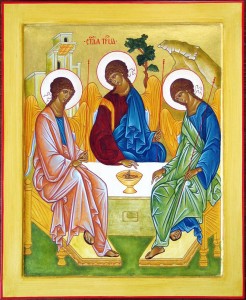
3 – the number of Persons in the One, Holy, Blessed, and Glorious Trinity
Today, our church asks us to focus our attention on the last of these numbers. Tomorrow, our country asks us to remember all the others. It is merely fortuitous that the calendar, this year, conflates the Feast of the Blessed Trinity with Memorial Day weekend, but it seems to me that the two speak to us with a united voice drawing our attention to common themes.
Memorial Day has its origins in a proclamation by General John A. Logan, commander-in-chief of the Grand Army of the Republic, the organization for Union Civil War veterans. On May 5, 1868, he called for an annual, national “Decoration Day.” It was observed for the first time that year on May 30; the date was chosen because it was not the anniversary of any particular battle and because it was the optimal date for flowers to be in bloom in most areas of the country. It was observed, that first year, in 27 states. A similar day of remembrance was held in the states of the former Confederacy on June 3, which was the birthday of Jefferson Davis, first and only President of the Confederate States of America. Beginning in the 1880s the name “Memorial Day” began to be used for these commemorations and it gradually became the more common term. For the first hundred years, these holidays were matters of state law, although in 1950 Congress issued a joint resolution requesting the President to issue a proclamation calling for a national observance on May 30 and every year since the presidents have done so. In 1967, by act of Congress, “Memorial Day” was declared the official name and May 30 the official date under Federal law. The following year, Congress passed the Uniform Monday Holiday Act, which moved Memorial Day, together with Washington’s birthday, Labor Day, Columbus Day, and Veterans Day, from their traditional dates to specified Mondays in order to create convenient three-day weekends.
The Veterans of Foreign Wars, by the way, opposed that change and has publicly stated its position that, “Changing the date merely to create three-day weekends has undermined the very meaning of the day.” Throughout his career in the Senate, the late Senator from Hawaii Daniel Inouye, a World War II veteran, annually introduced a measure to return Memorial Day to its traditional date of May 30. Obviously, his efforts proved unsuccessful.
The Solemnity, or Principal Feast, of the Most Holy Trinity has a somewhat longer history. The Sacramentary of St. Gregory the Great (who was pope from 590 to 604) contained prayers and a Preface for a celebration of the Trinity, but specified no date. Documents from the pontificate of Gregory VII (pope from 1073 to 1085) indicate that by that time an Office of the Holy Trinity was recited on the Sunday after Pentecost in some places, but it was not a universal practice. In 1162, Thomas á Becket (1118–70) was consecrated Archbishop of Canterbury on the Sunday after Pentecost, and his first act was to proclaim that the day of his consecration should be commemorated as a new festival in honor of the Holy Trinity. This observance spread from England throughout the western Catholic world until Pope John XXII in 1334, the last year of his 18-year papacy, ordered the feast observed by the entire Church on the first Sunday after Pentecost.
I want to suggest to you today that these two observances, one secular and one religious, share two common themes, and that this year’s fortuitous coincidence of Trinity Sunday and Memorial Day weekend allows us to explore them. Those themes are community and mystery.
There is a humorous video on YouTube made by a group calling themselves Lutheran Satire in which two Irishman engage St. Patrick in a dialog about analogies for the Holy Trinity. Although at first pronouncing themselves simple and unsophisticated, the two proceed to demonstrate considerable theological acumen as they condemn Patrick as a heretic each time he tries an analogy. The famous water-ice-steam analogy, they condemn as Modalism; the analogy of the sun, with its light and heat, they denounce as Arianism; when Patrick tries to liken the Trinity to a shamrock, they stop him and criticize him for preaching Partialism. Finally, Patrick gives up and asserts:
The Trinity is a mystery which cannot be comprehended by human reason, but is understood only through faith and is best confessed in the words of the Athanasian Creed which states that we worship one God in Trinity, and Trinity in Unity, neither confusing the Persons nor dividing the Substance, that we are compelled by the Christian truth to confess that each distinct Person is God and Lord, and that the deity of the Father, the Son and the Holy Spirit is One, equal in glory, co-equal in majesty.
The two Irishman, after a moment of stunned silence, respond, “Well, why didn’t you just say that?”
So there you have it: the Trinity is a mystery and every analogy by which we try to explain how God can be one-in-three fails, every attempt to comprehend the unity in which the Father, the Son, and the Holy Spirit together are one God ends up in heresy, and every sermon about the Doctrine of the Trinity either confuses the heck out of us or bores us to tears.
Therefore, rather than try to explain or comprehend the mystery that is the Trinity, let’s focus instead on the community that is the Trinity: the paradigm and model of all human community. The early Church Fathers explored in their writings how many aspects of our humanity reveal the divine image: our ability to perceive God’s presence; our apparently innate knowledge of the spiritual realm; our intellect; our ability to freely choose; and our capacity to live lives of goodness and love. These characteristics, they taught, belong to every human being and reveal much about God.
In the twentieth-century theologians have explored the concept of human personhood. To be made in the image of God is not to be made in the image of the Father only; it is to be made in the image of the Holy Trinity, to be made in the image of the Father, and of the Son, and of the Holy Spirit. Human beings are persons intended to be, like the Persons of the Blessed Trinity, in relationship with other persons. This means that participation in community is at the heart of our humanity; our relatedness to other persons is at the very core of who we are. The three Divine Persons are forever united with each other in mutual love. They dwell within one another; they collaborate and share in all their activities; they always act in harmonious accord. This is the model for the ideal human community, the paradigm of corporate human existence.
Human beings are supposed to work together in harmony in ways that preserve and respect the equality and dignity of every person. The English Orthodox bishop and theologian Kallistos Ware put it this way in an article in the journal of the Fellowship of St Alban & St Sergius:
Each social grouping — family, parish, diocese, church council, school, office, factory, nation — has as its vocation to be transformed by grace into a living icon of [the Holy Trinity], to effect a reconciling harmony between diversity and unity, human freedom and mutual solidarity, after the pattern of the Trinity. (The Human Person as an Icon of the Trinity, Sobornost 8, 17-18)
He also wrote in a later essay:
Belief in a God who is three-in-one, whose characteristics are sharing and solidarity, has direct and practical consequences for our Christian attitude toward politics, economics, and social action, and it is our task to work out these consequences in full detail. Each form of community — the family, the school, the workplace, the local eucharistic center, the monastery, the city, the nation — has as its vocation to become, each according to its own modality, a living icon of the Holy Trinity. (The Trinity: Heart of Our Life, in Reclaiming the Great Tradition: Evangelicals, Catholics and Orthodox in Dialogue, James S. Cutsinger, ed., InterVarsity:1997, 142)
On Friday, as has been customary in this country since 1950, the president issued a proclamation designating Memorial Day tomorrow as “a day of prayer for permanent peace.” In his proclamation, President Obama said:
On Memorial Day, we remember those we have lost not only for what they fought for, but who they were: proud Americans, often far too young, guided by deep and abiding love for their families, for each other, and for this country. Our debt to them is one we can never fully repay. But we can honor their sacrifice and strive to be a Nation equal to their example. On this and every day, we must meet our obligations to families of the fallen; we must uphold our sacred trust with our veterans, our service members, and their loved ones.
Above all, we can honor those we have lost by living up to the ideals they died defending. It is our charge to preserve liberty, to advance justice, and to sow the seeds of peace. With courage and devotion worthy of the heroes we remember today, let us rededicate ourselves to those unending tasks, and prove once more that America’s best days are still ahead. Let us pray the souls of those who died in war rest in eternal peace, and let us keep them and their families close in our hearts, now and forever. (Presidential Proclamation, May 24, 2013)
In other words, Memorial Day, like Trinity Sunday, is a day whose theme is community, the nation as community, the military services as community, the family as community. Bishop Ware’s description of Trinitarian community as embracing “diversity and unity, human freedom and mutual solidarity” could as easily have been used by the president to describe the community which celebrates Memorial Day; President Obama’s words of courage and devotion, sacrifice and trust, justice and eternal peace could as easily have been used to describe the community which is an icon of the Trinity.
There is also a mystery about Memorial Day, and the mystery is this: Why must young men and now young women go to war and die? One of my favorite Celtic folk songs reflects on this mystery. It was written in 1976 by the Scottish folksinger Eric Bogle and originally entitled No Man’s Land, but it is more commonly called The Green Fields of France or Willie McBride. It is the musing of a man stopping by a grave in a World War I cemetery and wondering about the man buried there. These are the last two verses:
Ah the sun now it shines on these green fields of France,
The warm summer breeze makes the red poppies dance,
And look how the sun shines from under the clouds;
There’s no gas, no barbed wire, there’re no guns firing now.
But here in this graveyard it’s still No Man’s Land,
The countless white crosses in mute witness stand
To man’s blind indifference to his fellow man,
To a whole generation that was butchered and damned.
Ah, young Willie McBride, I can’t help wonder why,
Did all those who lay here really know why they died?
And did they believe when they answered the call,
Did they really believe that this war would end war?
For the sorrow, the suffering, the glory, the pain,
The killing and dying were all done in vain,
For, young Willie McBride, it all happened again,
And again and again and again and again.
The mystery of Memorial Day is the mystery of war. No one wants it to happen, and yet it does, again, and again, and again, and again . . . The mystery of Memorial Day is . . . why?
The mystery of the Trinity is expressed in that number 3: How can God who is One be Three? It’s a mystery which we cannot comprehend. It can be understood only through faith; it can be lived out only in community.
The mystery of Memorial Day is expressed in those other numbers: 1,016,823 — 116,516 — 405,399 — 36,516 — 58,209 — 2,031 — 4,487 — 22. It’s a mystery we must comprehend and, through our faith and in our communities, bring to an end. Please take home the paper on which you wrote those numbers and tomorrow . . . think about that.
Let us pray:
Almighty God our heavenly Father, guide the peoples and nations of the world into the way of justice and truth, and establish among them that peace which is the fruit of righteousness, that the community of humankind may become more and more an image of the community of the Holy Trinity; through our Lord and Savior Jesus Christ. Amen.
====================
A request to my readers: I’m trying to build the readership of this blog and I’d very much appreciate your help in doing so. If you find something here that is of value, please share it with others. If you are on Facebook, “like” the posts on your page so others can see them. If you are following me on Twitter, please “retweet” the notices of these meditations. If you have a blog of your own, please include mine in your links (a favor I will gladly reciprocate). Many thanks!
[Jesus] said therefore, “What is the kingdom of God like? And to what should I compare it?”
(From the Daily Office Lectionary – Luke 13:18 (NRSV) – May 22, 2013.)
Jesus used parables and metaphors and analogies to try to explain the kingdom of God to his followers and sometimes they got it and sometimes they didn’t. Those of us who follow Jesus as clergy and as preachers have joined him in that struggle for 2,000 or so years. To a greater or lesser extent, every sermon preached is an attempt to answer the question, “What is the reign of God like?” And so we clergy always seem to be on the lookout for “sermon illustrations.”
Monday’s tragic tornado in Moore, Oklahoma, in the southern suburbs of Oklahoma City, has provided two visual parables.
The kingdom of Heaven is like ten pins in a bowling alley in the midst of a tornado. The winds blew at 200 mph; debris swirled around them and buildings fell. But those pins withstood the storm and endured.
Then, again, the kingdom of God is like a pet found in the debris of a tornado.
Ubi caritas et amor, Deus ibi est.
Congregavit nos in unum Christi amor.
Exsultemus, et in ipso jucundemur.
Timeamus, et amemus Deum vivum.
Et ex corde diligamus nos sincero.
Where charity and love are, God is there.
Christ’s love has gathered us into one.
Let us rejoice and be pleased in Him.
Let us fear, and let us love the living God.
And may we love each other with a sincere heart.
====================
A request to my readers: I’m trying to build the readership of this blog and I’d very much appreciate your help in doing so. If you find something here that is of value, please share it with others. If you are on Facebook, “like” the posts on your page so others can see them. If you are following me on Twitter, please “retweet” the notices of these meditations. If you have a blog of your own, please include mine in your links (a favor I will gladly reciprocate). Many thanks!
In the days when the judges ruled, there was a famine in the land, and a certain man of Bethlehem in Judah went to live in the country of Moab, he and his wife and two sons. The name of the man was Elimelech and the name of his wife Naomi, and the names of his two sons were Mahlon and Chilion; they were Ephrathites from Bethlehem in Judah. They went into the country of Moab and remained there. But Elimelech, the husband of Naomi, died, and she was left with her two sons. These took Moabite wives; the name of one was Orpah and the name of the other Ruth. When they had lived there for about ten years, both Mahlon and Chilion also died, so that the woman was left without her two sons or her husband.
(From the Daily Office Lectionary – Ruth 1:1-5 (NRSV) – May 20, 2013.)
And there you have it, ten years in the lives of six people, and the deaths of three of them, put to rest in five short Bible verses. As Antonio said to Sebastian, “What’s past is prologue” (The Tempest, Act 2, Scene 1) and for the author of Ruth apparently not very interesting prologue. The storyteller is (pardon the pun) ruthlessly efficient in his introduction (I assume the author was “he” – maybe not). He clears away the unnecessary detail of sixty “person-years” of life to set the stage for what is to follow.
When I realized that, it hit me pretty hard. I’m sixty years old! Could the sum-total of my life be as easily summarized and shuffled off simply as prologue for something else? I suppose it could, but I would hope not.
Recently I was at a gathering with a bunch of other clergy and at some point during our deliberations comments were made about the use and organization of time; someone else made a remark about how we compartmentalize the different areas of our lives; and then I heard someone say something about a magazine. I have to be honest and admit that (a) I wasn’t paying close attention and (b) I don’t know if these comments were all made in the context of the same conversation. In my head, though, they merged into a rumination about Time magazine as a metaphor for a human life.
I used to be a very faithful subscriber to and reader of Time magazine. I took out my first subscription when I was in high school (1967) and didn’t stop subscribing until I attended seminary in 1991. And before that, my parents and my brother had been subscribers, so I’d been reading that magazine for a long time. It didn’t change much in all those years and I suppose it still hasn’t, at least insofar as the magazine is organized.
The classic issue of Time magazine is a study in compartmentalization. There are “departments” for all the areas of news, or if you prefer the areas of life (although Life is a different, if related publication): U.S., World, Politics, Sports, Lifestyle, Religion, Fashion, Tech, Science, and so forth. Which departments appeared in a given weekly issue depended on what was making news that week. There were always overlaps between these departments, of course, and I suppose the editors would have to determine if a story about regulation of new oil technologies fit better under Politics or Tech or Science; one would guess that the decision would be based on which subject predominates.
Life (life, not Life magazine) is a lot like a Time magazine. We have “departments” – Family, Job, School, Church, Friends, Hobbies, Politics, and so forth – and somehow, like the editors of Time magazine, we decide how all the stories of our lives get organized. We decide what order they are put in and how, like the magazine, they are arranged; we put some things closer to the front cover of our lives, where the public is most apt to see them, and other things we bury in the back pages. Then stories are neatly bound for our presentation of self to the world.
Time magazines were held together with staples through the spines. Sometimes, the pages would come loose from the staples. First, the four center pages would come away. You’d put them back in and hope the magazine would hang together until you finished reading all the articles of interest, but it wouldn’t always work out that way. Sometimes someone would take the magazine apart because they needed a picture for a school report, or wanted to send an article to someone in a letter, or whatever . . . sometimes the staple would get pulled out or work its way out on its own, and then all the pages would be loose. If you weren’t careful, the pages would get mixed up in a mishmash. As you were sitting out by the pool, a breeze would come along and blow them away, and you’d chase them across the yard hoping to gather them all. Some would blow into the pool and get soaking wet; some would blow into the neighbor’s yard on the other side of the fence and you couldn’t get them because of the vicious dog; some would take flight and get caught in the branches of trees. The articles would be all jumbled and some pages would be missing and the stories would be incomplete and not make sense.
And sometimes life can be a lot like that unstapled, jumbled, blown apart, partly missing, chaotic Time magazine, too.
Suppose someone actually did report on everything you did everyday for a week, on every work related task, about every friend or co-worker or family member with whom you talked, on every school assignment, every leisure activity, every television program you watched, on everything. Suppose they wrote it all out, organized it into departments, bound it with a staple, and produced a magazine of your week. Suppose they did that every week. Suppose those magazines were stacked week after week, month after month, year after year. Can you visualize those stacks? Can you see the piles and piles of magazines with your face and your name on the cover like the Time magazine Person of the Year?
Now think about this . . . if Antonio was right that “what’s past is [simply] prologue” and some storyteller were going to summarize what’s in those stacks of magazines, those piles of stories as foreword to a new story, would five verses be enough? Do you think it could even be done in a way that would honor your existence? I don’t.
I think life is a lot more like Time magazine and a lot less like the introduction to the Book of Ruth! And I believe the Author of life is a lot more interested in the stories of our lives than the author of Ruth was in the stories of Elimelech, Mahlon, and Chilion. And for that, I’m grateful.
====================
A request to my readers: I’m trying to build the readership of this blog and I’d very much appreciate your help in doing so. If you find something here that is of value, please share it with others. If you are on Facebook, “like” the posts on your page so others can see them. If you are following me on Twitter, please “retweet” the notices of these meditations. If you have a blog of your own, please include mine in your links (a favor I will gladly reciprocate). Many thanks!
Some went down to the sea in ships
and plied their trade in deep waters; . . . .
(From the Daily Office Lectionary – Psalm 107:23 (BCP Version) – May 17, 2013.)
I cannot read this verse of Psalm 107 (today’s evening psalm) without remembering a poem, Sea Fever by the 20th Century English poet John Masefield:
I must go down to the seas again, to the lonely sea and the sky,
And all I ask is a tall ship and a star to steer her by,
And the wheel’s kick and the wind’s song and the white sail’s shaking,
And a grey mist on the sea’s face, and a grey dawn breaking.
I must go down to the seas again, for the call of the running tide
Is a wild call and a clear call that may not be denied;
And all I ask is a windy day with the white clouds flying,
And the flung spray and the blown spume, and the sea-gulls crying.
I must go down to the seas again, to the vagrant gypsy life,
To the gull’s way and the whale’s way, where the wind’s like a whetted knife;
And all I ask is a merry yarn from a laughing fellow-rover,
And quiet sleep and a sweet dream when the long trick’s over.
I remember this poem because of an incident from my late childhood when I was in the 7th Grade, about age 12, I guess.
I attended junior high in the San Fernando Valley suburbs of Los Angeles and in my 7th Grade English class we were required to memorize, recite, and offer an exegesis of poem. I chose this one. After dutifully reciting it, I explained what I believed the poem to mean. The teacher (whose name I do remember but will not give) praised my recitation, but then critiqued my interpretation by basically telling me I was wrong. My response in open class, “I can interpret a poem any damned way I please!”
As you might imagine, I was sent to the principal’s office. Well, I was really sent to the boy’s vice-principal, one of those people who seemed always to be smiling, even when angry or when disciplining a child. To be honest, I remember very little about the man except that smile which always seemed a bit creepy. The vice-principal decided my infraction was serious enough to require my mother to called and asked to come to the school.
If my mother had been a stay-at-home parent, that would not have been a big deal, I suppose. She was, however, a working woman, and at the time her work was as a secretary at a machine-tool manufacturing company in Long Beach. The last time I visited Southern California, the drive from Long Beach to the Valley took hours; traffic was awful. In those days, however, you could actually make the drive in about an hour. So, for an hour, I sat on a chair in the administrative office of the school, missing the rest of English class and whatever I had in the next period, dreading my mother’s appearance.
When my mother, neat, trim, petite woman of 45 years, standing all of 5’2″ tall, walked through the door, I could tell that she was more than angry. The hour on the freeway, I’m sure, had stoked the furnace of her ire; she was a force to be reckoned with, and I was not looking forward to the reckoning.
She told the school secretary who she was and why she was there, so far as she knew, and then sat down next to me with not a word. I knew I was in for it!
The vice-principal soon appeared, greeted my mother, and escorted us into his office. He explained to my mother what had been reported by the English teacher: “Eric told Mrs. ______ that he could, and I quote, ‘interpret a poem any damned way he pleases.'”
Something miraculous happened! In that instant my mother’s anger was redirected. I was no longer the object of her wrath. She met the vice-principal’s explanation with a stony silence, looking him squarely in the eyes, and then in a very calm and measured voice she said, “He can interpret a poem any damned way he pleases!” The vice-principal’s smile actually disappeared!
Now, I don’t really recommend that parents do exactly what my mother did. And I’m pretty certain that if she hadn’t been called away from her work, if she hadn’t had to drive the freeway for an hour, and if she hadn’t “stewed” in her car for that hour, she wouldn’t have said what she said. But I do know this . . . Although I do not remember what happened next, although I don’t recall the rest of the conversation with the vice-principal, and although I don’t recall whether I stayed in school the rest of the day or went home, I definitely remember one thing! I remember parental support. I remember my mother standing up for me.
To be honest, I have no idea what my interpretation of that poem was. Today, if I heard the 12-year-old child’s exegesis I gave that day, I’d probably agree with my English teacher and declare it dead wrong. But whatever the meaning of Sea Fever to the poet or English scholars in the century since it was written, for me that poem, and this psalm verse which always brings it to mind, mean parental support. They speak to me of a parent standing up for and standing by her child.
And this is part of the nature of scriptural interpretation. We each bring to the written text our own life’s experiences; these color our understandings and give us the images whereby we envision God. Psalm 107 sings of the gathering of God’s People, some who went east, some who went west, some who wandered trackless deserts, and some who went down to the sea in ships. God is said to gather them all and give them support and comfort, and the Psalmist repeatedly encourages each group, “Let them give thanks to the Lord for his mercy and the wonders he does for his children.” (vv. 8, 15, 21, and 31)
Like the merciful wonder of a mother supporting her son in the vice-principal’s office.
====================
A request to my readers: I’m trying to build the readership of this blog and I’d very much appreciate your help in doing so. If you find something here that is of value, please share it with others. If you are on Facebook, “like” the posts on your page so others can see them. If you are following me on Twitter, please “retweet” the notices of these meditations. If you have a blog of your own, please include mine in your links (a favor I will gladly reciprocate). Many thanks!
They asked, and quails appeared, and he satisfied them with bread from heaven.
(From the Daily Office Lectionary – Psalm 105:40 (BCP Version) – May 16, 2013.)
Once again I find this serendipitous connection between one verse in the Daily Office psalm and a news item in the daily papers. Psalm 105 is divided into two parts and our lectionary bids us read the first at Morning Prayer and the second at Evening Prayer. The psalm describes the Hebrews sojourn in Egypt. Part One (vv. 1-22) describes the captivity of Joseph and his later elevation to leadership in the pharaoh’s court, which occasioned the children of Israel taking refuge in “the land of Ham” where they were subsequently enslaved. Part Two (vv. 23-45) tells the story of Moses, the Exodus, and the Hebrews coming into the Promised Land.
So hunger and famine, deprivation and want surface as themes both as a cause of the Israelites residence and ensuing slavery in Egypt, and as a consequence of their journey through the Sinai desert escaping from that servitude. The quoted verse celebrates God’s provision of food during their desert trek.
In today’s Los Angeles Times there is an article which begins with this question, “What happens to the 40% of food produced but never eaten in the U.S. each year, the mounds of perfect fruit passed over by grocery store shoppers, the tons of meat and milk left to expire?”
Twice a month about 100 families line up in the parking lot and hallways of my church to receive a few bags of food. As a distribution point for the local food bank system, our pantry operation offers canned goods, fresh vegetables, meats, bread, and other staples, as well as such things as paper towels, toilet paper, and personal hygiene products, to those unable to afford them in the stores. On the last Saturday of each month we see our biggest crowds as the month’s Social Security, WIC, food stamps, and other assistance funds have diminished.
In light of that monthly experience, I read the L.A. Times’ opening question and all I can do is shake my head in wonder! 40% of food produced in this country is never eaten? And yet there are these hundreds of people lining up for a food hand-out in my church . . . and that scene is repeated across the country in countless venues, and on an almost daily basis. Something is wrong! Something is broken!
The partial answer to the Times’ question is that some of it goes into the production of electrical power. The article is about the Kroger grocery company (through its Ralph’s and Food4Less divisions) composting the “garbage” food and producing methane gas to power generators. While I applaud this environmentally sound disposal solution, I can’t help but wonder, “Wouldn’t it be better if the food didn’t go to waste? Wouldn’t it be better if, instead of allowing the food to become inedible, it was distributed to those who are hungry?”
In the story of the Exodus, the food provided by God – the quail and the manna – could not spoil because it could not be kept. It was to be gathered and eaten; whatever wasn’t eaten simply didn’t hang around – the quail flew off – the manna evaporated. So neither the psalm nor the longer story in Exodus provide guidance for what to do with leftovers. Common sense, I think, has to fill that in. And common sense, I think, suggests that instead of letting food go bad and become fodder for a methane generator, it ought to be used to feed the hungry. I also think that that would be more attuned to the Gospel imperative.
Turning old food into electricity is at least a sounder decision than that reported a few months ago in Augusta, Georgia, where the inventory of a bankrupt supermarket was simply thrown away – in the presence of hungry people hoping for a handout! The needy poor, according to an article in the Augusta Chronicle, stood in the parking lot and “watched marshals stand guard as food was tossed into the trash” and hauled away to the city dump. “Some people even followed the truck to the landfill and were still turned away,” GreenLeft reported.
God provided food for the people. God satisfied them with quail and bread. God still provides food for the people. How we use it or misuse it is up to us. We don’t seem to be doing a very good job. Something is wrong! Something is broken!
====================
A request to my readers: I’m trying to build the readership of this blog and I’d very much appreciate your help in doing so. If you find something here that is of value, please share it with others. If you are on Facebook, “like” the posts on your page so others can see them. If you are following me on Twitter, please “retweet” the notices of these meditations. If you have a blog of your own, please include mine in your links (a favor I will gladly reciprocate). Many thanks!
Those who act deceitfully shall not dwell in my house, and those who tell lies shall not continue in my sight.
(From the Daily Office Lectionary – Psalm 101:7 (BCP Version) – May 15, 2013.)
There’s a homiletic maxim attributed to Karl Barth that clergy should preach with the Bible in one hand and a newspaper in the other. These days, that sort of describes how I say the Daily Office. I use my laptop computer (I’m still not hip enough to have a “tablet” device) to access the Online Book of Common Prayer and the lessons of the Lectionary, and then having completed the Office and my prayers, I move on to scanning the media sites, and then to Facebook.
I don’t often comment in these meditations on any linkage between the two, but today I couldn’t help but note how apropos the quoted verse from Psalm 101 (the first of two morning psalms today) was to New York Post article offered by a colleague on his Facebook wall. The headline reads, Rich Manhattan moms hire handicapped tour guides so kids can cut lines at Disney World. According to the first paragraph,
Some wealthy Manhattan moms have figured out a way to cut the long lines at Disney World — by hiring disabled people to pose as family members so they and their kids can jump to the front, The Post has learned. The “black-market Disney guides” run $130 an hour, or $1,040 for an eight-hour day.
One mom boasted that her child, through this cynical manipulation of Disney’s compassion for the disabled, waited only one minute for a ride, while other children stood in line for 2-1/2 hours.
This goes beyond deceit and falsehood; this is more than the mere telling of lies. This is trafficking in human flesh. This is prostitution; there’s no other word for it. Granted there’s no sex involved, but let’s be honest about what is going on here. The children of these wealthy moms are being taught that it is perfectly all right to purchase another person’s body for their pleasure. These disabled persons are offering their handicapped flesh in the service of the child’s desire for entertainment and gratification (instant gratification, in fact).
I am really blown away and disheartened by this report. I struggle to be positive about humankind. I try every day to eschew my natural inclination toward cynicism; theologically, I reject the Calvinist (some would say Augustinian) notion that as a consequence of Adam’s Fall, every person born into the world is morally corrupt, enslaved to sin and, apart from God’s grace, utterly unable to choose good. And then along comes something like this, and my cynicism bursts its bounds and this idea of “total depravity” (as this Calvinist doctrine is called) looks awfully accurate!
Or maybe it’s not my cynicism! I did a little mathematical calculation based on the fees listed in the article and figure out that a “black-market Disney guide” who “works” only 15 days a month (and takes two months of the year off) would have an annual income of $156,000! I don’t begrudge anyone income honestly made; nor do I criticize anyone for making the best and highest use of the abilities (or disabilities?) they have been given. But come on! Is this income honestly made? Is this the best and highest use of human potential? Is there anything more cynical, more depraved than this callous use of a handicap or disability? I don’t think so.
“Those who act deceitfully shall not dwell in my house, and those who tell lies shall not continue in my sight.” But apparently they will dwell in Cinderella’s Castle and continue to the head of the line at Disney World.
====================
A request to my readers: I’m trying to build the readership of this blog and I’d very much appreciate your help in doing so. If you find something here that is of value, please share it with others. If you are on Facebook, “like” the posts on your page so others can see them. If you are following me on Twitter, please “retweet” the notices of these meditations. If you have a blog of your own, please include mine in your links (a favor I will gladly reciprocate). Many thanks!
[Jesus said to his disciples] “Whoever listens to you listens to me, and whoever rejects you rejects me, and whoever rejects me rejects the one who sent me.”
(From the Daily Office Lectionary – Luke 10:16 (NRSV) – May 14, 2013.)
I’ve been thinking a lot about this listen to voices stuff. A few weeks ago, the Fourth Sunday of Easter (April 21, 2013), we heard one of the “good shepherd” lessons in which Jesus says, “My sheep hear my voice. I know them, and they follow me.” (John 10:27). Now, he says, we hear his voice in the voices of his apostles, those whom he has sent. (This verse is taken from his instructions to and commissioning of the Seventy who are sent out to preach the Good News and heal those who come to them.)
And elsewhere he suggests that we hear his voice in the pleas of the needy for help. In Jesus’ explanation of the eschaton (end time) when the king shall separate the goats from the sheep, those who fail to help the needy from those who provide aid, he says, “Truly I tell you, just as you did it to one of the least of these who are members of my family, you did it to me.” (Matt. 25:40) Clearly, in some sense, those who render assistance have “listened” to those in need; the needy speak on behalf of Christ when they seek relief.
On the other hand, it is often said that God normally speaks to us through our consciences. That “still, small voice” that Elijah heard (1 Kings 19:12, KJV), that voice that speaks within the heart of a person is understood to be the voice of God. This is why prayer is described as a conversation with God, why prayer is understood to be as much (if not more) an activity of listening as of speaking. The thoughts that come to me in those moments of prayer, the promptings expressed by that “small voice,” however, sound like me. I hear my conscience in my own voice.
At a conference in the past few days, I heard a recovering alcoholic say, “I have a disease which lies to me in my own voice.” He went on to suggest that this is true of the power of evil in general, that it lies to us in our own voice. That interior voice we hear speaking to us may not, in fact, be God.
I’ve learned through the years that anything I hear in that “still, small voice” (which, I must admit, always sounds like my own voice) needs to be tested. I need to take those promptings and subject them to examination in the light of Scripture, but (again) that’s usually just me and my own voice doing the examining. I also need to take those promptings and lay them before one or more trusted advisors; I need to listen to those whom God sends into my life to aid in discernment. These may be family members, fellow clergy, lay leaders and members of the church, a spiritual director, or the hierarchs of my denominational tradition. Whomever, they help me to figure out if what I am hearing in my own voice is from God, from the power of evil, or from my own ego and wishful thinking.
“Whoever listens to you listens to me,” but whoever listens only to his or her own voice may not be doing so. Yes, God speaks to us in our own still, small voice, but the power of evil lies to us in our own voice. Inner promptings must be tested by community discernment.
====================
A request to my readers: I’m trying to build the readership of this blog and I’d very much appreciate your help in doing so. If you find something here that is of value, please share it with others. If you are on Facebook, “like” the posts on your page so others can see them. If you are following me on Twitter, please “retweet” the notices of these meditations. If you have a blog of your own, please include mine in your links (a favor I will gladly reciprocate). Many thanks!
Let us therefore approach the throne of grace with boldness, so that we may receive mercy and find grace to help in time of need.
(From the Daily Office Lectionary – Hebrews 4:16 (NRSV) – May 10, 2013.)
I have an inch-long scar on the palm of my left hand; if I look closely, I can still see the pin-prick scars on either side of it which represent where the sutures that closed the wound were placed. The scar is just below my left pinky finger, which doesn’t work quite so well as my right pinky because underneath the scar the tendon was cut and had to be reconstructed. I’ve had this scar and this less-than-functional finger since I was not quite nine years old. It is a reminder of the need for boldness.
The summer of 1960 was spent like many summers of my childhood visiting my paternal grandparents (if you’ve been reading these blog posts, you know that they had disinherited my father, but even so they still entertained their grandchildren). My cousins Bob (two years older) and Randy (a year younger) were also there. Bob and I decided to go scavenging in the city dump (then within walking distance of the town). We had to climb up a large, sandy hill at the edge of the landfill and then go down its other side to get to “the good stuff.”
When we got to its summit, Bob – brasher, bolder, older, heedless of danger – ran down the sandy slope into the bowels of dump. I, more timidly, afraid I might fall, picked my way down the slope and, sure enough, my footing gave way; I fell backwards and to the side, extending my hand to brace my fall. Under the sand, I found a broken bottle. That put an end to the expedition, angered my cousin, and ruined my summer. (I took off my t-shirt, wound it around my bleeding hand, and walked back to our grandparents’ home. Bob, accepting the fact that something was seriously wrong, ran ahead and prepared our grandmother, who got in the car, met me on the road, and took me to the emergency room.)
If I had simply done as Bob had done and boldly ran down the slope, my momentum would have carried me to the bottom. It was my timidity in trying (and failing) to carefully pick my way that was my undoing. Timidity leads to failure; temerity may not always lead to success, but timidity almost never does.
I think this is what the author of Hebrews is saying, too. If we timidly approach the throne of God, we’ll never get there. There will be obstacles (sandy hillsides and broken glass, for example) that we will not be able to overcome. If we approach with boldness, our spiritual momentum will carry us past those obstacles. We may (being human, we will) make some mistakes along the way, but as Martin Luther said, “Sin boldly, but believe more boldly still.”
I love this verse, and whenever I hear it, I think of that stupid, timid boy who got hurt in the landfall; if I’d just headed down that slope boldly, how different that summer would have been! The city dump may not be an appropriate analogy for the throne of grace for some folks, but it works for me.
====================
A request to my readers: I’m trying to build the readership of this blog and I’d very much appreciate your help in doing so. If you find something here that is of value, please share it with others. If you are on Facebook, “like” the posts on your page so others can see them. If you are following me on Twitter, please “retweet” the notices of these meditations. If you have a blog of your own, please include mine in your links (a favor I will gladly reciprocate). Many thanks!
Jesus said to her, “I am he, the one who is speaking to you.”
(From the Santoral Lectionary – John 4:26 (NRSV) – May 8, 2013.)
Note: Today, my verse for contemplation isn’t from the Daily Office Lectionary. It’s from the sanctoral lectionary for the commemoration of Julian of Norwich. Today is the 23rd anniversary of my ordination to the Sacred Order of Deacons; we used the lessons for Julian’s feast. So, I took the personal prerogative of reading those lessons this morning.
Jesus and an unnamed Samaritan woman are conversing by a village well where she, an unmarried woman apparently living in an adulterous relationship, has come to draw water at a time when other women will not be present. He, a Jew traveling through this hostile countryside, in contravention of Law and custom, has spoken to her. At the end of what must have been the oddest conversation of her life, he drops this bombshell: “I am the Messiah.” I’m sure she could hardly believe her ears!
Yesterday I spent the afternoon at a conference for clergy in which the presenter at the opening session asked us to engage in a bit of silent reflection, first to remember our sense of call (when did it happen? has it faded? when did it start to fade? what is different, then and now?), and then to call to mind the ways in which we feel bound up and exiled from that original sense of ministry. During our time of silent reflection, the presenter softly read selected verses from the Psalms.
As he was reading, I closed my eyes. I listened carefully to the words he was reciting. I tried to recall that growing understanding of discernment, of a sense of urgency about doing ministry as an ordained person. But a sound intruded, a rhythmic but irregular tapping, a familiar staccato, as if my consciousness were being pecked by hens the way my hands often were when gathering eggs in my grandmother’s chicken coop. I tried to ignore it . . . but there it was: tickety-tick-tick-tack, tackety-tack-tick-tick, pause, tickety tickety tickety. Pecking away at my mind. Suddenly I recognized it — the tapping of the keys on a lap-top computer not unlike the one I am using right now. I could hardly believe my ears!
I opened my eyes and searched the room. There! One of my colleagues across the room, typing away on a MacBook or a Dell or something. Apparently not listening to the speaker sonorously reciting the Psalms. Apparently not contemplating, reconnecting with his call. Not seeming present to the moment at all.
At first I was amused. I smiled. I closed my eyes again, determined to ignore the sound; now that I knew what it was, I could filter it out. — But I couldn’t. The more I tried not to hear it, the louder the typing became: TICKETY-TICK-TICK-TACK, TACKETY-TACK-TICK-TICK, TICKETY TICKETY TICKETY! I stopped smiling; I wanted to strangle my colleague! Those damned hens were pecking away at my soul!
Suppose the speaker had quietly announced in that tone of voice we all have heard, the one that cannot be denied, the one we know in the depths of our souls is speaking truth . . . suppose he had said to us, “I am he, the one who is speaking to you.” Would my colleague have heard it? Would I have heard it?
I don’t blame my colleague. I had arrived late, so I had left my lap-top in my car and run into the conference room just as the session had started. If I’d gotten there early, I’d probably have found an electrical outlet, plugged in my converter, fired up the ol’ MacBook, and started working on something. And when it came time to close my eyes and contemplate my sense of call, the chickens at my own hands would have pecked so loudly I’d never have heard a word of what was said.
The woman who came to the well came at a time when only she would be there. When the foreign rabbi spoke to her, she put down her bucket. She listened. She contemplated. She connected. She was present in the moment. No chickens pecked at her consciousness; no chickens pecked at her soul. She was able to hear him say, “I am he, the one who is speaking to you.”
We need to do that from time to time. We need to do that often. We need to get away from the pecking chickens so that we (and those around us) can hear.
====================
A request to my readers: I’m trying to build the readership of this blog and I’d very much appreciate your help in doing so. If you find something here that is of value, please share it with others. If you are on Facebook, “like” the posts on your page so others can see them. If you are following me on Twitter, please “retweet” the notices of these meditations. If you have a blog of your own, please include mine in your links (a favor I will gladly reciprocate). Many thanks!
 Three words come to mind as I read Paul’s question: indecision, duplicity, and dialectic. Each could be described as “saying ‘Yes, yes’ and ‘No, no’ at the same time.”
 I’d like you to take out a pen (there are some in the pew racks if you don’t have one of your own) and on a blank piece of paper, or an empty spot on your service bulletin, I’d like you write down these numbers:
 And there you have it, ten years in the lives of six people, and the deaths of three of them, put to rest in five short Bible verses. As Antonio said to Sebastian, “What’s past is prologue” (The Tempest, Act 2, Scene 1) and for the author of Ruth apparently not very interesting prologue. The storyteller is (pardon the pun) ruthlessly efficient in his introduction (I assume the author was “he” – maybe not). He clears away the unnecessary detail of sixty “person-years” of life to set the stage for what is to follow.
  I cannot read this verse of Psalm 107 (today’s evening psalm) without remembering a poem, Sea Fever by the 20th Century English poet John Masefield:
 Once again I find this serendipitous connection between one verse in the Daily Office psalm and a news item in the daily papers. Psalm 105 is divided into two parts and our lectionary bids us read the first at Morning Prayer and the second at Evening Prayer. The psalm describes the Hebrews sojourn in Egypt. Part One (vv. 1-22) describes the captivity of Joseph and his later elevation to leadership in the pharaoh’s court, which occasioned the children of Israel taking refuge in “the land of Ham” where they were subsequently enslaved. Part Two (vv. 23-45) tells the story of Moses, the Exodus, and the Hebrews coming into the Promised Land.
 There’s a homiletic maxim attributed to Karl Barth that clergy should preach with the Bible in one hand and a newspaper in the other. These days, that sort of describes how I say the Daily Office. I use my laptop computer (I’m still not hip enough to have a “tablet” device) to access the
  I’ve been thinking a lot about this listen to voices stuff. A few weeks ago, the Fourth Sunday of Easter (April 21, 2013), we heard one of the “good shepherd” lessons in which Jesus says, “My sheep hear my voice. I know them, and they follow me.” (John 10:27). Now, he says, we hear his voice in the voices of his apostles, those whom he has sent. (This verse is taken from his instructions to and commissioning of the Seventy who are sent out to preach the Good News and heal those who come to them.)
 I have an inch-long scar on the palm of my left hand; if I look closely, I can still see the pin-prick scars on either side of it which represent where the sutures that closed the wound were placed. The scar is just below my left pinky finger, which doesn’t work quite so well as my right pinky because underneath the scar the tendon was cut and had to be reconstructed. I’ve had this scar and this less-than-functional finger since I was not quite nine years old. It is a reminder of the need for boldness.
  Note: Today, my verse for contemplation isn’t from the Daily Office Lectionary. It’s from the sanctoral lectionary for the commemoration of Julian of Norwich. Today is the 23rd anniversary of my ordination to the Sacred Order of Deacons; we used the lessons for Julian’s feast. So, I took the personal prerogative of reading those lessons this morning.

