Revised Common Lectionary readings for the Seventh Sunday of Easter (Sunday after the Ascension): Acts 1:15-17, 21-26; Psalm 1; 1 John 5:9-13; and John 17:6-19.
 The story from the Acts of the Apostles this morning tells us that the apostles, in choosing a replacement for Judas Iscariot, relied on a game of chance. They couldn’t decide between two candidates so, rather than voting, they “cast lots”, drew straws, rolled the dice. Matthias got the short straw. As I was contemplating these lessons, and particularly this story, this week, I was also assaulted by radio and television advertisements for the new Horseshoe Casino in downtown Cleveland. And just like the lessons of the past few weeks, this coincidence of events triggered a memory of childhood. But this week, the memory was not of summers spent with my grandparents, it was of Saturdays spent with my father.
My father, R. York Funston, was a Certified Public Accountant in Las Vegas, Nevada. During the 1940s and 1950s one of the ways the authorities kept tabs on the gaming industry was through weekly audits of the casino records conducted by state-appointed CPAs, of which my dad was one. For some reason, the Gaming Control Board thought Saturday mornings would be the best time for the books to be collected, so that was when he would make the rounds of the five casinos he was responsible for. It was also the day my mother did her housekeeping and she didn’t want me underfoot, so I would accompany my dad as he drove through Las Vegas visiting the casinos.
The Las Vegas of the early 1950s was rather different from the city one visits today. In those days, Las Vegas as about the size of current-day Medina, Ohio. A permanent population of right around 30,000 people, a downtown like that of any other city with a Sears-Roebuck, a Rexall drug store, a locally owned department store called Ronzone’s, a movie theatre that showed double-features, and half-a-dozen or so casinos. We lived near the south edge of town in a post-war housing development called Huntridge. Just a couple blocks south of us was Sahara Boulevard, south of which was the desert and a collection of horse ranches called Paradise Valley.
Dad and I would get up and leave the house at about 6 a.m. on Saturday mornings and drive through Paradise Valley headed for the Tropicana Hotel & Casino to pick up the first set of books. Then we’d hit three other places on the strip and finish up downtown at Binny Binion’s Horseshoe, the casino which eventually became the big publicly-traded corporation now running a casino in Cleveland.
This was not, in terms of miles traveled, a very long trip, but it would take about four or five hours because at each stop my dad would have a cup of coffee and a conversation with the casino managers. At each place, I would get to spend time with a change girl or a cocktail waitress while Dad conducted his business, and sometimes I’d get to meet other people. For example, I met Frank Sinatra and Dean Martin and all the rest of the Rat Pack when I was four years old. But when we got to Binion’s, I got to do something else.
The Horseshoe was on the corner of Fremont, the downtown main street of Las Vegas, and Third Street, and the whole corner of the building was open to the street. Right at the corner, visible for everyone passing by to see, was a big glass box in which, it was said, there was $1,000,000 in U.S. currency in bills of various denominations. On either side of the box stood a uniformed guard carrying a shotgun. Casino patrons could get inside that box with all that money and large fan would blow a whirlwind around them and lift those bills so they were flying all around the person. I’m not sure how long the patron had, maybe a minute, but whatever it was, the idea was that during that period of time whatever bills the person could catch and hold on to, they got to keep. My dad would leave me there at the entrance to Binion’s Horseshoe and let me watch those people trying to catch money while he went inside and got the books. I never saw anybody catch very many bills – that’s really hard to do.
So when the Bible describes a game of chance as the means by which the apostles chose a successor to Judas, and the radio is broadcasting ads for a new casino in Cleveland, I remember those childhood visits to Binion’s Horseshoe and those silly people grabbing at those flying bills.
Luke does not tell us whether Matthias was commissioned in any way for his ministry as Judas’s replacement, but I think we can be fairly certain that he was. Elsewhere in Acts Luke describes acts of laying of hands and prayer to commission people for special ministries, and church historians assure us that from the very earliest days of the church this was the regular practice. Today we are commissioning a group of St. Paul’s members to perform a special ministry as part of what is called a Grow My Church Task Force. The “my” in “Grow My Church” refers to Christ; this title is a paraphrase of Jesus’ “Great Commission” to the Apostles, the commandment given them just before his ascension into heaven. St. Matthew reports it in these words:
Go therefore and make disciples of all the nations, baptizing them in the name of the Father and the Son and the Holy Spirit, teaching them to observe all that I commanded you; and lo, I am with you always , even to the end of the age. (Matt. 28:19-20)
Jesus refers to his intention to do this in today’s gospel from John, in what is called his “high priestly prayer” offered to God on the night of the Last Supper. In fact, this prayer is the Apostles’ commissioning by Jesus for the ministry they will be given:
Sanctify them in the truth; your word is truth. As you have sent me into the world, so I have sent them into the world. And for their sakes I sanctify myself, so that they also may be sanctified in truth. (John 17:17-19)
The word for sending here in the original Greek of the New Testament is apostello and it is from this word that we get our word apostle – an apostle is one who is sent.
In a few minutes, we will formally commission the Task Force, we will make them apostles sent to do a job, but before we do, I want to tell you what the Vestry, our parish governing board, has charged them to do. At its last meeting, the Vestry adopted this resolution:
We, the Vestry of St Paul’s Episcopal Church formally charge the members of the newly formed Grow My Church! Team, which includes Barbara Baird, Shelley Triebsch, Mark Hansen, Joe Mahn, David Muffet, Steve Rucinski, and Ray Sizemore, to help us learn more about our congregation. We commend to you the Grow My Church! course and ask that you exercise all diligence in prayer and study, and return to us with recommendations. Therefore, in the course of your study we formally charge you to develop a Congregational Growth Plan to help reinvigorate our church and better live out our role in The Great Commission. We pledge to review your recommendations, intending to fruitfully apply your work as the Holy Spirit guides us. We expect to hear back from you in four months and pledge to keep everyone involved in our prayers
The Task Force will be meeting on Monday evenings for twelve weeks. Each meeting will address a particular topic:
- Organization
- Landscape (What are the societal and community factors influencing our church?)
- Leadership (How does our governance structure work? How could it be improved?)
- Purpose (What is our mission? How well is it known to our members and to non-members?)
- Worship (Why we gather on Sunday? What do we do? What should we do?)
- Spirituality (What is our church’s relationship with God?)
- Service (What are our community outreach ministries? Are there others we should be doing?)
- Fellowship (What about the social time we spend together? Can it be improved?)
- Generosity (How do we talk about money? How do we raise it, use it, steward it?)
- Hospitality (How are we at welcoming the visitor and incorporating the newcomer?)
- Invitation (How well do we do at asking others to join us? What can we do to make our invitations more frequent and more effective?)
- Growth Plan (Putting it all together with action recommendations reported to the Vestry.)
OK … so that’s who they are, what they’ve been commissioned to do, and how they’re going to go about doing it.
Here’s what I hope they (and we) won’t do.
First, I hope they won’t be like those people in the glass box at Binion’s Horseshoe grabbing at the flying money. I sometimes feel that that is what the church has been doing for the past three or four decades. We have known that church membership has been declining, that Average Sunday Attendance has been going down, but we haven’t known what to do about it, so we stand in the whirlwind and grab at anything that flies by. We’ve had program after program that was supposed to reinvigorate the church and make us grow. We’ve had canned studies called Edge of Adventure, Living the Adventure, Faith Alive, Acts 29, and on and on. We’ve had spiritual experiences like Cursillo, Marriage Encounter, the charismatic movement, and the so-called contemporary worship craze. We’ve done Natural Church Development and we’ve done Unbinding the Gospel.
Some of these things have worked for while; some of these things have taught us lessons we ought to remember; some of these things actually have done harm. But much of it has been “like chaff which the wind blows away” or like the dollar bills flying around in that glass box. I hope this Task Force doesn’t repeat that experience but will be solidly grounded and take from the things we’ve tried and the things they study some good, reliable insights on which to make recommendations to the Vestry and to all of us. I hope that in this study this Task Force will be “like trees planted by streams of water, bearing fruit in due season.”
Second, I hope they won’t feel constrained by the past. I hope they won’t use (or even hear) two sentences. One is “We’ve never done it that way before” and the other is “We’ve always done it that way before.” There are lots of things that we (throughout the church not just in this parish) have not done that we clearly ought to be doing; and there are plenty of things that we’ve done for years that we need to abandon. Someone recently reminded me of an observation made back in the 1990s by Father Robert Farrar Capon, one of the great writers of our church. Fr. Capon, in a book entitled The Astonished Heart: Reclaiming the Good News from the Lost-and-Found of Church History, wrote:
The church can’t rise because it refuses to drop dead. The fact that it’s dying is of no use whatsoever: dying is simply the world’s most uncomfortable way of remaining alive. If you are to be raised from the dead, the only thing that can make you a candidate is to go all the way into death. Death, not life, is God’s recipe for fixing up the world.
As John wrote in today’s epistle, God intends for us to have eternal life, “and this life is in his Son,” and his Son said:
Very truly, I tell you, unless a grain of wheat falls into the earth and dies, it remains just a single grain; but if it dies, it bears much fruit. Those who love their life lose it, and those who hate their life in this world will keep it for eternal life. (John 12:24-25)
I believe that is as true for the church as a community as it is for each of us as individuals, but just as individuals must die to self in order to be born again, the church must die to all the things, the practices, the ways-we’ve-always-done-it that may have worked in the past but that are now holding us back.
Third, I hope that you won’t ignore their work. I hope you will participate in this process. As the Task Force works through these twelve weeks of study, they will be seeking your input. This white board over here will be in the hallway each week with a question or maybe two. There will be inserts in your bulletin for your answers. Please give them and put them on the board with those colored magnets you see. And sign them! The Task Force cannot respond to anonymity – they may want to get more information from you and they will want to respond to you. So give them your thoughts and take ownership of them. Have the courage of your convictions and let the Task Force have your testimony about your church.
Finally, after we commission them, we will hold them responsible for producing an action plan to report to the Vestry within four months pursuant to that resolution. I hope that they won’t just walk away from it. I hope that they, in turn, will hold us responsible to do the things in that plan. They are a Task Force and when their task is done, they will be discharged and their team disbanded, but I hope they will continue to be active in our pursuit of the Great Commission making sure that we do what they determine in this study we need to do.
The liturgy of commissioning the members of the Grow My Church! Task Force is in your bulletins. Would you please pull that out while I ask the members of the Task Force to step forward….
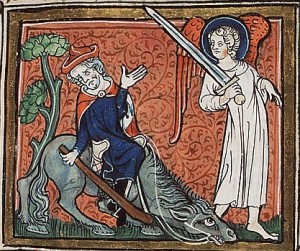 We’ve been following the story of Balak and Balaam from the Book of Numbers for a few days, although I’ve not been writing about it here. In truth, I find it a little dull. But Balaam’s words this morning strike me as pertinent to what’s going on in my denomination (the Episcopal Church) in Indianapolis this week: “What the Lord says, that is what I will say.” Balaam will not simply parrot whatever blessing or curse Balak wants; he will say what he understands God to want him to say. ~ A lot of resolutions are being debated at the General Convention and many of them will be referrals to standing or special committees and task forces with instructions for study and report. That’s all well and good, some actions of the church need study and careful consideration before they are taken. But all too often these referrals are not for disinterested and unbiased reflection. Take, for example, the question of whether the church should bless the committed relationships of couples who are of the same sex (“same-sex marriage” as some call it). ~ Before I continue, I need to be on record as believing that the church should offer such blessings, just as we do for committed couples of opposite sexes. ~ It is likely that some committee (the Standing Liturgical Commission, probably) will be asked to study the question of our theology and understanding of marriage. Good. But it will probably, in the same resolution, be tasked (in fact, I think there’s a resolution pretty much saying) to report back with suggested liturgies for such blessings. Bad. The outcome of the theological study is simply presupposed in the task! This isn’t a resolution to study the theology of marriage; it’s a resolution to provide a theological justification for same-sex marriage. ~ I suspect that another issue before the Convention, whether Holy Communion should be open to those who are not yet bapized members of the Christian faith, will result in a similar “study-and-report” referral. ~ Committees and task forces asked to do that should not also be given the job of preparing materials which can only be based on a pre-supposed outcome. When the Convention does so, it stands in the same position as Balak demanding that Balaam utter the blessings and curses of his choosing. Committees and task forces need to be free, like Balaam, to say not what the General Convention presupposes they will say, but what they understand God wants them to say. ~ By the way, Balaam had a donkey who could see angels and who tried to steer him away from danger. Most committees also have an ass or two who can do the same thing; pray God they do their job! ~ (Parenthetical closing remark: I don’t otherwise suggest that our committees emulate the confused, untrustworthy, and idolatrous Balaam, a man whom Peter described as being one who “loved the wages of iniquity” [2 Peter 2:15]. But insofar as he spoke God’s message without bias, go for it!)
 This psalm is actually optional for Morning Prayer, but it’s one I rather like, so I included it today. This psalm is a song of God’s abundance. Brotherhood and unity are likened to flowing oil and falling dew. ~ First, the oil. This is “fine oil” or, as another translation renders it, “precious” oil. The Hebrew is from the same root as used repeatedly in Genesis when God describes creation as “good”, towb. This isn’t just any oil! And it flows in copious quantities. This is not just a small amount dabbed on a forehead, such as the church does in the rite of chrismation at baptism or in the anointing of the sick; this is oil poured liberally over the head, flowing onto “Aaron’s beard”, and spilling onto robes. The Hebrew word peh meaning “edge” is here rendered as “collar”, but in older translations it was given the meaning “skirts”, which underscores even more the more the image of profligate abundance. ~ Then the dew. Look at a map of the Holy Land. Mt. Hermon is in southern Syria about 150 miles north of Jerusalem (“Zion”). Dew falls on the mountain in sufficient quantity to run off and water the hills of Zion far to the south. Again, profligate abundance! ~ Today is the start of the Episcopal Church’s 77th General Convention. Coincidentally, the Presbyterian Church USA is in the midst of its similar General Assembly. My prayer today is that brotherhood (is there a non-sexist term that conveys the same idea? – “siblinghood”?) and unity will be abundant and will prevail as the church seeks a path forward to carry out its mission of extending God’s blessing to all.
 Our first reading this morning is from a little book from the Apocrypha called The Book of Wisdom. At one time church tradition ascribed authorship to King Solomon, but it is now believed to have been written sometime in the first or second century before Christ by a Greek-speaking Jew of the Diaspora. It is found in the Greek-language version of Jewish scriptures, not in the Hebrew version, and is therefore not considered as canonical scripture by Jews or by Protestants. Roman Catholics and the Eastern Orthodox do accept it, and we Anglicans take a middle course, saying that we read them “for example of life and instruction of manners; but yet [we do] not apply them to establish any doctrine.” (Articles of Religion, Art. VI, BCP 1979, pg. 868). Well, here’s an example of life, then:
 I have already written one of these for today’s readings (see
  This is such a great verse! Matthew could have made some christological or soteriological comment about “the Son of Man” – in fact, he has done so earlier in this story and will do so again in the next chapter. But here the power and authority to heal is specifically described as being given not just to Jesus but “to human beings” . . . to you and to me! That’s great! ~ A couple of years ago the American Psychological Association reported that the first decade of the 21st Century saw a dramatic increase in the number of American adults praying about health issues. Even though attendance at formal religious services has fallen in the same period, informal and private spiritual practices such as prayer seem to be on the increase. One of the interesting results of a study by the Centers for Disease Control was that those who exercise are 25% less likely to pray than those who don’t…. One wonders if those who pray are less likely to exercise. ~ I’m not an exerciser myself. I admit that I should be; I’m just a lazy procrastinator who can’t get around to it. But I am a person who prays, and I often pray for health and healing for myself and for others. ~ The teacher of prayer who looms largest in my life is my late paternal grandfather. One of the things he taught me about prayer is “never pray for something you aren’t willing to work for.” His point was that God’s answer to your prayer just might be that God would send you into the midst of whatever the situation is to work toward a solution. I’m beginning to think that there’s a lesson here about exercise and health, too. I really shouldn’t be praying for my own physical health if I’m not willing to get off my duff and work for it. God has given me the authority to live a healthy life. I guess I’d better claim it and start doing it. ~ Tomorrow . . . maybe.
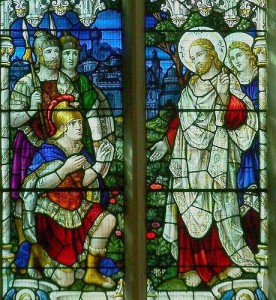 The words of the centurion are the root of a prayer spoken by many before receiving Holy Communion: “Lord, I am not worthy to receive you, but only say the word and I shall be healed.” As an Anglo-Catholic Episcopalian, recitation of this prayer used to be a part of my personal practice. But I have ceased to say it because I became uncomfortable about the change in emphasis from the biblical text to the liturgical text. A statement of faith in Christ’s power to heal another has been turned into a purely personal (and one is tempted to say “selfish”) prayer. ~ Paragraph 1386 of the catechism of the Roman Catholic Church explains the rational of the prayer: “Before so great a sacrament, the faithful can only echo humbly and with ardent faith the words of the Centurion: ‘Domine, non sum dignus ut intres sub tectum meum, sed tantum dic verbo, et sanabitur anima mea’ (‘Lord, I am not worthy that you should enter under my roof, but only say the word and my soul will be healed.’)” That’s great, except the quotation from the Centurion is inaccurate! In the Vulgate, the verse reads, “Tantum dic verbo et sanabitur puer meus.” (“Only say the word and my servant [or ‘child’] shall be healed.”) I am troubled reciting a prayer based on a misquotation of scripture. ~ The centurion in the story is about as far from self-centered as one can be. He seeks Jesus’ help not for himself but for his servant. He is unwilling for Jesus to be inconvenienced. It is in that spirit that he speaks these words, explaining that as a military officer he simply gives orders and things are done, so he has faith that One with the power of healing can simply do the same. It is for his selflessness that Jesus’ praises him and his faith. It seems somehow wrong to recite a prayer which turns that on its head! ~ I recall reading a few years ago about a medical brain-function study which demonstrated that selflessness is psychologically healthy and is the neuropsychological foundation of spiritual experience. Selfishness, on the other hand, is unhealthy: other scientific studies have demonstrated that it is impossible for a completely selfish individual to either survive or have a biological future. So I am unwilling to utter a prayer which turns a selfless intercession on behalf of another into a self-centered (one is tempted to say “selfish”) petition. “Lord, I am unworthy to receive you” … let’s just leave it at that.
 There was a meme circulating the conservative blogosphere and email circuit several months ago in which folks of a certain political persuasion asserted that they were “praying” for President Obama by reciting a verse from Psalm 109: “Let his days be few, and let another take his office.” The psalm continues in the next verse: “Let his children be fatherless, and his wife become a widow.” And the petition get even worse after that. This is not what Paul is admonishing the faithful to do in his letter to the young bishop Timothy. In fact, it is clearly the very opposite. ~ What would our country and our society be like if everyone did offer “supplications, prayers, intercessions, and thanksgivings … for … all who are in high positions”? One of the things I counsel folks who come to me with issues of unresolved anger toward another is to pray for that other. Not specific intercessions just simply to offer that person’s name before God with the simple request, “In this person’s life, Lord, may your will be done.” The nearly universal experience of my counselees is that over the course of time (the length of time varies from person to person) their anger dissipates; the typical observation is that is impossible to stay angry at someone for whom you are praying. ~ The purpose of prayer is not to inform God of anything of which we believe God may be unaware, to give God our good advice, or to conform God’s will to ours. Rather, it is to relinquish our own selfish desires in acquiescence to the one “whose power, working in us, can do infinitely more than we can ask or imagine,” as we remind ourselves as the end of the Daily Office (quoting Ephesians 3:20). ~ What would our society be like if everyone prayed for our leadership, even the leaders with whom we have political disagreements or personal dislikes? What would things be like if I prayed for that jackass in Congress, or that SOB in the state house? I cannot imagine, but Paul assures me that we would all “lead a quiet and peaceable life in all godliness and dignity.” Maybe we (that really means, I) should give it a try.

