Today, 9 July 2011, I walked the hills of southeastern England visiting two fascinating sites that may date back as many as 5,000 years!
First I visited the village of Uffington, Oxfordshire, and the hill south of town on which one finds a massive depiction in white chalk of a horse. I tried to take a picture of it, but from ground level that is very difficult to do and (on this day) the site was crawling with several hundred early elementary school students on school outings. So here’s a picture from Wikicommons:
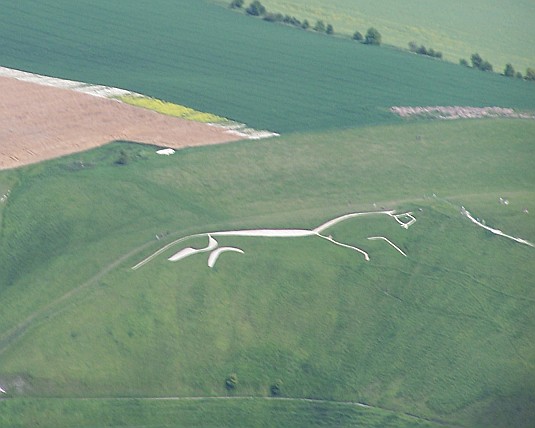
The Uffington White Horse from the Air
I walked up to the area where the head of the horse is seen in this picture. It was an overcast and hazy but warm day – a good thing because it was also very breezy. It was about a mile or so walk up the hill from the car park via the Ridge Path, which took me through the Uffington Castle, which isn’t what you think it is at all … not a castle in the medieval sense. Uffington Castle is all that remains of an early Iron Age hill fort. It is composed of two circular earth berms (with a circular ditch between them) surrounding about 32,000 square meters (nearly 8 acres). There is an entrance in the eastern portion, near the White Horse and another at the south (through which I entered). An entrance in the western side was apparently blocked up a few centuries after it was built. I was able to take a picture of the “castle” (although it doesn’t look like much). This picture is taken from the eastern entrance of the southeastern quadrant; the southern entrance can be seen at the right of the picture.

Uffington Castle, Oxfordshire, UK
As you can see, the White Horse is a highly stylised prehistoric hill figure, 110 m long (374 feet), formed from deep trenches filled with crushed white chalk. The figure is believed, and scientific tests have shown it, to date back some 3,000 years, to the Bronze Age. The purposes of its creators is completely unknown. It is not of Celtic origin, but G.K. Chesterton used it as the setting for part of his Catholic allegorical and poetic retelling of the story of the Saxon king Alfred the Great, who defeated the invading Danes in the Battle of Ethandun in 878, which is entitled The Ballad of the White Horse.
Before the gods that made the gods
Had seen their sunrise pass,
The White Horse of the White Horse Vale
Was cut out of the grass.Before the gods that made the gods
Had drunk at dawn their fill,
The White Horse of the White Horse Vale
Was hoary on the hill.Age beyond age on British land,
Aeons on aeons gone,
Was peace and war in western hills,
And the White Horse looked on.For the White Horse knew England
When there was none to know;
He saw the first oar break or bend,
He saw heaven fall and the world end,
O God, how long ago.
As retold by Chesterton, Alfred and his Saxons set out from the White Horse and Alfred gathers there three great chieftains, Mark a Roman, Eldred the Franklin who is a Saxon, and Colan who is a Celt. In describing Colan, Chesterton includes these priceless lines:
For the great Gaels of Ireland
Are the men that God made mad,
For all their wars are merry,
And all their songs are sad.
After visiting the Uffington site, I went to Avebury to see the largest “henge” in Britain (possibly the largest man-made earthwork of its kind in all of Europe). A henge (the word is derived from Stonehenge and was coined in the mid-20th Century) is an earthen berm circular with an interior circular ditch. Because the ditch is on the inside, not the outside, of the berm, henges are not considered to be defensive fortifications. One scholar, however, has suggested that they are defensive in that he believes they were built to contain something and protect those outside from what was inside – and what was inside was divine energy. The Avebury henge contains many standing stones that are laid out in peculiar formations, some circles, some straight lines, some curving formations not forming full circles. Here are some photos of the standing stones.

Standing Stones near World Heritage Center Shop, Avebury, UK

Stone Circle portion within the Avebury Henge
This is a map (from Wikimedia) showing the Avebury henge and the position of the standing stones (and theoretical stones completing the circles). It does not show the Avebury village buildings which have been built within the henge. The henge has a circumference of about 3/4 of a mile.

Map of Avebury Henge (non-free material from Wikimedia)
I am intrigued by the idea that because the ditch and bank face inward, in the opposite order that they would be placed in a defensive ring fort, something “dangerous” or “powerful” was understood to be inside the enclosure. The proposal is that henges were designed mainly to enclose ceremonial sites seen as “ritually charged” and therefore dangerous to people, that whatever took place inside the enclosures was intended to be separate from the outside. In other words, the henge may have been a means by which neolithic society set aside “sacred space” in much the same way that modern human beings do with churches, mosques, temples, and so forth.
The hymn An Aluinn Dún (The Heavenly Habitation), which was set out in an earlier post, is about sacred space (heaven, particularly). The Celts and the Gaels have a special sense about sacred places; they marked them, but did not attempt to set them off or guard against them in the way henges seem to do. In fact, holy caves and holy wells were understood to be places of refreshment, “thin places” between our world and the spiritual realm, not something to be feared, but something to enjoy, somewhere to grow closer to God.


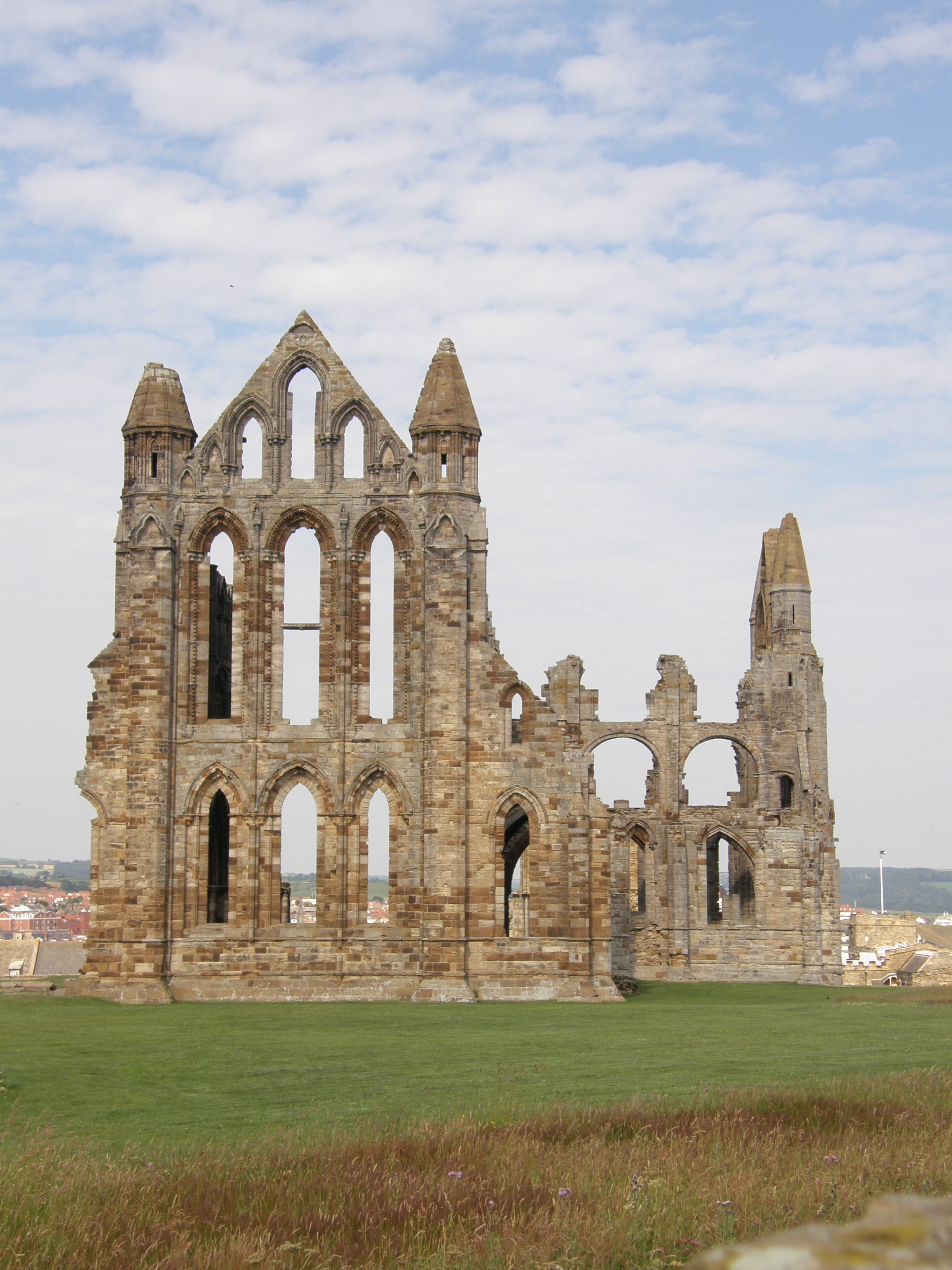




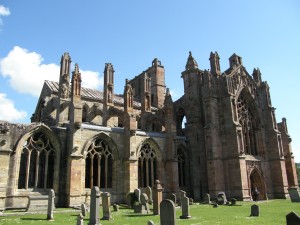 Melrose, Scotland, is an important place in Celtic church history. It was here that St. Aidan, abbot of Lindisfarne, established a mainland monastery bringing monks from Iona. It was in that Celtic monastery that St. Cuthbert became a monk and entered holy orders. This early monastic foundation, probably 2-1/2 miles from the current monastic ruin, has completely disappeared. In fact, was long gone by the 12th Century when Cistercian monks came and started what eventually became the Melrose Abbey we know now.
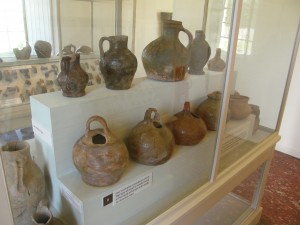 But the thing I thought about most as I left the place was the display of waste disposal artifacts. Unearthed in the excavations and on prominent display is the monks’ latrine, the “great drain” which carried away its contents and the waste of the on-site tannery, and a collection of pottery urinals! (Urine, however, was not considered waste! Tanners, which the monks were, soaked animal skins in urine to remove hair fibers. Urine is also used as a mordant to help prepare textiles, especially wool, for dyeing – and remember, these monks were shepherds with thousands of sheep to sheer and, one assumes, produce usable wool. In Scotland, the traditional process of “walking” (stretching) the tweed was preceded by soaking in urine. So these urinals may have been for the collection of a useful and necessary product, not considered waste.)
 On the north of the abbey grounds is a long, deep, stone-lined rectangular pit. A ground-level green and white sign labels it “Latrine”. About a foot or two of scummy, green, stagnant-looking water stands in it; I wondered if the Historic Scotland folks keep it that way for effect. The sign informs one that it would be periodically flushed out through the “great drain” (I keep putting that in quotes because that is the name given an exposed stone-lined culvert further to the north of the property heading downhill toward the river). One can imagine the long, narrow building sitting atop this pit with out-house privy seats.
 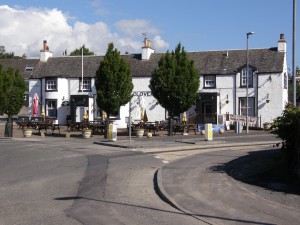 It was a very full day with lots to consider, lots to think about, and lots to relate. So let us return to Clovensford Country Hotel for the moment and consider the “full Scottish breakfast.” The full Irish, it ain’t! At least as served at Clovensford. Don’t get me wrong; it was a lovely breakfast, but it wasn’t what I was expecting.
  Driving on the left side of the road is something that pretty much comes back to you quickly after having done it before. Scottish roads are nearly identical to the Irish, though their country lanes are wider. I made a fool of myself getting into a place in the rental yard where I had to back up and couldn’t figure out for several minutes how to get the darned thing into reverse, but eventually figured that out.
 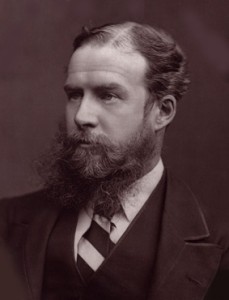 I had no idea who John Lubbock was, although I now know that I certainly should have. He was a Victoria era banker with many side interests, and the First Baron Avebury. He also was a good friend of Charles Darwin, whose hometown of Shrewsbury, Shropshire, I will be visiting in just under two weeks.
  Misused apostrophes added unnecessarily to plurals or added (or forgotten) with possessives … to use a serial comma or not … should this be a colon or semicolon … does a comma or period go inside the quotation marks or outside?

