Occasional thoughts of an Anglican Episcopal priest

Category: Religion (Page 118 of 118)

The Widening Wealth Gap — Dives and Lazarus Are Even Farther Apart

A colleague recently reported that in dismissing the elderly congregation at a weekday Eucharist, her mind went blank and all she could think to say was “Go forth and multiply.” When I heard this, it occurred to me that the elderly are certainly doing that – as more and more of us join the ranks thereof on a daily basis! Hence the ever-increasing need in the US for a really good comprehensive health care program for all citizens. It occurred to me as well that the elderly poor must also be increasing in number.

I was surprised that two recent reports on the economy (actually on the economic well-being) of Americans came out in the past week and neither received a great deal of comment from the media pundits or from politicians.

The first was the publication of the ranking of what is called “The Forbes 400” – the list of the 400 wealthiest people in the US. There was some minor rearrangement of positions (with Facebook’s Zuckerberg jumping over Apple’s Jobs, etc.) but what was most shocking was that these folks, in quite a contrast to the rest of the society, actually made money (increased their wealth) in the last year while for most of us change in assets was flat or actually lessened (my spouse and I are in the latter category as our home and retirement accounts both took major hits, and we had to spend from savings because income didn’t keep pace with expenses). The cumulative wealth of these rich folk, however, increased by 8% per annum; that means that on average, the value of their assets increased by eight times the increase that was seen by the S&P 500 index! New Jersey Newsroom reported, “Forbes 400 richest Americans in 2010 total worth was up 8% to $1.37 trillion, well out-earning the 1% rise in the S&P 500 index over the same period of time.” (http://www.newjerseynewsroom.com/economy/forbes-400-richest-people-in-american-mars-and-newhouse-top-list-from-nj)

The World Socialist Web Site (yes, I read the socialist press) reported that the total worth of the Forbes 400 is higher than the GDP of India, which has become one of the world’s leading economies (I believe it currently ranks 12th among the nations of the world). The population of India, by the way, is 1.2 billion people! In addition, the Forbes 400 total worth is greater than the projected 2011 deficits of all 50 US state budgets ($1.2 trillion). There’s an old story about a clergyman who stands up before his congregation with a good-news bad-news story. “The good news,” he says, “is that there is plenty of money in this congregation to fund our ministries and programs. The bad news is that it’s all still in your pockets.” Well … here we are with the civil equivalent. The good news – the good news is there’s plenty of money in the US to fund all of the state-level programs our citizens have come to expect of state government. The bad news – it’s all in the pockets of 400 people. The population of the US, by the way, is currently 310,327,585 (according to the US “census clock”). (The URL for the socialist report is http://www.wsws.org/articles/2010/sep2010/forb-s24.shtml)

On the other hand … the second piece of information was that the number of Americans living below the poverty line increased, again. “2009 figures are likely to show a significant rate increase to the range of 14.7 percent to 15 percent. Should those estimates hold true, some 45 million people in this country, or more than 1 in 7, were poor last year. It would be the highest single-year increase since the government began calculating poverty figures in 1959. The previous high was in 1980 when the rate jumped 1.3 percentage points to 13 percent during the energy crisis.” (http://www.huffingtonpost.com/2010/09/11/poverty-rate-in-us-saw-re_n_713387.html)

In other words wealth and poverty are both multiplying but not in the same way – the wealthy are getting richer, but it is the same people simply getting more money – there are not more wealthy people. The Poor, on the other hand, are getting poorer because the number of poor people is increasing. The wealth is flowing upwards, from the working poor who are sinking below the poverty level to the wealthy who are simply accumulating more capital.

The Republicans, who used to preach “trickle-down” economics (also known as “Reaganomics”) and now just baldly assert that if we don’t tax the wealthy they will create jobs for everyone else, wish us to believe that letting these people keep more of their wealth (by extending the income tax cuts given them under the Bush43 administration) would somehow improve the lives of all Americans. In the face of this clear economic evidence to the contrary, I don’t see how they can make that claim. If the wealthy getting wealthier somehow resulted in the poor getting jobs, the number of people below the poverty line should have decreased during the time the Forbes 400 were increasing their assets. But that didn’t happen – exactly the opposite did.

The old saw is true – The rich get richer and the poor get poorer. And somehow the Republicans, the Kock-brothers-funded Tea Party, and the obscenely wealthy have convinced working, middle class Americans that this is a good thing.

As I write this, I am well aware that on the next Sunday (Sept. 26, 2010) lectionary the Gospel Lesson is the story of Dives and Lazarus:

Jesus said, “There was a rich man who was dressed in purple and fine linen and who feasted sumptuously every day. And at his gate lay a poor man named Lazarus, covered with sores, who longed to satisfy his hunger with what fell from the rich man’s table; even the dogs would come and lick his sores. The poor man died and was carried away by the angels to be with Abraham. The rich man also died and was buried. In Hades, where he was being tormented, he looked up and saw Abraham far away with Lazarus by his side. He called out, ‘Father Abraham, have mercy on me, and send Lazarus to dip the tip of his finger in water and cool my tongue; for I am in agony in these flames.’ But Abraham said, ‘Child, remember that during your lifetime you received your good things, and Lazarus in like manner evil things; but now he is comforted here, and you are in agony. Besides all this, between you and us a great chasm has been fixed, so that those who might want to pass from here to you cannot do so, and no one can cross from there to us.’ He said, ‘Then, father, I beg you to send him to my father’s house– for I have five brothers– that he may warn them, so that they will not also come into this place of torment.’ Abraham replied, ‘They have Moses and the prophets; they should listen to them.’ He said, ‘No, father Abraham; but if someone goes to them from the dead, they will repent.’ He said to him, ‘If they do not listen to Moses and the prophets, neither will they be convinced even if someone rises from the dead.'” (Luke 16:19-31 NRSV)

The question I ask myself … do I have the intestinal fortitude to stand up in front of my congregation and preach this economic truth, and tell them that our capitalist financial economic system is sinful in light of this parable? Am I willing and able to risk my position as a relatively well-paid (though increasingly in-debt) pastor by confronting the political and financial biases of our society and my congregation?

I know that the church, or someone in the church has to do this …. but do I have the guts to be the one to do it here?
What’s at the Core? (Sermon for St. John’s Day)

On June 27, 2010, my parish hosted the local Masonic Lodge at its later worship service, as explained in the sermon below. The lessons for the Revised Common Lectionary for the day (Pentecost 5, Proper 8C) were 2 Kings 2:1-2, 6-14; Psalm 77:1-2, 11-20; Galatians 5:1, 13-25; and Luke 9:51-62. At the later service, however, we used the lessons from the Episcopal Church’s Common of Saints for the Feast of the Nativity of St. John the Baptist: Isaiah 40:1-11; Acts 13:14b-26; Psalm 85:7-13; and Luke 1:57-80. The following sermon was written to preach at both services with either set of lessons.

———————–

Today at the 10:00 a.m. service we will be commemorating St. John the Baptist.

We are hosting the local lodge of Free and Accepted Masons, whose custom it is to attend church together on the Sunday closest to the Feast of the Nativity of St. John the Baptist, also called “St. John’s Day.” In the Gospel lesson for that service, John’s father, the priest Zechariah (who had been rendered mute before John’s birth), utters a prophecy on the day John is circumcised. He says to his infant son:

You, child, will be called the prophet of the Most High;
for you will go before the Lord to prepare his ways,
to give knowledge of salvation to his people by the forgiveness of their sins.
By the tender mercy of our God,
the dawn from on high will break upon us,
to give light to those who sit in darkness and in the shadow of death,
to guide our feet into the way of peace.”

Luke, the writer of the Gospel, then concludes, “The child grew and became strong in spirit, and he was in the wilderness until the day he appeared publicly to Israel.”
In our Gospel at this [our early] service, we encounter Jesus, John’s cousin and Lord, the one for whom John was the forerunner, as Jesus encounters a variety of people who offer to follow him … after taking care of other business. Again, our Gospel writer is Luke:

As they were going along the road, someone said to him, “I will follow you wherever you go.” And Jesus said to him, “Foxes have holes, and birds of the air have nests; but the Son of Man has nowhere to lay his head.” To another he said, “Follow me.” But he said, “Lord, first let me go and bury my father.” But Jesus said to him, “Let the dead bury their own dead; but as for you, go and proclaim the kingdom of God.” Another said, “I will follow you, Lord; but let me first say farewell to those at my home.” Jesus said to him, “No one who puts a hand to the plow and looks back is fit for the kingdom of God.”

These two stories from Luke’s Gospel speak to us about what is central and what is not.

Today in the Episcopal Church and the Anglican Communion, and indeed in nearly all mainline Christian denominations, we are engaged (as we have always been) in a discussion about what is central to the Christian faith … what is core doctrine and what is not?

Some centuries ago, someone in the church laid down the maxim, “In essentials unity, in non-essentials liberty, in all things charity.” This has been attributed variously to St. Augustine, to John Wesley the founder of Methodism, to John Amos Comenius the founder of the Moravian Church, and to Peter Mederlein a 16th Century Lutheran theologian. I don’t really know who first said it, but it’s a good rule to follow. The problem is in determining what is central to religion, what is essential, and what (on the other hand) is peripheral or non-essential.

Today’s Gospel stories, whether of John the forerunner or Jesus his cousin and Lord, are guides for us in considering that question.

John was the son of a priest for whom one would have thought the religious establishment was central and essential. As Luke tells us, he “grew and became strong in the spirit.” As the son of a priest, it would have been expected that he would become a priest – the priesthood in Ancient Judaism was hereditary. Like his father, he would be expected to learn the rituals and to take his regular place in the rotation of priests serving in the sanctuary of the Jerusalem Temple, to be at the very center of power in the Jewish religion. Instead, he retreated into “the wilderness until the day he appeared publicly to Israel.”

In the religious world of John’s and Jesus’s day there were two important and powerful groups of Jewish leaders, both of whom are mentioned in the Gospels: The Sadducees and the Pharisees. The Sadducees were a priestly group, Aaronites, associated with the leadership of the Temple in Jerusalem; they claimed descent from Zadok, the high priest who had anointed King Solomon. Their approach to religion focused primarily on properly performing the Temple rites; they emphasized that portion of the Law of Moses which dealt with sacrificial ritual and did not believe in an afterlife. Most importantly, they rejected the so-called “Oral Torah” or “Talmud”, which concerned the daily life of Jews and which was revered by the Pharisees. For the Sadducees the center of power and authority, the Temple and its rituals was all important. John was, by birth, a Sadducee but he rejected all of that.

The Pharisees, in contrast to the Sadducees, embraced and emphasized the “Oral Torah” and its many and detailed rules for daily life, and they did believe in a resurrection and an afterlife. The Pharisees are the ancestors of today’s Rabbinic Jews with their rules of “keeping kosher.” The Pharisees believed that all Jews in their ordinary life, and not just the Temple priesthood or Jews visiting the Temple, should observe rules and rituals concerning home life, purification, and family relationships. For them, the center of religious power and authority was the Synagogue where the everyday Jew was taught to obey, and where they the Pharisees enforced, the rules of daily living.

Jesus the Rabbi was probably a Pharisee, or at least more sympathetic to their understanding of religion than that of the Sadducees. Nonetheless, in the encounters between Jesus and the three persons who want to follow him in the regular lectionary Gospel today, we find Jesus rejecting precisely these things: he has no “home life” (for unlike a bird or a fox, he has no home!); he has no concern for purity (“let the dead bury the dead”); and he couldn’t care less about family relationships (turning back to bid a parent farewell renders one unworthy of following him). Just as John, who would blaze his trail, rejected his Saddusaic heritage and its concept of the center of religious life, Jesus rejects his Pharisaic origins and its understanding of the core of religion.

Or were they? Were they rejecting their roots entirely or were they instead rejecting those peripheral things which those traditions had wrongly placed in the center of the Jewish faith? Were they instead rejecting the non-essentials with which others had covered over and obscured the essential? The non-essentials, whether ritual temple sacrifice or kosher laws of daily life, were central to the power structures of the day, but not to religion as John and Jesus saw it.

The Sadducees had put Temple ritual and sacrificial system at the center of their version of the Jewish faith. John rejected all of that. When the Sadducees and the Pharisees came out to see what he was doing at the Jordan River, he called them both a “brood of vipers” and admonished them to “bear fruit worthy of repentance.”
“The answer to sin,” he said, “is not offering some animal on the Temple altar! The answer to sin is repentance, turning back toward God! Having a contrite heart and washing here in the Jordan is more effective than any Temple sacrifice.” “Repent!” he said, because “one who is more powerful than I is coming after me; I am not worthy to carry his sandals. He will baptize you with the Holy Spirit and fire.”

That One, his cousin Jesus, also encountered the Sadducees and the Pharisees together. On one occasion the Sadducees put to him a rather silly question about the afterlife, imagining a woman who had seven husbands: Whose wife would she be in the here-after? Jesus dealt handily with that question and was then asked by a Pharisee, “What is the greatest commandment?”

Most folks understand that question to mean “Which of the Ten Commandments is most important?” or “Which of the many many rules of daily living in the Talmud is most important?” I believe that Pharisee was asking something very different. I believe he was asking, “Is the Saddusaic emphasis on the Laws of ritual sacrifice and Temple rite the central core of our religion, or is the Pharisaic emphasis on living a pure and holy daily life with all its minute rules at the core of our faith?”

And Jesus answered in a way that made it quite clear that he and his cousin John were right on the same track. “Neither,” was his answer.
“‘You shall love the Lord your God with all your heart, and with all your soul, and with all your mind.’ This is the greatest and first commandment. And a second is like it: ‘You shall love your neighbor as yourself.’ On these two commandments hang all the law and the prophets.”

God was his answer, as it had been John’s answer and as it should be our answer.

The essential core of our faith is love of God and those whom God loves. About that we are and must be united! Everything else, temple rituals, religious rites, rules of daily living and purity of conduct, questions of whether to use vestments or not, what color they should be if we do, who can be ordained or not, who can be married or not, whether to use candles or not, whether to have music, and if we do whether it can be accompanied by musical instruments, and all the other things we debate …. those are peripheral, the non-essential. With regard to those we can disagree and we must give each other the liberty to differ. And in all things we can and must treat one another with charity and good will. As St. Paul wrote to the Galatians, “The fruit of the Spirit is love, joy, peace, patience, kindness, generosity, faithfulness, gentleness, and self-control. There is no law with regard to such things.”

“In essentials, unity; in non-essentials, liberty; in all things, charity.” Amen.

————————

(Copyright 2010, The Rev. Dr. C. Eric Funston)

A Vision

This (edited to remove some awful, glaring typographical errors!) is the “Rector’s Reflection” I wrote for the May 2010 issue of St. Paul’s Epistle, the newsletter of St. Paul’s Episcopal Church, Medina, Ohio.
———————-

What Is A Vision?

In Eugene Peterson’s paraphrase version of Holy Scripture called The Message, he renders a portion of the Prophet Habakkuk’s prophecy this way:

And then God answered: “Write this. Write what you see. Write it out in big block letters so that it can be read on the run. This vision-message is a witness pointing to what’s coming. It aches for the coming; it can hardly wait! And it doesn’t lie. If it seems slow in coming, wait. It’s on its way. It will come right on time.” (Habakkuk 2:2-3)

The first half of Proverbs 29:18 in the Authorized version reminds us that “Where there is no vision, the people perish….”

In seven years time, April 2017, St. Paul’s Episcopal Church of Medina, Ohio, will be 200 years old. We will have much to look back over and to celebrate. Gwendolyn ______________ does a wonderful job of reminding us of our history, both long-ago and more recent. (In this issue of St. Paul’s Epistle, she relates the story of our Columbarium and Memory Garden.) We are very grateful to her for that ministry for it keeps us reminded of and connected to our foundation on the good works many.

That foundation provides us a good vantage point, not so much to look backward at our history as to look forward to our future. Sir Isaac Newton once wrote to a friend, “If I have seen a little further it is by standing on the shoulders of giants.” Sir Isaac, in turn, was quoting an aphorism of the early medieval scholar Bernard of Chartres. According to his student, John of Salisbury, “Bernard of Chartres used to say that we are like dwarfs on the shoulders of giants, so that we can see more than they, and things at a greater distance, not by virtue of any sharpness of sight on our part, or any physical distinction, but because we are carried high and raised up by their giant size.”

I believe we have not only the opportunity, but the duty to look forward, a duty to have a vision “pointing to what’s coming”, a vision that “aches for the coming,” that “can hardly wait!”

As one write has noted, “A Vision is an ideal and unique image of the future. It answers the question, ‘What should we become?’ How would you finish this question: ‘If anything is possible, if there no restraints whatsoever, our church ideally would be _______’? ”

A Vision is not a goal. Goals are good. We should have goals. Challenging goals help us to keep on doing what we have been doing, only more of it or getting better at it: win more games, get better grades, build nicer buildings, increase attendance at worship, broaden our musical horizons, serve more hungry people through Free Farmers’ Market.

A few years ago, a couple of business writers suggested that business organizations should have what they called “Big Hairy Audacious Goals” or “BHAGs”. They defined a BHAG this way: “A true BHAG is clear and compelling, serves as a unifying focal point of effort, and acts as a clear catalyst for team spirit. It has a clear finish line, so the organization can know when it has achieved the goal; people like to shoot for finish lines.” (Collins and Porras, Building Your Company’s Vision, 1996)

Goals are great! BHAGs are super! And it is said that goals, even the biggest and hairiest of them should be SMART, which means that a goal is Specific, Measureable, Attainable, Relevant, and Time-bound.

But a Vision is something different. A Vision is something that speaks to us so powerfully that those who hold it can say with conviction, “If we could achieve that, my life would have the deepest meaning?”

Where a goal keeps us doing what we’ve been doing, a Vision propels us to a different place, to a future radically different from the past. It has been said that the difference between a goal and Vision is continuity – a goal is continuous is the past, which a vision is radically discontinuous, a Vision gives us a compelling picture of a new tomorrow.

The Next Hundred Years

A few days ago the Senior Warden and his wife, Ray and Vicki _____________, took Evelyn and me to dinner at a local oriental restaurant. Predictably, our very pleasant time together ended with Fortune Cookies. My fortune was this: “If you keep doing what you’ve always done, you’ll keep getting what you’ve always gotten.”

WOW!

Could there have been a clearer statement of the need for a Vision for one’s life or one’s business … or one’s church? I don’t think so! If we simply change the word “you” to “the church” in that fortune cookie aphorism, the result is compellingly stark:

IF THE CHURCH KEEPS DOING WHAT IT’S ALWAYS DONE, THE CHURCH WILL KEEP GETTING WHAT IT’S ALWAYS GOTTEN.

Back in 1988, the Bishops of the Anglican Communion and, with them, the General Convention of the Episcopal Church, declared that the 1990s would be the “Decade of Evangelism.” To quote a recent politician, “How’d that go for ya?” Do you remember the church doing a lot of evangelism? Do you remember a lot of growth happening in the Episcopal Church during the 1990s? If you do, please tell the rest of us about it, because I sure don’t remember it! The Bishops and the Convention may have made a declaration, but the church kept doing what it had always done, and it kept getting what it had always gotten … at least what it had gotten since about 1965 – decreasing membership and increasing irrelevance to the lives of those around it.

Why wasn’t the Decade of Evangelism successful? Because it wasn’t compelled by a Vision. Recently, I wrote a note to a clergy friend with whom I was discussing our history of evangelistic success or lack thereof. This is what I wrote:

What I recall is “The Decade of Evangelism” being declared by the General Convention and then practically nobody, from “815” (i.e., our national headquarters) on down, actually doing anything about it. A few “progressive” parishes did some good work of evangelism and grew, and a few more “conservative” congregations did some good work of evangelism and grew, but for the most part the Episcopal Church just said, “We’re going to grow in this decade” and then sat back and assumed the rest of the world would invite itself to know Jesus.

What that experience proves, of course, is that it doesn’t matter whether a particular parish is progressive or conservative. What matters is whether the people in that parish learn how to tell the story of their relationship with Jesus and share that story with others. If we can do that, we grow; if we don’t do that, we die. Whatever else we do isn’t all that important if we’re not doing that.

So how about this as a Vision for our future, as a Vision for St. Paul’s Episcopal Church of Medina, Ohio, in the next hundred years?

My Vision for our parish is to be a community of people who know Jesus Christ personally, who know Jesus Christ so well that they can and do tell their story of knowing him to others wherever and whenever the opportunity presents itself, who know Jesus Christ so well that they recognize him in the neighbor who’s struggling with a broken marriage, in the homeless person on the street, in the hungry family whose monthly income has run out a week before the next paycheck and who have nothing to feed the kids!

My Vision for our parish is to be a community of disciples who follow Jesus so closely that we’re practically treading on his heels and who are so happy and joyful doing so that others, to whom we shout out invitations to join us, want to do exactly that because they can see that we’re on to something!

My Vision for our parish is to be a community of worshipers of every generation who know and tell all sorts of faith stories, who know and sing all sorts of music, who celebrate and share the Holy Eucharist as if it were (as it is!) the greatest party we’ve ever been to, who sometimes have to stand up during worship, not because the Prayer Book rubrics say to do so but because there are no seats left in the Nave!

My Vision for our parish is to be a community of Easter People who know the Real Presence of our Risen Lord among us and who share his presence with the world around us!

Alleluia! Christ Is Risen! The Lord Is Risen Indeed! Alleluia!

Whoever Is Not Against Us Is With Us

Proper 21 (RCL): Esther 7:1-6, 9-10; 9:20-22, and Mark 9:38-50

They were brought here as slaves. Our ancestors captured them and brought them to this country and put them to work, gave them new lives. Eventually they were allowed freedom and permitted to become part of the general populace, to become educated, to participate in the social and political life of the nation. Many of them became wealthy merchants and business leaders, and some of them even rose to national prominence, becoming important in government. But let’s face it! They were slaves! They aren’t really like us! And now one of them is at the very center of national power.

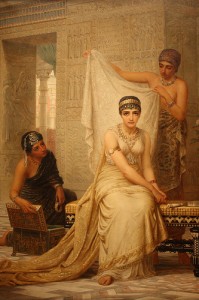
Queen Esther by Edwin Long, National Gallery of Australia

Queen Esther by Edwin Long, National Gallery of Australia

The Book of Esther is a parable for today, but I’m at something of a loss to explain why a short portion of it drops out of the blue into our lectionary today. We haven’t been reading from it during the past few weeks and we won’t read from it again in coming weeks. I could understand this one-time shot of Esther if we were in, say, the month of March. Then we might be acknowledging our solidarity with our Jewish brothers and sisters. As we heard in the lesson, they were enjoined to have a holiday on the 14th and 15th of Adar, and they still do to this day. The holiday of Purim, the most joyous in Jewish calendar, celebrates the salvation of the Jews related in Esther’s story. But the middle of the month of Adar usually falls in March in our calendar. So solidarity with modern Jews can’t be the reason we here this bit of Esther today.

Let’s consider the whole story of Esther and maybe that can help us figure this out.

Remember that the leading citizens of Israel had been taken captive and transported as slaves to the Persian empire. Most had been resettled near the capital, near modern Tehran, but many had been resettled throughout the provinces of Persian. They had become a part of the society. Many were merchants, some had entered into the king’s government service, a few had risen to high rank. One, Mordecai, was an advisor to King Xerxes (called Ahasuerus in our reading today).

Xerxes was in need of a queen. His former wife, Vashti, had been disrespectful and disobedient, so he had divorced her and exiled her. So the King ordered a search for a new queen. All of the marriageable young women were to be brought before him to show off their comeliness and their talents in a sort of beauty pageant.

Mordecai’s orphaned cousin was Esther, a lovely young woman, whom no one knew to be a Jew. Mordecai arranged for her to take part in the king’s pageant and (guess what?) she won. She became queen of Persia.

Now Mordecai had run afoul of another government minister named Haman – Haman hated the Jews! All that ranting I did at the beginning of this sermon … that was Haman’s opinion of the Jews of Persia (though you might have thought it something else).

As far as Haman was concerned the Jews were so different … They looked different. Their skin color was different. Their facial structure was different. They had a different God (although God isn’t mentioned at all in the Book of Esther). They had different customs and traditions. They kept a different calendar. They had different holidays. They did strange things to their baby boys. … They were so different they had to be dealt with in a decisive way. So Haman came up with a plan.

Haman obtained the King’s seal; he was given supreme authority over the empire. So he sent out letters using the seal to the provincial governors and the leaders of the cities. The letters ordered that on a particular day at a particular time, all of the Jews were to be rounded up and killed. Mordecai learned of this plan and contacted Queen Esther so that she would ask the king to countermand Haman’s orders.

Esther decided to deal with the situation in this way: she invited the king and Haman to her apartments in the royal palace for a banquet. It must have been quite a feast for, as our lesson tells us, the king and Haman were still drinking wine on the second day! That’s when Xerxes told her she could have anything she requested. And so, she told him about Haman’s plan and asked for the lives of her people. The king granted her petition and, not only that, decided to hang Haman for this treachery. Haman had erected a tall gallows outside his home where he intended to hang Mordecai … but he ended up being hanged on it himself.

So here we have this story set side by side with a story from the Gospel of Mark in which John, typical of the disciples, doesn’t quite understand what the Good News is all about. Remember that John and his brother James had asked for the thrones of power in Jesus’ kingdom, but Jesus had used their request to teach about the overturning of society – that the first would be last and the last, first, and that the leader must be the servant. Now John, still thinking in terms of power and status, wants to hoard the healing authority he and the others have through Jesus. There’s someone else casting out demons and he wants them stopped. He couldn’t do it himself, so he asks Jesus to do so.

But Jesus won’t. “Whoever is not against us is with us,” says Jesus. John, like Haman, wants to exclude the outsider. John, like Haman, wants to draw a small, narrow circle with the insiders inside and those who are different left out. But Jesus won’t permit that. Jesus draws a wide and encompassing circle that includes anyone who does not specifically and intentionally put themselves outside of it. “Whoever is not against us is with us.”

And then Jesus goes on with all this disturbing talk of cutting off hands and feet, plucking out eyes. What on earth is that all about? Well, it’s metaphorical language for those attitudes and actions of exclusion that we all, unfortunately, share with John and Haman.

Has anyone ever done this to you (putting up a hand as if blocking passage)? “Talk to the hand!” “Keep out!” “Stand back!” Or have you ever been “kicked out” of some place or some group? Have you ever put up your to hand block someone … or used your foot to kick someone out? “No, no,” says Jesus. Better get rid of that blocking hand, that kicking-out foot … there is no place for exclusion in God’s kingdom. “Whoever is not against us is with us.”

In Jesus’ and John’s time people believed in the “evil eye”. They believed that a certain look could curse someone, and that was another way to deal with those who were different, to keep them away from the insiders.

So what Jesus is saying is … if you (like Haman, like John) have any attitudes, any actions, any habits that exclude others, that push them away, that kick them out, that see them as outside the circle, get rid of those attitudes, actions and habits. The circle is drawn wide. “Whoever is not against us is with us.”

And that’s why we got that bit of Esther today. A story of exclusion, a story of the worst way of relating to the outsider, to those who are different in some way, set side-by-side with Jesus’ circle of inclusion. A story of violence contrasted with an injunction to peace. Our Gospel lesson concludes as Jesus says to everyone within his ever-widening circle, “Be at peace with one another.” Despite all that may be different among us, unless we intentionally exclude ourselves, we are all within Jesus’ circle; be at peace with one another. Amen.

Newer posts »