From the Book of Genesis:
The Lord God sent [Adam] forth from the garden of Eden, to till the ground from which he was taken. He drove out the man; and at the east of the garden of Eden he placed the cherubim, and a sword flaming and turning to guard the way to the tree of life.
(From the Daily Office Lectionary – Genesis 2:23-24 (NRSV) – January 14, 2014.)
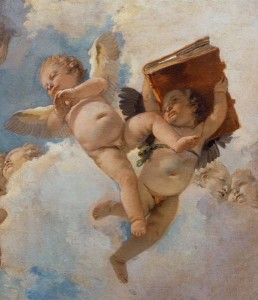 Look up cherub in a secular dictionary and this is what you find: “a member of the second order of angels, often represented as a beautiful rosy-cheeked child with wings.” (Collins) I don’t know why, when, or how the fat little boys with aerodynamically inadequate wings came to be an artistic and now normative depiction of cherubs, but there it is! Technically, these little guys (and they are male) are known as putti — an Italian plural; the singular is putto. (Putto is occasionally used in modern Italian to mean a male toddler.)
Say the word cherub (or its adjectival form, cherubic) to nearly anyone, and the image that will spring to his or her mind is almost guaranteed to be a putto. For me, this inaccurate representation of the cherubim has become the poster child for everything that needs to be unlearned.
As the end of the story of the Garden of Eden ought to make clear, the cherubim are beings of immense power, stationed on the path to the tree of life wielding flaming swords. They are the bearers of the throne of God (see Isaiah 37:16). Ezekiel describes the cherubim when recounting his vision of “four living creatures” whom he later identifies as cherubim:
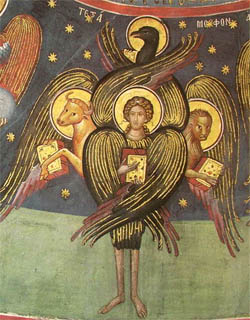
They were of human form. Each had four faces, and each of them had four wings. Their legs were straight, and the soles of their feet were like the sole of a calf’s foot; and they sparkled like burnished bronze. Under their wings on their four sides they had human hands. And the four had their faces and their wings thus: their wings touched one another; each of them moved straight ahead, without turning as they moved. As for the appearance of their faces: the four had the face of a human being, the face of a lion on the right side, the face of an ox on the left side, and the face of an eagle. (Ezek. 1:5b-10; cf. Ezek. 10)
Although our error of imagination in regard to the appearance of the cherubim can be easily corrected by a few minutes of bible study like this, the larger issue of unlearning is not so quickly or easily dealt with.
An old comedy album by the group the Firesign Theatre was entitled Everything You Know Is Wrong. I wouldn’t go that far, but we are conditioned by our families, societies, and culture to “know” many things . . . and much what we “know” as a result of that conditioning is simply inaccurate. Before we can know the truth, we have to unlearn the things of which we are convinced because of our conditioning.
Unlearning, however, is not simply replacing inaccuracies with “true facts.” It is not about right or wrong. Unlearning is an attitude of openness to that which lies beneath the judgment of right or wrong. It is about “moving away from” rather than “moving towards.” Zen masters often use the metaphor of emptying a full cup of tea. There is nothing beyond the emptying. The cup is not emptied so that it can be refilled; it is emptied so that it can be empty. Only when it is truly empty with no expectation or anticipation of being filled is the cup open to the future.
Jesus used another metaphor, that of an innocent child: “Truly I tell you, whoever does not receive the kingdom of God as a little child will never enter it.” (Mark 10:15)
So perhaps our chubby little wingéd friends, those little angelic toddlers, are a good image after all. If they are, as I suggested, the poster children for unlearning, let’s think about the way toddlers receive things.
A way to unlearn might be to try to go back to our first learning experiences and explore new things as toddlers would, through playfulness and curiosity. Toddlers never seem to have a plan, no preconceived notion of where they are going, no expectation of what is coming next. Jiddu Krishnamurti, the Indian philosopher, often described truth as a “pathless land;” toddlers seem to live in such a pathless country, a place of endless discovery. This, I think, is where Jesus invites: to a place where we can open ourselves, empty ourselves, and unlearn our conditioning, to the pathless country of truth where we can wander like a toddler with playfulness and deep curiosity.
====================
A request to my readers: I’m trying to build the readership of this blog and I’d very much appreciate your help in doing so. If you find something here that is of value, please share it with others. If you are on Facebook, “like” the posts on your page so others can see them. If you are following me on Twitter, please “retweet” the notices of these meditations. If you have a blog of your own, please include mine in your links (a favor I will gladly reciprocate). Many thanks!
====================
Father Funston is the rector of St. Paul’s Episcopal Church, Medina, Ohio.



 The musical Godspell debuted in 1971 (my junior year in college); in it, Christ is portrayed as a clown. Whether it was an expression of or the catalyst for the phenomenon of offering clown eucharists as an edgy, avant-garde presentation of the Christian Mysteries, I really don’t know. The two are inextricably linked in my memory.
 I sometimes wonder to what extent Paul, as an educated Jewish citizen of a Greek-speaking empire, was schooled in the classical Greek philosophers. Had he read Plato’s Republic? Was he aware of the conversation portrayed in Book VII between Socrates and Glaucon in which the allegory of the cave is laid out?
 My wife and I met at a Cursillo three-day weekend event. I was a part of the team (one of the cooks) putting on the Cursillo; she was “making” her Cursillo (as the lingo has it). She claims we’d met before at a fund-raiser fair at my parish (she attended elsewhere), but I was very busy during the fair and don’t recall that. I remember meeting her at the Cursillo weekend.
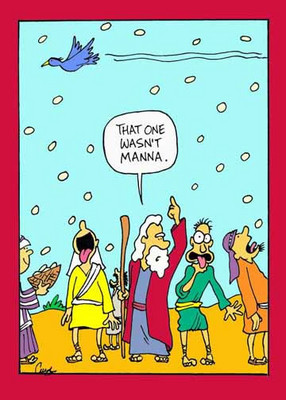 Jesus and a crowd who challenge his authority also make reference to the manna in today’s Daily Office gospel lesson in which Jesus says: “Your ancestors ate the manna in the wilderness, and they died. This is the bread that comes down from heaven, so that one may eat of it and not die. I am the living bread that came down from heaven. Whoever eats of this bread will live for ever; and the bread that I will give for the life of the world is my flesh.” (John 6:49-51)


