Occasional thoughts of an Anglican Episcopal priest

Category: Sermons (Page 37 of 40)

The Lord Is My Shepherd: I HATE that! – Sermon for Easter 4 – April 29, 2012

Revised Common Lectionary for the Fourth Sunday in Easter, Year B: Acts 4:5-12; Psalm 23; 1 John 3:16-24; and John 10:11-18.

Jesus the Good ShepherdMy father died in an automobile accident when I was five years old. Two things important to my religious life resulted from that. First, my mother and I stopped attending the Baptist church which she and my brother and I had gone to up to that point. Second, I started spending every summer with my paternal grandparents, Charles Edgar and Edna Earle Funston, in the town of Winfield, Kansas, and thus began attending the Methodist church during those summer vacations.

My grandparents were staunch Methodists. In those days that denomination was known simply as the Methodist Church, but as I remember the cornerstone of Grace Church identified it as having been established as a congregation of “the Methodist Episcopal Church (South)” which means that it was started as rather (shall we say) conservative parish. That certainly would have described my grandfather. (I’m named for my grandfather, but I thank my parents every day for deciding to change the middle name from “Edgar” to “Eric”. I don’t think I would have liked having the name “Edgar” – I’m not sure he did, either. The only person I ever heard call him “Edgar” was Edna! Everyone, including his grandchildren, called him “C.E.”)

My grandfather was a Sunday School teacher. When Edna and C.E. relocated to Winfield from Dodge City, Kansas, in 1919, the immediately joined Grace Church and almost as immediately my grandfather became a kindergarten Sunday School instructor. And he continued to teach that class for the next fifty years. I don’t mean that he continued to teach kindergarten. I mean that he continued to teach that class of individuals for the next five decades. The next year he was their First Grade teacher, and then their Second Grade teacher, and so on up until they were in their 50s and my granddad was in his late 70s! In that tradition, you went to Sunday School every week, regardless of your age; infants, children, youth, adults, everybody went to Sunday School.

As a result, my grandfather was well-versed in the Bible and in Wesleyan theology (probably as well as if not better than a lot of Methodist clergy), and he took it upon himself to make sure that his grandchildren were also well-instructed. So during those summer months, I not only went to Sunday School at Grace Methodist Church (where Sunday School was a year-round program; none of this “summer off” nonsense), I also received daily religious instruction at home. And one of the absolute requirements of that was that I learn the 23rd Psalm by heart (the King James Version, of course) and recite it every night at bedtime.

I hate the 23rd Psalm!

Eight years of saying it every night of every summer will do that to you! I tried to get him to change that. “Granddad, couldn’t we learn another psalm now? Say Psalm 117?” (I was being pretty cagey with that suggestion – the 117th Psalm is the shortest in the book – only two verses.) But, no, “The Lord is my shepherd, I shall not want” . . . every night!

After two years, my three cousins started also spending summers with our grandparents and I started sharing a room with my nine-month younger cousin Randy. In the room we shared, there was a picture of a nice looking young man (I suppose it was supposed to be Jesus), well-groomed with longish brown hair and neatly trimmed beard, wearing a long white robe, carrying an adorable (and clearly adoring) little lamb. That picture became the victim of our dislike of the 23rd Psalm. Every night after we’d said the psalm and bid our grandparents “Good Night”, Randy and I would throw spit-wads at that picture! (They say confession is good for the soul . . . I hope so – this is the first time I’ve ever told anyone about our late-night target practice with Jesus as the target!) Of course, that meant that we’d have to get out of bed early to clean off the picture for Grammy got a look at it!

So fast forward several years and here I am, now ordained a priest in the Episcopal Church, and every year on the Fourth Sunday of the Easter Season I find myself confronted by the 23rd Psalm and Good Shepherd Sunday. Every year, it’s the same thing, the same lesson from the Gospel of John: “I am the Good Shepherd.” Every year, “The Lord is my shepherd.” (Of course, since the 1979 Prayer Book and its new translation of the Psalms, that long-engrained memorization of the KJV means that I get tongue-tied when we recite the gradual.) And every year I try to find something nice, something pleasant, something up-lifting to say about this metaphor that not only means very little to an urban, city boy like me, but one that I really actively dislike.

I suspect that the metaphor of shepherd and sheep doesn’t really work for most modern Americans. If Jesus is the shepherd that means we are the sheep and that’s not a terribly flattering thing to say. I know that a few of us in this congregation have some experience with sheep, but most of us just have vaguely sentimental fuzzy notions of cuddly little lambs, notions that are wrong because sheep really aren’t very loveable animals . . . so what does this metaphor really say about us and about our Lord? And this is a metaphor, make no mistake about that. Jesus wasn’t really a shepherd and his followers not really sheep. But metaphors are supposed to aid our understanding; they use the qualities of the one element to illustrate the qualities in the other. So Jesus as shepherd sort of works; followers as sheep, on the other hand, doesn’t work for me at all and probably not for some of you, either.

If you, like me, spend some time each day surfing the internet or checking out your Facebook page or using the web for research, you’ve probably learned that there are dozens if not hundreds of compilations of quotations, some famous, some not so well-known, from poets, playwrights, philosophers, holy books, and so on. You can search through these collections for pithy remarks on just about any topic imaginable. I tried doing that several times earlier this week . . . . Do you know that there are no positive comments about sheep!?!

I think that’s where and why the Good Shepherd metaphor breaks down for me. Yes, it says wonderful things about Jesus and his dedication to the flock . . . . But it doesn’t say much about the flock and what it says doesn’t really fit with what Jesus expects of the flock! Jesus expects the sheep to become shepherds . . . .

In the 21st Chapter of the Gospel of John there is a story familiar to all of us, a story one of those post-resurrection appearances Jesus made during the fifty days before he ascended into heaven. The story is that some of the disciples were fishing on the Sea of Galilee and from their boat they see someone grilling fish on the shore. At first, they are not sure who it is but eventually one of them realizes that it is Jesus, at which point Peter, impulsive Peter, jumps out of the boat and swims to the beach. The others bring the boat in and Jesus invites them to have breakfast. As they are eating the grilled fish, Jesus asks Peter “Do you love me?” Three times he asks this; Peter’s feelings are hurt because he asks three times. Each time Peter answers, “Yes, Lord. You know I love you!” And each time Jesus responds in some fashion commissioning Peter, who here represents all of us, “Feed my sheep. Tend my flock. Take care of my lambs.” Jesus expects the sheep to become shepherds . . . .

St. Paul put it this way: we are called, he said, “to the unity of the faith and of the knowledge of the Son of God, to maturity, to the measure of the full stature of Christ;” we “must grow up in every way into him who is the head, into Christ.” (Ephesians 4:13,15) In the real world, sheep don’t do that! They do not grow up into shepherds! One of those quotations I found said, “You cannot make a man by standing a sheep on its hind legs.” (Max Beerbohm) It just doesn’t happen. So the metaphor breaks down, as all metaphors do. Jesus’ expectation, that the sheep become shepherds, nonetheless remains.

When I was in British Isles this past summer, I saw a lot of sheep. All over southern Scotland and northern England and throughout Ireland, one sees these lovely vistas of rolling hills, green pastures, and huge flocks of sheep. Sheep are lovely at a distance; not so pretty up close – they’re really quite dirty up close. But at a distance, they look like these lovely, fluffy white balls ambling across the beautiful, rolling, green pasture, mirroring the fluffy white clouds in the sky above . . . except in Ireland and Scotland. There, that pastoral scene is sort of marred by spray paint! Each sheep is marked with this splotches of bright red or bright blue spray paint! Sometimes both! First time I saw that, I wondered, “What’s that all about?”

Jesus says in today’s gospel lesson, “I am the good shepherd. I know my own and my own know me,” but how is someone else supposed to know whose sheep are whose? By those markings! Those splotches of paint are the way the shepherds, who mix their flocks in the common fields, identify ownership of the sheep. I got to thinking about that in terms of our identity as members of Christ’s flock, because we are marked as well.

In the liturgy of baptism or of confirmation, a follower of Jesus Christ in the Episcopal Church and in a few other traditions is marked just as surely as those painted sheep are marked. We call it “chrismation”. Some specially blessed oil is taken and with it a cross is made upon the forehead of the newly baptized person or the person being confirmed; the person is marked! In the baptismal rite we say, “You are sealed by the Holy Spirit is baptism, and marked as Christ’s own forever.” (BCP 1979, pg. 308) We are marked just as surely as those painted sheep are marked! The problem, of course, is that our outward mark is made with clear oil which no one else can see. How is that mark to be made known to others?

There was a news story recently about a woman who was arrested for car theft. Apparently, another driver did something she found annoying and she hit the roof, and the horn, screaming in frustration, cussing a blue streak, making certain hand gestures. As a result of this conduct a police officer who witnessed it approached her vehicle and ordered her to get out with her hands up. He took her to the police station where she was searched, fingerprinted, photographed, and placed in a cell. A couple of hours later she was released and the arresting officer apologized. He said, “I’m very sorry for this mistake. You see; I pulled up behind your car while you were blowing your horn, flipping off the guy in front of you, and cussing a blue streak at him. I noticed the ‘Honk if you love Jesus’ bumper sticker, the ‘What Would Jesus Do?’ bumper sticker, the ‘Follow Me to Sunday School’ bumper sticker, and the chrome-plated Christian fish emblem on the trunk. Naturally, I assumed you had stolen the car.”

How do others know we marked as Christ’s own? In the absence of big splotches of red or blue paint, how does anyone know whose sheep I am? St. John said it in that bit we heard from this first general letter to day: our identity is made known “not in word or speech, but in truth and action.” St. James put it another way, “Show me your faith apart from your works, and I by my works will show you my faith.” (James 2:18) It is through our actions that our mark is made apparent to all. It is through truth and action, through faith shown in works of mercy and justice that we the sheep become shepherds, that we grow up into the fullness of Christ, that our mark is seen.

This is the question the 23rd Psalm (as much as I dislike it) and the Good Shepherd gospel raise for me. Am I like that woman arrested for car theft, who had a lot of words about Jesus on the back of her car but whose mark was not made visible in truth and action? Is my mark apparent to those around me? Can anyone else tell that I am “sealed by the Holy Spirit in baptism and marked as Christ’s own for ever”?

“The Lord is my shepherd . . . .” Is that apparent to anyone else around me?

Amen.
Have You Anything Here to Eat? – Sermon for Easter 3B – April 22, 2012

Revised Common Lectionary for the Third Sunday of Easter, Year B: Acts 3:12-19; Psalm 4; 1 John 3:1-7; and Luke 24:36b-48

From the Gospel according to Luke:

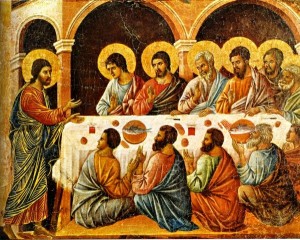
While in their joy they were disbelieving and still wondering, he said to them, “Have you anything here to eat?” They gave him a piece of broiled fish, and he took it and ate in their presence. (Luke 24:41)

Jesus Appears to the Disciples Behind Closed Doors, Duccio di BuoninsegnaI have to admit that I would be hard-pressed to choose one of the many post-resurrection appearances of Christ as my favorite. Each one recorded in Scripture is so full of vivid imagery and meaning that it would be nearly impossible to put one above another … having said that, however, I also have to admit an especial fondness for the one described here by Luke.
There are two things about this one that I really like. First is Luke’s comment that the disciples “in their joy … were disbelieving.” It’s such a great description of what their amazement must have been; it calls to my mind some of the great, little-used emotional descriptors of our language: consternation, bewilderment, perplexity, astonishment, and (my favorite) stupefaction. I think that’s what Luke is saying in this delightful turn of phrase, that the disciples were stupefied! It’s also Luke’s way of describing something that is handled somewhat more harshly in Mark’s telling of the story, which just happens to be the gospel lesson for the Daily Office today.
Mark, with typical economy of expression, describes the scene this way:

Later he appeared to the eleven themselves as they were sitting at the table; and he upbraided them for their lack of faith and stubbornness, because they had not believed those who saw him after he had risen. (Mark 16:14)

In one ancient manuscript of Mark’s gospel that is not accepted in the received version the text continues by describing the apostles’ reply:

And they excused themselves, saying, “This age of lawlessness and unbelief is under Satan, who does not allow the truth and power of God to prevail over the unclean things of the spirits. Therefore reveal your righteousness now” – thus they spoke to Christ. (Codex Washingtonensis or Freer Logion)

I like this recorded post-resurrection appearance, apocryphal though it may be, nearly as much as the one in today’s reading from Luke’s gospel. The fact that “they excused themselves” and that they demanded of Jesus “reveal your righteousness now”. It’s nearly as good as Luke’s description of “joyful disbelief”! I absolutely love this! It’s so darned modern . . . or maybe even post-modern. You can almost hear the eleven saying something like, “Well, Jesus, that resurrection stuff may be true for you, but it’s not true for us!” When we read these to texts together, Luke and Mark, describing this scene in their different ways, we get such a wonderful picture of the apostles. Astonished but still making excuses, perplexed but still making demands, stupefied but still relativizing the situation . . . these men aren’t just First Century Palestinian Jewish fisherman; they are 21st Century Americans; they are us!

The second thing I find absolutely delightful about Luke’s telling of the story is Jesus’ question: “Have you anything here to eat?” If this scene were set in a modern home, I think we could envision it happening in the kitchen, the apostles sitting around the kitchen table, Jesus showing up, saying “Hey!” then going to the refrigerator, opening the door, and looking in like a teenager getting home from school, “Anything here to eat?” They do, as this version of Luke tells us, have that broiled fish handy, and in the King James Version (supported by some ancient manuscripts) Luke also reports that they gave him a piece of honey-comb.

There is a long line of biblical scholarship that tells us that Jesus’ asking for something to eat, and then actually eating it, is his way of proving to the stupefied disciples that he’s not a phantom. The idea is that by consuming it in front of them, Jesus proves that he has not returned as a spirit, or a ghost, or some sort of apparition; a ghost, after all, could not be touched, or have an appetite, or eat things. Lutheran pastor Doug Schmirler put it this way: “It may be Luke’s way of saying: ‘Ghost? Did you ever see a ghost chew? Did you ever see a ghost swallow? Did you ever see a ghost digest? Well, did you?'” That’s certainly a good way to look at this, but this story seen from the combined perspectives of Luke and the Freer Logion addition to Mark speaks to me in a different way.

I prefer the versions that include the honey-comb because that makes Jesus’ eating much more than a mere demonstration of non-ghost-ness; it makes it a meal. Something savory, and something sweet; an entree and a dessert. This is not just a “Look; see, I’m not a spirit”. This is Jesus once again sitting down at the dinner table with his friends, just like he had done in the home of Mary, Martha and Lazarus, just like he did once before in this upper room, just like he did with Cleopas and his companion in the inn on the road to Emmaus. This is the community once again sitting together at the kitchen table.

And just like every family, every community at every dinner table, they are talking and discussing and maybe even getting a little cross with one another if that additional bit to Mark’s Gospel is trustworthy.

There is a restaurant in San Francisco called Credo, which I’m sure you know is simply the Latin word for “creed”. On their walls are painted quotations from all sorts of philosophers, writers, politicians, and so forth. On their menus they have their business credo written out:

At Credo, we believe in nourishing both the body and the mind. Our walls depict the universality of ideas, the clash of conflicting viewpoints and the democratic nature of discussion and debate. We believe that good food and good company go hand-in-hand. We believe in the time-honored tradition of the dinner table debate and the value of impassioned points of view. We believe simple things can be wonderful, like authentic ingredients, genuine creativity and gracious hospitality.

This is what is happening here: dinner table debate, impassioned points of view, genuine creativity, and gracious hospitality. This is the glory and power of Christ’s Resurrection; the creation of community, a new community.

This is why I like this story that Luke and Mark tell from different perspectives so much; it is such a clear vision of the resurrected community. In the very human act eating of a meal, in very human condition perplexity and befuddlement, in the very human process of making excuses and making demands, these eleven, once a dispirited and possibly dying community, are resurrected. These are not simply individuals on a personal spiritual quest; they are joined together into a new community in Christ, crucified with him, now risen with him, given new life and new purpose and new mission because of his resurrection.

This new community is an on-going one, a growing one, a maturing one. As John says in the reading from his first letter this morning:

See what love the Father has given us, that we should be called children of God; and that is what we are. … What we will be has not yet been revealed. What we do know is this: when he is revealed, we will be like him, for we will see him as he is. (1 John 3:1-2)

We do know this: that his eating the fish and the honey-comb revealed him to be a real human being and that that is what we are called to be – real human beings. Carroll Simcox, who edited the Episcopal Church magazine The Living Church for many years, put it this way:

You and I shall be our real, complete selves for the first time ever. We think of ourselves now as human beings. We really aren’t that?not yet. We are human becomings. The fetus conceived only yesterday is a human becoming. If you are living in Christ, believing in him and trying to follow and obey him as the master of your life, you are by his grace, becoming ever more and more like him. (Quoted by Guy Sayle, infra)

But John does not mean that God is making us into clones or exact replicas of Jesus of Nazareth. The wonderful paradox of the Christian faith is that the more we become like Jesus, the more we become our truest selves. The hope of the Christian faith is that we can become as truly human as the Resurrected Christ. Dr. Guy Sayles, a Cooperative Baptist preacher, put it this way:

As we discover deeper dimensions of Christ-likeness, we uncover more and more of our honest-to-God selves.

Jesus is the pattern and the power, the model and the source, of authentic human life. We are meant to have what he had and has:

  • a radical and liberating faith in God;
  • a childlike trust in the grace of God;
  • a trembling wonder before the mystery of life;
  • a durable hope that, because we are in God’s hands, death and sorrow and pain and tears are not the end, but joy and wholeness and laughter are;
  • an astonishing confidence that we and the world are headed, not toward midnight, but toward sunrise; and
  • an undimmed awareness that the heart of all things is unconditional and compassionate love.

Those eleven disciples sitting around that dinner table, confronted by what they at first thought was an apparition, were astonished but still making excuses, perplexed but still making demands, stupefied but still relativizing the situation. They were just like us, but as church history and the Book of Acts shows, in stories like the one we heard today, they became like him, they became their truest selves, and so shall we all. That is the power and promise of the Resurrection.

Alleluia and amen!

The Three-Act Drama of Redemption: Act Three – Easter Is a Joke! (Easter 2012)

Revised Common Lectionary for Easter Sunday, Principal Service, Year B: Isaiah 25:6-9; Psalm 118:1-2,14-24; Acts 10:34-43; Mark 16:1-8

In the run up to Easter which is the season of Lent several of us in this parish took some time out of our everyday lives to ponder the contemporary meaning of the ancient Hebrew writers we call “the Prophets.” We were guided in that study by scholar and seminary professor Walter Brueggemann, who encouraged us to think of the Prophets as poets rather than as seers or prognosticators. Brueggemann also asked us to think of contemporary poets whom we might consider prophets. I shared with the group one of my favorites, Kentucky farmer and poet Wendell Berry. I read to the group this poem entitled Manifesto: The Mad Farmer Liberation Front:

Love the quick profit, the annual raise,
vacation with pay. Want more
of everything ready-made. Be afraid
to know your neighbors and to die.
And you will have a window in your head.
Not even your future will be a mystery
any more. Your mind will be punched in a card
and shut away in a little drawer.
When they want you to buy something
they will call you. When they want you
to die for profit they will let you know.

So, friends, every day do something
that won’t compute. Love the Lord.
Love the world. Work for nothing.
Take all that you have and be poor.
Love someone who does not deserve it.
Denounce the government and embrace
the flag. Hope to live in that free
republic for which it stands.
Give your approval to all you cannot
understand. Praise ignorance, for what man
has not encountered he has not destroyed.

Ask the questions that have no answers.
Invest in the millenium. Plant sequoias.
Say that your main crop is the forest
that you did not plant,
that you will not live to harvest.
Say that the leaves are harvested
when they have rotted into the mold.
Call that profit. Prophesy such returns.

Put your faith in the two inches of humus
that will build under the trees
every thousand years.
Listen to carrion – put your ear
close, and hear the faint chattering
of the songs that are to come.
Expect the end of the world. Laugh.
Laughter is immeasurable. Be joyful
though you have considered all the facts.
So long as women do not go cheap
for power, please women more than men.
Ask yourself: Will this satisfy
a woman satisfied to bear a child?
Will this disturb the sleep
of a woman near to giving birth?

Go with your love to the fields.
Lie down in the shade. Rest your head
in her lap. Swear allegiance
to what is nighest your thoughts.
As soon as the generals and the politicos
can predict the motions of your mind,
lose it. Leave it as a sign
to mark the false trail, the way
you didn’t go. Be like the fox
who makes more tracks than necessary,
some in the wrong direction.
Practice resurrection.

I love that poem for its critique of modern society, but mostly I love it for that last line which summarizes the whole poem: “Practice resurrection.”

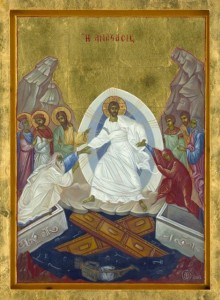
Resurrection IconIf you’ve been with us here for the services of Maundy Thursday, Good Friday, and Holy Saturday, or have been following the sermons on line, you know that we have come to Act Three of the three-act drama of redemption. In the first act, we saw the protagonist, Jesus of Nazureth, trying one last time make his disciples understand his mission and his message. Through the metaphor of bread and wine, through the enacted parable of foot-washing, through an agonized night of prayer in a garden, he tried to teach them that his was a mission of love and life, but they just didn’t seem to get it. As the curtain fell on Act One, he was being taken away to be questioned by Jewish and Roman authorities and the disciples, frightened and confused, were scattering, unsure of what was going to happen next.

That question was answered in Act Two as the Roman governor gave in to the stirred-up crowd and turned Jesus over to his soldiers who scourged him, beat him, mocked him, and finally crucified and killed him. The drama of redemption was shaping up to be a tragedy and, if that death on Calvary’s cross had been the end of it, it surely would have been. The hero dead the whole story would have tragic, and pointless, and of not much worth or interest to anyone. But of course, as we now learn in Act Three, it was not the end and, instead of a tragedy, the drama of redemption has turned out to be a comedy!

“A comedy?” you ask. “Of course,” I say, “because Easter is a joke!”

OK … I guess, perhaps, I should explain that. Well, what is a “joke”? One dictionary definition of joke is that it is an “activity characterized by good humor.” (WordNet, Princeton University, 1997.) Can you think of a better way to characterize the Resurrection of Jesus than as an “activity characterized by good humor”? The Resurrection was God’s activity of the highest and best humor! G.K. Chesterton once wrote:

Angels can fly because they take themselves lightly. Never forget that the devil fell by force of gravity … A good joke is the closest thing to divine revelation … They who have the faith have the fun.

So, Easter is joke, a very good joke! Easter reveals God as no other celebration has ever done. Only God can draw the greatest good out of the greatest evil. Of evil, Saint Thomas More once wrote, “The devil … that proud spirit … cannot endure to be mocked.” The people of the Middle Ages understood this and celebrate Easter by getting the last laugh on evil. In the 13th Century some German communities would throw a laughter party on Easter Sunday. Its purpose was simple: to celebrate God’s triumph over the devil. People would come back to church on Easter Sunday afternoon for Vespers and Benediction services. As a reward to the faithful for enduring many serious Lenten homilies, the priest would insert funny stories, poems, and even off-color jokes into his sermon and would draw moral conclusions from them.

An ancient Russian Orthodox tradition was to sit around the Easter dinner table telling jokes. Like those 13th-Century Germans, the Russians even told them in church. Why? Because Easter makes people joyous. After all, when we tell funny stories and laugh, we are imitating the cosmic joke that God pulled on Satan in the Resurrection. Satan thought he had won, but then God raised up Jesus from the dead and had the last word. As St. John Chrysostom preached in his famous Paschal Homily:

Hell grasped a corpse, and met God.
Hell seized earth, and encountered heaven.
Hell took what it saw,
and was overcome by what it could not see.

Hell was in turmoil having been mocked.

And the world laughs at Satan’s chagrin. Laughing at the Devil even has a name in theological tradition; it is called the risus paschalis, “Easter laughter”.

So in Act Three the drama of redemption turns out to be a comedy; God in Christ pulls a cosmic joke on the forces of evil and we rejoice in the triumph over Death that Easter embodies. Death had been a disturbing thing. For much of human history people have had an attitude toward it somewhat like Woody Allen’s: “It’s not that I’m afraid to die,” he once said. “I just don’t want to be there when it happens.” Jesus’ Resurrection turned the tables on Death. It was a cosmic joke! Where death had once been something to shudder at, the third act of the drama shows, that there is nothing to fear. As one Sunday School student put: “When you die, God takes care of you like your parents did when you were alive … only God doesn’t yell at you all the time.”

The German Reformed theologian Jurgen Moltmann, who wrote the book The Theology of Joy, writes, “Easter laughter is rooted in the wholly unexpected and totally surprising ‘reversal of all things.’ God had brought this reversal about by raising Christ…. The expectation was for cosmic death, but what comes is eternal life.”

We North Americans, especially us folks here in the upper midwest, are too darned serious. Praying and laughing seem to be far apart in our culture, but at Easter they come together, as they do throughout Holy Scripture. In Psalm 126, the Hebrews praised God with mirth: “Then our mouth was filled with laughter and our tongue with shouts of joy” (Ps. 126:2). Jesus promised laughter to those who are favored by God: “Blessed are you who weep now, for you will laugh.” (Luke 6:21) It seems the ancients were much more aware of the relationship between prayer and laughter than are we. Some scholars believe our English word joke ultimately comes (through Latin) from the ancient Umbrian word iuka, which means “prayers”!

So, Easter is a joke, a great big cosmic joke, in which God turns the tables on Satan, turns the tables on evil, turns the tables on death! Act Three reveals that the drama of redemption is actually a comedy, and we are invited … no – more that that … we are encouraged and empowered to join in the laughter, even in what seem to be the darkest of times.

In 1875, a German passenger liner, the SS Deutschland sunk off the coast of England. Among those killed were five Franciscan nuns. In their honor, the English Jesuit poet Gerard Manley Hopkins penned a long poem at the end of which he wrote these wonderful lines:

Remember us in the roads,
the heaven-haven of the Reward
Our King back … !
Let him easter in us.

Don’t you love that use of easter as a verb? “Let him easter in us.” God eastered Christ after three days. Christ easters in us. It’s like Wendell Berry’s admonition to “practice resurrection”! Easter isn’t just a day or a season, it’s a verb! An activity! … An “activity characterized by good humor.” Resurrection isn’t just something that happened about 2,000 years ago, or something that will happen sometime in some distant, unknown future; it’s an on-going reality, happening now; a joyful, laughter-producing, cosmic turning of the tables on death in which we are all invited, encouraged, and empowered to participate!

The third act of the drama of redemption shows us that Hopkins was right; easter is a verb! To easter is a decision, a decision God made in not giving into the Crucifixion, a decision we can each make every day not giving into the forces of death and despair. To easter is to do all the things Wendell Berry set out in his Mad Farmer Manifesto: loving the Lord, loving the world, working for nothing, planting sequoias, lying down in the shade, willfully losing our minds, and looking forward to the end of the world with laughter!

To easter is to engage in the spiritual process of not giving in … not giving in to negation and death … not giving in to meaninglessness and despair … not giving in to isolation and fear … not giving in to powerlessness and incapacitation. Easter is an act of brave human existence. Not just a day-long holiday of bunnies, bonnets, and bluebirds, Easter is a daily reality, a decision Christ’s Resurrection empowers each of us to make when faced with the inevitable difficulties of life, a decision to “practice resurrection” and refuse to surrender our essential humanity even in the face of death itself.

So the drama of redemption, my friends, is a comedy; Easter is a joke, a great big cosmic joke, the ultimate act of God’s good humor, the closest thing we have to divine revelation. And we who have the faith have the fun. Practice resurrection! Let him Easter in you! Amen!

The Three-Act Drama of Redemption: Act Three – The Paschal Homily (Easter 2012)

Revised Common Lectionary for the Great Vigil of Easter, Year B: Genesis 1:1-2:4a; Exodus 14:10-31; 15:20-21; Proverbs 8:1-8, 19-21;9:4b-6; Zephaniah 3:12-20; Psalm 114; Romans 6:3-11; Mark 16:1-8

Early Byzantine mosaic portrait of St John Chrysostom from the Cathedral of Hagia Sophia in ConstantinopleSome time in the late Fourth Century, St. John Chrysostom, Archbishop of Constantinople and an important Early Church Father known for his eloquence in preaching and public speaking (hence, the surname Chrysostom which means “golden-mouthed”), preached this sermon on Easter.
Since that time, throughout the Christian East, it has been a tradition to read this at the Great Vigil of Easter. It is known simply as “the Paschal Homily” and any Orthodox Christian who hears that title knows exactly what is meant.

I offer it to you this evening. (For those who have been following our “three-act drama of redemption” theme, the third-act sermon will be offered at tomorrow’s Festal Eucharist.)

Are there any who are devout lovers of God?
Let them enjoy this beautiful bright festival!

Are there any who are grateful servants?
Let them rejoice and enter into the joy of their Lord!

Are there any weary from fasting?
Let them now receive their due!

If any have toiled from the first hour,
let them receive their reward.

If any have come after the third hour,
let them with gratitude join in the feast!

Those who arrived after the sixth hour,
let them not doubt; for they shall not be short-changed.

Those who have tarried until the ninth hour,
let them not hesitate; but let them come too.

And those who arrived only at the eleventh hour,
let them not be afraid by reason of their delay.

For the Lord is gracious and receives the last even as the first.

The Lord gives rest to those who come at the eleventh hour,
even as to those who toiled from the beginning.

To one and all the Lord gives generously.

The Lord accepts the offering of every work.
The Lord honours every deed and commends their intention.

Let us all enter into the joy of the Lord!?
First and last alike, receive your reward.
Rich and poor, rejoice together!

Conscientious and lazy, celebrate the day!

You who have kept the fast, and you who have not,
rejoice, this day, for the table is bountifully spread!

Feast royally, for the calf is fatted.
Let no one go away hungry.

Partake, all, of the banquet of faith.
Enjoy the bounty of the Lord’s goodness!

Let no one grieve being poor,
for the universal reign has been revealed.

Let no one lament persistent failings,
for forgiveness has risen from the grave.

Let no one fear death,
for the death of our Saviour has set us free.

The Lord has destroyed death by enduring it.

The Lord vanquished hell when he descended into it.
The Lord put hell in turmoil even as it tasted of his flesh.

Isaiah foretold this when he said,
“You, O Hell, were placed in turmoil when he encountering you below.”

?
Hell was in turmoil having been eclipsed.
Hell was in turmoil having been mocked.
Hell was in turmoil having been destroyed.
Hell was in turmoil having been abolished.
Hell was in turmoil having been made captive.

Hell grasped a corpse, and met God.
Hell seized earth, and encountered heaven.
Hell took what it saw,
and was overcome by what it could not see.

O death, where is your sting?
O hell, where is your victory?

Christ is risen, and you are cast down!
Christ is risen, and the demons are fallen!
Christ is risen, and the angels rejoice!
Christ is risen, and life is set free!
Christ is risen,
and the tomb is emptied of its dead.

For Christ, having risen from the dead,
is become the first-fruits of those who have fallen asleep.

To Christ be glory and power forever and ever. Amen!

The Three-Act Drama of Redemption: Intermission – Meditation for Holy Saturday, 2012

Revised Common Lectionary for Holy Saturday, Year B: Lamentations 3:1-9, 19-24; Psalm 31:1-4, 15-16; 1 Peter 4:1-8; John 19:38-42

This meditation comes from a Holy Saturday homily written in Greek dating back to the fourth century and found in the record of an ancient liturgy; however, the author of this text describing the beginning of the Harrowing of Hell, Christ’s encounter with Adam and Eve, is unknown. During the intermission of the three-act drama of redemption, we read these program notes, beginning with an ancient anthem of the day.

Our shepherd, the source of the water of life, has died.
The sun was darkened when he passed away.
But now man’s captor is made captive.

This is the day when our Savior broke through the gates of death.
He has destroyed the barricades of hell,
overthrown the sovereignty of the devil.
This is the day when our Savior broke through the gates of death.

Something strange is happening – there is a great silence on earth today, a great silence and stillness. The whole earth keeps silence because the King is asleep. The earth trembled and is still because God has fallen asleep in the flesh and he has raised up all who have slept ever since the world began. God has died in the flesh and hell trembles with fear.
He has gone to search for our first parent, as for a lost sheep. Greatly desiring to visit those who live in darkness and in the shadow of death, he has gone to free from sorrow the captives Adam and Eve, he who is both God and the son of Eve. The Lord approached them bearing the cross, the weapon that had won him the victory. At the sight of him Adam, the first man he had created, struck his breast in terror and cried out to everyone: “My Lord be with you all”. Christ answered him: “And with your spirit”. He took him by the hand and raised him up, saying: “Awake, O sleeper, and rise from the dead, and Christ will give you light”.

I am your God, who for your sake have become your son. Out of love for you and for your descendants I now by my own authority command all who are held in bondage to come forth, all who are in darkness to be enlightened, all who are sleeping to arise. I order you, O sleeper, to awake. I did not create you to be held a prisoner in hell. Rise from the dead, for I am the life of the dead. Rise up, work of my hands, you who were created in my image. Rise, let us leave this place, for you are in me and I am in you; together we form only one person and we cannot be separated. For your sake I, your God, became your son; I, the Lord, took the form of a slave; I, whose home is above the heavens, descended to the earth and beneath the earth. For your sake, for the sake of man, I became like a man without help, free among the dead. For the sake of you, who left a garden, I was betrayed to the Jews in a garden, and I was crucified in a garden.

See on my face the spittle I received in order to restore to you the life I once breathed into you. See there the marks of the blows I received in order to refashion your warped nature in my image. On my back see the marks of the scourging I endured to remove the burden of sin that weighs upon your back. See my hands, nailed firmly to a tree, for you who once wickedly stretched out your hand to a tree.

I slept on the cross and a sword pierced my side for you who slept in paradise and brought forth Eve from your side. My side has healed the pain in yours. My sleep will rouse you from your sleep in hell. The sword that pierced me has sheathed the sword that was turned against you.

Rise, let us leave this place. The enemy led you out of the earthly paradise. I will not restore you to that paradise, but I will enthrone you in heaven. I forbade you the tree that was only a symbol of life, but see, I who am life itself am now one with you. I appointed cherubim to guard you as slaves are guarded, but now I make them worship you as God. The throne formed by cherubim awaits you, its bearers swift and eager. The bridal chamber is adorned, the banquet is ready, the eternal dwelling places are prepared, the treasure houses of all good things lie open. The kingdom of heaven has been prepared for you from all eternity.

Let us pray:

All-powerful and ever-living God, your only Son went down among the dead and rose again in glory. In your goodness raise up your faithful people, buried with him in baptism, to be one with him in the eternal life of your kingdom, where he lives and reigns with you and the Holy Spirit, one God, forever and ever. Amen.

The Three-Act Drama of Redemption: Act Two – Sermon for Good Friday 2012

Revised Common Lectionary for Good Friday, Year B: Isaiah 52:13-53:12; Psalm 22; Hebrews 4:14-16; 5:7-9; John 18:1-19:42

In the first act of the drama of redemption, Love tried to teach his lesson through bread and wine, through water and basin, through garden prayer, and through willing surrender to corrupt authority. The Body and Blood symbolically broken, the Body washing other bodies, the Blood sweated out in agonized prayer, these did not suffice and so, betrayed and exhausted, he surrendered. Whether or not he knew what would ultimately happen is irrelevant. He could do nothing else – if he were to remain faithful to his God, faithful to his values, faithful to his principles, faithful to his mission, he could do nothing else. And so now, in the second act, the incarnate Creator is prisoner to Destruction, now Life is condemned to death by Death.

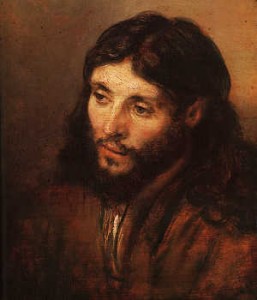
Rembrandt, Portrait of ChristIn the beginning he had been tempted by riches, by power, by idolization; all these had been offered in the desert. Now how great the temptation must have been to simply give up! Poet Denise Levertov ponders this allure in her poem Salvator Mundi: Via Crucis

Maybe He looked indeed
much as Rembrandt envisioned Him
in those small heads that seem in fact
portraits of more than a model.
A dark, still young, very intelligent face,
A soul-mirror gaze of deep understanding, unjudging.
That face, in extremis, would have clenched its teeth
In a grimace not shown in even the great crucifixions.
The burden of humanness (I begin to see) exacted from Him
That He taste also the humiliation of dread,
cold sweat of wanting to let the whole thing go,
like any mortal hero out of his depth,
like anyone who has taken herself back.
The painters, even the greatest, don’t show how,
in the midnight Garden,
or staggering uphill under the weight of the Cross,
He went through with even the human longing
to simply cease, to not be.
Not torture of body,
not the hideous betrayals humans commit
nor the faithless weakness of friends, and surely
not the anticipation of death (not then, in agony’s grip)
was Incarnation’s heaviest weight,
but this sickened desire to renege,
to step back from what He, Who was God,
had promised Himself, and had entered
time and flesh to enact.
Sublime acceptance, to be absolute, had to have welled
up from those depths where purpose
drifted for mortal moments.
(In The Stream & the Sapphire: Selected poems on religious themes [New Directions Books: 1997])

In this second act of the drama of redemption, it is faith and will which prevail, the faith and will of Jesus who did not step back, who did not give in to the human longing to simply cease.

Rembrandt, Raising the CrossIn this second act of the drama all that has gone before is recapitulated; all that we saw in yesterday’s first act, the supper in the upper room, the act of servanthood taught there, the agonized prayer in the garden, the willing surrender to unjust authority, and more. Not just yesterday’s first act, but all that has gone before from our first act of defiance in the first garden. Poet Ross Miller reminds us of that bond in his brief verse entitled Tau

That dreadful beam
that Jesu bore
knot made from pine
but ancient tree
that bore a bitter fruit

That pole on which it hung
he hung
knot made from pine
undying tree of life
that bears forever fruit

Take and eat – the Serpent cried
You shall not die
You shall be
like God
We bit
The Servant took those twisted words
held them on the knotted wood
Take and eat – the Servant cries
You shall not die
You shall be
like me
(Found at Stations of the Cross)

We shall be like him! It is here on the cross in this second act that the promise of the Incarnation, the guarantee of the Nativity is made good. Then we sang

Great little One! whose all-embracing birth
Lifts Earth to Heaven, stoops Heaven to Earth.
(In The Holy Nativity of Our Lord God: A Hymn Sung as by Shepherds, Richard Crashaw [1613-49])

Here on the cross, indeed, God “gathers up all things in Christ, things in heaven and things on earth.” (Eph. 1:10) And here on the cross, in an act of faithfulness and will, he died. Here on the cross, in this final fact of human existence, truly “God became man so that man might become a god.” (St. Athanasius, De Incarnatione)

But his death, we know, cannot be the end of the story. This is only the second act of a three-act drama. So his body must be taken down; it must be dealt with in the appropriate way.

Rembrandt, Descent from Cross

Composer Jimmy Owens paints the picture in his cantata No Other Lamb:

They took Him down,
His poor dead body,
and prepared Him for His burial.

They took Him down,
His poor pale body
drained of life, ashen, and stained
with its own life-blood.

His healing hands, now pierced and still;
Serving hands, that broke five loaves
to feed five thousand;
Holy hands, often folded in fervent prayer;
Poor gentle hands, now pierced and still.

His poor torn feet, now bloodied and cold;
Feet that walked weary miles
to bring good news to broken hearts
Feet once washed in penitent’s tears;
Poor torn feet, now bloodied and cold.

His kingly head, made for a crown,
now crowned – with thorns.
His poor kingly head, crowned with thorns.

His gentle breast, now pierced by
spear-thrust, quiet and still;
His poor loving breast.

His piercing eyes, now dark and blind;
Eyes of compassion, warming the soul;
Fiery eyes, burning at sin;
Tender eyes, beckoning sinners;
His piercing eyes, now dark and blind.

His matchless voice, fountain of the Father’s
thoughts, stopped –
and stilled – to speak no more.
Silence now, where once had flowed
Wisdom and comfort, Spirit and life;
His matchless voice; stilled, to speak no more.

They took Him down,
His poor dead body,
and prepared Him for his burial.
(They Took Him Down in No Other Lamb [Lillenas Publishing Co.])

And so the second act comes to a close, the body is laid in a tomb and as the rock is rolled to seal it, the now-torn curtain descends. We are left in the darkness of our hearts to contemplate our place in this drama. With poet Luci Shaw we realize that we just may be Judas or Peter….

because we are all
betrayers, taking
silver and eating
body and blood and asking
(guilty) is it I and hearing
him say yes
it would be simple for us all
to rush out
and hang ourselves
but if we find grace
to cry and wait
after the voice of morning
has crowed in our ears
clearly enough
to break our hearts
he will be there
to ask each again
do you love me?
(Judas, Peter in A Widening Light: Poems of the Incarnation [Regent College Publishing, 1997])

The Three-Act Drama of Redemption: Act One – Sermon for Maundy Thursday 2012

Revised Common Lectionary for Maundy Thursday, Year B: Exodus 12:1-14; Psalm 116:1,10-17; 1 Corinthians 11:23-26; John 13:1-17, 31b-35

Redemption is a drama in three acts – three acts and a brief intermission – tonight we take part in Act One.

Act One, Scene One: The curtain rises. We see a group of people gathered in an upper room somewhere in Jerusalem.

A meal is in progress… Is it a seder, the ritual meal of remembrance of the Passover? We don’t really know; the playwrights have not made this clear; the theater critics, the scholars debate this issue. Three of the story-tellers suggest that it is but the fourth, John, tells the tale very differently. (The synoptic gospels tell the story in a similar way and, if truth be told, in the same way – Luke and Matthew based their stories on Mark’s, so to be honest there aren’t three stories, there’s only one that would make us think that this supper is a seder, but John doesn’t. In fact, John doesn’t even care about that – he spends no time at all describing the meal, for him the important thing is what happened afterward, and that comes in a later scene. So as we begin this three-day, three-act drama of redemption, since we have heard Luke’s voice narrating the story, let’s just assume that what we see in this first scene of the first act is, indeed, a seder.)
Those present are prepared to do all that is laid out in the instructions in the book of Exodus; they have worn their sandals; they carry their staffs; they expect to eat of roasted lamb and unleavened bread and bitter herbs. They anticipate spending the night in remembrance of that which happened generations before in Egypt. If we can imagine that they celebrate as modern Jews celebrate, they expect the youngest among them to ask the questions, beginning with “Why is this night different from all other nights?” They know that the head of the household, their rabbi Jesus, will answer those questions in the prescribed way and tell the story of the Passover.

And when the youngest asks “Why do we eat the broken matzah?” they expect Jesus to answer “This is the bread of our affliction; the unleavened bread of poverty, baked and eaten in haste,” but instead he takes the bread, brakes it and says, “This bread is my body, given for you.”

Can’t you just see them in this scene, reclining in that upper room, those serving the meal coming and going, a breeze blowing through the open windows, following along in their prayer books, the Haggadah … They look up startled, glancing at one another, murmuring to each other, “What is he talking about? That’s not here! That’s not the right answer. Where is he? What page is he on?” But the moment passes, the meal moves on, until at the end he takes up the fourth and final cup of wine, the kiddush cup, which recalls God’s promise, “I will acquire you as a nation; you will be my people and I will be your God.” They expect Jesus to say, “Blessed are you, O Lord our God, sovereign of the universe, creator of the fruit of the vine,” but instead they hear, “This cup is my blood!” “What?! What is he saying???”

It is for Jesus and his disciples one of those fleeting opportunities when, because of the pupils’ confusion or frustration or grasping for understanding, the teacher can pass on to the students new information, new values, new moral understanding, a new behavior, a new skill, a new way of seeing and coping with reality; it is what we have come to call “the teachable moment” and so he teaches, yet again, “Remember! Remember,” he says, “Love one another as I have loved you.”

The curtain falls as Jesus continues to teach; the disciples look mystified.

Act One, Scene Two: The curtain rises again. We see the same group of people gathered in the same upper room somewhere in Jerusalem.

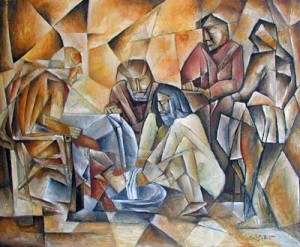
Jesus Washing the Feet of His Disciples by Michal SplhoThe meal is over, the dishes have been cleared. The disciples are arguing among themselves about who is the greater among them. Jesus looks frustrated and troubled; the teachable moment has passed and they clearly have not understood! They just haven’t gotten it.
“Look,” he says, “the greatest among you must become like the youngest, and the leader like one who serves. For who is greater, the one who is at the table or the one who serves? Is it not the one at the table? But I am among you as one who serves. Here, let me show you what I mean.” Getting up from the table, he takes off his robe, ties a towel around himself, pours water into a basin, and begins to wash and dry the others’ feet. Peter protests, “You will never wash my feet.” Jesus answers, “Peter, if I don’t wash you, you can’t be part of what I’m doing.” So Peter relents, “Well then, not only my feet! Wash my hands and my head, too!”

Peter speaks for us. We don’t get this foot-washing thing, do we? Washing our hands makes more sense to us, as it does to Anglican nun and poet Lucy Nanson who wrote:

Wash my hands on Maundy Thursday
not my feet
My hands peel potatoes, wipe messes from the floor
change dirty nappies, clean the grease from pots and pans
have pointed in anger and pushed away in tears
in years past they’ve smacked a child and raised a fist
fumbled with nervousness, shaken with fear
I’ve wrung them when waiting for news to come
crushed a letter I’d rather forget
covered my mouth when I’ve been caught out
touched forbidden things, childhood memories do not grow dim
These hands have dug gardens, planted seeds
picked fruit and berries, weeded out and pruned trees
found bleeding from the rose’s thorns
dirt and blood mix together
when washed before a cup of tea
Love expressed by them
asks for your respect
in the hand-shake of warm greeting,
the gentle rubbing of a child’s bump
the caressing of a lover, the softness of a baby’s cheek
sounds of music played by them in tunes upon a flute
they’ve held a frightened teenager,
touched a father in his death
where cold skin tells the end of life has come
but not the end of love,
comforted a mother losing agility and health.
With my hands outstretched before you
I stand humbled and in awe
your gentle washing in water, the softness of the towel
symbolizing a cleansing
the servant-hood of Christ.
Wash my hands on Maundy Thursday
and not my feet.

Yes, Peter speaks for us; we would rather our hands be washed. But Jesus insists, he must wash his disciples feet for only in this way does one truly honor and serve another in love, only in this way does one recall whose servant one is. He says to them, “If I, your master and teacher, have washed your feet, you must now wash each other’s feet.” Only in this way can his disciples remember his teaching that what is done for us is also to be done for others.

They don’t get the opportunity, however, for the second scene ends as Jesus becomes visibly agitated and declares, “One of you is going to betray me.”

As the curtain goes down, the disciples are looking puzzled and Judas Iscariot is leaving.

Act One, Scene Three: The curtain rises again. We see a garden and an olive grove just outside of Jerusalem. Jesus is there, accompanied by Peter, James, and John.

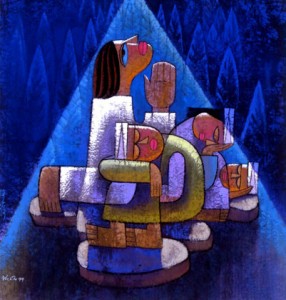
Praying at Gethsemane by He Qi “Stay here,” he tells them, “Stay awake while I go over there to pray.” As they settle themselves, he moves away from them, and collapses in a heap, sobbing: “O God … Father, let this pass!”
Three times he returns to find them asleep; three times they rise looking sheepish and embarrassed; twice he tells them again to try to stay awake as he goes away still pleading with God for a way out. “Enough,” he says the third time, “Enough! We’re leaving.”

When they look back on that night, how must they feel? When we look back, how should we feel?

Poet Mary Oliver offers a glimpse in her poem Gethsemane:

The grass never sleeps.
Or the roses.
Nor does the lily have a secret eye that shuts until morning.
Jesus said, wait with me. But the disciples slept.

The cricket has such splendid fringe on its feet,
and it sings, have you noticed, with its whole body,
and heaven knows if it ever sleeps.

Jesus said, wait with me. And maybe the stars did,
maybe the wind wound itself into a silver tree,
and didn’t move, maybe the lake far away,
where once he walked as on a blue pavement,
lay still and waited, wild awake.

Oh the dear bodies, slumped and eye-shut, that could not
keep that vigil, how they must have wept,
so utterly human, knowing this too
must be part of the story.

Yes, this too, our utterly human inability to fully keep company with our Lord, this too must be part of the story when it is told, as we see it unfold in the church’s memory tonight, but for now the stage fills, the garden becomes crowded … Judas returns accompanied by temple guards, and Roman soldiers, and servants of the priests … and are those some of the disciples showing up? The orchard of olives suddenly is filled with angry activity, with scuffling, with fighting, with confusion. Peter calls out, “Lord, should we fight back?” and, without waiting for an answer, draws his sword and cuts off a servant’s ear.

“Stop!” cries Jesus. He reaches out and tenderly touches the servant’s head, healing his wound. He seems sadly confused, “Why have you come to arrest me with swords drawn?” he asks, “I’ve been teaching in the temple all week! You could have taken me any time.” It all seems too much for him. Certainly, it’s too much for us! Again, a poet, Ted Loder, speaks for us:

Sometimes, Lord,
it just seems to be too much:
too much violence, too much fear;
too much of demands and problems;
too much of broken dreams and broken lives;
too much of wars and slums and dying:
too much of greed and squishy fatness
and the sounds of people
devouring each other
and the earth;
too much of stale routines and quarrels,
unpaid bills and dead ends;
too much of words lobbed in to explode
leaving shredded hearts and lacerated souls;
too much of turned-away backs and yellow silence,
red rage and the bitter taste of ashes in my mouth.

Sometimes the very air seems scorched
by threats and rejection and decay
until there is nothing
but to inhale pain
and exhale confusion.

Too much of darkness, Lord,
too much of cruelty
and selfishness
and indifference.

Too much, Lord
too much,
too bloody,
bruising,
brain-washing much.

Or is it too little,
too little of compassion,
too little of courage,
of daring,
of persistence,
[too little] of sacrifice?

Jesus and his captors exit; the disciples, confused and frightened, sneak out behind them. The curtain falls. We are left in darkness….

Let us pray:

Heavenly Father, as we enter again into the mystery of these three most holy days, as we participate once again in this three-act drama of redemption, we ask you to illumine our minds and hearts with the hope and promise of Christ’s passion, death, and resurrection; satisfy our hunger and thirst not for bread and drink alone, but for love, and truth, and justice, and peace; as we share your Son’s Body and Blood, renew us and energize us to be a true community of light amid the darkness of sin and injustice in our world; as Jesus invites us to share at his Table, let us in turn invite our brothers and sisters to the table where all can share the resources of your abundance, where justice and peace reign, and where love transforms souls and societies; as the drama of redemption continues, may life conquer death, may light shine in the darkness, and may courage and compassion grow from sacrifice; in Christ’s holy Name we pray. Amen.

Palm Sunday in Poetry – Sermon for April 1, 2012

Revised Common Lectionary for Palm Sunday, Year B: John 12:12-16; Isaiah 50:4-9a; Psalm 31:9-16; Philippians 2:5-11; and Mark 14:1-15:47

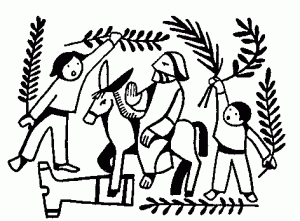
We have just read the simple, yet dramatic story of our Lord’s Passion as related in Mark’s Gospel. But we began our worship this morning with John’s story of Christ’s triumphal entry into Jerusalem. In the span of a few minutes we covered an entire week at the end of Jesus’ earthly life. Logic and reason cannot really make sense of this, and no ten-minute homiletic exegesis of these texts can help us comprehend the enormity of those events.

Perhaps, instead, some poetry.

Hark! how the children shrill and high
Hosanna cry,
Their joys provoke the distant sky,
Where thrones and seraphims reply,
And their own angels shine and sing
In a bright ring:
Such young, sweet mirth
Makes heaven and earth
Join in a joyful symphony.

And thus Holy Week begins on Palm Sunday. In this little poem entitled Palm Sunday by Henry Vaughan (1622-1695), the Welsh metaphysical poet, we get a glimpse of what was at the beginning, the joy that was supposed to be, the glory that was lost.

G.K. Chesterton (1874-1936), who has been called “the apostle of common sense” but was also known for his humor, gives us a glimpse into the mind of one of the lesser-considered characters in the drama of Jesus’ entering Jerusalem:

When fishes flew and forests walked,
And figs grew upon thorn,
Some moment when the moon was blood,
Then surely I was born.

With monstrous head and sickening cry,
And ears like errant wings,
The devil’s walking parody
Of all four-footed things.

The tattered outlaw of the earth,
Of ancient, crooked will;
Starve, scourge, deride me: I am dumb,
I keep my secret still.

Fools! For I also had my hour;
One far fierce hour and sweet:
There was a shout about my ears,
And palms before my feet.

Chesterton’s little poem is entitled The Donkey.

Marie J. Post (1919-1990), a 20th Century poet and hymn writer whose poems often appeared in The Banner, the denominational magazine of the Christian Reformed Church, in her poem, also entitled simply Palm Sunday, suggests parallels between that Palm Sunday ride and the Way of Tears Jesus would walk later in the week:

Astride the colt and claimed as King
that Sunday morning in the spring,
he passed a thornbush flowering red
that one would plait to crown his head.

He passed a vineyard where the wine
was grown for men of royal line
and where the dregs were also brewed
into a gall for Calvary’s rood.

A purple robe was cast his way,
then caught and kept until that day
when, with its use, a trial would be
profaned into a mockery.

His entourage was forced to wait
to let a timber through the gate,
a shaft that all there might have known
would be an altar and a throne.

A poem by a 17th Century Dutch theologian and poet, Jacobus Revius (1586-1658), whose poems have been translated into English by Dr. Henrietta ten Harmsel, helps us face the hard fact that it was our guilt, our sins for which Christ suffered; we are the villains in the tragedy that is Good Friday. His poem is entitled He Bore Our Griefs.

No, it was not the Jews who crucified,
Nor who betrayed You in judgment place,
Nor who, Lord Jesus, spat into Your face,
Nor who with buffets struck You as You died.
No, it was not the soldiers fisted bold
Who lifted up the hammer and nail,
Or raised the cursed cross on Calvary’s hill,
Or, gambling, tossed the dice to win Your robe.
I am the one, O Lord, who brought You there,
I am the heavy cross You had to bear,
I am the rope that bound You to the tree,
The whip, the nail, the hammer, and the spear,
The blood-stained crown of thorns You had to wear:
It was my sin, alas, it was for me.

Finally contemporary Canadian poet Carol Penner, who is also a Mennonite pastor, reminds us that the events of Palm Sunday and Holy Week are not simply historical events; they are present realities. Her poem is entitled Coming to the City Nearest You.

Jesus comes to Jerusalem, the city nearest you.
Jesus comes to the gate, to the synagogue,
to houses prepared for wedding parties,
to the pools where people wait to be healed,
to the temple where lambs are sold,
to gardens, beautiful in the moonlight.
He comes to the governor’s palace.

Jesus comes to Jerusalem, the city nearest you,
to new subdivisions and trailer parks,
to penthouses and basement apartments,
to the factory, the hospital and the Cineplex,
to the big box outlet centre and to churches,
with the same old same old message,
unchanged from the beginning of time.

Jesus comes to Jerusalem, the city nearest you
with his Good News and…
Hope erupts! Joy springs forth!
The very stones cry out,
“Hosanna in the highest,
blessed is he who comes in the name of the Lord!”
The crowds jostle and push,
they can’t get close enough!
People running alongside flinging down their coats before him!
Jesus, the parade marshal, waving, smiling.
The paparazzi elbow for room,
looking for that perfect picture for the headline,
“The Man Who Would Be King”.

Jesus comes to Jerusalem, the city nearest you
and gets the red carpet treatment.
Children waving real palm branches from the florist,
silk palm branches from Wal-mart,
palms made from green construction paper.
Hosannas ringing in churches, chapels, cathedrals,
in monasteries, basilicas and tent-meetings.
King Jesus, honored in a thousand hymns
in Canada, Cameroon, Calcutta and Canberra.
We LOVE this great big powerful capital K King Jesus
coming in glory and splendor and majesty
and awe and power and might.

Jesus comes to Jerusalem, the city nearest you.
Kingly, he takes a towel and washes feet.
With majesty, he serves bread and wine.
With honour, he prays all night.
With power, he puts on chains.
Jesus, King of all creation, appears in state
in the eyes of the prisoner, the AIDS orphan, the crack addict,
asking for one cup of cold water,
one coat shared with someone who has none,
one heart, yours,
and a second mile.
Jesus comes to Jerusalem, the city nearest you.
Can you see him?

The Catholic Church – Sermon for Lent 5B

Revised Common Lectionary for the Fifth Sunday in Lent, Year B: Jeremiah 31:31-34; Psalm 51:1-13 or Psalm 119:9-16; Hebrews 5:5-10; and John 12:20-33

Icon of MelchizedekThis is the fifth and last Lenten sermon addressing a question posed by a parishioner and, in fact, I will try to answer succinctly two related questions that two parishioners asked. One was “What does the word catholic mean when we say it in the Nicene Creed?” and the other was “What do you (meaning me, Father Funston) mean when you describe the Episcopal Church as being ‘in the Catholic tradition’?” (If you could see the way I have typeset these sermon notes, you would see that I have capitalized the “C” in catholic in the second question, but not in the first. That’s an important point which I will address shortly. But let me start with a basic definition in answer to the first inquiry.

These questions arise, of course, because there is one church denomination in this country and throughout the world which has arrogated to itself this word catholic and, of course, I refer to the Church of Rome. In everyday speech if you say the word catholic nearly everybody will think you are referring to the Roman Catholic Church, but, in truth, the word has much broader meaning and application than one denomination, however large and powerful it may be or think itself.

Catholic comes from the Greek katholikos, a compound word made up of kata meaning “about” or “concerning” and holos meaning “whole” (from the latter we get a word familiar many, holistic, which means to look at something in its entirety). Thus, the word catholic means “regarding the whole” or, more simply put, “universal” or “general.” In the context of the Creed, the word does not have anything to do with any denomination which calls itself “Catholic” such as the Church of Rome. In the worship book of the rather evangelical Methodist church which my paternal grandparents attended there was an asterisk next to the word catholic in the Creed and a footnote which read “meaning universal” just to be sure no one misunderstood and thought the Methodists had reunited with the Bishop of Rome.

As used in the Creed, the word catholic describes one of what are called the “four marks of the church”; these are that the church is one, holy, catholic, and apostolic. These are set out in the Outline of the Faith we find in The Book of Common Prayer. If you would turn to page 854 in the BCP, you can follow along in Catechism:

Q. Why is the Church described as one?
A. The Church is one, because it is one Body, under one Head, our Lord Jesus Christ.
Q. Why is the Church described as holy?
A. The Church is holy, because the Holy Spirit dwells in it, consecrates its members, and guides them to do God’s work.
Q. Why is the Church described as catholic?
A. The Church is catholic, because it proclaims the whole Faith to all people, to the end of time.
Q. Why is the Church described as apostolic?
A. The Church is apostolic, because it continues in the teaching and fellowship of the apostles and is sent to carry out Christ’s mission to all people.

In the words of the Gospel according to Matthew, we are sent out by Christ [there’s the apostolicity] to “make disciples of all nations [there’s the catholicity], baptizing them in the name of the Father and of the Son and of the Holy Spirit [there’s the holiness], and teaching them to obey everything that [Jesus, our one Lord] commanded” the apostles (Matthew 28:19-20a).

So in the Creed we express our faith in the point that Jesus makes in today’s gospel lesson. This confrontation by the curious Greeks reiterates something Jesus said to Nicodemus not too long before: “When I am lifted up from the earth, will draw all people to myself.” The Church is catholic because its mission is to draw all people to Christ.

This is what we mean by catholic with a lower-case “c” and applies to all Christian churches without regard to their polity, their style of worship, their understanding of the sacraments, their theology, or their manner of choosing, training, and addressing their clergy and leadership. When we capitalize the word and apply it to a subset of Christian traditions or to one in particular, we removing it slightly from its original meaning, and giving it a different twist. We start with an old “canon” or rule attributed to St. Vincent of Lerins: “What everywhere, what always, and what by all has been believed, that is truly and properly Catholic.”

Thus, instead of looking to the writings and doctrines of any Medieval or Reformation theologian, a church in the Catholic tradition looks to the earliest, universally accept teachings of the church, in addition to Holy Scripture this means primarily the first seven Ecumenical Councils: the First Council of Nicaea (325), the First Council of Constantinople (381), the Council of Ephesus (431), the Council of Chalcedon (451), the Second Council of Constantinople (553), the Third Council of Constantinople (680), and the Second Council of Nicaea (787). While the writings and doctrines of the Medieval theologians (Aquinas, Abelard, Duns Scotus, and others) or the reformers (Martin Luther, John Calvin, John Knox, and so forth) are of interest, they are not definitive. Only Holy Scripture is definitive, and only these councils of the undivided church and certain early theologians, especially the universally acknowledged “doctors of the church”, are given authoritative weight in the development of theological doctrine. (Those doctors of the church, by the way, are Saints Ambrose, Augustine, Jerome, Gregory the Great, John Chrysostom, Basil the Great, Gregory of Nazianzus, and Athanasius of Alexandria.)

So here is one refinement on the concept of catholicity: In the Catholic tradition, our theology and doctrine are drawn primarily from that which has been universally accepted and taught since the earliest days of the church, not from the teachings of a Medieval or Reformation theologian (no matter how wise and scholarly that theologian may have been). Thus, the Catholic churches (including both the Roman and the Anglican Traditions) preserve an understanding of the sacramental nature of the priesthood, the oblationary nature of Holy Communion, and the Real Presence of Christ in the Eucharist.

Another refinement of the concept of catholicity is in the polity (or organization) of the church and a reliance upon an historic, ordered ministry. As our Catechism in The Book of Common Prayer defines it:

Q. Who are the ministers of the Church?
A. The ministers of the Church are lay persons, bishops, priests, and deacons.

A Catholic understanding of the ministry, then, is that there is one basic order of ministers encompassing all the baptized, the laos or people of God, some of whom are set apart for special ministries in the orders of deacon, priest, and bishop. In particular, Catholic polity reveres the office of the bishop. One of those early theologians we like to look to for guidance, in this case St. Ignatius of Antioch, who wrote: “Wherever the Bishop appears, there let the multitude of the people be; just as where Christ Jesus is, there is the catholic church.” In Ignatius’s view, the Eucharist is Christ-centered and both the bishop and the priest, through their ministry, enable Christ to be present when each presides at a Eucharist. The priest presides only because he or she is ordained by the bishop and the college of presbyters, and serves with the consent of the bishop. The bishop, in turn, was ordained by other bishops in historic succession. Thus, the ordered polity of the churches ministry preserves its Catholicity through time.

Finally, I would note that the high regard of churches in the Catholic tradition for the sacraments encourages a certain liturgical style. The Catholic revival in the Church of England in the mid-19th Century promoted the use of Eucharistic vestments, the priest standing at the center of the altar (not standing at the north end which had been the practice encouraged by the Puritans in the Anglican church), the use of unleavened bread for the Eucharist, the mixing of water with the wine, the use of candles and of incense, and the chanting of Psalms and other parts of the service; all of these are now standard practices in the Episcopal Church. Our worship at its best cultivates a sense of reverence, awe, and mystery in the presence of the Holy One before whom even the angels in heaven veil their faces.

This is what I mean when I describe the Episcopal Church as being within the “Catholic tradition.” And I believe this tradition to be soundly biblical.

In the Epistle Lesson today, the writer of the Letter to the Hebrews looks back to one of the obscure characters of the Old Testament, the priest Melchizedek, in making his theological argument for the divinity of Christ. He quotes from Psalm 110:4 in which the Psalmist quotes God speaking to some unnamed prince of the people, “The Lord has sworn and he will not recant: ‘You are a priest for ever after the order of Melchizedek.'” This, argues the writer of Hebrews, was said to Christ.

Melchizedek is mentioned only one other place. In the Book of Genesis, Abram (whom God had not yet renamed Abraham) does battle with and defeats King Chedorlaomer of Elam and three other kings. When he does so, Melchizedek, who is described as King of Salem and priest of God Most High, approaches him, gives him bread and wine, and blesses him saying, “Blessed be Abram by God Most High, maker of heaven and earth; and blessed be God Most High, who has delivered your enemies into your hand!”

A high, Catholic understanding of ministry, especially of priestly ministry and worship, is fully in keeping with Scripture’s reverent depiction of Melchizedek. His name means, “My king is righteousness.” In his offering of bread and wine to Abram, St. Cyprian of Carthage (d. 258) saw “the Sacrament of the Sacrifice of the Lord prefigured,” and in one of the church’s earliest Eucharistic prayers we find a petition that the bread and wine offered in our worship be accepted by God like “the bread and wine offered by your priest Melchisedech.” An early Christian document from the Nag Hammadi library even suggests that Melchizedek may have been Christ himself. Melchizedek is therefore a type or exemplar of the universal priesthood, what Scripture calls “the priesthood of all believers,” of which the sacerdotal priesthood is merely a subset.

Catholic spirituality also is profoundly incarnational. Through Jesus, the Word made flesh, we see, hear and touch God. Similarly today, through the Holy Spirit, God uses his creation (bread, wine, holy oil, holy water etc.) as ways we can know and experience him. The Catholic tradition, recalling that God has written his covenant in our hearts (to use an image from today’s Jeremiah reading), encourages us to use our whole selves and all of our senses in worship so that the whole self, both body and soul, is lifted up in prayer and praise of God.

So the simple answer to the question “What does catholic mean?” is that it means “universal” or “general”, that it means that the church offers a message of salvation that is for all people, in all places, at all times. And that is also what it means to describe our church as holding to a “Catholic tradition;” that we teach, organize ourselves, and worship in a manner consistent with “what everywhere, what always, and what by all has been believed” in an unbroken line of continuity stretching even as far back as Melchizedek, the king of righteousness and priest of God Most High. It means that we seek to exemplify and to proclaim to the world a faith that is incarnational, vibrant and inviting, rooted in the traditions of the past but living in the present and embracing of the future, a faith in the One who was lifted up from the earth, that he might draw all people to himself.

Let us pray:

O God of unchangeable power and eternal light: Look favorably on your whole Church, that wonderful and sacred mystery; by the effectual working of your providence, carry out in tranquillity the plan of salvation; let the whole world see and know that things which were cast down are being raised up, and things which had grown old are being made new, and that all things are being brought to their perfection by him through whom all things were made, your Son Jesus Christ our Lord. Amen.

Fasting Is a Given – Sermon for Lent 4B – March 18, 2012

Revised Common Lectionary for the Fourth Sunday in Lent, Year B: Numbers 21:4-9; Psalm 107:1-3, 17-22; Ephesians 2:1-10; and John 3:14-21

Continuing our series of sermons in answer to parishioner questions, today we will explore fasting. A member of the congregation asked, “What is fasting and why do we do it?”

The simple answer is that fasting is going without some or all food or drink or both for a defined period of time. An absolute fast is abstinence from all food and liquid for a period of at least one day, sometimes for several days. Other fasts may be only partially restrictive, limiting particular foods or substance. The fast may also be intermittent in nature; for example, Muslims fast during the daylight hours of the month of Ramadan which is intended to teach Muslims patience, spirituality, humility, and submissiveness to God. Fasting as a spiritual practice is common to all major religions. Mahatma Gandhi once noted:

Every … religion of any importance appreciates the spiritual value of fasting … For one thing, identification with the starving poor is a meaningless term without the experience behind it. But … even an eighty-day fast may fail to rid a person of pride, selfishness, ambition, and the like. Fasting is merely a prop. But as a prop to a tottering structure is of essential value, so is the prop of fasting of inestimable value for a struggling soul.

In the Bible, the people of God in both the Hebrew and Christian Scriptures fasted for a variety of reasons:

  • They were facing a crisis. For example, the prophet Joel called for a fast to avert the judgment of God. (Joel 1:14, 2:12-15), and the people of Nineveh, in response to Jonah’s prophecy, fasted to forestall God’s judgment (Jonah 3:7).
  • They were seeking God’s protection and deliverance. For example, King Jehoshaphat in the Second Book of Chronicles proclaimed a fast seeking victory for Judah over the attaching Moabites and Ammonites (2 Chron. 20:3).
  • They had been called to repentance and renewal. The Psalmist, for example, in Psalm 109 cries:
    O Lord my God,
    oh, deal with me according to your Name; *
    for your tender mercy’s sake, deliver me.
    My knees are weak through fasting, *
    and my flesh is wasted and gaunt. (vv. 20,23)
  • They were asking God for guidance. Moses fasted for forty days and forty nights on Mount Sinai before he received the tablets on the mountain with God. (Deut. 9) St. Paul did not eat or drink anything for three days after he converted on the road to Damascus. (Acts 9:9)
  • They were humbling themselves in worship. The Book of Acts reports that it was with “fasting and praying” that the members of the church in Antioch “laid their hands on [Barnabas and Saul] and sent them off.” (Acts 13:3)

So fasting has a long and venerable history in all religions including our own. Indeed, Jesus assumed that his followers would fast. You may remember the lesson from Matthew’s Gospel which is always read on Ash Wednesday in which Jesus admonishes the disciples:

Whenever you fast, do not look dismal, like the hypocrites, for they disfigure their faces so as to show others that they are fasting. Truly I tell you, they have received their reward. But when you fast, put oil on your head and wash your face, so that your fasting may be seen not by others but by your Father who is in secret; and your Father who sees in secret will reward you. (Matthew 6:16-18)

In this passage Jesus doesn’t say, “If you pray … if you give … if you fast” but rather “when you pray … when you give … when you fast.” He simply expected his followers to do so. Did you know that fasting is mentioned more than 30 times in the New Testament? For a Christian, then, fasting is not an option. It should not be an oddity. Fasting, according to Jesus, is just a given.

During this season of Lent when we “give something up,” we are engaging in the spiritual discipline of the fast. We do so in remembrance of and in solidarity with Jesus during his forty days in the desert. We do so in remembrance of and in solidarity with our spiritual ancestors, the Hebrews, who spent forty years in the desert, often without food or sustenance. In today’s reading from the Book of Numbers, for example, “The people spoke against God and against Moses, ‘Why have you brought us up out of Egypt to die in the wilderness? For there is no food and no water, and we detest this miserable food.’” God’s wrath, of course, was kindled against them because of their complaining, but they were humbled by their privation. When we “give up something” (whether it be food or drink or some other thing that we enjoy), we are fasting and our fasting is a reminder of our own humility and own hunger for God. By refusing to feed our physical appetites, what St. Paul in today’s epistle lesson calls “the passions of our flesh” or “the desires of flesh and senses,” we become aware of our spiritual hunger.

The Baptist preacher and author John Piper, in his book A Hunger for God: Desiring God through Fasting and Prayer, encourages fasting with these words:

If you don’t feel strong desires for the manifestation of the glory of God, it is not because you have drunk deeply and are satisfied. It is because you have nibbled so long at the table of the world. Your soul is stuffed with small things, and there is no room for the great. God did not create you for this. There is an appetite for God. And it can be awakened. I invite you to turn from the dulling effects of food and the dangers of idolatry, and to say with some simple fast, “This much, O God, I want you.” (Pg 23)

Fasting is a way to bring into view those things we may need most to set aside but of which we are often unaware. In today’s lesson from John’s Gospel, Jesus tells Nicodemus that in the coming of the Son, “light has come into the world” and then says:

All who do evil hate the light and do not come to the light, so that their deeds may not be exposed. But those who do what is true come to the light, so that it may be clearly seen that their deeds have been done in God. (John 3:20-21)

In his book Celebration of Discipline: The Path to Spiritual Growth, Quaker theologian Richard Foster commends fasting as a way of bringing things to light:

More than any other single discipline, fasting reveals the things that control us. This is a wonderful benefit to the true disciple who longs to be transformed into the image of Jesus Christ. We cover up what is inside us with food and other good things, but in fasting these things surface. If pride controls us, it will be revealed almost immediately. David said, “I humbled myself with fasting” (Ps. 69:10). Anger, bitterness, jealousy, strife, fear – if they are within us, they will surface during fasting. At first we will rationalize that our anger is due to our hunger; then we know that we are angry because the spirit of anger is within us. We can rejoice in this knowledge because we know that healing is available through the power of Christ. (Pg. 48)

But when we fast, we must not delude ourselves into believing that the fasting itself is earning us any “brownie points” – it is not through our good deeds, including our fasting, that we earn salvation. Indeed, we cannot earn salvation. St. Paul reminds us of that forcefully in today’s epistle: “By grace you have been saved through faith, and this is not your own doing; it is the gift of God – not the result of works, so that no one may boast.” (Eph. 2:8-9)

Thinking that the act of fasting itself could earn God’s reward was condemned by God speaking through the Prophet Isaiah:

[You say,] “Why do we fast, but you do not see? Why humble ourselves, but you do not notice?” Look, you serve your own interest on your fast day, and oppress all your workers. Look, you fast only to quarrel and to fight and to strike with a wicked fist. Such fasting as you do today will not make your voice heard on high. Is such the fast that I choose, a day to humble oneself? Is it to bow down the head like a bulrush, and to lie in sackcloth and ashes? Will you call this a fast, a day acceptable to the Lord? Is not this the fast that I choose: to loose the bonds of injustice, to undo the thongs of the yoke, to let the oppressed go free, and to break every yoke? Is it not to share your bread with the hungry, and bring the homeless poor into your house; when you see the naked, to cover them, and not to hide yourself from your own kin? Then your light shall break forth like the dawn, and your healing shall spring up quickly; your vindicator shall go before you, the glory of the Lord shall be your rear guard. (Isa. 58:3-8)

So fasting is a spiritual discipline, but only when done with the proper prayerful attitude, the proper religious understanding – when done “in secret” as Jesus said in the Ash Wednesday reading from Matthew’s Gospel. Fasting is not so much about food, as it is about focus. It is not so much about saying “No” to the body, as it is about saying “Yes” to the Spirit. It is not about doing without; it is about looking within. It is an outward manifestation to an inward cry of the soul, a surfacing of those things that need to be brought to light, not to be condemned, but to be saved.

Let us pray:

Support us, O Lord, with your gracious favor through our Lenten fast; that as we observe it by bodily self-denial, so we may fulfill it with inner sincerity of heart; through Jesus Christ our Lord, who lives and reigns with you and the Holy Spirit, one God, for ever and ever. Amen. (Adapted from Holy Women, Holy Men, Collect for Friday after Ash Wednesday, pg. 34)

« Older posts Newer posts »