Occasional thoughts of an Anglican Episcopal priest

Category: Sermons (Page 40 of 40)

Preaching on Teen Suicide

The following is the text of an email I sent to some friends with whom I am part of an on-going internet community of some duration – an “email listserve” that has been in existence for several years.

This is long, but I have to write it down and share it with someone. And I apologize in advance for what I know to be offensive content below. It offended me – and I protested to the sender.

This morning I preached about the rash of recent gay teen suicides. I want to share the experience with you all. I preached ad lib with only a few notes.

I began reading John Donne’s Meditation XVII (“No man is an island, etc….”) and said that we had all been diminished recently by the suicides of Tyler Clementi (18 y.o. freshman at Rutgers), Asher Brown (13 y.o. middle school student in Houston), an unnamed 11 y.o. child in California, and Sladjana Vidovic (a Croatian immigrant student at a high school in Mentor, Ohio, age 16). Each of these children was driven to commit suicide because of bullying, teasing, oppression aimed at them because they were perceived as “different”, as outcasts. And the fault lies with each one of us because we have all participated in behaviour which has made such bullying permissible in our society. We have all sat by silently as jokes or political comments or gossip which was racist or sexist or heterosexist were uttered in our presence; we may even have told those jokes or made those remarks ourselves.

I then exegeted the lesson from Jeremiah and talked about how the Jews were the foreigners, the “other” in their exile in Babylon, and how although Jeremiah seems to be counseling assimilation, he is actually telling them to be proud of their heritage in a way that is respectful of those who are their oppressors, to pray and work for the welfare of the society in which they find themselves because in its welfare they will find their own wellbeing. And I noted how when they returned from exile, they hadn’t learned the lesson of what it is like to be “the other” in a strange society, how they had excluded the “Samaritans” from participating in the rebuilding of the Jerusalem temple and how the Jews continued, some of them even to this day, to practice religious intolerance and an exclusionary theology, noting particularly how it affected groups like women, gentiles, tax collectors, and the chronically ill (lepers) in Jesus’ day, and Palestinians today. I then moved on to the Gospel and focused on Jesus’s last words to Samaritan former leper – “your faith has made you well.”

I argued that it is our faith which can make our society well, if we will simply live up to it. Basically my message was “Stop it!” – do not in anyway participate in jokes, comments, conversations, that promote racism, heterosexism, sexism, or any other exclusionary ism. If you are with someone …who starts that kind of talk, tell them to stop it!

I made note of the fact that I had heard members of the congregation criticizing and making jokes about the President in the vilest and most racist of language, that I had heard men in the congregation make jokes about their wives or other women that were not fit to repeat, that I had heard women in the parish make jokes about gays and lesbians that were decidedly unladylike … and that I had said nothing when I had, but fair warning – no longer – if someone from now on says anything of that nature in my presence I will tell them “Stop it!”

I noted that in our Epistle Lesson, Paul warned Timothy of the power of words, of wrangling over words, and that’s basically what we have to deal with — the power of abusive, exclusionary words, of taunting and teasing and “making fun of” (a terrible euphemism if ever there was one). I made mention of James’s letter in which he notes that the tongue is a flame which can start a conflagration — and that is what we have – a conflagration of youthful suicides which result from words being spoken abusively, in a social climate which makes that acceptable behaviour. It is NOT acceptable and so we must stop it! So from now on, I will speak up and protest when I hear it. I will not do it myself … and I begged them not to do it and to speak up when they hear it.

Jesus told the outcast (the leper) that his faith had made him well – only our faith can make our society well – but that faith must be public and vocal – we must tell those who make an atmosphere of abuse acceptable through their racist, sexist, hetersexist jokes and snide remarks to STOP IT! And we must do it because that is the only way to be faithful to Jesus Christ!

That was my sermon, in a nutshell; it was longer, but that’s enough for here for now.

I expected a negative reaction from some, and I’m sure there was some. Mostly those who agreed with me told me as much, and those who didn’t avoided talking with me at all, even those very conservative members who usually do exchange pleasantries didn’t do so. Oh well….

Anyway, I came home … had lunch … checked my email.

So now I need to explain that we have a men’s group loosely affiliated with the church. It started as an attempt to create a men’s fellowship, but devolved into a poker and Scotch-sampling group and includes men whose families, for whatever reason, have left the Episcopal Church as well as members of the parish. This group meets on the 2nd Tuesday of the month and though I am usually unable to take part, I’m still on their email list. Tuesday is the next meeting and so several emails have been exchanged about where they are gathering, who’s hosting, the need to replenish the stock of various labels of Scotch, and so forth.

One of the men whose family are former members of the parish (now worshiping in a Southern Baptist church because of the couple’s very strong right-wing and Christian conservative feelings) … sent this email which I found in my in basket this afternoon:

Sorry guys, if any of you are offended by the attachment below, just couldn’t help it.

This will be my daily routine, through to 2012.

HOW TO START EACH DAY WITH A POSITIVE OUTLOOK

1. Open a new file in your computer.
2. Name it ‘Barack Obama’.
3. Send it to the Recycle Bin.
4. Empty the Recycle Bin.
5. Your PC will ask you: ‘Do you really want to get rid of ‘Barack Obama?’
6. Firmly Click ‘Yes.’
7. Feel better? GOOD! – Tomorrow we’ll do Nancy Pelosi.

Could there have been a more timely email, a better example of exactly what I was talking about? This offensive drivel was sent to about twenty men, mostly members of the parish, at least half of whom were in church this morning.

I sent this reply to the same recipients:

I am offended. This kind of nonsense is precisely what is wrong with this country. It comes from both sides of the political spectrum and it has to stop. This country and our society will only get worse if this kind of disrespect continues.

If anyone is tempted to send me anything of this nature, whether it be from the Left or the Right — Please don’t. And think about what you are doing and take my advice … don’t send it to anyone.

Stop this! Stop it now before this country sinks deeper into the abyss of incivility.

The sender very quickly sent a one-line email to the same list – “I apologize to everyone.” And I sent a quick one line, “Apology accepted. Thank you.”

It has to stop … it is this kind of incivility to those perceived as “other”, the demonizing of those that are different from ourselves, that has brought us to the point where 11 y.o. and 13 y.o. and 16 y.o. and 18 y.o. children are killing themselves because they are the targets of this sort of thing. It has to stop.

We have to stop it and we can only do that by standing up to it and demanding it stop.
The Widening Wealth Gap — Dives and Lazarus Are Even Farther Apart

A colleague recently reported that in dismissing the elderly congregation at a weekday Eucharist, her mind went blank and all she could think to say was “Go forth and multiply.” When I heard this, it occurred to me that the elderly are certainly doing that – as more and more of us join the ranks thereof on a daily basis! Hence the ever-increasing need in the US for a really good comprehensive health care program for all citizens. It occurred to me as well that the elderly poor must also be increasing in number.

I was surprised that two recent reports on the economy (actually on the economic well-being) of Americans came out in the past week and neither received a great deal of comment from the media pundits or from politicians.

The first was the publication of the ranking of what is called “The Forbes 400” – the list of the 400 wealthiest people in the US. There was some minor rearrangement of positions (with Facebook’s Zuckerberg jumping over Apple’s Jobs, etc.) but what was most shocking was that these folks, in quite a contrast to the rest of the society, actually made money (increased their wealth) in the last year while for most of us change in assets was flat or actually lessened (my spouse and I are in the latter category as our home and retirement accounts both took major hits, and we had to spend from savings because income didn’t keep pace with expenses). The cumulative wealth of these rich folk, however, increased by 8% per annum; that means that on average, the value of their assets increased by eight times the increase that was seen by the S&P 500 index! New Jersey Newsroom reported, “Forbes 400 richest Americans in 2010 total worth was up 8% to $1.37 trillion, well out-earning the 1% rise in the S&P 500 index over the same period of time.” (http://www.newjerseynewsroom.com/economy/forbes-400-richest-people-in-american-mars-and-newhouse-top-list-from-nj)

The World Socialist Web Site (yes, I read the socialist press) reported that the total worth of the Forbes 400 is higher than the GDP of India, which has become one of the world’s leading economies (I believe it currently ranks 12th among the nations of the world). The population of India, by the way, is 1.2 billion people! In addition, the Forbes 400 total worth is greater than the projected 2011 deficits of all 50 US state budgets ($1.2 trillion). There’s an old story about a clergyman who stands up before his congregation with a good-news bad-news story. “The good news,” he says, “is that there is plenty of money in this congregation to fund our ministries and programs. The bad news is that it’s all still in your pockets.” Well … here we are with the civil equivalent. The good news – the good news is there’s plenty of money in the US to fund all of the state-level programs our citizens have come to expect of state government. The bad news – it’s all in the pockets of 400 people. The population of the US, by the way, is currently 310,327,585 (according to the US “census clock”). (The URL for the socialist report is http://www.wsws.org/articles/2010/sep2010/forb-s24.shtml)

On the other hand … the second piece of information was that the number of Americans living below the poverty line increased, again. “2009 figures are likely to show a significant rate increase to the range of 14.7 percent to 15 percent. Should those estimates hold true, some 45 million people in this country, or more than 1 in 7, were poor last year. It would be the highest single-year increase since the government began calculating poverty figures in 1959. The previous high was in 1980 when the rate jumped 1.3 percentage points to 13 percent during the energy crisis.” (http://www.huffingtonpost.com/2010/09/11/poverty-rate-in-us-saw-re_n_713387.html)

In other words wealth and poverty are both multiplying but not in the same way – the wealthy are getting richer, but it is the same people simply getting more money – there are not more wealthy people. The Poor, on the other hand, are getting poorer because the number of poor people is increasing. The wealth is flowing upwards, from the working poor who are sinking below the poverty level to the wealthy who are simply accumulating more capital.

The Republicans, who used to preach “trickle-down” economics (also known as “Reaganomics”) and now just baldly assert that if we don’t tax the wealthy they will create jobs for everyone else, wish us to believe that letting these people keep more of their wealth (by extending the income tax cuts given them under the Bush43 administration) would somehow improve the lives of all Americans. In the face of this clear economic evidence to the contrary, I don’t see how they can make that claim. If the wealthy getting wealthier somehow resulted in the poor getting jobs, the number of people below the poverty line should have decreased during the time the Forbes 400 were increasing their assets. But that didn’t happen – exactly the opposite did.

The old saw is true – The rich get richer and the poor get poorer. And somehow the Republicans, the Kock-brothers-funded Tea Party, and the obscenely wealthy have convinced working, middle class Americans that this is a good thing.

As I write this, I am well aware that on the next Sunday (Sept. 26, 2010) lectionary the Gospel Lesson is the story of Dives and Lazarus:

Jesus said, “There was a rich man who was dressed in purple and fine linen and who feasted sumptuously every day. And at his gate lay a poor man named Lazarus, covered with sores, who longed to satisfy his hunger with what fell from the rich man’s table; even the dogs would come and lick his sores. The poor man died and was carried away by the angels to be with Abraham. The rich man also died and was buried. In Hades, where he was being tormented, he looked up and saw Abraham far away with Lazarus by his side. He called out, ‘Father Abraham, have mercy on me, and send Lazarus to dip the tip of his finger in water and cool my tongue; for I am in agony in these flames.’ But Abraham said, ‘Child, remember that during your lifetime you received your good things, and Lazarus in like manner evil things; but now he is comforted here, and you are in agony. Besides all this, between you and us a great chasm has been fixed, so that those who might want to pass from here to you cannot do so, and no one can cross from there to us.’ He said, ‘Then, father, I beg you to send him to my father’s house– for I have five brothers– that he may warn them, so that they will not also come into this place of torment.’ Abraham replied, ‘They have Moses and the prophets; they should listen to them.’ He said, ‘No, father Abraham; but if someone goes to them from the dead, they will repent.’ He said to him, ‘If they do not listen to Moses and the prophets, neither will they be convinced even if someone rises from the dead.'” (Luke 16:19-31 NRSV)

The question I ask myself … do I have the intestinal fortitude to stand up in front of my congregation and preach this economic truth, and tell them that our capitalist financial economic system is sinful in light of this parable? Am I willing and able to risk my position as a relatively well-paid (though increasingly in-debt) pastor by confronting the political and financial biases of our society and my congregation?

I know that the church, or someone in the church has to do this …. but do I have the guts to be the one to do it here?

What’s at the Core? (Sermon for St. John’s Day)

On June 27, 2010, my parish hosted the local Masonic Lodge at its later worship service, as explained in the sermon below. The lessons for the Revised Common Lectionary for the day (Pentecost 5, Proper 8C) were 2 Kings 2:1-2, 6-14; Psalm 77:1-2, 11-20; Galatians 5:1, 13-25; and Luke 9:51-62. At the later service, however, we used the lessons from the Episcopal Church’s Common of Saints for the Feast of the Nativity of St. John the Baptist: Isaiah 40:1-11; Acts 13:14b-26; Psalm 85:7-13; and Luke 1:57-80. The following sermon was written to preach at both services with either set of lessons.

———————–

Today at the 10:00 a.m. service we will be commemorating St. John the Baptist.

We are hosting the local lodge of Free and Accepted Masons, whose custom it is to attend church together on the Sunday closest to the Feast of the Nativity of St. John the Baptist, also called “St. John’s Day.” In the Gospel lesson for that service, John’s father, the priest Zechariah (who had been rendered mute before John’s birth), utters a prophecy on the day John is circumcised. He says to his infant son:

You, child, will be called the prophet of the Most High;
for you will go before the Lord to prepare his ways,
to give knowledge of salvation to his people by the forgiveness of their sins.
By the tender mercy of our God,
the dawn from on high will break upon us,
to give light to those who sit in darkness and in the shadow of death,
to guide our feet into the way of peace.”

Luke, the writer of the Gospel, then concludes, “The child grew and became strong in spirit, and he was in the wilderness until the day he appeared publicly to Israel.”
In our Gospel at this [our early] service, we encounter Jesus, John’s cousin and Lord, the one for whom John was the forerunner, as Jesus encounters a variety of people who offer to follow him … after taking care of other business. Again, our Gospel writer is Luke:

As they were going along the road, someone said to him, “I will follow you wherever you go.” And Jesus said to him, “Foxes have holes, and birds of the air have nests; but the Son of Man has nowhere to lay his head.” To another he said, “Follow me.” But he said, “Lord, first let me go and bury my father.” But Jesus said to him, “Let the dead bury their own dead; but as for you, go and proclaim the kingdom of God.” Another said, “I will follow you, Lord; but let me first say farewell to those at my home.” Jesus said to him, “No one who puts a hand to the plow and looks back is fit for the kingdom of God.”

These two stories from Luke’s Gospel speak to us about what is central and what is not.

Today in the Episcopal Church and the Anglican Communion, and indeed in nearly all mainline Christian denominations, we are engaged (as we have always been) in a discussion about what is central to the Christian faith … what is core doctrine and what is not?

Some centuries ago, someone in the church laid down the maxim, “In essentials unity, in non-essentials liberty, in all things charity.” This has been attributed variously to St. Augustine, to John Wesley the founder of Methodism, to John Amos Comenius the founder of the Moravian Church, and to Peter Mederlein a 16th Century Lutheran theologian. I don’t really know who first said it, but it’s a good rule to follow. The problem is in determining what is central to religion, what is essential, and what (on the other hand) is peripheral or non-essential.

Today’s Gospel stories, whether of John the forerunner or Jesus his cousin and Lord, are guides for us in considering that question.

John was the son of a priest for whom one would have thought the religious establishment was central and essential. As Luke tells us, he “grew and became strong in the spirit.” As the son of a priest, it would have been expected that he would become a priest – the priesthood in Ancient Judaism was hereditary. Like his father, he would be expected to learn the rituals and to take his regular place in the rotation of priests serving in the sanctuary of the Jerusalem Temple, to be at the very center of power in the Jewish religion. Instead, he retreated into “the wilderness until the day he appeared publicly to Israel.”

In the religious world of John’s and Jesus’s day there were two important and powerful groups of Jewish leaders, both of whom are mentioned in the Gospels: The Sadducees and the Pharisees. The Sadducees were a priestly group, Aaronites, associated with the leadership of the Temple in Jerusalem; they claimed descent from Zadok, the high priest who had anointed King Solomon. Their approach to religion focused primarily on properly performing the Temple rites; they emphasized that portion of the Law of Moses which dealt with sacrificial ritual and did not believe in an afterlife. Most importantly, they rejected the so-called “Oral Torah” or “Talmud”, which concerned the daily life of Jews and which was revered by the Pharisees. For the Sadducees the center of power and authority, the Temple and its rituals was all important. John was, by birth, a Sadducee but he rejected all of that.

The Pharisees, in contrast to the Sadducees, embraced and emphasized the “Oral Torah” and its many and detailed rules for daily life, and they did believe in a resurrection and an afterlife. The Pharisees are the ancestors of today’s Rabbinic Jews with their rules of “keeping kosher.” The Pharisees believed that all Jews in their ordinary life, and not just the Temple priesthood or Jews visiting the Temple, should observe rules and rituals concerning home life, purification, and family relationships. For them, the center of religious power and authority was the Synagogue where the everyday Jew was taught to obey, and where they the Pharisees enforced, the rules of daily living.

Jesus the Rabbi was probably a Pharisee, or at least more sympathetic to their understanding of religion than that of the Sadducees. Nonetheless, in the encounters between Jesus and the three persons who want to follow him in the regular lectionary Gospel today, we find Jesus rejecting precisely these things: he has no “home life” (for unlike a bird or a fox, he has no home!); he has no concern for purity (“let the dead bury the dead”); and he couldn’t care less about family relationships (turning back to bid a parent farewell renders one unworthy of following him). Just as John, who would blaze his trail, rejected his Saddusaic heritage and its concept of the center of religious life, Jesus rejects his Pharisaic origins and its understanding of the core of religion.

Or were they? Were they rejecting their roots entirely or were they instead rejecting those peripheral things which those traditions had wrongly placed in the center of the Jewish faith? Were they instead rejecting the non-essentials with which others had covered over and obscured the essential? The non-essentials, whether ritual temple sacrifice or kosher laws of daily life, were central to the power structures of the day, but not to religion as John and Jesus saw it.

The Sadducees had put Temple ritual and sacrificial system at the center of their version of the Jewish faith. John rejected all of that. When the Sadducees and the Pharisees came out to see what he was doing at the Jordan River, he called them both a “brood of vipers” and admonished them to “bear fruit worthy of repentance.”
“The answer to sin,” he said, “is not offering some animal on the Temple altar! The answer to sin is repentance, turning back toward God! Having a contrite heart and washing here in the Jordan is more effective than any Temple sacrifice.” “Repent!” he said, because “one who is more powerful than I is coming after me; I am not worthy to carry his sandals. He will baptize you with the Holy Spirit and fire.”

That One, his cousin Jesus, also encountered the Sadducees and the Pharisees together. On one occasion the Sadducees put to him a rather silly question about the afterlife, imagining a woman who had seven husbands: Whose wife would she be in the here-after? Jesus dealt handily with that question and was then asked by a Pharisee, “What is the greatest commandment?”

Most folks understand that question to mean “Which of the Ten Commandments is most important?” or “Which of the many many rules of daily living in the Talmud is most important?” I believe that Pharisee was asking something very different. I believe he was asking, “Is the Saddusaic emphasis on the Laws of ritual sacrifice and Temple rite the central core of our religion, or is the Pharisaic emphasis on living a pure and holy daily life with all its minute rules at the core of our faith?”

And Jesus answered in a way that made it quite clear that he and his cousin John were right on the same track. “Neither,” was his answer.
“‘You shall love the Lord your God with all your heart, and with all your soul, and with all your mind.’ This is the greatest and first commandment. And a second is like it: ‘You shall love your neighbor as yourself.’ On these two commandments hang all the law and the prophets.”

God was his answer, as it had been John’s answer and as it should be our answer.

The essential core of our faith is love of God and those whom God loves. About that we are and must be united! Everything else, temple rituals, religious rites, rules of daily living and purity of conduct, questions of whether to use vestments or not, what color they should be if we do, who can be ordained or not, who can be married or not, whether to use candles or not, whether to have music, and if we do whether it can be accompanied by musical instruments, and all the other things we debate …. those are peripheral, the non-essential. With regard to those we can disagree and we must give each other the liberty to differ. And in all things we can and must treat one another with charity and good will. As St. Paul wrote to the Galatians, “The fruit of the Spirit is love, joy, peace, patience, kindness, generosity, faithfulness, gentleness, and self-control. There is no law with regard to such things.”

“In essentials, unity; in non-essentials, liberty; in all things, charity.” Amen.

————————

(Copyright 2010, The Rev. Dr. C. Eric Funston)

An Ordination Sermon

On May 8, 2010, I had the privilege of preaching at the ordination of Jennifer Claire Leider to the Sacred Order of Priests. The lessons chosen by the ordinand were Isaiah 52:7-10; Ephesians 4:11-16; and Matthew 28:16-20. This is what I said:

We have heard three lessons from Scripture today. First, Isaiah’s radiant and joyful oracle: “How beautiful upon the mountains are the feet of the messenger who announces peace …..” (Isa. 52:7) The prophet reminds us here that we are all called to become those beautiful, swift-footed messengers who bring good news and announce salvation even as we go about our daily life.

Then Paul’s reminder that every one of us is gifted in some way to accomplish that mission, that each of us is given gifts “to equip the saints for the work of ministry, for building up the body of Christ.” (Eph. 4:12) And finally, the Great Commission: Christ’s injunction that we as a church are to “make disciples of all nations, baptizing them in the name of the Father and of the Son and of the Holy Spirit, and teaching them to obey everything that [Jesus has] commanded [us].” (Matt 28:19-20a)

These are not lessons usually read at ordinations, nor are they the lessons set out for the Feast of Dame Julian of Norwich, which today happens to be. They are lessons chosen by Jennifer because they speak particularly to her. But they are lessons which speak not so much to the office of the sacramental priesthood but to the ministry of the whole church, to the calling of the priesthood of all believers to spread the Gospel of Jesus Christ, to be disciples who make disciples, to invite the rest of the world into Jesus’s fellowship, to build up this wonderful and sacred mystery we call “The Church.”

Whenever I read or hear the words of Paul addressed to the Church in Ephesus that were read for us this morning, those wonderful words about the variety of gifts given to God’s People, I am reminded of my experience as rector of a congregation which grew rapidly and thus needed to construct a new building. That parish chose a phrase derived from Paul’s letter to Ephesus as its fundraising slogan: “Gifts for the Building Up of the Church.” (Not, I admit, the best bit of exegesis every done!)

Of course, one of the things that congregation needed to do, like any congregation in a building program, was to hire an architect, which we did as if we were calling a new pastor. We reviewed written submissions; we interviewed; we narrowed the field to four designers with church-related experience… and then we started visiting churches they had designed. We must have visited 50 or more religious buildings over the course of several weeks.

As we did so, we began to notice certain commonalities and similarities, and also certain distinctions between religious traditions. We noted, for example, that in ever church there was a room set aside for the use of the clergy in preparing to preside and preach, a room where they could adjust their vestments, review their sermon notes, and meditate with God before leading God’s People in worship. And we found that in that room there was always a sort of devotional focus object, an image, an icon, a statue on which the clergy could focus as they prayed. We discovered that we could predict what that object would be based on the denominational tradition of the church building, or conversely that we could pretty accurately guess what denomination’s church we were in by what that object was.

For example, in Lutheran churches one nearly always finds either that cross-within-a-heart-within-a-rose emblem that was Luther’s personal seal, or a picture of Martin himself. In Methodist churches, we always found a copy of that famous painting of Jesus holding a lighted lantern knocking at an ivy covered garden door. In Baptist churches, without fail the devotional focus image was Salman’s famous “Head of Jesus”. In Roman Catholic churches, of course, the clergy would pray before a statue or icon of the Blessed Virgin. And in Episcopal churches, there is always … a full length mirror…

So let us take a moment this morning and look into that mirror to see what is reflected back to us about this thing we call “priest”, this office of ministry into which the Bishop and the College of Presbyters will ordain Jennifer Claire Leider this morning.

Let us first of all see if Isaiah is correct about the feet of those ordained to announce the reign of God: “How beautiful,” Isaiah tells us … “How beautiful upon the mountains are the feet of the messenger ….” (Isa. 52:7) That may be, but as we look into our mirror please note, and let me assure you, that there is perhaps only one in a thousand, maybe only one in a million of the ordained who has beautiful feet like Daniel saw in his vision, “feet like in colour to polished brass” .. a body like beryl, a face as the appearance of lightning, eyes like lamps of fire, and a voice the voice of a multitude. (Daniel 10:6, KJV) One in a million, maybe… but as our mirror should show us most of us priests have feet of clay! We are as prone to stumbling, as prone to making missteps and mistakes, as prone to wander from the straight path of the Lord we love as any other member of the church.

In other words, dear friends, as I said before, priests in this church of ours are human beings! Whatever else we priests may be, whatever else we may be making of our sister Jennifer, she is and will remain as frail and fallible a human being as any of us. We have this treasure, as Paul reminded us, this light shining in our hearts, this poor and partial witness to the glory of God in the face of Jesus Christ, in earthen vessels, in clay jars prone to crack and break if we over-use and over-burden them. (2 Cor. 4:7) So let us remember that, above all else: The priest in this church is just a human being!

We have a tendency to forget that, that our priests are human beings. Almost since its beginning we Christians have struggled with two images of the church and thus of the clergy, and this is especially so at times like this when we ordain and empower leadership for the church: Is the church the Virgin Mother, pure, unsullied, and unstained? Or is she an Earth Mother gathering her wayward children to her skirts?

In the Virgin-Mother church, no eye is pure enough to see God, no tongue clean enough to speak God’s name. This church is vigilant in covering her children’s ears and eyes, trying to keep them from seeing or touching the world’s impurity. Her clergy are paragons of virtue, models to the flock in perfection and holiness, in morality and goodness.

In the Earth-Mother church, however, the dirty hands and unwashed faces of her children are a delight. “I am come that you might have life,” Jesus said, “and that you might have it abundantly.” This church’s children gather to her like Ma Kettle’s kids coming in from the barnyard, frogs in their pockets and grass stains on their jeans. What they lack in cleanliness they more than make up in liveliness and in joy. Her clergy are real people with real flaws, earthen vessels prone to breakage.

Of course, we Anglicans are “both/and” sorts of people and live with the tension between the clergy expectations of the Virgin-Mother church and the clergy reality of the Earth-Mother church. So, as we gaze into our full-length Episcopal mirror, let us be especially cognizant of that fact: let us acknowledge that the expectations we hang on the framework of a simple human being are phrased in the terms of that purer Virgin-Mother church.

In our liturgy, we will say today of Jennifer that we expect:
that she will exalt God in the midst of God’s people,
that she will offer acceptable spiritual sacrifices,
that she will boldly proclaim the gospel,
that she will rightly administer the sacraments of the New Covenant,
that she will be a faithful pastor,
that she will be a patient teacher,
that she will be a wise councilor.
And, finally, that in doing all these things, she will do so without reproach.

And let us admit that it is audacious of us to do so, to expect all of that from a frail and fallible human being. It’s not only audacious; it’s outrageous! Outrageously audacious! Or rather that it would be if we did not also believe and trust in Jesus’ promise at the end of Matthew’s Gospel to be with us always, to stand with the human beings we entrust with the church’s ministry, to fill them with the power of the Holy Spirit. Still, it’s a lot to ask of an earthen vessel – to be acceptable and bold and right and faithful and patient and wise and pure and good and holy!

So, Jennifer, why do you want to be a priest? I know you have already answered that question because I asked it of you almost two years ago, and I know that others have asked it of you many times over the past five or so years, but it bears repeating: “Why do you want to be a priest?”

We don’t expect you to answer it again today, because we know the answer. All of us presbyters have been asked it and we have answered it. We may have phrased the answer differently, but for each of us it is the same. It’s not that the person called to priesthood wants to be a priest; it’s that that person must be a priest!

Presbyterian pastor and author Frederick Buchner spoke for us all when he answered that question in his book, The Alphabet of Grace:
“I hear you are entering the ministry,” the woman said down the long table meaning no real harm. “Was it your own idea or were you poorly advised?” And the answer that she could not have heard even if I had given it was that it was not an idea at all, neither my own nor anyone else’s. It was a lump in the throat. It was an itching in the feet. It was a stirring of the blood at the sound of rain. It was a sickening of the heart at the sight of misery. It was a clamoring of ghosts. It was a name which, when I wrote it out in a dream, I knew was a name worth dying for even if I was not brave enough to do the dying myself and if I could not even name the name for sure. Come unto me all ye who labor and are heavy laden and I will give you a high and driving peace. I will condemn you to death. (Frederick Buechner, The Alphabet of Grace, pp. 109-110)

Buechner’s last sentence describing this call to priesthood is mind-blowing: “I will condemn you to death.” It is terrifying and it is terrific! We follow the Christ who leads us through death to life. Death to selfishness, death to ego, and life to the truest self within. We die to self to uncover what the Quakers call, “that of God within” or the “inner Teacher” … the True Self. Your call, Jennifer … our call is to continue dying to self and, as a result, to continue becoming truly alive, to continue growing in boldness and righteousness, in faithfulness and patience, in wisdom and, yes, even holiness.

It is, as any priest here will tell you, a painful process. To be a priest in Christ’s church is, as Paul made quite clear in his letters to the congregations in Ephesus and Rome, a gift; it is a wonderful, precious, costly, and painful gift. As you, Jennifer, have already learned in your hospital work, it will take you into the deepest intimacy with God’s people, with your people. As you have observed, at times you will be with them in the midst of their worst nightmares – death and divorce, devastating illness and the depths of despair. At times, you will feel put-upon and misused. At times, you will feel left out and neglected. At times, there will be conflict, and it will seem like it is eating you alive. People will hurt you, intentionally and spitefully, but also negligently or simply because they are in pain.

We could, I suppose, shelter you from that pain, but we won’t. Because the source of that pain is also the source of the most exquisite joy, when that same intimacy will privilege you with sharing God’s people’s, your people’s happiest and most blessed moments – when two people commit themselves to one another for life, when their children are born, when they know themselves to be God’s beloved.

But be forewarned…. In the midst of all the pain and joy, in dying to self to find your True Self, it is easy to lose yourself. So, it is a good thing every once in awhile to look into our Episcopal full-length mirror and take stock, to remind ourselves who we are and, more importantly, who stands with us.

It is traditional at this point, as an ordination sermon comes to its end, to ask the one whose life is about to be fundamentally altered to stand to receive a special charge. So now I will do that.

Jennifer, my charge to you is a story and a short list of rules.

The leaders of two nations met for a very important summit meeting. As they were talking, a subordinate of one rushed in … angry and livid. The prime minister responded, “Peter, remember Rule #6.”
“Ah! Yes, sir,” and he bowed out.
Another staff member rushed in, totally stressed, obviously overwhelmed.
“Maria, remember Rule #6.”
“Oh, yes, sir. I almost forgot. Thank you, sir.” She too bowed out.
A third rushed in. Same scenario.
The visiting leader is amazed. “Three people have rushed in, almost out of control. You simply mentioned Rule #6, and they immediately calmed down. I have to know this rule.”
“Oh yes,” responds his host. “Rule #6. It is a very good rule. Rule #6 is this: ‘Don’t take yourself too damned seriously.’”

Here are the other five rules:

Rule #1: Be very clear and committed to God’s Purpose and Mission.  Die daily to self that you may continue to become truly alive. Share your people’s good times and bad in all the terrifying pain and terrific joy of it. If you don’t, you destroy your chances of bringing God into in their lives.

Rule #2: Be very clear and committed to your Vision and Principles. You are the messenger announcing peace; you are sent to proclaim the Good News and to baptize all nations. Do whatever it takes to share Jesus with others.

Rule #3: Get out of the church, frequently! There are two reasons for this rule.  First, you must meet people where they are. If you are going to reach the nations and teach them, you need to search for them and you won’t find them inside the church building. Second, for your own sanity, find some friends who aren’t members of the Episcopal Church!

Rule #4: Mentor ten people to do ministry at least as well as, and preferably better than, you can. All those gifts Paul mentioned are given to the whole church – find the people who have them and help them learn to use them!

Rule #5: Do not avoid conflict.  Conflict is messy and it can be painful, but it is also creative and it can be the door to intimacy.  Just learn to not take it personally.

And, of course, Rule #6: Remember what G.K. Chesterton said about angels: “They can fly because they take themselves lightly.” Don’t take yourself too damn seriously. I am tempted to tell you to get a full-length mirror … but I’ve found at least three of them in every Episcopal Church I’ve served in, so I’m sure you’ll find one to use. Over the coming years, every so often, look in that mirror. Remind yourself, you may be a priest … but you are still just a human being! Remember who you are, and remember whose you are; remember who is standing with you. Remember the last sentence of the Great Commission: He is with you always, even to the end of the age! Amen. (Matt. 28:20b)

The Yoke of the Christ Child (Christmas Eve Sermon 2009)

Twenty years ago, not long after Thanksgiving Day, I was doing some Christmas shopping at one of those discount department stores. I won’t say which one, but the chain might have its corporate headquarters in Bentonville, Arkansas. Anyway, I was wandering through the Christmas paraphernalia aisles when my eye spotted a cheap plastic Nativity Set in its box all tightly sealed in shrink-wrapped cellophane. The top of the box had a picture of the crèche scene all set up; there was Mary and Joseph, some farm animals, a few shepherds, three wise men dressed as kings. There was, of course, a price sticker prominently displayed. But what had attracted my attention was that the Baby Jesus couldn’t be seen. What Mary and Joseph seemed to be gazing at with rapt attention and deep love was a sticker which had been placed right over their infant son: “Some Assembly Required” it said.

Right then and there I knew I had my theme for that year’s Christmas sermon! I bought that crèche set, kept it unopened in my office, and used it in that year’s Christmas Eve homily to illustrate the theological notion that in Christ, God the Father had joined heaven to earth and earth to heaven, that “some assembly”, some bringing together of God and humankind had been required and in the Incarnation God accomplished it.

And I also started a tradition of keeping my eye open for some similar object to use as each year’s “focus object” for this annual event, this sermon on the Nativity of Our Lord and Savior Jesus Christ. Over the years, these illustrative objects have become a source of great fun for me and I hope for the congregations who’ve been subjected to my preaching.

This year, not long after Thanksgiving Day, I happened to be in another sort of store …. The souvenir shop at the Anheuser-Busch Budweiser Brewery in St. Louis, Missouri, when my eye spotted this …. The 2009 29th Annual Christmas Commemorative Budweiser Beer Stein.

I’m sure you are asking the same question my colleagues of the Western Reserve Deanery Clericus asked last week when we had our annual Christmas luncheon gathering and I told them about this object: “What on earth!?” Mother Meghan Froelich, rector of Our Saviour Parish in Akron, spoke for the entire group (and perhaps for you) when, in her best Desi Arnez voice, she said, “Eric, you got some ‘splainin’ to do!”

So, my friends, herewith the explanation and a bit of theology concerning our Lord’s Birth.

What I would like us to focus on is not the stein itself, nor on its intended use. Rather, let us consider the wagon and team of Clydesdales depicted on the stein. When I was in business school taking a course in organizational management, the professor shared with us the results of a test of the theory of synergy (which is just a fancy way of saying that sometimes one-plus-one equals more than two). This study was done somewhere in the British Isles. A team of Clydesdale horses like those which pull to Budweiser wagon was used. Each horse was tethered to a number of barrels and tested on how much weight it could pull. These individual totals were duly recorded as well as the overall total weight. The team was then harnessed together, and the same process repeated. The weight of the barrels the team pulled was recorded. The weight the team pulled was 25% more than the total weight the individual horses pulled earlier. So, aha!, the theory of synergy was demonstrated.

The really interesting thing about the study was that the team of horses that were used was an “in tact” team. That means they had pulled things together for a long time. They knew each other. They trusted each other. They were used to working with each other. They were, in short, a team – not just a group of horses tethered together.
This is a vital point when discussing the meaning of synergy. In fact, it is the point. A team is more than just a group of individuals. A team is a well functioning, synergistic unit. Pulling you and me and every human being together into just such a team is one way of understanding what God was up to in the Incarnation, in the birth, life, death, resurrection, and ascension of Jesus of Nazareth.

What triggered my thoughts in this regard is this evening’s reading from the Prophet Isaiah and the way it seemed to point to something Jesus said which we find reported in the Gospel according to Matthew. Listen again to these words from the Prophet:

The people who walked in darkness have seen a great light;
those who lived in a land of deep darkness – on them light has shined.
You have multiplied the nation, you have increased its joy;
they rejoice before you as with joy at the harvest,
as people exult when dividing plunder.
For the yoke of their burden, and the bar across their shoulders,
the rod of their oppressor,
you have broken as on the day of Midian.
And how was this done? How did God break the yoke of burden, the bar across his people’s shoulders? Through the birth of this Child, for as the Prophet continues:
For a child has been born for us, a son given to us;
authority rests upon his shoulders; and he is named
Wonderful Counselor, Mighty God,
Everlasting Father, Prince of Peace.

The yoke of burden upon God’s people’s shoulders was broken when another yoke, the yoke of authority, was laid upon his Child’s shoulders.

Of course, the yoke referred to in these Biblical analogies is the sort used with oxen which does go across the shoulders of the animal. But horses are also yoked! When a team of horses is tethered together, the tack used is very complicated – each horse is fitted with a “harness collar”, a bridle, a bit and several other pieces of equipment, and then each pair of horses is linked together with a “neck yoke”. After that, each pair is then put in place and the neck yoke attached to the tongue or pole of the horse-drawn vehicle, like Budweiser’s delivery wagon.

Now, as I said, the yoke mentioned in Isaiah seems to point us to something that Jesus said in the Gospel according to Matthew. In 11th Chapter, speaking to the people of Capernaum and to us, Jesus says:

Come to me, all you that are weary and are carrying heavy burdens, and I will give you rest. Take my yoke upon you, and learn from me; for I am gentle and humble in heart, and you will find rest for your souls. For my yoke is easy, and my burden is light.

Jesus does not offer us a yoke in the same way that a farmer offers a yoke to an ox or a teamster offers the harness and neck yoke to his horses. Jesus is not offering to put on us something which he himself does not share. As with the pair of oxen yoked together, or a team of horses harnessed together, when we take upon ourselves the yoke of Christ Jesus becomes our “yokefellow”, a partner of infinite strength capable of carrying the entire burden himself. The burden is light because he shares it with us, we with him, and all of us with one another.

As that synergy test demonstrated, a yoke allows the strength of two or more animals to be linked and multiplied, sharing and reducing the heavy labor of the plow or wagon. A burden that might be overwhelming or perhaps impossible for one to bear can be equitably and comfortably borne by two or more bound together with a common yoke or harness. Christ’s yoke requires a great and earnest effort, but for those who truly are converted, his yoke is easy … and yoked together with him and with each other like an “in tact” team our burdens become light.

When horses are tethered in a team such as that shown on the Budweiser stein, the horse on the left of the front pair is called “the lead horse.” That’s the horse who is guided by the driver or “teamster” through the use of the reins; the other horses follow that “lead horse”, the lead horse gives them direction. When we accept Christ’s yoke, when we let him be our “yokefellow,” Jesus not only shares our burdens, he gives us direction. This is what the Incarnation means to us; this is what the Birth of Christ accomplishes. As Isaiah said in another place, “a little child shall lead them.” (Isa. 11:10)

I can’t think of horses and horse-drawn wagons without thinking of the “wild West” and I can’t think of the wild West without thinking of 19th Century author Bret Harte. His short-story The Luck of Roaring Camp is not a Christmas story, per se, but it has always spoken to me of the Nativity.

The Roaring Camp of the story’s title is described as the meanest, toughest mining town in all of the West. There were more murders and more thefts there than anywhere else. It was a terrible place inhabited entirely by men, and one woman who tried to serve them all in the town’s only saloon. Her name was Cherokee Sal and as the story begins, she dies while giving birth to a baby.

Well, the men take the baby and put him in a box with some old rags under him, but when they look at this, they decide it just isn’t right, so they take up a collection – each miner is allowed into Cherokee Sal’s cabin to see the baby and, like the three wisemen who will visit the Baby Jesus, each leaves a gift. The author says they left such things as “a golden spur; a silver teaspoon …. a Bank of England note for £5, and about $200 in loose gold and silver coin.” Then one of the men travels eighty miles to Sacramento to buy a rosewood cradle. He brings it back, and they put the rags and the baby into it. And, of course, the rags don’t look right there. So they send another of their number to Sacramento, and he comes back with some beautiful silk and lace blankets. And they put the baby, wrapped around with those blankets, in the rosewood cradle.

It looks fine until someone notices that the floor of the cabin is filthy. So these hardened, tough men get down on their hands and knees, and with their hardened and horny hands they scrub that floor until it shines. Of course, what that does is make the walls and the ceiling and the dirty windows without curtains look absolutely terrible. So they wash down the walls and the ceiling, and they put curtains at the windows. Now things begin to look as they think they should look. Then they realize they have to give up a lot of their fighting, because the baby sleeps a lot, and babies can’t sleep during a brawl. So the whole temperament of Roaring Camp softens.

As the story goes on, the men take the baby out to their mine and set him by the entrance in his rosewood cradle so they can see him when they came up. Of course, the noticed what a dirty place the mine entrance is, so they plant flowers and they made a very nice garden there. It becomes quite beautiful. They bring the baby shiny little stones and things that they find in the mine, but when they would put their hands down next to his, their hands looked so dirty. Pretty soon the general store sells out of soap and shaving gear and perfume and those sorts of things. In the story, a miner in the competing camp of Red Dog says, “They’ve a street up there in ‘Roaring,’ that would lay over any street in Red Dog. They’ve got vines and flowers round their houses, and they wash themselves twice a day!” Well, the point is that baby changed everything.

That’s what happened on that first Christmas. The Baby changed everything. Rough shepherds came in awe to gaze upon the child. Noble kings bowed like servants. History stopped and began anew. Life changed direction. Christ changes everything! He makes the old new, the gruff gentle, the hopeless hopeful. He gives everyone and everything a brand new start, a new direction to any life. He changes everything! That’s what can happen at Christmas for each of us when we allow Christ to take away the yoke of burden and oppression in exchange for his yoke, the yoke of love and freedom. Instead of wandering alone, shouldering our own burdens, we are given the gift of being an “in tact” team each member bearing a lesser load and having a God- given direction.

I must tell you that I was really pleased with myself standing in the Budweiser souvenir store holding this beer stein and putting together this Nativity and “yoke of Christ” connection. I was convinced it was a new take the story of the Incarnation. Of course, being a conscientious preacher I wouldn’t put together a sermon without doing a little bit of theological research. So that’s what I did when we came home from St. Louis. Guess what I found….

Back in the Fifth Century, a bishop of Rome made that same connection! St. Leo the Great concluded one of his Christmas Sermons with these words:

[Christ], placing within us the nature of His own gentleness and humility, begins in us that power whereby He has redeemed us, as the Lord Himself promises: Come to me, all you that labor, and are burdened, and I will refresh you. Take up my yoke upon you, and learn from me, for I am meek, and humble of heart; and you shall find rest for your souls (Matthew XI:28-29).

Let us therefore take upon us His not heavy or bitter yoke of truth, and let us be like unto Him in simplicity of heart, in Whose Glory we desire to share, He also helping us and guiding us towards the fulfillment of His own promises, Who, according to His great mercy, is powerful to wipe out our sins, and bring to perfection in each of us His own gifts, Jesus Christ our Lord, Who lives and reigns world with out end. Amen. (Sermon 23)

In a little while this evening, Keni Hansen, one of our choristers will thrill us with that lovely Christmas hymn O Holy Night in which the same connection is made! In my research, I learned that the English words were written by John Sullivan Dwight, a Unitarian minister, but the music was originally written in 1847 for a poem by French writer Placide Cappeau entitled Minuit, Chretiens (“Midnight, Christians”). In Cappeau’s poem, the last verse includes this line, “Love unites those that iron had chained.” So the French poet made the same connection: Christ’s birth unites us in the yoke of love and freedom who before were bound by the iron chains, the hard yoke of burden and oppression.

I also learned that in 1902 an English playwright named Laurence Housman published a piece for the stage entitled Bethlehem: A Nativity Play in which the shepherds recite these lines:

Son of God, shine on us !
Lamb of God, look on us !
Shepherd of men, set Thy sign on us
And lay Thy yoke on us !
And we will be thankful.

So, I have to admit that making the theological connection between the Nativity and Christ’s invitation to take his yoke upon us isn’t all that original. …. But illustrating it with a beer stein probably is! And so I hope that the next time you have a beer, or the next time you see a Budweiser ad, or a team of horses, or just a single Clydesdale, you’ll remember this stein and remember this Christmas message and give thanks for the Baby who came to share our burdens, to be our yokefellow, and to give direction to our lives.

Truly He taught us to love one another;
His law is love and His gospel is peace.
Chains shall He break for the slave is our brother;
And in His name all oppression shall cease. Amen.

Whoever Is Not Against Us Is With Us

Proper 21 (RCL): Esther 7:1-6, 9-10; 9:20-22, and Mark 9:38-50

They were brought here as slaves. Our ancestors captured them and brought them to this country and put them to work, gave them new lives. Eventually they were allowed freedom and permitted to become part of the general populace, to become educated, to participate in the social and political life of the nation. Many of them became wealthy merchants and business leaders, and some of them even rose to national prominence, becoming important in government. But let’s face it! They were slaves! They aren’t really like us! And now one of them is at the very center of national power.

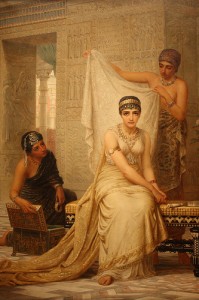
Queen Esther by Edwin Long, National Gallery of Australia

Queen Esther by Edwin Long, National Gallery of Australia

The Book of Esther is a parable for today, but I’m at something of a loss to explain why a short portion of it drops out of the blue into our lectionary today. We haven’t been reading from it during the past few weeks and we won’t read from it again in coming weeks. I could understand this one-time shot of Esther if we were in, say, the month of March. Then we might be acknowledging our solidarity with our Jewish brothers and sisters. As we heard in the lesson, they were enjoined to have a holiday on the 14th and 15th of Adar, and they still do to this day. The holiday of Purim, the most joyous in Jewish calendar, celebrates the salvation of the Jews related in Esther’s story. But the middle of the month of Adar usually falls in March in our calendar. So solidarity with modern Jews can’t be the reason we here this bit of Esther today.

Let’s consider the whole story of Esther and maybe that can help us figure this out.

Remember that the leading citizens of Israel had been taken captive and transported as slaves to the Persian empire. Most had been resettled near the capital, near modern Tehran, but many had been resettled throughout the provinces of Persian. They had become a part of the society. Many were merchants, some had entered into the king’s government service, a few had risen to high rank. One, Mordecai, was an advisor to King Xerxes (called Ahasuerus in our reading today).

Xerxes was in need of a queen. His former wife, Vashti, had been disrespectful and disobedient, so he had divorced her and exiled her. So the King ordered a search for a new queen. All of the marriageable young women were to be brought before him to show off their comeliness and their talents in a sort of beauty pageant.

Mordecai’s orphaned cousin was Esther, a lovely young woman, whom no one knew to be a Jew. Mordecai arranged for her to take part in the king’s pageant and (guess what?) she won. She became queen of Persia.

Now Mordecai had run afoul of another government minister named Haman – Haman hated the Jews! All that ranting I did at the beginning of this sermon … that was Haman’s opinion of the Jews of Persia (though you might have thought it something else).

As far as Haman was concerned the Jews were so different … They looked different. Their skin color was different. Their facial structure was different. They had a different God (although God isn’t mentioned at all in the Book of Esther). They had different customs and traditions. They kept a different calendar. They had different holidays. They did strange things to their baby boys. … They were so different they had to be dealt with in a decisive way. So Haman came up with a plan.

Haman obtained the King’s seal; he was given supreme authority over the empire. So he sent out letters using the seal to the provincial governors and the leaders of the cities. The letters ordered that on a particular day at a particular time, all of the Jews were to be rounded up and killed. Mordecai learned of this plan and contacted Queen Esther so that she would ask the king to countermand Haman’s orders.

Esther decided to deal with the situation in this way: she invited the king and Haman to her apartments in the royal palace for a banquet. It must have been quite a feast for, as our lesson tells us, the king and Haman were still drinking wine on the second day! That’s when Xerxes told her she could have anything she requested. And so, she told him about Haman’s plan and asked for the lives of her people. The king granted her petition and, not only that, decided to hang Haman for this treachery. Haman had erected a tall gallows outside his home where he intended to hang Mordecai … but he ended up being hanged on it himself.

So here we have this story set side by side with a story from the Gospel of Mark in which John, typical of the disciples, doesn’t quite understand what the Good News is all about. Remember that John and his brother James had asked for the thrones of power in Jesus’ kingdom, but Jesus had used their request to teach about the overturning of society – that the first would be last and the last, first, and that the leader must be the servant. Now John, still thinking in terms of power and status, wants to hoard the healing authority he and the others have through Jesus. There’s someone else casting out demons and he wants them stopped. He couldn’t do it himself, so he asks Jesus to do so.

But Jesus won’t. “Whoever is not against us is with us,” says Jesus. John, like Haman, wants to exclude the outsider. John, like Haman, wants to draw a small, narrow circle with the insiders inside and those who are different left out. But Jesus won’t permit that. Jesus draws a wide and encompassing circle that includes anyone who does not specifically and intentionally put themselves outside of it. “Whoever is not against us is with us.”

And then Jesus goes on with all this disturbing talk of cutting off hands and feet, plucking out eyes. What on earth is that all about? Well, it’s metaphorical language for those attitudes and actions of exclusion that we all, unfortunately, share with John and Haman.

Has anyone ever done this to you (putting up a hand as if blocking passage)? “Talk to the hand!” “Keep out!” “Stand back!” Or have you ever been “kicked out” of some place or some group? Have you ever put up your to hand block someone … or used your foot to kick someone out? “No, no,” says Jesus. Better get rid of that blocking hand, that kicking-out foot … there is no place for exclusion in God’s kingdom. “Whoever is not against us is with us.”

In Jesus’ and John’s time people believed in the “evil eye”. They believed that a certain look could curse someone, and that was another way to deal with those who were different, to keep them away from the insiders.

So what Jesus is saying is … if you (like Haman, like John) have any attitudes, any actions, any habits that exclude others, that push them away, that kick them out, that see them as outside the circle, get rid of those attitudes, actions and habits. The circle is drawn wide. “Whoever is not against us is with us.”

And that’s why we got that bit of Esther today. A story of exclusion, a story of the worst way of relating to the outsider, to those who are different in some way, set side-by-side with Jesus’ circle of inclusion. A story of violence contrasted with an injunction to peace. Our Gospel lesson concludes as Jesus says to everyone within his ever-widening circle, “Be at peace with one another.” Despite all that may be different among us, unless we intentionally exclude ourselves, we are all within Jesus’ circle; be at peace with one another. Amen.

Newer posts »