Occasional thoughts of an Anglican Episcopal priest

Category: Spirituality (Page 116 of 116)

Some Pictures

No great thoughts today (have there been any at all so far?) – just a few pictures.

I’m trying to figure out what to do about Flickr and its upload limit. I may need to figure out how to use MobileMe and make it publicly accessible. In the meantime, some photos here…

First, from Lady Waterford Hall in the Village of Ford, Northumberland. Lady Louisa Waterford founded a school here well before elementary education was compulsory in Britain. She was an amateur painter and also a very religious woman. To make the stories of the Bible come alive for her students she decorated the inside of her classroom with murals of biblical stories for which they and their parents were the models. The project took her 21 years. This is her portrait of “The Boy Jesus” –

The Boy Jesus at Waterford Hall

The Boy Jesus at Waterford Hall

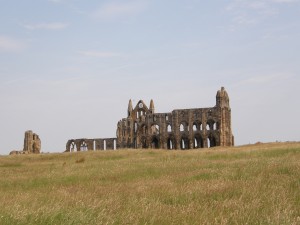
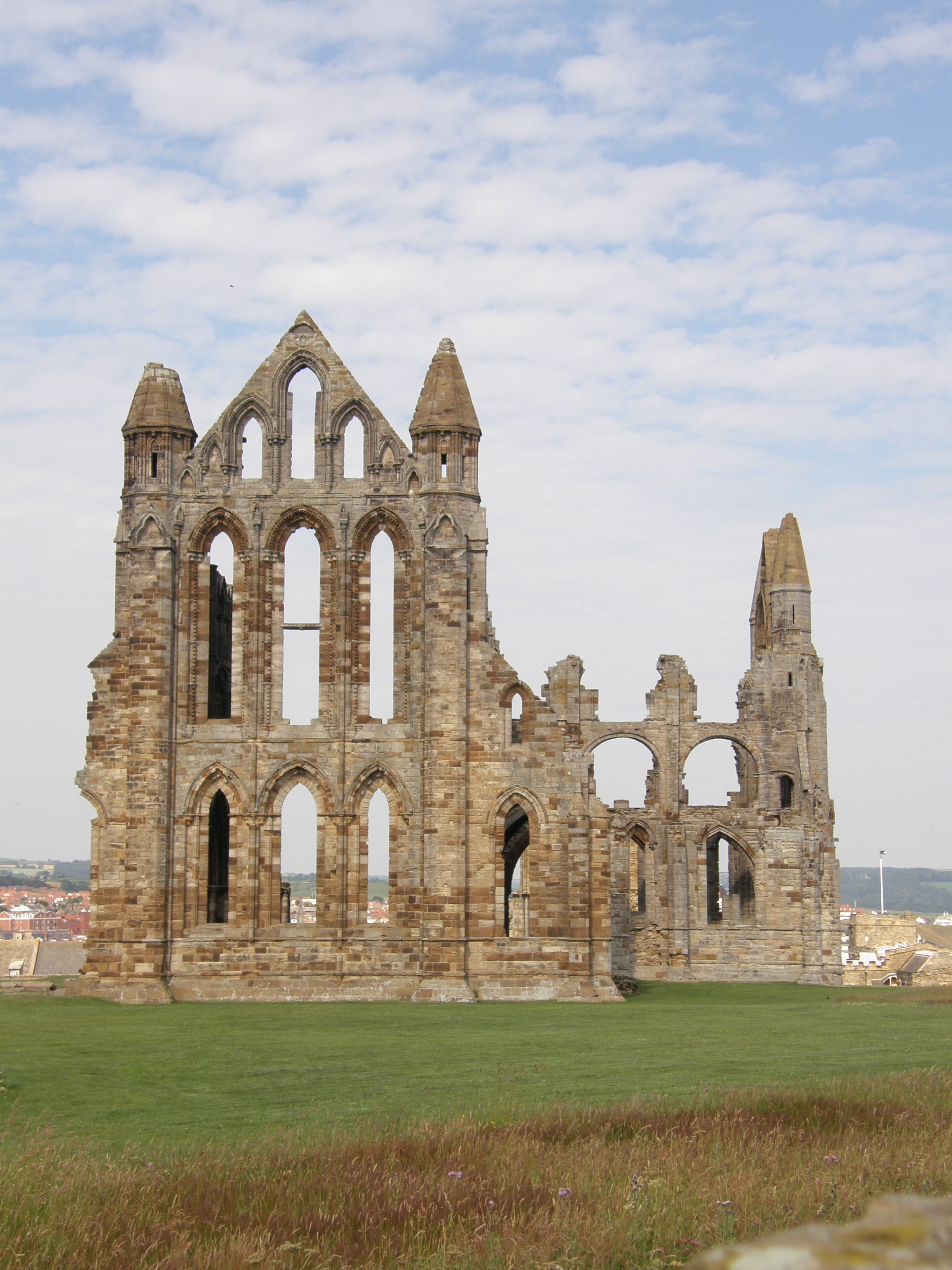
Next, Whitby Abbey. Whitby is a place important in Celtic Church history for it is here that a synod was held which essentially ended the influence of Celtic Christianity in Britain for several centuries. The first monastery here was founded in 657 CE by King Oswy of Northumbria. An Anglo-Saxon style “double monastery” for men and women, its first abbess was a formidable royal princess named Hilda. She hosted the Synod of Whitby in 664 at which it was decided that the English church would follow the traditions of Rome rather than the Celtic practices. Whitby is also famous as the home of the Anglo-Saxon poet Caedmon, an illiterate cowherd who was transformed into an inspired writer of Christian hymns. The Anglo-Saxon monastery has long since disappeared and is believed to have been in a location closer to the ocean than this 13th Century ruin; this monastery was begun in 1220 CE, like many of the re-established Celtic and Anglo-Saxon sites, by the Benedictines.

Whitby Abbey, N. Yorkshire, UK

Whitby Abbey, N. Yorkshire, UK

Third, a tomb in the Minster at York. I don’t actually know who this bishop is … but I love this non-traditional effigy. Usually these things simply look like the fully-vested stretched out corpse of whomever … but this one, with the bishop reclining, resting his head on his hand, and looking for all the world like a day-dreaming schoolboy who ought to be studying his Bible, struck me as delightfully whimsical.

Bishop's Tomb at York Minster

Bishop's Tomb at York Minster

My friend, the Rev. Michael Bishop, is the vicar of an eight-congregation united benefice in the Church of England. He ministers to the members of these eight congregations, offering worship in seven of the eight every Sunday! One of these is All Saints, Dalbury, Derbyshire, which houses this window – the oldest piece of stained glass in the British Isles. It depicts St. Michael the Archangel. I was particularly taken with it because Michaelmas happens to be my birthday.

St. Michael Window, All Saints, Dalbury, Derbyshire, UK

St. Michael Window, All Saints, Dalbury, Derbyshire, UK

Lastly – another depiction of St. Michael from a side chapel in Coventry Cathedral. My poor photographic skills and inadequate camera simply cannot convey the grandeur of the Cathedral of St. Michael, Coventry, nor the emotional impact this place has. The original Gothic cathedral was bombed during World War II. After the war, rather than restore the ruins or rebuild on the same site, it was decided that the ruins would be turned into a prayer area and the new cathedral built adjoining it. The new structure, in a style that can only be called “mid-century modern”, was started in 1956 and completed in 1962. It is magnificent! The old cathedral prayer garden is also outstanding.

Chapel at Coventry Cathedral

Chapel at Coventry Cathedral

Traveling Mercies! Please! (Part 2)

This piece follows up on a description of my day of departure from the states – here.

Suffice to say I got to and through Newark (where I had an awful Mexican supper badly burning the roof of my mouth on an obviously “nuked” chimichanga), and arrived in Edinburgh, Scotland, UK. I had pre-booked a rental vehicle from Enterprise Rent-a-Car, but finding the rental agency counters in the Edinburgh airport terminal is a bit of a trick … because they aren’t in the terminal; they’re in a separate building on the other side of the multi-level car park which thus can’t be seen from the terminal. Good planning.

Anyway, I got through immigration and customs with no problems (except a long wait because of some sort of public workers strike and then a computer outage), found the rental agency, got the car and a quick run-down on its features by the agency manager, loaded my things, and took off … only to discover that I’d misunderstood the instructions on how to get out of the parking area, made a wrong turn, and ended up blocking the way for in-coming rental returns. That’s when I discovered that I didn’t know how the put a Vauxhall Meriva five-door runabout into reverse! I put the vehicle in neutral, got out, and pushed it out of the way. Then spent several minutes looking through the owner’s manual and finally figured it out – I’d been pushing down on the gear shift knob (which was the way one got into reverse in my last two manual transmission cars) but learned that the Meriva has a pull-up ring around the gear shift stem. Well, OK, it works. And the car has turned out to be fun to drive.

The Hole of Horcum

The Hole of Horcum

After driving it for three days, however, it was time to fuel it up. I pulled into a Tessco petrol station, got out, and couldn’t get the fuel tank door to open. After looking everywhere for a release lever and not finding one, I pulled into a parking place and spent several more minutes with the owners’ manual, fruitlessly this time. I was almost ready to call Enterprise and ask, “How do I get this darned thing open!?” Then a calm voice in my head said, “What about the unlock button on the key fob?” “No,” I said to the voice, “it couldn’t be that easy, could it?” — The unlock function on the key is one of those where you press it once and the driver’s door opens, press it again all of the locks in the car are released. I pressed it twice. The fuel tank door opened! Thank you, calm voice in my head! I swung the car around the pumps and filled up.

American gasoline consumers! Listen up! The cost of petrol in the UK (the lowest grade being 95 octane, by the way) is currently between £1.309 and £1.399 depending on where you are and what station you prefer to patronize. I paid £1.319 per liter, or a total of £56.28 to fill my car with 42.67 liters of gasoline. In American terms, that’s $90.58 for 11.27 gallons – or $8.04 per gallon! Gasoline in Medina, Ohio, the day I left was $3.45 per gallon. We really don’t have anything to complain about! (I’ve since filled up twice again at similar prices.)

Anyway ….

Whitby Abbey

Whitby Abbey

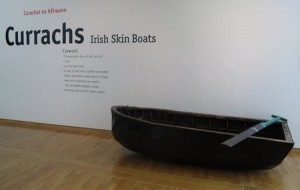
All of these minor annoyances, those set out in the earlier post and those described here, are just that, minor! When I was resting, praying, meditating at the Duddo Stone Circle and again a few days later when I was walking across the grass field at Whitby Abbey and then later that same day listening to the electronic guide commentary at Rievaulx Abbey, it occurred to me how difficult the lives and travels of the Celtic missionaries must have been. These men set out from Ireland not on jet aircraft arrived mere hours later; they sailed across the Irish Sea (not the most hospitable of waters) in small currachs, practically insignificant skin-covered boats. They traveled the countryside (which was wild and untamed, not the neatly farmed landscape of today) by foot, not in comfortable air conditioned vehicles whizzing along at 70 mph! No matter what the inconveniences of modern air travel, no matter how bad airline or airport food may be, no matter what difficulties one may have learning how to pilot a rental car … nothing that I have detailed above amounts to a hill of beans in comparison to the difficulties those Celtic monks must have faced!

Galway City Museum Currach Boat Exhibit, photo borrowed from wandermom.com

Galway City Museum Currach Boat Exhibit

It was the Celtic missionary tradition to send out thirteen men – an abbot and twelve brothers emulating Christ and the Twelve – to find a good location for a new monastic community, settle there, build their caiseal and within it their huts and other buildings, and begin seeking out the local peoples and telling them the Good News of redemption in Jesus Christ. They sailed in tiny boats; they walked across wild terrain shod only in sandals; they carried everything they needed – holy books and vessels, especially. They did the hard work of converting those who had never heard of God or of Jesus. And they did it successfully. They have much to teach us and we have much to learn.

This trip is teaching me about patience; it’s teaching me about letting go of annoyances; it’s teaching me about trusting God. Traveling charms, invocation of God’s protection while abroad, were a common part of the Celtic Christian experience. There are numerous examples of them in Alexander Carmichael’s magisterial collection of Scottish Gaelic folk hymns and poetry called Carmina Gadelica and in Douglas Hyde’s collection of Irish verse entitled Religious Songs of Connacht, from which the lyrics of many of the songs in Dantá Dé are taken. The following is from Hyde’s collection, the Irish and the translation are both from his text. It is not found in Dantá Dé. First, the Irish:

I n-ainm an Athar le buaidh
Agus an Mhic a d’fhulaing an phian
Muire ‘s a Mac go raibh liom ar mo thriall.

O a Mhuire cas dam ag an phort
Na leig m’ anam thart
Is mór m’ eagla roimh do Mhac.

I gcumaoin na naomh go raibh muidh (sinn)
Ag éisteacht le guth na n-aingeal
A’s ag moladh Mic Dé le saoghal na saoghal.

And the English rendering by Dr. Hyde:

In the name of the Father, with victory
And of the Son who suffered the pain,
That Mary and her Son may be with me on my travel.

O Mary meet me at the port
Do not let my soul [go] by thee,
Great is my fear at thy Son.

In the communion of the saints may we be,
Listening to the voices of the angels,
And praising the Son of God for ever and ever.

I’ve begun saying this invocation each morning before beginning my drive, thinking of the Celtic and Roman missionaries and the later medieval monks who traveled this way before me.

Connections: Friendship, Stones, and Walls

I inhabit a world of instant connections, or so I believe. Back home in the States almost anywhere I go I can pull out my laptop, turn it on, find an available WiFi network, link to it with little or no problem, and be instantly connected with the internet. I can check my e-mail, access informational websites, Skype with family and friends – in a word, be connected.

Not so Great Britain. Except for the fact that the housekeeper Clovenfords Country Hotel had to keep unplugging the router to plug in her vacuum cleaner, there was no problem my first lodgings. The next evening, however, I discovered that there is no connection at all on Lindisfarne. Holy Island simply seems unwired. There times my phone couldn’t even send a text message. Now in Whitby, I’m finding that although the B&B where I’m staying advertises “free WiFi”, its router keeps cutting in and out (without the excuse of an interfering house keeper) – good thing its free! I’d be really angry if I was paying for this. (Note: The next day things improved immensely – I actually think the problem was with the ISP because my computer kept showing that I was connected to the router, but the router wasn’t connecting to the internet.)

This matter of “being connected” brings me to the sorts of places I’ve visited the past few days – the Duddo Stone Circle (2200-1400 BCE), Hadrian’s Wall (c. 120 CE), Bede’s Monastery of St. Paul at Jarrow (681 and c. 12th Cent. CE), Lindisfarne Priory (687 and 1150 CE). These are ancient places of varying purposes but all, in a sense, are monuments to human connectedness, our connections to one another and our connections to the divine.

Duddo Stone Circle

Duddo Stone Circle

No one is quite sure what the Duddo Stone Circle is all about. It may have marked a burial site, but that cannot be proven because Victorian and early 20th Century excavations disturbed any cremation chamber that may have been there. It may have been a religious site of some sort, but who can tell. It is dated to the Bronze Age principally because of its size. Archeologists tell us that the final phase of stone circle building occurred during the early to middle Bronze Age (c.2200–1500 BCE) which saw the construction of small circles like Duddo, probably by family groups or clans rather than the larger population groups need to build the larger circles and henges.

The purpose of stone circles and henges is forever lost to us. They may have been religious; they have been astrological or astronomical observatories of a sort; they have been talismanic. Still, whatever the Duddo Stone Circle’s purpose and whoever its builders, it remains today as a monument to community and cooperation, to the human need to connect that which is greater than the individual. Though they have fallen been stood again over time, there they remain perhaps 4,000 years after their initial placement on that hillside in Northumbria.

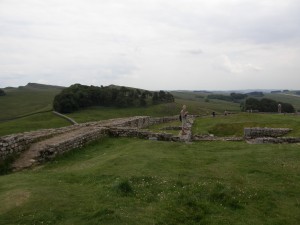
Housesteads Fort and Hadrians Wall

Housesteads Fort and Hadrians Wall

Hadrian’s Wall was built between 122 and 128 CE right across the island of Great Britain; it is 73 modern miles long! About 70 percent of this fortification (more than 50 miles) is made of squared stone outer walls with a fill of rubble and clay between them; these walls were 10 feet thick and 20 feet high! The remainder (mainly west of the River Irthing) was made of turf stacked 20 feet thick and 10 feet high. Forts were built every five to ten miles and turrets or guard posts every mile. It was built by the Roman Legions and they did it, including the forts and turrets, in six years! I visited Housesteads Roman Fort near Hexham and was fascinated by the orderliness of its layout and massiveness of the section of the wall to which it is connected. The wall and its forts are monuments to organization and communication, it nothing else, and sections of it are still standing nearly 1900 years later!

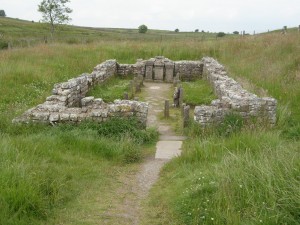
Carrawburgh Mithraeum Brocolitia

Carrawburgh Mithraeum Brocolitia

However, the ruins of Hadrian’s Wall are not simply the remains of a secular, military fortification of massive proportions. There is evidence that Hadrian believed it was his duty by “divine instruction” to build the wall to protect the Roman Empire. Furthermore, along the wall there are worship sites. A goodly number of Rome’s Legionaries were Mithraists, followers of a mystery religion which competed with Christianity in the early centuries and with the Christian Church (after made official by Constantine) eventually wiped out. Along the wall are evidences of Mithraic worship sites called Mithraea. One such Mithraeum is found at Carrawburgh near Housesteads Roman Fort. (For some reason it has been given the Celtic-based name Brocolitia, which probably means “badger hole”.

Lindisfarne Priory

Lindisfarne Priory

The monastery and the priory were founded by the Celtic missionaries from Ireland at about the same time and renewed five hundred years later. Lindisfarne and Jarrow were re-established as monastic communities by Benedictines from Durham Cathedral in the 12th Century and, if not for the savagery of Henry the Eighth’s disestablishment of the monasteries in the 15th Century, they might still be standing and might still be functional communities today. Like Duddo and Hadrian’s Wall before them, the still-standing ruins of these monasteries are testament to power of human connection and of human desire to connect to that which is greater.

While the Celtic ethos is certainly community-based, as the nature of the Celtic monastic communities of Ireland and those in Britain and Scotland in places like Lindisfarne, Jarrow, and Iona show, the hymns in Dantá Dé do not reflect that. The hymns Ní Ógáin selected are all, for the most part, hymns of individual prayer. However, there is one hymn which refers to God as “King of the friends,” or as Douglas Hyde translated it, “King of friendship.” The notes describe is as a morning hymn and as folk music (ceol na ndaoine, literally “music of the people”) “through L Grattan-Flood, Mus. Doc.” This is the Gaeilge original:

A Rí na gcarad, a Athair an tSlánuightheor’,
Fág in mo sheasamh mé ar maidin drádhachóir;
Déan-sa mo theagasg gan mearbhal, a Shlánuightheoir,
Agus sábháil m’anam ar cheangal an Aidhbheirseor’.

A Rí cruinne, do bheir loinnir ‘sa ngréin go moch,
Dílte troma agus toradh ‘na ndhiaidh go grod,
Innsim Duit-se mo chulpa agus féachaim is glaodhaim Ort,
Agus ná leig tuitim níos fuide bham féin san olc.

And this is a versified translation which Ní Ógáin attributes to Dr. Hyde:

O King of friendship, our Saviour’s Father art Thou;
O keep me erect, until evening shall cool my brow.
O teach and control, lest I unto sin should bow,
And save Thou my soul from the foe who follows me now.

O King of the world, Who lightest the sun’s bright ray,
Who movest the rains that ripen the fruit on the spray;
I look unto Thee, my transgressions before Thee I lay,
O keep me from falling deeper and deeper away.

Friendship, community, connectedness … these are the things that last and those human works which result from them last, as well. God is the King of the Friends, the King of Friendship. If we trust in God and in one another, the things we accomplish will be kept erect like the Standing Stones at Duddo. They will not be inconsistent, like internet connections. They will not fall “deeper and deeper away” but stand like Hadrian’s Wall and the walls of the ancient monasteries, testaments to the power of friendship and of faith.

Melrose Abbey – Waste Removal ….

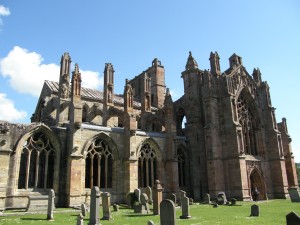
Melrose AbbeyMelrose, Scotland, is an important place in Celtic church history. It was here that St. Aidan, abbot of Lindisfarne, established a mainland monastery bringing monks from Iona. It was in that Celtic monastery that St. Cuthbert became a monk and entered holy orders. This early monastic foundation, probably 2-1/2 miles from the current monastic ruin, has completely disappeared. In fact, was long gone by the 12th Century when Cistercian monks came and started what eventually became the Melrose Abbey we know now.

Melrose Abbey, as it exists today, is an excavated ruin of what was a very large foundation of Cistercians; presumably there were hundreds of them. (I’ve tried to find an estimate of their highest numbers and have been unable to do so. However, I have found out that they herded between 13,000 and 15,000 sheep in the 14th Century! That takes a lot of manpower….) Only a few of the walls of the chapel, which we American Episcopalians would consider a very large gothic church, remain standing. Intriguing details of the place include a still-standing bell tower (in most monastic ruins these have long since fallen), a gargoyle in form of a pig playing bagpipes, the alleged burial place of Robert the Bruce’s heart (it really was buried here but whether a mummified heart found buried outside the cloister in an iron box is his is subject to some debate), and the beautiful large tracery window of the south transept (the work of a French mason now, of course, devoid of glass).
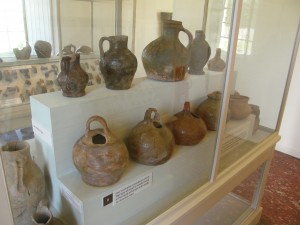
Melrose Abbey UrinalsBut the thing I thought about most as I left the place was the display of waste disposal artifacts. Unearthed in the excavations and on prominent display is the monks’ latrine, the “great drain” which carried away its contents and the waste of the on-site tannery, and a collection of pottery urinals! (Urine, however, was not considered waste! Tanners, which the monks were, soaked animal skins in urine to remove hair fibers. Urine is also used as a mordant to help prepare textiles, especially wool, for dyeing – and remember, these monks were shepherds with thousands of sheep to sheer and, one assumes, produce usable wool. In Scotland, the traditional process of “walking” (stretching) the tweed was preceded by soaking in urine. So these urinals may have been for the collection of a useful and necessary product, not considered waste.)

Of course, such workings were necessary; they are in any place where large numbers of people live together. One can see that the original planners of the abbey had taken this into account in the very design and lay out of the buildings. It was typical in these early medieval abbeys to lay out the cloister and conventual buildings on the south side of the abbey church so that they would not be in the shade of the church throughout most of the day; abbeys were not heated and their cloister gardens provided the monks with a good deal of their food, so sunlight was much valued. However, at Melrose the conventual structures are to the north of the chapel because it was on this side that water from the River Tweed could be diverted to the abbey, providing it fresh water and a means of flushing waste away through the “great drain”.

Melrose Abbey LatrineOn the north of the abbey grounds is a long, deep, stone-lined rectangular pit. A ground-level green and white sign labels it “Latrine”. About a foot or two of scummy, green, stagnant-looking water stands in it; I wondered if the Historic Scotland folks keep it that way for effect. The sign informs one that it would be periodically flushed out through the “great drain” (I keep putting that in quotes because that is the name given an exposed stone-lined culvert further to the north of the property heading downhill toward the river). One can imagine the long, narrow building sitting atop this pit with out-house privy seats.

I made note of the fact that while this “latrine” is fairly far removed from the cloister and the residential “range” of the abbey, it is right next door to what is believed to be the “novices’ day room”. In other words, those not yet fully members of the community had to put up with whatever odor might emanate from the loo; it seems there’s always been a hierarchy or division in the church, those who are in and those who are out, those who are privileged and those who are not, those who get to deal with the crap and those who are above that.

The main drain runs from the latrine (and the tannery) to the northwest toward what’s called the “mill lade”, a diverted stream from the River Tweed. On the other side of the drain is the commendator’s house. Built in the 15th Century, the original purpose of the building is unknown. In the late 16th Century, it was converted to a home for the last commendator of the abbey. It now houses a museum in which bits of stonework, pottery, and other items excavated from or pertinent to the abbey are on display. It is here that one finds a display case on one side of which are pottery pitchers used to serve ale or beer in the refectory; on the other side, urinals used by the monks in their dormitories. The two sorts of vessels are similar, but clearly distinguishable – good thing that!

I think this is first museum display of urinals I’ve ever seen, and the first monastic ruin in which the privy was so prominently signed and explained. So, naturally, that’s what caught my attention and occupied my thoughts as I left Melrose. As I pondered this, I realized that such waste disposal can be a metaphor for salvation – the flushing away of bodily waste and of human activities like tanning representing the washing away of sin through the salvific act of Christ. It’s not a metaphor one hears in many parish sermons (and I don’t feel inclined to use it myself), but it’s certainly a useful one for contemplation.

Traditional Christian teaching, especially that of the Middle Ages in which Melrose Abbey was built and of the Catholic Church reflected of the Gaelic hymns collected in Dantá Dé, focuses on the sacrifice of Jesus on the Cross as that moment which worked the cleansing of human souls, on Good Friday and the shedding of the Holy Blood as that which washes us from sin.

There is also a Good Friday hymn in Dantá Dé described as a “lullaby of the people of Baile-Argáin” and as “ancient music of Ireland” which exemplifies this. Here is the original Gaeilge:

Cuimhnigh a dhuine, gur thrí d’ choirthibh do céasadh Críost
Chun sal an pheacaidh do ghlanadh do phréimhshlioche Aoibh;
Ó dhóire A chuid fola chun sinn-ne go léir do nigh’
Bíom dá shíor-mholadh go h-osnadhach béarach choidhch.’

Ar lár mo chroidhe-se, a Rí ghil na bhflaitheas naomh,
Adhain teine an Naoimh-Sp’raid, mar ‘s caora tá ‘bhfad ar strae mé,
A lasaighfeas m’inntinn chun gníomhartha na n-olc do thréig’,
‘S a chuireas díbirt as mo smaointe ar bhaoise an tsaoghail.

Míle glóir don Athair ghní gach ribe de’n bhféar ag fás,
Míle glóir do’n Mhac ‘ghní gach gráinne de’n ghainimh san tráig,
Míle glóir do’n Spioraid ‘ghní gach réalt a bhflaitheas go h-árd,
Mar do bhi dtúis an tsaoghail, mar bhéas a’s mar tá.

And here is Ní Ógáin’s translation:

Remember, O man, that through thy sins Christ was crucified
To cleanse the stain of sin from the root-stock of Eve;
Since He shed His blood to save us altogether,
Let us be ever praising Him, with sighs and tears.

In the midst of my heart, O fair King of the holy heavens,
Kindle fire of the Holy Spirit, – for I am a sheep that is far astray -,
That will lighten my mind to forsake the deeds of evil,
And banish the folly of the world from out of my thoughts.

A thousand glories to the Father Who makes each blade of the growing grass,
A thousand glories to the Son, Who makes each grain of sand on the shore,
A thousand glories to the Spirit, Who makes each star in the heavens on high,
As it was in the beginning of the world, will be, and [now] is.

It’s a lovely hymn, and I believe its initial focus on Good Friday is correct so far as it goes; after all, as St. Paul wrote, “We proclaim Christ crucified.” (1 Cor. 1:23) However, the truth of the matter is that if his manner of life and his teaching had not preceded it, Jesus’ death on the Cross would have had no meaningful context. If there had been no Resurrection three days later, his death at Calvary would long ago have been forgotten. If Jesus’ death alone accomplished salvation there would have been no need for his rising to new life. The hymn concludes by raising our vision beyond the cross to the glories of creation.

So I would suggest that in a more complete, and surely in a Celtic, understanding, our salvation is worked not simply by Christ’s death but by the whole of what some scholars have called “the Christ event” – his conception, birth, life, teachings, death, resurrection, and ascension – all of those parts of Christ’s life, temporal and eternal, work to our redemption, our justification, our sanctification, and our salvation. I think this rings particularly true in Celtic spirituality; though the ancient hymn focuses on the crucifixion as the cleansing act, it concludes with a doxology praising the Holy Trinity not for that, but for creation of everything from the lowliest grain of sand to the brightest shining star. Consider also this verse from the famous lorica, St. Patrick’s Breastplate, as translated by Cecil Frances Alexander:

I bind this today to me forever
By power of faith, Christ’s incarnation;
His baptism in Jordan river,
His death on Cross for my salvation;
His bursting from the spicèd tomb,
His riding up the heavenly way,
His coming at the day of doom
I bind unto myself today.

We proclaim Christ crucified, Christ risen, Christ ascended; we proclaim Christ who has flushed away our waste!

The Full Scottish Breakfast

There’s something about old monastic ruins and the tumble-down wrecks of old stone churches that appeals to me. I’m not sure why, but there is. When we visited Ireland in 2005 and again in 2007, I dragged my poor wife Evelyn to and through so many religious ruins that I’m sure she’s seen more than enough of them.

But not me!

Today I drove from Clovenfords to Melrose, visited Melrose Abbey and Harmony Gardens, then drove on to Jedburgh and visited Jedburgh Abbey. After that, I turned toward Holy Island (Lindisfarne) and wandered through the Scottish Borders and Northumberland countrysides taking very small country roads across northeaster England. And when I got to the Holy Island, I made a preliminary visit to Lindisfarne Priory to which I will return tomorrow. Three monastic ruins in one day!

It was a very full day with lots to consider, lots to think about, and lots to relate. So let us return to Clovensford Country Hotel for the moment and consider the “full Scottish breakfast.” The full Irish, it ain’t! At least as served at Clovensford. Don’t get me wrong; it was a lovely breakfast, but it wasn’t what I was expecting.
In the breakfast room (the same restaurant where I’d had dinner the night before), the bar was set with cereals (for types in individual boxes), a basket of various sorts of croissants, muffins, and breakfast rolls, some packets of marmalade and jam, and four pitchers – one of milk, three of juice (orange, grapefruit, and cranberry). I was greeted by the same young woman who had served dinner and told to take any set table, which I did after selecting a cereal (Kellogg’s Fruit & Fibre), a croissant, and a packet of marmalade, and pouring a glass of orange juice.

She then asked if I wanted tea or coffee… Coffee, of course! …and handed me the breakfast menu. There were four options the first of which was the “full Scottish breakfast.” I don’t remember now what the others were, though I do recall that one was vegetarian and one involved smoked salmon. I ordered the “full Scottish” and requested my egg over-medium, which she confirmed. When it came, it was sunny-side up. No problem.

The rest of the plate consisted of grilled mushrooms (some exotic sort with long stems), two rashers of English (or, I suppose, Scottish) bacon which is much meatier than American bacon (more along the lines of so-called Canadian bacon), a sausage link, a grilled tomato half, what looked for all the world like one of those triangular hash-brown things you get at McDonald’s, about a half-cup of baked beans (exactly like Campbell’s pork-and-beans), and a round patty of what was billed as haggis, obviously cut from a canned product. She also delivered a rack of eight triangular pieces of toasted white bread (it could have been Wonder Bread).

The full Irish is described elsewhere on this blog and, while similar, the Scottish version just seemed skimpy … only one small egg, one banger, and haggis is no substitute for black pudding!

As I drove off after the breakfast, feeling somewhat dissatisfied with the whole thing, I recalled a short hymn from the Pentecost hymns section of Dantá Dé which is simply entitled Hymn of Mael-Isu, the author of the lyrics being identified as Mael-Ísú Ó Brolchám, an 11th Century poet one assumes since the hymn is dated 1038. (Textual notes indicate that Ní Ógáin found it in a musical manuscript from 1756 by “G. Flood, Dr. Mus.”) The Irish of the hymn is

An Spioraid Naomh, umainn, ionainn agus againn,
An Spioraid Naomh chugainn go dtige, a Chriost, go h-obann.

An Spioraid Naomh d’áitreabh ár gcuirp is ár n-anma,
Dár gcúmhdach go lághach ár ghuaisibh ‘s ar ghalraibh.

Ar bheamhnaibh, ar pheacaidh’, ar ífrionn ‘s ar fhíor-loit,
A Íosa, go naomhaighe, go saoruigh’ inn Do Spioraid.

The English translation by Ní Ógáin is

May the Holy Spirit be about us, in us, and with us,
May the Holy Spirit, O Christ, come to us speedily.

May the Holy Spirit dwell in our bodies and our souls,
May He protect us generously against perils, against diseases;

Against demons, against sins, against hell, against real woundings;
O Jesu, may Thy Spirit hallow us, deliver us.

I don’t know why this particular bit of the hymnal came to mind, this sort of mini-lorica*, but it did. As I recited it while driving, as I thought on the prayer in this hymn, I knew that my breakfast, although it hadn’t lived up to my expectations (which were unrealistic – who am I to say what “the full Scottish” ought to be?), was more than enough to get me on my way for the day. It was plenty, more than enough really. What’s more important than breakfast is the presence and protection of the Lord, and the hymn reminded and reassured me of that. So, filled with good Scottish nourishment and assured of God’s blessing, I had a lovely day of visiting monastic ruins and tumble-down wrecks of old churches!

I’ll have more to say in other posts today about the abbeys, the gardens, the countryside, and Holy Island, and there are photos of all that on the Flickr page.

(* lorica – an Irish verse-form prayer for God’s protection. According to Wikipedia, “In the Christian monastic tradition, a lorica is a prayer recited for protection. The Latin word lorica originally meant ‘armor’ or ‘breastplate.’ Both meanings come together in the practice of placing verbal inscriptions on the shields or armorial trappings of knights, who might recite them before going into battle.” Perhaps the most famous lorica is St. Patrick’s Breastplate.)

Summer and Sabbath

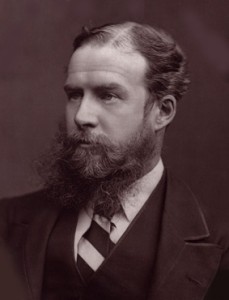
In about two hours I will be headed for Cleveland-Hopkins Airport to get on a flight to Newark and thence to Edinburgh. Checking email, Facebook, etc. before packing up the laptop, I found that a friend forwarded me an email from a United Methodist board of some sort containing two delightful quotations about summer and sabbath. The summer thought is from John Lubbock:

“Rest is not idleness, and to lie sometimes on the grass on a summer day listening to the murmur of water, or watching the clouds float across the sky, is hardly a waste of time.”

I had no idea who John Lubbock was, although I now know that I certainly should have. He was a Victoria era banker with many side interests, and the First Baron Avebury. He also was a good friend of Charles Darwin, whose hometown of Shrewsbury, Shropshire, I will be visiting in just under two weeks. Wikipedia has an extensive article about John Lubbock which includes this information:

In 1865 Lubbock published what was possibly the most influential archaeological text book of the 19th century, Pre-historic times, as illustrated by ancient remains, and the manners and customs of modern savages. He invented the terms Palaeolithic and Neolithic to denote the Old and New Stone Ages respectively. More notably, he introduced a Darwinian view of human nature and development. “What was new was Lubbock’s… insistence that, as a result of natural selection, human groups had become different from each other, not only culturally, but also in their biological capacities to utilize culture.”

Lubbock complained in the preface about Charles Lyell:

“Note.—In his celebrated work on the Antiquity of Man, Sir Charles Lyell has made much use of my earlier articles in the Natural History Review, frequently, indeed, extracting whole sentences verbatim, or nearly so. But as he has in these cases omitted to mention the source from which his quotations were derived, my readers might naturally think that I had taken very unjustifiable liberties with the work of the eminent geologist. A reference to the respective dates will, however, protect me from any such inference. The statement made by Sir Charles Lyell, in a note to page 11 of his work, that my article on the Danish Shell-mounds was published after Ms sheets were written, is an inadvertence, regretted, I have reason to believe, as much by its author as it is by me.” Preface to Pre-historic times.

Lubbock was also an amateur biologist of some distinction, writing books on hymenoptera (Ants, Bees and Wasps: a record of observations on the habits of the social hymenoptera. Kegan Paul, London; New York: Appleton, 1884.), on insect sense organs and development, on the intelligence of animals, and on other natural history topics. He was a member of the famous X Club founded by T.H. Huxley to promote the growth of science in Britain. He discovered that ants were sensitive to the ultraviolet range of the spectrum. The Punch verse of 1882 captured him perfectly:

How doth the Banking Busy Bee
Improve his shining Hours?
By studying on Bank Holidays
Strange insects and Wild Flowers!

Apparently, Mr. Lubbock’s time spent lying on the summer grass was not wasted. I hope that mine spent, in part, walking through the summer hills of Scotland, England, Wales, and Ireland will likewise not be a waste of time. And in that vein is the second quotation in my friend’s United Methodist email, a prayer for sabbath:

Sabbath God, in this season of long days and long daylight, we are grateful to be alive. Give us the wisdom to pause from our hectic routines and enjoy the simple things of this time of year. Let us live easily for a time, putting away watches and looking away from clocks, ignoring all the things that need to be moved, fixed or cleaned. Let us lose ourselves in the bounty of the earth you created. May this be a time of rest, refreshment and renewal. May we be calm enough and quiet enough to perceive your presence. Let us not fill all our time with endless activity.

The email says that this is prayer is “based on a prayer composed by Ted Loder in his book, My Heart in My Mouth.” I also didn’t know who Ted Loder is. It turns out he is another blogging clergy person. The profile on his blog says, “The Reverend Dr. Loder is a retired United Methodist minister who served as Senior Pastor for 38 years at Philadelphia, PA’s First United Methodist Church of Germantown (FUMCOG), which became well known around the country for its dynamic worship and preaching as well as its urban involvement and prophetic social action. He was named one of America’s most creative preachers. He has published several books of prayers, sermons and commentary including Guerrillas of Grace and Loaves, Fishes and Leftovers.” The header on his blog reads, “Stay Watchful – God is Sneaky.” I shall have to read this fellow….

As I fold up this laptop, stow it in my backpack, and start loading my bags into the car for the trip to the airport, my prayer is one petition in particular in the Rev. Dr. Loder’s prayer, “May this be a time of rest, refreshment and renewal.” Amen!

Spelling, Grammar, Punctuation … and Grace

Misused apostrophes added unnecessarily to plurals or added (or forgotten) with possessives … to use a serial comma or not … should this be a colon or semicolon … does a comma or period go inside the quotation marks or outside?

Verb tenses, definite and indefinite articles, prepositions, noun-verb agreement ….

Homophones (their, there, they’re … hear, here … right, write, rite) and so forth ….

This sort of thing drives me crazy as I write for “immediate publication,” which is essentially what blog writing is. Apparently I do not type what I think. Maybe I should retitle this blog “What am I TYPING this morning?” We would all be surprised, I’m sure! I know I am surprised when I re-read what I’ve published here. I find all of the issues above-mentioned and more when I do so. So there’s this constant process of correct, hit the update button, read again, correct, hit the update button, read again … and on and on it goes. (Especially transliterating the archaic Irish script of Dantá Dé into modern Latin lettering! I read and re-read, compare to the original, re-type, then do it again, and again, and still I find more things to correct.)

So, dear readers, I beg your indulgence. If you read a sentence that doesn’t make sense, read it again and figure out what’s missing. A helping verb, a preposition, a conjunction, something will make it good. I trust you to supply the correction … and to check back later and see if I’ve supplied something else!

A story …

When I was in seminary a good friend (a retired priest in my home parish) died, so I went to the seminary chapel and added his name to the prayer list for that day’s Evening Prayer service. The list asked us to include our name as requester and indicate our relationship to the person being remembered. Our officiant that evening was a commuter student who didn’t know all of the dormitory residents … and apparently in my grief or haste I did not write very legibly. So when the list of those for whose souls reposed was prayed came around, she prayed for “Father Hunt Parsons, friend of Ernie Funston.” Of course, there were sniggers and a few outright guffaws in the congregation.

Leaving the chapel at the conclusion of the service, Dr. Guy Lytle, who taught Anglicanism and church history, happened to go out the door beside me. He took me by the arm and said, “Don’t worry. God has spell-check on prayers.”

Since then I’ve come to regard that as a metaphor for God’s grace … God has spell-check on our lives! Like the automatic spell-checker in our word processers, God quietly and efficiently corrects (or simply chooses to overlook) the errors we commit.

And we are called to have spell-check (and grammar-check and gentle proofreading) for one anothers (another’s? anothers’?) lives.

So “grace to you and peace from God our Father and from the Lord Jesus Christ!”

Leaving the Fireflies

On June 30, 2011, I’ll load my rolling dufflebag filled with clothing and such, my backpack filled with computer and books, and my CPAP machine (its bag crammed with anything else I can fit into it) into the car, head for Cleveland-Hopkins Airport, and fly to Newark where I will wait for five hours and then take another plane to Edinburgh, Scotland, UK.

Last evening as I walked the dog after sunset, the sky still a fairly bright blue with plenty of light to see, I looked into the darkness of the woods behind our house and saw that the fireflies were beginning to flash their mating signals. I realized that I’m leaving Ohio at one of my favorite times of the year – firefly time! I love fireflies!

I was born and raised mostly in the little-known southern Nevada community of Las Vegas, but my summers from age 5 to age 13 were spent mostly in the southeastern Kansas town of Winfield. That area of Kansas has a lot of fireflies; my mother was born there and both of my parents were reared there. Those summers were spent living with my paternal grandparents and with my cousins, the children of my father’s only brother, who lived next door to them. A nearly daily activity during June and July was catching fireflies in the early evening so we could watch them flash on our dresser all night long.

I was delighted when we moved to Ohio to find fireflies here … not as many as there were in Kansas, but enough. An informational website maintained by Ohio State University has this to say about firefly habitat:

If you live in the United States, west of about the middle of Kansas, you are not apt to have the flashing type of fireflies in your area. Although some isolated sightings of luminous fireflies have been reported from time to time from regions of the western U.S., fireflies that glow are typically not found west of Kansas. The reason for this phenomenon is not known.

I can guarantee you that I never saw a firefly in Las Vegas! But those summers in Kansas there were plenty.

Fireflies are called different things in different parts of the country. I’m pretty certain that firefly was the most common term in Winfield, although occasionally someone might call them lightning-bugs. I know that some people also call them “glow worms” but the only time I ever heard them called that was when my mother would sing a song with that title popular back in those days. Whenever I would talk about catching fireflies, she start humming or singing that song. Here’s a YouTube video of the Mills Brothers singing it (it brings back a lot of memories!):

My cousins and I would catch the fireflies and keep them in mason jars. We’d grab a handful of the grass growing along the fence of our granddad’s garden (this was in the days long before “weed whackers” and no one ever seemed to feel like trimming that grass by hand, so it was always good and long, perfect for a mason-jar firefly habitat) and shove it in the jar, then run through the yard after the flashing bugs trying to trap them between jar and lid. The lid, of course, was a mayonnaise jar lid (Grammy wouldn’t let us use her good canning lids) that we had pounded a nail through several times to give the bugs air. We’d usually get five or six bugs in each jar and that would be enough for the night.

We’d put the jars on the dresser next to our beds in our grandparents’ basement or at my cousins’ house, wherever we were going to sleep that night, and then do something else for the rest of the evening. Eventually, though, bedtime would roll around and off we’d go, to lay awake as long as we could watching the fireflies flash. Come morning, Grammy would encourage us to set them free and we would dutifully dump out the contents of the jar, wilted grass, fireflies (dead or alive, who knew?), and all.

There are no fireflies in Ireland (though I’m told there’s a Klezmer band there called The Fireflies) so I am leaving one of my favorite sights of summer, the evening flashes of the lightning bugs. There are no fireflies in Ireland, but there is in the ancient verse and the Celtic spirituality of the Irish people a deep appreciation of nature and of nature’s God. In the early 20th Century, Dr. Douglas Hyde collected many bits of folk poetry reflecting that appreciation, including this one found in Dánta Dé. It is described as “ceol na ndaoine, as Albain, tré Lachlann MacBeathain” (“folk song from Scotland by Lachlann MacBeathain”); the notes in the hymnal indicate that Dr. Hyde collected it in 1924:

Áluinn fairrge spéir-ghlas
Áluinn uisgeacha ciúin,
Áluinn taithneamh na gréine
Ar na tonntaibh tá fúinn;
Faoileáin ‘g eiteal ‘s na spéarthaibh,
Teas le h-éirghe an lae;
Ó! nach áluinn, a Dhe!
Siúd uait amharc na sléibhte,
Bárra a bhfolach fá cheó,
Caoirigh ciúin ar a dtaobhaibh,
Síot a’s sonas a’s sógh.
Tógfad suas mo chroidhe-se
Tógfad suas mo ghlór,
Molfad Eisean a-choidhche
Fá gach iongantas mór;
Árdaigh feasta mo smaointe
Mar na sléibhte ‘san aéir,
Ciúnaigh feasta mo chroidhe-se
Mar an t-uisge soiléir;
Éist le m’athchuingh’, a Thigh’rna,
Tar a’s cómhnaigh im’ chléibh,
Réidhtigh m’anam: ‘s im’ inntinn
Déan-sa t’-árus, a Dhé.

The direct, non-metrical, prose interpretation:

Lovely is the sky-grey ocean,
Lovely the quiet waters,
Lovely the shining of the sun
On the waters below;
Seagulls flying in the skies,
Warmth with the rising of day, –
O how delightful is Thy world!
O how delightful, my God!
See in the distance the mountains,
Summits hidden in the mist;
Quiet sheep on their slopes,
Peace and pleasure and bliss.
I will lift up my own heart,
I will lift up my voice,
I will praise Him for ever
For each wonder great.
Lift Thou upwards my thoughts
Like to the mountains above,
Calm Thou henceforth my heart
Like the waters clear;
Hear, O Lord, my prayer,
Come, abide in my breast,
Quiet my soul, and within my mind
Make Thy dwelling, O God.

There are no fireflies in Ireland, but I’m sure if there ever had been they would have found there way into the religious songs of the Irish people. Fireflies spark our imaginations and light up our souls on summer nights. In a way, I’m sorry to be leaving the fireflies.

Newer posts »