====================
This sermon was preached on Sunday, September 2, 2012, at St. Paul’s Episcopal Church, Medina, Ohio, where Fr. Funston is rector.
(Revised Common Lectionary, Proper 17B: Song of Solomon 2:8-13; Psalm 45:1-2,7-10; James 1:17-27; and Mark 7:1-8,14-15,21-23.)
====================
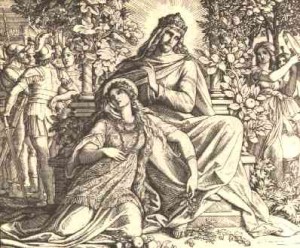 I want you for just a minute to close your eyes. Just sit back and relax, and imagine that you are hearing not my voice, but the voice of your beloved, the voice of the one person in this world who loves you more than any other . . . .
“Arise, my love, my fair one, and come away.”
Those words, of course, are from Scripture, from the Song of Songs or Song of Solomon, one of the oddest books in the Holy Bible, for it is nothing more nor less than a love song, a sensual and even erotic love song.
Our psalm this morning is also a love song. It is a marriage song which the Bible tells us was written by the Korahites or “Sons of Korah” for the wedding of a king. In fact, the Bible tells us a lot about this psalm, information that we don’t find in the Book of Common Prayer Psalter. First, it has an instruction: “To the leader: according to the Lilies.” Apparently this tells the choral director the tune or melody to which the psalm was to be sung. Second, it tells us that it was a song “of the Korahites” who were a musical guild (probably hereditary) in the Temple. Third, the psalm is described as a Maskil – this word is derived from a Hebrew word meaning “understanding” or “insight” and, thus, it is believed that Psalms so described are “insight-giving” or especially instructive. And, finally, it is described as a love song.
The insight comes, perhaps, in what is the third verse of our abbreviated recitation this morning:
Your throne, O God, endures for ever and ever,
a scepter of righteousness is the scepter of your kingdom;
you love righteousness and hate iniquity.
(Verse 7 in the BCP; vv. 6-7a in the NRSV)
In this verse, which has puzzled scholars for generations, though the singer seems still to be singing of the King, he names him “God”! The psalm appears to ascribe divinity to an earthly king which is something quite foreign to ancient Judaism. This is underscored by the last verse of the Psalm:
I will make your name to be remembered
from one generation to another;
therefore nations will praise you for ever and ever.
(Verse 18 in the BCP; v. 17 in the NRSV)
Here, this remarkable psalm lavishes on the human king the type of praise generally given to God! Christians, therefore, read this psalm as referring to Jesus, as we also read the Song of Solomon. The usual interpretation of both is that the Bridegroom or King is Jesus and the Bride or Queen is the church. However, in the middle ages the monastic mystics St. Teresa of Avila and St. Bernard of Clairvaux suggested a much more personal interpretation. In their commentaries Bernard and Teresa envisioned the love between Christ the Bridegroom and his bride, the individual soul, and they noted the way in which that love overflows to others.
For Bernard, the Song is about the manner in which the “thirsting soul” can rediscover the power of God’s love. “What a great thing is love, provided always that it returns back to its origin,” he writes; “flowing back again into its source, it acquires fresh strength to pour itself forth once again.” (On the Songs of Songs 83:4) Our journey to God’s love does not consist in our finding the path, but rather in being found on the path by Christ the Bridegroom who passionately seeks us. “Arise, my love, my fair one, and come away,” are words spoken by Christ to each one of us as he invites us to follow him. But the divine love is never intended to be, and is not complete if it is, purely individual and personal.
Bernard writes that the human soul aflame with the love of God “strives to win [other] souls with its habitual fire and renewed courage.” (58:1) “Love reveals itself,” he writes, “not by words or phrases, but by action and experience.” (70:1) Thus, says St. Bernard, love of God is not merely a personal experience; it is never complete unless it leads us to love our neighbors.
For Teresa of Avila, similarly, the Bridegroom’s call leads the soul back from a lack of love to love most fully realized:
Along how many paths, in how many ways, by how many methods You show us love! …[Not] only with deeds do You show this love, but with words so capable of wounding the soul in love with You that You say them in this Song of Songs and teach the soul what to say to You. (Meditations on the Song of Songs 3:14)
Using the sisters Martha and Mary of Bethany, as examples, Teresa, like Bernard, writes that the Song propels us to an exterior expression of love of neighbor. Only disciples who both pray with fervent desire and care for their neighbors, she writes, “imitate the laborious life that Christ lived.” (7:8)
So with the background of these songs of a divine love that compels us to share the love of God with those around us, we turn to today’s Gospel story of Jesus being confronted by and answering the Pharisees. The confrontation is over an issue of ritual cleansing, the failure of Jesus’ disciples to wash their hands before eating. Jesus, however, quickly turns that objection aside quoting from the 29th chapter of Isaiah, “‘This people honors me with their lips, but their hearts are far from me . . . . ” For Jesus the question is not one of ritual, not one of purity, not one of custom, not one of tradition. For Jesus the issue is love. “Their hearts are far from me.”
“Look,” he says, “the issue is not what’s on the outside. What’s on the outside cannot defile you. The issue is what’s on the inside. If the human heart is not filled with love, all sorts of filth results. If the human heart is not turned toward God with love, the result is disastrous.”
“Arise, my love, my fair one, and come away.”
Understand, the Pharisees weren’t bad people. They were trying to be good Jews. As the People of God, the Jews believed that God wanted them to be separate from other nations and peoples, that God wanted them to be pure and spotless. The word Pharisee means literally “separate ones.” They believed that the better and more stringently you observe the ritual practices, the more you were separate from, different from, and therefore more holy than others. Jesus was just telling them they were wrong, so he quoted from Isaiah about the heart and about love. This was the same prophet he quoted when he began his public ministry in his hometown synagogue in Nazareth. There, he read a passage from the 61st chapter of Isaiah. As Luke reports,
the scroll of the prophet Isaiah was given to him. He unrolled the scroll and found the place where it was written: “The Spirit of the Lord is upon me, because he has anointed me to bring good news to the poor. He has sent me to proclaim release to the captives and recovery of sight to the blind, to let the oppressed go free, to proclaim the year of the Lord’s favor.” (Luke 4:17-19)
Where the Pharisees sought to be separated from the unclean around them, Jesus preached the love of God which compels us to serve those around us, especially the ones who are considered unclean. Where the Pharisees were concerned about cleaning cups and washing hands, Jesus was concerned about cleaning lepers and washing their wounds. “Love reveals itself,” St. Bernard writes, “not by words or phrases, but by action and experience.” Only disciples who both pray with fervent desire and care for their neighbors, writes St. Teresa, “imitate the laborious life that Christ lived.”
This is the theme James takes up in today’s reading from his epistle: “Be doers of the word, and not merely hearers who deceive themselves.” “Religion that is pure and undefiled before God, the Father,” writes James, “is this: to care for orphans and widows in their distress, and to keep oneself unstained by the world.”
And this is what the Baptismal Covenant is all about. In a few minutes, we will baptize an infant, Finn, and an adult, John. Together with them and their sponsors, we will all reaffirm our own Baptismal Covenant as they make theirs. We will be asked, “Do you believe in God the Father? Do you believe in Jesus Christ, the Son of God? Do you believe in the Holy Spirit?” Answering these questions, we will prove ourselves to be hearers of the word. But that is not the end of the Baptismal Covenant.
We will then be asked these five questions:
- Will you continue in the apostles’ teaching and fellowship, in the breaking of bread, and in the prayers?
- Will you persevere in resisting evil, and, whenever you fall into sin, repent and return to the Lord?
- Will you proclaim by word and example the Good News of God in Christ?
- Will you seek and serve Christ in all persons, loving your neighbor as yourself?
- Will you strive for justice and peace among all people, and respect the dignity of every human being?
In other words, we will be asked, “Will you be doers of the word, and not merely hearers?” Our response will be, “I will, with God’s help.”
In Baptism, the Christ the Bridegroom embraces us as his own. “Arise,” he says as we come up out of the Baptismal waters, “Arise, my love, my fair one, and come away.” Come away not to be separated from others, but come away to share God’s overflowing love with them. Come away to strive to win other souls with habitual fire and renewed courage. Come away to imitate the laborious life that Christ the Bridegroom lived. “Arise, my love, my fair one, and come away.”
Amen.
 Episcopalians reciting the Daily Office usually read the Psalms from The Book of Common Prayer, not from the Bible. This can cause some confusion about psalm verses because the versification and number of verses in the BCP differs from that in most Bible translations. The Psalter used in Anglican prayer books, including that of the Episcopal Church (until the 1979 book) was based on Miles Coverdale’s translation of the Bible which predated the Authorized (King James) version by nearly 80 years. The Coverdale Psalter had been used in all editions of The Book of Common Prayer, back to the first in 1549; while some editorial changes were made, the basic versification and numbering was maintained and this was continued in the 1979 version, which is a new translation but follows the tradition of Coverdale. Although not metrical, the translation was rendered with chanting in mind.
 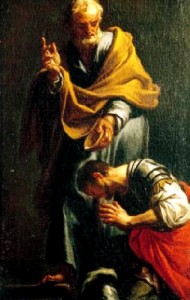 Judaism is not a missionary religion. It is, however, a proselytic religion. This means that Jews don’t go looking for converts, but those who come to them interested in becoming Jews are instructed and initiated; these initiates are called proselytes. Cornelius might have become a proselyte, but we know that he was not because if he had been, Peter would have had no issues with seeing him, meeting him, eating with him. Peter did have those issues initially, but then was shown the vision of unclean animals which he was told to eat. Peter interpreted that vision to mean that he should not treat non-Jews as unclean; it was the beginning of the Jewish Christian church welcoming non-Jews (“Gentiles”) as members.
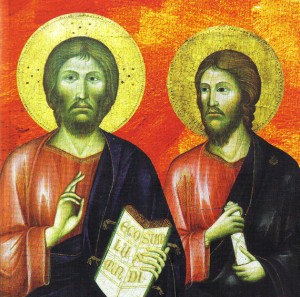 The picture of Jesus getting advice from his brothers just tickles me. John makes such a deal of it (while pointing out that his brothers did not believe in him – as the Messiah, I suppose – at the time). It seems so at odds with John’s otherwise oh-so-perfect, oh-so-divine Jesus!
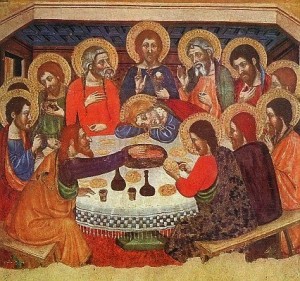 The Jews, John tells us, disputed among themselves as Jesus was delivering the lengthy dissertation on bread from which these statements come. Earlier he had introduced this idea that his flesh was bread to be eaten by his followers: “I am the living bread that came down from heaven. Whoever eats of this bread will live for ever; and the bread that I will give for the life of the world is my flesh.” (v. 51) The very idea of consuming human flesh is off-putting, even disgusting, and would have been extremely objectionable to the Jews; no wonder they grumbled and mumbled, complained and disputed. Even as a metaphor, the statement demands a lot from Jesus’ followers!
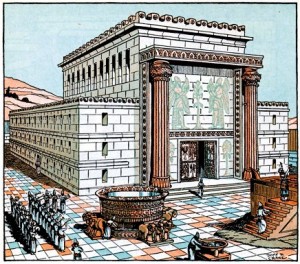 On the cover of our worship bulletin this morning is a depiction of King Solomon’s Temple. It’s an artist’s rendering of someone’s reconstruction of the Temple based on the description of its construction in the Old Testament record. Our first reading today (from the First Book of Kings), as long as it was, is just a small part of the dedicatory prayer that King Solomon offers when the Temple is finished and consecrated.
 Where were you on July 20, 1969? In July of 1969 I was living in a boarding house and studying in Florence, Italy. The boarding house or pensione in which I lived, Pensione Frati, did not have a television. My landlord, Colonello Roberto Frati, arranged for me and the other Americans living there to go to his sister-in-law’s home where we could watch Neil Armstrong’s and Buzz Aldrin’s moon landing on her TV – this great big box of a television set with a tiny black-and-white screen. We all gathered around that box peering into that tiny screen listening to the Italian news commentators and struggling to hear the American commentary behind them. I’m sure that when we heard of Commander Armstrong’s death we all thought about wherever we were on that day at that moment when he stepped out of the lunar lander and became the first human being to walk on another world.
 Wow! Does this look familiar? The second chapter of Job begins with a scene nearly identical to that which we considered yesterday. Satan (with other heavenly beings) presents himself in the heavenly throne room and, once again, God and Satan have a conversation about Job and, once again, the bet is made. In fact, it’s sort of “double down” time! Yesterday, I argued that although the Book of Job is fiction it (like the other forms of literature found in Holy Scripture) embodies truth.
 A later selection from the Book of Job was called up by the Sunday Eucharistic Lectionary several weeks ago. In my sermon I said to the congregation that the Book of Job is fiction (which it is). You should have seen the look on one of my parishioners’ face! There’s a fellow in the congregation who is, shall we say, conservative with regard to the Bible. While I don’t believe he actually considers the Bible to be the inerrant word of God per se, he’s pretty sure that it is to be taken with the highest degree of certainty and words like “myth” or “fiction” applied to Scripture are not to his liking. I swear I thought he might have an apoplectic fit right there in his pew! But let’s be honest: do we really think that God and Satan are engaged (or have ever been engaged) in a game of chance involving the lives of human beings?
 Psalm 130 is one of the seven “pentitential psalms” of the church (Psalms 6, 32, 38, 51, 102, 130, and 143), a tradition that stretches back to the Sixth Century if not earlier. It is also one of the “songs of ascents” (Psalms 120-134) that are believed to have been sung by pilgrims making their way up to Jerusalem or possibly when climbing up the Temple Mount for festival celebrations. Somehow it strikes me as both odd and poignant that a song or poem beginning “Out of the depths” is called a song of “ascent” – from the deepest sloughs of despond the poet calls out the Highest. Ascent, indeed!

