From the Wisdom of Jesus, Son of Sirach:
The leader of his brothers and the pride of his people
was the high priest, Simon son of Onias,
who in his life repaired the house,
and in his time fortified the temple.
When he put on his glorious robe
and clothed himself in perfect splendor,
when he went up to the holy altar,
he made the court of the sanctuary glorious.
(From the Daily Office Lectionary – Eccesiasticus 50:1,11 (NRSV) – November 7, 2014)
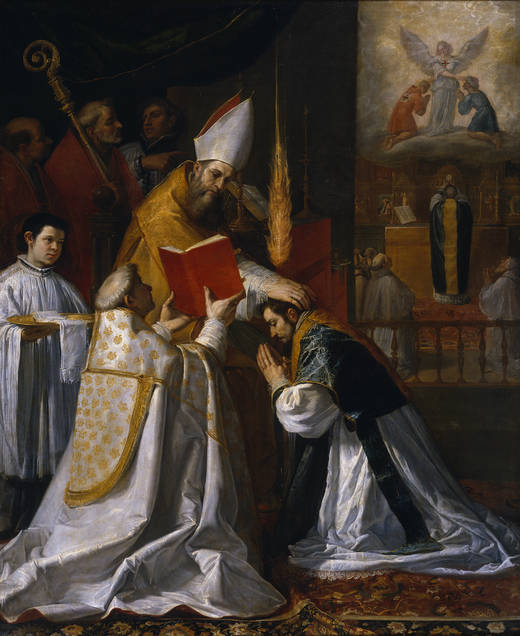 Tonight, as my diocese begins its annual governing convention in traditional fashion with a celebration of the Holy Eucharist, we will doing so in the context of an ordination – two ordinations, in fact, one to the diaconate and one to the presbyterate. This morning’s reading from Ben Sira is lengthy description of the glories of the ceremonial priesthood. One might have expected the church to have made this one of the potential readings for a presbyteral ordination, but in its wisdom, it has not.
My personal religious background is as the child of an inactive, not-quite-thoroughly-unchurched mixed marriage of a Disciple of Christ and a Methodist, the disinterested products of two decidedly American expressions of protestant evangelical Christianity. Until I was in high school my church attendance depended on which set of grandparents I was visiting; at home, church was out of the question. My grandparents’ churches were proudly non-ceremonial; the closest anyone came to wearing a vestment was the Methodist pastor’s doctoral gown.
In high school, I encountered the Episcopal Church in an Anglo-Catholic diocese. Bells, smells, chants, rich vesture . . . I knew I had come home! As I read the entire lesson today from Ecclesiasticus, I can almost remember every detail of that first encounter with the ritual of religion.
But the rubrics of the ordination service for a priest of the Episcopal Church do not permit or recommend Ben Sira’s soaring description of ceremonial liturgy and priestly elegance! Instead, we are given these choices from the Hebrew Scriptures:
- Isaiah 6:1-8, in which the soon-to-be-commissioned prophet cries, “Woe is me! I am lost, for I am a man of unclean lips, and I live among a people of unclean lips,” and has his lips seared with a burning coal; or
- Numbers 11:16-17,24-25, in which Moses is instructed to recruit seventy elders to “bear the burden of the people along with you so that you will not bear it all by yourself.”
And then there are the choices from the Psalter:
- Psalm 43 in which we ask, “Why are you so full of heaviness, O my soul? and why are you so disquieted within me?” or
- Psalm 132:8-19 in which we beg God “do not turn away the face of your Anointed.”
In the New Testament readings, Peter reminds us, “Do not lord it over those in your charge, but be examples to the flock” (1 Pt 5:3), a rather different vision than Ben Sira’s description of the magnificent Simon, son of Onias. Paul warns us through his words to the Ephesians to not “be children, tossed to and fro and blown about by every wind of doctrine, by people’s trickery, by their craftiness in deceitful scheming” (Eph 4:14), and in his admonition to the church in Philippi he instructs us, “Let your gentleness be known to everyone.” Again, a contrast to the picture of priesthood in this morning’s reading.
Don’t get me wrong! I love the ritual and the ceremonial. I love great vestments, incense, chant, trumpets, the clanging of bells – it’s all great show and great fun and adds to the experience of religion for me. But the priesthood is much, much more than all of that.
In my vesting sacristy hangs a simple frame with a printed copy of an address by an Englishman who was a bishop in Africa in the early years of the 20th Century. The Rt. Rev. Frank Weston, Bishop of Zanzibar, in his concluding address to the Anglo-Catholic Congress of 1923, finished with these words:
If you are Christians then your Jesus is one and the same: Jesus on the Throne of his glory, Jesus in the Blessed Sacrament, Jesus received into your hearts in Communion, Jesus with you mystically as you pray, and Jesus enthroned in the hearts and bodies of his brothers and sisters up and down this country. And it is folly – it is madness – to suppose that you can worship Jesus in the Sacraments and Jesus on the Throne of glory, when you are sweating him in the souls and bodies of his children. It cannot be done.
There then, as I conceive it, is your present duty; and I beg you, brethren, as you love the Lord Jesus, consider that it is at least possible that this is the new light that the Congress was to bring to us. You have got your Mass, you have got your Altar, you have begun to get your Tabernacle. Now go out into the highways and hedges where not even the Bishops will try to hinder you. Go out and look for Jesus in the ragged, in the naked, in the oppressed and sweated, in those who have lost hope, in those who are struggling to make good. Look for Jesus. And when you see him, gird yourselves with his towel and try to wash their feet.
Every time I put on my fine silk vestments from Whipple or Almy, the hand-made stoles and chasubles commissioned from private tailors, or the humble offerings created by members of the congregation, I read those words. The priesthood is not about Simon’s glorious robes and perfect splendor; it’s not about trumpets and thuribles and magnificent altars. That’s just the fun stuff we are privileged to enjoy. As the ordination readings and Bishop Weston remind us, priesthood is about serving God’s people in whom we find the living Jesus.
====================
A request to my readers: I’m trying to build the readership of this blog and I’d very much appreciate your help in doing so. If you find something here that is of value, please share it with others. If you are on Facebook, “like” the posts on your page so others can see them. If you are following me on Twitter, please “retweet” the notices of these meditations. If you have a blog of your own, please include mine in your links (a favor I will gladly reciprocate). Many thanks!
====================
Father Funston is the rector of St. Paul’s Episcopal Church, Medina, Ohio.



 This isn’t what we want or expect to hear from “the Prince of Peace,” but here it is! Jesus is not going to let us “make nice” and “all get along.” He insists that we acknowledge and confront the reality of interpersonal conflict, that we admit that even good news can bring division.
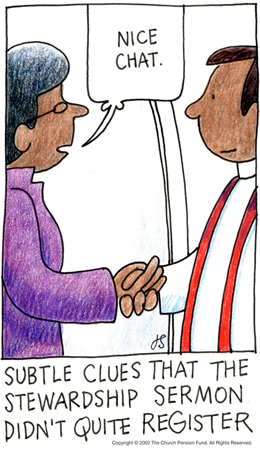 It’s about to come to an end, the annual appeal to church members everywhere to turn in a card saying how much they plan (hope, anticipate, expect, guess) to give in offerings in the coming year. Clergy everywhere are breathing both a sigh of relief that “stewardship season” is nearly done, while also wondering if there will be enough income to sustain the parish’s budget for another year. Congregational governing boards, treasurers, and budget committees are poring over the books and making plans – in some parishes they are adding new programs and new staff; in most, I suspect, they are trying to cut “fat” out of budgets already cut to the bone. I would guess there are more frowns than smiles being generated in the process of annual church budgeting.
 The shadows tonight will be full of dreams moving from house to house, door to door, seeking handouts of candy or toys or whatever with a cry of “Trick or Treat!” We hope the wind will stay away, at least until America’s children’s annual celebration of the ancient Celtic feast of Samhain is completed.
 I often wonder what (if any) thought went into the construction of various lectionaries, particularly the Daily Office lectionary of the Episcopal Church. Are the sometimes strange, sometimes enlightening, often puzzling juxtapositions of texts planned or simply fortuitous?
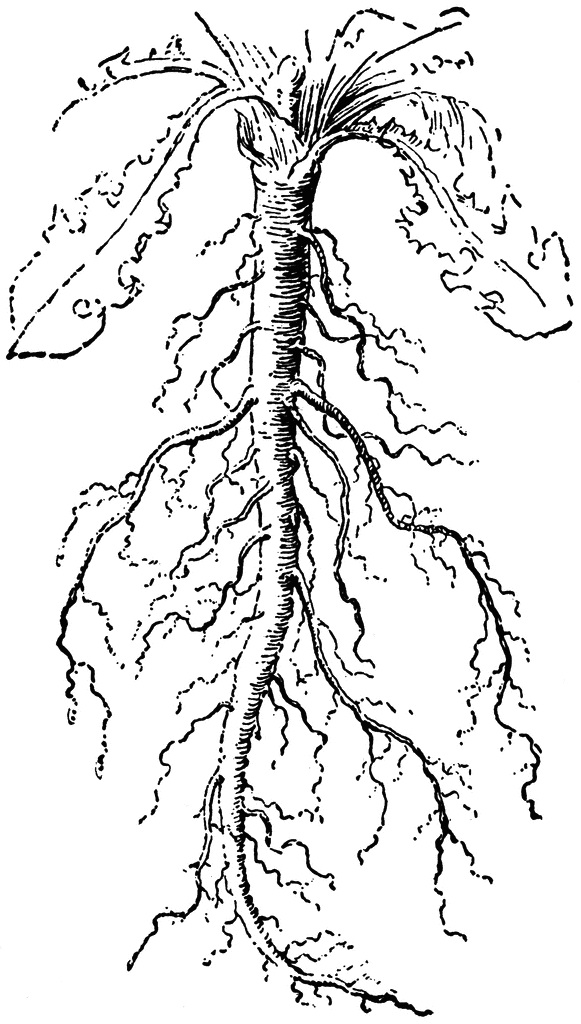 According to Ben Sira, personified Wisdom is rooted in Jerusalem; at the command of the Creator, she has take up residence in Zion among the Chosen People. These days I have a hard time seeing anything which can be counted as “wisdom” coming out of the modern government of that land, and I could write hundreds, even thousands, of words about what I believe to be the foolishness of the criminal injustice being perpetrated on the Palestinian people by that government. But I won’t. Not today. Today, my thoughts run to the question of rootedness, to the metaphor of sustenance drawn from a particular place, to the spatial and cultural peculiarity of wisdom, and to what happens when one leaves a particular place and takes up residence in another.

