From the Psalter:
I will ponder the glorious splendor of your majesty
and all your marvelous works.
(From the Daily Office Lectionary – Psalm 145:5 (BCP Version) – August 7, 2014)
 This morning, I woke up from a dream, grabbed the notepad on my nightstand, and scribbled some notes for a poem.
Then I poured a cup of coffee — thanking God for the wonder of automatic timer-controlled coffee makers — and opened my Book of Common Prayer to read the Daily Office.
Two psalms this morning. The first, Psalm 85:
They have said, “Come, let us wipe them out from among the nations;
let the name of Israel be remembered no more.”
* * *
Do to them as you did to Midian,
to Sisera, and to Jabin at the river of Kishon:
They were destroyed at Endor;
they became like dung upon the ground.
Too much this psalm reminds of Gaza and rockets and bombs and dead children, and I am not sure I want to continue the Office, but habit and discipline compel me to do so.
The second psalm . . . speaks to that strange dream and intermingles with my poem notes and I scribble some more and then hurry through the rest of the Office, unhappy when the reading from Judges presents Gideon as the hero who slew the Ishmaelites and, again, the dead of Gaza come to mind, but I rush through the prayers, hurriedly petitioning, “May they rest in peace and rise in glory,” and then return to my notes and finish the poem.
I’ll title it I Pondered the Works of God. Don’t ask me what it means. You decide.
I dreamed a dream of God
who was riding a motorcycle
a racing bike
and wearing a splendid
one-piece jumpsuit
of metallic silver fabric
and a helmet
and the visor on the helmet
obscured God’s face
when he turned
to look at me.God laid the bike down
on the track
in a cloud of tire smoke
like a burnt holocaust
of an ancient time
and God stood up
gloriously unharmed
and sprinted off the track
to open the trunk of his car
a 1957 Cadillac Coupe de Ville
and God began
to take off his helmet
and to climb
into the trunk
as he turned
to look at me.And I woke up
I awakened to a day
I knew would be filled
with decisions and doubts
with answers that would be
partial.And I pondered the works of God
how marvelously he piloted his cycle
how skillfully he laid it down
how carelessly he left it lay
how athletically he ran to his car
how absently he climbed into the trunk
how majestically he turned to look at me.And I knew
my partial answers
my doubtful decisions
would be
the solid foundation
of years to come
when God would turn
and look at me.
====================
A request to my readers: I’m trying to build the readership of this blog and I’d very much appreciate your help in doing so. If you find something here that is of value, please share it with others. If you are on Facebook, “like” the posts on your page so others can see them. If you are following me on Twitter, please “retweet” the notices of these meditations. If you have a blog of your own, please include mine in your links (a favor I will gladly reciprocate). Many thanks!
====================
Father Funston is the rector of St. Paul’s Episcopal Church, Medina, Ohio.
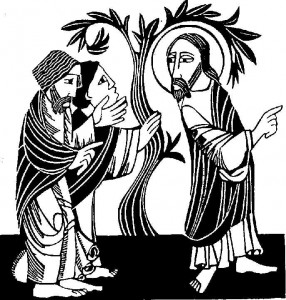 Every time I read this tale from John’s gospel, I am caught up short by this apparently pointless question. It seems such a non-sequitur, a request for irrelevant information. What could it have mattered where Jesus was staying? John doesn’t bother to give us an answer. We don’t know where this event took place. John never tells us a town and though the two disciples are permitted to come and see where Jesus was staying, the information is never given to the reader. A useless, irrelevant question made important in the dialog but never resolved for the audience — my college writing instructors would have torn this story apart.
 This is the text from which I took the title of this blog, That Which We Have Heard & Known. I did so because of my conviction that we have heard and known many things from Scripture, but we don’t know that we know them. We have heard them. If we are Episcopalians we have heard them many times over, but they never seem to be familiar.
  I am becoming quite fond of the New Revised Standard Version’s Psalter! It keeps hitting me with new ways, often disturbing ways of understanding the hymns of David, which I have habitually read from the Book of Common Prayer (1979) since being ordained. However, I’m finding new insights by using the NRSV and other translations instead of the Prayer Book.
 The 23rd Psalm is so popular, such a familiar and well-loved devotion for so many people, that one is loath to say anything about it. It was something my grandfather (staunch Methodist Sunday School teacher) insisted his grandchildren memorize and recite every night before bed, so I even have personal trepidation about messing with it. But mess with it I will.
 I don’t know what to do about Israel and Palestine. Apparently no one knows what to do about Israel and Palestine. There is so much bitterness and emotion on both sides and from all quarters that no one can even talk about Israel and Palestine.
 “Wait! I’ve never seen that verse.” I probably have, actually, but as with much of Scripture seeing it and paying attention to it are rather different things. In any event, that was my thought as I read the morning psalm today from the Bible instead of from the Book of Common Prayer.
  My usual Sunday afternoon occupation, after presiding and preaching at church and making any needed pastoral calls, is reading the online edition of the New York Times, which is what I did Sunday. Among the many items that got my attention was a very short report on some economic statistics, specifically on the fact that the net worth of the typical American family has decreased by more than a third over the last decade: “The inflation-adjusted net worth for the typical household was $87,992 in 2003. Ten years later, it was only $56,335, or a 36 percent decline, according to a study financed by the Russell Sage Foundation.” (
 Paul often ends his correspondence with these requests that the readers convey his personal greetings to specifically named people. I often find myself skimming those parts of the reading, just passing quickly over them. But, also, I often find myself pausing at these names, wondering about them. Who were they? What did they do in their daily lives? How is it that Paul was personally acquainted with them?

