Occasional thoughts of an Anglican Episcopal priest

Category: Daily Office (Page 37 of 70)

Mix Faith with Frustration – From the Daily Office – July 2, 2013

From the Gospel of Luke:

They said, “If you are the Messiah, tell us.” He replied, “If I tell you, you will not believe; and if I question you, you will not answer.”

(From the Daily Office Lectionary – Luke 22:67-68 (NRSV) – July 2, 2013.)

Frustration Relief KitIn the assembly of the elders of the people, the chief priests and the scribes, Jesus is asked, “Are you the Messiah?” and in response he gives vent to some very real human frustration.

I recently read an article about frustration as a plot element in writing fiction. The author suggested that frustration is, in fact, the most important emotion in fiction because nothing happens in a novel or short story unless the plans, wishes, or desires of the protagonist are frustrated. If Ahab had killed the white whale on his first attempt, Moby Dick would have been a very short tale, indeed. The author of the article pointed out, however, that frustration “is seldom a ‘pure’ emotion. It can come mixed with many others: anger (‘How dare they!’), hurt (‘Why won’t they help me?’), fear (‘I’ll never get what I want’), self-blame (‘I’m not good enough to succeed’), resignation (‘Can’t win ‘em all’), or bitterness (‘Life sucks’).”

One of my favorite episodes of The West Wing was about a submarine crisis off the coast of North Korea. The White House staff brought in an expert on submarine warfare to advise President Bartlett; Hal Holbrook played the character with droll dullness, droning on and on about difference experiences. In one scene, the expert and Leo McGarry were sitting on the sofas in the Oval Office talking; Leo was listening, the expert droning on. From off camera came the sound of a rhythmic thump – thump – thump. The camera pulled back to reveal the President banging his head on his desk . . . . I’m not sure what the President’s frustration might have been mixed with, but clearly that is not the best way to handle frustration!

With what, we might ask, is Jesus’ frustration mixed? I think the answer must be, “Faith.” Jesus is convinced that whatever happens, his God is with him. The night before this questioning, all the other emotions with which this frustration might have been mixed were sweated out in Garden of Gethsemane, leaving only faith: “Father, if you are willing, remove this cup from me; yet, not my will but yours be done.” (Luke 22:42) To be true to his mission (whatever we might now believe or understand it to be), to be true to his God, Jesus could not allow any other emotion to taint his frustration.

In any given situation, with what are our frustrations mixed? Too often they are like that article author described, mixed with emotions that result in negative or self-defeating outcomes. Our task is to spend some Gethsemane-time, sweating out those impurities, leaving only faith.

I think frustration mixed with faith might best be named “resolve,” which the dictionary defines as “firmness of purpose.” That certainly describes Jesus in the assembly of the elders (and throughout the Passion).

In an address at the University of Maine in October 1963, President John F. Kennedy exhorted his listeners: “Let us resolve to be masters, not the victims, of our history, controlling our own destiny without giving way to blind suspicions and emotions.” The example of Jesus suggests that, in some ways, we may still be “victims” no matter what we resolve and no matter how strong our faith may be. But our Lord’s example and the Christian faith also demonstrate that “victimization” to those who stand firm in their mission is a temporary state; on the other side one finds resurrection and redemption.

Frustration is a very real and very human situation. What we choose to mix with our frustrations is the determiner of outcome; followers of Jesus mix faith with frustration.

====================

A request to my readers: I’m trying to build the readership of this blog and I’d very much appreciate your help in doing so. If you find something here that is of value, please share it with others. If you are on Facebook, “like” the posts on your page so others can see them. If you are following me on Twitter, please “retweet” the notices of these meditations. If you have a blog of your own, please include mine in your links (a favor I will gladly reciprocate). Many thanks!

====================

Father Funston is the rector of St. Paul’s Episcopal Church, Medina, Ohio.

Leopards Changing Spots – From the Daily Office – July 1, 2013

From the Book of Acts:

They dragged [Stephen] out of the city and began to stone him; and the witnesses laid their coats at the feet of a young man named Saul.

(From the Daily Office Lectionary – Acts 7:58 (NRSV) – July 1, 2013.)

LeopardThis is the first appearance in the Christian story of the man who will become the early church’s greatest evangelist and the author of most of the New Testament. We are told that as he witnessed the martyrdom of the first deacon, “Saul approved of their killing him.” (Acts 8:1)

Saul would take the Gentile form of his name, Paul, when baptized and under that name would spread the Christian faith among non-Jews. One assumes that, from time to time, he might have told the story of witnessing Stephen being killed – it would make a powerful sermon illustration, don’t you think? He obviously told it to someone because eventually it got to Luke, who included it in his little history of the church.

This story of a public execution brought to mind a conversation I had with a parishioner just a few days ago. Texas recently executed its 500th death-penalty convict since resuming executions in 1980s; that news led us into a discussion of the death penalty. I am opposed to the death penalty on several grounds; my parishioner favors it. In the course of our conversation he put forth the argument that execution rids society of criminals who will kill again. He’s convinced that killers don’t change: “The leopard never changes his spots,” he said.

He certainly has the Bible (or at least the the Old Testament on his side. This old shibboleth comes from word of God spoken through the prophet Jeremiah! Lamenting the sinfulness of God’s People, the Lord asks: “Can Ethiopians change their skin or leopards their spots?”(Jer. 13:23, NRSV). Of course, the message of the prophet would suggest that the answer to that question is “Yes” else why call the people to repentance? And therein lies the theological and ethical issue I have with the death penalty. (I have legal, economic, and practical issues with it, as well.)

The death penalty denies the power of God in Christ to redeem, restore, and transform human existence. It precludes any possibility of repentance and amendment of life. When the capital punishment is imposed, the life of the convicted person is devalued and all possibility of change is ended. When the government undertakes capital punishment on behalf of the people (on my behalf), the people are implicated in that judgment and we are made to share in an ethic we may not accept (one which I do not accept). An ethic which says, as my congregant put it, that “leopards cannot change their spots.”

But that is not the Christian ethic (nor is it the ethic of the Old Testament in which that image is first spoken). The Christian ethic says that repentance is always possible. It is, in a very real sense, the whole message of Christ: “Repent, for the kingdom of heaven has come near.” (Matthew 3:2) The leopard can change its spots and the Christian hope is always that it will.

After all, Saul – who held the cloaks of the executioners and approved their killing of Stephen – changed his!

====================

A request to my readers: I’m trying to build the readership of this blog and I’d very much appreciate your help in doing so. If you find something here that is of value, please share it with others. If you are on Facebook, “like” the posts on your page so others can see them. If you are following me on Twitter, please “retweet” the notices of these meditations. If you have a blog of your own, please include mine in your links (a favor I will gladly reciprocate). Many thanks!

====================

Father Funston is the rector of St. Paul’s Episcopal Church, Medina, Ohio.

Give No Thought to Donkeys – From the Daily Office – June 29, 2013

From the First Book of Samuel:

As for your donkeys that were lost three days ago, give no further thought to them, for they have been found.

(From the Daily Office Lectionary – 1 Samuel 9:20 (NRSV) – June 29, 2013.)

Donkeys in the DesertThis advice not to worry about his donkeys is given by Samuel to Saul when Saul arrives at Ramah. It seems oddly out of place. Saul has been sent by God to Samuel, and God has informed Samuel that the man he will have sent to him is to be king over Israel. So Saul has had his cook set aside a special portion of meat and otherwise prepared to meet and anoint the man who would one day rule the country. Samuel comes to the town where he expects to find the man of God, and this statement is part of their first conversation:

Saul approached Samuel inside the gate, and said, “Tell me, please, where is the house of the seer?” Samuel answered Saul, “I am the seer; go up before me to the shrine, for today you shall eat with me, and in the morning I will let you go and will tell you all that is on your mind. As for your donkeys that were lost three days ago, give no further thought to them, for they have been found. And on whom is all Israel’s desire fixed, if not on you and on all your ancestral house?”

Again, the admonition about the donkeys seems oddly out of place. And, yet, I don’t think it is.

I think it’s Samuel’s way of telling Saul, “Don’t sweat the small stuff.” The lost donkeys are not important. They don’t matter right now; they have bigger, more important business to take care of. We all have bigger, more important business to take care of, yet we often get hung up worrying about missing donkeys. As Samuel has told Saul, someone else is seeing to them. Give them no further consideration; focus on what’s important!

So remember, give no further thought to your donkeys!

====================

A request to my readers: I’m trying to build the readership of this blog and I’d very much appreciate your help in doing so. If you find something here that is of value, please share it with others. If you are on Facebook, “like” the posts on your page so others can see them. If you are following me on Twitter, please “retweet” the notices of these meditations. If you have a blog of your own, please include mine in your links (a favor I will gladly reciprocate). Many thanks!

====================

Father Funston is the rector of St. Paul’s Episcopal Church, Medina, Ohio.

Change Is Life – From the Daily Office – June 25, 2013

From the Book of Acts:

“I tell you, keep away from these men and let them alone; because if this plan or this undertaking is of human origin, it will fail; but if it is of God, you will not be able to overthrow them — in that case you may even be found fighting against God!”

(From the Daily Office Lectionary – Acts 5:38-39 (NRSV) – June 25, 2013.)

Emerging Monarch ButterflyThe Pharisee Gamaliel gave sound advice to the Sanhedrin: “Leave them alone. If their movement is of God, you will not be able to stop it.” It’s advice the church, which benefited from it, has often failed to heed. We ought to follow it more often than we do . . . but there is that other rule the church more frequently follows: “Any change, at any time, for any reason, is to be deplored.” (Often attributed to an otherwise unidentified Victorian-era “Duke of Cambridge.”)

Episcopalians are said to be the poster children for this rule. The old joke asks, “How many Episcopalians does it take to change a light bulb?” . . . .

“Change! My grandmother gave that lightbulb!”

None of us are really comfortable with change. I suspect that most people, if they had their druthers, would just keep things mostly the same. For most of us the status quo is comfortable and staying the course gives us a sense of security. A read recently about a guy who bought a new radio, brought it home, placed it on the refrigerator, plugged it in, turned it to a station coming out of Nashville, home to the Grand Ole Opry, and then pulled all the knobs off. He had he wanted and had not intention to change.

But life without change isn’t life. It’s death. If there is one constant in this world it is that living things change; only lifeless things are static. And life, as Scripture tells us, is God’s will for God’s People. Isaiah prophesied, “No more shall there be in it an infant that lives but a few days, or an old person who does not live out a lifetime; for one who dies at a hundred years will be considered a youth, and one who falls short of a hundred will be considered accursed.” (Isa. 65:20)

Take heed of Gamaliel’s words to the Sanhedrin. Change is evidence of life, and life is the will of God, so change may be of God and, if so, you will be unable to overthrow it.

====================

A request to my readers: I’m trying to build the readership of this blog and I’d very much appreciate your help in doing so. If you find something here that is of value, please share it with others. If you are on Facebook, “like” the posts on your page so others can see them. If you are following me on Twitter, please “retweet” the notices of these meditations. If you have a blog of your own, please include mine in your links (a favor I will gladly reciprocate). Many thanks!

====================

Father Funston is the rector of St. Paul’s Episcopal Church, Medina, Ohio.

The Festal Shout – From the Daily Office – June 24, 2013

From the Psalter:

Happy are the people who know the festal shout!
they walk, O Lord, in the light of your presence.
They rejoice daily in your Name;
they are jubilant in your righteousness.

(From the Daily Office Lectionary – Psalm 89:15-16 (BCP Version) – June 24, 2013.)

Amen Corner“Festal shout” . . . the Hebrew is teruwah, a technical term for a liturgical response. (The root word is ruwa which is a verb meaning “to shout an alarm.”) It was probably something along the lines of “Hallelujah!” although it was probably not that particular Hebrew exclamation.
Episcopalians are well familiar with liturgical responses. We are almost programmed to make them. Say, “The Lord be with you,” to an Episcopalian, and it will prove very unlikely that he or she cannot help but say, “And also with you!” (Unless, of course, the person may be an old time traditional, in which case “And with thy spirit” will leap off the tongue.) However, familiar was we may be with liturgical responses, shouting them is something we simply don’t do, although in a crowded church we might be a little louder than usual.

And shouting out on our own in response to, say, a sermon? Out of the question!

Several years ago I had the privilege of preaching in a parish of the African Methodist Episcopal Church. I had gotten maybe two paragraphs into my prepared text when a member of the congregation called out, “Amen, preacher!” I must admit to being taken aback; I “stumbled” a bit, but got back on track pretty smoothly. Then it happened again! What had started as a typical Episcopal lecture-style homily turned into a dialog between the preacher and the congregation. We had fun together speaking the word of God to each other; there was joy and jubilation in that church It was great! I loved it! I’d never had a preaching experience like that before, and I’ve not had one since.

I don’t think we Episcopalians need to start shouting spontaneous responses to our sermons (although that might be fun), but I do think we need to cultivate that same sense of joy and jubilation, the vibrancy and liveliness that was evident in that AME congregation. We need to learn the “festal shout,” or at least find its spirit in our worship.

====================

A request to my readers: I’m trying to build the readership of this blog and I’d very much appreciate your help in doing so. If you find something here that is of value, please share it with others. If you are on Facebook, “like” the posts on your page so others can see them. If you are following me on Twitter, please “retweet” the notices of these meditations. If you have a blog of your own, please include mine in your links (a favor I will gladly reciprocate). Many thanks!

====================

Father Funston is the rector of St. Paul’s Episcopal Church, Medina, Ohio.

The Dark Lining of Joy – From the Daily Office – June 21, 2013

From the Psalter:

My friend and my neighbor you have put away from me,
and darkness is my only companion.

(From the Daily Office Lectionary – Psalm 88:19 (BCP Version) – June 21, 2013.)

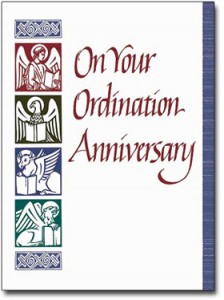
On Your Ordination Anniversary CardToday is the 22nd anniversary of my ordination as a priest in the Episcopal Church. It is also the 20th anniversary of the death of my older (and only) sibling, Rick.

Rick Funston died on Father’s Day 1993 of a cancer called Glioblastoma Multiforme Stage IV. Glioblastoma is an aggressive, extremely invasive, and invariably fatal form of primary site brain cancer; “primary site” means that it is not metastasized from some other location, as most brain cancers are (or so I’m told). Glioblastomas grew rapidly and are the sort of tumors that give cancer its name. Not many people know that cancer is called that because of invasive tumors’ resemblance to the many-legged crab. Cancer is the Latin word (derived from the Greek karkinos) for “crab.”

When Rick was diagnosed, I did some research and learned that the median survival time was about six months from date of diagnosis with nearly all patients passing away within two years. I just checked the current literature and see that the median has lengthened to 12 months and that 3-5% of patients survive as long as three years; they are called “long-term survivors.” Rick was not a long-term survivor.

His first symptoms appeared in October of 1992 and were initially misdiagnosed as a stroke. An accurate diagnosis was made in February of 1993; he died four months later.

Rick was nearly 10 years older than me. He went away to live with our grandparents and attend a private high school in my parents’ Kansas home town when I was 4 years old, so I really have almost no memory of him as a child. We next lived together, only very briefly, when he decided to leave the University of Texas in his sophomore year and attend UCLA; he moved into our parents’ and my home (our mother and stepfather; our father died when I was 5 years old) for a few months. We only really became close after I graduated from high school; he and his wife Janet and I toured Europe together the summer after my graduation.

I miss my brother a great deal. He had a wicked sense of humor. He was incredibly smart. His B.A. and M.A. were in American history; his Ph.D., in political science with a specialization in Constitutional law. He taught at San Diego State University and, at the time of his death, was the vice-president of the university. Somewhere along the line, he’d taken a few hours off from academe and gotten a J.D. as well. He spoke German, French, and Italian, and had more than a passing familiarity with Latin and Greek.

His cancer had attacked the part of the brain that controls speech. For pain relief and to extend his life as long as possible, surgery was done to remove as much of the tumor as could be gotten. This professor who spoke six languages, who lectured nearly every day, who had published several books and authored many articles lost his ability to form sentences and to converse easily. He couldn’t remember the names of colors; he couldn’t remember his children’s names. Sitting and talking with him you could see the frustration and anger, and the fear, in his eyes; he knew what he wanted to say, but he couldn’t get the words put together. It was maddening!

He set himself the goal of seeing his oldest child, my niece Saskia, graduate from college. He made that goal.

Every year on the anniversary of my ordination, I spend more time thinking about the brother I miss than about the ministry I have enjoyed. The last verse of the morning psalm, as a result, grabbed me by the throat! “My friend and my neighbor you have put away from me, and darkness is my only companion.”

Ordained ministry is lonely work. Clergy have very few friends or close companions, even among our colleagues in ministry. (A 1991 survey of clergy found that 70% of ordained ministers claimed to have no close friendships; a 2001 survey reported that 51% of clergy feel “lonely.”) During my first two and a half years of clergy life (one year as a deacon and eighteen months of priesthood before his diagnosis), my closest friend and adviser was my brother. He’d given some thought himself to becoming a pastor in the Lutheran tradition (something he was, and the entire Lutheran tradition should be, glad he didn’t pursue). I’ve not had a better, or even an equal, adviser since his death.

I won’t go so far as the psalmist and claim that “darkness is my only companion,” but there is a dark lining to the joy I feel remembering my ordination. I miss you, Rick, I really miss you!

====================

A request to my readers: I’m trying to build the readership of this blog and I’d very much appreciate your help in doing so. If you find something here that is of value, please share it with others. If you are on Facebook, “like” the posts on your page so others can see them. If you are following me on Twitter, please “retweet” the notices of these meditations. If you have a blog of your own, please include mine in your links (a favor I will gladly reciprocate). Many thanks!

====================

Father Funston is the rector of St. Paul’s Episcopal Church, Medina, Ohio.

Gandolfini, Hastings, and the Poor Widow: My Two Cents – From the Daily Office – June 20, 2013

From the Gospel according to Luke:

Jesus looked up and saw rich people putting their gifts into the treasury; he also saw a poor widow put in two small copper coins. He said, “Truly I tell you, this poor widow has put in more than all of them; for all of them have contributed out of their abundance, but she out of her poverty has put in all she had to live on.”

(From the Daily Office Lectionary – Luke 21:1-4 (NRSV) – June 20, 2013.)

Two CentsYesterday, the news services and Facebook were buzzing with the news of the death of James Gandolfini. Mr. Gandolfini, who was famous for playing the role of Tony Soprano in an HBO series The Sopranos, suffered a heart attack at the age of 51. The day before, there was a similar (though smaller) buzz about the death of investigative journalist Michael Hastings, aged 33, in an automobile accident.
Last week, a member of my congregation died at the age of 80 after years of crippling illness. Several weeks of acute respiratory distress came to an end when his family made the always difficult decision to withdraw life-sustaining medical treatment. Except for an obituary in the local papers and a notice on our parish’s Facebook page, his death received no press coverage and no social media mention.

It seems to me this morning that the contrast Jesus draws between the offering of the poor widow and the donations of the wealthy applies as well to the differences in how the world marks the passing of everyday folk compared to its notice of the deaths of celebrities. A man who has lived a life spent in productive work, making a small but steady contribution to the world, supporting his church, raising his children and grandchildren, quietly doing good works, has perhaps “put in more than all” of the famous actors or well-known reporters who get so much attention.

I suppose I may be biased. I knew my parishioner and I know his family. When I saw the news about Mr. Hastings, I had to do some research to find out if I know any of his work; it turns out I do – he is the journalist who broke the story about General Stanley McChrystal. When I saw the reports of Mr. Gandolfini’s death, I did not need to do so; I knew that he had played the Soprano part. But, truth be told, I’ve never seen an episode of The Sopranos and I have no idea what other roles the actor may have played. In either event, I can safely say that neither man has had as great an impact on my life and the lives of the people and community I know than my parishioner had.

I don’t mean to belittle their deaths nor the pain their passing may have caused those who love them, but I think perhaps we pay too much attention to those who claim (or are given) the name “celebrity” and not enough to the grandfathers and the poor widows around us, even in death. We should do as Jesus did in the Temple; we should take notice.

And that’s my two cents.

====================

A request to my readers: I’m trying to build the readership of this blog and I’d very much appreciate your help in doing so. If you find something here that is of value, please share it with others. If you are on Facebook, “like” the posts on your page so others can see them. If you are following me on Twitter, please “retweet” the notices of these meditations. If you have a blog of your own, please include mine in your links (a favor I will gladly reciprocate). Many thanks!

====================

Father Funston is the rector of St. Paul’s Episcopal Church, Medina, Ohio.

The Duties of the Priests – From the Daily Office – June 19, 2013

From the First Book of Samuel:

Now the sons of Eli were scoundrels; they had no regard for the Lord or for the duties of the priests to the people.

(From the Daily Office Lectionary – 1 Samuel 2:12-13a (NRSV) – June 19, 2013.)

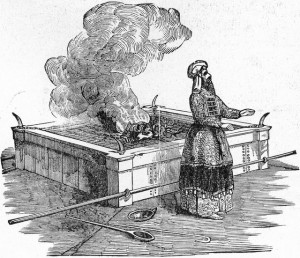
High Priest Offering Sacrifice of a Goat“. . . the duties of the priests to the people . . . ”

Canon 9 of Title III of the Constitution and Canons of the Episcopal Church is entitled “Of the Life and Work of Priests.” It is ten and a half pages long; several of its paragraphs begin with the words, “It shall be the duty . . . .”

The Catechism in The Book of Common Prayer teaches:

The ministry of a priest is to represent Christ and his Church, particularly as pastor to the people; to share with the bishop in the overseeing of the Church; to proclaim the Gospel; to administer the sacraments; and to bless and declare pardon in the name of God.

In the service of ordination of a priest, the candidate for ordination is asked early in the liturgy:

Will you be loyal to the doctrine, discipline, and worship of Christ as this Church has received them? And will you, in accordance with the canons of this Church, obey your bishop and other ministers who may have authority over you and your work?

Later in the service, the bishop addresses the ordinand with these words:

As a priest, it will be your task to proclaim by word and deed the Gospel of Jesus Christ, and to fashion your life in accordance with its precepts. You are to love and serve the people among whom you work, caring alike for young and old, strong and weak, rich and poor. You are to preach, to declare God’s forgiveness to penitent sinners, to pronounce God’s blessing, to share in the administration of Holy Baptism and in the celebration of the mysteries of Christ’s Body and Blood, and to perform the other ministrations entrusted to you.

In all that you do, you are to nourish Christ’s people from the riches of his grace, and strengthen them to glorify God in this life and in the life to come.

The ordinand is then asked eight more questions requiring him or her to promise to faithfully carry out specific ministries or to order his or her life in a particular way.

When the bishop and other presbyters lay hands upon the ordinand, the bishop prays:

Father, through Jesus Christ your Son, give your Holy Spirit to N.; fill him with grace and power, and make him a priest in your Church. May he exalt you, O Lord, in the midst of your people; offer spiritual sacrifices acceptable to you; boldly proclaim the gospel of salvation; and rightly administer the sacraments of the New Covenant. Make him a faithful pastor, a patient teacher, and a wise councilor. Grant that in all things he may serve without reproach, so that your people may be strengthened and your Name glorified in all the world. All this we ask through Jesus Christ our Lord, who with you and the Holy Spirit lives and reigns, one God, for ever and ever. [The pronouns are changed when the ordinand is a woman.]

When a priest accepts the call to be rector of a parish, he or she kneels in the center of the church’s worship space in the midst of the people and prays:

O Lord my God, I am not worthy to have you come under my roof; yet you have called your servant to stand in your house, and to serve at your altar. To you and to your service I devote myself, body, soul, and spirit. Fill my memory with the record of your mighty works; enlighten my understanding with the light of your Holy Spirit; and may all the desires of my heart and will center in what you would have me do. Make me an instrument of your salvation for the people entrusted to my care, and grant that I may faithfully administer your holy Sacraments, and by my life and teaching set forth your true and living Word. Be always with me in carrying out the duties of my ministry. In prayer, quicken my devotion; in praises, heighten my love and gratitude; in preaching, give me readiness of thought and expression; and grant that, by the clearness and brightness of your holy Word, all the world may be drawn into your blessed kingdom. All this I ask for the sake of your Son our Savior Jesus Christ. Amen.

“. . . the duties of the priests to the people . . . ”

I was a law office administrator and later a lawyer. I was an active member of the church. I served on the diocesan council, the commission on ministry, the camp and conference center board, and several other committees, commissions, and task forces. I even became the diocesan chancellor (the chief legal office of a diocese). From time to time my bishop (first Wes Frensdorff and then Stewart Zabriskie, both now departed) would say something like, “Why don’t we get you ordained?” or “When are you going to go to seminary?” or some other encouragement to take on the life and work of a priest, to bear the burden of “the duties of the priests to the people.” I would answer in protest, “I’m happy being a layman.”

Until one day, I couldn’t protest any longer. A friend who wanted to be a priest (he was a gas company engineer) but couldn’t afford the cost of changing careers died. He was only 45. At his funeral, I said to my wife, “I can’t do this anymore.” I started into the ordination process.

“. . . the duties of the priests to the people . . . ”

I didn’t want them. They can be onerous and burdensome. I don’t know how many of the duties of an Episcopal priest were also the duties of the priests of God at Shiloh. I know they had some duties that I’m very thankful we don’t have, like sacrificing animals. But I’ll bet the sons of Eli didn’t want them. The Law and the traditional inheritance of their tribe required that they do them, but I’ll bet they really didn’t want to, and that’s why they became “scoundrels.”

No one who does not feel that he or she cannot do anything else should take on “the duties of the priests to the people.” Maybe we ask the wrong questions at ordination. The really important question is “Can you do anything else?” because if you can, we shouldn’t be ordaining you. Our ordination screening process, the “discernment process” is (I guess) supposed to answer that question, although I’m not sure it does. But that is the most important question. Unless you simply cannot not be a priest, don’t be one.

“. . . the duties of the priests to the people . . . ”

They are often onerous and burdensome. I didn’t want them. In many ways, I still don’t want them. But I cannot not be a priest.

====================

A request to my readers: I’m trying to build the readership of this blog and I’d very much appreciate your help in doing so. If you find something here that is of value, please share it with others. If you are on Facebook, “like” the posts on your page so others can see them. If you are following me on Twitter, please “retweet” the notices of these meditations. If you have a blog of your own, please include mine in your links (a favor I will gladly reciprocate). Many thanks!

====================

Father Funston is the rector of St. Paul’s Episcopal Church, Medina, Ohio.

Nominate, Pray, Take Your Chances – From the Daily Office – June 18, 2013

From the Book of Acts:

So they proposed two, Joseph called Barsabbas, who was also known as Justus, and Matthias. Then they prayed and said, “Lord, you know everyone’s heart. Show us which one of these two you have chosen to take the place in this ministry and apostleship from which Judas turned aside to go to his own place.” And they cast lots for them, and the lot fell on Matthias; and he was added to the eleven apostles.

(From the Daily Office Lectionary – Acts 1:23-26 (NRSV) – June 18, 2013.)

Note: This blog has been “silent” the past few days for a variety of reasons. It was John Lennon, I believe, who observed that “life is what happens to you while you’re busy making other plans.” The past half-week or so has certainly been an example of that!

Drawing StrawsToday’s reading from Luke’s history of the early church details the method by which the eleven remaining apostles chose someone to replace Judas. It was a simple method: (a) identify the candidates; (b) pray; (c) take your chances. They drew lots, but they might have thrown dice, cut a deck of cards, flipped a coin, or done any number of other things that would have randomized the outcome.
There is something instructive in this lesson for Episcopalians who are now preparing for the 2015 meeting of the General Convention of the Episcopal Church at which a new Presiding Bishop will be chosen.

The Presiding Bishop is the Episcopal Church’s chief pastor (“head cook and bottle-washer” my late stepfather would have said). He or she (our current PB is a woman) is the Primate and Metropolitan of the church, equal in rank to the Archbishop of Canterbury and the other head pastors of the several autocephalic (independent and self-governing, though related and interdependent) provinces of the Anglican Communion.

How the Presiding Bishop is selected has changed three times in the 200-plus years of the American church’s existence. Under the original 1789 constitution of the church, the Presiding Bishop was simply the senior bishop in order of consecration. He (back then it was always “he”) served until death or retirement, when the next senior bishop took over; the Presiding Bishop retained his diocesan position (and in those days a bishop was also a parish rector). His only real duties were to be chief consecrator of new bishops and to preside at meetings of the House of Bishops; there was no national church administration and, to be honest, no Anglican Communion with which to interact. Eventually, the office was made elective in 1919. The archives of the Episcopal Church tell us:

The first election of a Presiding Bishop by General Convention took place in 1925. Since 1943 the Presiding Bishop has been required to resign diocesan jurisdiction upon election. In 1967 the duties of the office were significantly enhanced. As “Chief Pastor,” the Presiding Bishop is charged with initiating and developing church policy and strategy, speaking God’s Word to the church and the world, and visiting every diocese of the church. The title “Primate” was added in 1982. The Cathedral of Saint Peter and Saint Paul in Washington, D.C., is the official seat of the Presiding Bishop. The office of the Presiding Bishop is located at the Episcopal Church Center in New York City. The present term of office for the Presiding Bishop is nine years.

A term limitation was first imposed in 1976 when the canons were amended to provide for a twelve-year term (four triennia); this was amended in 1994 when the term was shortened to nine years. Our current Presiding Bishop was elected in 2006 and her term will end at the General Convention of 2015 when her successor will be elected.

In the past, the election has been by the House of Bishops with the House of Deputies concurring. Nominees were selected by the Bishops and the method of nomination and the balloting kept secret. At the last General Convention, it was decided that the whole church should be involved in the nomination process and a “joint commission” was created to select nominees consisting laity, clergy, and bishops. In the current budget of the church the princely sum of $226,000 is set aside for the expenses of this nominating committee. At the 2015 convention, because there has been no change in the Constitution or canons governing the process, the House of Bishops will elect and the election will be reported to the House of Deputies for its concurrence. Laity and clergy will not actually vote for the Presiding Bishop; they will “rubber stamp” the House of Bishops choice — the House of Deputies has never failed to concur in a Presiding Bishop election.

There are calls now to democratize the process further by amending the canons to provide that the PB be elected by both Houses of the General Convention, the House of Deputies voting “by orders” (which means the lay deputies and clergy deputies vote separately); to be selected, a nominee would need a majority of the votes of the bishops, a majority of clergy votes, and a majority of lay votes. (A “vote by orders” in the House of Deputies is a complicated and structurally conservative process actually requiring more than a simple majority, but that’s too much to think about this morning.)

I read about the drawing of lots by the Apostles in the first chapter of Acts and I begin to question the complication and expense of the processes we have devised . . . . Do they really work any better?

Praying and “taking your chances” has worked for the People of God throughout history, and random chance has been used to discern the divine will in many religions. For example, the I Ching (The Book of Changes) of China seeks guidance using the random tossing of yarrow stocks or the flipping of three coins to produce “hexagrams,” the meanings of which are recorded in the book. In the ancient Jewish religion, the High Priest carried two stones (or possible wooden or bone plates) in his breastplate, the Urim and Thummim, which were used to divine God’s Will; exactly what they were and how they were used is lost to history, but one speculation is that they were a sort of “holy dice” which would be cast and a message or meaning derived therefrom.

I have been told that in the tradition of some Eastern or Oriental Orthodox churches (particularly the Ethiopian church) bishops are selected by chance: the names of the eligible candidates are written on slips of paper which are put into a chalice and then one is randomly pulled out by a child. I’ve also been told that a similar method is (or was) used by the Moravians to select bishops with the interesting addition of a blank paper which, if drawn, would indicate that God was not satisfied with any of the named candidates and that the church should consider additional nominees.

It seems to me that these methods are equally as “democratic” as the expensive and complicated processes now underway in (or proposed for the future of) the Episcopal Church. We all share in such a random chance process!

Why not simply put the names of all eligible diocesan bishops (every bishop who has been in office at least five years and who will not reach mandatory retirement age before the end of the nine-year term) into a large chalice, pray, and let the youngest deputy present draw out a name? Presiding Bishop selected, complicated process and exorbitant expense avoided, and (by the way) the example of Scripture honored and followed.

Nominate, pray, take your chances! It worked for the Apostles. Surely it could work for us.

====================

A request to my readers: I’m trying to build the readership of this blog and I’d very much appreciate your help in doing so. If you find something here that is of value, please share it with others. If you are on Facebook, “like” the posts on your page so others can see them. If you are following me on Twitter, please “retweet” the notices of these meditations. If you have a blog of your own, please include mine in your links (a favor I will gladly reciprocate). Many thanks!

====================

Father Funston is the rector of St. Paul’s Episcopal Church, Medina, Ohio.

Removing the Distraction of Personality – From the Daily Office – June 14, 2013

From the Book of Jesus Ben Sirach:

He exalted Aaron, a holy man like Moses
who was his brother, of the tribe of Levi.
He made an everlasting covenant with him,
and gave him the priesthood of the people.
He blessed him with stateliness,
and put a glorious robe on him.
He clothed him in perfect splendour,
and strengthened him with the symbols of authority,
the linen undergarments, the long robe, and the ephod.
And he encircled him with pomegranates,
with many golden bells all round,
to send forth a sound as he walked,
to make their ringing heard in the temple
as a reminder to his people;
with the sacred vestment, of gold and violet
and purple, the work of an embroiderer;
with the oracle of judgement, Urim and Thummim;
with twisted crimson, the work of an artisan;
with precious stones engraved like seals,
in a setting of gold, the work of a jeweller,
to commemorate in engraved letters
each of the tribes of Israel;
with a gold crown upon his turban,
inscribed like a seal with ‘Holiness’,
a distinction to be prized, the work of an expert,
a delight to the eyes, richly adorned.
Before him such beautiful things did not exist.
No outsider ever put them on,
but only his sons
and his descendants in perpetuity.

(From the Daily Office Lectionary – Ecclesiasticus 45:6-13 (NRSV) – June 14, 2013.)

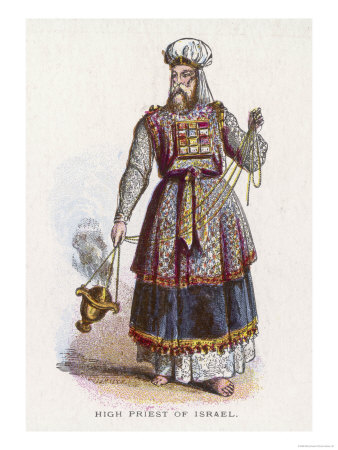
Jewish High Priest in His Ceremonial VestmentsWow!

And some people think an alb, stole, and chasuble are “fancy!”

There are a lot of essays out there on the history, origin, function, and purposes of vestments. Every writer has a slightly different take on the matter.

Here’s what I think: vestments obscure the minister. In a sense, vestments “democratize” the priesthood. Vestments symbolize the office of the priest, minister, or elder. No matter what the denominational tradition – whether they are the richly decorated, colorful vestments of the Orthodox or Catholic traditions, or the simple black Geneva gown of the Reformed tradition – the ceremonial garb obscures the personality of the individual wearing them. Personal differences among and between clergy can be a distraction, and there should be no distractions in worship. The focus should be God, not the presider.

Suppose we didn’t wear vestments (and there are traditions in which the preachers and worship leaders do not). And suppose one worship leader is dressed in a very stylish, well-tailored, custom-made, $3,000 Brooks Brothers suit. Suppose another is dressed in a $150 off-the-rack, polyester suit. Another, in t-shirt and jeans. Each participant in worship will react differently to these three clergy, based solely on their appearance. This difference in reaction may rational or non-rational; it may be volitional or non-volitional. But it will be there.

Now, suppose we have these same three leaders. But over their street clothes all are wearing an alb, a stole, and a chasuble. One cannot see any difference in their attire. That distinction between the clergy is erased.

Whatever the other reasons may be that we wear vestments, I think this obscuring of differences amongst the clergy is the most important. Vestments, fancy or plain, remove the distraction of personality.

====================

A request to my readers: I’m trying to build the readership of this blog and I’d very much appreciate your help in doing so. If you find something here that is of value, please share it with others. If you are on Facebook, “like” the posts on your page so others can see them. If you are following me on Twitter, please “retweet” the notices of these meditations. If you have a blog of your own, please include mine in your links (a favor I will gladly reciprocate). Many thanks!

====================

Father Funston is the rector of St. Paul’s Episcopal Church, Medina, Ohio.

« Older posts Newer posts »