From the Second Letter of John:
Everyone who does not abide in the teaching of Christ, but goes beyond it, does not have God; whoever abides in the teaching has both the Father and the Son. Do not receive into the house or welcome anyone who comes to you and does not bring this teaching; for to welcome is to participate in the evil deeds of such a person.
(From the Daily Office Lectionary – 2 John 9-11 (NRSV) – April 19, 2013.)
 Reading this on a morning when parts of Watertown and Cambridge, Massachusetts, are “locked down,” when the entire city of Boston and its environs are under a “shelter in place” order as police engage in a massive manhunt for one of the two suspected perpetrators of the Boston Marathon bombing (the other having been killed already) is a bit strange.
“Do not receive into the house or welcome anyone who comes to you” is exactly what the authorities are telling people. Of course, they are doing so for safety’s sake not because of some religious or philosophical concern for approving or participating in evil.
Nonetheless, this is precisely the problem that the incidents of this week present to each of us. How do we, by our “welcome” or by our silence, participate in the evil deeds that pollute our world? John Stuart Mill in the late 1880s said, “Bad men need nothing more to compass their ends, than that good men should look on and do nothing.” Similarly, “All that is necessary for the triumph of evil is that good men do nothing,” runs a saying often attributed to Edmund Burke. Although it’s unlikely Burke ever said that, it is true.
Mosaic law, to which the elder may be referring in this letter, provides, “When any of you sin in that you have heard a public adjuration to testify and — though able to testify as one who has seen or learned of the matter — do not speak up, you are subject to punishment.” (Lev. 5:1) By one’s silence, one participates in the sin and is subject to the law.
Are there any who might have prevented the Boston bombings simply by speaking up? If so, how many? We may never know. What we do know is that each of us has an obligation to do what we can to improve the world, to do something when confronted with evil. A verse in the Mishnah reads:
Humans were created singly, to teach you that whoever destroys a single soul [of Israel], Scripture accounts it as if he had destroyed a full world; and whoever saves one soul of Israel, Scripture accounts it as if she had saved a full world. (Sanhedrin 4:5)
The Unitarian clergyman Edward Everett Hale, in the same spirit, is often quoted as saying, “I am only one; but still I am one. I cannot do everything; but still I can do something; and because I cannot do everything, I will not refuse to do the something that I can do.” (This is often misattributed to Helen Keller.)
Most artistically, perhaps, is the expression of this sentiment of connection in the famous poem by Anglican priest John Donne:
No man is an island,
Entire of itself.
Each is a piece of the continent,
A part of the main.
If a clod be washed away by the sea,
Europe is the less.
As well as if a promontory were.
As well as if a manor of thine own
Or of thine friend’s were.
Each man’s death diminishes me,
For I am involved in mankind.
Therefore, send not to know
For whom the bell tolls,
It tolls for thee.
There are many big lessons to be learned from the events of this week, but this lesson of individual responsibility may be the most important: we are not alone, we are not disconnected, we not without responsibility — to welcome the perpetrator of evil, even to remain silent in the face of evil, is to participate in it.
====================
A request to my readers: I’m trying to build the readership of this blog and I’d very much appreciate your help in doing so. If you find something here that is of value, please share it with others. If you are on Facebook, “like” the posts on your page so others can see them. If you are following me on Twitter, please “retweet” the notices of these meditations. If you have a blog of your own, please include mine in your links (a favor I will gladly reciprocate). Many thanks!
====================
Father Funston is the rector of St. Paul’s Episcopal Church, Medina, Ohio.
 Mene, mene, tekel, upharsin. (KJV)
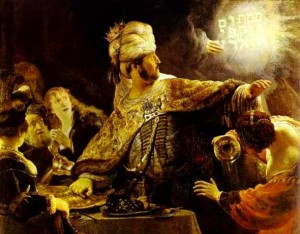 Many are familiar with the phrase “the writing on the wall,” but few know that it has a biblical origin. Here, today, is the beginning of the story from which it comes. Belshazaar, son of Nebuchadnezzar, has thrown a party. He orders booty from the Jerusalem Temple, sacred vessels of silver and gold, used as drinking vessels. While he and his friends are partying, the hand appears as related above and writes on the wall.
 In the 1989 movie Romero starring Raul Julia as the martyred Archbishop of El Salvador, there is a scene in which Father Manuel Morantes (played by actor Tony Plana) paraphrases these words of the elder John: “How can we love God, whom we have not seen, if we do not love our brothers and sisters whom we do see?” It is clear from the setting that what Father Morantes means by “love” is not merely romantic emotion; it is not starry-eyed sentimentalism; it is not impractical idealism. What Father Morantes means, and what I believe the elder means in this letter, is hard and gritty, down-to-earth, hands-on, practical caring about and caring for others.
 This renaming of Daniel by King Nebuchadnezzar intrigues me. Earlier in chapter 4, Nebuchadnezzar explains that Daniel “was named Belteshazzar after the name of my god” apparently because the king believed Daniel to be “endowed with a spirit of the holy gods.” (v. 8)
 It seems odd of the Lectionary to put us back to the beginning of Lent when we are not quite halfway through the season of Easter, but here we are, reading once again about Jesus’ temptations in the desert following his baptism.
 It’s been several days since I last offered one of these meditations. I took time off to deal with a family medical issue and then there was Holy Week and then there was Easter and then there was something else and then . . . . Life can become a series of excuses for not getting things done. John, in this first catholic epistle, will brook no excuses, no procrastination. Get it done! Do what is right, for that is righteousness; “all who do not do what is right are not from God.”
  What does it mean to believe? That is really the crux of the matter and the stumbling block for 21st Century folks. In modern American English, the dictionary tells us, the the verb to believe means, “to accept a statement, supposition, or opinion as true.” Is this what Jesus is saying to the Jewish authorities in the Jerusalem Temple? “I have told you and you do not accept my statements, suppositions, and opinions as true.” Somehow, I don’t think so.
 “The thief comes only to steal and kill and destroy.” This sentence really hit me today for a lot of very personal reasons I won’t get into. As I was doing my morning ablutions, I thought of the thieves who have stolen in and taken away loved ones, family members, and friends. I thought of how obvious those thieves were about it, and yet we passed those thieves off as simple eccentricities and odd behaviors.
 In my opinion there is probably no more misused piece of writing in all of Holy Scripture, unless perhaps it is Paul’s other toss-off line (in this same epistle): “For we hold that a person is justified by faith apart from works prescribed by the law.” (Rom. 3:28 NRSV) Both of them have led people to a religion that is all talk and no walk, which I am quite sure was not Paul’s intention at all!

