Occasional thoughts of an Anglican Episcopal priest

Category: Daily Office (Page 47 of 70)

The Right Hand of the Throne of God – From the Daily Office – January 5, 2013

From the Letter to the Hebrews:

Since we are surrounded by so great a cloud of witnesses, let us also lay aside every weight and the sin that clings so closely, and let us run with perseverance the race that is set before us, looking to Jesus the pioneer and perfecter of our faith, who for the sake of the joy that was set before him endured the cross, disregarding its shame, and has taken his seat at the right hand of the throne of God.

(From the Daily Office Lectionary – Hebrews 12:1-2 (NRSV) – January 5, 2013.)
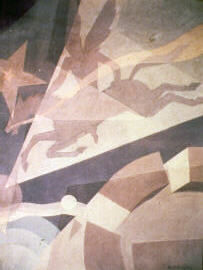
 
Original Illustration for God's TrombonesToday in my parish church we will be celebrating a Requiem Mass for a life-long member of the congregation, a spinster lady named Nancy who died a few weeks ago at the age of 81. She had never married, but she had a large family made up of those who had grown up in our town and county during the 1950s and 1960s for she had been the community’s “bookmobile lady.” There are many here who remember her in that way. The author of the Letter to the Hebrews, recalling perhaps the admonition in Ben Sira to remember those of whom “there is no memory . . . [who] have perished as though they had never existed . . . [but] whose righteous deeds have not been forgotten” (Sirach 44:9-10), reminds us of all those who relied on the promise of God and were commended for their faith. Nancy, whose life we celebrate today, was surely one of those.

At her requiem, I will read this wonderful poem by James Weldon Johnson entitled Go Down, Death — A Funeral Sermon. It is a poem I often read at the funerals of those who have passed away after a long life of service to family and community. As you read it here, where the poet names Sister Caroline, think of our sister Nancy:

Weep not, weep not,
She is not dead;
She’s resting in the bosom of Jesus.
Heart-broken husband — weep no more;
Grief-stricken son — weep no more;
Left-lonesome daughter — weep no more;
She only just gone home.

Day before yesterday morning,
God was looking down from his great, high heaven,
Looking down on all his children,
And his eye fell on Sister Caroline,
Tossing on her bed of pain.
And God’s big heart was touched with pity,
With the everlasting pity.

And God sat back on his throne,
And he commanded that tall, bright angel standing at his right hand:
Call me Death!
And that tall, bright angel cried in a voice
That broke like a clap of thunder:
Call Death! — Call Death!
And the echo sounded down the streets of heaven
Till it reached away back to that shadowy place,
Where Death waits with his pale, white horses.

And Death heard the summons,
And he leaped on his fastest horse,
Pale as a sheet in the moonlight.
Up the golden street Death galloped,
And the hooves of his horses struck fire from the gold,
But they didn’t make no sound.
Up Death rode to the Great White Throne,
And waited for God’s command.

And God said: Go down, Death, go down,
Go down to Savannah, Georgia,
Down in Yamacraw,
And find Sister Caroline.
She’s borne the burden and heat of the day,
She’s labored long in my vineyard,
And she’s tired —
She’s weary —
Go down, Death, and bring her to me.

And Death didn’t say a word,
But he loosed the reins on his pale, white horse,
And he clamped the spurs to his bloodless sides,
And out and down he rode,
Through heaven’s pearly gates,
Past suns and moons and stars;
on Death rode,
Leaving the lightning’s flash behind;
Straight down he came.

While we were watching round her bed,
She turned her eyes and looked away,
She saw what we couldn’t see;
She saw Old Death. She saw Old Death
Coming like a falling star.
But Death didn’t frighten Sister Caroline;
He looked to her like a welcome friend.
And she whispered to us: I’m going home,
And she smiled and closed her eyes.

And Death took her up like a baby,
And she lay in his icy arms,
But she didn’t feel no chill.
And death began to ride again —
Up beyond the evening star,
Into the glittering light of glory,
On to the Great White Throne.
And there he laid Sister Caroline
On the loving breast of Jesus.

And Jesus took his own hand and wiped away her tears,
And he smoothed the furrows from her face,
And the angels sang a little song,
And Jesus rocked her in his arms,
And kept a-saying: Take your rest,
Take your rest.

Weep not — weep not,
She is not dead;
She’s resting in the bosom of Jesus.

Nancy, and all that great cloud of witnesses, have gone to take their place with Jesus at the right hand of the throne of God.

====================

A request to my readers: I’m trying to build the readership of this blog and I’d very much appreciate your help in doing so. If you find something here that is of value, please share it with others. If you are on Facebook, “like” the posts on your page so others can see them. If you are following me on Twitter, please “retweet” the notices of these meditations. If you have a blog of your own, please include mine in your links (a favor I will gladly reciprocate). Many thanks!

====================

Father Funston is the rector of St. Paul’s Episcopal Church, Medina, Ohio.

Talking Trees – From the Daily Office – January 4, 2013

From the Book of Exodus:

Moses was keeping the flock of his father-in-law Jethro, the priest of Midian; he led his flock beyond the wilderness, and came to Horeb, the mountain of God. There the angel of the Lord appeared to him in a flame of fire out of a bush; he looked, and the bush was blazing, yet it was not consumed. Then Moses said, “I must turn aside and look at this great sight, and see why the bush is not burned up.” When the Lord saw that he had turned aside to see, God called to him out of the bush, “Moses, Moses!” And he said, “Here I am.” Then he said, “Come no closer! Remove the sandals from your feet, for the place on which you are standing is holy ground.” He said further, “I am the God of your father, the God of Abraham, the God of Isaac, and the God of Jacob.” And Moses hid his face, for he was afraid to look at God.

(From the Daily Office Lectionary – Exodus 3:1-6 (NRSV) – January 4, 2013.)
 
Decorated Christmas TreeAs I read the lesson from Exodus today, there is a bush in my dining room. It’s a four-foot tall evergreen and it’s sort of burning. There are little electrical lights all ablaze all over it. It’s our Christmas tree. (We have a short Christmas tree set on a table because we have three cats. We tried for a couple of years to have a normal size seven-foot tree with these guys, but it was impossible. So, small tree on table.)

If my Christmas tree suddenly started talking, what would it say? (I know the burning bush didn’t talk! It was God speaking “out of the bush.” OK.) Would it call me to a great ministry of leadership? Would it give me an historic prophetic ministry to accomplish? Probably not, I’m not really qualified.

But then, neither was Moses. Consider who he was. He was the child of slaves who was not even supposed to live. Floated down the river in a basket by his slave mother, he’d been found and adopted by Pharaoh’s daughter and reared as a prince. But then he’d blown it by raising his arm in anger and killing a guard. Rather than stick around and defend his action, he’d hidden the dead man’s body and run away. He was a fugitive from the law. He wasn’t particularly well spoken; in a few verses, he will try to decline God’s commission saying, “I am slow of speech and slow of tongue.” (4:10) He really didn’t want to do what God was telling him to do. “O my Lord, please send someone else,” he pleaded. (4:13) The God who spoke from out of the burning bush would not take “No” for an answer.

I think, perhaps, our Christmas trees do speak to us. Like God speaking to Moses from the burning bush, they call us to important ministries. They call us to ministries of life and love, of family and friends, of generosity and gratitude. They call us to spend time with those who are important to us and with those whom we do not yet know; they call us to give of ourselves and to accept from others the gifts of their being. And like God commissioning Moses, they won’t take “No” for an answer.

(Note to self: Consider writing a Christmas play in which the principal characters are two Christmas trees – Bruce the Spruce and Douglas the Fir . . . . )

====================

A request to my readers: I’m trying to build the readership of this blog and I’d very much appreciate your help in doing so. If you find something here that is of value, please share it with others. If you are on Facebook, “like” the posts on your page so others can see them. If you are following me on Twitter, please “retweet” the notices of these meditations. If you have a blog of your own, please include mine in your links (a favor I will gladly reciprocate). Many thanks!

====================

Father Funston is the rector of St. Paul’s Episcopal Church, Medina, Ohio.

The Presence of the Lord – From the Daily Office – January 3, 2013

From the Book of Genesis:

Jacob left Beer-sheba and went toward Haran. He came to a certain place and stayed there for the night, because the sun had set. Taking one of the stones of the place, he put it under his head and lay down in that place. And he dreamed that there was a ladder set up on the earth, the top of it reaching to heaven; and the angels of God were ascending and descending on it. And the Lord stood beside him and said, “I am the Lord, the God of Abraham your father and the God of Isaac; the land on which you lie I will give to you and to your offspring; and your offspring shall be like the dust of the earth, and you shall spread abroad to the west and to the east and to the north and to the south; and all the families of the earth shall be blessed in you and in your offspring. Know that I am with you and will keep you wherever you go, and will bring you back to this land; for I will not leave you until I have done what I have promised you.” Then Jacob woke from his sleep and said, “Surely the Lord is in this place – and I did not know it!”

(From the Daily Office Lectionary – Gen. 28:10-16 (NRSV) – January 2, 2013.)
 
Sunlight figure on wind-swept hilltopHow many places do we go where the Lord is and we do not know it? This story of Jacob reminds me of a song we sang in the Cursillo community where I meant my wife. It’s very pretty, very contemplative, and usually sung as an accompaniment to Holy Communion:
Surely the presence of the Lord is in this place.
I can feel His mighty power and His grace.
I can hear the brush of angels wings.
I see glory on each face.
Surely the presence of the Lord is in this place.

I like the song; I have good memories associated with it. The thing about the song that bothers me, however, is its linking of the Lord’s presence to a time or place of emotional or spiritual glory. Christians believe that God is omnipresent; as St. Paul said, God “is above all and through all and in all.” (Eph. 4:6) And even if we don’t quite believe that, we believe that Jesus promised that “where two or three are gathered in my name, I am there among them.” (Matt. 18:20) He didn’t promise to be there only when times were good or when people were on a spiritual high. Surely Christians gather in bad times and well as good, in times of sorrow as wall as of joy. We believe that God is present in those times, too.

It is often that we find ourselves unable to discern God’s presence, however. We find ourselves, like Jacob, not knowing that God is present. The question is how to train ourselves to be aware of the holy whenever and wherever we may be.

Here is a resolution for the New Year: to take the steps necessary to clear our consciences of those distractions that keep us from recognizing God’s presence with us. Let us resolve to turn off the cell phone, the television, the computer . . . to put down the newspaper, the book, the magazine . . . to listen carefully and prayerfully for the presence of God.

Perhaps if we do that we can live another lyric that this story brings to mind, the song Presence of the Lord by Blind Faith:

I have finally found a way to live
Just like I never could before
I know that I don’t have much to give
But I can open any door

Everybody knows the secret
Everybody knows the score
I have finally found a way to live
In the presence of the Lord

Because the truth is that surely the Lord is in all places – and often we do not know it! Let us resolve to finally find a way to live in the presence of the Lord.

====================

A request to my readers: I’m trying to build the readership of this blog and I’d very much appreciate your help in doing so. If you find something here that is of value, please share it with others. If you are on Facebook, “like” the posts on your page so others can see them. If you are following me on Twitter, please “retweet” the notices of these meditations. If you have a blog of your own, please include mine in your links (a favor I will gladly reciprocate). Many thanks!

====================

Father Funston is the rector of St. Paul’s Episcopal Church, Medina, Ohio.

Things That Are Not Visible – From the Daily Office – January 2, 2013

From the Letter to the Hebrews:

Now faith is the assurance of things hoped for, the conviction of things not seen. Indeed, by faith our ancestors received approval. By faith we understand that the worlds were prepared by the word of God, so that what is seen was made from things that are not visible.”

(From the Daily Office Lectionary – Hebrews 11:1-3 (NRSV) – January 2, 2013.)
 
StringsEvery so often something in Holy Scripture speaks to me of something other than the “purely” spiritual or “only” religious . . . and this little piece of the Letter to the Hebrews is one of those bits: “what is seen was made from things that are not visible.” Right!
One of my interests is theoretical physics; I’m interested in it but not knowledgeable of it because, quite honestly, the mathematics is way, way beyond my comprehension. But the broad outlines of the theories of quantum mechanics, gravity theory, and superstring theory I can grasp, and the latter postulates that everything that is is made up of tiny pieces of vibrating string too small to be observed by today’s instruments. What’s that sound like? Right! The Letter to the Hebrews!

Scientists of all sorts, I suspect, would bristle at the suggestion that their field of study involves anything that could be called “faith” in a religious, but the more I read of the literature of science the more it feels like theology. This convergence of superstring theory with the discussion of faith in Hebrews is just one example. Scientists all the time rely on the unseen as an explanation for the seen, just as this biblical author does.

Recently, a colleague made a distinction between a “scentific” outlook and a “scientistic” outlook. I thought it an interesting and useful distinction. Scientism (also known in philosophy as “positivism”) makes the claim that human beings can know only those things that are ascertained by experimentation through application of the scientific method. It makes the scientific method the exclusive approach to knowledge and reduces human inquiry to matters of material reality. Since the scientific method is emphasized with such great importance, scientism privileges the expertise of a scientific elite who can properly implement the method. However, such an emphasis overlooks and, indeed, devalues such cognitive tools as analogy and metaphor which help to frame the object of inquiry into familiar terms, or even mathematical models that simulate and predict the physical world. Scientism is a doctrinaire stance which leads to an abuse of reason and transforms a rational philosophy of science into an irrational dogma.

Although there are many who take such a stance, some of them well-known and popular pundits of science, it is hard to see how one could do so when faced with a scientific proposition such as superstring theory which posits that everything that is is made up of tiny pieces of vibrating string too small to be observed.

I could go on, and indeed many have, about the dangers of scientism, but that would be beyond the scope of these little meditations. Let it be sufficient today to acknowledge that both science and religion include a recognition that what is seen is made from things that are not visible. From that common ground, perhaps, a reconciliation can be forged and a way forward explored together.

====================

A request to my readers: I’m trying to build the readership of this blog and I’d very much appreciate your help in doing so. If you find something here that is of value, please share it with others. If you are on Facebook, “like” the posts on your page so others can see them. If you are following me on Twitter, please “retweet” the notices of these meditations. If you have a blog of your own, please include mine in your links (a favor I will gladly reciprocate). Many thanks!

====================

Father Funston is the rector of St. Paul’s Episcopal Church, Medina, Ohio.

Happy Holy Name Day! – From the Daily Office – January 1, 2013

From the Book of Genesis:

God said to Abraham, “As for you, you shall keep my covenant, you and your offspring after you throughout their generations. This is my covenant, which you shall keep, between me and you and your offspring after you: Every male among you shall be circumcised. You shall circumcise the flesh of your foreskins, and it shall be a sign of the covenant between me and you. Throughout your generations every male among you shall be circumcised when he is eight days old, including the slave born in your house and the one bought with your money from any foreigner who is not of your offspring. Both the slave born in your house and the one bought with your money must be circumcised. So shall my covenant be in your flesh an everlasting covenant. Any uncircumcised male who is not circumcised in the flesh of his foreskin shall be cut off from his people; he has broken my covenant.”

(From the Daily Office Lectionary – Gen. 17:9-14 (NRSV) – January 1, 2013.)
 
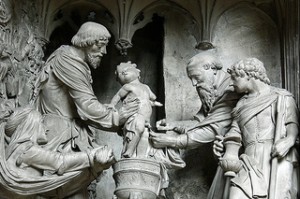
Circumcision of Jesus, Chartres CathedralToday, people all over the world go all sort of crazy making resolutions about how we will improve our lives in the coming year – it is New Year’s Day! But on the calendar of the church it is the Feast of the Holy Name, also known as the Feast of the Circumcision.

The law of Moses (as this bit of Genesis shows) required that newborn boys be circumcised on their eighth day of life. So on this eighth day after Christmas Day, we commemorate Jesus’ early submission to the law as recorded in Luke 2:21: “After eight days had passed, it was time to circumcise the child; and he was called Jesus, the name given by the angel before he was conceived in the womb.” (This verse also explains the first alternative title of this day.)

It seems to me appropriate that this feast day of the beginning of a new covenantal relationship between God and one of God’s children falls on the day the secular world also celebrates a new beginning. It reminds me of Carl Sandburg’s famous statement that “a baby is God’s opinion that life should go on.” The coincidence of New Year’s Day and Holy Name Day reminds us that life in relationship with God should go on. Here’s Sandburg’s full comment:

A baby is God’s opinion that life should go on. A book that does nothing to you is dead. A baby, whether it does anything to you, represents life. If a bad fire should break out in this house and I had my choice of saving the library or the babies, I would save what is alive. Never will a time come when the most marvelous recent invention is as marvelous as a newborn baby. The finest of our precision watches, the most super-colossal of our supercargo plants, don’t compare with a newborn baby in the number and ingenuity of coils and springs, in the flow and change of chemical solutions, in timing devices and interrelated parts that are irreplaceable. A baby is very modern. Yet it is also the oldest of the ancients. A baby doesn’t know he is a hoary and venerable antique – but he is. Before man learned how to make an alphabet, how to make a wheel, how to make a fire, he knew how to make a baby – with the great help of woman, and his God and Maker. (Remembrance Rock, Harcourt Brace:1948)

The coincidence of the Feast of the Circumcision with New Year’s Day is a reminder that, first day of the new year it may be, we know “as of old” how to live the life it presents us. Every year we make resolutions, new covenants perhaps, to do the things we’ve always known how to do, the things we’ve always known we should do. St. Paul wrote to the Romans that “real circumcision is a matter of the heart – it is spiritual and not literal.” (Rom. 2:29) John Wesley taught that this implies humility, faith, hope, and charity. Let us resolve, let us covenant to live out these qualities in the year ahead.

Happy Holy Name Day!

====================

A request to my readers: I’m trying to build the readership of this blog and I’d very much appreciate your help in doing so. If you find something here that is of value, please share it with others. If you are on Facebook, “like” the posts on your page so others can see them. If you are following me on Twitter, please “retweet” the notices of these meditations. If you have a blog of your own, please include mine in your links (a favor I will gladly reciprocate). Many thanks!

====================

Father Funston is the rector of St. Paul’s Episcopal Church, Medina, Ohio.

Everything Becomes New! – From the Daily Office – December 31, 2012

From the Second Letter to the Corinthians:

From now on, therefore, we regard no one from a human point of view; even though we once knew Christ from a human point of view, we know him no longer in that way. So if anyone is in Christ, there is a new creation: everything old has passed away; see, everything has become new!

(From the Daily Office Lectionary – 2 Cor. 5:16-17 (NRSV) – December 31, 2012.)
 
New Year's Eve ClockNew Year’s Eve and our epistle lesson in the Daily Office lectionary focuses on the old passing away and everything becoming new. It’s purely serendipitous, but what an opportunity to affirm our faith in God’s on-going and constant re-creation of the world.
Yesterday on the radio program On Being the guest, a physicist, made note of the fact that change is the only universal constant. He made reference to what he called “the univeral law of impermanence.”

We make a big deal of change on the New Year. We look back at the year past and celebrate or bemoan its major events. We make resolutions (most of which aren’t kept) of changes we will make in the coming year. But, truth be told, the changing of the calendar from one year to the next is a purely arbitrary event! There really is nothing that makes this day any different than the one before or the one after or any day any time during any year. Every day is an opportunity for change and improvement!

Everyday the old passes away! Everyday everything becomes new!

====================

A request to my readers: I’m trying to build the readership of this blog and I’d very much appreciate your help in doing so. If you find something here that is of value, please share it with others. If you are on Facebook, “like” the posts on your page so others can see them. If you are following me on Twitter, please “retweet” the notices of these meditations. If you have a blog of your own, please include mine in your links (a favor I will gladly reciprocate). Many thanks!

====================

Father Funston is the rector of St. Paul’s Episcopal Church, Medina, Ohio.

We Are Better Than This – From the Daily Office – December 28, 2012

From the Prophet Isaiah:

Surely your waste and your desolate places
and your devastated land—
surely now you will be too crowded for your inhabitants,
and those who swallowed you up will be far away.
The children born in the time of your bereavement
will yet say in your hearing:
“The place is too crowded for me;
make room for me to settle.”
Then you will say in your heart,
“Who has borne me these?
I was bereaved and barren,
exiled and put away—
so who has reared these?
I was left all alone—
where then have these come from?”

(From the Daily Office Lectionary – Isaiah 49:19-21 (NRSV) – December 28, 2012.)
 
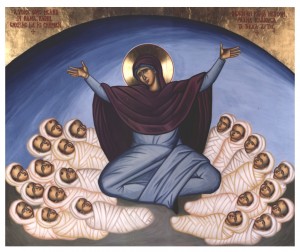
Holy Innocents IconToday is the Feast of the Holy Innocents and the Daily Office Lectionary again chooses lessons that underscore the day’s commemoration. In the midst of Christmas joy, we are reminded of the little children killed by Herod’s soldiers in the king’s attempt to do away with a perceived rival. I am not the first nor the only preacher or pastor to have thought of this story when, two weeks ago, gunman Adam Lanza opened fire at Sandy Hook Elementary School in Newtown, Connecticut. The wanton murder of children at any time makes the country where it occurs desolate and devastated. So today, again, we pray for the repose of the souls of those who died:
Charlotte Bacon, 6;
Daniel Barden, 7;
Olivia Engel, 6;
Josephine Gay, 7;
Ana M. Marquez-Greene, 6;
Dylan Hockley, 6;
Madeline F. Hsu, 6;
Catherine V Hubbard, 6;
Chase Kowalski, 7;
Jesse Lewis, 6;
James Mattioli, 6;
Grace McDonnell, 7;
Emile Parker, 6;
Jack Pinto, 6;
Noah Pozner, 6;
Caroline Previdi, 6;
Jessica Rekos, 6;
Avielle Richman, 6;
Benjamin Wheeler, 6;
Allison N. Wyatt, 6

Rachel Davino, 29;
Dawn Hocksprung, 47;
Anne Marie Murphy, 52
Lauren Russeau, 30;
Mary Sherlach, 56;
Victoria Soto, 27;

And, of course, also Nancy Lanza and Adam Lanza.

We pray for their souls, for comfort for their survivors, and for sanity in our land.

I just watched a public service announcement about our need for rational and reasonable regulation of gun and ammunition sales, gun ownership, and gun use. It includes the tag line, “We are better than this.” I pray God that the makers of the PSA are right, that we are better than this. We have to be. There are too many innocents dead.

====================

A request to my readers: I’m trying to build the readership of this blog and I’d very much appreciate your help in doing so. If you find something here that is of value, please share it with others. If you are on Facebook, “like” the posts on your page so others can see them. If you are following me on Twitter, please “retweet” the notices of these meditations. If you have a blog of your own, please include mine in your links (a favor I will gladly reciprocate). Many thanks!

====================

Father Funston is the rector of St. Paul’s Episcopal Church, Medina, Ohio.

There Is No Other Rock – From the Daily Office – December 27, 2012

From the Prophet Isaiah:

Thus says the Lord, the King of Israel
and his Redeemer, the Lord of hosts:
I am the first and I am the last;
besides me there is no god.
Who is like me? Let them proclaim it,
let them declare and set it forth before me.
Who has announced from of old the things to come?
Let them tell us what is yet to be.
Do not fear, or be afraid;
have I not told you from of old and declared it?
You are my witnesses!
Is there any god besides me?
There is no other rock; I know not one.

(From the Daily Office Lectionary – Isaiah 44:6-8 (NRSV) – December 27, 2012.)
 
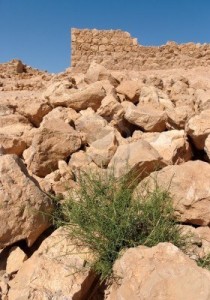
Ruins of Masada Fortress in IsraelOn the third day of Christmas the church calendar directs our attention to St. John the Evangelist and, again, the Daily Office lectionary falls in line. John is the gospeller whose wonderful prologue serves as the Gospel lesson at the Eucharist on Christmas Day (1:1-14) and on the first Sunday after Christmas (1:1-18). It is for me a much more meaningful Gospel of the Incarnation than Luke’s sweet story of innkeepers, shepherds, angels, and the virgin birth: “In the beginning was the Word, and the Word was with God, and the Word was God.” (v. 1)

John’s prologue speaks to me of a God who communicates and through communication creates, redeems, and saves. It reminds us of the story of creation in Genesis: “God said . . . .” and everything came into being.

Isaiah’s prophecy in today’s evening reading, I’m sure, is meant to underscore this. Isaiah, speaking on God’s behalf, demands communication from other gods who would seek to supplant the Almighty: “Let them proclaim . . . let them declare . . . who has announced? . . . let them tell.” And God reminds us that God is a communicator: “Have I not told you from of old and declared it?” Our God is a God who communicates, who is in relationship with his people, who comes among them to speak and to listen. The other gods are nothing but mute idols.

Or, at least, in Isaiah’s time, they were. As I write these words my television happens to be on; others in the family are watching a morning talk show and there are advertisements sprinkled among the stories of post-Christmas sales, politics, and “the fiscal cliff”. The gods of greed and consumption are communicating most loudly; the objects of modern worship are promoting themselves wantonly.

But are they listening? Do these gods hear the cries of the poor and homeless? Do these gods listen to the moans of the hungry and the sick? Do these gods pay heed to the needs of those who have no resources, who cannot pay homage in their temples of commerce?

These are gods for whom communication is one-way. They tell of themselves and they expect their worshipers to come . . . come and buy, come and consume, come and be consumed. But they do not listen. Only God the Word, incarnate in that baby celebrated in Luke’s sweet story, “became flesh and lived among us” and listens to us. “There is no other rock; I know not one.”

====================

A request to my readers: I’m trying to build the readership of this blog and I’d very much appreciate your help in doing so. If you find something here that is of value, please share it with others. If you are on Facebook, “like” the posts on your page so others can see them. If you are following me on Twitter, please “retweet” the notices of these meditations. If you have a blog of your own, please include mine in your links (a favor I will gladly reciprocate). Many thanks!

====================

Father Funston is the rector of St. Paul’s Episcopal Church, Medina, Ohio.

We Are All Called to Martyrdom – From the Daily Office – December 26, 2012

From the Book of Acts:

While they were stoning Stephen, he prayed, “Lord Jesus, receive my spirit.” Then he knelt down and cried out in a loud voice, “Lord, do not hold this sin against them.” When he had said this, he died. And Saul approved of their killing him. That day a severe persecution began against the church in Jerusalem, and all except the apostles were scattered throughout the countryside of Judea and Samaria. Devout men buried Stephen and made loud lamentation over him. But Saul was ravaging the church by entering house after house; dragging off both men and women, he committed them to prison.

(From the Daily Office Lectionary – Acts 7:59-8:3 (NRSV) – December 26, 2012.)
 
Icon of Saint StephenOn the second day of Christmas the church remembers a murder, the martyrdom of Stephen, and our Daily Office lectionary won’t let us forget it. Often the readings of the Daily Office seem to have nothing to do with the season and they seldom are tied to a saint’s commemoration, but today the morning and evening readings tell the whole story in gruesome detail.

Stephen is revered as the church’s first martyr. The word martyr in Greek merely means “witness” but the church (and thus our modern society) uses it to mean someone who has suffered and died for their faith. The Celtic church would identify three kinds of martyrdom, only one of which involves death, so-called “red martyrdom.” The others were “green martyrdom” and “white martyrdom.”

The green martyrs were those who left ordinary society for the life of a hermit on the mountaintops or islands of Ireland following the example of the Egyptian anchorites. Eventually, they merged their individual dwellings into the monastic communities which dominated the Irish church from the 6th through 9th Centuries.

White martyrs went further. They left Ireland altogether as missionaries. The first of these were Columba and his followers who founded the monastery at Iona. Others following their example went into northern Europe and beyond.

The 2nd Century theologian Tertullian said that “the blood of the martyrs is the seed of the church.” This is usually understood to mean that through the sacrifice of their lives the “red martyrs” led others to conversion and, on this Feast of Stephen, we see the great example of that in the eventual conversion of Saul, the zealous Jewish persecutor of the church, into Paul, the equally-zealous Christian missionary. But it seems to me that the blood of the green martyrs and the white martyrs, which was not spilled but continued to course through their veins during a life of prayer and service, was equally effective in the conversion of others.

It is not so much the blood of the martyrs but, as the original Greek word says, the witness of the martyrs, the example and testimony of the martyrs of all sorts, red, green, and white, that nurtures the growth of the church. On this second day of Christmas, we should remember that, in some sense, we are all called to martyrdom; we are all called to witness to our faith in the Child whose birth we continue to celebrate.

====================

A request to my readers: I’m trying to build the readership of this blog and I’d very much appreciate your help in doing so. If you find something here that is of value, please share it with others. If you are on Facebook, “like” the posts on your page so others can see them. If you are following me on Twitter, please “retweet” the notices of these meditations. If you have a blog of your own, please include mine in your links (a favor I will gladly reciprocate). Many thanks!

====================

Father Funston is the rector of St. Paul’s Episcopal Church, Medina, Ohio.

Today Is the Day! Well, Not Really – From the Daily Office – December 25, 2012

From the Prophet Zechariah:

Sing and rejoice, O daughter Zion! For lo, I will come and dwell in your midst, says the Lord. Many nations shall join themselves to the Lord on that day, and shall be my people; and I will dwell in your midst. And you shall know that the Lord of hosts has sent me to you. The Lord will inherit Judah as his portion in the holy land, and will again choose Jerusalem. Be silent, all people, before the Lord; for he has roused himself from his holy dwelling.

(From the Daily Office Lectionary – Zechariah 2:10-13 (NRSV) – December 25, 2012.)
 
Icon of the Nativity of ChristToday is the day! . . . . Well, not really. We don’t really know the date on which Jesus was born. In our ignorance, we Christians took over a pagan feast and made it our own. The feast of Sol Invictus became to feast of the Nativity. Celebrations of the birth of the conquering sun became the celebration of the birth of the conquering Son (a pun the only works in English).

Atheists and anti-religious types like to throw that fact in our faces and claim that Christianity is just a “made-up faith” (like all religions, they claim). Or, it used to suggest that Christianity is in someway “colonial”, taking over that which rightfully belongs to others. Or, the fact that many modern Christians do not know the history of the Christmas holiday becomes an indictment against all Christians as stupid and uninformed.

If you ask me, that is all a bunch of what my grandmother called pettifogging. The importance of this day lies not in its dating but in what it stands for. We don’t actually celebrate Jesus’ birthday; we celebrate the Nativity, the birth of God among us, the Incarnation of God in all times and in all places. We give thanks for God’s promise and God’s keeping God’s promise to come and dwell in our midst. It doesn’t matter on what particular day the Child in whom that was manifest was born. What matters is that he was born, not when. Before that reality silence and awe are the appropriate response, not pettifogging and bickering over calendars!

“How silently, how silently, the wondrous gift is given” wrote Episcopal priest Phillips Brooks in 1868 in the now popular carol O Little Town of Bethlehem. In it we sing this petition, “O holy Child of Bethlehem, descend to us, we pray; cast out our sin and enter in, be born to us today.” That is a prayer for everyday, not simply on this feast of Sol Invictus. Since we don’t know on what particular day Jesus was born, perhaps we should celebrate his birth on every day.

Everyday is the day!

====================

A request to my readers: I’m trying to build the readership of this blog and I’d very much appreciate your help in doing so. If you find something here that is of value, please share it with others. If you are on Facebook, “like” the posts on your page so others can see them. If you are following me on Twitter, please “retweet” the notices of these meditations. If you have a blog of your own, please include mine in your links (a favor I will gladly reciprocate). Many thanks!

====================

Father Funston is the rector of St. Paul’s Episcopal Church, Medina, Ohio.

« Older posts Newer posts »