From the Book of Revelation:
In appearance the locusts were like horses equipped for battle. On their heads were what looked like crowns of gold; their faces were like human faces, their hair like women’s hair, and their teeth like lions’ teeth; they had scales like iron breastplates, and the noise of their wings was like the noise of many chariots with horses rushing into battle. They have tails like scorpions, with stings, and in their tails is their power to harm people for five months. They have as king over them the angel of the bottomless pit; his name in Hebrew is Abaddon, and in Greek he is called Apollyon.
(From the Daily Office Lectionary – Revelation 9:7-11 – October 25, 2012)
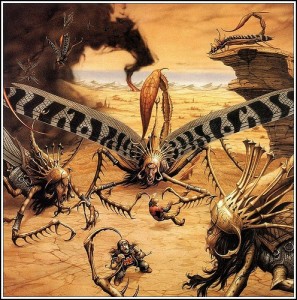 There’s lovely imagery in St. John of Patmos’s ecstatic dream. I’m particularly fond of his vision of the heavenly throne room:
Around the throne are twenty-four thrones, and seated on the thrones are twenty-four elders, dressed in white robes, with golden crowns on their heads . . . . And whenever the living creatures give glory and honor and thanks to the one who is seated on the throne, who lives forever and ever, the twenty-four elders fall before the one who is seated on the throne and worship the one who lives forever and ever; they cast their crowns before the throne, singing, “You are worthy, our Lord and God, to receive glory and honor and power, for you created all things, and by your will they existed and were created.” (Rev. 4:4,9-11)
From that vision came the last lines of Charles Wesley’s great hymn Love Divine, All Loves Excelling:
Till we cast our Crowns before Thee,
Lost in Wonder, Love, and Praise!
In today’s reading from the Apocalypse, however, the crowns belong to some rather fanciful and frightening beasts that John called “locusts” and then proceeded to describe as anything but locusts! These are monstrous flying insects the size of horses armored for battle possessing scorpions’ tails complete with stingers. We are told that these stingers cause torment but do not kill; those stung “will seek death but will not find it; they will long to die, but death will flee from them.” (v. 6)
I have to admit that I’m never sure quite what to make of or what to do with the Book of Revelation. I know it’s not a prophetic vision of the end times; it’s an apocalyptic vision meant to comfort the people of John’s own time and place (late first or early second century Roman Empire). I know that as the canon of scripture developed there was disagreement about its inclusion. But knowing those things doesn’t really help me know what to do with it now, other than to read it (as the lectionary has had us do for several days) and wonder, “What was John smoking?” This book always seems to me to be a sort of scriptural Scare Tactics or Total Blackout (Syfy channel game shows), or possibly evidence that God has a Tim-Burton-like sense of humor.
But, still, there are those lovely images of the heavenly throne room and the thought that we, unlike the horse-sized locusts, will some day cast our crowns before the throne of glory.
====================
A request to my readers: I’m trying to build the readership of this blog and I’d very much appreciate your help in doing so. If you find something here that is of value, please share it with others. If you are on Facebook, “like” the posts on your page so others can see them. If you are following me on Twitter, please “retweet” the notices of these meditations. If you have a blog of your own, please include mine in your links (a favor I will gladly reciprocate). Many thanks!
====================
Father Funston is the rector of St. Paul’s Episcopal Church, Medina, Ohio.
 There are a few folks flying all over the U.S. recently (and promising to do so for the next couple of weeks) who have not followed Ben Sira’s advice! Everyday for the past few weeks my mailbox has contained at least one and more commonly three or more expensively produced, glossy, color flyers extolling the virtues of one or the other of the political parties or candidates, or more often tearing down the other guys. Everyday for the past few weeks my voicemail has recorded a robo-call from some politician or political action group. Everyday at any hour of the day that I care to turn on my television set, I am treated to political advertisements and “news” shows. Someone is not following Ben Sira’s advice to “not seek high office or the seat of honor”! And we as a society are, I’m sad to say, disgraced among the nations by the spectacle of our electioneering.
 This is from one of today’s psalms for Evening Prayer. What got my attention and caught my imagination is the Psalmist image of unspoken thoughts being painful and bursting into flame demanding to be spoken. While it is intended to be a positive image of trying to not engage with the wicked until one can no longer refrain from doing so, until one’s righteousness is kindled against them, I could not help but be reminded of James’s words:
 Jesus is so demanding! Follow me and you won’t have a place rest; leave your dead; if you look back, you aren’t worthy!
  I’ve been thinking about this little bit of Scripture all day! It’s nearly 10:30 p.m. – time for Compline! – and I’m still thinking about seven words from the morning gospel: “Let these words sink into your ears” . . . .
  Heart, spirit, body. These two verses speak to me of the necessary investment of one’s whole self, the whole person, into the spiritual and religious life. One of the most influential lay theologians of the middle 20th Century, William Stringfellow wrote: “Spiritual maturity or spiritual fulfillment necessarily involves the whole person – body, mind and soul, place, relationships – in connection with the whole of creation throughout the era of time . . . . Spirituality encompasses the whole person in the totality of existence in the world, not some fragment or scrap or incident of a person.” (The Politics of Spirituality, Westminster John Knox: 1984, p. 22) If Stringfellow is right, and I think he is, then a plan for spiritual growth should follow the Psalmist example and “set the Lord always before” the person seeking to grow. Always . . . not just an hour or so on Sunday morning.
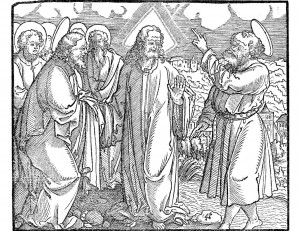 “Who do you say that I am?” Better writers and more erudite theologians than I have noted that this is the question at the heart of the gospel, the question that each person must answer for him- or herself. C.S. Lewis addresses it in one of my favorite of his writings, Mere Christianity:
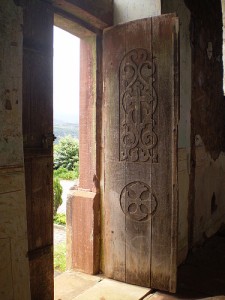 “Take nothing!” That’s not an instruction to be footloose and fancy free! When Jesus sends out the twelve with these instructions he is making them utterly dependent on the communities to which they may go; they are to rely completely on hospitality of others. Like Blanch Dubois, they are always to depend on the kindness of strangers.
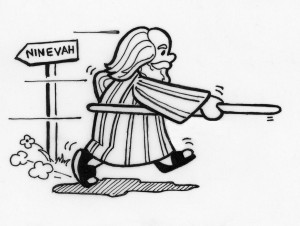 Jonah’s a fool! Trying to flee “from the presence of the Lord.” As if! This lesson today is an interesting contrast to Sunday’s Eucharistic Lectionary reading from Book of Job (Job 23:1-9,16-17) in which Job was bewildered and confused because he felt unable to find God: “Oh, that I knew where I might find him, that I might come even to his dwelling!” (Job 23:2) Jonah, on the other hand, would be perfectly happy never to find, or be found by, God.
 Sound familiar? Jesus sounded a lot like Micah at times:

