Occasional thoughts of an Anglican Episcopal priest

Category: Daily Office (Page 54 of 70)

Fruitful House of Bread – From the Daily Office – October 13, 2012

From the Prophet Micah:

But you, O Bethlehem of Ephrathah,
who are one of the little clans of Judah,
from you shall come forth for me
one who is to rule in Israel,
whose origin is from of old,
from ancient days.

(From the Daily Office Lectionary – Micah 5:1 – October 13, 2012)

House of BreadThis obscure little verse in the book of the Prophet Micah is best known to Christians from the story of the visitation of the wisemen in Matthew’s Gospel:

In the time of King Herod, after Jesus was born in Bethlehem of Judea, wise men from the East came to Jerusalem, asking, “Where is the child who has been born king of the Jews? For we observed his star at its rising, and have come to pay him homage.” When King Herod heard this, he was frightened, and all Jerusalem with him; and calling together all the chief priests and scribes of the people, he inquired of them where the Messiah was to be born. They told him, “In Bethlehem of Judea; for so it has been written by the prophet: “And you, Bethlehem, in the land of Judah, are by no means least among the rulers of Judah; for from you shall come a ruler who is to shepherd my people Israel.’ “

I’ve always been intrigued by the word Ephrathah (which Mattew does not quote). Apparently it is a place name; one source indicates that Ephrathah, or Ephrath, is the ancient name for the town of Bethlehem in Judah, in the southern part of the land of Israel. Micah uses both names in order to distinguish the town from another Bethlehem in the north. Another source tells me the name means “fruitful”.

The name Bethlehem means “house of bread” which always intrigues Christians who see it as somewhat prophetic of Jesus words at the Last Supper identifying the bread as his own body.

When I hear that Ephrathah means “fruitful” I am immediately put in mind of two other verses of Scripture. First, God’s admonition to Adam and Eve in Genesis: “Be fruitful and muliply.” (1:28) The second is Christ’s admonition to his disciples: “I appointed you to go and bear fruit, fruit that will last, so that the Father will give you whatever you ask him in my name.” (John 15:16)

In the name of Jesus’ place of birth as set forth in Micah, I hear a call to evangelism. Nurture and sustained by what comes from the “house of bread,” we are “to go and bear fruit;” we are sent out to “be fruitful and multiply,” The fruit which we are to bear is an increase in followers of the Way, an increase in the number of disciples (not simply the fruit of individual good works, nor only the “fruits of the spirit” in our own lives). Our efforts, our ministries, our prayers, our daily lives are to be the means by which the “house of bread” will truly be “fruitful.”

====================

A request to my readers: I’m trying to build the readership of this blog and I’d very much appreciate your help in doing so. If you find something here that is of value, please share it with others. If you are on Facebook, “like” the posts on your page so others can see them. If you are following me on Twitter, please “retweet” the notices of these meditations. If you have a blog of your own, please include mine in your links (a favor I will gladly reciprocate). Many thanks!

====================

Father Funston is the rector of St. Paul’s Episcopal Church, Medina, Ohio.

Three Women, Resources and Priorities – From the Daily Office – October 12, 2012

From the Gospel of Luke:

Jesus went on through cities and villages, proclaiming and bringing the good news of the kingdom of God. The twelve were with him, as well as some women who had been cured of evil spirits and infirmities: Mary, called Magdalene, from whom seven demons had gone out, and Joanna, the wife of Herod’s steward Chuza, and Susanna, and many others, who provided for them out of their resources.

(From the Daily Office Lectionary – Luke 1:1-3 – October 12, 2012)

Generic Debit CardThree cheers for the women of the church! Seriously, it seems to have ever been thus: women do the “heavy lifting” but end up little noticed in the background. One wonders if Jesus and the twelve could have done what they did if these women “who provided for them out of their resources” had not been so generous . . . .
Some suggest the women offered what we would call domestic services for Jesus and the twelve; others that they joined them in preaching the kingdom; still others that they were wealthy benefactors. One auther, Renita Weems, writes: “Mary Magdalene, Joanna, Susanna and other female traveling evangelists made up the band of female workers who surrendered and sacrificed everything to follow Jesus . . . . between teaching, they did the cooking; beyond recruiting, they did the mending; in excess of donating their funds, they donated their time.”

Frankly, I don’t know if there’s any support for such a vision of these women mending, cooking, or laundering, although it’s certainly possible. Nonetheless, it is pretty clear that they gave generously to Jesus’ mission; the gave their gifts, talents, time, money . . . . they gave, as Luke says, out of their resources, whatever those resources may have been. It was the women whose resources kept Jesus’ dream going. These women are paragons of generosity.

Throughout human history, financial support has been needed for any ministry that ever existed. Jesus and the twelve needed monetary support to carry on an active ministry that was dependent on the generosity of others. These women provided that support.

We all know the commonplace wisdom: look at a person’s checkbook, his or her monthly credit card statements or online banking report and you will gain insight as to the values and priorities by which he or she lives. If we had looked at the Magdalene’s statements, Joanna’s checkbook, and Susanna’s credit card receipts, we would have seen, at the top of their list of priorities, one name: Jesus.

Jesus is reported to have said: “Where your treasure is, there your heart will be also.” (Matt. 6:21) I know that all too often my treasure and my heart are elsewhere than they ought to be. Every day, I need to remember, sometimes to relearn what these generous women knew: that my heart and my treasure belong to Jesus Christ!

====================

A request to my readers: I’m trying to build the readership of this blog and I’d very much appreciate your help in doing so. If you find something here that is of value, please share it with others. If you are on Facebook, “like” the posts on your page so others can see them. If you are following me on Twitter, please “retweet” the notices of these meditations. If you have a blog of your own, please include mine in your links (a favor I will gladly reciprocate). Many thanks!

====================

Father Funston is the rector of St. Paul’s Episcopal Church, Medina, Ohio.

Political Speech: Prophetic or Nasty? – From the Daily Office – October 11, 2012

From the Prophet Micah:

And I said:
Listen, you heads of Jacob
and rulers of the house of Israel!
Should you not know justice?—
you who hate the good and love the evil,
who tear the skin off my people,
and the flesh off their bones;
who eat the flesh of my people,
flay their skin off them,
break their bones in pieces,
and chop them up like meat in a kettle,
like flesh in a cauldron.

(From the Daily Office Lectionary – Micah 3:1-3 – October 11, 2012)

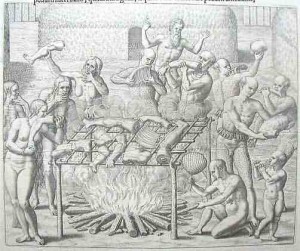
Cannibalism, Copper Engraving by Theodore de BryMicah gets just a wee bit graphic here with his metaphors, with his condemnation of political leaders, don’t you think? He has accused them of being cannibals! He describes them as treating the people like meat for a meal; they have butchered them, flayed them, broken their bones, and chopped them up for stew meat! It’s awful!

In the midst of our political campaign, I am intrigued by the awfulness of Micah’s prose as it compares to the things we are seeing about the candidates, about President Obama, about Governor Romney, and on the local level about those running for the Senate, for the House, and for state and local offices, though those are not quite as bad as the presidential advertisements, commercials, and so forth. Worse than the television advertisements and radio spots are the things that others (the superPACs and the partisan websites) are throwing up on the internet, on Facebook, on Twitter. Some of it truly awful. Like Micah’s prose.

Where does one draw the line? Each week in our Prayers of the People, my parish includes a petition that political discourse during the election campaign will be civil, courteous, and productive. So far, I’m sad to say, it seems to be none of those things. I think many people would agree that it is excessively negative, but has it crossed the line? I believe that it has; it always does – this election is no different from any other of my adult life, to be honest. Every election year seems to bring out the worst in people.

Why do we feel justified in uttering such terrible things about others, especially about those who are our leaders or those who would like to be our leaders? And is there any difference between our election year condemnations of incumbents and challengers, Micah’s prophetic condemnations of the leaders of Jacob, the rulers of Israel? Are we following in a prophetic tradition when we call them out in such “purple prose” for what we believe are their failings?

Are we being prophetic like Micah and his colleagues in Scripture? Or was Micah just being nasty like us and our neighbors? Is there a difference? I wish I knew.

====================

A request to my readers: I’m trying to build the readership of this blog and I’d very much appreciate your help in doing so. If you find something here that is of value, please share it with others. If you are on Facebook, “like” the posts on your page so others can see them. If you are following me on Twitter, please “retweet” the notices of these meditations. If you have a blog of your own, please include mine in your links (a favor I will gladly reciprocate). Many thanks!

====================

Father Funston is the rector of St. Paul’s Episcopal Church, Medina, Ohio.

Radical Preaching – From the Daily Office – October 10, 2012

From the Prophet Micah:

Alas for those who devise wickedness
and evil deeds on their beds!
When the morning dawns, they perform it,
because it is in their power.
They covet fields, and seize them;
houses, and take them away;
they oppress householder and house,
people and their inheritance.
* * *
“Do not preach” – thus they preach –
“one should not preach of such things;
disgrace will not overtake us.”
* * *
If someone were to go about uttering empty falsehoods,
saying, “I will preach to you of wine and strong drink”,
such a one would be the preacher for this people!
* * *
The one who breaks out will go up before them;
they will break through and pass the gate, going out by it.
Their king will pass on before them,
the Lord at their head.

(From the Daily Office Lectionary – Micah 2:1-2,6,11,13 – October 10, 2012)

Bible Lighted by Votive CandleMicah condemns those who plot to do wrong “on their beds” and then carry out their plans when they rise; he prophesies God’s retribution against them. But then he is told not to do so; those to whom he preaches not only reject his prophecy, they tell him not to preach such things at all. He concludes that they only want to hear their preachers tell them of pleasant things, the things they enjoy; they want preachers who will utter “empty falsehoods” and preach of “wine and strong drink.”
I’m sure that every preacher has at one time or another felt like Micah. I remember early in my ordained career being told by a congregant that all she wanted from church was to spend Sunday morning with her friends singing songs she knew and hearing “an uplifting message.” But not every bible text lends itself to an “uplifting message” and from time to time there are social ills that need to be addressed! The early 20th Century Swiss theologian Karl Barth insisted that theology and preaching had to be done with the Bible in one hand and the newspaper in the other. Another theologian, Reinhold Niebuhr is often credited with saying that the role of the preacher is to “comfort the afflicted and afflict the comfortable.” (Interestingly enough, the originator of that idea was newspaper humorist Finley Peter Dunne who said it was the role of newspapers to do so.)

Micah, Barth, and Niebuhr thus call the preacher to view contemporary culture, especially the news of the day, though scriptural lenses and view the Word of God through cultural lenses, to call out and condemn that in the culture which does not accord with the word of God, even if the preacher is, in turn, condemned for doing so. The witness of Micah reminds us that doing so will result in criticism from at least some of those to whom one preaches. The thin-skinned preacher would do well to be safe and conservative and always preach that pleasant, uplifting message. In my opinion, he or she would not be faithful, but he or she would be likely never hear “Do not preach of such things” from his or her congregation.

Preachers, as Micah makes clear, and as Barth and Niebuhr intimated, are not called to play it conservatively safe. Preachers are called to be (as Micah puts it) “the one who breaks out”, the one who leads his or her people out of their comfortable culturally-bound lives through the gate of Scripture so that they may follow “the Lord at their head.” It isn’t always, or even often, an easy-to-hear, uplifting message that breaks down those cultural walls. It is been said that the word of God is radical and so it is; Scripture gets to the root, the radix, of human existence and good preaching should do the same. Although Barth was speaking in a political context, something else he is reported to have said is also true of preaching: “The radical is probably wrong but has a chance of being right; the conservative is always wrong.”

====================

A request to my readers: I’m trying to build the readership of this blog and I’d very much appreciate your help in doing so. If you find something here that is of value, please share it with others. If you are on Facebook, “like” the posts on your page so others can see them. If you are following me on Twitter, please “retweet” the notices of these meditations. If you have a blog of your own, please include mine in your links (a favor I will gladly reciprocate). Many thanks!

====================

Father Funston is the rector of St. Paul’s Episcopal Church, Medina, Ohio.

God Has Done Great Things – From the Daily Office – October 9, 2012

From the Psalms:

When the Lord restored the fortunes of Zion, then were we like those who dream.
Then was our mouth filled with laughter, and our tongue with shouts of joy.
Then they said among the nations, “The Lord has done great things for them.”
The Lord has done great things for us, and we are glad indeed.

(From the Daily Office Lectionary – Psalm 126:1-4 (BCP Version) – October 9, 2012)

Jesus Clapping and Shouting for Joy (artist unknown)Have you ever visited a church which as part of its normative worship service gives congregants an opportunity to voice aloud their own prayers to God? It may surprise some that the Episcopal Church is one such religious group. In the typical service of the Holy Eucharist in the Episcopal Church, following readings from Scripture, the sermon and a recitation of the Nicene Creed, the congregation is led in a responsive cycle of prayer called The Prayers of the People.

A rubric (a direction for the conduct of worship services) in The Book of Common Prayer outlines what is to be included in these prayers. It states that

Prayer is offered with intercession for
The Universal Church, its members, and its mission
The Nation and all in authority
The welfare of the world
The concerns of the local community
Those who suffer and those in any trouble
The departed (with commemoration of a saint when appropriate)
(BCP, Page 359 or 383)

Six forms of suggested prayers are provided in the BCP, but other forms conforming to the rubrical requirements may be used. Each of those forms provides opportunities for silence during which the People are encouraged to speak their own petitions, intercessions, or thanksgivings. The sixth form even includes this specific invitation, “The People may add their own thanksgivings.” (Page 393)

I have visited a lot of Episcopal Churches. I have heard many prayer leaders invite the People’s prayers during those silences. I have seldom heard anyone laugh, shout with joy, or express gladness because the Lord has done great things for them. Why do you suppose that is? Garrison Keillor (who is an Episcopalian, by the way) has suggested that “Episcopalians believe in prayer, but would practically die if asked to pray out loud.” That may be doubly true of giving thanks out loud.

I have no answer to the question. Keillor suggests that Episcopalians are known for our blandness, our excessive calm, and our fear of giving offense, and maybe that’s part of it. I don’t know. But I do wish in prayers and worship that we would laugh a little more, shout with joy from time to time, and let our gladness show when God has done great things for us, because God has done great things for us!

====================

A request to my readers: I’m trying to build the readership of this blog and I’d very much appreciate your help in doing so. If you find something here that is of value, please share it with others. If you are on Facebook, “like” the posts on your page so others can see them. If you are following me on Twitter, please “retweet” the notices of these meditations. If you have a blog of your own, please include mine in your links (a favor I will gladly reciprocate). Many thanks!

====================

Father Funston is the rector of St. Paul’s Episcopal Church, Medina, Ohio.

Why Do You Call Me “Lord, Lord”? – From the Daily Office – October 8, 2012

From the Gospel of Luke:

Jesus said: “Why do you call me “Lord, Lord,” and do not do what I tell you? I will show you what someone is like who comes to me, hears my words, and acts on them. That one is like a man building a house, who dug deeply and laid the foundation on rock; when a flood arose, the river burst against that house but could not shake it, because it had been well built. But the one who hears and does not act is like a man who built a house on the ground without a foundation. When the river burst against it, immediately it fell, and great was the ruin of that house.”

(From the Daily Office Lectionary – Luke 6:46-49 – October 8, 2012)

Jesus Teaching the CrowdsIt’s a darn good question, “Why do you call me “Lord, Lord,” and do not do what I tell you?” As we come to the last month of the 2012 political campaign, it is one which needs to be carefully considered by many Christians on all sides of the political divide. Are the values on which Christian voters are making their decisions those taught by Jesus, or are they cultural values dressed up in Christian clothing? One-issue voters in particular should take a broader look at their choices; just because a candidate supports your position on a question of particular importance to you does not mean his or her overall platform conforms well to the values of the Gospel, or does what Jesus told us to do.

Yesterday, evangelical preachers and churches around the country broke the law by engaging in something called “Pulpit Freedom Sunday”. They claimed to be the victims of “religious discrimination” because of a provision in American tax law which prohibits churches which claim religious tax exemption from endorsing political candidates and preachers from making campaign speeches from their pulpits. In this blog, I will not debate the law or the legality of what these churches and preachers did, but I do want to suggest that they have lost their way. Christ’s church was never intended to be a political party; Jesus is not a Republican, nor is he a Democrat; he is not a Green, or a Libertarian. Preaching politics from the pulpit undermines the Gospel message which is for all regardless of their political affiliation or their voting decisions. Preaching partisan politics from the pulpit is not doing what Jesus told us to do!

When the Gospel of Christ is equated with a particular party’s platform or a particular candidate’s position, the person or institution preaching that equivalence is not doing what Jesus told us to do. In fact, I believe they have even stopped calling Jesus “Lord, Lord” – they have given their allegiance to something or someone else!

The Gospel should impact our political decisions; I’m not suggesting otherwise. But churches and preachers should not be endorsing political nominees nor telling their congregations how to vote. Instead, they should be encouraging their members to give food to the hungry and something to drink to the thirsty, to welcome the stranger, to give clothing to the naked, to care for the sick and those in prison (see Matthew 25), and ask themselves how their political decisions best accomplish those goals. Because that is what Jesus told us to do!

====================

A request to my readers: I’m trying to build the readership of this blog and I’d very much appreciate your help in doing so. If you find something here that is of value, please share it with others. If you are on Facebook, “like” the posts on your page so others can see them. If you are following me on Twitter, please “retweet” the notices of these meditations. If you have a blog of your own, please include mine in your links (a favor I will gladly reciprocate). Many thanks!

====================

Father Funston is the rector of St. Paul’s Episcopal Church, Medina, Ohio.

The Womb-Love of Mother God – From the Daily Office – October 6, 2012

From the Prophet Hosea:

How can I give you up, Ephraim?
How can I hand you over, O Israel?
How can I make you like Admah?
How can I treat you like Zeboiim?
My heart recoils within me;
my compassion grows warm and tender.

(From the Daily Office Lectionary – Hosea 11:8 – October 6, 2012)

Mother and Child DrawingThis passage is one of my favorites in the book of the prophet Hosea. (I’m a fan of that prophet for a number of reasons and this little-remarked verse is one them.) Hosea’s major metaphor for the relationship of God with Israel is that of marriage. Hosea portrayed God as Israel’s “husband” and condemend the nation because of the “adulterous” relationship it had had with other gods. As a “prophetic act” Hosea married a prostitute named Gomer, with whom his relationship parallels that of God with Israel. He tells of Gomer running away from him and having sex with another man, but he loves her and forgives her. Similarly, even though the people of Israel worshiped other gods, Hosea prophesied that Yahweh continues to love his people and does not abandon the covenant with them. This verse, however, departs from that metaphor and presents, instead, a maternal and feminine image of God.

At the heart of this verse are two Hebrew words, one of which is translated as “heart”; the other, as “compassion”. The first is leb and in Judaic understanding it refers not merely to the body’s physical heart, but to the innermost being of the human person. It refers to the center of personal life, to a human being’s psychic and spiritual energies upon which the whole moral and religious condition of a person completely depends. Here, it is God who has this sort of inner core of being, and the center of God’s Being is inextricably linked in this verse with God’s compassion.

Our English word compassion derives from the Latin for “suffering together”; compassion is the ability to share in the suffering of another, to be empathetic. The Hebrew word translated as “compassion” is rechemet, which comes from the Hebrew root rechem which literally means “womb”. The Hebrew understanding of compassion is deeply maternal, rooted in a profound metaphor of birthing and motherhood; compassion in Hebrew thought might best be conceived not as “shared suffering”, but as “womb love”. This word applied to God conjurs a beautiful image of God as our mother doing all the amazing and miraculous things a life-giving, birthing mother does. She protects her unborn child; she nourishes, cradles, and prepares her child. She gives birth to her child and after delivering her child, how can she give up or forget her child? “Can a woman forget her nursing child, or show no compassion for the child of her womb?” asks God in Isaiah, “Even these may forget, yet I will never forget you.” (Isaiah 49:15)

My father died when I was five years old and, though my mother remarried when I was ten, for five important formative years of my childhood my mother was the only parent I knew; so this maternal metaphor for God speaks loudly to me. I do not have a problem with patriarchal imagery and what hymnist Brian Wren called “kingafap language” (King-God-Almighty-Father-Protector) for God, but I know that many do. For them, Hosea’s and Isaiah’s maternal images may be even more powerful.

We must always remember that every word we speak, every image we conceive, every verse of Scripture we read about God is a metaphor and every metaphor is limited. Still, this often-overlooked verse from the prophet Hosea reminds us that we are God’s children and that at the center of God’s Being is the womb-love of a mother for her child, for us.

====================

A request to my readers: I’m trying to build the readership of this blog and I’d very much appreciate your help in doing so. If you find something here that is of value, please share it with others. If you are on Facebook, “like” the posts on your page so others can see them. If you are following me on Twitter, please “retweet” the notices of these meditations. If you have a blog of your own, please include mine in your links (a favor I will gladly reciprocate). Many thanks!

====================

Father Funston is the rector of St. Paul’s Episcopal Church, Medina, Ohio.

Complacency Is Just Not an Option! – From the Daily Office – October 5, 2012

From the Gospel of Luke:

Jesus said: “But woe to you who are rich, for you have received your consolation. Woe to you who are full now, for you will be hungry. Woe to you who are laughing now, for you will mourn and weep. Woe to you when all speak well of you, for that is what their ancestors did to the false prophets.”

Bookplate Engraving of "Sloth"Today I am forcing myself to get back in the groove with these daily meditations on bits of Scripture from the lessons of the Episcopal Church’s Daily Office Lectionary. I took a break two weeks ago about the time of my father-in-law’s death and funeral, a break which was just supposed to be a couple of days, and it stretched on and on and I got out of the habit. I tried, a couple of times (once with a bit from Judith and once with bit from the fourth chapter of Luke), but I couldn’t discipline myself to sit down, compose, and publish the thoughts in my head. I was slothful; in the words of medieval monks, I was suffering from daily, early-morning acedia. Acedia, one of the Seven Deadly Sins, according to Wikipedia is “a state of listlessness or torpor, of not caring or not being concerned with one’s position or condition in the world.” That is not the mental state exhibited by Jesus in today’s Gospel lesson from Luke, but I think he addresses it and, thus, today’s lesson has helped me out of my own torpor.
In today’s Gospel we have the Lukan version of the Beatitudes which differs in many respects from the more well-known and oft-quoted version in Matthew (Matt. 5:3–12). It differs so much that we refer to Luke’s rendition as “the Blessings and Woes” rather than as “Beatitudes,” and that title gives witness to the most distinctive difference, the addition of the “woes” addressed to the well-off. And it is those “woes” which I focus on today.

Each of these states of woe is introduced in the same way. In Greek the word translate into English as “woe” is ouai. It’s pronounced something like “oo-why” and is, according to something I remember reading in seminary but can’t find now, an onomatopoetic term expressive of a sigh . . . a sigh of profound sadness. So rather than being (as is often understood) Christ’s prediction of some terrible calamity that is to befall the well-to-do, the satisfied, the currently happy, or those who are lauded, these “woes” are statements of Jesus’ current sadness about them.

Why should Jesus be unhappy about this state of well-being? I suspect it is because well-being can lead to complacency or, worse, to efforts to maintain it at the expense of others. Complacency is a form of acedia. It makes people fear the unknown, mistrust the untried, and abhor the new; it makes people resist change. The complacent will stick to what they have always done even when it stops working. The theme-song of the complacent is, “We’ve always done it this way.” Jesus stands in opposition to “the way it’s always been done.” He calls us to new ways of behavior, new ways of being in community, new ways of caring for one another. No wonder he sighs so deeply with such sadness for the satisfied, for the complacent.

So this is where I find encouragement, inspiration, and energy in this passage . . . after heaving these profound sighs, Jesus doesn’t just sit there. He goes on with his teaching, issuing his call for changed behavior, and then goes on with his ministry; in the first verse of the next chapter, Luke tells us, “After Jesus had finished all his sayings in the hearing of the people, he entered Capernaum.” (Luke 7:1) Immediately, he is confronted by a request for healing and then, shortly thereafter, he raises the son of the widow of Nain from death. For Jesus (and for us) complacency is just not an option! We may sigh, but there is always something to be done.

====================

A request to my readers: I’m trying to build the readership of this blog and I’d very much appreciate your help in doing so. If you find something here that is of value, please share it with others. If you are on Facebook, “like” the posts on your page so others can see them. If you are following me on Twitter, please “retweet” the notices of these meditations. If you have a blog of your own, please include mine in your links (a favor I will gladly reciprocate). Many thanks!

====================

Father Funston is the rector of St. Paul’s Episcopal Church, Medina, Ohio.

Comprehending the Mind of God – From the Daily Office – September 25, 2012

From the Book of Judith:

Who are you to put God to the test today, and to set yourselves up in the place of God in human affairs? You are putting the Lord Almighty to the test, but you will never learn anything! You cannot plumb the depths of the human heart or understand the workings of the human mind; how do you expect to search out God, who made all these things, and find out his mind or comprehend his thought?

(From the Daily Office Lectionary – Judith 8:12-14a – September 25, 2012)
 
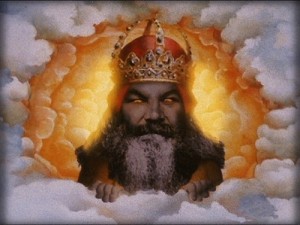
God from Monty Python & the Holy GrailThe Book of Judith is part of the Apocrypha or Deutercanon, those books accepted as Holy Writ by part of the Old Testament by Roman Catholic and Eastern Orthodox Christians, but rejected by Protestants and by rabbinic Judaism. As Anglicans, we Episcopalians adopt the position taken in the 39 Articles of Religion: they are the “other Books the Church doth read for example of life and instruction of manners; but yet doth it not apply them to establish any doctrine.” (Art. VI, BCP 1979, page 868)

The story of Judith is relatively simple. She was a widow living in the city of Bethulia when it is under siege by Holofernes, a general of the Ninvite king Nebuchadnezzar. Facing starvation, the people of the city demand that their rulers surrender. The elders of the town, named Uzziah, Chabris, and Charmis, calm them by promising to surrender Bethulia to Ninevites unless God helps rescues the city within so five days. This angers Judith who upbraids the town rulers (the selected verses are from her speech to the three elders). She then takes things into her own hands, wins entrance into the enemy camp, finds Holofernes passed out, drunk in his tent, and decapitates the general. She escapes from the camp, brings the head to the town elders, and saves the city.

While I find the book a wonderful story of faith in action, and its heroine a woman to looked up to, the verses I’ve quoted from its eighth chapter are troubling. I believe that it’s perfectly all right to put God to the test and that searching out God, trying to find out God’s mind, and seeking to comprehend God’s thought are worthy endeavors that God encourages. In the book of Prophet Malachi, when the people fail to pay their tithes, God says, “Bring the full tithe into the storehouse, so that there may be food in my house, and thus put me to the test, says the Lord of hosts; see if I will not open the windows of heaven for you and pour down for you an overflowing blessing.” (Mal. 3:10) I believe that it is not only in regard to tithes and offerings that God encourages us to “put me to the test;” God wants us to seek understanding, to try to comprehend God.

The Franciscan writer St. Bonaventure in his essay Itinerarium mentis in Deum (“The Journey of the Mind to God”) wrote of this comprehension or understanding as an ascent or journey and offered this advice:

He, therefore, who wishes to ascend to God must first avoid sin, which deforms nature. He must bring the natural powers of the soul under the influence of grace, which reforms them, and this he does through prayer; he must submit them to the purifying influence of justice, and this, in daily acts; he must subject them to the influence of enlightening knowledge, and this in meditation; and finally, he must hand them over to the influence of the perfecting power of wisdom, and this in contemplation.

Obviously, it takes effort and practice; it takes study and work. To make this effort is not (as Judith berated the Bethulian elders) to “set oneself up in the place of God,” but it is an endeavor to learn and understand. It is an effort blessed by God – we read in the Book of Proverbs:

My child, if you accept my words and treasure up my commandments within you,
making your ear attentive to wisdom and inclining your heart to understanding;
if you indeed cry out for insight, and raise your voice for understanding;
if you seek it like silver, and search for it as for hidden treasures –
then you will understand the fear of the Lord and find the knowledge of God.
For the Lord gives wisdom; from his mouth come knowledge and understanding;
he stores up sound wisdom for the upright; he is a shield to those who walk blamelessly,
guarding the paths of justice and preserving the way of his faithful ones. (Prov. 2:1-8)

So, as much as it pains me to disagree with a heroine of Scripture . . . Judith, you’re just wrong about this! You were right to cut off Holofernes’ head, but not to try to shut down the minds of those who seek to comprehend the Almighty!

====================

Father Funston is the rector of St. Paul’s Episcopal Church, Medina, Ohio.

Eyewitness Testimony – From the Daily Office – September 24, 2012

From the Gospel of Luke:

Since many have undertaken to set down an orderly account of the events that have been fulfilled among us, just as they were handed on to us by those who from the beginning were eyewitnesses and servants of the word, I too decided, after investigating everything carefully from the very first, to write an orderly account for you, most excellent Theophilus, so that you may know the truth concerning the things about which you have been instructed.

(From the Daily Office Lectionary – Luke 1:1-4 – September 25, 2012)
 
Bible Beat“Just as they were handed on to us . . . .” Those eight words from the introduction to Luke’s Gospel are often overlooked; in fact, I’d be willing to bet there are members of the church who’ve never heard or read them! The prologue to Luke’s Gospel is a very formal, brief, and somewhat vague introduction, but these eight words may be the most important in it. They ought to be heard as a caution to those who would treat this (or any Gospel) as absolute truth; Gospels are not histories, nor are they eyewitness accounts. As the writer makes clear, it was someone else who witnessed the things he writes about; he learned them because they were “handed on” and because he has done his research.

Not that eyewitness testimony would be all that great! As a former trial lawyer, I can verify from personal experience that eyewitness evidence is notoriously unreliable. This is because human beings don’t actually remember what we see; we reconstruct what we believe we have seen. Memory is a reconstruction, not a record. Research has shown that memory traces are, at best, highly impoverished versions of the original perception. Eyewitnesses often have insufficient information in their memories, so they reconstruct events adding pieces of information from other sources. There are two main sources of additional information: 1) pre-existing stereotyped mental models of objects and events, and 2) other memories. When people recognize a situation, either in perception or in memory, they invoke the most applicable steretypical model, or another similar memory, and unconsciously fill in missing information in order to complete the picture. This is why two eyewitnesses will describe an event in very different ways. This (in part) is why there are four Gospels, each telling Jesus’ story in a different way.

So even though Luke “investigated everything carefully from the very first,” his Gospel cannot be taken as 100% historical fact; none of the Gospels can. That’s no reason not to read them, study them, read, mark, and inwardly digest them. But it is a reason not to beat other people over the head with them. The Gospels are part of the story “handed on to us” and like Luke, we have to do our research and do our best to discover the truth.

====================

Father Funston is the rector of St. Paul’s Episcopal Church, Medina, Ohio.

« Older posts Newer posts »