Occasional thoughts of an Anglican Episcopal priest

Category: Daily Office (Page 55 of 70)

Doers of the Word – From the Daily Office – September 23, 2102

From the Letter of James:

Be doers of the word, and not merely hearers who deceive themselves. For if any are hearers of the word and not doers, they are like those who look at themselves in a mirror; for they look at themselves and, on going away, immediately forget what they were like. But those who look into the perfect law, the law of liberty, and persevere, being not hearers who forget but doers who act – they will be blessed in their doing.

(From the Daily Office Lectionary – James 1:22-25 – September 23, 2012)
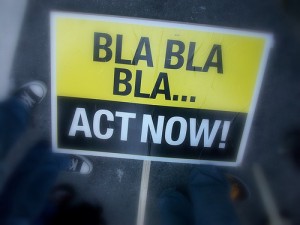
 
Bla Bla Bla - Act NowIt is said that Martin Luther hated the Letter of James; he called it an “epistle of straw” and didn’t believe it should be in the Bible. Why? Some folks will tell you it is because this epistle doesn’t support Luther’s theology of justification by grace through faith; James insists that works are necessary and the reformer just didn’t like that. However, that’s not really the case. Luther had doubts about the epistle’s apostolicity; he didn’t think it was really written by James the Apostle. He was probably right.

Nonetheless, in his preface to the New Testament, Luther praised the Letter of James and said he considered it a good book “because it sets up no doctrine of men but vigorously promulgates the law of God.” According to Luther’s biographer, Roland Bainton, “Once Luther remarked that he would give his doctor’s beret to anyone who could reconcile James and Paul. Yet he did not venture to reject James from the canon of Scripture, and on occasion earned his own beret by effecting reconciliation. ‘Faith,’ he wrote, ‘is a living, restless thing. It cannot be inoperative. We are not saved by works; but if there be no works, there must be something amiss with faith.’ ” (Here I Stand: A Life of Martin Luther)

Earlier this year, President Barack Obama addressed a prayer breakfast and took this passage as his text. Among other things, this is what he said:

The Bible teaches us to “be doers of the word and not merely hearers.” We’re required to have a living, breathing, active faith in our own lives. And each of us is called on to give something of ourselves for the betterment of others – and to live the truth of our faith not just with words, but with deeds.

So even as we join the great debates of our age – how we best put people back to work, how we ensure opportunity for every child, the role of government in protecting this extraordinary planet that God has made for us, how we lessen the occasions of war – even as we debate these great issues, we must be reminded of the difference that we can make each day in our small interactions, in our personal lives.

As a loving husband, or a supportive parent, or a good neighbor, or a helpful colleague – in each of these roles, we help bring His kingdom to Earth. And as important as government policy may be in shaping our world, we are reminded that it’s the cumulative acts of kindness and courage and charity and love, it’s the respect we show each other and the generosity that we share with each other that in our everyday lives will somehow sustain us during these challenging times.

That’s pretty good Christian theology, Mr. President!

====================

Father Funston is the rector of St. Paul’s Episcopal Church, Medina, Ohio.

KJV Paul or NRSV Paul? – From the Daily Office – September 22, 2012

From the Book of Acts:

Paul stood in front of the Areopagus and said, “Athenians, I see how extremely religious you are in every way. For as I went through the city and looked carefully at the objects of your worship, I found among them an altar with the inscription, ‘To an unknown god.’ What therefore you worship as unknown, this I proclaim to you.”

(From the Daily Office Lectionary – Acts 17:22-23 (NRSV) – September 22, 2012)

St Paul Window, St Paul's Church, Medina, OhioEvery Sunday I stand in front of a stained-glass window depicting this scene, the altar window of St. Paul’s Episcopal Church in Medina, Ohio. St. Paul stands magisterially among a group of attentive Athenians, his right arm raised, his index finger pointing to heaven; the Parthenon is scene in the background; a banner lost amidst Victorian decoration declares (in good King James English), “Whom therefore ye ignorantly worship, him declare I unto you.” (v. 23)

The contrast between the modern (New Revised Standard) and older (King James) translations is absolutely striking! In verse 22 of the text as translated above, Paul praises the Athenians as “extremely religious.” In the KJV translation, he condemns them as “too superstitious.” In the translation of verse 23 above, they worship God as “unknown”; in the KJV, they worship “ignorantly.” In the modern translation, Paul is respectful of the Athenians; in the Authorized version, he addresses them with contempt.

In the Greek, the first term is deisidaimonia which can have either affirmative (“religious”) or negative (“superstitious”) meanings. The second term is agnoeo which is related to our English word agnostic; it directly translates as “not knowing”. Paul uses it frequently in his letters to mean such things as “unaware,” “uninformed,” or “not recognizing.” Like the first term, it can have either affirmative or negative meanings depending on context.

How should we read it? Like the good bishops and scholars who translated the Authorized Version under warrant of King James in the early 17th Century, or like the modern scholars who translated the NRSV in the late 20th Century? And which version ought we to emulate in our dealings with non-Christians?

It should come as no surprise to anyone that my preference is for the later translation. Although Paul is often forceful in his rhetoric, neither his letters nor Luke’s portrait of him in the Book of Acts suggests that he was ever deliberately rude. He was, rather, respectful of his audiences; I believe we should give him the benefit of the doubt and translate his conversation with the Athenians in that light. I believe, also, that as we engage those who are not of the Christian faith it is that same attitude of respect and courtesy that we should adopt.

The Athenians of our day are our neighbors, our friends and co-workers, who have adopted a new version of agnosticism, who say, “I am spiritual but not religious.” It is these “SBNRs” (as some current writers of church literature have labeled them) to whom we are commissioned to present the Gospel. Several months ago, I read a blog post by an author I like and respect which, I’m sad to say, takes the KJV attitude towards such folks. The post is entitled Spiritual but Not Religious? Please Stop Boring Me. In it the author, a clergy person, describes the experience many of us ordained have had of sitting next to an SBNR on an airplane; she complains that she finds such persons, these folks who “find God in sunsets,” simply uninteresting:

Being privately spiritual but not religious just doesn’t interest me. There is nothing challenging about having deep thoughts all by oneself. What is interesting is doing this work in community, where other people might call you on stuff, or heaven forbid, disagree with you. Where life with God gets rich and provocative is when you dig deeply into a tradition that you did not invent all for yourself.

Thank you for sharing, spiritual but not religious sunset person. You are now comfortably in the norm for self-centered American culture, right smack in the bland majority of people who find ancient religions dull but find themselves uniquely fascinating. Can I switch seats now and sit next to someone who has been shaped by a mighty cloud of witnesses instead? Can I spend my time talking to someone brave enough to encounter God in a real human community? Because when this flight gets choppy, that’s who I want by my side, holding my hand, saying a prayer and simply putting up with me, just like we try to do in church.

Now, as I said, I like and respect this author, but I can’t applaud the attitude betrayed by this particular comment. This is the attitude of the KJV Paul condemning the Athenians as superstitious and ignorant! This attitude is not going to win any converts. I sympathize with the author; I know how dull and boring those on-board conversations can be. I know what it’s like to get onto an airplane hoping for a little “down time” only to have to do the work of being a “professional Christian”. It’s hard work, but guess what? It’s the work we were baptized to do (not ordained to do, baptized); it’s the work to which all Christians are called – to love our neighbor as ourselves, to spread the Gospel, to make the faith attractive to others. We do that when emulate the NRSV Paul; we fail if we follow the example of the KJV Paul.

====================

Father Funston is the rector of St. Paul’s Episcopal Church, Medina, Ohio.

Be Righteous, Not Stupid! – From the Daily Office – September 21, 2012

From Psalms:

When my mind became embittered,
I was sorely wounded in my heart.
I was stupid and had no understanding;
I was like a brute beast in your presence.

(From the Daily Office Lectionary – Psalm 7:21-22 (BCP Version) – September 21, 2012)
 
Raging Bull CartoonToday’s evening Psalm is ascribed to Asaph who, according to the genealogies in the Books of Chronicles, seems to have been one of King David’s chief musicians. His sons, we are told, were assigned by David to “prophesy with lyres, harps, and cymbals” (1 Chr 25:1). Asaph seems to have been something of a psychologist, for in these two verses he draws the connection between anger and stupidity – being embittered and “wounded in heart” leads to lack of understanding and brutish behavior. Was there ever a truer observation?

There is nothing wrong with anger per se. In fact, St. Paul commends anger that is controlled: “Be angry but do not sin; do not let the sun go down on your anger, and do not make room for the devil” (Eph. 4:26). It’s the loss of control that is the problem. As we read in the Book of Proverbs: “One given to anger stirs up strife, and the hothead causes much transgression.” (Prov. 29:22) In fact, we find Asaph’s point repeated in Proverbs: “One who is quick-tempered acts foolishly, and the schemer is hated” (Prov. 14:17) and “Whoever is slow to anger has great understanding, but one who has a hasty temper exalts folly” (14:29). Someone who flies off the handle and cannot or does not control their anger will say things they wouldn’t normally say and do things they wouldn’t normally do – stupid things!

A Japanese Buddhist sage, Nicherin Daishonin, once wrote, “The extremity of greed, anger, and stupidity in people’s minds . . . is beyond the power of any sage or worthy man to control.” Albert Einstein is reported to have said, “Two things are infinite: the universe and human stupidity; and I’m not sure about the universe.” Does the extreme, possibly infinite, amount of uncontrollable stupidity in the world suggest that there is a similar infinite amount of anger and rage?

The Hebrew word for anger in the verses from the Book of Proverbs quoted above is anaph, which seems to be derived from a root word referring to the flaring of one’s nostrils. It calls to mind those cartoons of raging bulls with smoke puffing from their nostrils, which reminds me of the Psalmist’s image of the angry individual behaving like a “brute beast.”

Two words are used in the original Greek of the New Testament to name anger. One is thumos which the lexicon defines as “passion, anger, heat, anger forthwith boiling up and soon subsiding again.” Its origin or root is a word that describes the immolation or burning of animal sacrifices. It refers to an uncontrolled outburst of blazing anger. It is a sudden outburst of anger, a flying off the handle that rages like a fire out of control. The other is orge with the lexicon defines as a “movement or agitation of the soul,” wrath or indignation; it comes from a root meaning to stretch. The word implies a slowly building, controlled, and slow-burning anger, what we might call “righteous indignation”. It is the first type of anger that leads to stupidity; the second can lead to positive change.

Dr. Martin Luther King, Jr., in his book Strive for Freedom laid out six principles of nonviolence, the first of which acknowledges the positive potential of controlled anger:

Nonviolence is a way of life for courageous people. It is a positive force confronting the forces of injustice, and utilizes the righteous indignation and the spiritual, emotional and intellectual capabilities of people as the vital force for change and reconciliation.

The lesson I take from this bit of the Psalm is “Don’t be stupid!” Don’t let uncontrolled anger cloud your judgment. There’s more than enough stupidity in the world already (possibly an infinite amount, as Einstein suggested); don’t add to it. If your nostrils flare . . . use them to take a deep breath and get control! Controlled anger, righteous indignation, can be a force for good. Stupidity never can. Be righteous, not stupid!

====================

Father Funston is the rector of St. Paul’s Episcopal Church, Medina, Ohio.

God My Crag, God My Commonwealth – From the Daily Office – September 20, 2012

From Psalms:

In you, O Lord, have I taken refuge;
let me never be ashamed.
In your righteousness, deliver me and set me free;
incline your ear to me and save me.
Be my strong rock, a castle to keep me safe;
you are my crag and my stronghold.

(From the Daily Office Lectionary – Psalm 71:1-3 (BCP Version) – September 20, 2012)
 
Castle Kennedy, ScotlandThis is one of my favorite images from Scripture, God as strong rock, castle, crag, and stronghold. In fact, during my sabbatical last year this verse kept coming to mind as I explored the ruins of castles and monastic foundations in Scotland, England, and Ireland. My fondness for this metaphor today dovetails with my thoughts the past couple of days about the nature of sovereignty (see yesterday’s meditation on praying Psalm 72 in modern America) and God’s reign (the day before, considering the modern political implications of Christ’s triumphal entry in John 9).
Like any metaphor and every metaphor, God as rocky fortress is limited. All metaphors, similes, and analogies breakdown at some point. Nonetheless, this is where the metaphor in today’s Psalm takes me . . . .

Life in a stone castle was anything but relaxed and luxurious. Even the “lairds and ladies of the manor” would have had their work to do, although it wouldn’t have been as onerous as that of, say, the scullery maids, the chamberlains, or the stable boys. Monastic foundations weren’t much different: a division of labor shared by everyone from the newest novice or lay brother to the abbot or prior. The same would have held true in a Celtic or early medieval convent. Everyone would have had some share in keeping the community within the stone walls running smoothly to everyone’s good. In a very real sense, the castle, monastery, or convent would have been a “commonwealth”.

Although mostly used today in the context of international trade (as in “the commonwealth of nations”) or as a synonym for nation, state, or territory (as in “the Commonwealth of Massachusetts” or “the Commonwealth of Puerto Rico”), the word dates from the 15th Century with a different significance. Meaning “common well-being,” it connoted a community of interest promoting the public welfare or general good of every member.

In the 17th Century the philosopher Thomas Hobbes wrote his book Leviathan on the origin, nature, and forms of a commonwealth, explaining that the function of a commonwealth is to protect human liberty and provide security for the people living in it. Hobbes argued that the citizens or subjects of a commonwealth have the right to food, clothing, and shelter, the right to protection from harm or injury, the right to engage in lawful commerce, the right to an education, the right to health and safety, and the right to legal protection of one’s possessions; these rights are matched by the commonwealth’s mutual responsibility to protect them. Interestingly, Hobbes’s treatise suggests the notion that the kingdom or reign of God is an eternally perfect and spiritual commonwealth.

Which brings me back to the metaphor in the Psalm. God conceived of by the Psalmist as a castle, crag, or rocky fortress is not simply an image of God’s protection of individual safety; it is a metaphor of the community which in God lives and moves and has its being (Acts 17:28). The Psalmist’s strong rock, castle, crag, and stronghold is Jesus’ kingdom of God (or kingdom of heaven). It is the commonwealth of God, “the kingdom of our Lord and of his Messiah, and he will reign forever and ever.” (Rev. 11:15) It is the community of eternal life in which we, believing participants, have mutual accountability for our rights and responsibilities.

When we pray this Psalm and claim God as our stronghold, we also claim our rights and take up our responsibilities as “citizens with the saints and also members of the household of God.” (Eph. 2:19)

====================

Father Funston is the rector of St. Paul’s Episcopal Church, Medina, Ohio.

It’s A Puzzlement! – From the Daily Office – September 19, 2012

From Psalms:

Give the king your justice, O God,
and your righteousness to a king’s son.
May he judge your people with righteousness,
and your poor with justice.
May the mountains yield prosperity for the people,
and the hills, in righteousness.
May he defend the cause of the poor of the people,
give deliverance to the needy,
and crush the oppressor.

(From the Daily Office Lectionary – Psalm 72:1-4 (NRSV) – September 19, 2012)
 
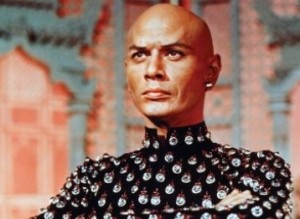
Yul Brynner as the King of Siam in The King and IIt’s a puzzlement!

In a recent online discussion of economic issues, a participant commented: “Government should not be charged with solving societal issues such as poverty, and this should be a society’s efforts to solve these problems through programs, charities, etc. sought by a willing group of individuals.” (I quote the comment as written; no editing.)

I don’t understand this compartmentalization of reality, this distinction of “government” as somehow separate from and different from “society”. I especially don’t understand it in a country whose founding document begins,

We the People of the United States, in Order to form a more perfect Union, establish Justice, insure domestic Tranquility, provide for the common defence, promote the general Welfare, and secure the Blessings of Liberty to ourselves and our Posterity, do ordain and establish this Constitution for the United States of America.

What is “society” if it is not “We the People”? And in our system of governance, the government, the sovereign, is also “We the People”. So how is it that “government” is distinct and different from “society” in the context of the United States of America? We the People decide by our votes who serves in “the government”. If we like the job they do, we vote them in again; if not, we vote them out. (There are a lot of people employed by “the government” who are not elected to it; but they are not “the government” — they are “government employees”. We can get rid of them, too, by voting out their elected bosses who are answerable to us.)

OK . . . so there’s that political framework puzzlement, but there’s also a religious puzzlement. Christian folk, especially conservative evangelical American Christian folk, love to pray the Psalms. Some of our most conservative brothers and sisters will allow no music in their worship other than the Psalms. So here we have a Psalm praying to God to give “the king” the power to “judge [God’s] poor with justice,” to “defend the cause of the poor,” to “give deliverance to the needy.” Later in the Psalm, “the king” is praised because he “delivers the needy when they call” (v. 12), he “has pity on the weak and the needy” and saves their lives (v. 13), he redeems their lives from oppression and violence (v. 14). In other words, he does all the things the participant in that conversation said the government shouldn’t do.

But the king was the government at the time the Psalms were written! We might be tempted to change king to president in an attempt to contextualize and modernize this Psalm to fit our American circumstance, but president would be the wrong word to substitute. The right word would be government. And an even more correct substitution would be We the People . . . for the king named in this Psalm was the sovereign and in our country We the People are the sovereign.

If we wish to pray this Psalm in our context, that would be the way to do it:

Give We the People your justice, O God,
and your righteousness to our children.
May We the People judge your people with righteousness,
and your poor with justice.
May the mountains yield prosperity for the people,
and the hills, in righteousness.
May We the People defend the cause of the poor of the people,
give deliverance to the needy,
and crush the oppressor.

Why the compartmentalization of life? Why the separation of government from society? Why the failure to see that what we revere in Holy Scripture, the righteousness prayed for the government in ancient Israel, ought to be our prayer for the government in modern America? Why the failure to see that it should be a prayer for ourselves? Why the refusal, as a society, as a nation, as the sovereigns of our nation’s government, to deliver the needy when they call, to have pity on the weak and the needy and save their lives, to redeem the lives of the poor from oppression and violence?

We the People are the society. We the People are the sovereign. We the People are the government. We the People are the ones called by this Psalm and charged by Holy Scripture with “solving societal issues such as poverty.” Why is this so difficult to comprehend?

As another king (a fictional one) was wont to say, “It’s a puzzlement!”

====================

Father Funston is the rector of St. Paul’s Episcopal Church, Medina, Ohio.

God’s in Control – From the Daily Office – September 18, 2012

From John’s Gospel:

The next day the great crowd that had come to the festival heard that Jesus was coming to Jerusalem. So they took branches of palm trees and went out to meet him, shouting,
“Hosanna! Blessed is the one who comes in the name of the Lord – the King of Israel!.”

(From the Daily Office Lectionary – John 9:12-13 – September 18, 2012)
 
2008 Electoral MapWe are living through a presidential election campaign in the United States. It seems to have been going on for ever, and the political ads and the news coverage of the candidates are increasing in intensity and in frequency. Pollsters take the public’s political pulse; commentators analyze the polls; the public reacts to the analysis; the pollsters re-poll the public. It’s a system of pendulum swings that feeds upon itself and oscillates back and forth. Flip-flopping candidates are matched by a flip-flopping electorate, and the candidates, their surrogates, and the commentators all decry the fickleness of the crowd.
But there is nothing new in a vacillating crowd, just look at today’s story of Jesus’ triumphal entry into Jerusalem. In just a few days, without the help of 24/7 television news and the internet, the same crowd will be whipped into a frenzy demanding Jesus’ execution. In their eyes, Jesus will go from king to criminal in less than a week! They will move from “Hosanna!” to “Hang him!” in four days’ time! Talk about a rapidly swinging electoral pendulum!

Of course, at this point in the American electoral process opinions are pretty much hardened; our electoral choices are probably rock-solid by now. The candidates are courting a small portion of voters, the so-called “undecided”. This group makes up under 10% of the voting public: a recent Wall Street Journal poll says only 3% of voters haven’t decided who they will vote for, while Gallup places the number at 8% at the highest. In physics terms, I suspect, the “amplitude” of the political pendulum’s oscillations is very small.

It was larger in Jesus’ time. As told in the Gospels, the swing involved nearly the whole crowd of visitors (and residents) in Jerusalem, not just a small (under 10%) group of “undecided” Jews.

Here’s what I take away from a comparison of the Jerusalem crowd and the American electorate, and the outcome of their and our decisions . . . in the long run, they were not in control and, frankly, neither are we. That’s not to say that we shouldn’t care, shouldn’t decide as carefully and prayerfully as we can, shouldn’t take part in the electoral process, shouldn’t vote. We should do all those things! But we should do so in the faithful assurance that, in the long run, God is and will be in control. The “Jerusalem electorate” chose badly; God redeemed that decision and used its result for the salvation of the world. However we choose, whatever the short term result, in the long term God will use it.

Archbishop William Temple, archbishop of Canterbury during the Second World War, once said:

“While we deliberate, God reigns.
When we decide wisely, God reigns.
When we decide foolishly, God reigns.
When we serve God in humble loyalty, God reigns.
When we serve God self-assertively, God reigns.
When we rebel and seek to withhold our service God reigns –
The Alpha and the Omega, which is and which was,
And which is to come, the Almighty.”

So we should do our homework. We should study the issues, review the candidates, take part in the process, vote in the election. We should do so hopefully and, regardless of the outcome, we should not despair. In the end, whatever decision we make, God’s in control!

====================

Father Funston is the rector of St. Paul’s Episcopal Church, Medina, Ohio.

Wonderfully and Marvelously Made – From the Daily Office – September 15, 2012

From the Psalms:

For you yourself created my inmost parts;
you knit me together in my mother’s womb.
I will thank you because I am marvelously made;
your works are wonderful, and I know it well.
My body was not hidden from you,
while I was being made in secret
and woven in the depths of the earth.

(From the Daily Office Lectionary – Psalm 139:12-14 (BCP Versification) – September 15, 2012)
 
I wasn’t sure whether I wanted to tackle what this portion of the evening Psalm for today brings to mind. After all, I love the Old Testament reading for today which is (as many have recently been) from the Book of Job; it is that wonderful chapter where God, having had enough of Job’s whining, finally answers him saying:

Who is this that darkens counsel by words without knowledge?
Gird up your loins like a man,
I will question you, and you shall declare to me.
Where were you when I laid the foundation of the earth?
Tell me, if you have understanding.

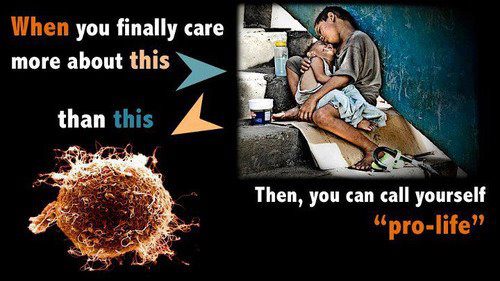
I just love God’s reply which basically says, “Who the Hell are you?” But as I was reading this lesson, I came upon this question that God asks, “Who shut the sea with doors when it burst out from the womb?” and that mention of a womb took me back to the evening Psalm and that took me back to a conversation I was part of earlier in the week. The conversation had to do with abortion, opposition to abortion, and what it means to be pro-life.

The conversation was sparked by this picture:

“Jesus,” said one party to the conversation, “commands us to care about both?”

“Where,” asked another party, “does Jesus command us to care about fetuses.”

Of course, Jesus does not; Jesus never made much mention of pregnancy or childbirth or care for the unborn. However, today’s Psalm might be read to lay the foundation for an understanding of God’s care for the unborn. The other party to the conversation didn’t go there, however. Instead, that person referred to Jesus’ citation of the second great commandmant: “Love your neighbor as yourself.” (Matt. 22:39) He continued with this assertion: “Since a baby in utero is a person and a child of God, the baby is your neighbor.” This statement is a logical as well as a theological stretch, I’m afraid, and here is where I started giving the issue some thought.

The reference to “a baby in utero” is fraught with issues. There is considerable debate today as to when a fertilized egg achieves the status of “baby”. It is not, however, at the moment of conception. Technically, from a medical point of view, a baby isn’t a baby until it’s born; “baby”, medically, refers to an infant, a newborn. From two months after conception until birth the child in utero is considered a fetus. During the first two months after conception, it is an embryo. (And then there are the theological issue of “ensoulment”, which is said to happen at “quickening”, and the legal issue of “viability”, which is the ability of the fetus to live outside the womb. Neither time nor space allow exploration of those issues.)

The second issue with the statement is in referring to whatever it is that is in utero as a “person”. Personhood is a legal concept and, in law, personhood is achieved at birth. (I’m not going to get into the currently hot political issue of whether corporations are people; that’s a whole other legal question.) Legally, a person is an autonomous being, a natural born man, woman, or child. The fertilized egg, embryo, or fetus in utero may be a person-in-potential, but is not yet a person-in-actuality. There are, of course, a number of proposed bills or constitutional amendments in several states that would change this legal definition, but as of now this is where American law stands.

Now, having said that, there are good reasons for being opposed to abortion, but basing that opposition on the supposed personhood of the in utero embryo or fetus, and stretching that personhood to neighbor status, and attaching Jesus’ “second great commandment” to that supposed neighbor just is not one of them. I’m opposed to abortion because I truly do believe, as this Psalm says, that God is involved in the procreative and developmental processes, that the development of the embryo into a fetus and the growth of the fetus are not simply mindless biological operations, that there is a mystical, spiritual “knitting” taking place, that we human beings are wonderfully and marvelously made by God. Abortion interferes with God’s work whereby we are “made in secret and woven in the depths of the earth.”

But I am also opposed to the outlawing of abortion because I hold what I believe is a fully consistent “pro-life” philosophy. I believe that one who is opposed to abortion must also be in favor of safeguarding the health and welfare of mothers before, during, and after giving birth. I believe that one must be in favor of improving the lives of children after they are born. A truly pro-life position would promote child and maternal welfare and health programs, feeding programs, education programs, and (I believe) access to safe and legal abortion in those circumstances where the life, health and safety of the mother are at risk, where the pregnancy results from rape or incest, or where there is medical reason to believe that the person-in-potential will be born with severe physical or mental developmental handicaps which would make life an intolerable burden. To be truly pro-life is to be pro-choice, because the choice is not between abortion or a baby; the choice is between a safe, legal abortion and an unsafe, deadly one. No woman should ever have to choose the latter!

To oppose abortion without supporting infant and maternal health programs, child welfare programs, good education, and access to safe and legal abortion when needed, is not a pro-life stance. It is simply to be pro-birth, but there is so much more to life after birth!

We are wonderfully and marvelously made, knit and woven together by God in our mother’s wombs, not just to be born but to have a life, a good life. That’s why, as opposed to abortion as I may be, I hold to a pro-life pro-choice position in favor of the availability of legally regulated, medically safe, accessible abortion for women who need to choose that path.

====================

Father Funston is the rector of St. Paul’s Episcopal Church, Medina, Ohio.

Unbind Him and Let Him Go – From the Daily Office – September 14, 2102

From the Gospel of John:

When Jesus saw [Mary] weeping, and the Jews who came with her also weeping, he was greatly disturbed in spirit and deeply moved. He said, “Where have you laid him?” They said to him, “Lord, come and see.” Jesus began to weep. So the Jews said, “See how he loved him!”
* * *
[Jesus] cried with a loud voice, “Lazarus, come out!” The dead man came out, his hands and feet bound with strips of cloth, and his face wrapped in a cloth. Jesus said to them, “Unbind him, and let him go.”

(From the Daily Office Lectionary – John 11:33-36,43-44 – September 14, 2012)
 
Icon of the Raising of LazarusMy father-in-law died a week ago; he will be laid to rest later today. His ashes will be interred next to those of my mother-in-law, his first wife, who passed away sixteen years ago. Marge was a Christian and an active church member; Paul was not. I’m not sure he was ever baptized but, if he was, he left that behind long ago. (Yes, I know the theology of baptism – once baptized, always baptized – and that may true from the church’s point of view, perhaps even from God’s perspective, but that was not Paul’s reality.)

There’s an old saw that “there are no atheists in foxholes,” but in our few, brief conversations about religious faith I learned from Paul how wrong that is. A communications specialist with the Air Force in World War II, Paul had seen plenty of death during combat and had been present at the liberation of one of the concentration camps; a personal encounter with the inhumanity of war and oppression had knocked any notion of God completely away. Paul simply didn’t believe. Coming face to face with the issue theologians and philosophers call “theodicy” had made religious faith impossible for him.

But Paul was a good man. Except for a couple of years during high school and those war years in Europe, Paul spent his entire life, all 95+ years of it, in the same small Nevada town. Everyone knew Paul and Paul would have done (and often did do) anything for any of his neighbors. I know that there will be a crowd at the memorial event the family has planned and that many will weep. Some (my wife and I among them) will quietly say prayers for this good man who didn’t believe but who lived his life the way believers are supposed to live theirs.

Despite the insistence of some on the Pauline requirement that salvation requires that one “confess with your lips that Jesus is Lord and believe in your heart that God raised him from the dead,” (Rom. 10:9) I cannot believe that my father-in-law is not among the saved. When I read the Gospels, I do not find Jesus laying down such requirements. Rather, I find him focusing on how one lives one’s life. I find him promising eternal life to those who do good, who help their neighbors, who care for those who cannot care for themselves, who provide food to the hungry, who make this world a better place because they have lived in it. By that standard, my father-in-law Paul is one of the saints in light. I’m quite confident that on that last great day, he will hear a voice crying “Paul, come out!” and that Jesus will say to whomever is handling the administrative details of the resurrection, “Unbind him, and let him go.”

May he rest in peace and (surely to his surprise) rise in glory!

====================

Father Funston is the rector of St. Paul’s Episcopal Church, Medina, Ohio.

Guilt Tripping Jesus – From the Daily Office Lectionary – September 13, 2012

Martha by David Leiberg, Visual Meditations on the GospelFrom the Gospel of John:

When Martha heard that Jesus was coming, she went and met him, while Mary stayed at home. Martha said to Jesus, “Lord, if you had been here, my brother would not have died.”

(From the Daily Office Lectionary – John 11:20-21 – September 13, 2012)
 
Today, my wife and I are traveling to her home town to bury her father who died last week. I hope beyond hope that no one will say to her, “I wish you had been here.”

My mother died thirteen years ago just before Christmas and those very words were said to me by my stepfather. Can you say, “Guilt trip”? I know that wasn’t his intent, but that’s sure how it felt. I had visited her a few weeks before the end, and my wife and daughter had been there just a few days before she passed away, but none of us were able to be there the week she died. The week before Christmas parish clergy and their families just don’t leave home! (Especially those of us who have no assistants, no staff to pick up the slack!) So I wasn’t there; I couldn’t be there; I regretted not being there; and the last thing I needed to hear was someone drive that point home! (A few years later when my stepfather died, I was en route to visit him when he died just a couple of hours before I arrived. My stepsister said, “I wish you could have been here” . . . . Déjà vu all over again!)

I’m pretty confident Martha wasn’t guilt-tripping Jesus (nor is her sister Mary a few verses later when she says exactly the same thing), but it sure sounds like it. Maybe she was. In fact, I cannot read her words without a tone of anger; try as I might, when this lesson comes up in the lectionary to be read at public worship, that’s how I read it. Parishioners have remarked on that, that they hear it even when I try for some other tone of voice.

Maybe she was angry. Anger, as Elisabeth Kübler-Ross taught us, is the second of the five stages of grief, right after denial. So it’s entirely possible that she was angry with Jesus. After all, she knew him well. She may have witnessed one or more of his acts of healing; she probably had expected him to come before her brother Lazarus’ death and make him well. But he didn’t and Lazarus died. That would be enough to piss you off! So maybe she was angry at Jesus.

And that’s OK. Jesus can take it. He does take it. He takes people’s anger all the time. As a parish priest I see it again and again. Angry people pissed off at God about whatever is wrong in their lives. They’re ticked at the Almighty and, somewhat contradictorily, they feel guilty about it. I tell them it’s OK, that there’s nothing to feel guilty about. “God’s a big boy,” I tell them, “he can take it.” (Hey! Don’t get all feminist and inclusivist on me. I know God’s not a boy. It’s a metaphor! OK?) And I tell them the story of Martha and Mary and how they got angry at Jesus and how Jesus accepted that and dealt with it lovingly. Go ahead, be angry. The best people to be angry with are the ones who love us. Like God.

But please, don’t guilt trip people who are also grieving and angry. Don’t say, “I wish you could have been here” (even though it’s true and even though you don’t mean it as a criticism). Mary and Martha had some reason to say it to Jesus; they knew he could have done something! None of the rest of us have his gifts.

====================

Father Funston is the rector of St. Paul’s Episcopal Church, Medina, Ohio.

Look Who I’m Talking To! – From the Daily Office – September 12, 2012

From the Gospel of John:

Thomas, who was called the Twin, said to his fellow-disciples, “Let us also go, that we may die with him.”

(From the Daily Office Lectionary – John 11:16 – September 12, 2012)
 
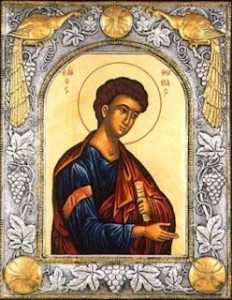
Icon of Saint ThomasCommentaries insist that all John is doing in identifying Thomas as having been “called the Twin” is translating his Semitic name into its Greek equivalent, Didumos meaning “two-fold, twain, or twin”. But I wonder why he does this? A strain of Christian gnosticism insisted that Thomas was Jesus’ twin brother! Wouldn’t that have been interesting? How would we explain the Incarnation if the “power of the Holy Spirit” which came over Mary and produced a child with no earthly father had actually resulted in twins? Only one of them would be the Incarnation? Would that even make sense? No, I don’t think the gnostics got that one right, at all. But still, I find it intriguing that John throws in this little tidbit that Thomas was called “the Twin.” (He does it three times! He must have thought it important! See also John 20:24 and 21:1.)

This intriguing fellow, after Jesus refuses his disciples’ advice and decides to go to Bethany to deal with the death of Lazarus, utters the words, “Let us go, that we may die with him.” Die with whom? Jesus, one supposes. But he could be referring to Lazarus. Let’s assume (as most others have before us) that he means Jesus. Can’t you hear the exasperation in his voice? One can almost hear sarcasm. I can envision Thomas turning to the other disciples and saying, as so many Jewish vaudeville comedians have done, “Look who I’m talking to!” Yet again Jesus declines to take the advice of those closest to him. Yet again he’s going to do something they think is foolish, dangerous, and ill-advised. Sure that Jesus is walking into some sort of death-trap, Thomas heaves himself up and says (probably with an indignant sigh), “C’mon! Let’s go get ourselves killed!”

For all his sarcasm and indignation, however, Thomas is the obedient disciple. He may have objections; he may have second thoughts. He may know all the reasons that what is asked of him is impractical but, after having his say, he is still going to do it because his Lord has asked it of him. Could it be that John is not calling him “the Twin” at all? Could it be that in naming him Didumos John is calling him “Thomas two-fold”? “Thomas who is of two minds”? Thomas who voices objections but carries through in any event?

That’s the tough part of the story to internalize and make my own, the carrying through anyway. I usually only get as far as the objections, the second thoughts, and the impracticalities, or at least I take a long time to get through them (when I do get through them). For example, I knew in high school that I was called to ordained ministry, but did everything possible to not respond to the call as a young man. In college, my university chaplain and my parish priest both encouraged me to make an application for postulancy and to consider seminary. I followed their urgings but, looking back, I realize I also did just about everything I could to undermine the process. I was successful – I was rejected by the Commission on Ministry of the Diocese of San Diego. They told me finish college, maybe get a graduate degree and then re-apply. “Yeah, right!” was my reply. That was in 1973. Fifteen years later after two graduate degrees and a career practicing law, several refusals to my then-bishop who often encouraged me to consider ordination, and a lot of nagging from God, I finally reapplied and quickly went through the process. Twenty-two ordained years later, I can’t imagine not being in the ministry.

I guess that’s why I find Thomas so intriguing and so beguiling. I can relate to someone who voices objections, who gets exasperated with God, who gets a little sarcastic with the Lord, who complains about what he’s asked to do. I’m sure that he knew it was pointless, that Jesus was going to get his way in the end . . . but he bitched and moaned anyway, just to have his say. (Sometimes, I think Thomas’ post-resurrection “doubt” was not so much disbelief, as just another incident of getting in a snarky little dig.)

The really intriguing and beguiling figure in the story, however, is Jesus. I can see him sitting there listening to Thomas with a wry little smile and an affectionate shake of the head. He knows Thomas is going to come along in the end, but he also knows that Thomas has to have his say first, and he lets him have it. In my mind’s eye I see Thomas, having voiced his complaints, heaved his sigh, and spoken his sarcasm, getting to his feet and being the first one out the door, Jesus following him, smiling affectionately, shaking his head, and thinking to himself, “Look who I’m talking to!”

====================

Father Funston is the rector of St. Paul’s Episcopal Church, Medina, Ohio.

« Older posts Newer posts »