Occasional thoughts of an Anglican Episcopal priest

Category: Daily Office (Page 59 of 70)

How Is It We Hear? – From the Daily Office – August 3, 2012

From the Book of Acts:

“How is it that we hear, each of us, in our own native language? Parthians, Medes, Elamites, and residents of Mesopotamia, Judea and Cappadocia, Pontus and Asia, Phrygia and Pamphylia, Egypt and the parts of Libya belonging to Cyrene, and visitors from Rome, both Jews and proselytes, Cretans and Arabs – in our own languages we hear them speaking about God’s deeds of power.”

(From the Daily Office Lectionary – Acts 2:8-11 – August 3, 2012)

These are the words spoken by the great crowd of Jews and others who thronged the streets of Jerusalem for the Festival of Shavu’ot when the Twelve, empowered by the Holy Spirit, begin to tell the story of Jesus in languages they had never before spoken. Shavu’ot is a celebration with both agricultural and historical significance in Judaism. It is known as the “festival of the first fruits,” a harvest feast when the first fruits were brought as offerings to the Temple; it is also known as the “festival of the giving of the Law,” a celebration of the handing down of Torah on Mt. Sinai. It was called Pentecost, a Greek word meaning “fiftieth”, because it always falls on the fiftieth day after the Passover. That year it fell on the fiftieth day after the Resurrection and, thus, the Christian feast of the Holy Spirit carries that name, as well.

Twenty centuries later, the Jews still celebrate Shavu’ot and Christians still celebrate Pentecost, but what a different world we inhabit. Can we still find meaning in the notion of offering the first fruits to God? Does the giving the Law still have significance? And what of all those languages and the Apostles’ unprecedented immediate linguistic skill?

For us North American Christians an agricultural feast seems a distant and remote idyllic pastoral fantasy. We are no longer connected to the land. Our culture has moved away from an agrarian basis, through the industrial revolution, even beyond a manufacturing basis; we now live in what is being called a “service economy”. We no longer generally produce anything tangible! What are the “first fruits” of non-productive labor in a service economy? It just boils down to money, I guess.

And what about the myth (a word I use with no disrespect intended and with no suggestion that the story’s point is untrue) of God giving the stone tablets to Moses? In a time when that Law has been largely set aside by Christians and even many Jews – in a time when most people have separated the secular civil laws of everyday life from religious observance and custom – in a time when we conceive of the law as something made (“like sausage”) by a group of bickering, nasty, polarized, do-nothing elected officials – in such a time, how are we to give thanks for “the law”? Do we even want to?

Which leaves me to ponder that gift of languages? There are still plenty of them and there are more, in a sense, than ever before; even as actual, spoken tongues die out for lack of use, new means of communication arise – emoticons and email abbreviations have birthed tweets and hashtags – Facebook and LinkedIn and their ilk are the new “crowded streets” – night-time Twitter conversations are held by church people discussing ways “social media” can be used to spread the Gospel – tongues of flame seem to dance on computer monitors and laptops, on tablets and smartphones.

How is it we hear? How is it we understand? How is it we grasp the ancient truths of receiving the Law, the offering the first fruits, experiencing God’s deed of power? I’ve no doubt that hearing and understanding and comprehension are going on . . . but I often wonder if the church (the institution, not the people) is playing any part in that process of communication and comprehension. I hope and pray the Holy Spirit will alight upon us all and give us the gifts we need to do so, so that all may hear and understand in whatever “language” they best comprehend.

====================

Father Funston is the rector of St. Paul’s Episcopal Church, Medina, Ohio.
Ordained Ministry: The Full Inclusion of Women – From the Daily Office – August 2, 2012

From the Book of Judges:

At that time Deborah, a prophetess, wife of Lappidoth, was judging Israel. She used to sit under the palm of Deborah between Ramah and Bethel in the hill country of Ephraim; and the Israelites came up to her for judgement.

(From the Daily Office Lectionary – Judges 4:4-5 – August 2, 2012)

So . . . how is it (would someone please explain to me) that people have a problem with women in leadership roles in religious communities? Say, for example, as presbyters or bishops in the church? Today’s Daily Office reading is but one example of women in the Holy Scriptures exercising leadership among God’s People. If Deborah could be a prophetess and a judge over Israel, what is it that prevents a woman from being a priest and an overseer over the church?

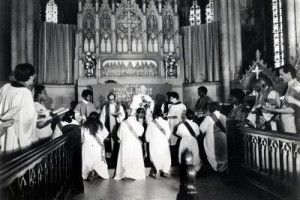
Ordination of the Philadelphia ElevenThis past Sunday, the Episcopal Church marked the 28th anniversary of the women known as “the Philadelphia Eleven” who were ordained on July 29, 1974. Four retired bishops (Daniel Corrigan, Robert DeWitt, Edward Welles and George Barrett) chose to defy the General Convention of the Episcopal Church which, at its regular triennial meeting in 1973, had voted against opening the priesthood to women; women were already eligible for ordination as deacons. Joined by male presbyters who supported them and the candidates, they ordained eleven women deacons to the priesthood: Merrill Bittner, Alla Bozarth-Campbell, Alison Cheek, Emily Hewitt, Carter Heyward, Suzanne Hiatt, Marie Moorefield Fleisher, Jeannette Piccard, Betty Bone Schiess, Katrina Martha Swanson, and Nancy Hatch Wittig. Shortly thereafter, four additional women were also “irregularly” ordained: Eleanor Lee McGee, Alison Palmer, Betty Powell, and Diane Tickell. A firestorm of controversy erupted in the church: charges were filed against these dissident bishops (Daniel Corrigan, Robert DeWitt, Edward Welles and George Barrett) and an emergency meeting of the Episcopal House of Bishops was convened on August 15, 1974.
However, the “stained glass ceiling” had been shattered. The next meeting of the General Convention was held in September 1976, and a resolution to change the church’s canon law to allow the ordination of women for all three orders of ministry (bishop, priest, and deacon) was adopted. Since then women’s ordained ministry has been recognized not only in the Episcopal Church but in several provinces of the Anglican Communion and has proven a great blessing to the Church.

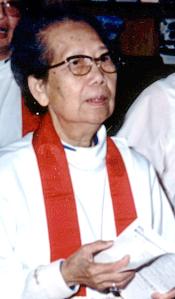
The Rev. Florence Li Tim-OiThese women were not the first to be ordained to the Anglican priesthood, however. During the Second World War, Florence Li Tim-Oi was ordained to the presbyterate on January 25, 1944, by the Rt. Rev. Ronald Hall, Bishop of Hong Kong, in response to the crisis among Anglican Christians in China caused by the Japanese invasion. No male clergy could be found who were willing to take on the onerous ministry, but Ms. Li was, so she was ordained and served with distinction. After the war, the Archbishop of Canterbury sought to make the bishop and the priest rescind the ordination, but neither did. Ms. Li voluntarily ceased serving as a priest until more than 30 years later when she immigrated to Canada where the Anglican Church, following the Episcopal Church’s lead, had begun to ordain women. Her priesthood was recognized and she served as an honorary canon in Toronto, ministering among the immigrant Chinese population.

These women have stood in the footsteps of Deborah and other women described in Scripture (in both the Old and New Testaments) who led and served God’s People. The great women leaders of the Bible demonstrate, as do the fruits of ministry of these women and the many who followed them, I believe, that there is and should be no impediment to the full inclusion of women in all orders of the church’s ministry. I simply do not understand how anyone could believe otherwise.

====================

Father Funston in the rector of St. Paul”s Episcopal Church, Medina, Ohio.

“Magic and Superstition”? Not At All – From the Daily Office – August 1, 2012

From the Acts of the Apostles:

So when they had come together, they asked him, “Lord, is this the time when you will restore the kingdom to Israel?” 7He replied, “It is not for you to know the times or periods that the Father has set by his own authority. But you will receive power when the Holy Spirit has come upon you; and you will be my witnesses in Jerusalem, in all Judea and Samaria, and to the ends of the earth.” When he had said this, as they were watching, he was lifted up, and a cloud took him out of their sight. While he was going and they were gazing up towards heaven, suddenly two men in white robes stood by them. They said, “Men of Galilee, why do you stand looking up towards heaven? This Jesus, who has been taken up from you into heaven, will come in the same way as you saw him go into heaven.”

(From the Daily Office Lectionary – Acts 1:6-11 – August 1, 2012)

Salvador Dali, Ascension of ChristHave you ever done that thing on a public street corner where a couple of people stand there looking up and pretty soon some passing pedestrian, wondering what they are gazing at, will stop and look up, and then another and then another and so on until a lot of people are looking up into the sky at nothing for no reason? I have an image of that in my mind when I read the this passage, although in this case the “men of Galilee” are not looking at nothing for no reason. They are looking at something they can no longer see, except in their minds’ eye, and it is certainly not “for no reason” that they are doing so. Something phenomenal has happened to them; someone they thought had been killed by the authorities had returned from the dead, had eaten with them, talked with them, appeared to them over the course of over seven weeks, and now he had “ascended into heaven.” They had plenty of reason to stand there staring into the sky into which he had apparently gone.

In the past few days, I read a critique of a recent gathering of “emergent church” leaders in which the author lambasted the presentations made there as fitting “very neatly into a 4th century church gathering.” He then went on to say that as a “progressive” Christian he rejected the notion that Christians “have to believe in the Trinity, incarnation, substitutionary death, literal physical resurrection/empty tomb, and imaginary Santa Claus in the clouds.” And he concluded saying that he is “very impatient with magic and superstition that passes for religion in the 21st century.”

I am left to wonder what of Christianity is left after rejecting very nearly every doctrine set forth in the Nicene and Apostle’s Creeds. One may agree with him about the substitutionary atonement theories of what occurred in Christ’s death and resurrection, and needless to say one thoroughly agrees that God is not an “imaginary Santa Claus in the clouds” – but I ask again, rejecting the other things in the list, what of Christianity is left? The men of Galilee clearly would have been looking up into the sky at nothing for no reason if this fellow is correct in his rejection of the “magic and superstition” that he apparently believes creedal and doctrinal Christianity to be.

But I don’t believe that it is that, at all! During the past couple of weeks, I have been re-reading the theology of Dorothy L. Sayers. In one of her essays entitled The Greatest Drama Ever Staged she tackles the assertion that the Christian story is “dull”. After briefly rehearsing (in her own inimitable style) the story of Jesus as related in the synoptic Gospels she writes:

So that is the outline of the official story – the tale if the time when God was the underdog and got beaten, when He submitted to the conditions He had laid down and became a man like the men He had made, and the men he had made broke Him and killed Him. This is the dogma which we find so dull – this terrifying drama of which God is the victim and hero.

If this is so dull, then what, in Heaven’s name, is worthy to be called exciting?

In another of her essays, Creed or Chaos?, she writes:

It is worse than useless for Christians to talk about the importance of Christian morality, unless they are prepared to take their stand upon the fundamentals of Christian theology. It is a lie to say that dogma does not matter; it matters enormously. It is fatal to let people suppose that Christianity is only a mode of feeling; it is vitally necessary to insist that it is first and foremost a rational explanation of the universe. It is hopeless to offer Christianity as a vague idealistic aspiration of a simple and consoling kind; it is, on the contrary, a hard, tough, exacting, and complex doctrine, steeped in a drastic and uncompromising realism.

And here Ms. Sayers answers my question about the “progressive” Christian’s dismissal of the “magic and superstition” of dogma, of creed and doctrine; what is left is simply “a mode of feeling” and “a vague idealistic aspiration of a simple and consoling kind.” What is left, in my opinion, is indeed dull and not worthy to be called religion!

It seems to me that gathering for “Christian” worship in such a context would be not too much different from standing on the street corner looking up at nothing. If you only thought of God as an imaginary Santa Claus in the clouds, and didn’t believe in the Incarnation or the Resurrection, what would you be looking to? And if someone joined you, what could you point them toward? No, the men of Galilee were not standing there staring up into the sky looking at nothing for no reason, and neither are we. They were staring in bemused amazement and wonder that they had been privileged to be in the company of the Creator of the Universe who had been pleased to call them and us “friends” and had given them and us the task of changing the world! And that is what our dogmas, our creeds, and our doctrines signify. They are not “magic and superstition”; they are, as Miss Sayers said, “first and foremost a rational explanation of the universe.”

====================

Father Funston in the rector of St. Paul’s Episcopal Church, Medina, Ohio.

Bombast and Bluster: American Political Discourse – From the Daily Office – July 31, 2012

From the Psalms:

Those of high degree are but a fleeting breath, *
even those of low estate cannot be trusted.
On the scales they are lighter than a breath, *
all of them together.
Put no trust in extortion;
in robbery take no empty pride; *
though wealth increase, set not your heart upon it.

(From the Daily Office Lectionary – Psalm 32:10-12, BCP versification – July 31, 2012)

WARNING: I reveal my politics in this post. If you don’t want to read about them, don’t continue!

There are no words that can adequately convey how thoroughly disgusted I am with the tone and content of political discourse in the United States of America as we approach the November 2012 elections. I make no bones of the fact that I am a liberal or a “progressive” as the Left now calls itself. My favorite senator is Bernie Sanders of Vermont. If there were a functioning Socialist Party in the US, I’d probably be a member. As it is, I’m an independent who tends to vote for Democrats, but frequently I find myself not voting for any standing candidate.

I am not one of those who goes in for the false equivalency of saying, “Both sides do it.” Yes, there are some on the Left who go overboard in their rhetoric, but in my estimation and opinion it is the Right, the Republican Party and the so-called Tea Party, who engage in the worst of the political nonsense. Much of what one finds on the internet coming from those quarters is racist and inflammatory; it is ill-informed; it is downright false and untrue. The words of our president or other Democrats are taken out of context and twisted completely away from their original meanings . . . the gullible, party-faithful fall for it and parrot it back without ever checking the facts. Statistics are distorted and history is ignored. It’s shameful!

But the worst of it all is the constant barrage of bombast in favor of continuing tax cuts for the wealthiest Americans on the grounds that they are “job creators”! They are not! Money put into the pockets of people who already have plenty of money does not make its way into the marketplace. Money in the pockets of business owners does not encourage them to hire people. It is only money given to those who actually spend it, to the middle-class consumers who create product demand, that creates jobs. This is simple economics which our politicians are simply ignoring.

Which brings me to the admonitions of today’s Psalm: “Though wealth increase, set not your heart upon it.” Increasing the wealth of those of “high degree” who are “but a fleeting breath” is not the way to increase the prosperity of the people. It accomplishes none of the good we are to accomplish under the Law of Moses or the mandate of the Gospel! It does not further love of God nor of our neighbor. It does not feed the hungry, house the homeless, clothe the naked, nor heal the sick; it does not increase care of the widow or the orphan or the stranger who is in our land. It accomplishes nothing, not a shred of those things the Bible commends society to do. So long as our political discourse focuses only on questions of wealth and its increase, it serves no good purpose, whether it is the bombast of the Right or the bluster of the Left.

There are no words that can adequately convey how thoroughly disgusted I am with the tone and content of political discourse in the United States of America as we approach the November 2012 elections, but these will have to do: our political discourse does not honor God; it does not honor our neighbor; it does not honor our country. It is an embarrassment.

====================

Father Funston in the rector of St. Paul’s Episcopal Church, Medina, Ohio.

In Praise of Anonymous Church Members – From the Daily Office – July 30, 2012

Paul wrote to the Romans:

I commend to you our sister Phoebe, a deacon of the church at Cenchreae, so that you may welcome her in the Lord as is fitting for the saints, and help her in whatever she may require from you, for she has been a benefactor of many and of myself as well.

(From the Daily Office Lectionary – Romans 16:1-2 – July 30, 2012)

As the letter to the Romans draws to a close, Paul sends greetings to several persons by name: Phoebe (named here), Prisca, Aquila, Epaenetus, Mary, Andronicus, Junia, and many others. As I read through there names, I cannot help but wonder who these otherwise forgotten church members were. What were their roles in the church? What did they do outside the church?
Each Sunday in my congregation, following the tradition of the Episcopal Church, we pray for

The Universal Church, its members, and its mission,
The Nation and all in authority
The welfare of the world
The concerns of the local community
Those who suffer and those in any trouble
The departed . . . . (BCP 1979, page 35)

We prepare a master prayer list for the Prayer Leader which includes various names under each of these categories: other congregations, dioceses, and provinces together with their clergy and bishops; the president, our governor, soldiers serving overseas; those who are celebrating birthdays or anniversaries; those who are ill or injured; those who have died and those who are bereaved. As these names are read out, most in the congregation know who some of them are, but probably no one knows them all. And in a few years time, and certainly after a century or more, someone reading the prayer list will have little if any idea who any of them are. The list will be as strange and curious as Paul’s extended greetings at the end of this letter.

And yet, these people are the church! Without such people there would be no church. The church is nothing without the people. It is not the buildings; it is not the organization or the hierarchy. The church is the people of God, nothing else. The church consists of these unremarkable individuals who go about their daily lives trying to do what is right, trying to serve one another and the world around them, praying for one another and for others, doing their best to live out the gospel as they understand it.

I am reminded of Ben Sira, the author of the apocryphal book called Ecclesiasticus, who after praising the great and memorable added, “Of others there is no memory; they have perished as though they had never existed; they have become as though they had never been born, they and their children after them. But these also were godly men, whose righteous deeds have not been forgotten.” (Ben Sira 44:9-10)

So as we come to the end of Paul’s letter to the church in Rome with his greetings to those important church members who have otherwise been forgotten, let us praise church members who go quietly through their days doing their best to serve God, giving time and treasure as they are able, whose names will not be remembered or known beyond a small circle of fellow Christians, but who are the true pillars of the church. Let us praise them and thank them, and thank God for them.
====================

Father Funston in the rector of St. Paul’s Episcopal Church, Medina, Ohio.

Always the Poor – From the Daily Office – July 19, 2012

From Matthew’s Gospel:

Now while Jesus was at Bethany in the house of Simon the leper, a woman came to him with an alabaster jar of very costly ointment, and she poured it on his head as he sat at the table. But when the disciples saw it, they were angry and said, “Why this waste? For this ointment could have been sold for a large sum, and the money given to the poor.” But Jesus, aware of this, said to them, “Why do you trouble the woman? She has performed a good service for me. For you always have the poor with you, but you will not always have me.”

(From the Daily Office Lectionary – Matthew 26:6-11 – July 19, 2012)

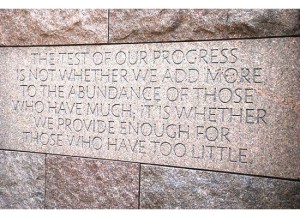
In yesterday’s gospel lesson Jesus told the story of the king separating the righteous form wicked as a shepherd separates sheep from goats and saying “As you care for the poor, you care for me.” It reminded me of a few cogent remarks that have been made about the measure of society – From Samuel Johnson: “A decent provision for the poor is the true test of civilization.” From Mahatma Ghandi: “A nation’s greatness is measured by how it treats its weakest members.” From Franklin Delano Roosevelt: “The test of our progress is not whether we add more to the abundance of those who have much, it is whether we provide for those who have too little.”
Now is Jesus giving up? “You will always have the poor with you.” Is he saying, “No matter how much you do for the poor, it won’t be enough”? And then he says, “But you won’t always have me,” which excuses the act of costly worship performed by the unnamed woman. So fancy rituals are to be preferred to service to those in need? Is that what this means?

I think not, at least I hope not. I believe that Jesus is making reference to an observation in the Book of Deuteronomy: “Since there will never cease to be some in need on the earth, I therefore command you, ‘Open your hand to the poor and needy neighbor in your land.'” (Deut. 15:11) What appears to be going on in this incident is an illustration of timeliness and priority. Service to the poor is a constant obligation but, at that particular time and place, service to Jesus as he prepared to die took priority.

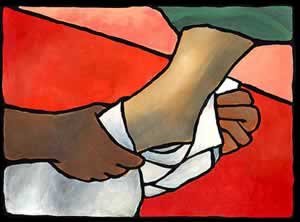
Worship and adoration of God are a priority; in fact, they may be the central priority of the church. An occasional foray into what we might call “pure” worship (the sort of ritual and ceremony Christians do on Sunday morning, for example) is certainly needed, but constant worship as an activity of everyday life is what is enjoined, constant worship in the context of constant service. “Rejoice in the Lord always; again I will say, Rejoice.” (Philip. 4:4) The key word is “always” – not just in the special moments when take time to wash and anoint his feet. We must, as Brother Lawrence admonishes, accustom ourselves to continual conversation with God; this can and should be done in all we do, especially in and during our service to poor whose feet also need washing (remember Bishop Weston’s words quoted yesterday).

Recently, I heard a preacher suggest that a way to understand Jesus’ reference to Deuteronomy, his statement that “you always have the poor with you,” is that it is with the poor that Jesus’ followers will be found; if we truly live out his gospel, we always will be found among and serving the less fortunate of society. This is as much worship as the Mass on Sunday.

So there is no real dichotomy; there was no “giving up”. There was, simply, a recognition of time and place and priority. And the statement of an unfortunate truth: we always have the poor with us.

====================

Father Funston in the rector of St. Paul’s Episcopal Church, Medina, Ohio.

The Heart of the Gospel – From the Daily Office – July 18, 2012

Jesus told of the separation of sheep and goats:

The king will say to those at his right hand, “Come, you that are blessed by my Father, inherit the kingdom prepared for you from the foundation of the world; for I was hungry and you gave me food, I was thirsty and you gave me something to drink, I was a stranger and you welcomed me, I was naked and you gave me clothing, I was sick and you took care of me, I was in prison and you visited me.” Then the righteous will answer him, “Lord, when was it that we saw you hungry and gave you food, or thirsty and gave you something to drink? And when was it that we saw you a stranger and welcomed you, or naked and gave you clothing? And when was it that we saw you sick or in prison and visited you?” And the king will answer them, “Truly I tell you, just as you did it to one of the least of these who are members of my family, you did it to me.”

(From the Daily Office Lectionary – Matthew 25:34-40 – July 18, 2012)

More than any other story in all of the gospel accounts, this one underscores for me what is at the heart of the Good News of Jesus Christ: love of neighbor, service to others, care for those who are unable to care for themselves, and in so doing to demonstrate our love of God.

The First Letter of John sums it up beautifully: “Those who say, ‘I love God,’ and hate their brothers or sisters, are liars; for those who do not love a brother or sister whom they have seen, cannot love God whom they have not seen. The commandment we have from him is this: those who love God must love their brothers and sisters also.” (1 John 4:20-21)

Samuel Johnson was quoted by his biographer, James Boswell, as saying “A decent provision for the poor is the true test of civilization.” A similar sentiment, “A nation’s greatness is measured by how it treats its weakest members,” is attributed to Mahatma Ghandi. In his second inaugural address, President Franklin Delano Roosevelt said, “The test of our progress is not whether we add more to the abundance of those who have much, it is whether we provide for those who have too little.”

In the sacristy of the first church I served as a cleric (which was also the parish that raised me up as a candidate for Holy Orders) was a quotation from the Rt. Rev. Frank Weston, Bishop of Zanzibar from 1908 until his death in 1924. Speaking at the conclusion of a worldwide Anglo-Catholic Congress in London the year before his death, Bishop Weston had reminded his listeners, “You cannot claim to worship Jesus in the Tabernacle, if you do not pity Jesus in the slum.” He concluded his speech with these words:

You have got your Mass, you have got your Altar, you have begun to get your Tabernacle. Now go out into the highways and hedges where not even the Bishops will try to hinder you. Go out and look for Jesus in the ragged, in the naked, in the oppressed and sweated, in those who have lost hope, in those who are struggling to make good. Look for Jesus. And when you see him, gird yourselves with his towel and try to wash their feet.

This message has been proclaimed by many speakers in many ways and at many times, but however it is said, it all boils down to the simple fact that as and what we do for the least in our community, we do for God. If we fail to provide for them, all our words and rituals count for nothing. This is the heart of the gospel.

====================

Father Funston in the rector of St. Paul’s Episcopal Church, Medina, Ohio.

Risky Talents – From the Daily Office – July 17, 2012

Jesus told the parable of the talents:

The one who had received the one talent also came forward, saying, “Master, I knew that you were a harsh man, reaping where you did not sow, and gathering where you did not scatter seed; so I was afraid, and I went and hid your talent in the ground. Here you have what is yours.” But his master replied, “You wicked and lazy slave! You knew, did you, that I reap where I did not sow, and gather where I did not scatter? Then you ought to have invested my money with the bankers, and on my return I would have received what was my own with interest.

(From the Daily Office Lectionary – Matthew 25:24-27 – July 17, 2012)

You know this story. A rich man goes away for some period of time entrusting huge amounts of wealth to his servants. To one he gives five talents, an amount of silver roughly the value of one hundred years of work of an ordinary laborer. To another two and to the third one. The first two use the money and double it. The third, timid and fearful of his employer’s reprisal should he lose it, buries it in the ground. Upon the owner’s return, he is punished for failing to invest the money.

It seems unfair that he should be punished for giving back exactly what he was given. He hasn’t wasted the property; he hasn’t squandered it or take it for his own. The rich man got back every thing he left with him.

I’ve always thought that if the servant had invested the money and lost it, there would have been no punishment. I believe that if the investment had been well thought out, even if it failed, the rich man would have shrugged it off and said, “Fair play!” This isn’t a story about rewarding success; it’s a story about rewarding risk. It’s a story which encourages us to move out of our comfort zones, take a risk, and try something. Jesus wants his followers to take risks; he certainy took plenty of them himself.

It’s been said that Christianity is an adventure of the spirit or it is not Christianity. Christians are called to eschew safety and security, and do the tasks that only Jesus’s people can do. We are called into ministries that take us out of our comfort zones and stretch us beyond the circle of relationships and practices with which we are familiar in our usual faith communities. All around us there are opportunities for extraordinary and life-changing interaction with other people, but require that we move into greater uncertainty and engage in activities in which we have a great chance of feeling discomfort, encountering resistance, or being required to make personal sacrifice.

The author Jack London once wrote:

I would rather be ashes than dust!
I would rather that my spark burn out in brilliant blaze than it be stifled by dry rot.
I would rather be a superb meteor, every atom of me in magnificent glow, than a sleepy and permanent planet.
The proper function of man is to live, not exist.
I shall not waste my days in trying to prolong them.
I shall use my time.

Whatever talents we have been given, we are to use them, not bury them in the ground.

====================

Father Funston in the rector of St. Paul’s Episcopal Church, Medina, Ohio.

A Prostitute & An Unscrupulous God – From the Daily Office – July 16, 2012

From the Book of Joshua:

Joshua son of Nun sent two men secretly from Shittim as spies, saying, “Go, view the land, especially Jericho.” So they went, and entered the house of a prostitute whose name was Rahab, and spent the night there.

(From the Daily Office Lectionary – Joshua 2:1 – July 16, 2012)

This is one of the things that I find so captivating about the Old Testament: its heroes and heroines are not supermen and superwomen. They aren’t even regular, run-of-the-mill folks. They are often, as here, the outcasts and sinners, the morally flawed, the ethically ambiguous, the folks who were looking out for themselves as much as they were trying to do something good (sometimes a lot more the former than the latter). “A prostitute whose name was Rahab” was as capable of doing God’s work as was a Levite, a priest, or a great military leader.

Furthermore, the manner in which she did the Lord’s work is, to be brutally honest, a bit suspect; at best her motives and her methods were morally questionable. Not only did she allegedly practice an immoral profession, she was disloyal to her city, lying to the civil authorities and striking a bargain with the enemy for favorable treatment for her self and her family. Nonetheless, she holds a place of honor in the story of God’s People. According to tradition, she became a true and sincere convert to the religion of Yahweh, married Joshua, and became the ancestress of several priests and prophets, including Jeremiah.

Recently, a friend quoted a familiar aphorism sometimes attributed to Abigail Van Buren (the “Dear Abby” pen name of Pauline Phillips): “The church is a hospital for sinners, not a museum of saints.” The story of Rahab is a case in point. To be one of God’s people doesn’t require perfection. One need not be morally pristine or ethically pure; one’s motives need to be immaculate. What is required is faithfulness, not spotlessness. As the writer of the Letter to the Hebrews made note, “By faith Rahab the prostitute did not perish . . . .” (Heb. 11:31)

Human beings are rarely pure in any way and in most things our motives are mixed. God is more than willing for us to come into God’s company as sullied as we may be. In fact, God is not above using our imperfections! C.S. Lewis hit the nail on the head when he wrote, “God is, if I may say it, very unscrupulous.” (Surprised by Joy) The story of Rahab just proves his point.

====================

Father Funston in the rector of St. Paul’s Episcopal Church, Medina, Ohio.

Gentle Rain or Category-5 Storm? – From the Daily Office – July 13, 2012

Moses said:

Give ear, O heavens, and I will speak;
let the earth hear the words of my mouth.
May my teaching drop like the rain,
my speech condense like the dew;
like gentle rain on grass,
like showers on new growth.
For I will proclaim the name of the Lord;
ascribe greatness to our God!

(From the Daily Office Lectionary – Deuteronomy 32:1-3 – July 13, 2012)

The 77th General Convention of the Episcopal Church has just concluded and, I know from having been a deputy or a volunteer at past conventions, those who attended had a wonderful time (unless they came away righteously angry over one action or another, in which case they are now thoroughly enjoying being in the “right” while the rest of the church, they are sure, is going to Hell in a hand-basket). But I do wonder whether the actions of #GC77 (as the Twitter hashtag named it) will “drop like the rain” and “condense the like dew” and provide gentle nurture for “new growth.”

In preparation for the Convention, all the delegates received a massive paperback tome called “The Blue Book” – I don’t know if it was actually blue, sometimes it is, sometimes it isn’t. This book contains all the proposed legislation the bishops and deputies will be asked to deal with, together some other materials needed for the efficient running of the assembly. I’m told that this triennium’s book ran to nearly 800 pages! Upon arrival at the convention, the church’s legislators also receive a huge 3-ring notebook of changes to what’s in the Blue Book, together additional reports and proposed legislation: pages are added to or replaced in this binder at every session of the convention throughout the several days of legislative sessions.

At GC77, when all was said and done, there were 441 pieces of business (resolutions, canonical changes, elections, budget, special business). 441! That’s impossible! Even if, on average, each of these items were to receive 10 minutes of floor time, it would take over 73 hours of legislative time in each of the two “houses” to deal with them all. The GC77 schedule included less than 43 hours of legislative time for the bishops and deputies. In other words, each item of business brought to the convention, received an average of under six minutes of deliberative consideration. (Many received none at all; a few received a lot more!)

The reason for all of this, of course, is micromanagement and wastes of time. One of the proposed resolutions (one that was adopted) was A015 entitled “Commend Democratic Movements in the Middle East and North Africa.” (An “A” resolution is proposed by a committee, commission or other body of the national church.) It had four resolves: to commend the “Arab Spring”; to call on the US government to exercise leadership; to reaffirm a resolution from 21 years before; and to urge the President to seek accountability from recipients of foreign aid. That’s all well and good, but is dealing with what is essentially a “feel good” resolution requiring no action by the church a proper, productive, or efficient use of the time of nearly 850 deputies and 165 bishops? I suggest that it is not.

Evelyn Manzella's Materials from GC77This overload of unproductive work is not a “gentle rain” . . . this is a Category-5 hurricane, a tsunami, a deluge of biblical proportions! Actually, the thought did occur to me that it’s bigger than “biblical proportions” – the Law of Moses, the Torah, the Pentateuch, the first five books of Holy Scripture, the word of God to the Chosen People for all time (whatever one calls it) in my Oxford Annotated Bible only takes up 308 pages (complete with footnotes). The word of GC77 to the people of the Episcopal Church for a mere three years is more than twice the size, not including the loose-leaf supplement!

Of course, there are significant things that came out of the convention. A rite to bless the relationships of same-sex couples making a life-long commitment to one another, for example. (That probably won’t be received everywhere as a “gentle rain” fostering “new growth”!) And there is what seems to be a commitment to a new re-envisioning and restructuring the church, which looks like a good thing. (Of course, adoption of that resolution was followed by the election of leadership that is anything but new – capable and dedicated, I know, but let’s be honest – these folks are part of the well-entrenched, long-experienced cadre of church governors.)

My hope for the Episcopal Church after GC77 comes not from the formal actions of the legislative houses, nor from the elections of those who will manage the church’s official affairs for the next three years. It comes from the emergence of things like The Acts 8 Moment and from the commitment of a new generation of clergy and lay leadership who appear more interested spreading the gospel of Jesus Christ than in micromanaging the church, in proclaiming the name of the Lord and ascribing greatness to our God than in passing feel-good resolutions.

And in that there is hope for teaching that will foster new growth!

====================

Father Funston is the rector of St. Paul’s Episcopal Church, Medina, Ohio.

« Older posts Newer posts »