Paul wrote:
When you were slaves of sin, you were free in regard to righteousness. So what advantage did you then get from the things of which you now are ashamed? The end of those things is death. But now that you have been freed from sin and enslaved to God, the advantage you get is sanctification. The end is eternal life. For the wages of sin is death, but the free gift of God is eternal life in Christ Jesus our Lord.
(From the Daily Office Lectionary – Romans 6:20-23 – July 2, 2012)
 I am still thinking of my Sunday sermon from yesterday’s Revised Common Lectionary lessons. We had chosen to follow “track 2” of the Lectionary and so read from the Book of Wisdom: “God did not make death, and he does not delight in the death of the living . . . . but through the devil’s envy death entered the world.” (Wis. 1:13,2:24) Paul seems to be drawing on exactly the same thought: life is the gift of God, death is the result of the things of sin. As I said yesterday, God is not in the business of death. ~ So why is it that in our modern society the most publicly zealous followers of Jesus, a certain segment of American evangelical Christians, seem to embrace a culture of death? Why do they support capital punishment, get behind exporting war into other countries, applaud when abortion clinics are bombed, and defend our government when intelligence services or military engage in “water-boarding” to gather information? As a political comedian and comentator who also happens to be a Catholic Christian notes, only in America “can you be pro-war, pro-torture, pro-death penalty, pro-land mines, pro-unmanned drones and still call yourself ‘pro-life’.” Well, really, one can’t. Those things aren’t “pro-life” and it’s just hypocrisy to claim that title while promoting a culture of death, a culture that is the result of sin, that is the outcome of the devil’s envy. None of those things are “pro-life” and (in my theological opinion) none can be reconciled with Christian faith. “God did not make death, and he does not delight in the death of the living.” Neither should God’s people.
(Note: The accompanying photograph is from Dazzling Design, to which the photograph links. There are some very creative photo images to be found there.)
 The end of June and we’re reading about Jesus’ triumphal entry? OK, whatever . . . . ~ At this time of year and at this particular time in the life of the Episcopal Church (just before the General Convention), my attention is drawn to the last sentence of today’s gospel lesson, the fact that people told one another about Jesus. ~ A couple of days ago, I mentioned a
  Paul’s logic is sometimes hard to follow and his rhetoric is often overblown, and he certainly had a tendency to go on and on about some things, but this point he makes clearly and simply, and concludes: “By one man’s obedience the many will be made righteous.” (v. 19) ~ This gets back to something I addressed in an earlier meditation: theories of the atonement and how it works for us. How is that we are saved? Is it by our faith in Jesus or through Jesus faith in God the Father and through his act of faithfulness to his message and mission? In this passage from Romans, Paul makes it clear that it is Christ’s obedience, his faith, his righteousness, not our own, that wins our salvation and accomplishes atonement. ~ There are many theories of how the atonement works. Theologically, I don’t think any of them really work. The best thing I’ve ever heard about how it works is from a Baptist preacher from Texas named Gerald Mann: “I have never understood all of those theories about how Christ atoned for our sin, but I do know that somehow in the cross event, God took upon Himself the blame for having created a world where things can go wrong. The resurrection is God’s declaration that eventually things will go right.” ~ And I am reminded of a line from the recent movie Best Exotic Marigold Hotel. Sonny, the youthful innkeeper (played by Dev Patel), says to one of the elderly English guests (I can’t remember which one), “We have a saying in India, ‘Everything will be alright in the end… if it’s not alright, then it’s not the end’.” Through one man’s act of righteousness everything will be alright in the end.
 We all know how this one goes. The owner hired more workers at various times throughout the day, finally hiring some who worked only one hour. At the end of the day, he paid all of the workers the same wage regardless of the time they worked. The earliest hired thought that was unfair and complain, to which the owner replied, basically, that he paid them what they agreed. Jesus ends with the famous aphorism, “So the last will be first, and the first will be last.” ~ Every time I read this passage the words that strike me most are “I will pay you whatever is right.” The definition of “right” in this circumstance, it seems to me, depends on who one is in the story, especially if it is set in our modern capitalist society. Perhaps not in Jesus’ time and place, but in our time and country with religious pluralism and economic disparity the definition of “right” is a variable thing. For the employer, a “right” wage would be that which maximizes his profit. For the supervisor in the vineyard, a “right” wage might be a perhaps larger amount sufficient to keep the workers happy and working. For the worker, a “right” wage would be enough to support his or her family with some for saving and a little left over for discretionary spending. For the government, a “right” wage would be at least enough to keep a worker off the public dole and to allow the worker to pay sufficient taxes to fund necessary public services. What is “right” is a hard thing to know. ~ In fact, I can’t imagine a modern worker accepting an employment contract that simply said, “Worker will be paid what is right”! Can you? Most employment agreements need to include a set starting wage in dollars-per-hour and a description of non-salary benefits including health insurance, pension or profit-sharing plan, vacation allowed, and so forth. Whatever is “right” needs to be carefully laid out. ~ Why should that be? Why isn’t there at least some universal notion of “rightness”? Shouldn’t there be some normative standard for the moral treatment and compensation of employees? Shouldn’t workers be able to trust their bosses to do what is “right” for them? I think there should be . . . but the truth is that human nature is “fallen”, that humans (both workers and employers) are greedy, that (as I’ve said) “right” is not always obvious. That’s why we have laws. That’s why we have regulations. That’s why government in a world where corporations are multi-national or trans-national or global (or whatever term you want to use for “great big and humungous”) cannot be “small”. Government needs to be big enough to lay down rules for how “whatever is right” can be determined in a pluriform society. ~ And the church and her members need to be “big enough” to speak up for what is “right” when others in our society – whether individuals, or big corporations, or the government – would do what is “not right”. If something is “not right”, speak up and say so! Be the first to do so, not the last.
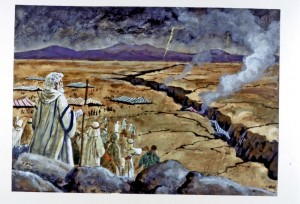 So the story of Korah’s rebellion (which lead me yesterday to give thought to the current leadership crisis in the Episcopal Church) continues in today’s reading and Moses (now with Aaron) is again falling on his face! This time because God, righteously unhappy with the Hebrews because of Korah and his companions, decided to simply wipe them out. Moses and Aaron made the case that this would be (to coin a phrase) overkill. So God relented and decided only to wipe out Korah, his companions, and their families. The rebels “together with their wives, their children, and their little ones” (v. 27) stood before their tents and then “the earth opened its mouth and swallowed them up, along with their households – everyone who belonged to Korah and all their goods.” (v. 32) And just for good measure, 250 Levites who’d been standing around with censers (as instructed by God through Moses) were consumed by fire which “came out from the Lord.” (v. 35). I probably don’t need to tell you that I find this story more than a little troubling! This vengeful warrior god taking out his pique on a large number of people, including small children, is not the god I particularly want to worship! ~ I once had a parishioner who was part of my team of lectors (folks who assist in worship by reading the lessons from Holy Scripture) who refused to read from the Old Testament: “I don’t believe in that god,” she would say. Well, I thought, neither did Marcion, but the church decided he was wrong, that the God of the Old Testament is the same God who is the Father of Jesus Christ, that we do worship that God, and we have to wrestle with the discomfort these ancient writings inflict upon us. Still, I didn’t insist that she read the Old Testament lessons. After all, this sort of reading (as I said) makes me more than a little uncomfortable, too! ~ And that is at it should be. The Hebrew Scriptures are the story of a people’s developing understanding of their God and their relationship with God. That story will have and does have the same sorts of violent and unpalatable events any human history will have. This is why the historical-critical method of studying the Bible is important, for it enables us to grasp what it actually meant to live as one of the Chosen People in any given era. The more accurately we understand the world of the Hebrews, the Israelites, or the church, the more we can see how the people of the Bible understood themselves to be in relationship with God. ~ A daily meditation on the Scriptures is not the place to wrestle with and resolve the difficulties and discomforts passages such as this episode from Numbers create. However, it is a place to suggest that approaching the biblical picture of God with a recognition that the Hebrews progressed in their apprehension of God, appreciating the historical circumstance of the Bible’s stories, allows us to see these stories in as positive a light as possible. Seen in this light, the more brutal parts of the Bible may still communicate valid insights – even to us. We simply don’t have the luxury of saying “I don’t believe in that God”! Rather, we have the responsibility to wrestle with these pictures of God.
 Moses “fell on his face.” This is biblical language for expressing great despair and sadness, not the reaction to a leadership confrontation a modern person would expect. Anger? Yes. Hostility? Yes. Yelling and shouting and public protestation of one’s rightness? Yes. Falling prostrate on the ground in desperate sadness? Not so much. ~ It would appear that in the confrontation of Korah and his compatriots, Moses felt personal responsibility. He believe that what had gone wrong with the Hebrews was his fault. He seems to have believed that he himself had created an atmosphere which had led to less-than-perfect delegated administration and justice. ~ Unfortunately a leadership crisis in the Episcopal Church isn’t resulting in similar behavior from the church’s leadership. In recent months the two highest officials of the church (the Presiding Bishop and the President of the House of Deputies) have had a public squabble over when and how one or the other might communicate with other persons in the church (the cause of the dispute was a video the PB made and sent to members of the House of Deputies, apparently without a “heads-up” to the PHoD). More recently, proposals for the church’s budget for the coming triennium have raised concern among many church members. In response to the first criticisms, the Executive Council issued a statement which was wholey inadequate (in my opinion) and failed to take responsibility. Then the PB (apparently distancing herself from the Executive Council of which she is actually a member and the chair) has come out with her own budget proposal. Now one or more members of the council have their backs up, writing blogs and making statements about being stabbed in the back. In all of this, there hasn’t been a lot of “falling on one’s face” going on. ~ The incident described in the Book of Numbers was really all about Korah’s personal grievances, suitably disguised for public consumption. Moses could have fired right back at him. But Moses suspected that his own earlier mistakes might be the cause of Korah’s uprising, that it was his failure which had created a setting in which discontent could germinate and ultimately promote the Levite rebellion. So, in humility, Moses admits accountability. Might a little of Moses’ humility be a good idea for the current crop of spiritual leadership? ~ Several church members recently have written blogs analyzing the budget and the business of the up-coming General Convention. Would that the Episcopal Church’s bishops, Executive Council, Presiding Bishop, deputies to General Convention, et al. would read these and consider their own roll in creating the situation in which the church finds itself. But I’m afraid they are too busy pointing the finger at one another, blind-siding one another, accusing one another of stabs in the back, playing turf wars, and engaging in cat-fights and pissing-contests. ~ We could use a little less of that sort of thing and a lot more falling on faces!
 Okay . . . . This makes me very uncomfortable on a Saturday morning! Jesus says this after condemning divorce and saying it would be better not to marry. The description of “eunuchs who have made themselves eunuchs for the sake of the kingdom of heaven” is usually understood as a metaphorical statement of dominical authorization of clerical celibacy. I mean, really, can self-castration be anything other than a metaphor for voluntarily abstaining from marriage, family life, and sex? ~ Jesus’ description of the first two sorts of eunuchs is squarely within Jewish tradition. The Hebrew word usually translated “eunuch” (saris) describes two categories of sexually impotent persons: those born impotent and those subsequently rendered so. In Deuteronomy and Leviticus, men who are sexually impotent as a result of birth or of accident are denied certain rights and obligations and considered to be of inferior social status. Jesus, thus, uses of the word “eunuch” twice in a literal sense familiar to Jewish tradition, would he have suddenly changed gears and use it in a metaphorical sense meaning something quite different? This would not be typical of his style. ~ So who are those in the third category? I find it troubling that Jesus speaks in the present tense, referring not to some conditional future but to men living at his time: “there are eunuchs who have made themselves . . . .” Who are they? In Jesus’ society, deliberate castration was repulsive to all social instincts, contrary to the Law, or associated the idolatry of foreign religions. So one must ask: To what phenomenon could Jesus possibly have been referring? ~ Here’s the kicker . . . we don’t have any way of knowing. Jesus might have been familiar with the castrati priests of pagan cults, maybe that’s the reference. He was surely familiar with the ascetic Jewish sects such as the Essenes, maybe that’s the reference. There’s been a suggestion that because of his own celibacy (and that of his followers) that “eunuch” was tossed as them as a taunting jeer, maybe this is a response to that. There’s little, if any, biblical support for any of these suppositions, so it’s a toss-up! ~ My point is this: I don’t know what Jesus is talking about, but whatever it is it makes me squirm very uncomfortably! And guess what? That’s true of a lot of Scripture; there are a lot of things in the Bible that I don’t understand and that make me squirm. I read recently that any exegetical hermeneutic should include “a clear sense of the impossibility of closure.” This is one of those times when “closure” about the scriptures is simply not possible.
 In an alternative reading, Jesus tells Peter to forgive “seventy times seven times.” Whether seventy-seven or 490 times, Jesus’ point is that forgiveness is continuous. It isn’t a once-over-and-done sort of thing; it is something that must go on and on and on. ~ Archbishop Desmond Tutu, a man I greatly respect, once said this about forgiveness: “To forgive is not just to be altruistic. It is the best form of self-interest. It is also a process that does not exclude hatred and anger. These emotions are all part of being human. You should never hate yourself for hating others who do terrible things: the depth of your love is shown by the extent of your anger. However, when I talk of forgiveness I mean the belief that you can come out the other side a better person. A better person than the one being consumed by anger and hatred. Remaining in that state locks you in a state of victimhood, making you almost dependent on the perpetrator. If you can find it in yourself to forgive then you are no longer chained to the perpetrator. You can move on, and you can even help the perpetrator to become a better person too.” ~ Note that the archbishop refers to forgiveness as a “process”. Again, a process is not a single instant. The dictionary tells us that a process is “a systematic series of actions directed to some end” or “a continuous action, operation, or series of changes.” Changing the other person, or getting him or her to change actions, behavior, or words isn’t the point of forgiveness; forgiveness is about changing oneself, one’s own life. As Archbishop Tutu said, “It is the best form of self-interest.” ~ Nor is forgiveness reconciliation. Forgiveness can lead to reconciliation, but not always; sometimes (for example, if the offender is dead, absent, or unwilling to communicate) reconciliation is impossible. Forgiveness, however, is always possible, even when reconciliation is not. ~ Do you need to forgive someone? Take the first step: move away from your role as victim. There are only 489 more steps to go!
 This is Jesus at his organizational problem solving best. Some really good advice about settling internal church conflict: talk it out. Talk it out individually; if that doesn’t work, talk it out with a couple of other people; if that doesn’t work, talk it out in the larger community. And if that doesn’t work . . . here’s where I believe people misunderstand Jesus. ~ The last instruction is that if the obstreporous member remains unmoved, let him or her “be to you as a Gentile and a tax-collector.” This is usually read to mean that we should ostracize or excommunicate the offending member. But I think this may be a misreading! ~ The word here translated as “Gentile” is “ethnikos“, a derivate of “ethnos“. This is the very word Jesus uses in the Great Commission: “Porenthente oun mathetensate panta ta ethne . . . ” – Go therefore and make disciples of all nations. ~ And tax collectors? Jesus sat down to dinner with them (Matthew 9). Jesus said they would get into the kingdom of God before the chief priests and the elders of the people (Matthew 21). Jesus praised the tax collectors for believing John the Baptist (Matthew 21). He called Matthew the tax collector to be one of his central party. ~ So how are we to treat “a Gentile and a tax-collector”? By shunning . . . or by dining with them? By excommunication . . . or by calling them to closer communion with God in Christ?

