Jesus said:
If your hand or your foot causes you to stumble, cut it off and throw it away; it is better for you to enter life maimed or lame than to have two hands or two feet and to be thrown into the eternal fire. And if your eye causes you to stumble, tear it out and throw it away; it is better for you to enter life with one eye than to have two eyes and to be thrown into the hell of fire.
(From the Daily Office Lectionary – Matthew 18:8-9 – June 20, 2012)
 This has to be one of the most troubling bits of the Gospels. Jesus is not suggesting that one engage in self-mutilation. Any suggestion that a person should actually engage in this behavior is to be rejected. ~ Self-mutilation is a serious issue in modern society. Psychiatrist Karl Menninger suggested that self-mutilation might be an effort to heal oneself. He wrote that local self-destruction is a form of partial suicide to avert total suicide. It is now recognized as symptomatic of borderline personality disorder. So this is clearly an example of a bit of Scripture which is not to be taken literally! ~ So what is it? It is an example of semitic hyperbole. Jesus was a native speaker of Aramaic, although his words have been transmitted to us in the koine Greek of the New Testament. Speakers of semitic languages (Hebrew, Aramaic and Arabic) use hyperbole so often and in such grossly exaggerated forms that to an English speaker it almost seems to border on lying. We can assume that Jesus said this originally in Aramaic in which hyperbole was an accepted way of making a point. By exaggerating something beyond the bounds of rationality, Jesus catches our attention, stating truths in a “bigger than life” way and waking us up to the reality of our own misbehavior. ~ As G. K. Chesterton noted, Jesus was a master of the hyperbole: “Christ had even a literary style of his own . . . The diction used by Christ is quite curiously gigantesque; it is full of camels leaping through needles and mountains hurled into the sea.” ~ So, don’t tear out your eye or cut off your hand, but do be aware of your own sinfulness and misbehavior . . . and do something less drastic but effective about it!
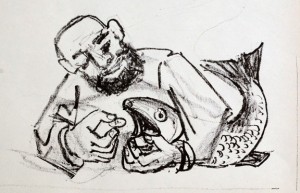 This is a weird little fish tale peculiar to Matthew’s Gospel. The temple tax about which it is told is a requirement drawn from Exodus 30:13: “Each [man] who is registered shall give: half a shekel according to the shekel of the sanctuary (the shekel is twenty gerahs), half a shekel as an offering to the Lord.” While Exodus does not make this an annual levy, most Jewish men paid the tax each year, including Jews who lived outside of Palestine. The tax provided a significant portion of the revenue needed to operate the Jerusalem Temple. There is an entire tractate of the Mishnah (Shekalim, fourth tractate in the order of Mo’ed) devoted to this tax which rather establishes its importance. Unlike Roman taxes, this tax was paid with patriotic pride by the Jews until the destruction of the temple by the Romans in A.D. 70. ~ Jesus asks Peter whether earthly kings tax their sons, to which Peter replies in the negative. Jesus seems to be implying that he, as Son of God, the King of the Temple, is exempt from the tax. However, were he to refuse to pay it, he would create a scandal, perhaps people would take his refusal to mean that he didn’t support or approve of the worship of the Temple, or that he was not loyal to the Jewish religion. They might get the idea that he didn’t think others should pay the tax. ~ So Jesus provides a way for Peter to pay the tax for him that underscores his divinity – the coin to pay the tax for both them miraculously appears in the mouth of a fish. That’s the weird part of the story. Like his walking on water and calming the storm at sea, this episode demonstrates that Jesus is the Lord of nature, but I don’t really think that’s his point here. Rather, I believe he is simply doing something that will leave an indelible impression on his disciples. ~ So there must be some lesson here for them (and for us). I think there are two. This story underscores Jesus’ humility before and on behalf of others; he declines to scandalize the community or to be a stumbling block for others. In this story he is an example of the humility we are called to exhibit, of the way in which we are to act on behalf of others, in which we are to the give up our own rights and interests for the good of others. We may not be able to produce valuable coins from the mouths of fishes, but we are able to give for others’ good even if we are not required to do so, especially when we are not required to do so!
 Before I went on holiday to Canada over the past ten or so days (which is why there hasn’t been one of these meditations since June 10), a parishioner told me that his regular attendance at church the past several months is because of a sermon I preached from which he took the message, “Christians go to church!” I seldom remember my own sermons well enough to know which one or what line someone might be referring to when they tell me something like this, but I’m nearly certain that it wasn’t on this text. However, that would be the message I would preach were this to come up in the Lectionary readings for a public worship service. ~ I suspect that my parishioner was referring to a sermon in which I may have used this old chestnut of an illustration: A member of a certain church, who previously had been attending services regularly, suddenly stopped coming to church. After a few weeks, the pastor decided to visit. The Pastor found the man at home alone, sitting before a blazing fire. Guessing the reason for his Pastor’s visit, the man welcomed him, led him to a comfortable chair near the fireplace and waited. The Pastor made himself at home but said nothing. In the grave silence, he contemplated the dance of the flames around the burning logs. After some minutes, the Pastor took the fire tongs, carefully picked up a brightly burning ember and placed it to one side of the hearth all alone. Then he sat back in his chair, still silent. The host watched all this in quiet contemplation. As the one lone ember’s flame flickered and diminished, there was a momentary glow and then it’s fire was no more. Soon it was cold and lifeless. The Pastor glanced at his watch and realized it was time to leave; he slowly stood up, picked up the cold, dead ember and placed it back in the middle of the fire! Immediately it began to glow once more with the light and warmth of the burning coals around it. As the Pastor reached the door to leave, his host said with a tear running down his cheek, “Thank you so much for your visit and especially for the fiery sermon. I shall be back in church next Sunday.” ~ That’s what the mutual encouragement that Paul describes is all about, keeping the embers of faith burning. As my parishioner said, “Christians go to church!”
 God used the vision of a sheet filled with unclean animals to get Peter’s attention. “Here,” said the voice, “eat this stuff!” That would certainly have gotten my attention! I eat all sorts of things Jews would consider “not kosher” – pork, ham, bacon, crab, lobster, clams, black pudding (I love black pudding!), haggis; none of that would have gotten my attention. But a commandment to eat from a sheet filled with eels or snakes or lizards or insects of any sort would definitely have done so. So I can understand Peter’s rather negative reaction! ~ This vision was metaphorical or allegorical or a simile or something like that. (You’d think a one-time English major could keep those straight.) God wasn’t really telling Peter to eat those things; God was making a point about people. God’s point was to make Peter understand that God had nothing against gentiles, that all are equal in God’s sight. (I’m not sure how, as a gentile, I feel about being represented by eels and whatever, but I suppose God can use whatever metaphors God chooses. . . .) The lesson, obviously, was that Peter ought to be as accepting and admit gentiles into the Christian fellowship. ~ When the voice said to Peter, “What God has made clean, you must not call profane,” those words were meant to have application far beyond Peter and Cornelius (the specific gentile who was about to come seeking baptism). There’s a lesson there for us, too. In Christ, God has made every person in the world equal before him without regard to nationality, ethnicity, race, sex, sexual orientation, hair-eye-or-skin color, right- or left-dominance (and even the ambidextrous)! As Paul wrote in yesterday’s epistle lesson: “There is no longer Jew or Greek, there is no longer slave or free, there is no longer male and female; for all of you are one in Christ Jesus.” (Gal. 3:28). Therefore, we Christians must treat every person we meet with dignity and respect. It’s more than too bad that we don’t; it’s sinful! ~ I may not be willing (or even able) to eat eels or snakes or insects. In fact, the very idea of eating eels makes me go, “Ewwwww!” and get slightly nauseated. But I had better learn to accept every human being as my equal before God, or I suspect that I will not be allowed to stand there myself.
 I try really hard not politicize these meditations, but I cannot help but think of the political rancor in our country during this election season, particularly the signs that have been paraded at so-called “tea party” rallies by persons who self-identify as “Christians” or more particularly as members of the “Christian Right”. There’s been plenty on the Left, as well, but it is from the Right that the most vile “hate speech” is heard. Just yesterday I saw a news item that Terry Jones, the pastor of the Dove World Outreach Center in Gainesville, Florida, the same fellow who threatened to burn a Qur’an several months ago, has now hung an effigy of President Obama on a gallows in front of his church. How can someone who presents himself as a Christian pastor do that? Especially in light of these words from Jesus? Especially in light of the words from Paul which are also in today’s Daily Office reading: “There is no longer Jew or Greek, there is no longer slave or free, there is no longer male and female; for all of you are one in Christ Jesus.” (Gal. 3:28) One hastens to point out to “Pastor” Jones that President Obama (despite the rantings of the far Right and no matter how one may feel about his politics) is a baptized Christian, a brother in the Lord, a fellow member of the church universal. How on earth can this man do this? ~ A couple of days ago some members of my parish and I were talking about the festival held each spring in an Ohio village near our town. It celebrates something like the return of the swallows to San Juan Capistrano in California, only in this case it is the return of the turkey vultures to Hinckley, Ohio. (You read that correctly . . . turkey vultures.) For some reason I once learned that turkey vultures (and other types of buzzard) defend themselves through the use of projectile vomiting. It occurs to me on reading this text from Matthew and considering our political discourse (especially antics like these of “Pastor” Jones) in its light, that the projectile-vomiting turkey vulture just might be the mascot of present-day American politics. May God have mercy!
 The writer of the Gospel according to Matthew may have intended this story to show Jesus’ power over nature underscoring his divinity, or at least his status as a major prophet. But I have often thought it might be considered from an allegorical perspective, as well. ~ As Jesus walks upon the waters, he transcends that which would overwhelm him; the physical act represents the indispensable gift of grace, the ability to rise above the negative elements and events of one’s time. His defiance of the natural order symbolizes his life lived according to standards higher than any human code of conduct; his reaching out to Peter and inviting him to do the same demonstrates the extending of grace to others. ~ Madeleine L’Engle once wrote, “Peter was able to walk on the water until he remembered he didn’t know how.” The hand of grace extended to us is what gives us the ability to set aside the memory of not knowing how, the ability to rise above the flood that would otherwise inundate us. ~ Creedence Clearwater Revival sang a song entitled Walk on the Water in which the singer tells of seeing a man walking on the water of the river near his home, a man calling out his name and saying “Do not be afraid.” The singer’s reaction is exactly the wrong one! “I swear I’ll never leave my home again . . . I don’t want to go; I don’t want to go. No, no, no, no. I don’t want to go.” ~ Staying at home, cowering in fear, is simply not an option. The only option is to seize the hand of grace and forget that we don’t know how to walk on the water.
 I’m not sure, but those may be my three favorite words in all of Paul’s writings: “You stupid Celts!” That’s what he’s saying here. The Galatians were Celts, distant cousins of the Irish, Welsh, Scots, and Bretons. They all had their origins in the Celtic homelands of the northwestern Alps and migrated to Asia Minor, the islands of Britain and Ireland, and other places. And here Paul calls the Celts of Asia Minor anoetos, a Greek word which means “lacking understanding” and is variously translated as foolish, thoughtless, senseless, or stupid. “You stupid Celts!” ~ It is generally believed that Paul is reacting against the Galatians acceptance of the suggestion of the “Judaizers” that they needed to be circumcised before they could really become Christians. But I wonder . . . . I’ve done a fair amount of study of Celtic spirituality, at least of the western (British Isles) sort; I spent a three-month sabbatical translating ancient Gaelic religious poetry. The western Celtic understanding of Christ’s work was rather different from the Pauline notion. Paul (especially as developed by Augustine but, I think pretty clearly, originally) saw Christ’s salvific work in terms of propitiation and justification: just a few more verses and he will insist to the Galatians “Christ redeemed us from the curse of the law.” (v. 13) The Celts, on the other hand, thought in terms of Jesus completing the goodness of creation; they believed much like Origen did that human beings were not so much fallen or cursed by sin as immature and incomplete, striving not for redemption but for perfection. ~ Some of Origen’s views were eventually anathematized as heretical and, though he is viewed as a “Church Father”, he has not been sainted. Later Celtic theologians have suffered the same indignity. The Irishman Johannes Scotus Eriugena believed that all human beings reflect attributes of divinity and that all are capable of progressing toward perfection, a view that Paul would clearly have disputed; Eriugena’s theology was discredited as “Irish porridge” and “an invention of the devil.” The Culdee monk Pelagius (who was probably a Breton rather than Irish) taught that humans do not have inherent sinfulness, but rather have a natural sanctity and the moral capacity to choose to live a holy life; Pelagius, too, was condemned as a heretic. ~ I sometimes wonder if this pervasive western Celtic belief in the essential goodness of humankind and in the progressive divinization or completion of creation might have been shared by their eastern cousins in Galatia. If so, it might have been this which led them to be more accepting of the Judaizer’s suggestions; after all, if the Christian goal is divinization and if circumcision put the Chosen People closer to God, perhaps it ought to be considered. No wonder Paul, who didn’t believe human beings could do anything to contribute to their own sanctification, thought them stupid and foolish! How different might the Christian church today be if the views of the Galatians, Pelagius, Eriugena, and other Celts had prevailed? One will never know. ~ I do know this, however. Those Celtic views ought to be heard and considered. None of us fully knows the mind of God and the views and thoughts of all should be valued as we struggle together to understand. They may be my favorite words of Paul, but not because they are particularly beneficial; indeed, they are not. The church today would be much better off and a much more congenial society if no one ever said or wrote anything like, “You stupid Celts!”
 I have already written one of these for today’s readings (see
 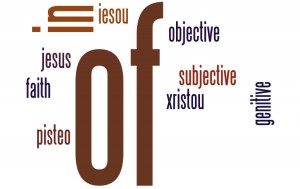 Do you see that little asterisk at the end of the quoted scripture? It’s there because a footnote in the Bible tells us that “faith in Jesus Christ” is only one possible interpretation of the original koine Greek. The alternative is “the faith of Jesus Christ.” Change a preposition and you change the entire sense of the sentence! “In” or “of”? Are we saved by our faith in Jesus? Or by Jesus’ faith in his Father? I’m going to suggest that it is the latter. The faith of Jesus, the confidence he had in the God he trusted in, the commitment he made to his mission, the fidelity he had to the values he taught. That is what saves us, not anything we do, say, or believe. Salvation is a matter of grace, the unwarranted, unmerited, unearnable grace of God. ~ The reason this debate exists, by the way, is that the preposition is not even there in Greek. Rather, in Greek the ending of the noun gives an indication of meaning. In the Greek of this text we find something called the “genitive” case. It is unclear whether Paul intended the “genitive subjective” (which would support the “of” understanding) or the “genitive objective” (which leads to the “in” translation). Although the objective understanding has prevailed for centuries, a lot of modern scholars are arguing that we might better understand Paul’s meaning with the subjective interpretation. I think they have a point. ~ It is not our faith in Jesus which justifies us, but the faithfulness of Jesus Christ to his mission and to his God. What is most important about this is the implication it has for us. Faith is a gift; we are saved through faith by grace and not by any work of our own. Salvation is not from the human act of believing but from the divine act of Jesus’ obedience. Thus, our human faith is not a prerequisite for salvation but is our appropriate response to the blessing given through the faithfulness of Christ. ~ “We know that a person is justified not by the works of the law but through the faith of Jesus Christ.” Of not in!
 “Vanity of vanities! All is vanity.” The frustration of the Preacher is something I believe we’ve all experienced at one time or another. “What is the point of it all?” is a question every adult probably has asked at least once, if not several times. ~ In the past few days I’ve been part of two committees trying to schedule meetings in the same few days; coordinating the calendars of about twenty different people, all with work schedules and personal lives, is next to impossible and leads to precisely the kind of frustration Ecclesiastes voices. What do mortals get from all the toil and strain? ~ As our world gets more and more complex, the abilities to be flexible, to think in terms of alternatives, to see different potential outcomes as equally good (stop looking for the one, best answer), to share differing visions nonjudgmentally, to let go of personal involvement and trust others to do a good job in their own way even if it is not your way, to clearly communicate and consult with others about ideas, all these will help avoid the sense of futility evinced in these verses. Perhaps the most important skill is the one specifically alluded to here, the ability to turn off one’s mind at night! ~ One of the best pieces of advice I was ever given about those restless night-time thoughts was to write them down. If a thought persists, write it down. Then when it comes back again, look at it with disinterest; you’ve written it down and you will deal with it in the morning. Can’t do anything about it late at night, anyway; it’s all vanity. ~ The world is a rapidly changing and the rate of change is accelerating. Flexibility and a good night’s rest are essential survival skills.

