Jesus healed a paralyzed man:
When the crowds saw it, they were filled with awe, and they glorified God, who had given such authority to human beings.
(From the Daily Office Lectionary – Matthew 9:8 – May 24, 2012)
 This is such a great verse! Matthew could have made some christological or soteriological comment about “the Son of Man” – in fact, he has done so earlier in this story and will do so again in the next chapter. But here the power and authority to heal is specifically described as being given not just to Jesus but “to human beings” . . . to you and to me! That’s great! ~ A couple of years ago the American Psychological Association reported that the first decade of the 21st Century saw a dramatic increase in the number of American adults praying about health issues. Even though attendance at formal religious services has fallen in the same period, informal and private spiritual practices such as prayer seem to be on the increase. One of the interesting results of a study by the Centers for Disease Control was that those who exercise are 25% less likely to pray than those who don’t…. One wonders if those who pray are less likely to exercise. ~ I’m not an exerciser myself. I admit that I should be; I’m just a lazy procrastinator who can’t get around to it. But I am a person who prays, and I often pray for health and healing for myself and for others. ~ The teacher of prayer who looms largest in my life is my late paternal grandfather. One of the things he taught me about prayer is “never pray for something you aren’t willing to work for.” His point was that God’s answer to your prayer just might be that God would send you into the midst of whatever the situation is to work toward a solution. I’m beginning to think that there’s a lesson here about exercise and health, too. I really shouldn’t be praying for my own physical health if I’m not willing to get off my duff and work for it. God has given me the authority to live a healthy life. I guess I’d better claim it and start doing it. ~ Tomorrow . . . maybe.
 This is the beginning of familiar story. The demons challenge Jesus, “What have you to do with us?” and he, in turn, banishes them into a herd of swine, which then rush into the Sea of Galilee and drown. The swineherds run into the nearby town and tell what happened. The townspeople come out and, being afraid, beg Jesus to leave. Of course, the demoniacs are cured but we don’t know anything further about them. Matthew’s version of the story puzzles me. Mark and Luke also tell the tale and, if scholars are correct, it’s likely that Luke and Matthew got it from Mark who wrote his gospel first. (Compare Mark 5 and Luke 8.) ~ Here’s the first thing that puzzles me – Matthew slightly changes the location. Mark and Luke say this happened in the country of Gerasenes; Matthew, in the country of the Gadarenes. Now I know from my bible studies that these towns, Gadara and Gerasa, are close to one another and neither is actually on the Galilean lake. Both are Gentile towns near the eastern shore of the lake. The town in that area on the lake was Hippos. Why did Matthew choose to put this event in this slightly different location? I don’t know. And, so far, as I know there is no scholarship to answer that question. It’s just, as Yul Brynners king of Siam would say, a puzzlement. ~ The second puzzlement is why Matthew doubles the number of demoniacs. In Marks original tale and Luke’s repetition of it, there is a single possessed man. Matthew says there were two. In all other respects than these two details, the stories are the same. Why does Matthew say there were two possessed persons? Does that make the healing twice the miracle as it is in Mark’s version? I don’t think so. It’s just as frightening to the townspeople – whether Jesus cures one man or two, they still beg him to leave. ~ I have no answers to these puzzlements. I don’t even know if these minor changes of detail have any significance. Probably they don’t. But these little details are among the things about scripture study and contemplation that sometimes grab my attention and make me lay awake at night wondering, “Why two? Why two?” ~ It’s a puzzlement!
 Although this is not the end of the the Letter to the Church in Ephesus, it sure sounds like it ought to be! Maybe that’s why the Book of Common Prayer uses it as one of the possible endings to the Daily Offices of Morning Prayer and Evening Prayer. The others are 2 Corinthians 13:14 and Romans 15:13; the first reminds us of God’s grace, love, and fellowship; the second, of hope, joy, and peace. This one reminds us of God’s abundance. God can do “abundantly far more” than we can conceive. The Prayer Book version is practically hyperbolic: “Glory to God whose power, working in us, can do infinitely more that we can ask or imagine.” (BCP 1979, p. 126) ~ This is a profoundly countercultural message! In a world controlled by bankers, insurers, and oil companies, we have been sold a story of scarcity that competes with and, in the popular secular imagination, has prevailed over the gospel of abundance. Yes, some resources (such as fossil fuels) are limited, so they have to properly used and preserved. But alternatives are not – science and agriculture have proven that there are many sources of fuel which are renewable. Because human culture has taken the irreplaceable resources (coal, oil, metals) as the paradigm for all economies, rather than sustainable and renewable resources (crops, herds, rapid-growth woods) we buy into the scarcity model even though these alternatives demonstrating God’s provident abundance are all around us. ~ What can we do to change this? How can the church of Christ, which has the gospel of plenty to preach, foster a paradigm shift from a distrustful economy of scarcity to generous economy of abundance? It seems to me that we don’t even try. Once a year, most church congregations beg their members for annual pledges and then budget on the scarcity model, denying even our most fundamental teaching of reliance on God. I wonder what would happen if we truly believed and truly lived the abundance Scripture assures us is there. I really do wonder . . . because abundance is wonderful!
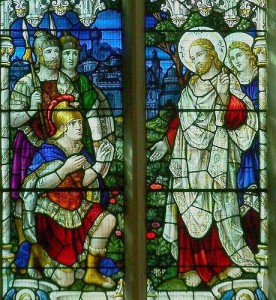 The words of the centurion are the root of a prayer spoken by many before receiving Holy Communion: “Lord, I am not worthy to receive you, but only say the word and I shall be healed.” As an Anglo-Catholic Episcopalian, recitation of this prayer used to be a part of my personal practice. But I have ceased to say it because I became uncomfortable about the change in emphasis from the biblical text to the liturgical text. A statement of faith in Christ’s power to heal another has been turned into a purely personal (and one is tempted to say “selfish”) prayer. ~ Paragraph 1386 of the catechism of the Roman Catholic Church explains the rational of the prayer: “Before so great a sacrament, the faithful can only echo humbly and with ardent faith the words of the Centurion: ‘Domine, non sum dignus ut intres sub tectum meum, sed tantum dic verbo, et sanabitur anima mea’ (‘Lord, I am not worthy that you should enter under my roof, but only say the word and my soul will be healed.’)” That’s great, except the quotation from the Centurion is inaccurate! In the Vulgate, the verse reads, “Tantum dic verbo et sanabitur puer meus.” (“Only say the word and my servant [or ‘child’] shall be healed.”) I am troubled reciting a prayer based on a misquotation of scripture. ~ The centurion in the story is about as far from self-centered as one can be. He seeks Jesus’ help not for himself but for his servant. He is unwilling for Jesus to be inconvenienced. It is in that spirit that he speaks these words, explaining that as a military officer he simply gives orders and things are done, so he has faith that One with the power of healing can simply do the same. It is for his selflessness that Jesus’ praises him and his faith. It seems somehow wrong to recite a prayer which turns that on its head! ~ I recall reading a few years ago about a medical brain-function study which demonstrated that selflessness is psychologically healthy and is the neuropsychological foundation of spiritual experience. Selfishness, on the other hand, is unhealthy: other scientific studies have demonstrated that it is impossible for a completely selfish individual to either survive or have a biological future. So I am unwilling to utter a prayer which turns a selfless intercession on behalf of another into a self-centered (one is tempted to say “selfish”) petition. “Lord, I am unworthy to receive you” … let’s just leave it at that.
 I wasn’t sure whether I wanted to quote this bit or the story from Numbers 11 (also in the Lectionary cycle for today) in which Moses chose 70 men to receive a portion of the spirit and to take on some of the burden of the people. Two of the men, Eldad and Medad, did’t make it to the tent of meeting, but nonetheless received the spirit in the camp. Joshua, Moses’ assistant, protested but Moses replied, “Would that all the Lord’s people were prophets, and that the Lord would put his spirit on them!” It seems to me that Paul is saying that’s what God accomplishes in Jesus; that all people now are prophets, all have the spirit, all together are becoming a dwelling place for God. ~ Today I’m drawn to Paul’s opening words in this passage, particularly “you are citizens.” We’ve seen a lot of politicking in our country recently and a lot of talk about a citizen’s duty. Partisans on both the Left and the Right correctly assert that a citizen should ask questions, know what’s going on, and be informed. I believe this is true regardless of where one lives, whether one is a citizen of the United States, Canada, Ireland, or Cameroon. Wherever one is a citizen, one should do these things to be an active participant in one’s country. ~ If we are “citizens with the saints,” of what are we citizens. Paul answers this question elsewhere saying “our citizenship is in heaven.” (Philippians 3:20) As citizens of heaven, then, we should be as informed as possible about “that heavenly country where, with all [God’s] saints, we [hope to] enter the everlasting heritage of [God’s] sons and daughters.” (BCP 1979, p. 369) This means that throughout life we have an obligation to engage in bible study, in life-long Christian formation and education, in asking questions of clergy and church leaders and questioning the answers we receive. There should never be “graduation” from Sunday School! ~ There is much wringing of hands and gnashing of teeth today about the failure of the church and its state of decline, and much of it is warranted. At root, however, I believe part of the fault for the state of the church lies in the laps of its leadership over the past several decades, leaders who have failed to encourage the church’s members to think of themselves as spirit-filled citizens, and I believe part of the failure in all this lies with ourselves and our fellow citizens to stay truly active and informed. ~ Do I have a solution? No, not really. I offer no panacea, just encouragement to acknowledge the spirit within you, to get involved, and be an informed citizen of heaven. Like the consuls of revolutionary France I cry, “Let our citizens arise for the security of what they hold most dear, for the sacred interests of humanity!”
 Two things happened yesterday. First, I had a conversation with my son (who is also a priest) about the future of parish ministry. Suffice it to say that we both have misgivings and considerable trepidation about that; I, for one, don’t see much future for parish ministry unless the church makes some radical changes – too many are needed to discuss in detail in a short morning meditation like this one. ~ Second, as a member of a committee charged with approving assistance grants to local congregations, I was asked yet again to approve a grant to fix a roof. The roof in question is for a parish which is not supporting itself through the giving of its membership. It seems to survive on grants and the largesse of a single, now-dead member who established a trust for its benefit; without those funding sources, it could not sustain its budget. I commented to my fellow committee members: “I wonder why we keep pumping money into maintaining buildings for marginal congregations. We ought to be investing in health and this doesn’t feel like we’re doing that.” ~ Both of those conversations came to mind when I read this gospel lesson today . . . as did an on-line (Facebook) tête-à-tête with a priest in England about car insurance rates, capitalism, and the plight of the poor in which we both suggested that force might be the only way to change the world economic system. I suggested to my colleague that our agreement on that point “means that we are acknowledging the church’s failure to accomplish its mission.” ~ And then another colleague, a younger preacher active in the “emergent church” movement reminded me of this observation from Episcopal priest and author Robert Farrar Capon: “The church can’t rise because it refuses to drop dead. The fact that it’s dying is of no use whatsoever: dying is simply the world’s most uncomfortable way of remaining alive. If you are to be raised from the dead, the only thing that can make you a candidate is to go all the way into death. Death, not life, is God’s recipe for fixing up the world.” (The Astonished Heart: Reclaiming the Good News from the Lost-and-Found of Church History, Wm. B. Eerdmans Publishing Co., 1996) ~ The rains, floods, and winds are beating against the house that is the church, especially against the houses that are the parishes of the mainstream denominations. We have got to change in radical ways. We have got to stop listening to the world and start, again, listening to Jesus! Radical, by the way, is derived from the Latin radix meaning “root”; the change we need to make is a return to our roots, to Jesus and the apostles, to early Christian understandings of what means to be church. We have to change or the church will, indeed, fall. I think Capon is right – the church as it has become has to drop dead in order to rise again, or it will fall – and if it simply falls, its fall will be great and it will not get up.
  Today is the Feast of the Ascension. Today we remember that, forty days after his resurrection, Jesus ascended into heaven, disappearing from his disciples’ sight into the clouds. Luke tells us in the Book of Acts that the disciples stood there gazing up towards heaven, and that two men, presumably angels, appeared and asked “Why do you stand looking up towards heaven? This Jesus, who has been taken up from you into heaven, will come in the same way as you saw him go into heaven.” (Acts 1:11) So we have two biblical promises: “I’m still with you” and “He’s not with you but he’ll be back.” The Christian paradox illustrated in the readings for a single day. ~ For me the meaning of the Ascension is summarized in the petition of one of the collects for the day in the American Book of Common Prayer (1979): that “we may also in heart and mind there ascend, and with him continually dwell” – or as Jesus put it in John’s gospel “that where I am, there you may be also.” (John 14:3) I don’t understand that as a future conditional promise but rather as a present permissive reality. Christ’s ascension allows us to be in God’s presence, now . . . no matter what our circumstance may be. It’s a matter of us recognizing that presence in the present, which we so often fail to do because we think of it as a future reward for some good behavior or something on our part when, in reality, it has nothing to do with our behavior or our goodness at all. The apparent paradox of the two biblical promises accurately reflects our confusion.
  This conversation troubles me. It falls at the end of a lengthy debate between Jesus and a group of biblical scholars composed of both Sadducees and Pharisees (two groups which seldom, if ever, agreed). They have challenged Jesus with three questions: the legality of paying taxes to Caesar; the status of a many-times married woman after the resurrection of the dead (whose wife will she be?); and the greatest of the commandments. Jesus has answered those questions and now asks them one of his own. It’s a trick question. It silences his critics and none of them ever again asks him a question. ~ That’s what troubles me. I don’t follow Jesus because he has the gift of witty repartee or because he has cut-and-dried answers to life’s questions or because he is a viciously effective debater who subdues his opponents. In fact, I follow Jesus for quite opposite reasons. I follow Jesus because in his footsteps I find pathways to contemplate and explore the questions of life to which there are often no solid answers. I follow Jesus because I find responses to my questions which invite and encourage further exploration, not answers which end and cut off discussion. ~ Was Jesus satisfied with the Pharisees response? Was he pleased that they sat mute and did not dare to ask a follow-up question? Matthew doesn’t tell us (nor does Mark, who tells the same story in a different fashion). But after this exchange, Jesus turns to the crowd and says to them about “the scribes and the Pharisees”, “Do not do what they do.” According to Matthew, Jesus apparently is referring to a lot of picky and burdensome ritual practices which the Pharisees heap onto others’ shoulders without lifting a finger to assist. But I wonder if he might not also be saying, “Don’t stop asking questions. Don’t stop exploring life’s issues. Don’t stop talking about God and the Messiah. Even if you don’t understand, maybe especially if you don’t understand, don’t sit there mute!” ~ On the Second Sunday of Easter the Eucharistic lectionary had us consider the story of “Doubting Thomas” (as it does every year). In my parish that was also “Children’s Sunday” when, instead of a formal recitation of the gospel and a learned sermon, the gospel is told to our children in story-book fashion with a discussion at their level of what it means. I suggested to them that it is very important to note that Jesus did not criticize Thomas for asking questions and that we should understand that to be an encouragement to ask questions of our own, and never stop doing so. So, yeah … I think Jesus may have been doing the same thing here. I think he may have been very disappointed in the Pharisees and Sadducees who did not “dare to ask him any more questions.” Don’t stop asking questions!
 There was a meme circulating the conservative blogosphere and email circuit several months ago in which folks of a certain political persuasion asserted that they were “praying” for President Obama by reciting a verse from Psalm 109: “Let his days be few, and let another take his office.” The psalm continues in the next verse: “Let his children be fatherless, and his wife become a widow.” And the petition get even worse after that. This is not what Paul is admonishing the faithful to do in his letter to the young bishop Timothy. In fact, it is clearly the very opposite. ~ What would our country and our society be like if everyone did offer “supplications, prayers, intercessions, and thanksgivings … for … all who are in high positions”? One of the things I counsel folks who come to me with issues of unresolved anger toward another is to pray for that other. Not specific intercessions just simply to offer that person’s name before God with the simple request, “In this person’s life, Lord, may your will be done.” The nearly universal experience of my counselees is that over the course of time (the length of time varies from person to person) their anger dissipates; the typical observation is that is impossible to stay angry at someone for whom you are praying. ~ The purpose of prayer is not to inform God of anything of which we believe God may be unaware, to give God our good advice, or to conform God’s will to ours. Rather, it is to relinquish our own selfish desires in acquiescence to the one “whose power, working in us, can do infinitely more than we can ask or imagine,” as we remind ourselves as the end of the Daily Office (quoting Ephesians 3:20). ~ What would our society be like if everyone prayed for our leadership, even the leaders with whom we have political disagreements or personal dislikes? What would things be like if I prayed for that jackass in Congress, or that SOB in the state house? I cannot imagine, but Paul assures me that we would all “lead a quiet and peaceable life in all godliness and dignity.” Maybe we (that really means, I) should give it a try.
 I was reminded just this morning in something else I read that there is no positive attribute “darkness”. Darkness actually is nothing; it is simply the absence of light. We cannot and do not measure darkness; we measure light and when there is no light, that’s nothing. The only purported measurement of darkness I know of is the Bortle Dark-Sky Scale, but in truth the Bortle Scale is a nine-level numeric ranking of night sky’s brightness. There is no negative side of the scale. Once one reaches the bottom of the scale where there is total absence of light, there is no greater (or perhaps one should say, lesser) degree of darkness. There are degrees of light, but not of darkness. ~ So how is that modern scientific people who know this can make sense of a phrase like “the power of darkness”? If darkness is simply the absence of light, then darkness is nothing . . . literally “no-thing”. And no-thing can have no power. I can imagine someone saying, “If darkness is no-thing, and no-thing has no power, then God’s rescue is meaningless.” Of course, I don’t believe that, but I can certainly imagine someone in today’s world working through that line of thought. ~ I think one of the failings of our age is the loss of a poetic or metaphorical understanding of reality. I know that Paul is using “darkness” as a synonym or a metaphor for evil, but the trouble is that our spiritual or religious language is so often at odds with the physical reality we know around us, and in a world which has lost an appreciation for the poetic that is a problem. The English satirist Malcom Muggeridge said, “There is no such thing as darkness; only a failure to see.” Shakespeare wrote, “There is no darkness but ignorance.” Perhaps in our time, we need to understand Paul to be saying that God rescues us from our own callowness and incomprehension. Perhaps in our time, the human problem is not so much sinfulness as it is willful stupidity! ~ American author and neurosurgeon Ben Carson once wrote, “God has given us more than fourteen billion cells and connections in our brain. Why would God give us such a complex organ system unless he expects us to use it?” I believe St. Paul would have agreed. Failure to use those brain cells in every possible way, both in science and in matters of faith, is giving into “the power of darkness” from which God has rescued us.

