 Monday being “Memorial Day,” this weekend, in the traditions of our country, we are remembering and celebrating those who have fought on behalf of, and given their lives for, the United States. In the traditions of the church today, we are celebrating something called “Rogation Sunday,” on which we give thanks for the abundance of the earth and ask God’s blessings upon agricultural pursuits, upon the fields and the herds. I’d like to read you a story about giving thanks for abundance. It is from the Paul Harvey radio program.
Category: Eucharist (Page 7 of 36)
 A few years ago, at my former parish, we had a Sunday school presentation in which each of the kids was to recite a verse of Scripture. On little guy came up and just stood there, shuffling his feet and looking very uncomfortable; he just couldn’t remember his line… His mother was in the front row to prompt him. She gestured and formed the words silently with her lips, but it did not help. Her son’s memory was blank. Finally, she leaned forward and whispered the cue, “I am the light of the world.” The child beamed and with great feeling and a loud clear voice said, “My mother is the light of the world.”
Today, we have the happy coincidence of celebrating Mother’s Day and contemplating another of Jesus famous “I am” statements: “I am the good shepherd.” I believe that this coincidence can help us to understand this famous metaphor. Last Monday was the feast of Julian of Norwich, the early 15th Century mystic who was given, and recorded, a series of “divine shewings.” In her text, The Revelations of Divine Love, published in modern translation under the title Showings, she wrote this:
The human mother will suckle her child with her own milk, but our beloved Mother, Jesus, feeds us with himself, and with most tender courtesy, does it by means of the Blessed Sacrament, the precious food of all true life.[1]
A clergy person of my acquaintance, following Julian’s vision of Jesus as our “beloved mother,” recast today’s Gospel lesson in terms of motherhood, rather than shepherding.
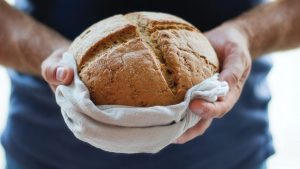 Anthelme Brillat-Savarin , an 18th century French politician once said, “Tell me what kind of food you eat, and I will tell you what you what kind of man are.”[1] The 19th century philosopher Ludwig Feuerbach said, “Man is what he eats.”[2]
These observations have been distilled into our modern idiom. “You are what you eat” is a saying one hears or reads pretty regularly. And it’s true. Eating shapes our identities, defines who we are. A particular food and drink may highlight ethnicity, nationality, or age: tacos, lasagna, Coca Cola (over fifty), Pepsi (under thirty,) hamburgers, sushi. Food and drink defines the great holidays and important celebrations of our lives: champagne on New Year’s Eve, turkey at Thanksgiving, plum pudding at Christmas, hot dogs on the Fourth of July, eggs at Easter.
An ordained colleague of mine once commented that the Sacramental presence of the Eucharist has shifted location in the modern church. Once the table-fellowship of the church was centered on the altar; now, he said, it is found elsewhere depending upon denominational tradition. For Baptists, it is now found in the fried chicken dinner; for Methodists, in the potluck supper; and for Episcopalians, at coffee hour. He was kidding, of course, but there is an element of truth in his humor.
 In today’s Gospel lesson we heard, as we always hear on the Second Sunday of Easter Season, the story of “doubting Thomas.” What is striking about the Thomas’s demand … “unless I see” … is that our Lord accepts and encourages it … “Reach out your hand.”
This deceptively simple story is a great encouragement to those of us who follow the Anglican path in Christianity. We have the inheritance of a method of engaging the Faith (and Life) which is described in the work of the seminal Anglican theologian Richard Hooker. Fr. Mike Russell, who has recently published a re-issue of Hooker’s Of the Lawes of Ecclesiastical Polity, describes this method this way:
Anglicans frequently talk about the three-legged stool of authority that distinguishes them from Roman Catholics and Protestants. The former give more authority to Church traditions, the latter to Holy Scripture, but Anglicans somehow add them together and then mix in human reason. Once again, that mixture is Mr. Hooker at work re-framing the discussion. What emerges hardly fits our popular notion of a code of laws and, in fact, we come to understand that in talking about laws, Mr. Hooker is actually speaking throughout about the nature and exercise of authority.[1]
This sermon was first preached on Easter Sunday, 2001, at St. Francis of Assisi in the Pines Episcopal Church, Stilwell, Kansas, where I was rector from July 1993 to June 2003. I had thought it lost when that parish abandoned its internet domain after I left that position. However, at the urging of a friend, I searched for it on the Internet Archive’s “wayback machine,” and was surprised to find it. I have updated some of the references and corrected some mistakes to publish it here. I have always thought it a pretty good sermon, and I guess others have thought so, too: in the course of researching sources to update the footnotes, I found that a rather large chunk of it had been reproduced in full, without attribution, as the pastor’s 2019 Easter letter in the newsletter of a Roman Catholic parish in Scotland.[A] (As my fellow Anglican cleric Charles Caleb Cotton wrote in 1824 – and Oscar Wilde later quoted and expanded – “Imitation is the sincerest [form] of flattery.”[B])
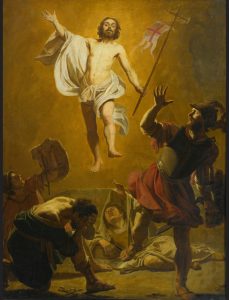 Easter is a joke. Amen.
(The Preacher steps out of the pulpit, perhaps even returns to his chair, then returns to the pulpit.)
OK … I guess I should explain that. What is a “joke”? Princeton University’s WordNet Dictionary says, in one of its definitions, that a joke is an “activity characterized by good humor.”[1] Can you think of a better way to characterize the resurrection of Jesus than as an “activity characterized by good humor”? The Resurrection of Jesus of Nazareth was God’s activity of the highest and best humor!
I wrote in our newsletter, The Canticle, that the Sunday we call “Easter” is really not a separate feast day; it is the third part of a three-day celebration that begins at sundown on the previous Thursday, the day we call “Maundy.” This three-day celebration is called by an ancient Latin name, “the Triduum.” The Triduum is a single celebration in three acts. We have arrived at Act Three in the drama of redemption.
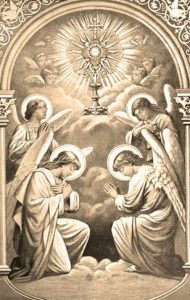 With churches suspending public worship out of concern for the contagion of Covid-19, the noval coronavirus, we Episcopalians (and many others) are prevented from receiving Holy Communion. An ancient practice of the Church in such circumstances, for there have always been those who, for whatever reason, are unable to take the Sacrament, is to make an act of “spiritual communion.”
Spiritual communion was defined by St. Thomas Aquinas as “an ardent desire to receive Jesus in the Holy Sacrament and a loving embrace as though we had already received Him.” This is a lovely way to unite oneself to God through prayer, expressing to God one’s desire to be united with Christ when we are unable to do so through reception of Holy Communion.
The Roman Catholic saint, Alphonsus Liguori, taught a four-step method of of making a spiritual communion.
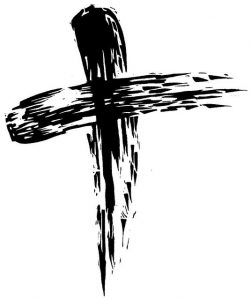 Today marks the beginning of the season we call “Lent,” an old English word which refers to the springtime lengthening of the days. What is this season all about, these forty days (not counting Sundays) during which we are to be, in some way, doing what a hymn attributed to St. Gregory the Great says: “Keep[ing] vigil with our heavenly lord in his temptation and his fast?”[1]
A few years ago, Dr. Jonn Sentamu, the current Archbishop of York, described Lent as a time for seeking and getting to know God better.[2] Similarly, an essay about Lent in an issue of the National Catholic Register was titled “A Season for Seeking.”[3] I’m not sure I buy that, however. As the Roman Franciscan author Richard Rohr says, “We cannot attain the presence of God because we’re already in the presence of God. What’s absent is awareness.”[4] Lent is not so much a time for seeking God, who is always there, as it is for becoming aware of God.
And the interesting thing is that we are encouraged to become aware of God by becoming more aware of ourselves. Yes, Jesus does say to give with one hand not letting the other know what’s happening, but this seems more an instruction to follow the Deuteronomic command to “open your hand [to one in need] … to give liberally and be ungrudging when you do so”[5] rather than a direction to act without self-awareness.
 “In the Name of God the Broken-Hearted. Amen.”
In January of 1991, I was a student at Church Divinity School of the Pacific, where there is a tradition of Thursday night community eucharists followed by dinner together in the seminary refectory. On the evening of Thursday, January 17, the Rev. Dr. John Kater, professor of ministry theory and practice, was our preacher and he began his sermon with the invocation I have just offered. You see, that was the day “Operation Desert Shield” became “Operation Desert Storm,” and we had all been glued to the TV sets in the common room, the dormitory lounges, or our apartments watching as the US Air Force began a bombardment of Baghdad that was to last for weeks and, eventually, lead into nearly three decades of war in the Persian Gulf region.
There was another American bombing of Baghdad just a few days ago in which the military leader of Iran, Qassem Soleimani, was killed. If the news reports are correct, his death may trigger more armed conflict in the region. So this weekend, as we read in our newspapers about the Iranian general’s death and tonight consider the visit of a group of Iranian scientists to Israel, it seemed good to repeat that invocation tonight.
 In the beginning, God said . . . and there is creation.[1] In the beginning was the Word, and the Word became flesh . . . and there is salvation.[2] When we cry “Abba! Father!” it is not us but the Spirit who speaks through us . . . and there is sanctification.[3] At the core of our faith is communication and personal relationship, and how we express that is vitally important. It is more than an intellectual enterprise. Choosing, using, hearing, reading, interpreting, and translating our words and those of scripture is a spiritual and existential exercise, as well. To demonstrate this, I have brought a prop to use this morning: this. [Bottle of Mountain Dew]
What is this? I mean, generically what is this beverage called? You might call it “pop” or “soda” or (despite the fact that it is not a cola and not a product of the Coca-Cola Company) if you were from some parts of the American South you might call it a “coke.” If you were from Great Britain or Ireland, you might call it a “fizzy drink.” If a man we have just met describes Mountain Dew as his favorite kind of Coke or calls it his favorite fizzy drink, we will automatically know something about him and we will assume much, much more, and what we know, what we think we know, and what we assume will all color our relationship with our new acquaintance.
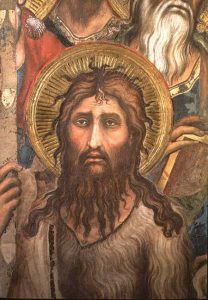 When I was a kid growing up first in southern Nevada and then in southern California, the weeks leading up to Christmas (we weren’t church members so we didn’t call them “Advent”) were always the same. They followed a pattern set by my mother. We bought a tree and decorated it; we set up a model electric train around it. We bought and wrapped packages and put them under the tree, making tunnels for that toy train. We went to the Christmas light shows in nearby parks and drove through the neighborhoods that went all out for cooperative, or sometimes competitive, outdoor displays. My mother would make several batches of bourbon balls (those confections made of crushed vanilla wafers and booze) and give them to friends and co-workers. Christmas Eve we would watch one or more Christmas movies on TV, and early Christmas morning we would open our packages . . . carefully so that my mother could save the wrapping paper. Then all day would be spent cooking and watching TV and playing bridge. After the big Christmas dinner, my step-father and I would do the clean up, my brother and my uncle would watch TV . . . and my mother would sneak off to her room and cry. You see . . . no matter how carefully we prepared, no matter how strictly we adhered to Mom’s pattern, something always went wrong. We never got it right; Christmas never turned out the way my mother wanted it to be.
Some years later, I read the work of the Israeli poet Yehuda Amichai and I understood what our family problem was.


