====================
A sermon offered, on the Third Sunday of Advent, Year B, December 14, 2014, to the people of St. Paul’s Episcopal Church, Medina, Ohio, where Fr. Funston is rector.
(The lessons for the day, RCL Advent 3B, were Isaiah 66:1-4,8-11; Psalm 8126; 1 Thessalonians 5:16-24; and John 1:6-8,19-28. These lessons can be read at The Lectionary Page.)
====================
 “There was a man sent from God, whose name was John. He came as a witness to testify to the light. . . .” (Jn 1:6) The baptism of Jesus is never mentioned in the Gospel of John, so John the forerunner is never called “the Baptist” in this Gospel. He is, instead, the one who testifies, the witness who tells the truth.
Truth telling is risky business, as we all know and as John the witness would find out. He told the truth about Herod Antipas and his adulterous relationship with Herodias, and he lost his head over it. Telling the truth is risky business.
John told the Truth to Power. Dressed like a wild man (according to Mark’s Gospel which we heard last week), he stood in the midst of the People of Israel and interpreted for them the signs of the time in light of the words of the Prophets who had preceded him.
The mid-20th Century theologian Karl Barth is reputed to have advised preachers that they should work the newspaper in one hand and the Bible in the other. Whether he ever actually said that is a matter of some debate, but in a letter to his friend Eduard Thurneysen in November of 1918, he described himself as “brood[ing] alternately over the newspaper and the New Testament” seeking to discern “the organic connection between the two worlds concerning which one should … be able to give a clear and powerful witness.” (Barth to Thurneysen, 11-11-1918) John the testifier of Truth to Power was doing that very thing, making the organic connection between the world of his day and the world of his Scriptures, and giving a clear and powerful witness.
And that is the very thing which you and I and every follower of Jesus Christ are also called to do; it is the ministry not only of the professional theologian, not only of the parish priest and preacher, not only of the prophet; it is the ministry of each and every baptized person to “proclaim by word and example the Good News of God in Christ.” (BCP 1979, page 305) That is the ministry which we promise to undertake when we are baptized, a promise we repeat at every baptism in which we take part.
Today is the second anniversary of the killing of twenty children and six adults at Sandy Hook Elementary School in Newtown, Connecticut. On the Sunday following that awful massacre I stood in this pulpit and told you that I had spent the previous “48 hours following the news reports, weeping, screaming at the television, reading the statements of bishops and other clergy, enraged at the injustice of it, angry because as a society we seem unwilling (not incapable, unwilling) to do anything about the epidemic of gun violence that seems to sweep unchecked across our country.” (2012 Sermon)
I was later advised by a well-meaning member of the congregation suggested that I should turn off the TV, put down the newspaper, disconnect my internet news-feeds, and “just tell the nice parts of the Jesus story.” But I can’t do that, you see, because that wouldn’t be making the organic connection between the world of our day and the world of our Scriptures. That wouldn’t be testifying to the light; that would be lying about the darkness. Psalmist didn’t simply sing about shouldering the sheaves with joy; the Psalmist also paid heed to the fact that that joy follows carrying out the seed with weeping; the harvest of rejoicing comes after the seed is sowed with tears. (Ps 126:6-7)
Rejoicing in the midst of difficulty is the theme of this Third Sunday of Advent! In the tradition of the church, today is known as Gaudete Sunday or “Rejoicing Sunday” because in the medieval church the introit, entrance chant which began the Mass, was Gaudete in Domino semper: iterum dico, gaudete, “Rejoice in the Lord always; again, I say, rejoice,” from Paul’s letter to the Philippians (Phns 4:4), the same message he writes to the Thessalonian church in today’s epistle lesson: “Rejoice always, pray without ceasing, give thanks in all circumstances.” (1 Th 5:16)
This year, as two years ago, it is difficult to focus on that theme of thanks and rejoicing. Although we hold in one hand the Gospel of light, in the other we hold the newspaper coverage of the Senate Intelligence Committee’s executive summary of a report detailing the unspeakable acts of “enhanced interrogation techniques” undertaken by the Central Intelligence Agency as part of the so-called “war on terror.” (See, e.g., Mother Jones) It is difficult to focus on thanksgiving and joy when we read about the things done on our behalf . . . and let’s be honest and not try to distance ourselves from that fact, these things were done on our behalf to gain information to ferret out and punish those who had accomplished, and to protect us from other potential, acts of terrorism.
Let’s also be honest and put to rest the euphemism of “enhanced interrogation techniques” and admit that it is more accurate and truthful to describe the CIA’s actions as torture, as Senator John McCain did in his statement on the Senate floor: “I have long believed some of these practices amounted to torture, as a reasonable person would define it.” (McCain Floor Statement) Unfortunately, the public debate about the CIA’s actions has, in the words of my friend and colleague Tobias Haller, gotten “lost in the utilitarian thicket of ‘did it produce results’ rather than sticking with the basic truth that ‘torture is wrong’.” (Facebook status)
Although it is clear that we, as Americans, can differ on the question of whether torture produces useful information – personally, I agree with Senator McCain “that the abuse of prisoners will produce more bad than good intelligence . . . that victims of torture will offer intentionally misleading information if they think their captors will believe it . . . [and that] they will say whatever they think their torturers want them to say if they believe it will stop their suffering” – although we can differ on that issue, we need to set aside the “utility” question, this red herring about whether torture produces useable intelligence. “Utility” underlies an ends-justifies-means morality which is contrary to, among other things, the Christian faith we claim to hold.
“Utility” is not and never should have been the basis of discussion or consideration of or decision to use torture to gather intelligence. As Christians we believe that God spoke to and through the prophet and commissioned not only him, commissioned not only Jesus who used his words to begin his public ministry, but commissioned all of God’s People
to bring good news to the oppressed,
to bind up the brokenhearted,
to proclaim liberty to the captives, and release to the prisoners;
* * *
to comfort all who mourn. (Isa. 61:1-2)
As Christians who have accepted this as our own ministry in our baptismal promise to “strive for justice and peace among all people, and respect the dignity of every human being,” (BCP 1979, page 305) we must insist that morality, not utility, is and should have been the touchstone for that decision, and that that decision should have been other than it was.
We must speak that Truth to Power. Some of us may feel called to hold signs in marches and protests, though not all of us need do so; some of may feel called to telephone or write our senators and congressmen, though not all of us need do so; some of may feel called to author letters to the editors of national or local publications, though not all of us need do so. What we must all do, however, is witness to the Truth as we know it in our everyday lives: Jesus said to his disciples and says to us today, “You will be my witnesses in Jerusalem, in all Judea and Samaria, and to the ends of the earth.” (Acts 1:8)
We are to witness to and rejoice in the moral truth of the simple command, “Do to others as you would have them do to you.” (Lk 6:31) This, as Jesus made clear, is the heart of the Law and the central message of the Prophets. (Mt 7:12) We witness to this truth when we “love [our] enemies, do good, and [give], expecting nothing in return,” when we are “merciful, just as [our] Father is merciful,” when we refuse to judge, when we forswear condemnation, when we extend forgiveness. (Lk 6:35-37)
There was another story in the news this week, one which initially made me quite sad but in which, in retrospect, I find cause to rejoice.
Last Wednesday there was a funeral in Los Angeles, California. People of faith, from several religious traditions, came together to assist the County of Los Angeles in burying the ashes of nearly 1500 people who had been cremated in 2011 and whose ashes, for a variety of reasons, had been unclaimed by family members for three years. They included over 900 men, over 400 women, and nearly 140 infants and children. They were buried together in one grave with a simple stone bearing only the year, 2011.
According to the report in the L.A. Times, those present decorated the grave with teddy bears and flowers; a cellist played a simple, somber tune. Clergy offer Christian and Jewish prayers; a Hindu chant was intoned. The Lord’s Prayer was said in English, Spanish, Korean and a language from the Fiji Islands. Religious leaders read poems by the late Maya Angelou.
I rejoice that people of faith joined together to pray for the repose of those who had been abandoned, that people of faith took the place of the families who had forgotten them, that people of faith provided for these forsaken dead a human community to mourn their passing.
And this is the relationship between these two otherwise unrelated news stories of the past week. Studies of the survivors of torture demonstrate that they are left with intense feelings of abandonment, with a sense of estrangement from their families and communities, with an inability to form or reform human relationships of dependency and attachments, and with muted and inexpressible rage and grief. Those who are tortured are made to feel like those dead and abandoned ashes.
In concluding his statement on the Senate floor, Senator McCain agreed with me that torture’s immorality, not any concern about its utility, is the reason it should not be used. “In the end,” he said, “torture’s failure to serve its intended purpose isn’t the main reason to oppose its use. I have often said, and will always maintain, that this question isn’t about our enemies; it’s about us. It’s about who we were, who we are and who we aspire to be.”
We Christians stand with our Bible in one hand, with the newspaper in our other, making the organic connection between the world of our day and the world of our Scriptures. Making that connection we must face the question, who do we aspire to be? Who are we called to be? Are we called to be those who, themselves or by delegation to others, make the living feel like dead ashes? Or are we rather called to be those who “comfort [and] provide for those who mourn, [who] give them a garland instead of ashes, the oil of gladness instead of mourning, the mantle of praise instead of a faint spirit?” (Isa 61:2-3)
“Rejoice always, pray without ceasing, give thanks in all circumstances” (1 Th 4:4) that we aspire to the latter calling, the great calling to be Christ’s witnesses, tellers of Truth to Power, to the ends of the earth! Amen.
====================
A request to my readers: I’m trying to build the readership of this blog and I’d very much appreciate your help in doing so. If you find something here that is of value, please share it with others. If you are on Facebook, “like” the posts on your page so others can see them. If you are following me on Twitter, please “retweet” the notices of these meditations. If you have a blog of your own, please include mine in your links (a favor I will gladly reciprocate). Many thanks!
====================
Father Funston is the rector of St. Paul’s Episcopal Church, Medina, Ohio.
 When Philip told Nathanael that he had found the Messiah and that he was the son of a carpenter from Nazareth, Nathanael’s immediate response was, “Can anything good come from Nazareth?” (Jn 1:46). Obviously Nazareth had a reputation, and not a good one. I often wonder if, as Jesus was making his way through the Holy Land, especially early in his ministry when he wasn’t well-known, people would ask him, “What was it like growing up in Nazareth?”
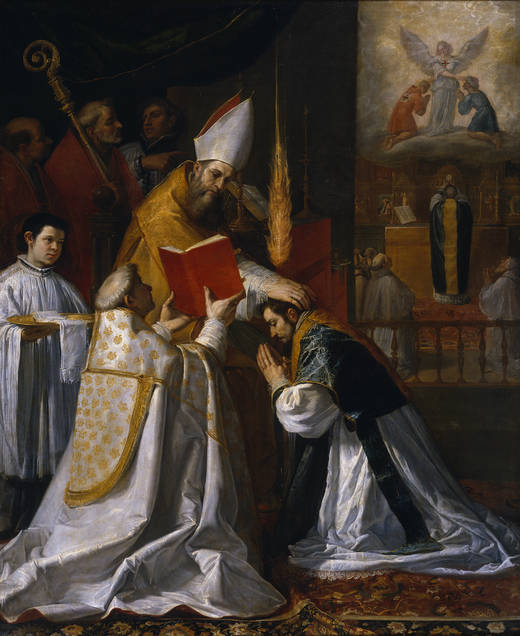 Tonight, as my diocese begins its annual governing convention in traditional fashion with a celebration of the Holy Eucharist, we will doing so in the context of an ordination – two ordinations, in fact, one to the diaconate and one to the presbyterate. This morning’s reading from Ben Sira is lengthy description of the glories of the ceremonial priesthood. One might have expected the church to have made this one of the potential readings for a presbyteral ordination, but in its wisdom, it has not.


 This isn’t what we want or expect to hear from “the Prince of Peace,” but here it is! Jesus is not going to let us “make nice” and “all get along.” He insists that we acknowledge and confront the reality of interpersonal conflict, that we admit that even good news can bring division.
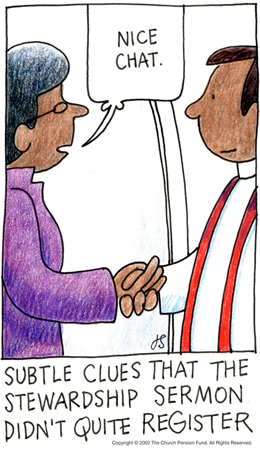 It’s about to come to an end, the annual appeal to church members everywhere to turn in a card saying how much they plan (hope, anticipate, expect, guess) to give in offerings in the coming year. Clergy everywhere are breathing both a sigh of relief that “stewardship season” is nearly done, while also wondering if there will be enough income to sustain the parish’s budget for another year. Congregational governing boards, treasurers, and budget committees are poring over the books and making plans – in some parishes they are adding new programs and new staff; in most, I suspect, they are trying to cut “fat” out of budgets already cut to the bone. I would guess there are more frowns than smiles being generated in the process of annual church budgeting.
 The shadows tonight will be full of dreams moving from house to house, door to door, seeking handouts of candy or toys or whatever with a cry of “Trick or Treat!” We hope the wind will stay away, at least until America’s children’s annual celebration of the ancient Celtic feast of Samhain is completed.
 I often wonder what (if any) thought went into the construction of various lectionaries, particularly the Daily Office lectionary of the Episcopal Church. Are the sometimes strange, sometimes enlightening, often puzzling juxtapositions of texts planned or simply fortuitous?

