From the Psalms:
O that today you would listen to his voice!
(From the Daily Office Lectionary – Psalm 95:7b (NRSV) – March 8, 2013.)
 Today we are asked by the Episcopal Church’s Lectionary to use Psalm 95 as the invitatory at the Daily Office of Morning Prayer. Whether we recite the whole psalm or the abbreviated text we call The Venite, we say these words: “Oh, that today you would hearken to his voice!” (as the Prayer Book renders them). Lent is a season that calls us to pay attention to God, to be involved in God’s world, and to be aware of God’s presence.
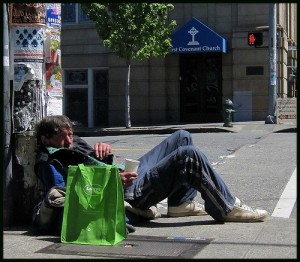
The year I was in residence in Berkeley, California, at Church Divinity School of the Pacific working on a Certificate of Anglican Studies, there was a homeless man who habitually hung out on Euclid Avenue. One often encountered him along the stretch between the seminary and the north gate of the Cal Berkeley campus where there are several businesses including bars and restaurants. Although he would frequently be there panhandling, just about as often one would find him asleep in one of the non-business doorways, his long legs stretched out onto the sidewalk. I can remember stepping over his legs on more than one occasion. When he was awake and begging, he was usually respectable in his asking for handouts, but too often for comfort he could also be rude and offensive. He was clearly disturbed, possibly schizophrenic and also possibly dangerous, as I learned when I tried to engage him in conversation one day. Given that he was of a similar age to me and given the things he yelled at me liberally sprinkled with abusive obscenities, I suspect that he might have been a Vietnam veteran. I never tried to talk with him after that, but if he was panhandling when I passed by, I would give him whatever change was in my pocket, usually around a dollar; I must confess, however, that just about as often (or perhaps more often) I would find some excuse to cross the street before reaching him. What I never did was try to get him help, to find him shelter, or food, or medical care . . . nor, it seemed, did anyone else.
Today on the Episcopal Chuch’s sanctorale calendar is the commemoration of Geoffrey Anketell Studdert Kennedy, an Anglican priest and British army chaplain during World War I. A poet, Studdert Kennedy, wrote a poem entitled Indifference which touches on the admonition of Psalm 95:7b and my Berkeley experience:
When Jesus came to Golgotha, they hanged Him on a tree,
They drove great nails through hands and feet, and made a Calvary;
They crowned Him with a crown of thorns, red were His wounds and deep,
For those were crude and cruel days, and human flesh was cheap.When Jesus came to Birmingham, they simply passed Him by.
They would not hurt a hair of Him, they only let Him die;
For men had grown more tender, and they would not give Him pain,
They only just passed down the street, and left Him in the rain.Still Jesus cried, “Forgive them, for they know not what they do,”
And still it rained the winter rain that drenched Him through and through;
The crowds went home and left the streets without a soul to see,
And Jesus crouched against a wall, and cried for Calvary.
I’ve no idea what became of that man on Euclid Avenue in Berkeley, California . . . but I know who he was.
“O that today you would listen to his voice!”
====================
A request to my readers: I’m trying to build the readership of this blog and I’d very much appreciate your help in doing so. If you find something here that is of value, please share it with others. If you are on Facebook, “like” the posts on your page so others can see them. If you are following me on Twitter, please “retweet” the notices of these meditations. If you have a blog of your own, please include mine in your links (a favor I will gladly reciprocate). Many thanks!
====================
Father Funston is the rector of St. Paul’s Episcopal Church, Medina, Ohio.
 “We hold these truths to be self-evident, that all men are created equal, that they are endowed by their Creator with certain unalienable Rights, that among these are Life, Liberty and the pursuit of Happiness.” There is an undeniable link between truth and autonomy, between authenticity and independence. Those who seek to take away liberty do so by use of falsehood, and most effective untruths are those which are the biggest. Adolph Hitler described the phenomenon:
 Why has the health of the people not been restored? This is God’s question of the leadership of ancient Israel, but it could certainly be the question asked of modern America! Other questions could also be asked, even in the aftermath of the healthcare reform debates, the passage of the Affordable Care Act, and its vindication as constitutional by the U.S. Supreme Court. Why is it that, in the practice of medicine, we do not have equal treatment for everybody? Why is that every American is guaranteed a lawyer, but not a doctor? Why don’t we (even now) have guaranteed health care for everyone?
 Scholars and commentators seem to agree (and a computer search of various translations confirms) that there is no single verse of the Hebrew scriptures saying what John says Jesus quoted. It seems to be an amalgam or summary of several different bits of the prophets. When I read this story of John’s, however, it isn’t a prophet that comes immediately to mind. Instead, I think of a portrayal of Lady Wisdom in the Book of Proverbs:
 I’ve been thinking about this all day and there is so much to say . . . but this cuts so deeply into so many areas of life that I cannot bring myself to say any of them.
 Some years ago, during the summer of 2000 to be exact, I was one of about a dozen adults who chaperoned 87 teenagers on a ten-day tour of northern Italy. One of the pieces of advice given our group by the organizing tour guide was that the young ladies would not be allowed into Italian cathedrals wearing shorts or tank-tops. She suggested that they take with them, and always have on hand a light-weight over-blouse and a large scarf that they could tie around their waist to form a sort of skirt. This caused no amount of amusement among our group 17- and 18-year-old, Twenty-First Century, American girls, but it only took one time being escorted out of a church by a stern Italian nun for them to realize how serious the advice was and to never again forget to put on their overshirts and their wrap-around skirts.
  Thirty or so years before the episode described here by John, Mary “gave birth to her firstborn son and wrapped him in bands of cloth, and laid him in a manger, because there was no place for them in the inn” in a town called Bethlehem. (Luke 2:7) We are told here and elsewhere that Jesus had brothers, and his brothers were named “James and Joseph and Simon and Judas.” (Matthew 13:55) He had sisters, too, but their names are not reported in Scripture.
 It’s called bibliolatry and it’s been around a long, long time. The dictionary definition of bibliolatry is “excessive reverence for the Bible as literally interpreted.” What I most enjoy about modern bibliolatry is that it denies that it is bibliolatry in the most circular and bibliolatrous of ways.
 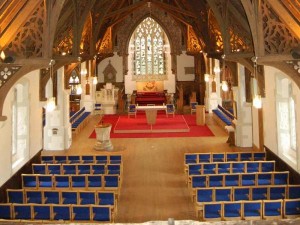 Despite the tradition that the Psalms were written by King David, any good commentary will tell you that this Psalm was written probably in the first decades of the Sixth Century BC, at around the time of the fall of Jerusalem to the Babylonians circa 598 BC. Some scholars would even suggest that it was written as late as the Maccabean era (circa 165 BC). Personally, I tend to go with the earlier date; the Psalm’s description of wide spread destruction of religious meeting places seems more in line with the pre-Exilic invasion.
 Recently, a graphic has been making the rounds on Facebook. I received it from another church and posted it on my parish’s Facebook page about 24 hours ago with the caption, “Something to think about.” As of the moment I am writing, this graphic has been “liked” 235 times. It has been shared 1,412 times. And according to Facebook’s calculations, it has been seen over 132,400 times. That’s only as originating our page. It is being posted and shared on other pages and, no doubt, has even larger numbers than these at some of those other pages.

