From Luke’s Gospel:
Jesus said, “It is easier for a camel to go through the eye of a needle than for someone who is rich to enter the kingdom of God. Those who heard it said, “Then who can be saved?” He replied, “What is impossible for mortals is possible for God.” Then Peter said, “Look, we have left our homes and followed you.” And he said to them, “Truly I tell you, there is no one who has left house or wife or brothers or parents or children, for the sake of the kingdom of God, who will not get back very much more in this age, and in the age to come eternal life.”
(From the Daily Office Lectionary – Luke 18:25-30 (NRSV) – November 26, 2012)
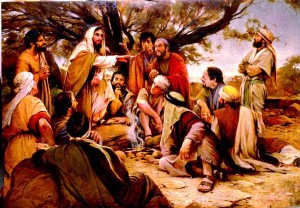 Do you ever wish someone whom you respect and admire hadn’t said what they said, because what they said is so hard to explain to someone who doesn’t respect and admire them, and what they said just sounds wrong, even to you? Then you know how I feel about the last response of Jesus in this conversation with Peter!
Jesus has just answered the question of someone Luke calls “a certain ruler” (in Mark’s Gospel he is described as a “rich young man”) about how to inherit eternal life with the famous reply, “Sell everything you own and give the money to the poor.” The disciples (more people than the Twelve, I think) are as unhappy with this hyperbolic response as the original questioner, and Peter seems downright outraged. “What are you saying?” I can almost hear him shouting at Jesus. “We have given up everything for you!” Is Jesus simply placating him with the promise of pie-in-the-sky-by-and-by? That’s what it sounds like. “Don’t worry! You’ll get it all back and get to live forever, too!”
Of course, I’m pretty certain that’s not what Jesus meant, but it’s so hard to explain that to someone who is skeptical of this whole God-Incarnate thing to begin with.
The reason I’m pretty certain that that’s not what Jesus meant is that here, unlike in the Markan version of this story, he doesn’t say, “You’ll get back a lot more of the things you gave up.” In Mark he does say pretty much that: “Truly I tell you, there is no one who has left house or brothers or sisters or mother or father or children or fields, for my sake and for the sake of the good news, who will not receive a hundredfold now in this age – houses, brothers and sisters, mothers and children, and fields, with persecutions – and in the age to come eternal life.” (Mark 10:29-30) Gave something up? Get a hundred more back. That’s what Mark’s Jesus says. But in Luke’s version of the story all that Jesus promises is “very much more.” I think that here there is a qualitative rather than quantitative difference in the promised return. In Mark, Jesus promises his follower will get a lot of the same stuff but at a price, i.e., persecutions; here, something better is promised . . . maybe peace, contentment, love, blessing, the Presence of God, the gifts of Holy Spirit . . . one doesn’t know, but it will be “very much more” than what was sacrificed. Are Mark and Luke trying to say the same thing? Are the things they report Jesus promising as rewards to the faithful follower equivalent? I don’t know; I hope they are, but the texts don’t make it easy to tell. And neither text makes it easy to explain to the skeptical unbeliever.
And the icing on the cake in both versions is the promise of “eternal life” in “the age to come”! It looks like a promise of immortality in the future, but (again) I’m not so sure. Both of these are coded phrases. The second one is found in lots of rabbinic literature, some contemporary with Jesus, some from later periods. It doesn’t necessarily mean the future; it means the time when God’s rule directs human affairs. That can be at any time when a person or persons give up their falsely perceived autonomy and live in accordance with God’s will. “The age to come” can (and does) exist concurrently with “this age”. It’s like that both-and, here-and-not-here, within-you-but-also-only-nearby thing that Jesus announced, the Kingdom of God. “Eternal life” is also not a future thing. For Jesus “eternal life” doesn’t mean immortality; it means life in eternity, where eternity is God’s Presence. “Eternal life” means living in God’s Presence with full awareness.
So the promised reward (whether it includes a hundred houses or not) is a qualitatively different life. Whatever we are called to give up in order to live a faithful life, possibly the hyperbolic “everything” that Jesus and Peter mention in this text, the reward of such a life is “very much more.” Which brings me back to how to explain it to the unbeliever . . . and the truth is that I don’t think it can be explained. It can only be lived and when it is lived, it becomes very apparent to someone not living it. An old friend of mine used to say this was the very best form of evangelism, to live the Christian life so well that one fairly glows with peace, contentment, love, blessing, the Presence of God, and the gifts of Holy Spirit. Others will see that and think, “I want that.” Then we don’t have to explain it, just offer it. Give it all up; get back so very much more.
====================
A request to my readers: I’m trying to build the readership of this blog and I’d very much appreciate your help in doing so. If you find something here that is of value, please share it with others. If you are on Facebook, “like” the posts on your page so others can see them. If you are following me on Twitter, please “retweet” the notices of these meditations. If you have a blog of your own, please include mine in your links (a favor I will gladly reciprocate). Many thanks!
====================
Father Funston is the rector of St. Paul’s Episcopal Church, Medina, Ohio.
Is go dtí tú mo mhuirnin slán
 Today is the last Sunday after Pentecost called “the Feast of Christ the King.” A relatively new feast on the calendar of the church, it was instituted by a 20th Century pope and originally set in late October as a response to the Protestant celebration of “Reformation Sunday” on the Sunday closest to October 31, the anniversary of Luther’s posting on the Wittenburg chapel door. The latter, I would suppose, started with the Lutherans but has spread throughout American Protestantism; I know of Presbyterian, Reformed, UCC, and Methodist churches that mark it. I know of no Episcopal congregations that do so. Episcopalians did take to Christ the King, however, and since Paul VI moved it to the last Sunday of the Christian year, every congregation I’ve been a part of has celebrated it. With the adoption of the Revised Common Lectionary, it is now an official part of our tradition.
 Although from a modern perspective, the prayer of the Pharisee is rather bigoted, but we should try to see it from his perspective and from within his culture, which Jesus shares. When we do so, we can see that Jesus is not criticizing the individual, but rather condemning an entire system of religion which divides and categorizes people. Jesus is denouncing any system, religious, social, or political, which separates people on the basis of bigotry and fear.
 It may be the United States’ holiday of Thanksgiving Day, but the Daily Office continues at this time of year delivering its message of repentance rather than encouraging thanksgiving. The Old Testament lesson is another from Malachi in which the Lord speaking to the priests says that he has spread dung on their faces and put them out of his presence! The gospel lesson from Luke has Jesus predicting the end of the world. And then there’s this epistle lesson which condemns the wealthy. Just not a lot of giving thanks!
 Several years ago I served in a small parish which had a very tight budget. Among its many cost-saving efforts was the reuse of altar flowers. Arrangements would be purchased and used on one Sunday, then quickly put away in the refrigerator in the basement kitchen to be used again the next week. Of course, they didn’t last as well as they might have been wished to (and some varieties of flower fared worse than others), so it was noticeable that they’d been around for awhile. In addition, if there’d been any sort of parish dinner in the interim so that food had been stored in the same refrigerator, they would often have taken on a bit of the odor of fried chicken or garlic or cheesy tuna surprise.
  Giving thanks at a time privation, that’s what these two verses from Habakkuk’s prophecy are about. Habakkuk describes a situation in which he (and all the people of Jerusalem) have lost everything. Just look at what he lists in verse 17: figs, grapes, and olives, the year-round fruit crops of the area; the fields, which is to say the annual crops, the grains and staple foods; flock and herd, which means sheep and cows. All their their produce is gone, all their livestock are dead.
  There are two passages of Scripture that I always think of when vestries or other church governing boards begin to discuss a vision for the church’s mission and ministry. One is the King James version of Proverbs 29:18a – “Where there is no vision, the people perish.” – the other is this passage from Habakkuk. I really like the image of the vision being written so large that someone running by can read it and make sense of it; the church’s vision needs to be as big, expansive, and attention-getting as a billboard.
 The “valley of decision” is probably another name for the Valley of Jehoshaphat referred to in an earlier verse of this chapter of the Prophet Joel. Jehoshaphat (a Hebrew name pronounced “yeh-hoh-shah-faht”) is a compound word of two other Hebrew terms, Yahweh (one of the names of God) and shaphat (meaning “to judge” or “to decide”). Jehoshaphat, therefore, means “God will judge” or “God will decide”. Geographically, the valley of Jehoshaphat, the valley of decision, lies between the city of Jerusalem and the Mount of Olives.
 I suppose I take issue with Scripture more often than I should, but this is one of those bits that I just can’t agree with. I vehemently disagree with James’s equation of “doubt” with what he calls “double-mindedness”. The Greek word translated “double-minded” is dipsuchos , from dis , meaning “twice,” and psuche , meaning “mind.” James use of it to describe someone who has doubts suggests that such a person is divided in his or her interests or loyalties, wavering, two-faced, and half-hearted.

