Occasional thoughts of an Anglican Episcopal priest

Category: Worship (Page 86 of 107)

Gentle Partisanship – From the Daily Office – October 31, 2012

From the Book of Ben Sira:

Many have fallen by the edge of the sword,
but not as many as have fallen because of the tongue.
Happy is one who is protected from it,
who has not been exposed to its anger,
who has not borne its yoke,
and has not been bound with its fetters.
For its yoke is a yoke of iron,
and its fetters are fetters of bronze;
its death is an evil death,
and Hades is preferable to it.
* * *
Take care not to err with your tongue,
and fall victim to one lying in wait.

(From the Daily Office Lectionary – Sirach 28:18-21,26 – October 31, 2012)

PartisanshipI am a political junkie (to use a term probably copyrighted by the NPR radio show Talk of the Nation). I love the democratic political process by which we in the United States choose our leadership. I don’t, however, love what it sometimes makes me become – a hyperpartisan. Once I have considered the issues and the candidates, once I have decided for which candidate or party or side of an issue I am going to vote, I am decidedly opinionated and not shy about sharing that opinion.

The reading from Ben Sira today concerns slander rather than opinion (or at least that is how the translators have rendered the original which literally means “a third tongue”). I don’t think I have ever actually slandered any politician, but I will admit that my opinionated descriptions of some have been less than kind. I think Ben Sira’s admonitions may nonetheless apply.

Recently my friend Sarah, who is a priest and a military chaplain, posted this reflection as her Facebook status:

I have been avoiding overtly political posts since I love and serve a broad cross-section of the population and will not host hostility in my home or on my fb page. As a spiritual guide, it is time for me to openly say something about the things people of faith must consider if they are to follow the shared fundamental ethics of the major world religions. As a priest and minister of the Gospel of Jesus Christ, it is time for me to say something about what it means to vote Gospel values. It means voting for whomsoever has a preferential option for the poor, the widowed, the orphaned, the outcast. It means voting for whomsoever has demonstrated consistent concern for bringing high places low, for straightening crooked paths, for feeding the hungry, honoring the despised, protecting the least of these. We are a community, and while rugged individualism may be an American value, it is not a Christian value. If you want to vote your values, vote out of the conviction that God can and will honor self-sacrifice out of love for “the least of these.” If you want to live your values, practice love and not vitriol. If you want to vote your values, do not try to force your personal moral practices about things related to sex into the laws of the land. Instead, make this country a great place for all people from all socioeconomic classes to be married and raise children. Continuing praying for God’s love to prevail even if it costs you and me and us everything. If you pray for God’s love to prevail, share that love, including love for your enemies. This means action in word and deeds, including how we regard those who believe differently than we do. It means a return to civility and bipartisanship. As one of my medical colleagues (who, by the way, I imagine will vote quite differently than I would like him to!) lives by: “charity faileth never.”

I agree with Sarah wholeheartedly as to what it means to vote one’s values and what it means to vote as a follower of Jesus Christ. It’s those last couple of lines in her Facebook status that call me up short! It’s the embodying of those same values in our political discourse as well as in our vote that I have trouble with. It’s the “words and actions,” the “civility and bipartisanship”, the never-failing charity part.

I try, Lord knows, I try to be like Sarah. I try to follow Ben Sira’s admonitions. I don’t always (in fact, I seldom) succeed. But I hope that Thomas Merton was right, that the desire to please God does in fact please God, that though we do not succeed there is merit in the attempt. (The Merton Prayer)

I will always love politics. I will always be partisan. God grant that in my partisanship I can be gentle, or at least try to be . . . and I hope that that is enough.

====================

A request to my readers: I’m trying to build the readership of this blog and I’d very much appreciate your help in doing so. If you find something here that is of value, please share it with others. If you are on Facebook, “like” the posts on your page so others can see them. If you are following me on Twitter, please “retweet” the notices of these meditations. If you have a blog of your own, please include mine in your links (a favor I will gladly reciprocate). Many thanks!

====================

Father Funston is the rector of St. Paul’s Episcopal Church, Medina, Ohio.

Light in the Darkness – From the Daily Office – October 30, 2012

From the Gospel of Luke:

Jesus said, “No one after lighting a lamp puts it in a cellar, but on the lampstand so that those who enter may see the light. Your eye is the lamp of your body. If your eye is healthy, your whole body is full of light; but if it is not healthy, your body is full of darkness. Therefore consider whether the light in you is not darkness. If then your whole body is full of light, with no part of it in darkness, it will be as full of light as when a lamp gives you light with its rays.”

(From the Daily Office Lectionary – Luke 11:33-36 – October 30, 2012)

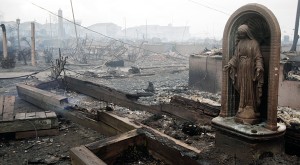
Storm Damage, New York Times photograph, 10/30/2012Last night Hurricane Sandy hit the eastern seaboard of the United States. Atlantic City was hit hard; the iconic boardwalk is gone; and with electrical power failures, the neon lights of the casino signs went dark. In Manhattan, a ConEd transformer station blew up; video of the explosion was quickly posted on Facebook and later shown on national television news programs. The lower third of the island was in darkness. Hundreds of thousands, if not millions, of people are now without electrical power and may not have light or heat for many days.

In this morning’s gospel lesson Jesus makes his point about the spiritual light within each person. The devastation wreaked by this storm, if our experience with prior disastrous such as Katrina, Irene, and many others, is simply the beginning of a very dark period for a lot of people. It will be a time when the light within each will be tested and some will truly shine. It goes without saying that these kinds of events can bring out the worst in some people, but it is also true that they can and do bring out the best in many others.

I have several friends who are volunteers with the Red Cross and other agencies in the affected area, and other friends who are clergy or active lay church members. I know that they will all be hard at work doing what they can to relieve the sufferings of others, even as they themselves have been affected by the storm. Their eyes are clear, they see what has to be done, and the light of Christ shines in and through them.

I thought of them last night as I watched the news of the storm. For them and for all who must now cope with the loss and damage caused by Sandy, I offered this prayer from the Order of Compline:

Keep watch, dear Lord, with those who work, or watch, or weep this night, and give your angels charge over those who sleep. Tend the sick, Lord Christ; give rest to the weary, bless the dying, soothe the suffering, pity the afflicted, shield the joyous; and all for your love’s sake. Amen. (BCP 1979, page 132)

Keep watch, dear Lord, with those who work, or watch, or weep throughout the time of recovery from Hurricane Sandy, and bless especially those who are light in the darkness.

====================

A request to my readers: I’m trying to build the readership of this blog and I’d very much appreciate your help in doing so. If you find something here that is of value, please share it with others. If you are on Facebook, “like” the posts on your page so others can see them. If you are following me on Twitter, please “retweet” the notices of these meditations. If you have a blog of your own, please include mine in your links (a favor I will gladly reciprocate). Many thanks!

====================

Father Funston is the rector of St. Paul’s Episcopal Church, Medina, Ohio.

Keep Your Mouth Shut! – From the Daily Office – October 29, 2012

From the Book of Ben Sira:

One who trusts others too quickly has a shallow mind, and one who sins does wrong to himself. One who rejoices in wickedness will be condemned, but one who hates gossip has less evil. Never repeat a conversation, and you will lose nothing at all. With friend or foe do not report it, and unless it would be a sin for you, do not reveal it; for someone may have heard you and watched you, and in time will hate you. Have you heard something? Let it die with you. Be brave, it will not make you burst!

(From the Daily Office Lectionary – Sirach 19:4-10 – October 29, 2012)

Gossip (Mouth to Ear)Don’t you just love gossip? That juicy little tid-bit that you just can’t wait to pass on to a friend? It’s so wonderfully delicious, that little bit of o-so-salacious information about some mutual acquaintance? C’mon, admit it! You just love it. We all do. It’s human nature.

Gossip is probably the most common problems in human relationships. It is insidious; most people don’t even realize when a discussion turns towards gossip, but gossip can kill a relationship. It happens much more often than we would like to admit. In simple terms, gossip basically is that could be seen as a negative spoken about one person to another when the subject is not there to hear it first hand and respond. It could be something seemingly innocent said without intent to harm, or it could be a harsh, intentional slander or assisination of character.

Gossip has many dangers. Just a few are

  • hurt feelings
  • stress
  • destroys cooperation
  • discourages the sharing of vulnerability
  • creates (or destroys) reputations
  • damages trust

We can all agree with Ben Sira that gossip should be avoided! The British Baptist preacher Alan Redpath is said to have had a rule to avoid gossip. He told himself “Think!” and asked himself five questions:

T – Is it true?
H – Is it helpful?
I – Is it inspiring?
N – Is it necessary?
K – Is it kind?

If what one is about to say does not pass those tests, Redpath said, keep your mouth shut! That’s about as good a paraphrase of Ben Sira’s advice as I can think of. “Be brave, it will not make you burst!”

====================

A request to my readers: I’m trying to build the readership of this blog and I’d very much appreciate your help in doing so. If you find something here that is of value, please share it with others. If you are on Facebook, “like” the posts on your page so others can see them. If you are following me on Twitter, please “retweet” the notices of these meditations. If you have a blog of your own, please include mine in your links (a favor I will gladly reciprocate). Many thanks!

====================

Father Funston is the rector of St. Paul’s Episcopal Church, Medina, Ohio.

The Patients of Job: Part Four – “Can You Love What You Can’t Control?” – Sermon for Pentecost 22, Proper 25B – October 28, 2012

====================

This sermon was preached on Sunday, October 28, 2012, at St. Paul’s Episcopal Church, Medina, Ohio, where Fr. Funston is rector.

(Revised Common Lectionary, Proper 25B: Job 42:1-6,10-17; Psalm 34:1-8; Hebrews 7:23-28; and Mark 10:46-52. These lessons can be read at The Lectionary Page.)

====================
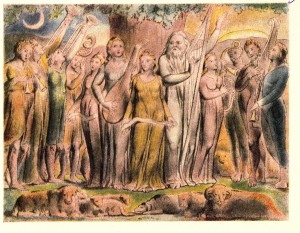
"So the Lord blessed the latter end of Job more than the beginning" by William BlakeSo here we are at the end of the Book of Job and the last of our sermons in this series entitled The Patients of Job. Let’s review the lessons we have learned, the spiritual remedies we have found in the medicine chest of this book.

First, in the introductory scenes in which the character God gave Satan leave to torment Job in ways he did not deserve, we learned that stuff sometimes happens in a person’s life, as it does in the story of Job, that he or she does not merit and for which he or she is not to blame! Stuff sometimes happens in your life that you do not deserve, and you are not to blame for it! The first bit of medicine we found in the Book of Job was the lesson to give up the “Why me? What have I done to deserve this?” ways of thinking, and stop beating ourselves up over things we can’t control! We also learned from the first part of Job’s story that life is a set of questions and that if there is truth to be found in this book, or in any of the books of the Bible, it is to be found in the process of struggling with those questions.

You’ll remember that, in the second reading we heard from this book, Job had decided to take God to court but had a problem: he didn’t know where to find God. In contemplating Job’s quandary, we recalled that our Christian faith assures us that in our times of pain and suffering, God comes to us in the loving acts of others. In illness, for example, God comes to us in the ministrations of the medical professionals who treat us. In emotional distress, God comes to us through those who offer us encouragement. In moments of deep need, God is there in a mysterious way through those who care for us. This gives us hope and courage. We need not cry out as Job did, “Oh, that I knew where I might find him;” (23:3) God knows where to find us. This is the balm for our souls, the spiritual medicine that we found in our second lesson from the Book of Job, that in our times of need, God knows were to find us and that, indeed, God does come to us.

In our third reading, last week, God spoke to Job but did not directly answer Job’s legal complaints. Instead, God’s response to Job was an invitation to us to participate in creation, to get creative. God let Job and us know that the answer to life’s problems is to get creative, to do something unexpected, to think outside the box. That is spiritual medicine for us because neither our problems, nor our world, nor our God will fit neatly into our preconceived boxes.

So those are the Book of Job’s spiritual medicines so far: stuff happens – don’t let it get you down; life is a bunch of questions, not a set of answers; God knows where to find us; and think outside the box.

Between last week’s lesson and this week’s reading, God continues to speak to Job about creation, describing its wildness, its beauty, and its uncontrollable nature; in Chapters 40 and 41, God specifically mentions the great bests Behemoth and Leviathan which cannot be captured and which overwhelm any who see them. The descriptions of nature in these ending chapters are suffused with the love that God has for God’s creation. This overwhelming and uncontrollable world which God created and which God loves is the answer God gives to Job’s self-pitying “Why me?” a question which clearly makes no sense in such a world.

Which brings us to the end and the epilogue but, frankly, these don’t make much sense. They seem to contradict everything we’ve learned so far. The whole book up to this point has seemed to be an argument against the old “wisdom religion” with its system of retributive justice, its idea that God rewards the righteous and punishes the wicked, that whatever happens to you, good or bad, is because you deserve it, so just accept it. But here at the end of the book that seems to be exactly what is happening: Job is rewarded for his righteousness by being reimbursed for his losses. “The Lord restored the fortunes of Job . . . the Lord gave Job twice as much as he had before.” Furthermore, God replaces Job’s ten dead children with ten new children, as if children are fungible commodities. Eliphaz, Bildad, and Zophar seem to have been right all along.

But if that’s what this Book of Job is all about, then it offers no spiritual medicines to us at all, for we know that the world simply doesn’t work that way! The righteous aren’t always rewarded; the wicked aren’t always punished; in fact, it’s all too often the other way around. If we read the end of the story in that way, we must be missing something. And indeed we are.

The lesson to be learned here requires that we compare the Job who is “restored” with the Job who existed before all of his losses. That earlier Job was a man who sought to control his world. We are told that that Job “would rise early in the morning and offer burnt offerings according to the number [of his children]; for Job said, ‘It may be that my children have sinned, and cursed God in their hearts.’ This is what Job always did.” (1:5) The restored Job, having been shown how uncontrollable the world is, turns loose of control; even before his death would require him to, he gives an inheritance to his children, his daughters as well as his sons. (42:15)

Ellen F. Davis, Professor of Bible and Practical Theology at Duke University Divinity School, in her book Getting Involved with God: Rediscovering the Old Testament (Cowley:Cambridge, MA, 2001), characterizes God’s speeches to Job, just the opening part of which we heard in last week’s reading, as posing for Job and us this question: “Can you love what you do not control?” (pg. 140)

You may be familiar with a popular saying that goes something like this: “If you love something, set it free. If it comes back, it’s yours. If it doesn’t, it never was yours.” God’s admonitions to Job and his restoration of Job’s fortunes affirm the first part of that, but call into the question the bits about return. The point here seems to be that even if it does return, it was never yours, at least it was never yours to control. In God’s descriptions of nature, of the unruliness of the weather, of the harshness of the wilderness, of the violence of the seas, of the wildness of the beasts, God made it clear that God made Creation wild and free, but God nonetheless loves Creation. This new, restored Job has learned to love his family in the same way, respecting their dignity and freedom, not seeking to control their world.

So the lesson for us to learn, the spiritual medicine for us at the end of the book, like the first lesson at its beginning, has to do with our lack of control. From the early scenes, we learned to accept that we cannot control the world; at the end, we learn to love it anyway. Love it even its most out-of-control, darkest times, because the lesson at the end of this Book of Job tells us that when the dark, uncontrollable night is over, the sun always rises. There is always the promise of hope. That is not only the balm at the end of Job’s story, it is the recurring message of the story of God and God’s People told again and again.

In the time of Noah, it rained for forty days and forty nights; water covered the earth for nearly a year. There was nothing Noah and his family could do about it; they were not in control. But, eventually, the dry land appeared again and God hung a rainbow in the sky.

For generations, the Hebrews were slaves in Egypt. There was nothing they could do about; they were not in control. But then God sent Moses and they were freed.

For forty years they wandered the desert because they were not in control, but eventually Moses led them to, and Joshua led them into, the Promised Land.

The Babylonians sacked Jerusalem and carried away the leaders and a goodly portion of God’s People to Babylon. They were exiled for seventy years; there was nothing they could do about it; they were not in control. But, eventually, God raised up Cyrus the Persian who defeated the Babylonians and set the Israelites free to return and rebuild.

Bartimaeus was blind. There was nothing he could do about it; he was not in control. But, eventually, the Son of God happened by and his sight was restored.

The Son of God himself was beaten, mocked, crucified and killed, laid in a tomb that was not his own. There was nothing he could do about it; he had given up control. But, eventually, there was Easter!

The last verse of the Book of Job as we have received it is, “And Job died, old and full of days.” But in some Greek-language texts there is one more verse added, “And it is written that he will rise again with those whom the Lord raises up.” The end of the Book of Job is a reminder to love what we cannot control, to love what is wild and free, because as bad as things may get, as dark and out-of-control as they may be, eventually there will be something very much like resurrection. And that is balm for our souls, that we like Job “will rise again with those whom the Lord raises up.” Amen.

====================

A request to my readers: I’m trying to build the readership of this blog and I’d very much appreciate your help in doing so. If you find something here that is of value, please share it with others. If you are on Facebook, “like” the posts on your page so others can see them. If you are following me on Twitter, please “retweet” the notices of these meditations. If you have a blog of your own, please include mine in your links (a favor I will gladly reciprocate). Many thanks!

====================

Father Funston is the rector of St. Paul’s Episcopal Church, Medina, Ohio.

Theodicy and Abortion – From the Daily Office – October 27, 2012

From the Book of Ben Sira:

It was he who created humankind in the beginning,
and he left them in the power of their own free choice.
If you choose, you can keep the commandments,
and to act faithfully is a matter of your own choice.
He has placed before you fire and water;
stretch out your hand for whichever you choose.
Before each person are life and death,
and whichever one chooses will be given.

(From the Daily Office Lectionary – Sirach 15:14-17 – October 27, 2012)

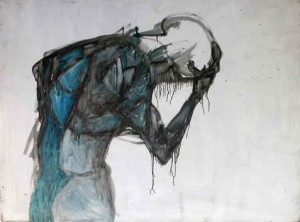
Grief (watercolor wash, artist unknown)Well, there it is! Bigger than life! Free will! Of course, I know that as an Anglican I am not supposed to use this text, or any part of the Deuterocanon, to settle matters of doctrine, but only read them ” for example of life and instruction of manners.” [Articles of Religion, Article VI, BCP 1979, page 868] But come on! There it is!
I probably shouldn’t go there, but the past 48 hours have made it impossible not to think about free will without thinking of Indiana senate candidate Richard Mourdock who stirred up controversy when he said during a debate that “even when life begins in that horrible situation of rape, that is something that God intended to happen.” He tried to explain himself later saying, “God creates life, and that was my point,. God does not want rape, and by no means was I suggesting that he does. Rape is a horrible thing.” He only dug a deeper hole. If it is true that politics and religion don’t mix, it is even more true that politics and the problem of theodicy don’t mix!

“Theodicy” is a little-used word theologians coined to describe what is generally called “the problem of evil.” It posits this rational conundrum:

  1. God is all-powerful.
  2. God is all-good.
  3. God is all-knowing.
  4. Evil exists.

Only three of these four propositions (says the issue of theodicy) can be true; since we know that evil exists, then one of the other three statements must be false. Many philosophers and theologians have wrestled with this issue and I’m not going to get into it in a brief meditation on the daily office lessons, other than to acknowledge that it exists and that one way it is answered is the very subject Jesus son of Sirach brings up in this reading: free will. In other words, in making the universe (and humankind within it) free, the all-powerful, all-loving, all-knowing God allows the possibility that evil may occur.

St. Thomas Aquinas affirmed in the Summa Theologica that God’s ultimate purpose for creation is so good, so great that it involves “allowing” the possibility of evil, but (as Aquinas points out) to “allow” is not the same as to “cause”. Furthermore, the enduring good that allows evil includes the possibility that good can redeem evil; because of this remaining good, a return path to good is always possible. I think this is the theological concept candidate Mourdock was trying to articulate, but doing so badly and causing himself and his party a good deal of trouble.

I can agree with Mr. Mourdock up to a point, but not about the conclusion he ultimately reaches. In his view, apparently, the return to good, the redemption of the evil of rape, is found in the conception of life which may result. For him, that redemption is (apparently) automatic and, thus, a pregnancy resulting from rape is redemptive; it is a good so great that it cannot be aborted. But neither Aquinas nor any theologian has ever argued that the return to good is automatic; it is always and only contingent – it is possible but never guaranteed. Furthermore, there is the counter possibility in the circumstance of a rape that further evil, not good, could result from the pregnancy and later birth. Indeed, the experience of women who have born the children conceived in rape shows a wide variety of outcomes, many extremely negative, many a continuation of the evil done to them.

That is why I cannot come to the theological conclusion reached by candidate Mourdock, nor to the political conclusion to which he comes, i.e., that abortion should be outlawed with no exception provided for conceptions resulting from rape. Indeed, I cannot come to any conclusion which entirely outlaws abortion. To do so denies to women the freedom of will given humankind from the beginning about which Ben Sira writes; this is a matter about which women should decide for themselves “in the power of their own free choice.” Therefore, abortion should be safe. It can only be safe if it is legal and regulated; if it is outlawed, it will nonetheless continue. The choice for our society is not between abortion and no abortion; it is between abortion which is safe and abortion which is deadly.

I cannot say that I would never, as a priest, counsel a woman to undergo an abortion, but I would nearly always argue for an alternative. In the end, however, it would not be my decision; it would be hers. And if she chooses to abort the fetus, then it is her right to have that procedure done in the safest way possible. Years ago, I participated in a panel discussion with an Eastern Orthodox colleague ordained many years longer than me. During the presentations he said, “I would rather console a woman who’s had a safe, legal abortion, than bury one who’s had an illegal abortion. And I’ve done both.” Unlike my colleague, I have not, thank God, buried the victim of an illegal abortion, and certainly I never want to.

We will always wrestle with the problem of theodicy, but we should do so in the context of theological schools and churches. It is not an issue to be solved in the halls of congress, nor in the operating suites of hospitals, nor in the offices of obstetricians, nor with the bodies of women whom God made free to act as a matter of their own choice.

====================

A request to my readers: I’m trying to build the readership of this blog and I’d very much appreciate your help in doing so. If you find something here that is of value, please share it with others. If you are on Facebook, “like” the posts on your page so others can see them. If you are following me on Twitter, please “retweet” the notices of these meditations. If you have a blog of your own, please include mine in your links (a favor I will gladly reciprocate). Many thanks!

====================

Father Funston is the rector of St. Paul’s Episcopal Church, Medina, Ohio.

How Not to Converse – From the Daily Office – October 26, 2012

From the Book of Ben Sira:

Do not find fault before you investigate;
examine first, and then criticize.
Do not answer before you listen,
and do not interrupt when another is speaking.

(From the Daily Office Lectionary – Sirach 11:7-8 – October 26, 2012)

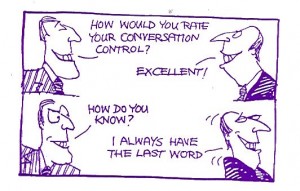
Conversation Skills CartoonJesus son of Sirach offered a lot of good advice in his little book sometimes called Liber Eccesiasticus, a book not included in the canon of inspired Scripture recognized by Protestants, but found in that selection of texts called the Apocrypha. Anglicans decline to use these texts to settle matters of doctrine, but read them ” for example of life and instruction of manners.” (Articles of Religion, Article VI, BCP 1979, page 868)
None of that advice, it seems to me, is better, nor more timely, than these verses from today’s Old Testament reading: investigate before speaking; listen before answering. The so-called “debates” (which were anything but) between the candidates for the presidency and vice-presidency of this country were exercises in how not to have a constructive and productive conversation. In whatever the format, none of which worked, these “debates” were showcases of people whose ears were hardly ever engaged, who weren’t examining things before criticizing and who weren’t listening before answering, and who definitely were interrupting when others were speaking.

I may use YouTube snippets of the debates in my pre-marital counseling of engaged couples! In that counseling, I talk with the couples about effective communication and problem solving and always, always encourage two things: active listening and assertiveness (which is very different from aggressiveness). Active listening means paying attention, not interrupting, and restating what you have heard so that you confirm your understanding; it means taking personal responsibility for getting what you hear from the other person right. Assertiveness means getting what the other hears from you right. It means taking responsibility for your feelings by using “I” statements; it means stating your position clearly and directly, not relying on the other to read your mind.

Obviously, the need for good interpersonal communications skills has been around as long as there have been people and the advice I give these couples is nothing new. Jesus Ben Sira was giving the same advice, how not to converse, a couple of millennia ago!

====================

A request to my readers: I’m trying to build the readership of this blog and I’d very much appreciate your help in doing so. If you find something here that is of value, please share it with others. If you are on Facebook, “like” the posts on your page so others can see them. If you are following me on Twitter, please “retweet” the notices of these meditations. If you have a blog of your own, please include mine in your links (a favor I will gladly reciprocate). Many thanks!

====================

Father Funston is the rector of St. Paul’s Episcopal Church, Medina, Ohio.

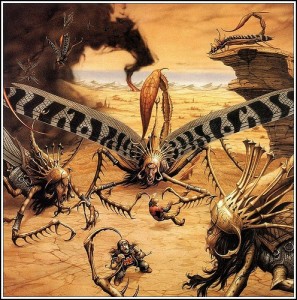
Horse-Sized Locust Scorpions . . . and Crowns – From the Daily Office – October 25, 2012

From the Book of Revelation:

In appearance the locusts were like horses equipped for battle. On their heads were what looked like crowns of gold; their faces were like human faces, their hair like women’s hair, and their teeth like lions’ teeth; they had scales like iron breastplates, and the noise of their wings was like the noise of many chariots with horses rushing into battle. They have tails like scorpions, with stings, and in their tails is their power to harm people for five months. They have as king over them the angel of the bottomless pit; his name in Hebrew is Abaddon, and in Greek he is called Apollyon.

(From the Daily Office Lectionary – Revelation 9:7-11 – October 25, 2012)

Horse-Sized Locust Scorpions, Copyright All rights reserved by _danN_ There’s lovely imagery in St. John of Patmos’s ecstatic dream. I’m particularly fond of his vision of the heavenly throne room:

Around the throne are twenty-four thrones, and seated on the thrones are twenty-four elders, dressed in white robes, with golden crowns on their heads . . . . And whenever the living creatures give glory and honor and thanks to the one who is seated on the throne, who lives forever and ever, the twenty-four elders fall before the one who is seated on the throne and worship the one who lives forever and ever; they cast their crowns before the throne, singing, “You are worthy, our Lord and God, to receive glory and honor and power, for you created all things, and by your will they existed and were created.” (Rev. 4:4,9-11)

From that vision came the last lines of Charles Wesley’s great hymn Love Divine, All Loves Excelling:

Till we cast our Crowns before Thee,
Lost in Wonder, Love, and Praise!

In today’s reading from the Apocalypse, however, the crowns belong to some rather fanciful and frightening beasts that John called “locusts” and then proceeded to describe as anything but locusts! These are monstrous flying insects the size of horses armored for battle possessing scorpions’ tails complete with stingers. We are told that these stingers cause torment but do not kill; those stung “will seek death but will not find it; they will long to die, but death will flee from them.” (v. 6)

I have to admit that I’m never sure quite what to make of or what to do with the Book of Revelation. I know it’s not a prophetic vision of the end times; it’s an apocalyptic vision meant to comfort the people of John’s own time and place (late first or early second century Roman Empire). I know that as the canon of scripture developed there was disagreement about its inclusion. But knowing those things doesn’t really help me know what to do with it now, other than to read it (as the lectionary has had us do for several days) and wonder, “What was John smoking?” This book always seems to me to be a sort of scriptural Scare Tactics or Total Blackout (Syfy channel game shows), or possibly evidence that God has a Tim-Burton-like sense of humor.

But, still, there are those lovely images of the heavenly throne room and the thought that we, unlike the horse-sized locusts, will some day cast our crowns before the throne of glory.

====================

A request to my readers: I’m trying to build the readership of this blog and I’d very much appreciate your help in doing so. If you find something here that is of value, please share it with others. If you are on Facebook, “like” the posts on your page so others can see them. If you are following me on Twitter, please “retweet” the notices of these meditations. If you have a blog of your own, please include mine in your links (a favor I will gladly reciprocate). Many thanks!

====================

Father Funston is the rector of St. Paul’s Episcopal Church, Medina, Ohio.

The Better Angels of Our Nature – From the Daily Office – October 24, 2012

From the Book of Ben Sira:

Do not seek from the Lord high office,
or the seat of honor from the king.
Do not assert your righteousness before the Lord,
or display your wisdom before the king.
Do not seek to become a judge,
or you may be unable to root out injustice;
you may be partial to the powerful,
and so mar your integrity.
Commit no offense against the public,
and do not disgrace yourself among the people.

(From the Daily Office Lectionary – Ben Sira 7:4-7 – October 24, 2012)

Abraham LincolnThere are a few folks flying all over the U.S. recently (and promising to do so for the next couple of weeks) who have not followed Ben Sira’s advice! Everyday for the past few weeks my mailbox has contained at least one and more commonly three or more expensively produced, glossy, color flyers extolling the virtues of one or the other of the political parties or candidates, or more often tearing down the other guys. Everyday for the past few weeks my voicemail has recorded a robo-call from some politician or political action group. Everyday at any hour of the day that I care to turn on my television set, I am treated to political advertisements and “news” shows. Someone is not following Ben Sira’s advice to “not seek high office or the seat of honor”! And we as a society are, I’m sad to say, disgraced among the nations by the spectacle of our electioneering.

And how could it be otherwise in a society like ours? In a culture in which the People are the sovereign, charged with choosing our leaders by popular vote, how could it be otherwise? We could, I suppose, try to limit the period of campaigning. We could, I suppose, try to limit the amount spent on political advertisements. I’m not sure these or other measures would work, but we could try.

What might work better is for everyone, more the People than the politicians, to remember and meditate upon the closing words of Abraham Lincoln’s first inaugural address:

We are not enemies, but friends. We must not be enemies. Though passion may have strained, it must not break our bonds of affection. The mystic chords of memory, stretching from every battle-field, and patriot grave, to every living heart and hearth-stone, all over this broad land, will yet swell the chorus of the Union, when again touched, as surely they will be, by the better angels of our nature.

If we and those who seek our votes would simply remember that we are not enemies, and let ourselves be touched “by the better angels of our nature,” if we and those who seek our votes would focus on truth and on laying out a vision for our country and our world instead of tearing down the other candidate, if we and those who seek our votes would carry out our democratic processes in humility, then perhaps we would not need Ben Sira’s injunction to “commit no offense against the public,” perhaps we could be assured that our election cycles do not disgrace ourselves among the nations.

Until then, though, Ben Sira’s words are not merely an injunction; they stand as stark indictment of our political campaigns. God grant that when it is all over, the better angels of our nature can unite us again.

====================

A request to my readers: I’m trying to build the readership of this blog and I’d very much appreciate your help in doing so. If you find something here that is of value, please share it with others. If you are on Facebook, “like” the posts on your page so others can see them. If you are following me on Twitter, please “retweet” the notices of these meditations. If you have a blog of your own, please include mine in your links (a favor I will gladly reciprocate). Many thanks!

====================

Father Funston is the rector of St. Paul’s Episcopal Church, Medina, Ohio.

The Fire Inside – From the Daily Office – October 23, 2012

From the Psalms:

So I held my tongue and said nothing;
I refrained from rash words;
but my pain became unbearable.
My heart was hot within me;
while I pondered, the fire burst into flame;
I spoke out with my tongue.

(From the Daily Office Lectionary – Psalm 39:3-4 – October 23, 2012)

FlameThis is from one of today’s psalms for Evening Prayer. What got my attention and caught my imagination is the Psalmist image of unspoken thoughts being painful and bursting into flame demanding to be spoken. While it is intended to be a positive image of trying to not engage with the wicked until one can no longer refrain from doing so, until one’s righteousness is kindled against them, I could not help but be reminded of James’s words:

The tongue is a small member, yet it boasts of great exploits. How great a forest is set ablaze by a small fire! And the tongue is a fire. The tongue is placed among our members as a world of iniquity; it stains the whole body, sets on fire the cycle of nature, and is itself set on fire by hell. (James 3:5-6)

It’s a metaphor of mixed meaning, the unspoken word as a fire bursting from the tongue in burning speech. It can slay the wicked, but it can also destroy the world. The problem is that once those thoughts begin to smolder inside one’s being they can’t be controlled; they can’t be smothered out; they can’t be contained. Bob Seeger has a great song entitled The Fire Inside which includes these lines:

You’re out on the town, safe in the crowd
Ready to go for the ride
Searching the eyes, looking for clues
There’s nowhere you can hide
The fire inside

“There’s nowere you can hide the fire inside!” It’s going to get out; it’s going to known. Our goal should not be to contain the fire or keep it hidden; that’s when we lose control of it. Our goal should be to channel it and use it. Another word for the “the fire inside” is passion. Theologian Frederick Buechner has written that vocation is where our greatest passion meets the world’s greatest need: “The kind of work God usually calls you to do is work (a) that you need most to do and (b) that the world needs most to have done. The place God calls you to is the place where your deep gladness and the world’s deep hunger meet.” (Wishful Thinking: A Seeker’s ABC) Everyone has a vocation. The Psalmist’s was to speak God’s truth in the midst of the wicked. Each of us must discern our own.

What is the fire inside and where can it be used?

====================

A request to my readers: I’m trying to build the readership of this blog and I’d very much appreciate your help in doing so. If you find something here that is of value, please share it with others. If you are on Facebook, “like” the posts on your page so others can see them. If you are following me on Twitter, please “retweet” the notices of these meditations. If you have a blog of your own, please include mine in your links (a favor I will gladly reciprocate). Many thanks!

====================

Father Funston is the rector of St. Paul’s Episcopal Church, Medina, Ohio.

No Ifs, Ands, Or Buts – From the Daily Office – October 22, 2012

From Luke’s Gospel:

As they were going along the road, someone said to him, “I will follow you wherever you go.” And Jesus said to him, “Foxes have holes, and birds of the air have nests; but the Son of Man has nowhere to lay his head.” To another he said, “Follow me.” But he said, “Lord, first let me go and bury my father.” But Jesus said to him, “Let the dead bury their own dead; but as for you, go and proclaim the kingdom of God.” Another said, “I will follow you, Lord; but let me first say farewell to those at my home.” Jesus said to him, “No one who puts a hand to the plough and looks back is fit for the kingdom of God.?”

(From the Daily Office Lectionary – Luke 9:57-62 – October 22, 2012)

No ExcusesJesus is so demanding! Follow me and you won’t have a place rest; leave your dead; if you look back, you aren’t worthy!

My grandmother used to have a way of responding to excuses. She’d tell us to do something and my brother or my cousins or I would say, “But, Grammy . . . . ” And she would reply, “No ifs, ands, or buts!”

As I reflected on today’s gospel lesson I tried to find some humor in it, but the plain truth of the matter is that Jesus is demanding. To the rich young man he said, “Sell all you have, give the money to the poor, then follow me.” (Luke 18:22) To his followers he says, “If something in your life, even a part of your body, causes you to sin, get ride of it.” (Mark 9:43-47) Our allegiance to him and his gospel is to be so exclusive that it may even make enemies of our closest relatives: “I have come to set a man against his father, and a daughter against her mother, and a daughter-in-law against her mother-in-law; and one’s foes will be members of one’s own household.” (Matthew 10:35-36) No ifs, ands, or buts about it!

This is a man who brooks no compromise and if we are to be his followers, he demands that we adopt the same attitude: “A disciple is not above the teacher, nor a slave above the master; it is enough for the disciple to be like the teacher, and the slave like the master.” (Matthew 10:24-25)

No wonder many of those who thought they would be his disciples turned back and even those who continued with him found his teachings and example hard to follow. We still do; the church and her members still make the compromises he warned us not to make. But in the end we are left to ask with Peter, “Lord, to whom can we go? You have the words of eternal life.” (John 6:68)

It is a dilemma! To whom else can we go? But Jesus is so demanding! No ifs, ands, or buts about it!

====================

A request to my readers: I’m trying to build the readership of this blog and I’d very much appreciate your help in doing so. If you find something here that is of value, please share it with others. If you are on Facebook, “like” the posts on your page so others can see them. If you are following me on Twitter, please “retweet” the notices of these meditations. If you have a blog of your own, please include mine in your links (a favor I will gladly reciprocate). Many thanks!

====================

Father Funston is the rector of St. Paul’s Episcopal Church, Medina, Ohio.

« Older posts Newer posts »