Occasional thoughts of an Anglican Episcopal priest

Category: Worship (Page 91 of 107)

We’ve Never Done It This Way Before! – From the Daily Office – September 1, 2012

From the Acts of the Apostles:

[Peter said to the circumcised:] “I remembered the word of the Lord, how he had said, ‘John baptized with water, but you will be baptized with the Holy Spirit.’ If then God gave them the same gift that he gave us when we believed in the Lord Jesus Christ, who was I that I could hinder God?” When they heard this, they were silenced.

(From the Daily Office Lectionary – Acts 11:16-18 – September 1, 2012)
 
Changing a Light BulbA couple of days ago I talked about Cornelius’s conversion from pagan to Christian through some time spent as a pious not-quite-proselyte Gentile. In today’s reading Peter defends his decision to baptize the Gentiles (Cornelius and his entire household) with this great question, “Who was I that I could hinder God?” It certainly shut down his critics!

How often do we stand in God’s way? Well, how often have you heard these words: “We’ve never done it this way before”? Or it’s more affirmatively stated equivalent, “We’ve always done it this way before”? Both usually said in that dismissive, fatally negative tone of voice.

“How many Episcopalians does it take to change a light bulb?”

“Change??!?!?!??!”

It happens again and again in our churches. Nearly everyone will acknowledge that we need new carpet for the Nave or the Parish Hall, but then someone will ask, “What’s wrong with our old carpet? I like the old carpet.” I once served a church where there was universal agreement on the need to replace the carpet in the worship space, and everyone agreed that it should be red (the color of the previous carpet), but the Vestry debated for six months about the shade of red! (Finally, a member of the board just went out and ordered the carpet and put all out of our misery!)

I read recently about a church where a recently deceased parishioner had left a bequest of $15,000 for a new prayer garden. The memorial committee met for months, but eventually disbanded because they couldn’t decide where to put it or what it would look like. “We’ve never done it this way before!”

Wouldn’t be great if that were a cry of delight and adventure instead of the fatally negative dismissal of change it usually is?

A few years ago my wife and I made our first trip overseas together to Ireland, a country neither of us had ever visited. Everything we did on that trip was something we had never done before. We had never before driven on the narrow back-country lanes of Ireland, the single-track roads where one might meet a flock of sheep or a herd of cows and have to back up a hundred yards or more to wide spot and let them pass before you could go on. We had never before climbed the cliffs of County Antrim and seen the Giants’ Causeway. We had never before eaten “the full Irish breakfast” with black pudding, baked beans, sauteed mushrooms, and grilled tomatoes added to our usual fare of bacon and eggs. For eighteen days we lived an almost hourly experience of never having done nearly everything this way before, and we loved it.

Wouldn’t it be great if folks in the church, instead of fearing change and difference, would greet new things with “We’ve never done it this way before!” as a cry of delight and adventure?

We always need to remember Jesus’ words, “You did not choose me but I chose you.” (John 15:16) We have been invited by God to a surprising adventure. Just like Peter we need to ask (some of us constantly), “Who am I to hinder God?” Ours is not to hinder God, but to follow God; not to stand in God’s way, but to journey in God’s way; not to say dismissively, “We’ve never done it this way before,” but to cry with delight and excitement, “We’ve never done it this way before!”

====================

Father Funston is the rector of St. Paul’s Episcopal Church, Medina, Ohio.

The Blameless Bagged at Sunrise – From the Daily Office – August 31, 2012

From the Psalms:

To the leader: according to The Deer of the Dawn. A Psalm of David.

(From the Daily Office Lectionary – Psalm 22, introduction – August 31, 2012)
 
Deer at SunriseEpiscopalians reciting the Daily Office usually read the Psalms from The Book of Common Prayer, not from the Bible. This can cause some confusion about psalm verses because the versification and number of verses in the BCP differs from that in most Bible translations. The Psalter used in Anglican prayer books, including that of the Episcopal Church (until the 1979 book) was based on Miles Coverdale’s translation of the Bible which predated the Authorized (King James) version by nearly 80 years. The Coverdale Psalter had been used in all editions of The Book of Common Prayer, back to the first in 1549; while some editorial changes were made, the basic versification and numbering was maintained and this was continued in the 1979 version, which is a new translation but follows the tradition of Coverdale. Although not metrical, the translation was rendered with chanting in mind.

I often take a look at the Psalms in the New Revised Standard Version (my preferred translation) to see what differences there might be. Among the things not included in the BCP’s Psalter are the introductory directions and titles found in the Psalms in the Bible, so it was the introduction to this evening’s Psalm that caught my attention today, particularly the image “the Deer of the Dawn.”

Not all of the Psalms have these introductory directions; in fact, the majority do not. Some of them are clearly musical instructions: “On stringed instruments” (Ps. 41, 54, 55, 61, and 67), “For flutes” (Ps. 5), “According to the Sheminith” (Ps. 6 and 12, apparently a reference to an eight-stringed instrument, or perhaps to a particular meter or octave); “For the harp” (Ps. 8 and 81 ). Fifteen of the Psalms (120-134) are titled “songs of ascent”, which may be a liturgical direction or a reference to particular festival usage. Several Psalms, like this one, have introductory authorship ascriptions: for example, many say “a psalm of David”; a few are labeled “a psalm of Asaph”.

A few psalms, like today’s, have lovely, poetic images in their introductory rubrics. Psalm 56 is labeled “concerning the silent dove afar off”; Psalms 45 and 69 are “for the lilies”; and Psalms 60 and 80 are described is “on the lily of the testimony.” Some believe these might be references to popular tunes to which the Psalm is to be sung, but no one really knows.

In any event, the image of the “deer of the dawn” caught me up today. Psalm 22 is familiar to most Christians because Jesus is said by Matthew and Mark to have quoted its first verse on the cross: “My God, my God, why have you forsaken me?” (Matt. 27:46; Mark 15:34) Psalm 22 is prescribed in the liturgy for Good Friday, and is sometimes recited during overnight prayer vigils on Maundy Thursday. But in none of those usages is the introductory rubric and this image, “the deer of the dawn,” mentioned; the introductory directions are not read as part of the liturgy.

I am not a hunter. I can safely say that I have never shot at a wild animal, ever. But I have many friends who are hunters and they tell me that dawn is the best time to go after deer. They tell that the earliest hours of the morning are when the deer are most active. Right around dawn is when they leave their beds and move to feeding areas. A spot near a trail between the two will give a hunter a good opportunity for an hour or two after sunrise. I believe this because our home backs up to a wooded easement a few miles in length and about 500 yards wide. I usually rise just about at dawn and as I get my first cup of coffee in the dim light of the kitchen, I can just make out the woods and any movement there may be. Frequently, a doe and one or more fawns or yearlings will be moving through the trees . . . often headed for our landscaping to munch on our hostas and other plants! (I have never shot at a wild animal . . . but I have been tempted.)

It seems somehow oddly appropriate that Jesus quoted from this Psalm and that it is used at late-night Maundy Thursday vigils and at Good Friday liturgies. Not simply because of Jesus’ words, nor because the Psalm includes such crucifixion-relevant language as

All who see me laugh me to scorn;
they curl their lips and wag their heads, saying,

“He trusted in the Lord; let him deliver him;
let him rescue him, if he delights in him.”

(and)

They stare and gloat over me;
they divide my garments among them;
they cast lots for my clothing.

(Ps. 22:7-8, 17)

But because of this almost-forgotten introductory image “the deer of the dawn.”

We are told in Mark 14 and Matthew 26 that after the passover supper, Jesus took Peter, James, and John to the garden at Gethsemane and spent some time in prayer. It has always seemed to me that this must have stretched over several hours and that his betrayal and arrest must have occurred in the early morning hours. The Temple authorities, soldiers, and police who came to get him chose a time and a place not unlike a deer hunter, a time when they would have the best opportunity to find him, the best shot to take him. Jesus is “the Lamb of God” but it seems he is also “the deer of the dawn,” the innocent taken in the quiet of the new day’s early hours, the blameless bagged at sunrise.

====================

Father Funston is the rector of St. Paul’s Episcopal Church, Medina, Ohio.

Occasional Missionaries – From the Daily Office – August 30, 2012

From the Book of Acts:

[Peter asked Cornelius,] “Now may I ask why you sent for me?’ Cornelius replied, “Four days ago at this very hour, at three o’clock, I was praying in my house when suddenly a man in dazzling clothes stood before me. He said, ‘Cornelius, your prayer has been heard and your alms have been remembered before God. Send therefore to Joppa and ask for Simon, who is called Peter; he is staying in the home of Simon, a tanner, by the sea.’ Therefore I sent for you immediately, and you have been kind enough to come. So now all of us are here in the presence of God to listen to all that the Lord has commanded you to say.”

(From the Daily Office Lectionary – Acts 10:29-33 – August 30, 2012)
 
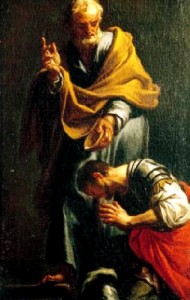
Peter Baptizing the Centurion Cornelius by Francesco Trevisani (1709)Judaism is not a missionary religion. It is, however, a proselytic religion. This means that Jews don’t go looking for converts, but those who come to them interested in becoming Jews are instructed and initiated; these initiates are called proselytes. Cornelius might have become a proselyte, but we know that he was not because if he had been, Peter would have had no issues with seeing him, meeting him, eating with him. Peter did have those issues initially, but then was shown the vision of unclean animals which he was told to eat. Peter interpreted that vision to mean that he should not treat non-Jews as unclean; it was the beginning of the Jewish Christian church welcoming non-Jews (“Gentiles”) as members.

Christianity is a missionary religion. Christians go looking for converts – or at least we’re supposed to and in the beginning we did. Someone may have told Cornelius about Jesus and about the followers of Jesus or, more likely, someone simply lived a Christian life. Cornelius had already been attracted to the Jewish religion and was following some of its practices, but the only way he could have become interested in hearing “all that the Lord had commanded Peter to say” was if someone had primed the pump, so to speak.

Once in a long while someone who is not a Christian will call me or will stop in the office and inquire about baptism (in fact, it happened quite recently, but that was the first time in several years). It always turns out that they have witnessed something in the life of a friend or family member that they find attractive – a way of handling misfortune, of dealing with the death of a loved one, of helping someone less fortunate than themselves. Having seen this, the inquirer has talked to the person and somehow in conversation they have learned that their friend or family member is a church member. Further conversation leads to further inquiry which leads eventually to me, to a conversation not unlike this conversation between Peter and Cornelius. When I’ve asked my version of “Why have you sent for me?” I’ve never been told about a vision of an angel in dazzling clothes, but I have been told about Christians testifying to their faith.

Christianity is a missionary religion, and occasionally Christians act like missionaries. When they do, Corneliuses show up.

====================

Father Funston is the rector of St. Paul’s Episcopal Church, Medina, Ohio.

Brotherly Advice – From the Daily Office – August 29, 2012

From John’s Gospel:

Now the Jewish festival of Booths was near. So [Jesus’] brothers said to him, “Leave here and go to Judea so that your disciples also may see the works you are doing; for no one who wants to be widely known acts in secret. If you do these things, show yourself to the world.”

(From the Daily Office Lectionary – John 7:2-4 – August 29, 2012)
 
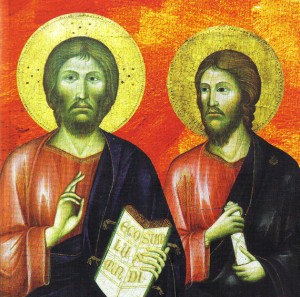
Icon of Jesus and his brother JamesThe picture of Jesus getting advice from his brothers just tickles me. John makes such a deal of it (while pointing out that his brothers did not believe in him – as the Messiah, I suppose – at the time). It seems so at odds with John’s otherwise oh-so-perfect, oh-so-divine Jesus!

It isn’t clear who these brothers are; there are some who suggest they are older half-brothers. Although there’s no biblical warrant for this, there is this pious invention of a first family for Joseph. The story is that Joseph was a lot older than Mary, had been married before, and had sons from that first marriage. Thus, Mary became a step-mother and Jesus had a bunch of older half-brothers. The reason for this invention is a belief in the “perpetual virginity” of Mary which seems to have originated in the 2nd Century with Irenaeus; his contemporary Origen came up with the step-brothers theory. What I always wonder about is why there’s no mention of these other kids in the few stories we have of Christ’s infancy and childhood. Where were they when Joseph and Mary made the trip to Bethlehem? Did they go along (then why aren’t they portrayed in Luke’s Gospel)? Or were they left home with relatives? What about the flight to Egypt? Surely Joseph wouldn’t have left them behind while he moved to another country! Were they with the family in Jerusalem when, instead of joining the return party, Jesus stayed behind to dazzle the Temple intellectuals? If they were, why didn’t they help in the search for the missing boy? Anyway, as this probably makes fairly clear, the whole perpetual virginity thing seems suspect to me.

So if these brothers aren’t Joseph’s boys from a first marriage, they must be Joseph’s and Mary’s subsequent issue; after all, Jesus is described by Luke as Mary’s “firstborn” (Luke 2:7). Presumably they are “James and Joses and Judas and Simon” (named in Mark 6:3 and Matthew 13:55), and they are Jesus’ younger brothers.

I never had a younger brother. I had an older brother (nearly a decade older, in fact). He passed away several years ago and I often miss his brotherly advice. We were not close during my childhood, but once I was in college we got close and became good friends. It helped that we lived in the same metropolitan area; I was a student at UC:San Diego and later at California Western School of Law in San Diego; my brother was on the faculty at San Diego State University. We saw each other often, enjoyed each other’s company, and I often turned to him for counsel.

Jesus getting advice from his brothers (whether they were older or younger doesn’t really matter) appeals to me. I can relate to that picture of Jesus and it helps me to believe that Jesus can relate to me. I believe Jesus can (and does) give me brotherly advice.

====================

Father Funston is the rector of St. Paul’s Episcopal Church, Medina, Ohio.

To Whom Can We Go? – From the Daily Office – August 28, 2012

From John’s Gospel:
 

Jesus asked the twelve, “Do you also wish to go away?” Simon Peter answered him, “Lord, to whom can we go? You have the words of eternal life. We have come to believe and know that you are the Holy One of God.”

(From the Daily Office Lectionary – John 6:67-69 – August 28, 2012)
 
"Angry Jesus" from "Here's Looking At Jesus"Several years ago, when I still earned my living by practicing law, I represented a man who was a sculptor; that was his hobby, not his profession. He was really very talented at carving stone. One of the pieces he showed me was a crucifix; the face of Jesus was contorted in rage. I told him that I had never imagined that look on Jesus’ face at that time. He referred me to Luke 23:34 in which Jesus says, “Father, forgive them; for they do not know what they are doing.” He told me he’d imagined that Jesus was angry at that moment, that the import of his words something like, “Father, you forgive them! I can’t, not right now! They have no idea how stupid and cruel this is!” It was an Aha! moment for me, a moment when I had an insight into Christ that has stuck with me all the years since. That artist and his crucifix forever changed the way I hear Luke’s version of the Crucifixion, and to be honest I think I hear the story more clearly as a result. (Accompanying this meditation is another “angry Jesus” from a Brazilian artist who had been tortured. The picture links to another person’s blog post, a sermon about images of Jesus that is really quite good.)

In the first of several eucharistic prayers in the Episcopal Church’s Book of Common Prayer, the presider at Holy Communion gives praise to God for the mission of the Son, sent by the Father, “to share our human nature, to live and die as one of us, to reconcile us to you, the God and Father of all.” That phrase, “to share our human nature,” it seems to me, picks up on a theological point made by the writer of the Letter to the Hebrews, the description of Christ who “in every respect has been tested as we are, yet without sin.” (Heb. 4:15) It is the same point made in the Nicene Creed when we insist that the Son “by the power of the Holy Spirit . . . became incarnate from the Virgin Mary and was made man.” It is the same point made in the Chalcedonian Definition that insists that Christ is not only “truly God” but also “truly man.” Jesus was a human being! And what human being undergoing the intense and excruciating pain of crucifixion would not be angry?

So you wonder (I’m sure), what has that to do with Jesus asking the Twelve if they, like others offended by his bread/body metaphor, want to turn away from him?

John’s portrayal of Jesus has always troubled me. He’s just a little too divine for me. He knows ahead of time what is going to happen; he seems to read the minds of the people around him. In fact, elsewhere in today’s reading from John’s Gospel, we are told that he was “aware that his disciples were complaining about” the bread/body allusion and that “Jesus knew from the first who were the ones that did not believe, and who was the one that would betray him.” This Jesus actually isn’t a whole lot like me; he’s not in every respect as I am or as most other people in my experience are. We are not aware of what those around us are thinking and we generally do not know “from the first” the way things are going to turn out. And if Jesus is as we are, then he wasn’t as all-knowing and all-seeing as the Gospel of John seems to make him out. But if he is like us when he questions the Twelve, “Do you also wish to go away?” then I suspect there might be a little irritation, a little frustration, a little anger in his tone of voice.

Not, perhaps, the outrage portrayed by my sculptor client in his version of the Crucifixion, but the everyday peevishness of hard-working human beings who have done their level best only to see things go not quite as hoped for, the simple annoyance of someone who has patiently explained things only to find him- or herself misunderstood, the vexation that accompanies the common experience of unrealized expectations. That’s what I hear in Jesus’ voice in today’s reading.

And I hear it, too, in Peter’s reply. (I hear the same exasperated tone of voice in Peter’s response to Jesus when he makes the comment about rich people getting into heaven in all three of the Synoptic Gospels: “Look, we have left everything and followed you.” [Mark 10:28]) “To whom can we go?” he asks. The whole conversation just sounds like the tired, worn-out men who have traveled far, done much, worked hard, and still don’t quite see the fruits of their effort they had hoped to see. They are frustrated with the situation and they are ill-tempered with one another. And you know what? I love that! I love it that Jesus and Peter and the others are that real, that human, that honest with one another that they can show their feelings and vent their frustrations. These are not superheroes; these are not emotionless automata; these are not people who are always in control. They are, in every respect, as we are. Peter, and James, and John, and (most importantly) Jesus have been there where we often find ourselves, ill-tempered, snappish, and a bit out of sorts.

“To whom can we go?” To whom else would we want to go than to someone who knows us as we are because he’s been there, who knows us as we are because he’s experienced even worse?

====================

Father Funston is the rector of St. Paul’s Episcopal Church, Medina, Ohio.

Bread? Body? Questions Without Easy Answers – From the Daily Office – August 27, 2012

Jesus said:
 

Those who eat my flesh and drink my blood have eternal life, and I will raise them up on the last day; for my flesh is true food and my blood is true drink. Those who eat my flesh and drink my blood abide in me, and I in them.

(From the Daily Office Lectionary – John 6:54-56 – August 27, 2012)
 
The Jews, John tells us, disputed among themselves as Jesus was delivering the lengthy dissertation on bread from which these statements come. Earlier he had introduced this idea that his flesh was bread to be eaten by his followers: “I am the living bread that came down from heaven. Whoever eats of this bread will live for ever; and the bread that I will give for the life of the world is my flesh.” (v. 51) The very idea of consuming human flesh is off-putting, even disgusting, and would have been extremely objectionable to the Jews; no wonder they grumbled and mumbled, complained and disputed. Even as a metaphor, the statement demands a lot from Jesus’ followers!

Church-going Episcopalians (and others who participate weekly in Holy Communion) are perhaps overly familiar with the metaphor. It’s not that we have somehow explained it away, I don’t think we have. Rather we have made it routine. Weekly (or more frequent) communion, with sweet wine and tasteless little cracker we laughingly call “bread” seems to have weakened the impact of this shocking metaphor. I mean, really, to someone who does not hear these words through 2,000 years of eucharistic practice, eating flesh and drinking blood sound a whole lot like cannibalism and vampirism.

How can we recapture the power of this metaphor? How can we make it make sense both to ourselves and to the non-church world in the 21st Century? As a ministry colleague has put it, “How would we explain this to a person who has watched Buffy the Vampire Slayer and read every word of the Twilight Series, but never stepped foot in a church or even know what the Bible is?”

I wish I had the answer to these questions, but the answers are less important than the questions themselves. Simply knowing that there are questions, acknowledging that they are real, that they are troubling, that they are important, and that there are no easy answers is the first step in our calling to show that Christ is real, and troubling, and important to the world, that Christ is relevant in the 21st Century.

Questions are much more important than answers, especially the hard ones.

====================

Father Funston is the rector of St. Paul’s Episcopal Church, Medina, Ohio.

Will God Dwell on the Moon? – Sermon for Pentecost 13, Proper 16B – August 26, 2012

====================

This sermon was preached on Sunday, August 26, 2012, at St. Paul’s Episcopal Church, Medina, Ohio, where Fr. Funston is rector.

(Revised Common Lectionary, Proper 16B: 1 Kings 8:1,6,10-11,22-30,41-43; Psalm 84; Ephesians 6:10-20; and John 6:56-69.)

====================
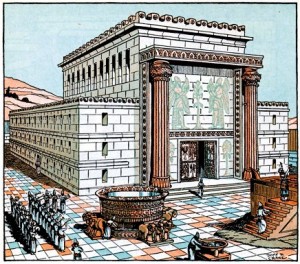
Temple of SolomonOn the cover of our worship bulletin this morning is a depiction of King Solomon’s Temple. It’s an artist’s rendering of someone’s reconstruction of the Temple based on the description of its construction in the Old Testament record. Our first reading today (from the First Book of Kings), as long as it was, is just a small part of the dedicatory prayer that King Solomon offers when the Temple is finished and consecrated.

The building of the Temple marked a very significant change in the Jewish religion. Well, really, let’s not call it the Jewish religion because it wasn’t that, yet. Let’s just say, “The religion of the people of Israel.” These people were not, though we often imagine them to be, strict monotheists. Even in this prayer Solomon leaves open the question of whether there might be gods other than their God: “O Lord, God of Israel, there is no God like you in heaven above or on earth beneath.” There might be other gods, lesser gods perhaps, demigods, or even demons, part of a heavenly pantheon of gods, but this God, the God of the People of Israel is greater than any of those others.

At this time, all the different nations, sometimes even different clans or families, had their own religions, their own gods. And nearly all of these religions believed the gods to be sort of tied to the land. If you moved from one place to another, you stopped worshiping the god of the first place and took up the worship of the god of your new residence. If a woman married outside of her family or tribe, married into a different clan, she would give up the religion of her family and take up that of her husband.

The People of Israel’s God, however, was different. Their God was not tied to a particular place. Their God was connected to a holy object, instead. God was associated with the Ark of the Covenant which they had created in the desert to contain God’s holy relics, the tablets of the Law given to Moses at Sinai (together with a pot of manna and Aaron’s staff). They carried the Ark with them, actually before them, as they traveled through the desert, as they crossed into the Holy Land, as they conquered the Canaanites and took possession of the country.

You may recall that in those first years, the People of Israel had no monarch: they considered God to be their king. The histories are silent as to where the Ark was kept during the period of the Judges, or during the reign of the first monarch, King Saul. But we know that David wanted to build a permanent location for it; he wanted to build a Temple. But God refused. He told David, through the prophet Nathan,

Are you the one to build me a house to live in? I have not lived in a house since the day I brought up the people of Israel from Egypt to this day, but I have been moving about in a tent and a tabernacle. (2 Sam. 7:5-6)

So David did not build the Temple, but he did build a special tent in his city, Bethlehem, and brought the Ark there. We are told

David danced before the Lord with all his might; David was girded with a linen ephod. So David and all the house of Israel brought up the ark of the Lord with shouting, and with the sound of the trumpet. . . . They brought in the ark of the Lord, and set it in its place, inside the tent that David had pitched for it. (2 Sam. 6:15, 17)

David designed the Temple, but he never built it. His son Solomon was the one to do that.

So the Temple was finished, the sacred implements from David’s tent had been moved into it, the Ark of the Covenant was installed into the Holy of Holies where only the High Priest would be allowed to go and Solomon offers this long prayer of dedication. In it he asks a very important question: “But will God indeed dwell on the earth?” (1 Kings 8:27) By building the Temple, Solomon sought to provide God a place to dwell on earth and, in so doing, he made the religion of his people more like that of their neighbors than it had been.

Remember their religions had tied their gods to particular places whereas the God of Israel had moved about the countryside with his People. Now God had a permanent home and, over time, the Jews would centralize God’s worship in the Temple and they would eventually decree, in the Book of Deuteronomy, that the cultic part of their faith could only be performed in that place. Sure, people could gather anywhere for prayer, they could go synagogues for religious instruction, but they could only offer sacrifice and perform the Temple rites in the Temple at Jerusalem. God had become tied to a place. (This was one of the differences the Jews had with Samaritans with whom they shared a devotion to God and who also followed the Law as set out in Genesis, Exodus, Numbers, and Leviticus, but who rejected the restrictions of Deuteronomy and had their own temples, primarily at Mt. Gerazim.)

By the time of Jesus, Solomon’s question had been firmly answered by the Jews. Yes, said their religion, God will dwell on earth, in this place, this Temple in Jerusalem. In the birth of Jesus, however, God gave a different answer: God will not dwell in a building in a particular place; God will dwell with and among God’s People: as the Gospel of John affirms, “The Word became flesh and lived among us.” (John 1:14) Will God indeed dwell on earth? Yes, God will live among God’s people as one of us. God lived among us as an infant born in Bethlehem. God lived among us as an itinerant rabbi who had no home. God lived among us as a rabbi accused of being a rabble-rouser. God lived among us as a rabble-rouser condemned to die a criminal’s death. God lived among us as a criminal executed on a cross.

On the night before he died, he gathered with his friends for a Passover meal. There is some debate as to whether it was a Seder, the sacred meal of Judaism, but if it was he radically changed its nature, just as Solomon building the Temple had radically changed the nature of the religion of Israel. In the Passover meal, Jews become one with their ancestors; the Passover story is brought present to them in the ritual of the Seder and they, in turn, live through the Passover story, but the meal does not bring God into their midst. When Jesus took the bread of affliction and said, “This is my body,” when he took the cup of blessing and said, “This is my blood,” when he told his followers, “Do this when you remember me,” when he promised, “Where two or three gather, I am there,” Jesus gave us a power and an obligation unlike any given before to any people by God. We have the privilege to bring God present among us in the Bread and Wine of the Eucharist, the Christ’s Body and Blood.
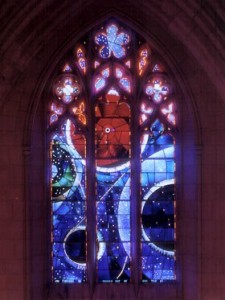
Moon Rock Window, Washington D.C. National CathedralWhere were you on July 20, 1969? In July of 1969 I was living in a boarding house and studying in Florence, Italy. The boarding house or pensione in which I lived, Pensione Frati, did not have a television. My landlord, Colonello Roberto Frati, arranged for me and the other Americans living there to go to his sister-in-law’s home where we could watch Neil Armstrong’s and Buzz Aldrin’s moon landing on her TV – this great big box of a television set with a tiny black-and-white screen. We all gathered around that box peering into that tiny screen listening to the Italian news commentators and struggling to hear the American commentary behind them. I’m sure that when we heard of Commander Armstrong’s death we all thought about wherever we were on that day at that moment when he stepped out of the lunar lander and became the first human being to walk on another world.

What almost nobody knew until a long time afterward was that something else happened on the moon that day. Buzz Aldrin, a devout Christian and an ordained elder in his Presbyterian congregation, had taken a communion kit with some bread and wine to the moon. In the Presbyterian Church, the lay elders of the church who serve a function similar to our vestry members, are actually ordained by their congregation, and that ordination empowers them to bless the elements of Holy Communion. At the time Aldrin and Armstrong landed on the moon, the pastor and members of his Presbyterian church were watching TV but unlike most of us, they were also celebrating communion. Armstrong joined them across space, blessing the bread and wine on the moon and partaking there of Holy Communion.

In the act of Holy Communion we are joined with Christians everywhere and everywhen — with all those in every place who also take part in the Eucharistic feast, with all those who have done so at ever Eucharist since Christ’s last supper with his disciples, with all those who will celebration Communion in the future. We are joined with them and we are joined with God in Christ as we eat of his Body and drink of his Blood, no matter where we are on earth or even on the moon.

Will God indeed dwell on the earth? Yes! Will God dwell on the moon? Yes! God dwells with God’s People wherever the memory of Jesus is invoked in the Holy Communion, wherever bread and wine are blessed and consecrated the Body and Blood of God incarnate in Christ. God will dwell with God’s People across time and across space, even on the moon, and wherever else in this Solar System or beyond we may go, so long as we do this in memory of Jesus. Amen.

Playing My Harp in the Voting Booth – From the Daily Office – August 25, 2012

From the Book of Psalms:

By the rivers of Babylon —
there we sat down and there we wept
when we remembered Zion.
On the willows there
we hung up our harps.
For there our captors
asked us for songs,
and our tormentors asked for mirth, saying,
“Sing us one of the songs of Zion!”
How could we sing the Lord’s song
in a foreign land?

(From the Daily Office Lectionary – Psalm 137:1-4 – August 24, 2012)
 
This is one of my favorite psalms, not so much for its own import, but because of the reggae song Rivers of Babylon which is based on it. Here’s a YouTube recording of the Melodians singing the song. (My favorite version is a live performance by Jimmy Cliff, but I couldn’t find a good video of it.)

It is the plaint of the refugee: how can we sing the Lord’s song in a foreign land? How can we do anything that is normal to us? How can we be the people we are meant to be in a context not our own?

This is the life of the Christian according to St. Paul! We who are members of the Body of Christ are not in our “native land”; we are not at home in this world. To the Philippians he wrote, “Our citizenship is in heaven.” (Philip. 3:20) And to the Ephesians, “You are citizens with the saints and also members of the household of God.” (Eph. 2:19)

This is difficult for us to accept. We like to think that the context in which we find ourselves, our worldly situation, is where we are supposed to be! I was born and reared in the United States of America; I was educated in its schools, worked in its industry, worship in its churches, vote in its elections. I am an American! And yet Paul and Psalm 137 insist that I am a “stranger in a strange land”, that I am a citizen of somewhere else, that my values are not necessarily those of the world and the society in which I find myself, leaving me with the question asked in the Psalm: How can I sing the Lord’s song in this foreign land? How can I apply the values of the gospel in my daily life in this place-other-than-heaven? How do those values influence the way I vote, the choices I make, the activities i do, the way I spend money?

And let’s be honest and take a step back to an earlier question . . . . Do gospel values influence my daily life, my vote, my choices, my activities? Or have I hung up my harp on the willows and given up trying to sing God’s song in this strange place? I hope that I have not, and I hope over the next several weeks to tune my harp and take it with me into the voting booth in November.

====================

Father Funston is the rector of St. Paul’s Episcopal Church, Medina, Ohio.

God! You Need to Change! – From the Daily Office – August 24, 2012

From the Book of Job:
 

One day the heavenly beings came to present themselves before the Lord, and Satan also came among them to present himself before the Lord. The Lord said to Satan, “Where have you come from?” Satan answered the Lord, “From going to and fro on the earth, and from walking up and down on it.” The Lord said to Satan, “Have you considered my servant Job? There is no one like him on the earth, a blameless and upright man who fears God and turns away from evil. He still persists in his integrity, although you incited me against him, to destroy him for no reason.” Then Satan answered the Lord, “Skin for skin! All that people have they will give to save their lives. But stretch out your hand now and touch his bone and his flesh, and he will curse you to your face.” The Lord said to Satan, “Very well, he is in your power; only spare his life.”

(From the Daily Office Lectionary – Job 2:1-6 – August 24, 2012)
 
Time for ChangeWow! Does this look familiar? The second chapter of Job begins with a scene nearly identical to that which we considered yesterday. Satan (with other heavenly beings) presents himself in the heavenly throne room and, once again, God and Satan have a conversation about Job and, once again, the bet is made. In fact, it’s sort of “double down” time! Yesterday, I argued that although the Book of Job is fiction it (like the other forms of literature found in Holy Scripture) embodies truth.

So what is the truth behind this scene? It’s a legitimate question. This picture of God wagering with Satan is important enough to the story that it is repeated. It must be telling us something. As I ponder it, I am struck by a “What if . . . . ?” A big “What if . . . . ?” What if God really does gamble with our lives? What if God really is a . . . jerk? Now, understand please, I don’t think that that is the truth behind this fictional scene, but what if . . . . ?

When I was reading theology in preparation for ordination, one of the modern theologians I most related to was the French Reformed theologian Jacques Ellul. My favorite of his works was L’Esperance Oubliee (“Hope Forgotten”) which was published in English under the title Hope in a Time of Abandonment. Writing from a conviction that “we have entered upon the age of abandonment, that God has turned away from us,” Ellul nonetheless asserts, “Hope is a protest before this God, who is leaving us without miracles and without conversions, that he is not keeping his Word … It is Job’s great declaration, ‘my eye pours out tears to God, that he would maintain the right of a man with God’ (Job 16:20-21).” Prayer, says Ellul, is how we give voice to this hopeful protest; prayer is how we, empowered by hope, insist that God fulfill God’s promise. Hope and prayer is how we demand that

It is God who needs to change. It is God who must return to enlighten his Church and to make our hearts shout for joy . . . It is God who has to change, and hope is the resolute will to make God change . . . It is to bring about once again the implementation of that wonderful statement of the Old Testament, “and God repented”.

If God (to return to my “What if . . . . ?”) is being a jerk, we have the hopeful protesting power to say, “God! You need to change!”

====================

Father Funston is the rector of St. Paul’s Episcopal Church, Medina, Ohio.

Job Is Fiction, But It’s True – From the Daily Office – August 23, 2012

From the Book of Job:
 

One day the heavenly beings came to present themselves before the Lord, and Satan also came among them. The Lord said to Satan, “Where have you come from?” Satan answered the Lord, “From going to and fro on the earth, and from walking up and down on it.” The Lord said to Satan, “Have you considered my servant Job? There is no one like him on the earth, a blameless and upright man who fears God and turns away from evil.” Then Satan answered the Lord, “Does Job fear God for nothing? Have you not put a fence around him and his house and all that he has, on every side? You have blessed the work of his hands, and his possessions have increased in the land. But stretch out your hand now, and touch all that he has, and he will curse you to your face.” The Lord said to Satan, “Very well, all that he has is in your power; only do not stretch out your hand against him!” So Satan went out from the presence of the Lord.

(From the Daily Office Lectionary – Job 1:6-12 – August 23, 2012)
 
Realistic Dice IllusionA later selection from the Book of Job was called up by the Sunday Eucharistic Lectionary several weeks ago. In my sermon I said to the congregation that the Book of Job is fiction (which it is). You should have seen the look on one of my parishioners’ face! There’s a fellow in the congregation who is, shall we say, conservative with regard to the Bible. While I don’t believe he actually considers the Bible to be the inerrant word of God per se, he’s pretty sure that it is to be taken with the highest degree of certainty and words like “myth” or “fiction” applied to Scripture are not to his liking. I swear I thought he might have an apoplectic fit right there in his pew! But let’s be honest: do we really think that God and Satan are engaged (or have ever been engaged) in a game of chance involving the lives of human beings?

Because, when you get right down to it, that is the set up of the Book of Job – a bet between God and the Devil as to whether this good man, Job, will curse God if his life turns to garbage. If someone in the church does think that that’s the way God runs the universe, perhaps that person is following the wrong religion because that surely is not the way the Christian faith sees the world! In this, Christianity is not at odds with science. Albert Einstein once famously remarked, “God does not play dice with the universe.” And while quantum mechanics, chaos theory, superstring theory, and a whole host of new scientific and mathematical suppositions rely on the concept of probability rather than certainty, they still don’t posit a game of chance as determining the structure of reality.

If a game of chance is not the way the universe runs, then what are we to make of these verses from today’s Old Testament reading? If they are not factually accurate, then we have only two choices: they are a lie, or they are fiction.

If they are a lie, then they undermine the whole concept of Holy Scripture as an embodiment of Truth. If they are fiction, however, there is no problem. The Bible is not, as everyone ought to acknowledge, so much a book as it is a library. It is a collection of books, as we readily admit whenever we refer to the works found in this collection. We don’t refer to the “chapter of Genesis” or the “section of Isaiah”; we refer to them as “books”, books within a library. Just like a library, the Bible includes many kinds of literature. There are histories (the Books of Kings, Chronicles, and the Acts of the Apostles, for example). There are works of poetry (Psalms). There are books of etiquette and advice on good living (Proverbs and Ecclesiastes). There are memoirs (the Gospels). There are collections of letters (the Pauline and other Epistles). There are law books (Leviticus and Deuteronomy). And among various other forms of writing, there is fiction (Job is both an example of fiction and of poetry).

The question for the student of Biblical literature is “Does fiction embody truth?” Do any of these non-historical, non-scientific forms of literature embody truth? What is the truth of a poem, for instance? Well, as an early 20th Century writer on the subject of poetry put it, poetry expresses the truth that

behind our daily occupation, beyond the business of the market and the pleasure of the circus, there lies an unexplored world of beauty – a world of complete satisfaction for the highest human capacity, a world from which we may derive courage, and hope, and faith, to help us in this world we live in. (Laurie Magnus, Introduction to Poetry, London:1902, pg. 68)

Fiction does the same thing. Ralph Waldo Emerson once said, “Fiction reveals truth that reality obscures.” Among the reasons fiction is worth writing, reading, and studying is not that it’s entertaining (although good fiction truly is), but rather that it teaches us important lessons about the world, about human beings, and (the religious person says) about God. It does so even if we’re not actively studying, not trying to learn these things; they get into us and into our thinking in unconscious ways. That’s what Scripture is supposed to do, too. And that’s why Scripture includes fiction and poetry along with history, memoir, and correspondence. And that’s why it’s perfectly OK to say, “Job is fiction.” It may be fiction, but it’s nonetheless true!

====================

Father Funston is the rector of St. Paul’s Episcopal Church, Medina, Ohio.

« Older posts Newer posts »