We have spent a day walking Aberdeen, nice town – but disappointing in that today is a local holiday and some things are closed (and the Anglican cathedral where Bishop Seabury was consecrated is one of them – bummer!) We are now on our way to Royal Deeside (village of Ballater) for a look-around and probably dinner, then we will return to our Aberdeen digs for the night. Tomorrow, on to Edinburgh for three days and then home.
Page 123 of 130
I am running behind with blogging about this trip – one of the things we’ve discovered about the west of Scotland (out in the Islands and the Highlands) is “iffy” internet … either the B&B doesn’t even provide it (or some do at an unreasonable cost) or the connection is sporadic. So it has meant not much opportunity to upload photos and blog postings.
Here’s what we’ve done:
We stayed in Oban and visited the Isle of Mull and the Holy Island of Iona. We went from there through Fort William to Portree on the Isle of Skye, with a stop at Eilean Donan Castle. On Skye we visited the Faerie Glen, the village of Uig and a pottery there, then Dunvegan Castle, and finally the Talisker Whisky Distillery.
From Skye we drove to Inverness along the shore of Loch Ness with a stop at Urquhart Castle. We have really enjoyed Inverness. We took a quite bus tour of this small city, then visited Inverness Castle (only the outside because it is a functioning government building closed on Saturdays), St. Andrew’s Episcopal Cathedral (where we will go to church this morning), and the House of Fraser Kilt Makers (Evie won’t let me buy a kilt), where we learned how kilts are made. We also walked along the River Ness and crossed it on “the bouncy bridge”. In the afternoon, we drove to Culloden Moor where the Jacobite Rebellion ended in the last battle fought on British soil and to Cawdor Castle where some sort of food festival was in progress so we didn’t stop and go in.
Today, after church, we will drive through the Cairngorms, visit a couple of castles along the way as well as the Glenfiddich distillery making our way to Aberdeen where we will be for two nights.
There is a lot to write about … but just as when I was driving around Ireland with Caitlin & Jeff and Patrick & Michael, I’m finding very little opportunity to sit down and do the work of writing (to say nothing of the tasks of reviewing, editing and up-loading photographs). So bear with me … the travelog may get written after we return to Ohio, but it will get written.
On 17 September, Evie and I arose and enjoyed breakfast in our B&B, the Torbay Lodge Guest House in Dumfries, Scotland.
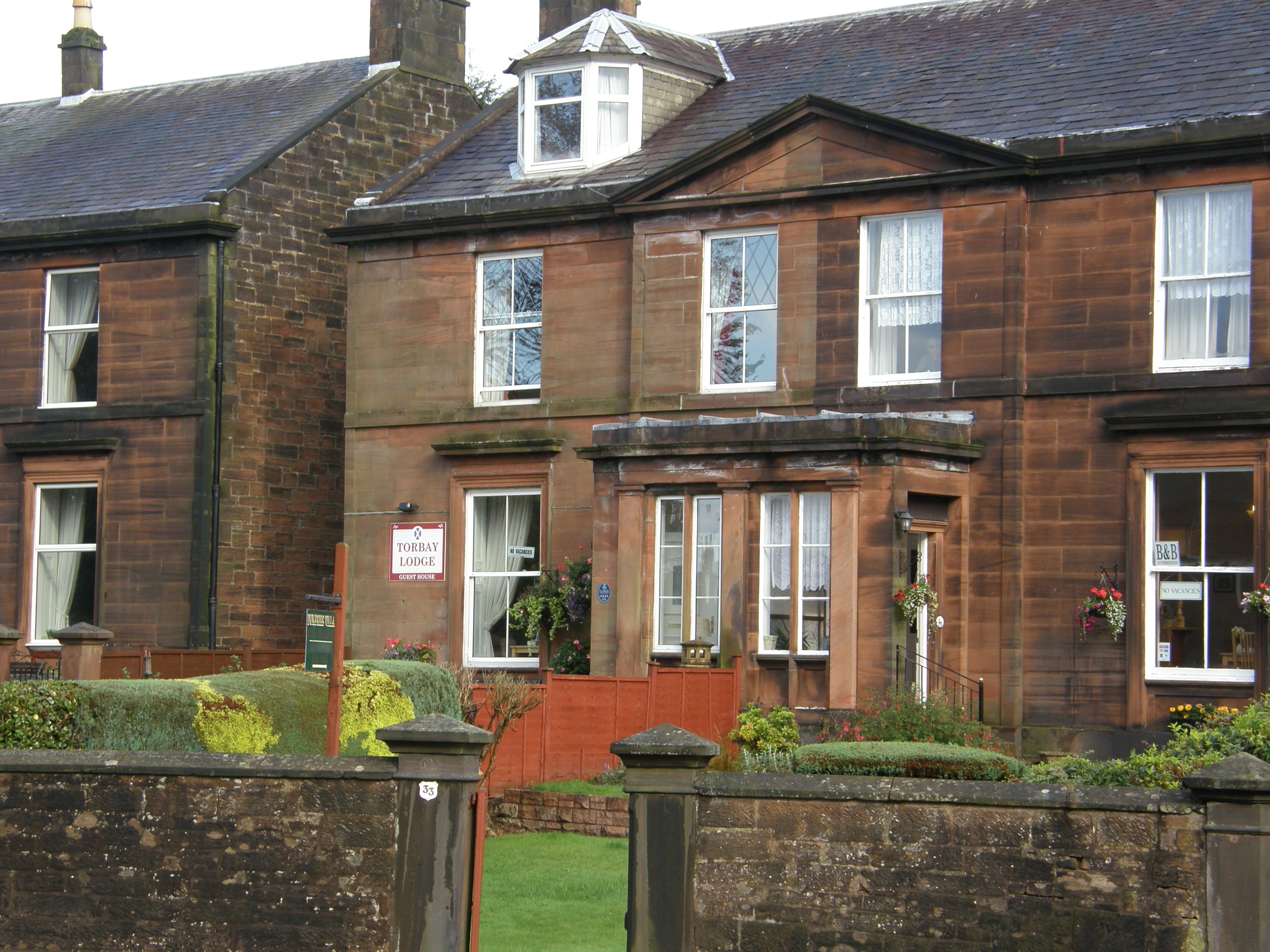
Torbay Lodge Guest House, Dumfries, Scotland
We walked across the street and visited St. John’s Scottish Episcopal Church – a lovely old building (with a brand new pipe organ).

St. John's Scottish Episcopal Church, Dumfries
We then hit the road and went to the village of New Abbey, about six miles south of Dumfries. It is the location of Sweetheart Abbey.

Sweetheart Abbey, New Abbey, Scotland
Sweetheart Abbey is a Cistercian monastery, founded in 1275 by Lady Dervorguilla Balliol of Galloway in memory of her husband John de Balliol. Dervorguilla and John founded Balliol College, Oxford. When John died, Devorguilla had his embalmed heart placed in an ivory shrine. This shrine was placed before her at meals, and she would give it’s share of every dish to the poor. She died in Buittle Castle on January 28, 1290, and was buried in front of the altar in the Abbey church with the casket containing John’s heart in her arms. The monks at the Abbey then renamed the Abbey in tribute to her devotion to her husband. Their son, also John, became King of Scotland but his reign was brief and tragic. The Master and Fellows of Balliol College some years ago had a special grave marker installed at the place believed to be her grave.
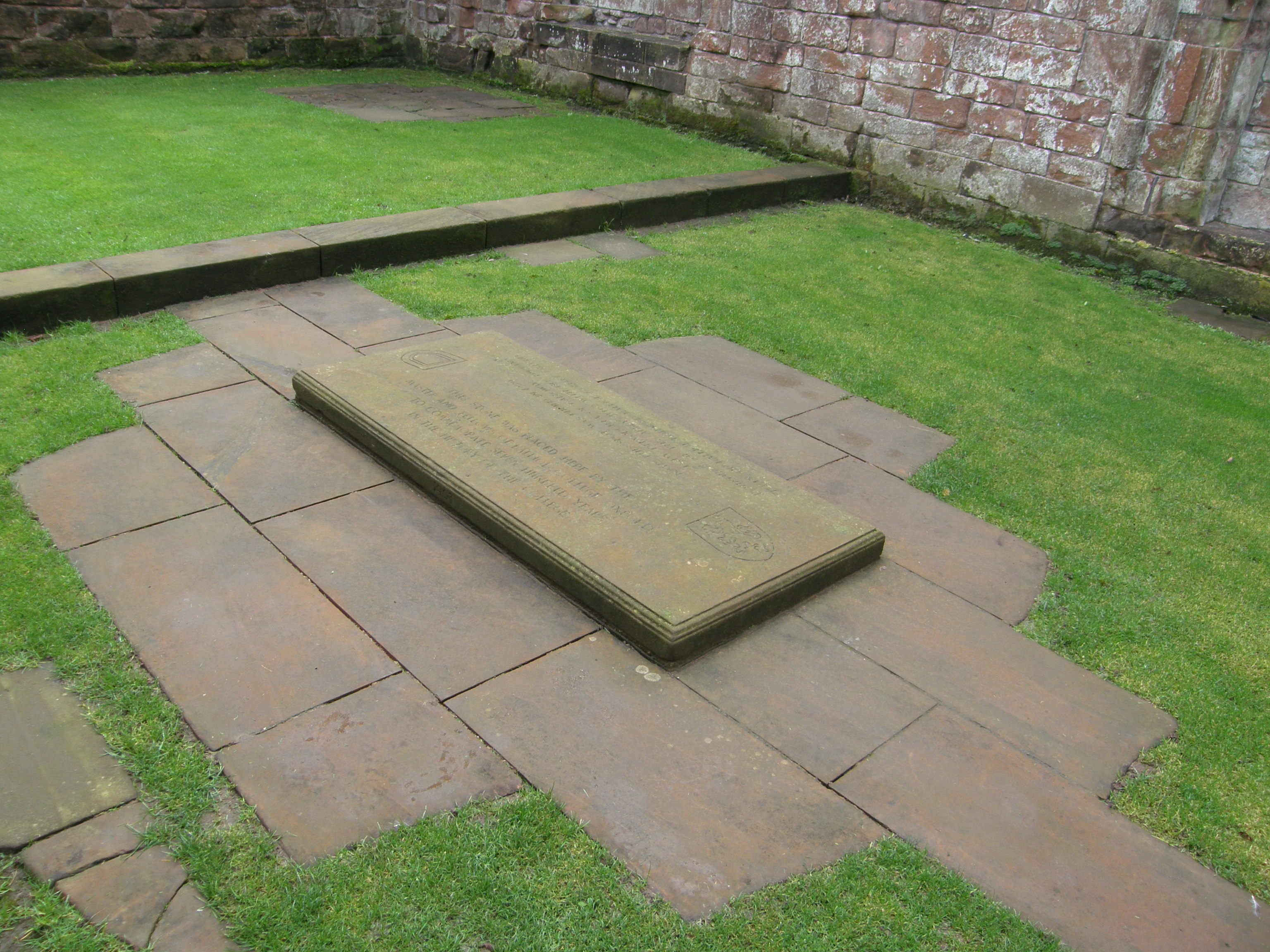
Marker at Devorguilla Balliol's Grave, Sweetheart Abbey
Here are a couple other photos of the abbey ruins:

Sweetheart Abbey, New Abbey, Scotland

Sweetheart Abbey, New Abbey, Scotland
After the abbey, we walked through the small and very charming town of New Abbey to the Corn Mill, the last functioning medieval grain mill in Scotland.

Main Street of New Abbey, Scotland

The New Abbey Corn Mill
Next, after deciding that (unfortunately) we didn’t have time to visit Whithorn, the site of the earliest Christian mission in Scotland. It was there that St. Ninian founded his settlement called “Candida Casa” or White House. Instead, we stayed on the main road toward Glasgow and stopped at Castle Kennedy Gardens.

The Ruins of Castle Kennedy

The Ruins of Castle Kennedy
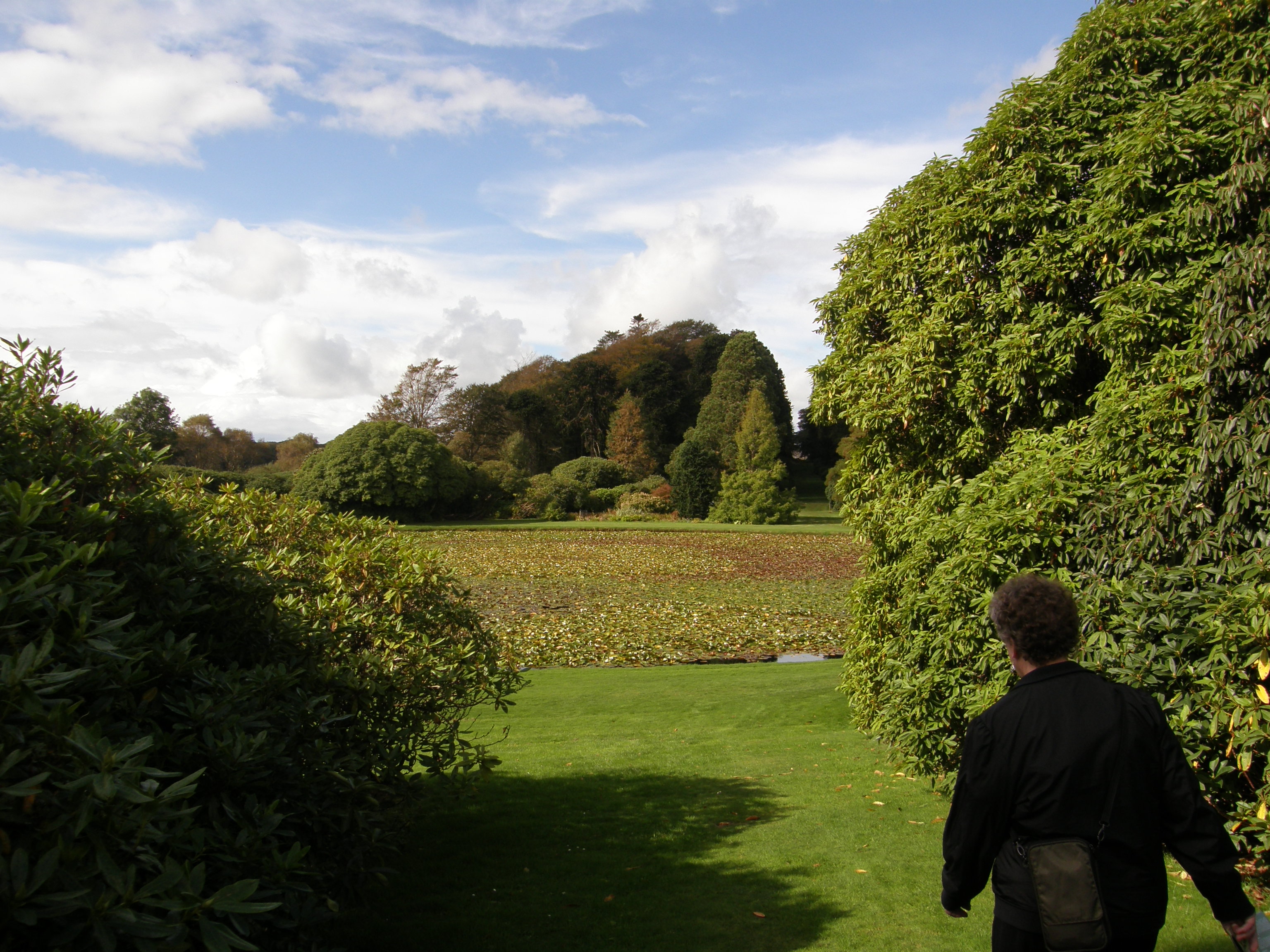
Castle Kennedy Gardens

Castle Kennedy Gardens

Castle Kennedy Gardens
My Facebook albums of photographs taken in these locations can be found here:
We then drove on to Glasgow where we spent two nights; that will be the subject of another blog post.
Yesterday, I flew from Dublin, Ireland, to Edinburgh, Scotland, and spent the night at an airport hotel. This morning, Evie flew in from the States and we began our tour of Scotland by first having a “full Scottish breakfast” (pretty much like a full Irish or a full English) at the hotel and then hitting the road for Dumfries by way of Lanark. We went to Lanark because it is a place with which a parishioner, Sue, has a connection. It’s a very nice town – we visited the tourist information office, had a cup of coffe, walked the High Street, passed by a couple of churches, took a couple of photos, and then went a short way out of the downtown area to visit “New Lanark”, historic cotton mill.

High Street, Lanark, Scotland (St. Nicholas Parish Church at the "bottom")
The cream-colored structure in the above photograph is St. Nicholas Parish Church of the Church of Scotland. According to the website Sacred Scotland, it was built by John Reid of Nemphlar in 1774, and described as a “large two-storey classical box with a square tower and steeple.” Prominent on the facade is an 8-foot statue of William Wallace sculpted by Robert Forrest. The church exterior was restored 2008-09. Unfortunately, other than on Sunday mornings and Wednesday evenings it is open by appointment only.

Statue of William Wallace on St. Nicholas Parish Church, Lanark, Scotland
William Wallace, by the way, is the fellow whose life and military campaign was fictionalized by Mel Gibson in the movie Braveheart.
Other churches we passed were Greyfriars Church, apparently also a parish of the Church of Scotland like St. Nicholas, and Christ Church, a parish of the Scottish Episcopal Church. We liked the signage and the planting of the front walk of Christ Church. This signage is much more informative and inviting than what one sees on parishes of the Church of Ireland, which is one of the problems the Church of Ireland has, in my opinion. (The Church of Ireland needs to do a LOT of work in the area of evangelism, invitation, welcoming and incorporation … not unlike the American Episcopal Church.) Unfortunately, Christ Church like St. Nicholas was locked up, so we couldn’t get a look inside.

Sign, Christ Church, Lanark

Evie at the Doorway of Christ Church, Scottish Episcopal Church, Lanark
In addition to the parish’s own sign, there is a sign we saw elsewhere as we drove to Lanark: “The Scottish Episcopal Church Welcomes You”

The Scottish Episcopal Church Welcomes You
After our brief walk through the center of Lanark, we drove about a mile out of the town to the New Lanark World Heritage Site. This is a nicely restored 18th century cotton mill village established in 1785 and nestled in beautiful valley along the River Clyde. New Lanark was a Utopian experiment set up by social reformer Robert Owen who, with partners, purchased the mill in 1810 and began to run it and take care of the workers in accordance with his social principles. (I didn’t know much about Robert Owen before visiting the site, but plan to learn more about him as time allows.)
Part of the tour of the site involves a pretty glitzy ride through “The Annie McLeod Experience”, which reminded us of a low-key Disney-theme-park sort of ride. I don’t think their presentation of cotton milling is as good as I saw at Quarry Bank Mill in Wilmslow (see my blog entry on 17 July 2011), but the restoration is very impressive. The walk-through showing what life was like in the workers’ “apartments” is very interesting, and a there is a roof-top garden with several sculptures of animals. Below are a few pictures of the sculptures and the buildings:

Owl Sculpture, Rooftop Garden, New Lanark, Scotland

Ducks Sculpture, Rooftop Garden, New Lanark, Scotland

Raven Sculpture, Rooftop Garden, New Lanark, Scotland

Frog Sculpture, Rooftop Garden, New Lanark, Scotland

Otter Sculpture, Rooftop Garden, New Lanark, Scotland

Some Buildings of New Lanark World Heritage Site
For more information about New Lanark, visit its website here.

The Gate to the Holy Tree in Clonfert, Ireland
At lunch after church in Banagher, Ireland, this past Sunday I was told that I’d missed something when I went to see St. Brendan’s Cathedral in Clonfert … evidence (as my informant put it) that “paganism is alive and well in Ireland.” What I had missed is called a “votive tree” or a “wishing tree”. I decided that before I left Ireland I would go back and see this thing.
Then, perusing the morning’s papers online, I came across a story in England’s The Daily Mail entitled Who says money doesn’t grow on trees? Coins mysteriously appear in trunks up and down the country about similar trees in Great Britain.
Apparently this is not a phenomenon limited to Ireland and England; Scotland and Wales have such trees, too. And there are others in such places as Hong Kong, Argentina, and Belgium. (Wikipedia has an article about wishing trees here.)
While some trees (like the ones described in the Daily Mail article) are “coin-only” trees, the tree in Clonfert is not. It is festooned with neckties, dolls, Roman Catholic holy cards, pictures of babies, toys, brassieres, hats, rosaries, cigarette packages … in incredible variety of things.

St. Brendan's "Wishing Tree", Clonfert, Co. Galway, Ireland
I’m not surprised to find a “holy tree” in Ireland; finds plenty of “holy wells” in this country, why not a holy tree? After all, although partially disputed by some modern Celtic scholars (for example, Peter Berresford Ellis author of The Celts: A History and Celtic Myths and Legends), the Roman authors Lucan and Pomponius Mela, claimed that the Celts of Gaul worshiped trees and met for religious rites in sacred groves, a practice which Tacitus and Dio Cassius claimed to have found among the Celts in Britain. The names of certain Celtic tribes in Gaul reflect the veneration of trees, such as the Euburones (the Yew tribe), and the Lemovices (the people of the elm).

St. Brendan's "Wishing Tree", Clonfert, Co. Galway, Ireland
In fact, “holy trees” are often found next to holy wells. Although it is the well not the tree that is considered the source of blessing or healing, one often finds votive objects tied to a nearby tree with strips or rags of cloth in the belief that, while the object remains, the prayers will still be effective. These trees are are often called “cloutie trees” (“cloutie” [Irish] or “clootie” [Scots] is a slang word for “rag”, perhaps from the Gaeilge clúidín for “small covering [or] napkin”).

St. Brendan's "Wishing Tree", Clonfert, Co. Galway, Ireland
There is no well next to St. Brendan’s Tree, although there is a path called “the Nun’s Walk.” I’m told that this path originally led to the Bishop’s residence and, apparently, there was a convent associated with the cathedral; a first portion of the road one takes from the Clonfert cathedral back to Banagher is called “Nunsacre Road”.

St. Brendan's "Wishing Tree", Clonfert, Co. Galway, Ireland
The remains of Hurricane Katia are blowing across Ireland today. I’d planned some outings, but with the windiness, I decided to stay in and work on music.
Here’s a YouTube video someone took of what these winds are like on the Atlantic Coast. It was taken at Malin Head, which is rather a long way north and west of my location in Co. Offaly. The winds here in the midlands are not quite as strong as they are on the coast.
Because of these winds, flights have been cancelled, ferries have cancelled voyages, and small craft warnings are in effect. This should blow through in the next 24 hours, so I don’t anticipate any difficulties traveling to Scotland on Thursday.

"Address" marker in the stone perimeter wall of McDonalds Farm
For the past month (and the next few days), 15 August through 15 September, I’ve been living in an Irish cottage.

Front of Chestnut Cottage Showing Enclosed Porch
A distinctive feature of the Irish rural countryside is the Irish cottage. One might believe that these homes have been here forever, but in fact they are a relatively recent occurrence dating back to around the 1700s. The cottage in which I have been living for the past month is one of the earliest: the original central part of the cottage is believed to be about 300 years old! My landlord’s ancestor migrated to this part of Ireland from the north, acquired land and settled here on the south side of the Shannon River. The central part of this cottage is the original farmhouse. My landlord was born here, as where his eight younger siblings. At one time there were twelve people (all nine children, his mother and father, and his grandmother) living in this space. (The landlord married in 1978 at the age of 28, at which time he moved out of the cottage and built a new farmhouse immediately next to it. In 2005, he and his wife began renting out this cottage to vacationers; they added to it in 2007. In 2010 they built a second, modern rental cottage a short way down the lane from this property.)

The modern farmhouse (built 1978) at McDonalds Farm
The original cottage floor plan can be described as follows: One enters through a doorway which is basically central to the gable wall (an enclosed porch was added to this doorway in 1940). This brings you into the main room which was the original kitchen, dining area, and family room. To one’s right are two rooms, a very small bedroom and a bathroom which was originally the pantry (it was converted with the introduction of in-door plumbing in 1940). To one’s left, behind the fireplace wall, is a bedroom. (At the end of the cottage, behind the bedroom wall, is a storage room which was originally a stable for the family cow.) That’s it; the original cottage consisted of nothing more.

The entry porch (mudroom)
Two major alterations have been made to the original cottage: first, the additions of 1940 mentioned above which also included the addition of a small kitchen opposite the entry door and, beyond the kitchen; second, at the back of the cottage, in the “L” of the kitchen/bedroom wing and the original cottage, another bedroom and a bathroom were added in 2007. At some time, I’m not sure when, all floors in the cottage were either tiled with ceramic or floored with wood-look vinyl.

The bedroom added in 1940

A very small bathroom, a converted pantry; indoor plumbing came in 1940

The modern bedroom added in 2007
Cottages began to appear in the first half of the 18th Century which saw the rise of the “Protestant Ascendancy” in Ireland, local de facto rule by Irish Anglicans, many of whom built large manor houses in both the towns and the rural areas. Some historians believe that cottages are the result of local application of the building techniques employed for the larger estate houses. Before the building of cottages, the typical Irish farm dwelling was a round hut-style dwelling built of wattle and daub. Typically, these were grouped together in or around a round stone enclosure, a caher or “ring fort” (see my earlier entry about Caherconnell, Circles of Protection, 24 August 2011).
While cottages tended to have a common floor plan throughout the country, building materials varied from region to region. The only transportation available was a donkey or ox and cart, so materials had to come from nearby. Stone was used in coastal and rocky areas like the Connemara (such as where I spent my first month here in Ireland). Because of stone’s enduring nature, Connacht cottages abandoned during the Great Famine of the 1840s stand today as memorials to that tragedy (see my earlier entry about Famine Houses, My Daily Walk, 27 July 2011). In the midlands, such as where I have spent my second month here, clay bricks and smaller rocks would have been used, and in boggy areas, turf or sod could have been used; both of these building materials would have been (as this cottage has been) plastered and the exterior plaster lime washed. It has been said that these cottages literally grew out of the landscape that surrounded them.
Early cottages were built directly on the ground without foundations; however as building methods improved, foundations made of trenches stones, clay and mud became more common. Floors were usually of simple compacted dirt, although flag stones were used where available.

The front room (sitting room, kitchen, family room) of the original cottage
Usually, the center of the home was the fireplace or hearth in the main room which served as kitchen, parlor, and family room. It might also have been the room in which children slept; sometimes, a low sleeping loft was built over part of this room. The hearth was usually formed of stone and located at the center of the house. The most typical fuel was turf (see my earlier entry A Drive through the Bog, 31 July 2011), a fuel still in use today. Some fireplaces were built of wattle and daub, however the introduction of the hotter burning fuel (coal) necessitated stone flues to prevent chimney fires. (Although a central hearth was most common, there are cottages where the hearth is located on the entry wall and others where it was put at either end of the cottage.)
A “master bedroom” was frequently build behind the fireplace, and this is the layout of the cottage I have rented.

The original "master" bedroom of the cottage
The fireplace was the heart and soul of the cottage, about which daily life revolved – cooking, drying, heating, and a focal point for social gatherings. The fire was never allowed to extinguish with ashes strewn over it at night to keep the embers alive for morning. The importance of the hearth in cottage life is illustrated by the Irish version of “there’s no place like home”: Níl aon tinteán mar do thinteán féin (“There’s no fireplace like your own fireplace”).

Turf burning stove which replaced the original hearth in the mid-20th Century
During my stay, I’ve gotten to know the McDonald’s dog, Buddy. He’s considered a “collie” although I think he’s got a lot of other genes in him, as well. He’s natural cattle dog; we have taken walks down the lane together and he always wants to herd the cows in the fields we pass. He loves to be petted and sits in the doorway of the cottage when I have the door open. However, he’s not comfortable inside a closed house. If he comes in and I close the door, he begins to moan and becomes agitated. In any event, he’s a good dog and, in the absence of my own Fionna, good to have around.

Buddy, the McDonalds' farm dog
I’ve enjoyed my retreat here. I’ve gotten work done on my music project (though not as much as I might have hoped), and I’ve very much enjoyed spending time with my adult children and their partners. But I’ve got to be honest and admit that I’m looking forward to seeing my wife again and, in a couple of weeks (after touring Scotland with her), returning home. The Irish are very right: Níl aon tinteán mar do thinteán féin!

Chestnut Cottage (behind modern farmhouse)
The cottage, by the way, takes its name from this very large tree just outside its front door.

The Chestnut Tree for which the Cottage is named
All of the above photos of the cottage and more can be seen in a Facebook album here.
The following is a sermon I will preach at St. Paul’s Parish, Church of Ireland, Banagher, County Offaly, Republic of Ireland, on 11 September 2011, the tenth anniversary of the Al Qaeda terrorist attack on the World Trade Center, the Pentagon, and possibly the White House (the third of three hijacked planes crashed into a field in Pennsylvania when passengers fought the hijackers). The closing prayer is adapted from a litany adapted by the Rev. Paul Gaston from WCC materials.
Good morning! Let me tell you a little bit about who I am and how I happen to be standing in front of you offering a few thoughts about our lessons from Holy Scripture on this tenth anniversary of the Al Qaeda attack on the World Trade Center.
I am a priest of the American Episcopal Church, a part of the Anglican Communion. In our church it is the usual practice for clergy to take sabbaticals after some period of service, usually somewhere between five and seven years in a given parish. I’m the rector of St. Paul’s Parish in Medina, Ohio, and have been since the summer of 2003; was unable to take a sabbatical in the normal course because of a variety of obstacles, but this year it proved possible, so here I am spending time in Britain, Ireland, and Scotland visiting places important in Celtic Christian history, reading and translating old Irish hymns, and arranging some music.
Part of my sabbatical design was to also spend time with my adult children, who with their partners have each spent a week with me based here in County Offaly and visiting different places around the country. This is my fourth trip to Ireland, so I had some ideas of things they might like to do; they had places they wanted to see; and they found more things to do and places to visit once they got here. So I’ve driven all over this island and gone to many places many of you may never have seen. (I have found in my own life that my wife and I only visit attractions near where we live when we have guests and there are many places in the Cleveland area that, after eight years of living there, we’ve still not been. So I suspect the same may be true of you.)

Kilmainham Gaol, Dublin, Ireland
One of the places that I visited for the first time while my son Patrick and his wife Michael were here last week was Kilmainham Gaol. As one interested in Irish history, you would think that I’d have gone there before now, but it just never happened until last Monday. It was a fascinating place to see and our tour guide’s comments about the actions of the British officials at the time of the Easter Rising of April 24, 1916 got me to thinking about the reaction of the American government to the events of 9/11, and both seem to me to highlight something about our lessons from Scripture today.
You know your own history, I’m sure, but let me just remind you that Rising was not popularly supported! It caused a great deal of death and destruction and there was considerable antagonism towards the rebels. After their surrender on April 29, as they were marched away by the British troops, they were hissed at, pelted with refuse, and denounced as “murderers” and “starvers of the people”. The British soldiers had to protect them from the civilians!

The 1916 Corridor - Cells Where the Volunteer Leaders Were Incarcerated
It was what happened just a few days later that turned the tide of public opinion – the courts martial and subsequent executions of the Volunteer leaders: Patrick Pearse, Thomas MacDonagh and Thomas J. Clarke on 3 May, of Joseph Plunkett, William Pearse, Edward Daly and Micheal O’Hanrahan on 4 May, of John MacBride on 5 May, of Eamonn Ceannt, Micheal Mallin, J.J. Heuston and Cornelius Colbert on 8 May, and James Connolly and Sean MacDiarmada on12 May. As well, the tale of the hastily arranged pre-execution wedding of Joseph Plunkett and Grace Gifford, and the treatment of the couple by the authorities affected public sentiment.

Stone Breakers' Yard at Kilmainham Gaol, Where Executions Were Carried Out
Now, I don’t want to suggest in any way that the Al Qaeda terrorists who flew those planes (and their innocent passengers) into the World Trade Center, the Pentagon, and that field in Pennsylvania are the moral equivalents of the leaders of the Rebellion; they are not. But I would like to suggest that the subsequent actions of the United States government led at the time by President George Bush bear an uncomfortable resemblance to those of the British authorities in 1916.
On September 12, 2011, the tide of world opinion was essentially the same as that of the Irish people on April 24, 1916 – it ran decidedly against the Muslim extremists just as Irish opinion ran against the leaders of the Rising. But just as the British authorities squandered the goodwill of the Irish people by their vengeful and unnecessarily quick executions of the Volunteers, the American authorities squandered world-wide goodwill toward America by starting not one but two vengeful and unnecessary wars in Iraq and Afghanistan, one of which continues to this day and is likely to continue for the foreseeable future, both of which have proven exceptionally costly to the people of those countries, to America, and to the whole world.
Recently, Robert Hutchings, Dean of the Lyndon B. Johnson School of Public Affairs at the University of Texas in Austin has said, “Sept. 11, 2001 was a watershed event in this country and throughout the world. Now, with the passing of 10 years, it is a unique time for reflection.” Similarly, your president Mary McAleese has referred to the Easter Rising as “that watershed event in Ireland’s narrative.”
Which brings me to today’s Scriptures….
In our reading from the Book of Exodus we are told that “the waters were divided. The Israelites went into the sea on dry ground, the waters forming a wall for them on their right and on their left.” The Exodus was a watershed event par excellence, one might say, the major turning point in the history of the Hebrew people, the one to which they look back as the moment which defines who and what they are, the one which they re-enact each year in the Feast of Passover as the defining moment of their community.

The "New" East Wing of Kilmainham Gaol, Dublin, Ireland
We should note that the response of the national authority (Pharaoh and his army) to the departure of the Hebrews was not terribly different from the response of the British authorities to the Easter Rebellion nor of the American administration to the attacks of 9/11 – it was military reaction, a violent reaction, and ultimately a response which has failed. Our world is neither safer nor more peaceful than it was a decade ago; some would argue it is just the opposite.
As history has shown over and over in many countries and many contexts, such responses by those in power are ultimately doomed to failure – the
response of the British Raj to the nonviolent revolt of the Indian people led by Mahatma Gandhi, the response of segregationists to the Freedom Riders in the American South and the Civil Rights movement of Martin Luther King, Jr., the response of the Apartheid regime of Southern Africa to efforts of the non-white population – all echo and repeat the response of Pharaoh and his army to the freedom march of the Hebrews. We and our political leaders again and again, over and over forget the lessons of history.
Again, I do not want to suggest in anyway that the murderers who killed 3,000 or more people on September 11 are equivalent to the Hebrews, the Irish Volunteers, or those who marched for freedom in India, America, or South Africa. But I do want to suggest that the responses of those in power in all those instances were similar and all resulted from our human failure to learn the lessons of history and of Holy Scripture, that ultimately the violent military reaction is doomed to failure.
In contrast, in the Gospel lesson for last Sunday, Jesus laid out a plan of conflict resolution for the community we call the church. You may remember that in last week’s lesson Jesus said: “If another member of the church sins against you, go and point out the fault when the two of you are alone. If the member listens to you, you have regained that one. But if you are not listened to, take one or two others along with you, so that every word may be confirmed by the evidence of two or three witnesses. If the member refuses to listen to them, tell it to the church; and if the offender refuses to listen even to the church, let such a one be to you as a Gentile and a tax collector.” In other words, in a conflict situation, we followers of Jesus are admonished to seek reconciliation, not retaliation; to respond with measured deliberation, not react with hasty violence; to forgive, not to avenge.

Mural of the Virgin Mary Painted on her Cell Wall by Grace Gifford, Kilmainham Gaol
In today’s Gospel lesson, my favorite apostle Peter (who never quite seems to get things right) questions Jesus about this: “Lord, if another member of the church sins against me, how often should I forgive? As many as seven times?” Jesus said to him, “Not seven times, but, I tell you, seventy-seven times.” Other translators insist that this text should be rendered “seventy times seven times.” And scholars tell us that this number, whether “seventy-seven times” or “seventy times seven” is an example of Aramaic hyperbole representing limitless, unfathomable infinity. Jesus is telling Peter to always forgive, to constantly seek reconciliation, to never react in retaliation.
And that is what the hasty, violent, military response is … a reaction. Forgiveness, on the other hand, is a decision. Forgiveness does not mean forgetting; it does not mean blotting out painful memories, but it does mean not reacting out of them. Archbishop Desmond Tutu, who headed South Africa’s post-Apartheid Truth and Reconciliation Commission, once said:
In forgiving, people are not being asked to forget. On the contrary, it is important to remember, so that we should not let such atrocities happen again. Forgiveness does not mean condoning what has been done. It means taking what happened seriously … drawing out the sting in the memory that threatens our entire existence.
Forgiveness means saying to ourselves and to others, “I will not allow what has happened to control my life. I take control of my life back from the perpetrators. From now on I will control my life.”
Jesus calls us to make the decision to forgive, to take control of our lives and of our world, to foreswear violent reactivity, to be deliberative in reconciliation, to always seek peaceful resolution.
Dean Hutchings, whom I quoted earlier, said that on this tenth anniversary of the 9/11 attack, our task should be to “honor those whose lives were lost on that day, but [also to] continue to try to understand the longer-term meaning and import of those events, even as we tackle a host of new challenges.” It was a watershed event which has changed the very nature of our world.
I suggest to you that the extreme polarization we see in current American politics, the rise of the so-called “Tea Party” on the Right and their counterparts on the Left, is in large part a result of the reactive, violent, military response to the events of 9/11 (though its roots probably go back further than that). I suggest to you that in large measure the shape of the American and world economy is a result of the costs of two wars started in that reactive response, one of which continues at a cost (according to some estimates) of about a third-of-a-billion dollars a day or more.
I challenge you to consider this question – what might our world be like today, ten years on, if the US government had responded differently to 9/11? What might Ireland have been like if the British authorities of 1916 had responded differently in the days following the Easter Rising? We can never know, of course … but we do know this … that in contrast to violence, in contrast to reactive war, in contrast to hasty executions, a different response – the decision to forgive and seek reconciliation – is the Gospel mandate.

Chapel at Kilmainham Gaol, Dublin
Let us pray:
God of peace and justice, we recall today those who lost their lives, those who lost loved ones, and those who gave themselves in service on September 11, 2001, and in the violent decade that has followed. We hold the whole of your world in prayer, praying that violence may be overcome and the path to peace and reconciliation may be found. God of life, God of love, in the face of tragedy we turn to you. Hear our cry, listen to our prayers and to the heavy silence of our hearts, which we offer in the name of your son Jesus Christ who trod the path of peace and forgiveness in the face of violence. Amen.
A few days ago I took a short drive and visited an ancient cathedral dedicated to St. Brendan the Navigator. It is currently a Church of Ireland church, part of the multi-point benefice that includes Banagher. It is in Clonfert, Co. Galway, only about 10 kilometers from my cottage outside of Banagher on the other side of the Shannon River.

St. Brendan's Cathedral, Clonfert, Co. Galway, Ireland
According to the church tradition, St. Brendan was born in about 484 in Ciarraighe Luachra near the port of Tralee, County Kerry, in the southwest of Ireland. He was taken from his home as a small boy and raised to become a monk. His early education was overseen by St. Ita in whose convent school little boys were taught “faith in God with purity of heart; simplicity of life with religion; generosity with love.” He completed his education with St. Erc (that’s “Erc” not “Eric”) whom St. Patrick is said to have ordained as Bishop of Slane. St. Erc ordained Brendan to the priesthood.

St. Brendan's Cathedral, Clonfert, Co. Galway, Ireland
Brendan is the patron saint of travelers and sailors because of the numerous voyages accredited to him. Although most of the legends of St. Brendan agree that he was an adventurous traveler, discrepancies concerning the direction of his travels remain. A few sources talk about his trips to Scotland and Wales, and there are place names in both countries supporting the idea that he journeyed there. Others cite the coast of Brittany and islands surrounding Ireland where he worked tirelessly to establish monasteries and spread the word of God.

Doorway of St. Brendan's Cathedral, Clonfert, Co. Galway, Ireland
The most famous story of St. Brendan is that of his search for a land of plenty in the far west, which is recounted in Navigatio Sancti Brendani (“The Voyage of St. Brendan”). This story is in the form of an immram, an epic poem style peculiar to Ireland that describes a hero’s series of adventures in a boat. According to this legend, Brendan and his companions had several adventures along the way including an encounter with a talking bird, a visit to Hell complete with demons, and landing on the back of an enormous whale which they mistook for an island.

Interior of St. Brendan's Cathedral, Clonfert, Co. Galway, Ireland
The story is usually assumed to be a religious allegory, but there has been considerable discussion as to whether the legends are based on actual events, including speculation that the “Isle of the Blessed” was actually North America. Whether St. Brendan really took this journey and “discovered” America is question for debate. There are several individuals, scholars, and groups that firmly believe that the voyage took place. In the 1970s, after much preparation and research, documentary maker Tim Severin duplicated the trip in a small vessel modeled after the traditional Irish curragh. It is also said that artifacts have been found in America proving that Brendan and his fellow monks had landed there.

Cathedra at St. Brendan's Cathedral, Clonfert, Co. Galway, Ireland
Whether these voyages are fact or fiction, it is without doubt that Brendan was the founder of the monastery where the cathedral is located in Clonfert.

St. Brendan's Grave at Clonfert, Co. Galway, Ireland
St. Brendan died around 580 AD and his body was buried at Clonfert.

Headstone on St. Brendan's Grave
To followers of this blog, an apology:
I’d hoped to post several pieces here this week now that my son and daughter-in-law have concluded their visit to Ireland. I’ve been working on some of the music from the Dánta Dé hymnal, mostly just getting it transcribed into the Sibelius software, but had planned to take some time each day to enter some thoughts here.
Unfortunately, as the Scottish poet Robert Burns famously observed, “The best laid schemes o’ mice an’ men gang aft a-gley.”
In this case, that scourge of travelers, intestinal distress, struck with a vengeance. I haven’t left the cottage in three days and haven’t felt much like writing (or anything else). Doing the musical transcription, which simply entails copying notes and doesn’t take much effort, is about all I’ve been able to get done.
I still hope to get something posted and will do my best to do so.


