That Which We Have Heard & Known

Occasional thoughts of an Anglican Episcopal priest

Page 71 of 130

Reading in Context – A Poem

Harsh Light on the BibleReading in Context

I sit at night,
Wrapped in a shawl preparing to read.
Warm, I sit in my recliner.
A fire burns in my den’s old stone hearth.
I take up the book.
The table-lamp’s friendly liquid light
illumes metaphors of similes of analogies.
Invasions and wars and mayhem and death;
traveling tents turned into temples,
temples transfixed on tentpegs,
temples topped with spires,
temples crowned with thorns,
thorny words that bring no comfort.
This is my work.
I read.

The page is slick; the writing, oily.
The eye slides off,
like a late-night dancer from a lubricated
length of well-polished pole.
This? This is supposed to be holy?

The words are sour; the prose is acrid.
The brain spits up,
like a distempered infant disgorging
a dose of terpin hydrate.
This? This is supposed to be sacred?

The verse is harsh; the stories, dreadful.
The spirit rebels,
like a captive cruel-clawed kitten
being clutched too tightly.
This? This is supposed to be helpful?

She died tonight,
Breathed her last and turned away.
Numb, I sit in the unused chapel.
An electric candle flickers in the darkness.
I pick up a book.
The fluorescent light
callously barging in through the doorway
shines on praises of glories of blessings of forgiveness.
Seas parting, tables spread, honey, milk, wine, bread;
mountaintop holy ground welcoming feet,
feet of the messengers,
feet bathed at Passover,
feet pierced with spikes,
spikenard-like words that succor and soothe.
This is our life.
I read.

The words make sense; the stories comfort.
My soul unwinds
like the knotted cord of an old
black telephone desk set.
This. This is the word of the Lord.

(By C. Eric Funston)

Be Glad – From the Daily Office – January 8, 2013

From the Psalter:

This is the day that the Lord has made; let us rejoice and be glad in it.

(From the Daily Office Lectionary – Psalm 118:24 (NRSV) – January 8, 2014.)

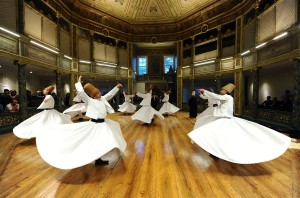
Whirling DervishesMy wife and I met at a Cursillo three-day weekend event. I was a part of the team (one of the cooks) putting on the Cursillo; she was “making” her Cursillo (as the lingo has it). She claims we’d met before at a fund-raiser fair at my parish (she attended elsewhere), but I was very busy during the fair and don’t recall that. I remember meeting her at the Cursillo weekend.

The Cursillo movement and the Cursillo community became an important of the early years of our marriage. We married about six months after meeting and in another six months we relocated to another state where I attended law school. There was an active Cursillo community in that location and we became involved.

An eye-opening move, that was. We discovered that the Cursillo community in our original home had been doing things incorreclty! Not just different. They’d been wrong. They’d been violating of the agreement between the Episcopal Church and the Roman Catholic Cursillo Movement, which had licensed the Cursillo method to the Episcopalians. And, we later learned, they knew they’d been doing so.

This comes to mind today because one of the major elements of a Cursillo weekend is music. In those communities, it was the sort of music that today might be called “praise choruses” or “church folk” or “contemporary.” Simple, easily remembered, repetitive songs accompanied by guitars, banjos, tambourines, bongos. One song common to both communities was based on this verse; in fact, it was this verse so far as I can remember.

There may have been verses and this may simply have been the chorus, but all I can recall is this verse: “This is the day, this is the day, that the Lord has made, that the Lord has made. We will rejoice, we will rejoice, and be glad in it, and be glad in it.” A catchy, bouncy little tune to which one could dance a formless dance, whirling like a dervish! It was easy to get caught up in and it demonstrated to me the spiritual power of music, simple melodies, and physical movement. Whirling and spinning and experiencing the power of the Spirit!

When my wife and I returned to our original home after three years in law school, we were asked to be the leaders of a coeducational three-day Cursillo event. We agreed, but we said we wanted to try to abide by the agreement between our church and the Roman Catholics, to discontinue those practices which violated the accord, to keep faith with our brothers and sisters who had gifted us with the Cursillo as a tool for deepening the faith of mature Christians.

There was push-back. In fact, there was outright rebellion. Members of the community refused to sponsor candidates to the weekend we were to lead; others refused to contribute to the cost of the event. Evelyn and I resigned from leadership and felt we had no choice but to withdraw from the community.

What had been an important support for us in the early years of married life became a source of grief and sadness. It still is. We miss being a part of that community and we miss the nearly automatic entry being in the Cursillo community gave us to a wider circle of church friends when we relocated. Where we live now, there is no active Cursillo community so the sharpness of the grief is dulled; there are no “Reunions,” nor “Ultreyas” (as the regular get-togethers of Cursillistas are called), so no constant reminders that we are no longer a part of Cursillo.

And yet we rejoice that we were fortunate to have been called to that community. It’s where we met; it sustained us. Like each day the Lord makes, it has passed. When it was here, we rejoiced in it and we were glad. And we look back on it still with gratitude. When I think of it, I think of this verse and that danceable chorus, and my soul comes alive in the Spirit, whirling and spinning, and expressing the joy that community gave us . . . and how grateful I am to that experience for the gift of my wife and the family we have created.

Everyday is a new day that the Lord has made; we will rejoice and be glad in it, whirling and spinning in the power of the Spirit.

====================

A request to my readers: I’m trying to build the readership of this blog and I’d very much appreciate your help in doing so. If you find something here that is of value, please share it with others. If you are on Facebook, “like” the posts on your page so others can see them. If you are following me on Twitter, please “retweet” the notices of these meditations. If you have a blog of your own, please include mine in your links (a favor I will gladly reciprocate). Many thanks!

====================

Father Funston is the rector of St. Paul’s Episcopal Church, Medina, Ohio.

Prayers Interrupted – A Poem

A House at Dawn

Prayers Interrupted

click tick pop
bang moan
click sigh
the echo of muffled
bass drum
hushed boom
a wood block
tapped by an angry cricket
tick tickity tick tick tick . . . click pop
an army of ants
do a soft-shoe
on a snare drum
sh shh sh sh sh sh
while the wind breaths through
a McDonald’s smoothie straw
moan . . . sigh . . .
sigh . . . moan
prayers interrupted
the muted percussion
of a house
coming alive
on winter’s morn
amen

(By C. Eric Funston)

Euripides on Friends and Relatives

++++++++++++++++++

Euripides (c. 480 – 406 BC) was an Athenian playwright, a great dramatist known for tragedies with very unhappy endings. Some of his plays are so tragic that they have been described as “almost unbearable,” and Aristotle called him “the most tragic of poets.” Apparently, however, he had a comic side, as well.

Euripides on Friends and Relatives

+++++++++++++++++++

Choosing Life – From the Daily Office – January 7, 2013

From the Book of Deuteronomy:

He humbled you by letting you hunger, then by feeding you with manna, with which neither you nor your ancestors were acquainted, in order to make you understand that one does not live by bread alone, but by every word that comes from the mouth of the Lord.

(From the Daily Office Lectionary – Deuteronomy 8:3 (NRSV) – January 7, 2014.)

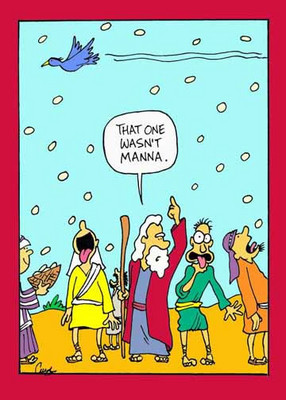
Manna from Heaven CartoonJesus and a crowd who challenge his authority also make reference to the manna in today’s Daily Office gospel lesson in which Jesus says: “Your ancestors ate the manna in the wilderness, and they died. This is the bread that comes down from heaven, so that one may eat of it and not die. I am the living bread that came down from heaven. Whoever eats of this bread will live for ever; and the bread that I will give for the life of the world is my flesh.” (John 6:49-51)

So I know that I really ought to be thinking pious thoughts about the Eucharist, or something . . . .

But, truth be told, what I’m really led by these lessons to think about is dieting and weight loss. Damn it!

Back in late September, I was having trouble fastening my trousers and avoiding stepping onto the bathroom scale, but eventually I did so and was appalled at the number it gave me. So I decided to do something about it and, before going public, lost a few pounds. When I was down to 273 lbs. (273! For God’s sake!) I decided I needed the “moral support” of my congregation, so inspired by another priest who had done so, I created a “Reduce the Rector” campaign and asked people to pledge dollars against pounds lost.

By Thanksgiving I’d lost 20 pounds, and then . . . well, let’s just say there was a diet hiatus through New Year’s. Fortunately, only a pound and a half was regained. But, now . . . .

Now Moses and Jesus are talking about food and more than food and reminding me that I need to focus on the healthier stuff that God has in store for me. Moses’ line about being “humbled” by the food eaten (the manna) and Jesus’ comment that “they ate and they died” really put a zinger into it. Food, too much of it and not the right kinds of it, is a humbling thing for me and I know if I don’t change the way I deal with it, it will kill me. High cholesterol, hypertension, blood sugar issues, joint pain, tendonitis . . . in some way or another, they are all related to the excess weight I am embarrassed to carry.

So . . . end of diet hiatus. Back to healthy eating and (even in the frigid cold) taking walks and getting more exercise.

The annotations to Deuteronomy tell me the last verse of the passage has an alternative reading: “One does not live by bread alone, but by anything that the Lord decrees.” I’m going to start focusing on something else God decreed through Moses: “Choose life so that you and your descendants may live!” (Deut. 30:19) I choose healthy eating and healthy living; I choose life.

====================

A request to my readers: I’m trying to build the readership of this blog and I’d very much appreciate your help in doing so. If you find something here that is of value, please share it with others. If you are on Facebook, “like” the posts on your page so others can see them. If you are following me on Twitter, please “retweet” the notices of these meditations. If you have a blog of your own, please include mine in your links (a favor I will gladly reciprocate). Many thanks!

====================

Father Funston is the rector of St. Paul’s Episcopal Church, Medina, Ohio.

Walking a Dog in Winter – A Poem

Winter Scene on Our StreetWalking a Dog in Winter

white on white on white
falling white
blowing white
drifting white
vision obliterating white

is there a dog
at the end
of this leash?

the sidewalk
a blue-green wound
in the white
slowly healing
flesh of winter
icy granulation in-filling
around my feet

the leash moves
(there is a dog!)
back and forth
searching searching searching
find the spot
find the right spot
find the only spot
but, for God’s sake,
find it soon

(By C. Eric Funston)

River of Words – From the Daily Office – January 6, 2013

From the Psalter:

There is a river whose streams make glad the city of God, the holy habitation of the Most High.

(From the Daily Office Lectionary – Psalm 46:5 (BCP Version) – January 6, 2014.)

A River in the Desert

Two poems about rivers . . . first from the Malaysian poet John Tiong Chunghoo who is known best for his haiku, a work entitled Part of God:

created in his likeness
the anger – thunder
the warning – lightning
the tears – rain
the smile – the breeze
the punishment – earthquake
lesson – the echo, memory
the trees, birds,
sea, clouds and sky
his pictorial poetry
in his likeness
i paint them
with words
that run
like a river
reflecting their beauty in me
styling them in realism
on a calm day
impressionism
on a breezy one
as the river
dances with light
modernism
when the river
shakes the
inquisitive mind
of the mysteries of life
all the blocks and angles
the river registers
as it unfolds a scroll
of god’s law
surrealism
mistfilled
a river scene
i did to run away from
a mind that torments
a world that begs for
an answer to everything

I am intrigued by Chunghoo’s image of poetry as a river, of words as flowing water. I grew up in the desert of southern Nevada and, as an adult, enjoyed recreational backpacking down the valley of the Virgin River, a tributary of the Colorado that now makes up the northern branch of Lake Mead. In the desert, a river is a source of life. Around it the ground is parched, dry, and apparently lifeless, but immediately next to it and in it there is abundance of life. Words, Chunghoo seems to suggest, are like that; they are more than mere devices of communication — they are sources of life in a world that “begs for an answer to everything.”

That’s a biblical image! Genesis: “Then God said, ‘Let there be . . . .'” John’s Gospel: “In the beginning was the Word . . . . ” God’s words are life-giving. Human words can be, too! Communication sustains the life of community. The river of words makes glad the city.

The second poem, read together with Chunghoo’s, read in the light of the image of a river of communication, is an old hymn given new meaning:

Shall we gather at the river,
Where bright angel feet have trod,
With its crystal tide for ever flowing
by the throne of God?
Gather at the river!
Yes, we’ll gather at the river,
The beautiful, the beautiful river,
Yes well gather at the river
that flows by the throne of God.
Shall we gather? Shall we gather at the river?

Shall we gather at the river of words? Shall we give life to one another with our communication and our conversation? Is there any other way?

Interestingly, Robert Lowry, the Baptist minister who wrote the hymn, was also a professor of literature. I wonder what he might have thought of a “river of words” . . . .

====================

A request to my readers: I’m trying to build the readership of this blog and I’d very much appreciate your help in doing so. If you find something here that is of value, please share it with others. If you are on Facebook, “like” the posts on your page so others can see them. If you are following me on Twitter, please “retweet” the notices of these meditations. If you have a blog of your own, please include mine in your links (a favor I will gladly reciprocate). Many thanks!

====================

Father Funston is the rector of St. Paul’s Episcopal Church, Medina, Ohio.

A Theology of Gift Giving – Sermon for the Second Sunday of Christmas – January 5, 2014

====================

This sermon was preached on the Second Sunday of Christmas, January 5, 2014, at St. Paul’s Episcopal Church, Medina, Ohio, where Fr. Funston is rector.

(The Revised Common Lectionary, Christmas 2A: Jeremiah 31:7-14; Ephesians 1:3-6,15-19a; Psalm 84; and Matthew 2:1-12. These lessons can be read at The Lectionary Page.)

====================
Gifts of the Wise MenVery recently in the church office mail there was this small envelope addressed to me personally — the address has been typed out on a separate sheet of paper, cut therefrom, and glued onto the envelope. There is no return address and the postmark is a Cleveland, OH, cancelation. Inside there was no personal note of any kind, just a page torn from the last quarter’s Forward Day by Day devotional. One side, as you can see, has been scribbled all over; clearly not the side I am supposed to read. The other is the meditation for October 30, 2013, which begins:

Have you ever suffered because you sat through a really boring, abstract, incoherent, and disconnected sermon? Most of us have. Believe it or not, some people report that after enduring something like that, they decide never to go back to that particular church or any church at all. Sermons can make or break some people’s relationship with the church.

(The entire meditation can be read at Forward Day by Day.)

I have to be honest — my first reaction on receiving this was to think, “Well, that’s not something I wanted to get!” And immediately I was reminded of one Christmas when our children were quite young.

Our family tradition is to wait until Christmas morning to open our packages, so even if we’d been to the Midnight Mass we would rise early to see what Santa had brought. On the Christmas I recalled, our daughter rushed down the stairs from her second-floor room to the tree set up in our first-floor den and tore open the largest of her gifts, ripping to shreds the wrapping paper with obvious excitement. However, when she saw what was under the wrapping her expression changed to disappointment and she cried out, “That’s not what I wanted!” I don’t remember what she had wanted; I don’t even remember what we had given her. But I remember that reaction.

It got me to thinking about the reasons we give things to one another, the how of it and the why of it. What is the “theology of gift giving?” The gifts of the wise men to the Christ-child help us to explore that question.

The first element of such a theology would be the recognition that the giving of gifts is perfectly acceptable! There are some who teach that it is not, but we have plenty of examples in Scripture including, of course, the very story we are told in today’s gospel reading of the visitation of the Magi. More basically, we have God’s own example starting with the gift of life to plants, animals, and human beings as described in the Creation stories and exhibited most clearly in God’s self-giving in Jesus Christ. Generosity and charity are fundamental to an active Christian faith. Giving is the very thing that defines our belief: God-made-human gave himself entirely so that we might be free to give ourselves entirely back to God. As James said, “Every generous act of giving, with every perfect gift, is from above, coming down from the Father of lights.” (James 1:17, NRSV) Gift-giving, in a sense, is the purpose of the Incarnation, so it is something strongly encouraged.

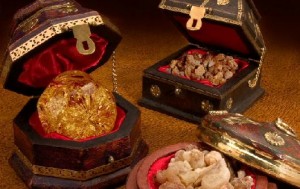
The second element of a theology of gift giving is that giving gifts allows us to be ministers of grace, the free and undeserved help of God. The gifts of the wise men were symbolic: the hymn “We Three Kings” lays out in verse what these are. Gold is a symbol of kingship, frankincense (used for incense in worship) is a symbol of deity, and myrrh (an embalming oil) is a symbol of death. (By the way, did you know that that hymn is quintessentially Episcopalian? It was written by John J. Hopkins in 1857 for a Christmas pageant at General Theological Seminary, the Episcopal Church divinity school in New York City.) In other words, they are symbolic of the full grace and mercy of God incarnate in Jesus. Every gift we receive, especially those from God but really from anyone, is a demonstration of God’s grace because, after all, grace is undeserved. How many times have you opened a present and sat there with the gift still in the box, looking at the giver with eyes and thinking to yourself, “What done to deserve this?” That question, of course, is rhetorical. The answer is “Nothing.” Gift giving is a form of grace by which we imitate the behavior of God and model the character of God.

The third element of a theology of gift giving is that it give us opportunity to display the love of God. “Each one must give as he has decided in his heart, not reluctantly or under compulsion, for God loves a cheerful giver,” wrote Paul to the Corinthians. (2 Cor. 9:7, ESV) And, of course, “God so loved the world that he gave his only Son.” (John 3:16, NRSV) Every gift should be a reflection of that love. If a gift is a real gift it is given with no thought of return. It’s not about starting an endless series of gift exchanges. It’s not about buttering someone up. It’s not about impressing someone or trying to get someone to do something for you. A real gift is an act of unconditional love, with no demands, no hints, no requirements of any return. Love, as Paul reminds us in the First Letter to the Corinthians,

is patient; love is kind; love is not envious or boastful or arrogant or rude. It does not insist on its own way; it is not irritable or resentful; it does not rejoice in wrongdoing, but rejoices in the truth. (1 Cor. 13:4-6)

Our gift-giving character should be one of genuine love. By giving a gift, we are symbolically recalling the gift of Christ for our salvation because “God so loved the world.”
The final element of a theology of gift giving, the element to which the first three point, is that it is relational. When the Magi encountered the Christ-child, they worshiped him: “On entering the house, they saw the child with Mary his mother; and they knelt down and paid him homage.” Worship is an expression of relationship at its deepest. However we define the word worship, it has its center in how we relate to God; it is the very reason, Scripture tells us, that we were created.

As I think I’ve mentioned before, one of my favorite poets is the African American James Weldon Johnson. At funerals, I often use one the poems from his collection God’s Trombones: Seven Negro Sermons in Verse. Another poem in that book is entitled The Creation; it explores this truth of our creation. The poem begins —

And God stepped out on space,
And he looked around and said:
“I’m lonely —
I’ll make me a world.”

The poem continues, as Genesis does, detailing the creation of earth, the seas, the plants, the animals . . . and then goes on —

Then God walked around,
And God looked around
On all that He had made.
He looked at His sun,
And He looked at His moon,
And He looked at His little stars;
He looked on His world
With all its living things,
And God said, “I’m lonely still.”

Then God sat down
On the side of a hill where He could think;
By a deep, wide river He sat down;
With His head in His hands,
God thought and thought,
Till He thought, “I’ll make me a man!”

Up from the bed of the river
God scooped the clay;
And by the bank of the river
He kneeled Him down;
And there the great God Almighty
Who lit the sun and fixed it in the sky,
Who flung the stars to the most far corner of the night,
Who rounded the earth in the middle of His hand;
This Great God,
Like a mammy bending over her baby,
Kneeled down in the dust
Toiling over a lump of clay
Till He shaped it in His own image;
Then into it He blew the breath of life,

And man became a living soul.
Amen. Amen.

“Like a mammy bending over her baby . . . .” We are created for relationship — relationship with God and relationship with each other. Like the gift giving of the Magi, that’s what our gift giving to one another is all about. It is a tangible expression of relationship; although gifts are given out of love with no expectation of reciprocation, they do provoke a response. They are relational, and in the way we relate to each other, especially in our giving of gifts to each other, we exhibit how we relate to God.

I’ll be honest. I was upset by this anonymous gift. But in the end I’m grateful for it because it is a reminder of this most important element of the theology of gift giving, this relational aspect. After that rather brutal opening paragraph, the Forward Day by Day meditation examines what it calls “Jesus’ methodology” of preaching by story-telling and then concludes, “In spite of all of our media gadgets, communications systems, and technological tools, we still need to truly perceive, listen, and understand.”

My mentor, the late Fr. Karl Spatz, taught me to think of a sermon as a conversation and as a gift. A sermon is not a lecture and it has many participants. Preaching is grounded in community, and like gift giving is relational. Preaching is not me or any clergy person standing in the pulpit telling you what we think that you should hear. A sermon is an exploration of the things we all struggle to understand, the troubles we all have to deal with, the things we all try to do better, the joys we all celebrate. A sermon is a priest’s prayerful and considered reflection upon these things, offered humbly as a gift to the gathered community. The congregation’s part in the conversation is to receive the gift and, as the meditation says, make the effort “to truly perceive, listen, and understand.” That may sometimes mean that we continue the conversation at a later time, perhaps through notes like this one — but we can only really continue the conversation that if I know who you are . . . .

When all is said and done, any gift giving (including any preaching) is an imperfect thing. It is an imperfect thing that seeks the perfection of the one true gift, the gift of Jesus for the salvation of the world. Amen.

====================

A request to my readers: I’m trying to build the readership of this blog and I’d very much appreciate your help in doing so. If you find something here that is of value, please share it with others. If you are on Facebook, “like” the posts on your page so others can see them. If you are following me on Twitter, please “retweet” the notices of these meditations. If you have a blog of your own, please include mine in your links (a favor I will gladly reciprocate). Many thanks!

====================

Father Funston is the rector of St. Paul’s Episcopal Church, Medina, Ohio.
« Older posts Newer posts »