Occasional thoughts of an Anglican Episcopal priest

Tag: Lent (Page 1 of 5)

An Unjust War: Sermon for the Third Sunday in Lent – 8 March 2026

There is an aphorism about preaching that says the preacher “must hold the Bible in one hand and the newspaper in the other.” This is often attributed to the influential Swiss theologian Karl Barth, whom Time Magazine in the 1960s called “the greatest living Protestant theologian.” Truth is, however, that he never really said it. What he actually said, in an interview with Time in 1963, was, “Take your Bible and take your newspaper, and read both. But interpret newspapers from your Bible.”[1] In other words, try to understand events in the world through the lens of Scripture and take guidance from it as you seek to live in this world.

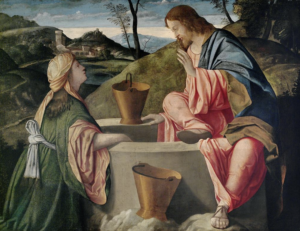
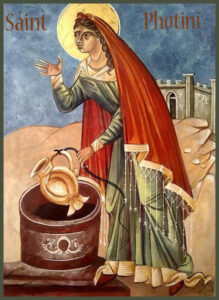
As I followed the news media the past few weeks, two stories stood out for me. One was the witness of the women who are the surivors of Jeffrey Epstein’s human trafficking enterprise. The other was the tale of the US Women’s Ice Hockey team who won the Olympic gold medal but were nonetheless made the butt of a joke by the president. It seemed to me that John’s story of Jesus’ long conversation with the Samaritan woman at Jacob’s well offers us a lens through which to view these news stories. So I started making notes for a sermon along those lines.

Continue reading

Satan Is a Bully: Sermon for the First Sunday in Lent – 22 February 2026

I assume that everyone here has seen A Christmas Story?[1] It’s hard to live in the Cleveland area and not to know about the 1983 cult classic Christmas movie, and by now, with the Turner movie channel running it as a marathon every Christmas, to have seen it. Do you remember the character “Scut” Farkus? That was the bully who, accompanied by his toady Grover Dill, made Ralphie’s life miserable. Until, that is, Ralphie had simply had enough and exploded, knocked Scut down into the snow, and gave him a bloody nose. This morning, I’m going to try to convince you that that’s sort of what’s happening in today’s gospel lesson.
A rather standard way of preaching the Temptations of Christ is to say that Satan’s point is to raise doubts about whether Jesus is who he thinks he is by casting doubt on his relationship with God, and that Jesus’ rejections of the temptations “prove his identity as God’s divine and beloved son.”[2] I’m probably a heretic, but I don’t think that’s the point of this story at all; that’s not what this episode is about.

Continue reading

Of Lent and Social Action – Sermon for Lent 3, RCL Year B

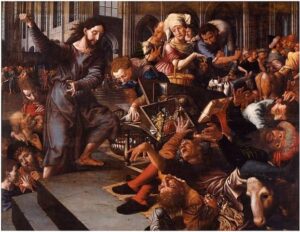
When I was about 8 or 9 years of age, my grandparents gave me an illustrated bible with several glossy, color illustrations of various stories. They weren’t great art, but they were clear and very expressive. My favorite amongst them was the illustration of today’s gospel lesson.

I know it was John’s version of the cleansing of the Temple because in that picture Jesus was swinging a whip. John’s is the only version of the story with that detail. The rest of the picture was filled with movement. Jesus was whirling about like a dervish, his long hair and the hem of his rob flaring out. Men were scattering, tables and cages sailing through the air, birds fluttering away, and coins flying everywhere.

A couple of decades ago, when several of my friends were wearing “WWJD?” (What would Jesus do?) bracelets, I’d think of that illustration and wonder, “Have you considered that time with the whip in the Temple courtyard?”

Continue reading

Of Temptation and Self-Discovery – Sermon for Lent 1, RCL Year B

What is Lent all about?

Some say it’s a time when we are supposed to find the presence of God in everyday life. The Most Rev. Dr. Jonn Sentamu, Archbishop of York from 2005 to 2020, suggested as much in his 2015 Ash Wednesday meditation when he said, “Lent is a time to get to know God better.”[1] The metaphor of keeping Lent as being a journey during which we search for, find, and come to know more of God is so widespread and prevalent, one cannot find its origin.

It seems to be the most common way to think about Lent. But that way isn’t working for me this year, especially as I contemplate Mark’s description of Jesus’ baptism and its aftermath. If in our Lenten discipline we are to be, in some way, doing what a Lenten hymn attributed to St. Gregory the Great says — “keep[ing] vigil with our heavenly lord in his temptation and his fast”[2] — then we should pay particular attention to what really was going on there and seek to do during Lent what seems to be going on with Jesus in the wilderness.

Continue reading

Something to Boast About: Sermon for the 3rd Sunday in Lent, 2023 (RCL Year A)

We “boast in our sufferings,” writes Paul to the Romans, “knowing that suffering produces endurance, and endurance produces character, and character produces hope, and hope does not disappoint us….”[1] It sounds, doesn’t it, like Paul is encouraging the Romans to brag about their problems and how well they handle them, as if endurance, character, and hope were the prizes handed out in some sort of “affliction Olympics.”
Well, he’s not. The Greek word here is kauchaomai which the lexicon interprets as “to glory in a thing.”[2] The New American Bible rendered this injunction as “we exult in our tribulations.” The old Revised Standard Version translated this word as “rejoice.” I rather like Eugene Peterson’s paraphrase of this text in The Message: “We … shout our praise even when we’re hemmed in with troubles.”[3] So, no … Paul is not encouraging competitive bragging.

Well, then, what is he doing?

Continue reading

As Long As It Takes (Sermon for the First Sunday in Lent, RCL Year C), 6 March 2022

Lord God,
We ask you to hold the people of Ukraine deep in your heart.
Protect them, we pray; from violence,
from political gamesmanship,
from being used and abused.

Give, we pray, the nations of the world the courage
and the wisdom to stand up for justice
and the courage, too, to dare to care generously.

Lord, in your mercy, take from us all the tendencies in us
that seek to lord it over others:
take from us those traits
that see us pursuing our own needs and wants
before those of others.

Teach us how to live in love and dignity and respect
following your example,
that life may triumph over death,
and light may triumph over darkness. Amen. [1]

The Pope’s message for Lent is a poignant one, beginning with an acknowledgement that “going to some small extent without food [may not seem to] mean much, at a time when so many of our brothers and sisters are victims of war … and are undergoing such suffering, both physically and morally.” Nonetheless, insisted His Holiness, “Lent must mean something,” and he urged all Christians to focus on “the common heritage of humanity.”[2]

Continue reading

Lenten Self-Awareness: Sermon for Ash Wednesday, 25 February 2020

Today marks the beginning of the season we call “Lent,” an old English word which refers to the springtime lengthening of the days. What is this season all about, these forty days (not counting Sundays) during which we are to be, in some way, doing what a hymn attributed to St. Gregory the Great says: “Keep[ing] vigil with our heavenly lord in his temptation and his fast?”[1]

A few years ago, Dr. Jonn Sentamu, the current Archbishop of York, described Lent as a time for seeking and getting to know God better.[2] Similarly, an essay about Lent in an issue of the National Catholic Register was titled “A Season for Seeking.”[3] I’m not sure I buy that, however. As the Roman Franciscan author Richard Rohr says, “We cannot attain the presence of God because we’re already in the presence of God. What’s absent is awareness.”[4] Lent is not so much a time for seeking God, who is always there, as it is for becoming aware of God.

And the interesting thing is that we are encouraged to become aware of God by becoming more aware of ourselves. Yes, Jesus does say to give with one hand not letting the other know what’s happening, but this seems more an instruction to follow the Deuteronomic command to “open your hand [to one in need] … to give liberally and be ungrudging when you do so”[5] rather than a direction to act without self-awareness.

Continue reading

Lenten Journal 2019 (19 April)

Lenten Journal, Good Friday

It is said that the dogwood used to be a tree of mighty stature, taller and stronger than the oak. It was also a tree that spread around the world. Because of its abundance and strength, it was the tree chosen by the Romans to make the crosses on which they executed criminals.

One day, however, the wood of the dogwood tree was formed into a cross and used to crucify an innocent man, a man who, it turned out, was the Son of God. The dogwood was bereft. Sensing its grief and shame Christ said to the tree, “No longer will you be used for this purpose. You shall from now on grow, not tall and strong, but slender and weak. Further, your flower shall form a reminder of the cross and each petal will bear a mark of the nails. You need not be ashamed, nor need you grieve. You will be a reminder of my willing sacrifice.”

Continue reading

Lenten Journal 2019 (16 April)

Lenten Journal, Day 41

“Day 41” seems odd to write in a Lenten journal, but I’ve not separated out Sundays in my count of the days. We say “40 days of Lent” because Sundays are excluded; there are actually 46 days between Ash Wednesday and Easter Sunday. I started this journal on the Thursday after Ash Wednesday and called that entry “Day 1” … so, weird or not, I’m calling this “Day 41” of Lent.

It’s also “Chrism Tuesday” (not an official name), the day on which clergy gather with their bishop to renew their ordination vows. The actual traditional day for this is Maundy Thursday but somewhere along the line American dioceses moved this service to Tuesday in Holy Week. Today marks the first time in my ordained life that I have not attended the Chrism Mass. Instead, I went to the orthopaedic clinic and endured a session of biometric measurement gauging the progress of my knee replacement recovery.

Continue reading

Lenten Journal 2019 (15 April)

Lenten Journal, Day 40

A picture of Fionna popped up on my Facebook “wall” this week. It has done so before. Whenever it does, it brings tears to my eyes. I am reminded how important having a dog is in my life. I remember my former companions: my first dog, Baron; the dog who kept me sane throughout college, Shadrak; the stray Cocker Spaniel we came to call “the best dog ever,” Josephine; and all the others.

It is said that Martin Luther was a dog-lover. He had a little dog named Tölpel (which is German for “fool”). He once said of dogs, “The dog is the most faithful of animals and would be much esteemed were it not so common. Our Lord God has made His greatest gifts the commonest.”

Continue reading

« Older posts