 I assume that everyone here has seen A Christmas Story?[1] It’s hard to live in the Cleveland area and not to know about the 1983 cult classic Christmas movie, and by now, with the Turner movie channel running it as a marathon every Christmas, to have seen it. Do you remember the character “Scut” Farkus? That was the bully who, accompanied by his toady Grover Dill, made Ralphie’s life miserable. Until, that is, Ralphie had simply had enough and exploded, knocked Scut down into the snow, and gave him a bloody nose. This morning, I’m going to try to convince you that that’s sort of what’s happening in today’s gospel lesson.
A rather standard way of preaching the Temptations of Christ is to say that Satan’s point is to raise doubts about whether Jesus is who he thinks he is by casting doubt on his relationship with God, and that Jesus’ rejections of the temptations “prove his identity as God’s divine and beloved son.”[2] I’m probably a heretic, but I don’t think that’s the point of this story at all; that’s not what this episode is about.
 “You are the light of the world. … [L]et your light shine before others, so that they may see your good works and give glory to your Father in heaven.”
 Do you all know what a tort is? Tort … T-O-R-T … no E on the end; I’m not talking about those wonderful little German or Austrian pastries. A tort is a civil wrong that causes harm to another person, resulting in legal liability for the person who commits the wrong. You leave a puddle of milk on the floor of your grocery store knowing it’s there, then someone slips in it and injures themselves: you have committed a tort. You speed through a stop sign, collide with another car, and injure the driver: you’ve not only broken the law, you’ve committed a tort.
 Let’s have a show of hands: everyone who believes that there is a Constitution of the United States raise your hand. OK, good. Now everyone who believes in the Constitution of the United States raise your hand. Some of you might be thinking, “Wait. Didn’t he just ask us to do that?” Well, no. There’s a difference between “belief that” and “belief in.”
  One of the things I try to do when I read the stories of Jesus in the Gospels, when he uses an odd or striking metaphor like “I will make you fishers of people”
 I understand that St. Andrew’s Parish is, today, beginning its annual stewardship campaign, so I suppose it’s appropriate that we heard the story of Jesus being confronted by the wealthy man who wants to inherit eternal life in today’s Gospel reading from Mark. This tale must have been an important one to the earliest Christians, because we find it in all three of the Synoptic Gospels. Mark tells us only that the man is wealthy; Matthew adds that he is young; and Luke informs us that he is a ruler of some sort. But none of those details really changes the basic nature of the encounter: a potential disciple comes to Jesus seeking guidance and Jesus tells him that he must give up everything he possesses – “You lack one thing; go, sell what you own, and give the money to the poor….”
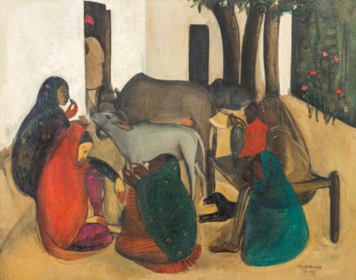 “They’re eating the dogs, they’re eating the cats.”
 The United States is, at least ostensibly, a very religious country. Nearly two hundred years ago, Alexis de Tocqueville wrote that “there is no country in the world where … religion retains a greater influence over the souls of men than in America; and there can be no greater proof of its utility and its conformity to human nature than that its influence is powerfully felt over the most enlightened and free nation of the earth.”
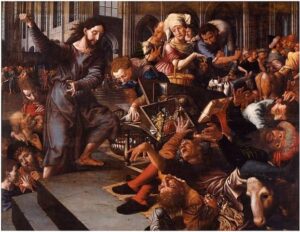 When I was about 8 or 9 years of age, my grandparents gave me an illustrated bible with several glossy, color illustrations of various stories. They weren’t great art, but they were clear and very expressive. My favorite amongst them was the illustration of today’s gospel lesson.

