The United States is, at least ostensibly, a very religious country. Nearly two hundred years ago, Alexis de Tocqueville wrote that “there is no country in the world where … religion retains a greater influence over the souls of men than in America; and there can be no greater proof of its utility and its conformity to human nature than that its influence is powerfully felt over the most enlightened and free nation of the earth.”[1] While recent polling data demonstrate that the influence of religion seems to have declined, it remains a powerful force.
According to an average of all 2023 Gallup polling, about 75% of Americans identify with a specific religious faith, and 71% say that religion is either “important” or “very important” in their lives; over 40% attend religious services at least monthly, more than half of those weekly.[2]
 We have had more than enough of contempt,
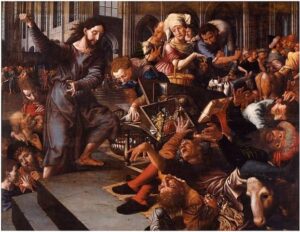 When I was about 8 or 9 years of age, my grandparents gave me an illustrated bible with several glossy, color illustrations of various stories. They weren’t great art, but they were clear and very expressive. My favorite amongst them was the illustration of today’s gospel lesson.
 What does it mean to say “Jesus is Lord”? The question arises because of today’s dialog between Jesus and some of the Pharisees about the relative importance of the Commandments. Jesus responds to a lawyer’s question about the greatest commandment and then follows his response with a question about the lordship of the Messiah, the anticipated “Son of David.”
  Power and authority. These are the subjects of our lessons from Scripture this morning. Later this month they will figure as key concepts in a trial scheduled to begin in Fulton County, Georgia. That trial will focus on an alleged attempt to disrupt, even to stop, what we have come to call “the peaceful transfer of power.” Historian Maureen MacDonald wrote a few years ago:
 Heavenly Father,
 Do any of you know the story of Tubby the Cocker Spaniel? Well . . . remember Tubby’s name. We’ll come back to him, but first let’s put today’s gospel lesson in perspective.
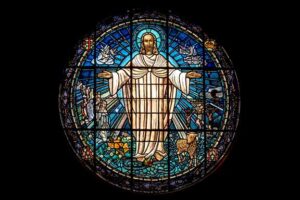 It’s the last Sunday of the Christian year, sort of a New Year’s Eve for the church. We call it “the Feast of Christ the King” and we celebrate it by remembering his enthronement. Each year on Christ the King Sunday we read some part of the crucifixion story. As Pope Francis reminded the faithful in his Palm Sunday homily a few years ago, “It is precisely here that his kingship shines forth in godly fashion: his royal throne is the wood of the Cross!”