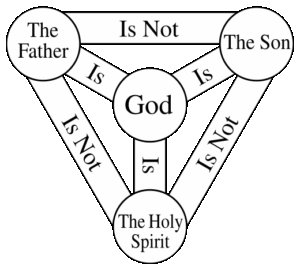
 A few weeks ago, as I was looking forward to my annual cover-Rachel’s-vacation gig here at Harcourt Parish, my plan was to preach a sort of two-part sermon on play and playfulness. Seemed like a good summer-time thing to do. Last week, on Pentecost Sunday, I suggested to you that playfulness is a gift of the Holy Spirit, that play is why we were made. Today being Trinity Sunday, I planned to follow-up with a few words about how a metaphor of play and playfulness can help us understand and participate in the relational community which the triune God is.
Then the Immigration and Customs Enforcement doubled down on Mr. Trump’s promises of “mass deportations” across the country, but especially in Southern California and particularly in Los Angeles (where I grew up, by the way). People took to the streets in protest; the administration used that as an excuse to nationalize the California National Guard and met the protesters not only with 2,000 guardsmen but with 700 Marines, as well.
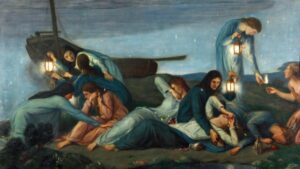 We have three intriguing lessons from scripture today. First we have a denunciation of Hebrew worship, which also interestingly contains a verse most famous in American politics for having been spoken on the steps of the Lincoln monument by Dr. Martin Luther King, Jr. Some people who dislike liturgy, or some aspect of liturgy, like incense, or vestments or music, ignoring that sentence about justice flowing like streams, have used this text to prove that God also dislikes, liturgy, or incense, or vestments, or whatever. However, that’s not what this lesson is about and I’ll get back to that in just a moment.
  There is an old tradition in the church: on Trinity Sunday, rectors do their best to get someone else to preach. If they have a curate or associate priest, he or she gets the pulpit on that day. If not, they try to invite some old retired priest to fill in (as Rachel has done today). No one really wants to preach on Trinity Sunday, the only day of the Christian year given to the celebration or commemoration of a theological doctrine, mostly because theology is dull, dry, and boring to most people and partly because this particular theological doctrine is one most of us get wrong no matter how much we try to do otherwise.
 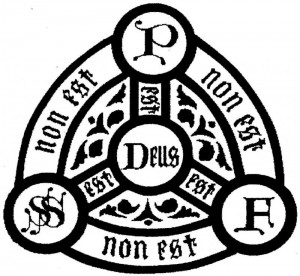 There is an old tradition in the church: on Trinity Sunday, rectors do their best to get someone else to preach. If they have a curate or associate priest, he or she gets the pulpit on that day. If not, they try to invite some old retired priest to fill in (as Father George has done today). No one really wants to preach on Trinity Sunday, the only day of the Christian year given to the celebration or commemoration of a theological doctrine, mostly because theology is dull, dry, and boring to most people and partly because this particular theology is one most of us get wrong no matter how much we try to do otherwise. Back when I was a curate getting the Trinity Sunday assignment, my rector encouraged me with the sunny observation that, listening to a sermon in almost any church on Trinity Sunday, one could be practically guaranteed to hear heresy.

