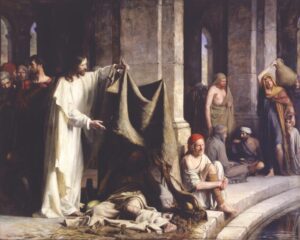
 “Do you want to be made well? … Stand up, take your mat and walk.”[1]
My father won a Bronze Star for bravery under fire in World War II. His citation for “meritorious achievement [at a battle] in the vicinity of Ensheim, Germany, somewhat casually mentions that he “was wounded by enemy artillery fire.”
The wound which the citation glides over so nonchalantly was actually multiple shrapnel wounds that pretty much tore up his right leg and required two years of surgeries, physical therapy, and learning to walk again. He was left with a significant limp and constant pain for the rest of his life, pain which he self-medicated. His drug of choice was alcohol. Some of my earliest memories include fetching for him a Miller Hi-Life beer from the fridge or the bottle of Wild Turkey bourbon in the living room drinks cabinet.
Late on the night of March 30, 1958, while driving under the influence of that alcohol, he lost control of his car on a desert highway east of Kingman, Arizona, rolled his Thunderbird convertible three times, and broke his neck. My father, though he did not die in service and was, indeed, a civilian at the time of his death, was a casualty of World War II just as surely as if he had died on that battlefield in Germany. I am certain that if, at any time during those thirteen years between his wounding at Ensheim and his death in the Arizona desert, someone had said to him “Do you want to be made well?” his answer would have been, “Yes! Hell, yes!”
 Let’s have a show of hands: everyone who believes that there is a Constitution of the United States raise your hand. OK, good. Now everyone who believes in the Constitution of the United States raise your hand. Some of you might be thinking, “Wait. Didn’t he just ask us to do that?” Well, no. There’s a difference between “belief that” and “belief in.”
  One of the things I try to do when I read the stories of Jesus in the Gospels, when he uses an odd or striking metaphor like “I will make you fishers of people”
 I understand that St. Andrew’s Parish is, today, beginning its annual stewardship campaign, so I suppose it’s appropriate that we heard the story of Jesus being confronted by the wealthy man who wants to inherit eternal life in today’s Gospel reading from Mark. This tale must have been an important one to the earliest Christians, because we find it in all three of the Synoptic Gospels. Mark tells us only that the man is wealthy; Matthew adds that he is young; and Luke informs us that he is a ruler of some sort. But none of those details really changes the basic nature of the encounter: a potential disciple comes to Jesus seeking guidance and Jesus tells him that he must give up everything he possesses – “You lack one thing; go, sell what you own, and give the money to the poor….”
 “They’re eating the dogs, they’re eating the cats.”
 Again this week as last, our first reading today is from the First Book of Kings and like last week’s, it is a prayer spoken by King Solomon. Last week, it was a private prayer spoken in a dream late at night. Today, it is a public prayer. As long as it was, this reading is just a small part of the dedicatory prayer that Solomon offered when the Temple was finished and consecrated. In it, Solomon asks an important question, “[W]ill God indeed dwell on the earth?”
 The United States is, at least ostensibly, a very religious country. Nearly two hundred years ago, Alexis de Tocqueville wrote that “there is no country in the world where … religion retains a greater influence over the souls of men than in America; and there can be no greater proof of its utility and its conformity to human nature than that its influence is powerfully felt over the most enlightened and free nation of the earth.”
 We have had more than enough of contempt,
 Are you a music fan? A classical music fan? I am. I love the great symphonies – Beethoven’s Fifth, his Ninth, Tchaikovsky’s Fifth, Dvorak’s From the New World, and many others – they just bowl me over. I can sit down in a concert venue and no matter what emotional state I may be in, a good symphony or concerto can overcome it – cynicism, depression, grumpiness, whatever my condition may be it will be conquered by the music and I will be uplifted. It doesn’t even have to be live in a concert hall. Sometimes when I’m feeling a bit out of sorts, I’ll put on a CD or an MP3 and just let the music fill me. At its best, music literally lifts me up and sets me dancing. In fact, in the proper setting, even badly played band music can have that effect.

