Occasional thoughts of an Anglican Episcopal priest

Category: Anglican (Page 113 of 115)

Give Back to Caesar…. Give to God: A Sermon for Proper 24A

Once again we are in the 22nd Chapter of Matthew which we began last week with Jesus telling that strange parable of the wedding banquet, but to truly understand what is going on here we have to go back to Chapter 21.
At the beginning of Chapter 21, Jesus tells two disciples to go to Bethphage and untie the foal of a donkey which he needs to ride into the city of Jerusalem. When I tell you that, you should immediately realize that this story takes place on or shortly after Palm Sunday; in fact, today’s confrontation takes place on the Monday after Palm Sunday. Jesus rode into the city in triumph and was haled as a king, as the One who comes in the Name of the Lord. He had gone to the Temple and driven out the sellers of sacrificial animals and the money-changers. After that, he returned to Bethany and spent the night, probably in the home of his friends Mary and Martha. The next day he went back to the Temple and began teaching in parables, during which he is confronted by various power groups – the Pharisees, the Sadducees, the Herodians, and probably others.

In this conversation, Matthew tells us that Jesus’ antagonists are the Pharisees and the Herodians. That’s important information because any sort of cooperative action between those two groups was darn near impossible. Matthew is saying something here like, “Harry Reid and John Boehner went together to ask Jesus this question.” It’s like saying that a Tea Partier and a participant in Occupy Wall Street took a united stand on something.

Pharisees, of course, were the Jewish sticklers for the Law. They insisted that righteousness required adherence to every little “jot and tittle” of the Mosaic rules. Herodians on the other hand weren’t Jews at all! They were Idumeans who had come to rule in Jerusalem with their king, Herod, as puppets under the Romans; they didn’t give one wit for the Law. But here they are confronting Jesus together because both felt threatened by him.

They come and ask what sounds like a simple question: Under the Jewish Law is it permissible, for a Jew, to pay taxes to the Romans? They’re trying to trap Jesus – if he says “Yes” he’ll lose the support of religious Jews and his movement will fizzle; if he says “No” he’ll be liable to arrest and prosecution by the Romans as political troublemaker and his movement will lose its leader and fizzle. They win in either case.

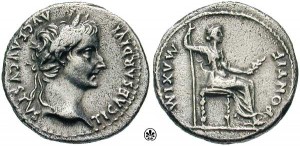
Jesus, however, is not going to fall for the trap. He asks to see one of the coins that would be used to pay the tax. Doing so, he traps them and points out how ridiculous their alliance is. The Pharisees, under the Law, could not possibly have possessed the coin in question and would never have brought one into the Temple precincts. Under the Jewish Law it was absolutely forbidden to bring into the Temple anything bearing an image, especially something bearing a religious image, an idol of a foreign religion. On one side, the coin in question, a denarius, would have had an image of Caesar and the words, Augustus Tiberius Caesar Divi Augusti Filius – “Augustus Tiberius, Emperor, son of the Divine Augustus”; on the other side, Caesar’s title Pontifex Maximus– “High Priest”. In other words, the coin was a religious object; it proclaimed the creed of the emperor-worship cult which was part of the Roman civic religion. The Herodians, client rulers of the Romans, would have had no problem with the coin, but it would have been anathema to the Pharisees. By asking for the coin, and getting a Herodian to produce one, Jesus was demonstrating to everyone who utterly ridiculous this alliance between the two parties was.

Jesus’ answer to the question, though, is what truly exposes the hypocrisy of their partnership: “Give [back] therefore to the emperor the things that are the emperor’s, and to God the things that are God’s” (Matt. 22:21). (Our New Revised Standard Version of the text says to “give” to the emperor – the word “render” is more familiar to many of us from the King James Version – but the Greek verb is apodidomi, which means to “give back”, to “return” or to “repay”.)

Jesus’ answer is tricky; it gets to the very heart of the matter and points out how very different these two parties are. The Herodians would be perfectly happy with Jesus’ reply; they would be satisfied with an answer that seems to suggest that we owe equal allegiance to the governing authorities and to God, that the political realm and the religious realm place separate but equal demands upon us and that we are obliged to obey both. There are plenty of modern American folks who would agree with them, too.

To the Pharisees, on the other hand, “The earth is the Lord’s and all that is in it, the world and all who dwell therein.” (Ps. 24:1 They would that morning have said in their daily prayers, “It is our duty to praise the Master of all, to ascribe greatness to the Molder of primeval creation” (the Aleinu); thus, they would have prayed that God’s Name be “exalted and sanctified in the world that he created” (the Kaddish). If, as these prayers suggest, all things belong to God, then what can possibly be left over to return to the emperor? Both the Pharisee and the Herodians are left wondering what Jesus really means. Whose side (if any) he is really on?

Of course, the answer to that question is that Jesus is on neither side of that division. Jesus is on God’s side.

But we, like the Pharisees and the Herodians, are left here wondering, what does this answer mean for us? How are we to understand and live out Jesus’ answer?

By answering, “Repay to Caesar what belongs to Caesar,” Jesus is not unambiguously saying, “Go ahead, pay your taxes!” Rather, by placing the emperor and God in parallel, Jesus also makes parallel their images. They give him the denarius and he gives it right back to them with this question, “Whose head is this, and whose title?” And, of course, they answer, “Caesar’s.” “OK, fine,” says Jesus, “it must be his. Give it back to him.” The second half of the answer, “and [give] to God what belongs to God,” is comprehensive and includes all areas of life. Having pointed out whose likeness is on the coin, Jesus answer demands that we then ask ourselves and answer the further question, “What – or (better) who – bears God’s image?”

After this confrontation, the 22nd Chapter of Matthew contains two more challenges to Jesus. The Sadducees, after the Pharisees and the Herodians walk away, present their rather silly hypthetical about the imaginary woman who married seven brothers in succession and ask, “Whose wife will she be in the afterlife?” (in which the Sadducees, by the way, don’t even believe). Then the kicker … a lawyer asks him, “Teacher, which commandment is the greatest?” Jesus, as we will hear in next week’s Gospel lesson, is that loving God with one’s whole heart, mind and soul is the first and greatest commandment, and the second, loving one’s neighbor as oneself, is just as important. Humans, not coins, bear God’s true image, and no edict of Caesar, no tax imposed or law declared by the secular government, can absolve Jesus’ followers from the mandate to love God and to see and serve God in our neighbor.

To what seemed like a trick question Jesus responded, “Give to Caesar what is Caesar’s, and to God what is God’s.” On that ancient denarius that was given to Jesus was an image of Caesar, merely money was owed to him, whereas every human being bears the image of God, implying that each of us, and all of us together, “render to God,” the Master of all and the Molder of creation, our selves, our entire selves wholly and without reservation.

Let us pray:

Almighty and eternal God, so draw our hearts to you, so guide our minds, so fill our imaginations, so control our wills, that we may be wholly yours, utterly dedicated to you; and then use us, we pray, according to your will, and always to your glory and the welfare of your people; through our Lord and Savior Jesus Christ. Amen.

Where’s the Groom? – A Sermon for Proper 23A

Today in the lessons from Scripture we’ve heard two stories – one that the Book of Exodus gives us as a true story from the history of our ancestors in the faith of Yahweh, the other a parable told by Jesus to instruct the followers of that faith.

The historical tale tells us that when Moses went up Mt. Sinai to receive the Tablets with the Ten Best Ways (as Mother Kay referred to the Ten Commandments last week), the people left down at the base camp got a little anxious and decided they needed some sort of focus object for their worship, an idol (in other words). So they appealed to Moses’ brother Aaron to “make us a god”.

Now they hadn’t yet heard the Law that God had given to Moses, the Law in which God had said, “You shall not make for yourself an idol, whether in the form of anything that is in heaven above, or that is on the earth beneath, or that is in the water under the earth,” the Law in which God specifically commanded, “You shall not make gods of silver alongside me, nor shall you make for yourselves gods of gold.” They hadn’t yet heard it, but they broke it in ignorance because that is exactly what Aaron and these Hebrews did!

Aaron took their golden jewelry, melted it down, and cast it into the form of a Golden Calf, and then the people “offered burnt offerings and brought sacrifices of well-being,” they “sat down to eat and drink, and rose up to revel.” In other words, they threw a party.

The parable is also about a party. Jesus tells his audience that the kingdom of heaven is like a wedding reception hosted by a king for his son. Those who were initially invited made light of the occasions and killed the messengers who brought their invitations, so the king sent his army to wipe them out. That, as you remember is what God had threatened to do with the revelers back at Mt. Sinai. As we might expect, that story in Exodus tells us that God got mighty angry about the Golden Calf and threatened to wipe out the Hebrews whom he had just saved from the Egyptians and start over. If not for Moses’ pleas on their behalf, that’s what God would have done.

The king in Jesus’ parable doesn’t exercise the same restraint, however. “His troops destroyed those murderers, and burned their city.” Then the king sends his servants out into the highways and byways to bring in whomever they can find to fill the banqueting hall so there can be a party. They “gathered all whom they found, both good and bad; so the wedding hall was filled with guests.”

Now if the parable ended there, we could all breathe a sigh of relief. Two stories of God’s mercy and compassion. In the historical tale, God relented and “changed his mind about the disaster that he planned to bring on his people.” In the parable, the king, who clearly represents God, (although he justly condemns the murderers) eventually extends welcome to all sorts and conditions of human beings, the good and the bad. Everybody is welcome; nobody is excluded. We like this! It makes us feel good; it’s warm and fuzzy.

Unfortunately for those good feelings, however, the parable doesn’t stay with that warm and fuzzy ending. Jesus adds a post-script: “When the king came in to see the guests, he noticed a man there who was not wearing a wedding robe, and he said to him, ‘Friend, how did you get in here without a wedding robe?’ And he was speechless. Then the king said to the attendants, ‘Bind him hand and foot, and throw him into the outer darkness, where there will be weeping and gnashing of teeth.'” Not so warm and fuzzy anymore…. In fact, we’re confused!

There is a tradition of exegesis going back centuries that argues that it was an ancient wedding tradition that the groom’s father would host the nuptial feast and provide everything necessary: the food, the wine, the place, the decorations, and the festal garments for the guests. Unlike today’s weddings, you wouldn’t have to rent your own tuxedo or buy your party dress; the host would supply it for you. Thus, the guests from the streets, including the one who eventually gets thrown out, would have had the opportunity to dress appropriately as they arrived. This one fellow, however, failed to honor his host’s generosity by failing to put on the proffered garment. Apparently, it was St. Augustine, the early Fifth Century bishop of Hippo, who first made this assertion, but modern scholars have failed to turn up any historical evidence to support it.

Another typical interpretation of this parable and the unhappy guest’s failure to put on a wedding garment it is analogous to putting on righteousness, to our obligation to change our life to one of penitent joyfulness as Susan Pendleton Jones, director of special programs at Duke Divinity School, argues in her fairly standard exegesis of this parable:

Jesus is issuing the invitation for all to join him as God’s guests in a banquet feast called the kingdom of heaven.

Life in the kingdom is a party where God is the host and all of us have received a royal invitation. Yet some of us come unprepared, as a second parable reminds us. One guest is improperly dressed, and is thrown out of the banquet – quite a contrast to the inclusive tone of the previous parable. To wear a wedding garment is to know the significance of the occasion, to allow God’s gracious invitation to change our lives, and to live accordingly. The dinner guest has received a gift from the king – the invitation to a joyous, elaborate feast – to which he has not responded appropriately. When we receive a gift such as salvation or forgiveness, we are called to lives of penitent joyfulness.

All are invited to feast at the table, but not every response is acceptable. We are called to repent in preparation or the party, not because we have to but because we know we are entering into the presence of a gracious, forgiving God. We will be left out if we think that God’s love carries with it no desire for response from us. Though we are often tempted to play the host, these parables together confirm that we need God to be the host – not only for the grace-filled invitation to the banquet, but also for the expectation of holy living that God presumes of those in attendance. Grace is amazing, but so God’s desire for our response. (Party Time, The Christian Century, Sept. 22-29, l999, p. 897)

All of that is certainly valid commentary and there is much for us to think about there, but let me stretch our understanding here just a little by taking a different approach, one suggested by the Reformer John Calvin. It seems to me that there’s someone left out of this parable … Where’s the bridal couple? More specifically, where’s the groom? I think we have to hear and understand this parable through the lens of Scripture, not through the lens of a questionable assertion about historical wedding practices, and I think we can’t escape the verse from the Book of Revelation that tells us, “Blessed are those who are invited to the marriage supper of the Lamb.” (Rev. 19:9) We know who the groom is, but we still have to ask, in the context of the parable, where is the groom?

In the lesson from Paul’s letter to the church in Philippi today, the apostle asks his readers “stand firm in the Lord” and to “be of the same mind in the Lord.” In other letters, he expresses this same thought in a different way – in the letter to the Romans he admonished his readers to “put on the Lord Jesus Christ;” in the letter to the Ephesians, he encouraged his readers to clothe themselves with the likeness of God; and in his letter to the Galatians, he reminds all Christians that when “you were baptized into Christ [you] clothed yourselves with Christ.” John Calvin asserted that when we seek to understand this parable and meaning of putting on the wedding garment, we should look to these verses for guidance. If we do, we find that the unhappy thrown-out guest isn’t us at all! We are already clothed in our wedding garment.

We who are baptized have already clothed ourselves with Christ; we have already put on the likeness of the Lamb of God who is the groom at this wedding. So again I ask, when the one guest is tossed “into the outer darkness, where there will be weeping and gnashing of teeth,” where is the groom?
Well, we know the answer.

Open your Prayer Books, if you would please, to page 53. At the bottom of the page is the beginning of the Apostle’s Creed; I chose to look at this Rite I version because it’s rather more graphic and direct than the modern translation. Look at the last line on page 53. In the Apostle’s Creed we assert about Jesus Christ that “He descended into hell.” Perhaps you’ve just glossed over that statement in the Creed. Perhaps you’ve never had a satisfactory explanation of what Jesus was doing in hell between his death and resurrection.

Our faith teaches us that before he was raised from the dead, Jesus went to the place of the dead to retrieve those who had not heard the Gospel and to break open the iron bars of the gates of hell. In Peter’s first letter we are told that Jesus “was put to death in the flesh, but made alive in the spirit, in which also he went and made a proclamation to the spirits in prison, who in former times did not obey,” (1 Pet. 3:18-20) and that “the gospel was proclaimed even to the dead, so that, though they had been judged in the flesh as everyone is judged, they might live in the spirit as God does.” (1 Pet. 4:6)

A few years ago it was fashionable in some circles to ask “What would Jesus do?” That’s what I’m getting at asking where is the groom in the parable. The Creed and the First Letter of Peter tell where Jesus the Groom is in this parable. They tell us what he would do, what he was doing! He went to get the ones cast into outer darkness and bring them into the kingdom, to the wedding banquet with him. And that is where we, who are already clothed in Christ through baptism, are called to go as well.

I don’t know, to be honest, whether this is a “right” interpretation of this parable, or any better an interpretation of it than the more traditional exegesis of Ms. Jones from Duke or the host-provides-the-garment story from Bishop Augustine. It has been said parables work best when we stop working so hard to interpret them and instead allow them to interpret us. That’s true also of the historical stories of the Bible, stories like today’s tale of the Golden Calf.
These stories challenge us to take our clothing in Christ seriously. They encourage us not to understood ourselves as saved and going to heaven, as the guests wearing the proper tuxedo at the wedding feast, but rather, clothed in Christ, putting on the likeness of the Groom, to stand in the place of the Groom, to plead like Moses on behalf of the other, to be the one who goes into the outer darkness to retrieve and to protect the other. Isn’t that where the Groom is? Isn’t that what Jesus did and what Jesus would do? Isn’t that what we who have been clothed with Christ in our baptism should do? Then and only then can we, in the words of the Psalm, see the prosperity of God’s elect and be glad with the gladness of God’s people, only then will we glory in God’s inheritance.

Let us pray:

O God of all the nations of the earth: Remember the multitudes who have been created in your image but have not known the redeeming work of our Savior Jesus Christ, especially those who are our neighbors and friends, or the members of our own families; and grant that we, having clothed ourselves in Christ, by our prayers and our labors may bring them to know and worship you as you have been revealed in your Son; who lives and reigns with you and the Holy Spirit, one God, for ever and ever. Amen.

Scotland: Glasgow, Loch Lomond, Mull & Iona – More Photos and a Few Comments

Glasgow, 18 September 2011 … so far this was our least favorite place in Scotland, but we had our best church experience here and found the best restaurant so far, go figure. We took a City Sightseeing Bus Tour of the city – but didn’t see anything we wanted to photograph! The city is old, tired, and dirty. I’m sure Glaswegians are proud of their city – the people at St. Mary’s Cathedral certainly seemed to be (and they were very friendly and chatty – and we met old friend AKMA [theologian AKM Adam] who is now teaching at Glasgow) – but the city doesn’t show it.

Our B&B was passable, not great. But great indeed was having lunch with our friend Elizabeth’s brother Stephen, his wife Ruth, and their two sons. Also very good was that restaurant called “The Landesdown” on Landesdown Crescent.

We went to two church services at St. Mary’s Cathedral – a Choral Eucharist on Sunday morning and Choral Evensong that evening. Both were wonderful services and at both we were made to feel very welcome!

Cathedral Church of St. Mary the Virgina, Glasgow, Scotland

Cathedral Church of St. Mary the Virgina, Glasgow, Scotland

We did take some pictures of the cathedral and of one storefront. See our Glasgow pictures here.

Leaving Glasgow, we drove to Loch Lomond going first to Balloch and Loch Lomond Shores, where the Loch Lomond Aquarium is located. We didn’t visit the aquarium, but did take a couple of photos of the Maid of the Loch paddle steamer at Balloch Pier. We drove up the west side of the loch to the village of Luss where we took a cruise of the loch islands to Balmaha and back. It was a very overcast, rainy, and windy day – as the photos reflect. After the cruise we visited the village church (a parish of the Kirk).

A Tree in the Misty Rain of Loch Lomond

A Tree in the Misty Rain of Loch Lomond

You can see our Loch Lomond and Luss photos here.

Then it was on to Oban. We hadn’t originally planned to stay in Oban; we had planned to stay on the Holy Island of Iona … but we had to change those plans and in a hurry find a B&B in Oban. We were very fortunate to find a good B&B within walking distance of Oban’s town center and the pier. Leaving the car at the B&B we walked to the town and booked the Three Isles Tour which would have given us time on Mull, Staffa, and Iona. However, the next morning at the ferry terminal it was announced that the tour was cancelled due to weather.

We were devastated! Our opportunity to visit Iona lost! So we went back to the tour booking company (two blocks away) for a refund. Fortunately, we learned there that it was only the Staffa part which was cancelled and we could still go to Mull and Iona. So we rebooked, ran back to the ferry and made our way to the Holy Island.

As we rode the bus the 30 miles or so across Mull from the ferry terminal from Oban to the ferry to Iona, we became more convinced that our decision not to stay on Iona was the correct one – without having seen Mull and its single-track road I would not have wanted to drive it. I would drive it now, but would have been very concerned driving it sight-unseen.

An advantage of taking the bus instead of driving myself was that I could actually see the scenery! We were blown away by the waterfalls that abound on Mull (and also on the Isle of Skye where we went later). These are all fed solely by precipitation – rain and condensation from cloud mist. There is no snow (or very little and none that remains) on these islands, so there’s not a snow-melt source for the streams and waterfalls (as there is in the American Rockies), and yet there are these rushing streams and fabulous waterfalls. In addition, both Mull and Skye have these huge rugged mountains! Nothing like I had imagined them at all.

A Waterfall on Mull

A Waterfall on Mull

Our photos of the trips to, from and across Mull (taken on board ferries and from the bus) can be seen here.

Finally, the Holy Island … although I’m not unhappy about our not spending two nights on the island, someday I would like to spend more time there. It is a sacred place – you can feel the Spirit as you stand on its wind-swept ground. Our visit was all too brief! Our photos of the Abbey, the nunnery ruins, and a few other locations on Iona can be seen here.

Iona Abbey, Holy Island of Iona, Scotland

Iona Abbey, Holy Island of Iona, Scotland

After our stay in Oban, we moved on to the Isle of Skye … and that will take us to another blog entry.

Aberdeen – Nice Town!

We have spent a day walking Aberdeen, nice town – but disappointing in that today is a local holiday and some things are closed (and the Anglican cathedral where Bishop Seabury was consecrated is one of them – bummer!) We are now on our way to Royal Deeside (village of Ballater) for a look-around and probably dinner, then we will return to our Aberdeen digs for the night. Tomorrow, on to Edinburgh for three days and then home.

Reflections on the Tenth Anniversary of “9/11”

The following is a sermon I will preach at St. Paul’s Parish, Church of Ireland, Banagher, County Offaly, Republic of Ireland, on 11 September 2011, the tenth anniversary of the Al Qaeda terrorist attack on the World Trade Center, the Pentagon, and possibly the White House (the third of three hijacked planes crashed into a field in Pennsylvania when passengers fought the hijackers). The closing prayer is adapted from a litany adapted by the Rev. Paul Gaston from WCC materials.

Good morning! Let me tell you a little bit about who I am and how I happen to be standing in front of you offering a few thoughts about our lessons from Holy Scripture on this tenth anniversary of the Al Qaeda attack on the World Trade Center.

I am a priest of the American Episcopal Church, a part of the Anglican Communion. In our church it is the usual practice for clergy to take sabbaticals after some period of service, usually somewhere between five and seven years in a given parish. I’m the rector of St. Paul’s Parish in Medina, Ohio, and have been since the summer of 2003; was unable to take a sabbatical in the normal course because of a variety of obstacles, but this year it proved possible, so here I am spending time in Britain, Ireland, and Scotland visiting places important in Celtic Christian history, reading and translating old Irish hymns, and arranging some music.

Part of my sabbatical design was to also spend time with my adult children, who with their partners have each spent a week with me based here in County Offaly and visiting different places around the country. This is my fourth trip to Ireland, so I had some ideas of things they might like to do; they had places they wanted to see; and they found more things to do and places to visit once they got here. So I’ve driven all over this island and gone to many places many of you may never have seen. (I have found in my own life that my wife and I only visit attractions near where we live when we have guests and there are many places in the Cleveland area that, after eight years of living there, we’ve still not been. So I suspect the same may be true of you.)

Kilmainham Gaol, Dublin, Ireland

Kilmainham Gaol, Dublin, Ireland

One of the places that I visited for the first time while my son Patrick and his wife Michael were here last week was Kilmainham Gaol. As one interested in Irish history, you would think that I’d have gone there before now, but it just never happened until last Monday. It was a fascinating place to see and our tour guide’s comments about the actions of the British officials at the time of the Easter Rising of April 24, 1916 got me to thinking about the reaction of the American government to the events of 9/11, and both seem to me to highlight something about our lessons from Scripture today.

You know your own history, I’m sure, but let me just remind you that Rising was not popularly supported! It caused a great deal of death and destruction and there was considerable antagonism towards the rebels. After their surrender on April 29, as they were marched away by the British troops, they were hissed at, pelted with refuse, and denounced as “murderers” and “starvers of the people”. The British soldiers had to protect them from the civilians!

The 1916 Corridor - Cells Where the Volunteer Leaders Were Incarcerated

The 1916 Corridor - Cells Where the Volunteer Leaders Were Incarcerated

It was what happened just a few days later that turned the tide of public opinion – the courts martial and subsequent executions of the Volunteer leaders: Patrick Pearse, Thomas MacDonagh and Thomas J. Clarke on 3 May, of Joseph Plunkett, William Pearse, Edward Daly and Micheal O’Hanrahan on 4 May, of John MacBride on 5 May, of Eamonn Ceannt, Micheal Mallin, J.J. Heuston and Cornelius Colbert on 8 May, and James Connolly and Sean MacDiarmada on12 May. As well, the tale of the hastily arranged pre-execution wedding of Joseph Plunkett and Grace Gifford, and the treatment of the couple by the authorities affected public sentiment.

Stone Breakers' Yard at Kilmainham Gaol, Where Executions Were Carried Out

Stone Breakers' Yard at Kilmainham Gaol, Where Executions Were Carried Out

Now, I don’t want to suggest in any way that the Al Qaeda terrorists who flew those planes (and their innocent passengers) into the World Trade Center, the Pentagon, and that field in Pennsylvania are the moral equivalents of the leaders of the Rebellion; they are not. But I would like to suggest that the subsequent actions of the United States government led at the time by President George Bush bear an uncomfortable resemblance to those of the British authorities in 1916.

On September 12, 2011, the tide of world opinion was essentially the same as that of the Irish people on April 24, 1916 – it ran decidedly against the Muslim extremists just as Irish opinion ran against the leaders of the Rising. But just as the British authorities squandered the goodwill of the Irish people by their vengeful and unnecessarily quick executions of the Volunteers, the American authorities squandered world-wide goodwill toward America by starting not one but two vengeful and unnecessary wars in Iraq and Afghanistan, one of which continues to this day and is likely to continue for the foreseeable future, both of which have proven exceptionally costly to the people of those countries, to America, and to the whole world.

Recently, Robert Hutchings, Dean of the Lyndon B. Johnson School of Public Affairs at the University of Texas in Austin has said, “Sept. 11, 2001 was a watershed event in this country and throughout the world. Now, with the passing of 10 years, it is a unique time for reflection.” Similarly, your president Mary McAleese has referred to the Easter Rising as “that watershed event in Ireland’s narrative.”

Which brings me to today’s Scriptures….

In our reading from the Book of Exodus we are told that “the waters were divided. The Israelites went into the sea on dry ground, the waters forming a wall for them on their right and on their left.” The Exodus was a watershed event par excellence, one might say, the major turning point in the history of the Hebrew people, the one to which they look back as the moment which defines who and what they are, the one which they re-enact each year in the Feast of Passover as the defining moment of their community.

The "New" East Wing of Kilmainham Gaol, Dublin, Ireland

The "New" East Wing of Kilmainham Gaol, Dublin, Ireland

We should note that the response of the national authority (Pharaoh and his army) to the departure of the Hebrews was not terribly different from the response of the British authorities to the Easter Rebellion nor of the American administration to the attacks of 9/11 – it was military reaction, a violent reaction, and ultimately a response which has failed. Our world is neither safer nor more peaceful than it was a decade ago; some would argue it is just the opposite.

As history has shown over and over in many countries and many contexts, such responses by those in power are ultimately doomed to failure – the
response of the British Raj to the nonviolent revolt of the Indian people led by Mahatma Gandhi, the response of segregationists to the Freedom Riders in the American South and the Civil Rights movement of Martin Luther King, Jr., the response of the Apartheid regime of Southern Africa to efforts of the non-white population – all echo and repeat the response of Pharaoh and his army to the freedom march of the Hebrews. We and our political leaders again and again, over and over forget the lessons of history.

Again, I do not want to suggest in anyway that the murderers who killed 3,000 or more people on September 11 are equivalent to the Hebrews, the Irish Volunteers, or those who marched for freedom in India, America, or South Africa. But I do want to suggest that the responses of those in power in all those instances were similar and all resulted from our human failure to learn the lessons of history and of Holy Scripture, that ultimately the violent military reaction is doomed to failure.

In contrast, in the Gospel lesson for last Sunday, Jesus laid out a plan of conflict resolution for the community we call the church. You may remember that in last week’s lesson Jesus said: “If another member of the church sins against you, go and point out the fault when the two of you are alone. If the member listens to you, you have regained that one. But if you are not listened to, take one or two others along with you, so that every word may be confirmed by the evidence of two or three witnesses. If the member refuses to listen to them, tell it to the church; and if the offender refuses to listen even to the church, let such a one be to you as a Gentile and a tax collector.” In other words, in a conflict situation, we followers of Jesus are admonished to seek reconciliation, not retaliation; to respond with measured deliberation, not react with hasty violence; to forgive, not to avenge.

Mural of the Virgin Mary Painted on her Cell Wall by Grace Gifford, Kilmainham Gaol

Mural of the Virgin Mary Painted on her Cell Wall by Grace Gifford, Kilmainham Gaol

In today’s Gospel lesson, my favorite apostle Peter (who never quite seems to get things right) questions Jesus about this: “Lord, if another member of the church sins against me, how often should I forgive? As many as seven times?” Jesus said to him, “Not seven times, but, I tell you, seventy-seven times.” Other translators insist that this text should be rendered “seventy times seven times.” And scholars tell us that this number, whether “seventy-seven times” or “seventy times seven” is an example of Aramaic hyperbole representing limitless, unfathomable infinity. Jesus is telling Peter to always forgive, to constantly seek reconciliation, to never react in retaliation.

And that is what the hasty, violent, military response is … a reaction. Forgiveness, on the other hand, is a decision. Forgiveness does not mean forgetting; it does not mean blotting out painful memories, but it does mean not reacting out of them. Archbishop Desmond Tutu, who headed South Africa’s post-Apartheid Truth and Reconciliation Commission, once said:

In forgiving, people are not being asked to forget. On the contrary, it is important to remember, so that we should not let such atrocities happen again. Forgiveness does not mean condoning what has been done. It means taking what happened seriously … drawing out the sting in the memory that threatens our entire existence.

Forgiveness means saying to ourselves and to others, “I will not allow what has happened to control my life. I take control of my life back from the perpetrators. From now on I will control my life.”

Jesus calls us to make the decision to forgive, to take control of our lives and of our world, to foreswear violent reactivity, to be deliberative in reconciliation, to always seek peaceful resolution.

Dean Hutchings, whom I quoted earlier, said that on this tenth anniversary of the 9/11 attack, our task should be to “honor those whose lives were lost on that day, but [also to] continue to try to understand the longer-term meaning and import of those events, even as we tackle a host of new challenges.” It was a watershed event which has changed the very nature of our world.

I suggest to you that the extreme polarization we see in current American politics, the rise of the so-called “Tea Party” on the Right and their counterparts on the Left, is in large part a result of the reactive, violent, military response to the events of 9/11 (though its roots probably go back further than that). I suggest to you that in large measure the shape of the American and world economy is a result of the costs of two wars started in that reactive response, one of which continues at a cost (according to some estimates) of about a third-of-a-billion dollars a day or more.

I challenge you to consider this question – what might our world be like today, ten years on, if the US government had responded differently to 9/11? What might Ireland have been like if the British authorities of 1916 had responded differently in the days following the Easter Rising? We can never know, of course … but we do know this … that in contrast to violence, in contrast to reactive war, in contrast to hasty executions, a different response – the decision to forgive and seek reconciliation – is the Gospel mandate.

Chapel at Kilmainham Gaol, Dublin

Chapel at Kilmainham Gaol, Dublin

Let us pray:

God of peace and justice, we recall today those who lost their lives, those who lost loved ones, and those who gave themselves in service on September 11, 2001, and in the violent decade that has followed. We hold the whole of your world in prayer, praying that violence may be overcome and the path to peace and reconciliation may be found. God of life, God of love, in the face of tragedy we turn to you. Hear our cry, listen to our prayers and to the heavy silence of our hearts, which we offer in the name of your son Jesus Christ who trod the path of peace and forgiveness in the face of violence. Amen.

Circles of Protection: The Dúns and Cahers of Ireland, and the Christian Community

One of the places I visited with my daughter Caitlin and her friend Jeff was the Caherconnell Ring Fort in the Burren of County Clare. A ring fort is an early medieval farmstead enclosed by one or more roughly circular dry stone walls or earthen banks. Although called “forts”, these dwelling-places are believed to have not been designed for defense. Rather, the role of the walls was to give shelter and security to the family, their livestock, and their possessions. The scale and complexity of the banks or walls may also have served as an indicator of the occupier´s status.

Caherconnell, according to an archeologist quoted on its website, “is a large and perfect fort 140-145 feet in external diameter, nearly circular in plan. It is 12 feet thick and from 6-14 feet high. The masonry consists of large blocks many 3 feet long and 2 ft. 6 in. high. The inner face is almost perfect.” It is a large and impressive place believed to have been originally built circa 400-600 AD and inhabited (and possibly rebuilt) up to the 15th or 16th Century.

Caherconnell Ring Fort

Caherconnell Ring Fort

Gateway of the Caherconnell Ring Fort, from Outside the Fort

Gateway of the Caherconnell Ring Fort, from Outside the Fort

Gateway of the Caherconnell Ring Fort, from Inside the Fort

Gateway of the Caherconnell Ring Fort, from Inside the Fort

The interior of the fort was divided by a stone wall and there are foundations of buildings which may have been dwellings, workshops, livestock enclosures, or for other purposes.

Interior of the Caherconnell Ring Fort with Remains of Dividing Wall

Interior of the Caherconnell Ring Fort with Remains of Dividing Wall

Caitlin and Jeff Studying the Caherconnell Ring Fort Interior

Caitlin and Jeff Studying the Caherconnell Ring Fort Interior

Archeological Dig Currently Underway inside Caherconnell Ring Fort

Archeological Dig Currently Underway inside Caherconnell Ring Fort

Although Caherconnell and the other ring forts of the Burren (it is estimated there may be as many as 450 in that area) date from the middle of the first millennium AD, this style of stone enclosure is quite ancient in Ireland. A few years ago, my wife Evelyn and I visited Dún Aonghasa on Inis Mór (the largest of the Aran Islands), and a couple of years after that, with a class from Acadamh na hOllscolaíochta Gaeilge, I visited Inis Meán (the middle island) where one finds Dún Chonchúir. These forts are believed to date from pre-Christian times, perhaps the 2nd Century BC.

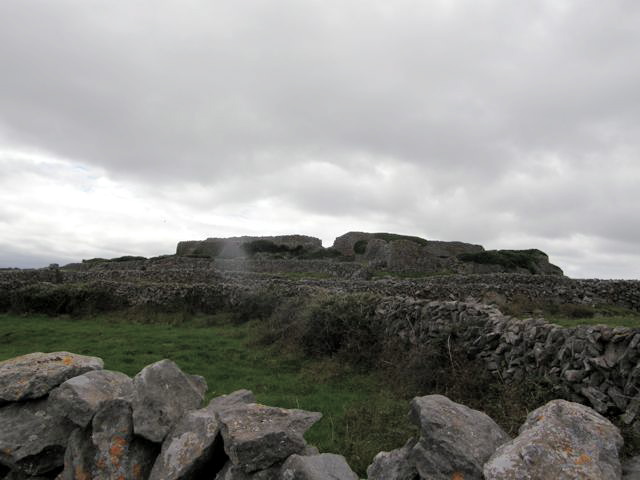
Dún Chonchúir, Inis Meáin, Exterior

Dún Chonchúir, Inis Meáin, Exterior

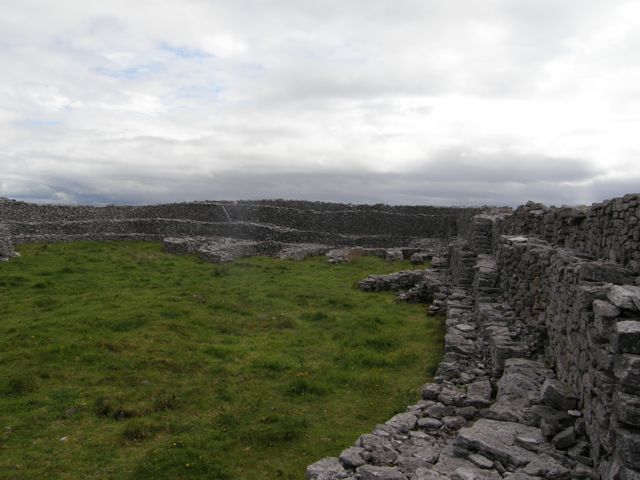
Dún Chonchúir, Inis Meáin, Interior

Dún Chonchúir, Inis Meáin, Interior

Notice that the names of these earlier structures include the term dún which means “fort” and was sometimes used to describe a castle. The later structures, the ring forts of the Burren, are named with the term “caher”, an Anglicized form of the Irish word cathair, which seems to have originally meant “a dwelling place” and in modern Irish means “city”. Both are terms for shelter and protection. St. Augustine used the image of a city as a metaphor for heaven in his treatise The City of God. In an earlier post, Translating Hymns (Part 3) (22 June 2011), I posted a hymn from Dánta Dé entitled An Dún Áluinn (“The Beauteous Fort”) in which the 13th Century Irish bard Donnchadh Mór O Dálaigh (who may also have been Abbot of Boyle Abbey) used the image of a dún as a metaphor for heaven. Both, of course, are drawing on the imagery of the Book of Revelation in which John of Patmos received a vision of heaven as a walled city: “And I John saw the holy city, New Jerusalem, coming down from God out of heaven, prepared as a bride adorned for her husband.” (Revelation 21:2)

John continues:

I heard a loud voice from the throne saying, “See, the home of God is among mortals. He will dwell with them; they will be his peoples, and God himself will be with them; he will wipe every tear from their eyes. Death will be no more; mourning and crying and pain will be no more, for the first things have passed away.” (Revelation 21:3-4)

Again, shelter and protection are the dominant themes, just as they were the purpose of the circular dúns and cathairs of Ireland.

Earlier this year Christian leaders in the United States, including the Presiding Bishop of my own tradition, the Episcopal Church, issued a statement entitled A Circle of Protection. In it, they remind our political leaders that “budgets are moral documents, and how we reduce future deficits are historic and defining moral choices.” As leaders of and spokespersons for the larger Christian community, they “urge Congress and the administration to give moral priority to programs that protect the life and dignity of poor and vulnerable people in these difficult times, our broken economy, and our wounded world.” The statement includes these key principles:

  1. The nation needs to substantially reduce future deficits, but not at the expense of hungry and poor people.
  2. Funding focused on reducing poverty should not be cut. It should be made as effective as possible, but not cut.
  3. We urge our leaders to protect and improve poverty-focused development and humanitarian assistance to promote a better, safer world.
  4. National leaders must review and consider tax revenues, military spending, and entitlements in the search for ways to share sacrifice and cut deficits.
  5. A fundamental task is to create jobs and spur economic growth. Decent jobs at decent wages are the best path out of poverty, and restoring growth is a powerful way to reduce deficits.
  6. The budget debate has a central moral dimension. Christians are asking how we protect “the least of these.” “What would Jesus cut?” “How do we share sacrifice?”
  7. As believers, we turn to God with prayer and fasting, to ask for guidance as our nation makes decisions about our priorities as a people.
  8. God continues to shower our nation and the world with blessings. As Christians, we are rooted in the love of God in Jesus Christ. Our task is to share these blessings with love and justice and with a special priority for those who are poor.

Among the morning hymns of Dánta Dé is a short prayer for shelter and protection. In the spirit of the Circle of Protection statement, I offer it here on behalf of the poor and hungry. It is set out below in the original Irish, in the translation by Úna ní Ógáin, and in my own translation:

Rí na naomh dár ndíon gach lae
Ar shaoigheadaibh daora an dhiabhail
Noch bhís go gear ar tí gach naoimh
De chlainn bhoicht Éabha riamh
Mo mhile lean-sa claoidhte faon
Faoi gach éiliomh dian,
Acht tríot-sa, a aon-mhic dhilis dé,
Go dtigeam-na saor ó phian

Ms. ní Ógáin’s translation:

The King of the saints be our shelter each day,
Against the dangerous darts of the devil,
Who is ever keenly pursuing each saint
Of the poor children of Eve
My thousand sorrows, worn, exhausted,
Because of each hard temptation;
But through Thee, o dear Only Son of God,
May we come safe from pain.

My own translation:

King of the saints, our shelter every day
Against the furious arrows of the devil
Who is [constantly] sharply pursuing each saint
Of the poor children of Eve
Our thousand sorrows, worn down, helpless
Because of each severe corruption
But through you, God’s only true Son,
May we come free of pain.

Just as the dúns and cathairs of ancient Ireland provided circles of protection for those who lived within them, the Christian community is to be a circle of protection. The difference between the church and the dúns and cathairs is that the circle of protection drawn by the Christian is to be inclusive of all, those without as well as those within. Archbishop William Temple, who was Archbishop of Canterbury during the Second World War, once wrote these words: “The Church is the only society that exists for the benefit of those who are not its members.” And I am reminded of the poem Outwitted by American poet Edwin Markham:

He drew a circle that shut me out —
Heretic, rebel, a thing to flout.
But Love and I had the wit to win:
We drew a circle that took him in.

Two Monastic Foundations (Co. Wicklow) – Part Two

While I was in County Wicklow (Contae Chill Mhantáin), as I have earlier reported, I visited two very different monastic ruin sites: Glendalough, where Naomh Caoimhín (St. Kevin) established a “monastic city” in the 6th Century, and Baltinglass Abbey, a Cistercian foundation established in 1148 by Dermot McMurrough, king of Leinster. The former is now a very large national park with an impressive visitors center and a four-star hotel; the latter is tucked away in a forgotten corner of the town of Batlinglass in the churchyard of a minor Church of Ireland parish behind a national school, with no accommodation for visitors as all.

St. Mary's - Baltinglass, Church of Ireland, on Whose Grounds the Abbey Is Located

St. Mary's - Baltinglass, Church of Ireland, on Whose Grounds the Abbey Is Located

This is the second part of a two-part entry; the first part was a description of my visit to Glendalough. This is a description of Baltinglass Abbey.

Baltinglass Abbey

Baltinglass Abbey

Baltinglass was the second house to be colonized from the Cistercian (also known as “Trappist”) stronghold at Mellifont Abbey. The first was Bective Abbey in Co. Meath founded in 1147.

Mellifont itself was founded in 1142. Known in Irish as An Mhainistir Mhór, literally “the big abbey”, it thrived for 400 years until it was disestablished in 1556. Thereafter, it was used as a Tudor manor house until it was finally abandoned in 1727. New Mellifont Abbey was founded in 1938 and is now an active Trappist monastery. It is located in County Louth, north of Dublin.

Baltinglass was a successful abbey and, in its turn, colonized other foundations, including the more famous Jerpoint Abbey in County Kilkenny in 1180.

Baltinglass Abbey

Baltinglass Abbey

The construction of the permanent buildings at Baltinglass began only a few years after the initial foundation and the church was raised relatively quickly. The buildings are typical of the Irish versions of the Cistercian Romanesque style.

One of the abbots built himself a “tower house” or castle in the late middle ages, and in 1541 it was reported that Baltinglass owned castles at Graungeforth, Knocwyre, Mochegraunge, Graungerosnalvan, Grangecon, and Littlegraunge among others.

Tower House within Baltinglass Abbey

Tower House within Baltinglass Abbey

In the early 16th Century the annual income of the abbey was estimated at £76 in time of war and £126 in peace time. These may not seem like large figures until one considers the comparative value of the pound in the early 16th Century. That pound (actually a monetary unit known as the Angel at the time) would have a current value of £4,910 (or $8,105). Thus, annually the war time income of Baltinglass Abbey would have been £373,000 (about $616,000); peace time income, £620,000 (about $1,023,000). This made Baltinglass one of the richest Cistercian abbeys in Ireland at the time.

Perhaps its financial success is the reason Baltinglass was one of the first five Irish Trappist monasteries suppressed in the first round of closures during Henry VIII’s Dissolution in 1536-37.

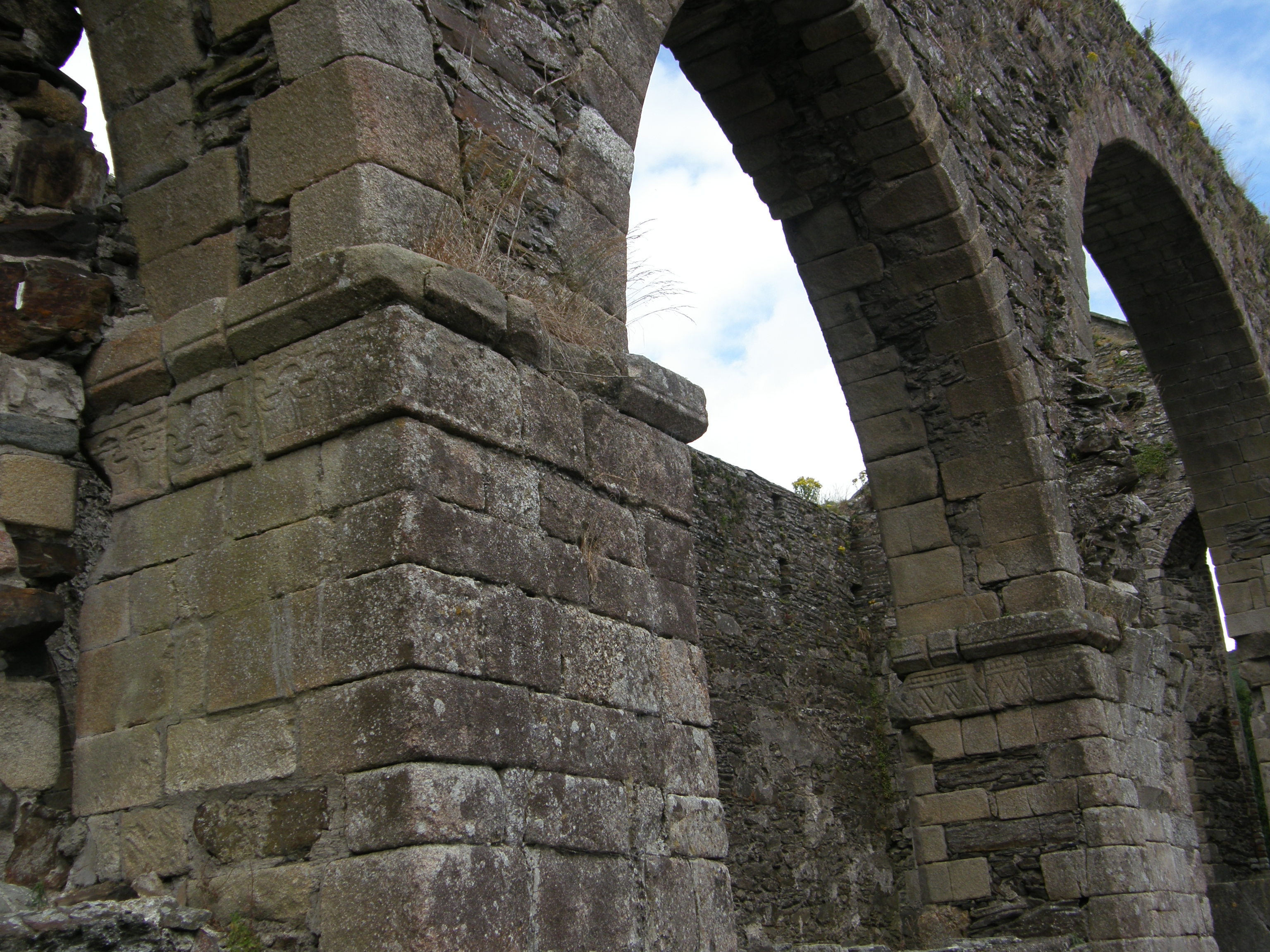
Although none of the conventual buildings survive, the abbey church remains relatively unscathed. The church is considered one of the finest examples of Romanesque architecture in Ireland. The church contains a rich array of carvings, including some with animals and human figures. The northeast crossing pier is decorated with a lion and foliage ornaments. The nave of the church is aisled with alternating cylindrical and square piers, which are of English origin, the bases of which are decorated with a range of unusual designs.

Romanesque Arches at Baltinglass Displaying Decorative Carving

Romanesque Arches at Baltinglass Displaying Decorative Carving

Nave Arches at Baltinglass, Note the Alternating Cylindrical & Square Piers

Nave Arches at Baltinglass, Note the Alternating Cylindrical & Square Piers

These were crafted by the so-called “Baltinglass Master” who subsequently worked on the abbey at Jerpoint. A series of tiles have also been discovered at the site; one design depicts a warrior thrusting forward with a circular shield.

Baltinglass Tile showing Ornate Celtic Knotwork

Baltinglass Tile showing Ornate Celtic Knotwork

Other features of interest are the bases of two Romanesque doorways in the nave aisle and the well-preserved sedilia in the presbytery.

The Sedilia (Inset Clergy Seating) at Baltinglass Abbey

The Sedilia (Inset Clergy Seating) at Baltinglass Abbey

An odd and very out-of-place addition to the site is a great pyramid style granite mausoleum, built in 1832 as a tomb for the Stratford family who were powerful estate owners in the area.

The Stratford Family Mausoleum

The Stratford Family Mausoleum

One wonders why, if a leading Irish architecture magazine (Archiseek) has declared that Baltinglass Abbey is “considered one of the finest examples of Romanesque architecture in Ireland,” this site is not better preserved and presented. I have some thoughts, not all of them complimentary to the Irish people or the Irish church….

First, I would note that Baltinglass Abbey was not an indigenous Irish foundation – it was Cistercian, an order from France. Glendalough, on the other hand, was founded by a beloved indigenous, early Celtic saint. Now this alone is not a reason for it to be so ignored in its little corner of Co. Wicklow. There are plenty of well-preserved and better presented Trappist foundations; Baltinglass’s daughter house, Jerpoint Abbey, is one example.

Second, I think it more important in this regard to not that Baltinglass is not held and administered by the Office of Public Works, Heritage Ireland, or another state agency as the better presented sites are. Rather, it is (as noted) on the grounds of a parish of the Church of Ireland. All of the historic church properties of Ireland after the reformation (especially after the dissolution of the monasteries) became the property of the established church – although this country was a part of the English Crown’s domain at the time, this was not the Church of England. Rather the Church of Ireland came into existence as a reformed church independent of the Roman Catholic Church in 1536 when the Irish Parliament declared Henry VIII to be the Supreme Head of the Church on earth (i.e. Head of the Church of Ireland); Henry actually became head of the Irish church before becoming king of the Irish nation! He was not declared King of Ireland until 1541. (Previously, his title, one granted English kings by the Pope, was Lord of Ireland. The declaration that he was King of Ireland was, therefore, part of the Anglo-Irish ecclesio-political reform.)

The Church of Ireland was disestablished by The Irish Church Act of 1896, which empowered the commissioners of the Church of Ireland to transfer all important churches and ecclesiastical buildings into the care of the Irish State, to be preserved as national monuments and not to be used as places of public worship. One hundred thirty-seven ancient buildings, apparently not including Baltinglass Abbey, were listed for transfer to the Commissioners of Public Works. The paramount consideration was the saving of the nation’s architectural heritage. Had Baltinglass Abbey been transferred to the Public Works department, there would be a better chance of it having a better presentation.

Why do I think this would be the case? Two reasons. First, the Church of Ireland is not a wealthy church by any stretch of the imagination. I believe it is incapable of properly funding the support of its aging buildings, especially those which are not in regular use. In my travels around this country, I have been distressed to see the poor state of repair of many Anglican churches. If I were asked (and I haven’t been, admittedly) I would recommend to the Church of Ireland that it undertake a program of building renewal and refurbishment, and in some cases of building divestment – including divesting itself of antiquities it cannot properly maintain.

Second, the Church of Ireland is a minority church; in 2006 (latest year for which I can find statistics) less than 3% of the people of the Irish Republic declared themselves members of the Anglican church here. Nearly 87% declared themselves Roman Catholic. The other ten percent are shared among other Christian traditions and other religious faiths, as well as a large group (more than half the size of the Church of Ireland) who state they are non-religious. Despite being a modern, secular state (although one with heavy involvement from the majority religious body, especially in the area of education), Ireland is a very divided culture.

I remember being in Donegal and asking about the whereabouts of members of the Funston family there or in neighboring counties. The very lovely and gracious lady with whom we were talking was from the village of Pettigo and recalled that there were Funstons living there, “but they weren’t our people,” by which she clearly meant they weren’t Roman Catholic. (As it turned out, the Funstons we did eventually meet were Anglicans.)

I believe this divide deprives Church of Ireland antiquity sites like Baltinglass Abbey of the broader publicity and support they might otherwise get. I was surprised to find that, although there is public signage to other places in the village of Blatinglass (including Roman Catholic churches), there is none indicating where one can find the Abbey! (Remember, this is a place “considered one of the finest examples of Romanesque architecture in Ireland”!) I had to stop at a petrol station to ask how to find it….

I may be wrong … but the difference in the treatment of these two monastic sites in the same county suggests to me that the Republic of Ireland still has a long way to come in the dealing with the divide between “Catholic” and “Protestant” (which Anglicans are here considered to be … and for now I won’t get into that debate).

Nonetheless, having visited both Glendalough and Baltinglass Abbey during my stay in County Wicklow, I give thanks to God for the witness of the men and women who lived and worked in such foundations. I offer in celebration of their faith the closing doxology of the Dánta Dé hymnal, first in Irish and then in translation:

Dennacht ocus étrochta,
Ecna, altugud buide,
A mórnert is comachta
‘Con Ríg comic na huile.

Glóir is cáta is caendúthracht,
Molad, airfitiud adbal,
Rográth ón uile chride
Do Ríg nime ocus talman.

Forsin Trínóid togaide
Ré cách, iar cách, do ellacht
Bennacht ocus bithbennacht,
Bithbennacht ocus bennacht.

And the English translation:

Blessing and radiance,
Wisdom and thanksgiving,
Great power and might,
Be to the King who rules over all.

Glory and honor and sweet-devotion,
Praise and wondrous music
Ardent love from every heart
To the King of heaven and earth.

To the exalted Trinity
Before all, after all, hath pertained
Blessing and eternal blessing,
Blessing-eternal and blessing.

A Word about Signs

Signs are ubiquitous – they are everywhere! Do you remember that old rock-and-roll song by the Five Man Electrical Band (and I do mean old, like 40 years old!)?

And the sign said “Long-haired freaky people need not apply”
So I tucked my hair up under my hat and I went in to ask him why
He said “You look like a fine upstanding young man, I think you’ll do”
So I took off my hat, I said “Imagine that. Huh! Me workin’ for you!”
Whoa-oh-oh

Sign, sign, everywhere a sign
Blockin’ out the scenery, breakin’ my mind
Do this, don’t do that, can’t you read the sign?

And the sign said “Anybody caught trespassin’ would be shot on sight”
So I jumped on the fence and yelled at the house,
“Hey! What gives you the right?
To put up a fence to keep me out or to keep mother nature in
If God was here, he’d tell you to your face, Man, you’re some kinda sinner”

Sign, sign, everywhere a sign
Blockin’ out the scenery, breakin’ my mind
Do this, don’t do that, can’t you read the sign?

Now, hey you, mister, can’t you read?
You’ve got to have a shirt and tie to get a seat
You can’t even watch, no you can’t eat
You ain’t supposed to be here
The sign said you got to have a membership card to get inside
Unh!

And the sign said, “Everybody welcome. Come in, kneel down and pray”
But when they passed around the plate at the end of it all,
I didn’t have a penny to pay
So I got me a pen and a paper
and I made up my own little sign.
I said, “Thank you, Lord, for thinkin’ ’bout me. I’m alive and doin’ fine.”
Wooo!

Sign, sign, everywhere a sign
Blockin’ out the scenery, breakin’ my mind
Do this, don’t do that, can’t you read the sign?

Sign, sign, everywhere a sign
Sign
Sign, sign

They are everywhere! There aren’t a lot of commercial advertising signs in the UK or in Ireland (well, there are a lot in Ireland, but they are mostly small and local). One of my favorites is this on one the local pier (Caladh Tadgh – “the stone pier”):

Sign at Caladh Tadhg, An Cheathrú Rua, Co. na Gaillimhe, Éire

Sign at Caladh Tadhg, An Cheathrú Rua, Co. na Gaillimhe, Éire

I actually have no idea at all what this sign is saying, but I love the wording of it and all the things it suggests to a strange mind like my own.

Here’s another sign one sees a lot of in this part of Ireland these days:

Irish Real Estate "For Sale" Sign

Irish Real Estate "For Sale" Sign

Le Diol is Irish for “For Sale.” If I had the money, I’d be very tempted to buy one of the properties where a sign like this is posted. (The one in this picture is a bed-and-breakfast property in An Cheathrú Rua. I wonder what it would be like to run a B&B….)

There is a sign one sees in the UK and here in Ireland that is similar to a sign we see along roads in the USA:

UK - Ireland Road Sign showing a Camera

UK - Ireland Road Sign showing a Camera

In the States, the sign that is sort of like this (in that it depicts a camera) generally indicates a scenic view-point from which one can take nice photographs. I first saw this sign in southern Scotland, but it never seemed to be at a place where there was anything to see or, if it was, there was never a convenient place to pull over and take a photograph. So I was puzzled by these signs. Since I couldn’t see any scenic view-point pullouts, I began to ignore them.

Then in Derbyshire, I saw the sign together with a sign warning of the presence of pedestrians:

Camera Sign together with Pedestrian Sign

Camera Sign together with Pedestrian Sign

So I was all the more confused. Surely, these signs must be pointing to something worth seeing, and I was missing these scenic views! But there were still no places to pull over where the signs were posted and I didn’t want to just stop in the road way!

Then, near the home of my friends in Penn, High Wycombe, I saw a sign with the same camera image but accompanied by explanatory words:

Speed Cameras Sign

Speed Cameras Sign

Oh! They aren’t signs about scenic views at all! They are signs warning speeding motorists that they are being photographed and their license plate numbers recorded!

Thank heaven I was driving at or below the speed limit (not always true at home, I admit) in the UK and continue to do so here in Ireland. (Of course, I’m of the opinion that anyone who exceeds the speed limit – or, in some places, even drives as fast as the limit – on these roads is completely nuts!)

The lesson of this sign is that we ignore signs, especially those we don’t really understand, at our own peril. That’s true spiritually as surely as it is in driving through a country not one’s own. Being unable to read a sign reminds me of an incident in Matthew’s Gospel:

The Pharisees and Sadducees came, and to test Jesus they asked him to show them a sign from heaven. He answered them, “When it is evening, you say, ‘It will be fair weather, for the sky is red.’ And in the morning, ‘It will be stormy today, for the sky is red and threatening.’ You know how to interpret the appearance of the sky, but you cannot interpret the signs of the times. An evil and adulterous generation asks for a sign, but no sign will be given to it except the sign of Jonah.” Then he left them and went away. (Matthew 16:1-4)

Matthew does not further explain “the sign of Jonah,” but Luke quotes Jesus as explaining the symbolism in his version of this story, “Just as Jonah became a sign to the people of Nineveh, so the Son of Man will be to this generation.” (Luke 11:30) Generally, the “sign of Jonah,” the witness of Jonah as prophet to the ancient Israelites is taken to mean that if Israel would not repent, God would take away the power and strength he had given them and give it to a another nation or people, and that nation would (in turn) humiliate and punish Israel.

So when we fail to appreciate, to understand and heed those signs that appear in our lives, we run the risk of losing that with which we have been entrusted. We run the risk of losing the ministry and the benefits we have been given, and find ourselves in need. We have all been given gifts, and we are expected to use them to the benefit of others; failing to do this, we run the risk of losing them. “From everyone to whom much has been given, much will be required; and from the one to whom much has been entrusted, even more will be demanded.” (Luke 12:48)

Pay attention to the signs in your life!

I’ve not been back to Caladh Tadhg since shooting that first photograph, but when I do I’ll be sure to disinfect!

Sunday, a Sermon, and Superstring Theory

Time away from the Irish (the language, not the people)….

On Sunday, 24 July 2011, I left my teach loistín (“boarding house”) and drove the 32 km from An Cheathrú Rua to Galway to attend the Sung Eucharist at the Collegiate Church of St. Nicholas, a church which formerly (pre-Reformation) was the central church of the city. That distinction is now held by the Roman Catholic Cathedral, “The Cathedral of Our Lady Assumed into Heaven and St. Nicholas”. (How the BVM was assumed into St. Nicholas, I have no idea….) But St. Nicholas Collegiate Church, now an Anglican congregation of the Church of Ireland, continues to play a central role in the life of the city. The church has marvelous acoustics and is host to a variety of concerts, dramas, conferences, and other cultural and educational events throughout the year.

Interior of St. Nicholas Collegiate Church, Galway

Interior of St. Nicholas Collegiate Church, Galway

It also plays the role of providing a place of worship for visiting tourists who do not wish to attend a Roman Catholic Mass. The Sunday morning congregation, especially during the summer, is an aggregation of Irish Anglicans, Protestants of several sorts (many of whom do not speak English), and tourists with little or no religious background at all (some of whom, I sure, wander in on Sunday morning to see the historic church and get “trapped” in the service). Such was the congregation this Sunday.

Interior of St. Nicholas Collegiate Church, Galway (from choir)

Interior of St. Nicholas Collegiate Church, Galway (from choir)

I arrived in Galway about one hour before the service, so I went to a local café and had a cup of coffee. Thirty minutes before the service, I made my way to the church and found a seat – not difficult as there were very few people there. A church warden introduced himself and offered me a leaflet which included nearly the entire service with an insert of the hymn lyrics. On learning that I am a priest, he asked if I would read one of the lessons for the day, to which I assented.

One of the transepts of the church has been closed off with a partial glass screen and made into the choir room. The choir was practicing and their music filled the church – it was grand! It put one into a prayerful mood and prepared one to enter into worship.

Transept, St. Nicholas Church, Galway (used as choir room)

Transept, St. Nicholas Church, Galway (used as choir room)

About 15 minutes before the service was to start, a woman priest vested for the day began greeting those of us seated in the nave. She was to be the presider in the absence of the rector, who is on holiday this month.

The service started on time with a procession of crucifer, choir, and clergy. Although lay eucharistic ministers would later assist with the distribution of communion, they were not vested and did not process with the altar party. The placement of choir, clergy and altar assistant was interesting and, given that everything is moveable (and moves frequently for various events), I wondered if this is a standard arrangement or if they experiment regularly with different seating plans.

The service followed a fairly familiar pattern, more similar to the American church’s liturgy than were the Church of England services I experienced a couple of weeks ago, although as in the English church, the service began with a confession and absolution before the Gloria in Excelsis. Then there were the reading of the lessons, a sermon, a variant form of the Creed (sort of a Q-&-A format), prayers, the Peace, the offertory, the Great Thanksgiving, the distribution of Holy Communion (at stations, a central position for the Bread from the priest and four cups of Wine), the final blessing, the last hymn and the dismissal. It all followed a familiar and comforting pattern.

Free-standing Altar, St. Nicholas Church, Galway

Free-standing Altar, St. Nicholas Church, Galway

The lessons for the day were those of the Revised Common Lectionary – from the Hebrew Scriptures the story of Solomon asking God for the gift of wisdom; from the Epistles Paul’s assurance in Romans that nothing can separate us from the love of God; from the Gospel’s Jesus rapid fire mini-parables that the Kingdom of God is like a mustard seed, a buried treasure, a pearl of great price, a net thrown into the sea.

Altar Window, St. Nicholas Church, Galway

Altar Window, St. Nicholas Church, Galway

The homily admonished us to do as Jesus did and look for God’s reign in the ordinary things, the ordinary places, the ordinary people of our lives. In the course of the homily, the preacher compared the structure of Jesus’ delivery of the parables to that of the Psalms referring to the Hebrew practice of parallelism as “the rhyming of ideas.” That description stuck with me.

Chancel and High Altar, St. Nicholas Church, Galway

Chancel and High Altar, St. Nicholas Church, Galway

Later in the day, I relaxed with a book, The Elegant Universe by Brian Greene. In it, describing the findings of quantum mechanics as an introduction to a discussion of superstring theory, the author writes:

Even in an empty region of space – inside an empty box, for example – the uncertainty principle says that the energy and momentum are uncertain: They fluctuate between extremes that get larger as the size of the box and the time scale over which it is examined get smaller and smaller. It’s as if the region of space inside the box is a compulsive “borrower” of energy and momentum, constantly extracting “loans” from the universe and subsequently “paying” them back. But what participates in these exchanges in, for instance, quiet empty region of space? Everything. Literally. Energy (and momentum as well) is the ultimate convertible currency. E=mc2 tells us that energy can be turned into matter and vice versa. Thus if an energy fluctuation is big enough it can momentarily cause, for instance, an electron and its antimatter companion the positron to erupt into existence, even if the region was initially empty! Since this energy must be quickly repaid, these particles will annihilate one another after an instant, relinquishing the energy borrowed in their creation. And the same is true for all other forms that energy and momentum can take – other particle eruptions and annihilations, wild electromagnetic-field oscillations, weak and strong force-field fluctuations – quantum-mechanical uncertainty tells us the universe is a teeming, chaotic, frenzied arena on microscopic scales.

As I read this I was reminded of the first words of Holy Scripture:

In the beginning when God created the heavens and the earth, the earth was a formless void and darkness covered the face of the deep, while a wind from God swept over the face of the waters. Then God said, “Let there be light”; and there was light. And God saw that the light was good; and God separated the light from the darkness. God called the light Day, and the darkness he called Night. And there was evening and there was morning, the first day.

Transfiguration Window, St. Nicholas Church, Galway

Transfiguration Window, St. Nicholas Church, Galway

People ask why I read books on particle physics, quantum mechanics, and string theory for relaxation. I really don’t have a good answer, and I have to admit that a lot of what I read, though it fascinates me, goes right over my head! But, for reasons which are probably beyond anyone’s comprehension, including my own, my idea of relaxing reading is exactly the sort of stuff that bored me to tears 40+ years ago – physics books. In the new understandings of quantum mechanics, superstring theory, the multiverse speculation, and other work seeking the “theory of everything” (or “TOE” as Greene and others call it), I see science converging with religion. As microscopic physics gets “weirder” (Greene’s term, again), it seems to me it gets more theological, as well. Every so often a passage strikes, if you will, a theological cord. This was one of them … the description of even empty space as “teeming, chaotic, frenzied” seems to me to echo, to “rhyme” (to use the preacher’s term) with the idea of the writer of Genesis that “a wind from God” (the Holy Spirit) sweeps over creation. Numerous theologians have taken off from this Genesis account to assert that the Holy Spirit “enthuses” all things; that the wind from God blows through and within all of creation … even empty space. How great it is that science’s new understanding of empty space as “teeming” and “frenzied” rhymes with faith’s vision of empty space as filled with God’s wind!

In Sunday’s sermon, the preacher reminded us to seek God in the everyday stuff of life. As scientists probe the “weirdness” of the smallest dimensions of everyday stuff, I think they’re doing just that … seeking God. They may be calling it the search for the TOE, but to from my perspective it’s just a variation of the same search human beings have been on for millennia, the search for meaning.

Baptismal Font, St. Nicholas Collegiate Church, Galway

Baptismal Font, St. Nicholas Collegiate Church, Galway

And now … back to the Irish.

St. Bartholomew’s Wilmslow – 13 July 2011

Let’s back up a few days and consider St. Bartholomew’s Church in the Parish of Wilmslow; it is one of two congregations in the Parish, the other being St. Anne’s Church. Though I visited both, I was able only to get photographs at the first.

A church has been on the site of St. Bartholomew’s building since 1264, but the current building was built in the early 16th Century; all that remains of the earlier structure is a crypt below the altar of the current church. The current building also incorporates a structure from the 1400s which now forms the base of the church’s bell tower. The building is made of local sandstone which the Parish’s guidebook acknowledges is “weather-blackened”; I rather think the black discoloration is more from industrial pollution than simply from the “weather”. Wilmslow is quite close to Manchester, center of the English Industrial Revolution, and has its own very large cotton mill which used coal-fired steam to power its spinning jennies and looms; coal smoke is most likely the cause of the blackening.

This photo was taken from the city park across the street. One enters the building through a porch to the viewer’s left; the altar and crypt are at the end to your right.

St. Bartholomew's, Wilmslow

St. Bartholomew's, Wilmslow

One enters the church grounds through the “lichgate”, although there are other entrances as well. I’m told that all funeral processions begin here, the officiant leading the pall bearers with the casket and the congregation following behind. According to the dictionary, a lichgate is “a roofed gate to a churchyard, formerly used as a temporary shelter for the bier during funerals.”

St. Bartholomew's, Wilmslow, Lichgate

St. Bartholomew's, Wilmslow, Lichgate

I visited the church on a Wednesday morning just a few minutes before the midweek Eucharist. I had limited time to take pictures and, with church people preparing prayerfully for worship, forebore using flash. As a result many of my interior pictures simply didn’t turn out.

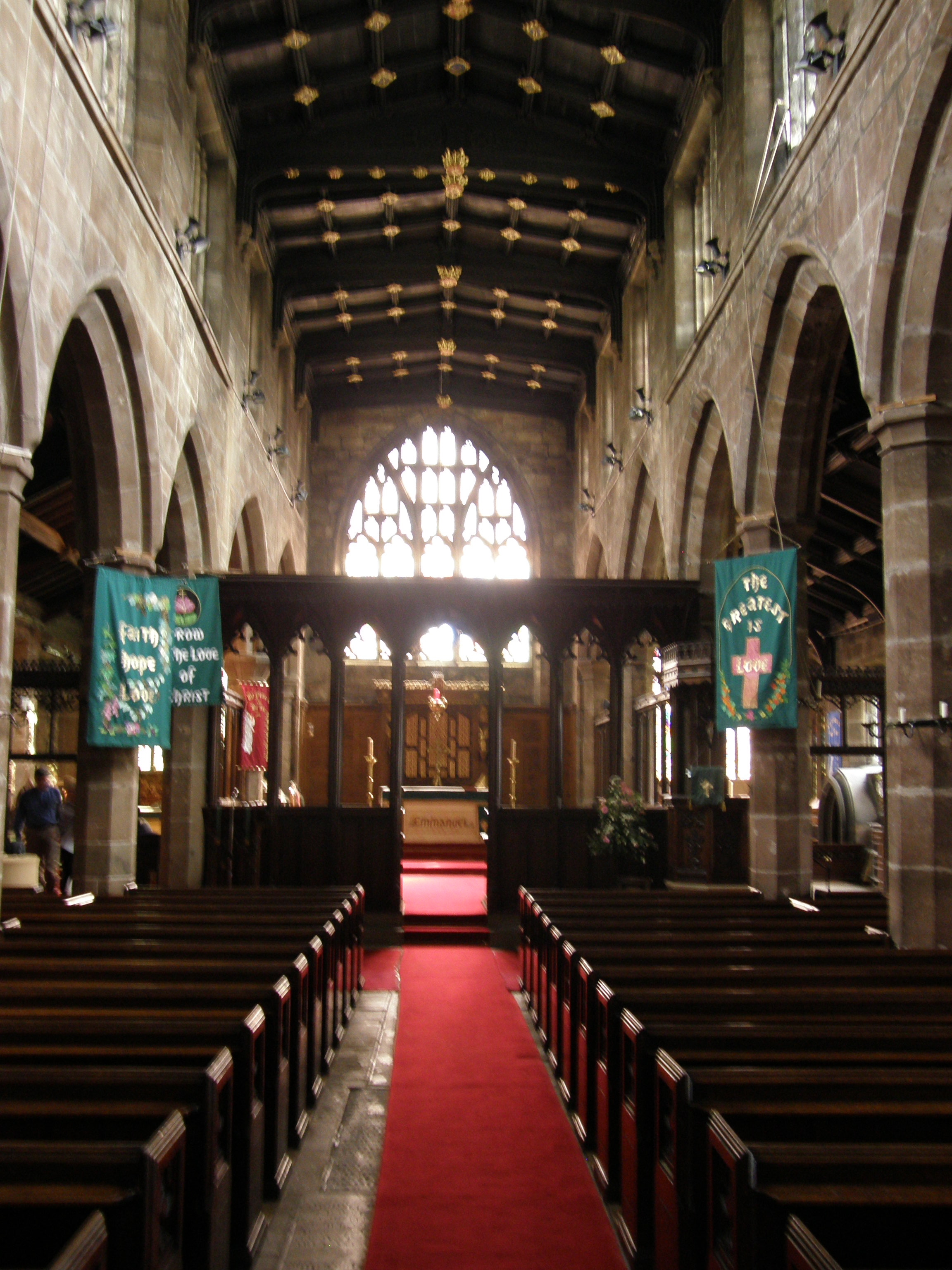
On entering the church one finds a very dark interior, typically English Gothic but with Victorian emmandations which, frankly, are a detraction! I apologize for the blurriness of this photo; given the dark lighting conditions, it was the best I could get. Notice in the ceiling a larger-than-usual golden boss (a blur really, sorry). I tried to get a picture of this, but none came out. Such bosses, whether stone or wood, usually depict stylized flowers or angels … this one is the Devil! According to the church’s history, “It is meant to show the Devil nailed in perpetuity to the roof and obliged to listen helplessly to the congregation insistently singing the praises of God.”

St. Bartholomew's, Wilmslow, interior

`St. Bartholomew's, Wilmslow, interior

Notice the screen separating the congregation from the choir and chancel; although part of this is an original 16th Century rood screen, it was incorporated into an 1865 restoration in which all the pews in the church were replaced by the current pews and this “vestry chapel” in the choir was installed. This provided “more dignified” seating and a place for the governing board to meat. The individual, upholstered seats are labeled with brass plaques inscribed in Latin for the various offices of the board.

St. Bartholomew's, Wilmslow, interior

St. Bartholomew's, Wilmslow, interior

The church council has tried get permission from the diocese and the historical preservation authorities to remove this chapel, moving the seats to exterior walls and the screen to the base of the bell tower in order to restore a more original appearance to the church; unfortunately, that permission has been denied. If the screen were moved to the bell tower, a floor could be built at the same height as its top on which the bell ringers could stand; as things are now, the bell ringers stand on the ground floor and thus block entrance through the main door which is in the bell tower.

In the bell tower is an engraved stone plaque bearing these words: “John, son of Robert and Penelope Hunt, was killed by the first bell on Sunday, August the 30th 1767.” Apparently, the 13-year-old boy was fatally injured when the treble or smallest of the six bells broke loose from its mounting and fell on him! Those six bells are still in use today.

I was able to take pictures of some of the stained glass windows and here are a few of those.

St. Bartholomew's, Wilmslow, interior

St. Bartholomew's, Wilmslow, interior

St. Bartholomew's, Wilmslow, interior

St. Bartholomew's, Wilmslow, interior

St. Bartholomew's, Wilmslow, interior

St. Bartholomew's, Wilmslow, interior

St. Bartholomew's, Wilmslow, interior

St. Bartholomew's, Wilmslow, interior

I was unable to film the crypt, which is a very small, cramped space below the altar. It is believed to date from the original 13th Century church. In more modern times it fell into disuse, was filled with rubble and forgotten. During repairs to the church in the 1970s, it was rediscovered. In 1979, the Lebanese Consul in Manchester, Christian Emile Fadil, paid for its restoration in memory of his late wife. Now a chapel, the altar there is made of Lebanese cedar and on the wall are three glass panels engraved with golden lettering reading, “Pease I give unto you” in English, Arabic, and Hebrew. It has become the custom of the church that, following the Saturday evening Easter Vigil service, the clergy of the parish and others who wish to join them keep the rest of the overnight vigil in this chapel until the festival service on Easter morning.

St. Bartholomew’s is a lovely church building which evidences the faith of generations, even centuries of Wilmslow’s residents. It shows how each generation alters the church building to meet its needs to make the structure a more suitable tool for the ministry appropriate to their circumstance. It is, I believe, unfortunate that those more interested in historic preservation than in living ministry are blocking the current congregations efforts to continue in that tradition. As I was discussing this situation with my friend who is on the congregation’s ministry team, I was reminded of Jaroslav Pelikan’s aphorism, “Tradition is the living faith of the dead; traditionalism is the dead faith of the living.”

« Older posts Newer posts »