From the Gospel according to Matthew:
Do not presume to say to yourselves, “We have Abraham as our ancestor”; for I tell you, God is able from these stones to raise up children to Abraham.
(From the Daily Office Lectionary – Matthew 3:9 (NRSV) – May 6, 2014.)
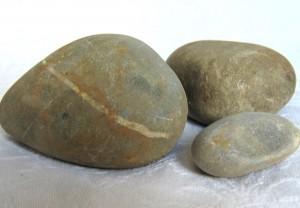 John the Baptizer is speaking to the Pharisees and the Sadducees, warning them against the very common human practice of relying upon the piety of our forebears instead of practicing our own faith. Relying on the religion of our ancestors is weakens and attenuates our own spirituality. One might as well be rocks lying by the roadside.
A few days ago, in what I consider a badly reasoned decision, Town of Greece v. Galloway, the U.S. Supreme Court upheld the practice of beginning secular legislative body meetings (in the particular case, a city council) with sectarian prayer. Justice Anthony M. Kennedy, writing for the majority, reasoned: “Legislative prayer has become part of our heritage and tradition, part of our expressive idiom, similar to the Pledge of Allegiance, inaugural prayer, or the recitation of ‘God save the United States and this honorable Court’ at the opening of this Court’s sessions.” He might as well have said, “We have Abraham as our ancestor.”
I’ve no problem with public prayer. I lead it on a pretty regular basis. I have a problem with prayer offered in a secular legislative body in a nation that is supposed to have a separation of church and state. The First Amendment to our Constitution includes two clauses which work that separation. One is known as “the establishment clause” and provides that government “shall make no law respecting an establishment of religion.” The other is called the “free exercise clause” and provides that government shall do nothing “prohibiting the free exercise” of religion.
A legislative body’s rule of procedure requiring prayer at the opening of its sessions violates at least the first of these clauses; it is a law establishing a religious practice. Arguably, it also violates the second clause although (as Kennedy and others have noted) no one is forced to participate in the prayer and, one supposes, could absent oneself from the session until the prayer was concluded.
My concern, in light of today’s reading from Matthew, is not with the Constitutional issue of public governmentally-sponsored prayer. Rather, it is with the notion that somehow the religiosity of our nation is dependent upon practices of government and the (mistaken) notion that our Founders (our equivalent of Abraham) intended this to be a “Christian nation.” This is the argument often made and now being repeated in innumerable online discussions of this ruling.
I can find no difference between “The Founders intended this to be a Christian nation” and “We have Abraham as our ancestor.” Both rely upon the supposed faith of long-dead forebears rather than the lively faith of living people. Any number of prayers may be recited at city council meetings or in state or national legislative chambers; unless and until the people of the nation begin actually living and practicing whatever religion they claim to hold — actually participating in religious events and, more importantly for Christians, feeding the hungry, clothing the naked, and housing the homeless — those prayers are no better than the protest of the Pharisees and Sadducees, “We have Abraham as our ancestor.”
This is especially true when Christian prayer opens a legislative session in which the legislators proceed to enact legislation which flies in the face of Jesus’ commands — when funds are stripped from feeding programs, when homelessness is made a crime, when public assets are diverted to the benefit of the rich at the expense of the poor. The prayer and the faith which it represents are rendered meaningless, with as little life as a pile of rocks.
There is a place for prayer, but it is not in the halls of government and it is not in the historic and attenuated traditions of long-dead forebears. It is in the hearts and lives of living persons acting out their faith. Relying on government-sponsored prayer is nothing more than claiming Abraham as our ancestor, nothing more than being dead stones.
====================
A request to my readers: I’m trying to build the readership of this blog and I’d very much appreciate your help in doing so. If you find something here that is of value, please share it with others. If you are on Facebook, “like” the posts on your page so others can see them. If you are following me on Twitter, please “retweet” the notices of these meditations. If you have a blog of your own, please include mine in your links (a favor I will gladly reciprocate). Many thanks!
====================
Father Funston is the rector of St. Paul’s Episcopal Church, Medina, Ohio.
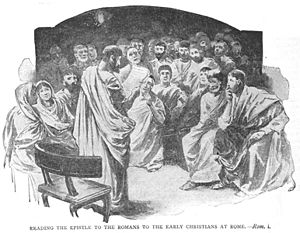 Apparently Moses didn’t learn anything from his experience at the battle with Amelek when he needed Aaron and Hur to hold up his hands, so his father-in-law Jethro has to remind him that he can’t do it all alone and that, if he tries to do so, he will wear himself out. Smart man, Jethro!
 At first blush, this just feels like another unbelievable story of religious ritual and “magic hands.” It fits neatly into the pattern of war stories one finds in the Torah that are attributed to the Deuteronomist. For that writer, the Hebrews’ victory in battle always depends not on military preparation, strength of arms, or fighting skill, but on ritual exactitude — perform a religious ritual properly and you win, flub it and you lose.
 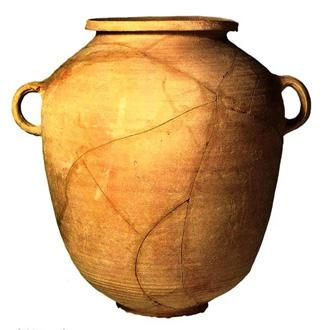 An ephah is a bushel, about 35 liters. Ten ephahs make a homer; a tenth of an ephah is an omer. (I’ll bet that was sometimes confusing.) So an omer is 3.5 liters, just a little bit shy of a gallon.
 Two days ago we celebrated the Feast of St. Mark the Evangelist and the Gospel lesson for use at the Eucharist was the opening of his Gospel which relates the story of Jesus’ baptism following which, Mark says, “the Spirit immediately drove him out into the wilderness,” (Mk 1:12) so the word “wilderness” caught my attention today.
 I am given to hyperbole. I know that. So, apparently, was David (the superscript to this psalm attributes it to David), as the first verse of today’s evening psalm amply demonstrates. I’ll bet he got into as much trouble (or maybe more) because of that as I get into!
 My mind really isn’t on the scriptures this morning . . . except this idea of being informed of something before it occurs, so that when it does occur, one will be ready to accept it.
 I think Jesus is being a little rough on Philip. Granted, Jesus has done everything possible during his ministry to make the Father known, to be transparent to those around him, to reveal as much of himself as he can. Still, it is possible to be with someone for years and still not know them.
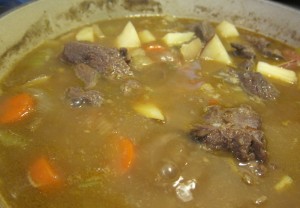 “Better the devil you know than the devil you don’t know,” was something my grandmother often said. Apparently she took after the ancient Israelites . . . but then don’t most people. We would rather stay in (or return to) a bad situation than face a possibly worse predicament. God know these people well — not too much farther down the road they will complain about their hunger and long for the pots of stew they enjoyed as slaves:
 Psalm 136 is twenty-six verses long. The second half of every single verse is the same: “For [God’s] steadfast love endures for ever.”

