Occasional thoughts of an Anglican Episcopal priest

Category: Anglican (Page 53 of 115)

Memorial Day at Church – Sermon for the Sixth Sunday of Easter (May 26, 2014)

====================

On the Sixth Sunday of Easter, May 25, 2014, this sermon was offered to the people of St. Paul’s Episcopal Church, Medina, Ohio, where Fr. Funston is rector.

(The lessons for the day were: Acts 17:22-31; Psalm 66:7-18; 1 Peter 3:13-22; and John 14:15-21. These lessons can be read at The Lectionary Page.)

====================

Memorial Day Cemetery FlagsI’m going to do something I have never done before! I’m going to read someone else’s sermon. While I was pondering these lessons, doing the usual research, and thinking about what to say, I came upon a superb sermon preached on Memorial Day weekend three years ago when, as today, the lesson from Acts was the story of St. Paul preaching at the Areopagus. The preacher was the Rev. Kurt Wiesner who is the rector of All Saints Episcopal Church in Littleton, New Hampshire, and whom many of us remember from his tenure as curate at our own Trinity Cathedral. This is what Kurt had to say and I earnestly commend his thoughts to you:

[The sermon as originally posted on the internet can be found on Fr. Wiesner’s blog One Step Closer: Religion & Popular Culture.]

Memorial Day in Church — (A sermon preached Sunday of Memorial Day Weekend, 5/29/2011)

Contrary to the assumptions of many, Memorial Day is not officially a celebration of the church. Unlike Independence Day and Thanksgiving Day (both which I have talked about in the past), it is not on our church calendar, and there is no prayer in our Prayerbook to mark this day. It did not come from the church, nor was it formally adopted by it.

Robert Bellah writes that sociologists have suggested that America has a secular “civil religion” –- one with no association with any religious denomination or viewpoint –- that has incorporated Memorial Day as a sacred event. Our American tradition includes an obligation to honor the sacrifices made by our nation to earn our freedom. With the Civil War, a new theme of death, sacrifice and rebirth enters the civil religion. Memorial Day gave ritual expression to these themes, integrating the local community into a sense of nationalism. The American civil religion in contrast to that of France was never anticlerical or militantly secular; in contrast to Britain it was not tied to a specific denomination like the Church of England. Instead, Americans borrowed selectively from different religious traditions in such a way that the average American saw no conflict between the two, thus mobilizing deep levels of personal motivation for the attainment of national goals. (Civil Religion in America, by Robert Bellah, 1967. Used by Wikipedia)

This cannot completely explain why the church has not officially adopted Memorial Day: after all, the church has taken and adapted plenty of public events and celebrations in the past. Perhaps it’s only a matter of time. Then again, one could argue that every day is a Memorial Day in the church.
Regardless, this morning I want to share with you some Memorial Day history, which comes mostly from the Wikipedia Memorial Day entry:

Our tradition of Memorial Day comes from the time after the Civil War, honoring the soldiers who had died by decorating their graves with flags or flowers. By 1865 the practice of decorating soldiers’ graves had become widespread in the North. The first known observance was in Boalsburg, Pennsylvania, on October, 1864, and each year thereafter. Similar events followed around the northern states on various scales.

In Charleston, South Carolina, in 1865, freed enslaved Africans celebrated at the Washington Race Course, today the location of Hampton Park. The site had been used as a temporary Confederate prison camp for captured Union soldiers in 1865, as well as a mass grave for Union soldiers who died there. Immediately after the cessation of hostilities, freedmen exhumed the bodies from the mass grave and reinterred them in individual graves. They built a fence around the graveyard with an entry arch and declared it a Union graveyard. On May 1, 1865, a crowd of up to ten thousand, mainly black residents, including 2800 children, proceeded to the location for events that included sermons, singing, and a picnic on the ground.

Beginning in 1866 the southern states had their own Memorial Days. The earliest Confederate Memorial Day celebrations were simple, somber occasions for veterans and their families to honor the day and attend to local cemeteries.

General John A. Logan may be most responsible for growth of a particular holiday. On May 5, 1868, in his capacity as commander-in-chief of the Grand Army of the Republic -– the organization for Northern Civil War veterans -– Logan issued a proclamation that “Decoration Day” should be observed nationwide. It was observed for the first time on May 30 of the same year; the date was chosen because it was not the anniversary of a battle.

There were events in 183 cemeteries in 27 states in 1868, and 336 in 1869. The northern states quickly adopted the holiday; Michigan made “Decoration Day” an official state holiday in 1871 and by 1890 every northern state followed suit. The ceremonies were sponsored by the Women’s Relief Corps, which had 100,000 members.

The Decoration Day speech became an occasion for veterans, politicians and ministers to commemorate the war -– and at first to recall the atrocities of the enemy. They mixed religion and celebratory nationalism and provided a means for the people to make sense of their history in terms of sacrifice for a better nation, one closer to their God. People of all religious beliefs joined together, and the point was often made that the German and Irish soldiers had become true Americans in the “baptism of blood” on the battlefield.

By the end of the 1870s the rancor was gone and the speeches praised the soldiers of both the Union and Confederacy. In 1882, the name of Decoration Day was formally changed to Memorial Day in “memory” and ‘honor” of those who gave their lives fighting for a common cause, America.

This name, however, did not become more common until after World War II and was not declared the official name by Federal law until 1967.

Many Americans observe Memorial Day by visiting cemeteries and memorials. A national moment of remembrance takes place at 3 p.m. local time. Another tradition is to fly the flag of the United States at half-staff from dawn until noon local time. The half-staff position remembers the more than one million men and women who gave their lives in service of their country. At noon their memory is raised by the living, who resolve not to let their sacrifice be in vain, but to rise up in their stead and continue the fight for liberty and justice for all. The National Memorial Day Concert takes place on the west lawn of the United States Capitol the Sunday before Memorial Day. The concert is broadcast on PBS and NPR. Music is performed, and respect is paid to the men and women who died in war.

There have, however, been a number of the historical problems concerning Memorial Day. Many of the celebrations have included a demonization of whatever is the perceived other side: not just concerning the Civil War, but the world conflicts that have followed. Certain ideologies have upended Memorial Day at different times. Continuing from Wikipedia:

In many southern locations in the 1890s from the consolatory emphasis of honoring soldiers to public commemoration of the Confederate “Lost Cause”. Changes in the ceremony’s hymns and speeches reflect an evolution of the ritual into a symbol of cultural renewal and conservatism in the South.
By the 1950s, the theme of Memorial Day had become more geared towards American exceptionalism and understood duty to uphold freedom in the world.

There have also been challenges beyond nationalism. The tradition has become permanently linked to sporting events. One of the longest-standing traditions is the running of the Indianapolis 500, the auto race has been held in conjunction with Memorial Day since 1911, run on the Sunday preceding the Memorial Day holiday. The Coca-Cola 600 stock car race has been held later the same day since 1961. The Memorial Tournament golf event has been held on or close to the Memorial Day weekend since 1976.

On June 28, 1968, the Congress passed the Uniform Holidays Bill which moved three holidays from their traditional dates to a specified Monday in order to create a convenient three-day weekend. The holidays included Washington’s Birthday, Veterans Day, and Memorial Day. The change moved Memorial Day from its traditional May 30 date to the last Monday in May. The law took effect at the federal level in 1971. This change is still controversial. The VFW stated in a 2002 Memorial Day Address:

Changing the date merely to create three-day weekends has undermined the very meaning of the day. No doubt, this has contributed a lot to the general public’s nonchalant observance of Memorial Day. (David Mechant, April 28, 2007, “Memorial Day History”, in the Wikipedia entry)

While the actual significance of the original date is debatable, it is pretty clear that Memorial Day Weekend’s role as the unofficial start of summer has come to dominate the observance. And I don’t think it’s a stretch to say that, in the vocabulary of many, the phrase “Memorial Day” include the word “sale.”

As I said at the beginning, Memorial Day is not officially a day marked by the Episcopal Church. Certainly remembering those who have given their lives in service is appropriate for church communities to do, and explains why plenty of individual churches celebrate the day.

Perhaps some of what the church has to offer Memorial Day can be found in Paul’s insightful preaching in the Book of Acts this morning (Acts 17:22-31). Paul observes the many religious practices of the Athenians. He does not spend it time condemning what is wrong with their practice. Instead, he lifts up the Athenians pursuit of religious understanding, and building on their creativity and passion, preaches about God “…in whom we live and move and have our being”. (Acts 17:28)

Perhaps it is the role of the church to not only help remember what is good in Memorial Day … honoring those who died in service to their country … but to also lift up the day as something more: articulating a vision of a world that so values peoples’ lives as dwelling in God, that violence towards others becomes unacceptable.

Perhaps this is why I find the [hymn from the United Methodist Hymnal], A Song of Peace, so appropriate:

This is my song, O God of all the nations,
A song of peace for lands afar and mine;
This is my home, the country where my heart is;
Here are my hopes, my dreams, my holy shrine:
But other hearts in other lands are beating
With hopes and dreams as true and high as mine.

My country’s skies are bluer than the ocean,
And sunlight beams on clover leaf and pine;
But other lands have sunlight too, and clover,
And skies are everywhere as blue as mine;
O, hear my song, Thou God of all the nations,
A song of peace for their land and for mine.

This is my song, O God of all the nations,
A song of peace for (people) in every place;
And yet I pray for my beloved country
The reassurance of continued grace:
Lord, help us find our oneness in the Savior,
In spite of differences of age and race.
[From the United Methodist Hymnal (Stanzas 1 & 2 by Lloyd Stone, Stanza 3 by Georgia Harkness)]

========================

That is Kurt’s sermon…. to which I want to add just a brief postscript, beginning with a personal story:

From 1972 to 1974, I was the youth minister at St. Peter’s Episcopal Church in Del Mar, California, where Fr. Tally Jarrett, a former military chaplain who had served in Germany, was the rector. Fr. Tally had absolutely no musical talent or skill, and seldom used hymns in his sermons, so (unlike me) he did not select the hymns for worship; he left that up to the Choir Director. (I select the hymns, but I leave the selection of preludes, postludes, voluntaries, and anthems up to Bertie.)

One Sunday we had a guest preacher, the local Reformed Jewish rabbi, and I was on the schedule as the chalice bearer for the service. As we lined up in the back of the church for the procession, the organist struck the opening notes of the first hymn, Glorious Things of Thee Are Spoken. The words were written by John Newman, the same man who wrote Amazing Grace, but the hymn is set to the tune Austria by Franz Joseph Haydn. That tune is also the music for Das Lied der Deutschen, the German national anthem. Fr. Tally heard that tune start up, looked at the rabbi, and turned beet red with embarrassment; the rabbi just laughed and said, “Don’t worry about it! It’s a lovely tune.”

Thursday evening I was here in the church and heard the choir practicing their anthem . . . which turns out to be a choral arrangement of that hymn. I chuckled remembering that Sunday morning back in Del Mar and it occurred to me how similar to that event the singing of that tune, the melody of the national anthem of our sworn World War II enemy, on Memorial Day is. Some of us who fought against Germany in WW2 ourselves or whose fathers fought in that theatre, as did mine, might find it odd to do so. I find it particularly appropriate; a reminder that we have gotten past that conflict and that our former enemy is now our ally.

I would ask you to pay particular attention to the final verse that the choir will sing:

Savior, since of Zion’s city
I through grace a member am,
Let the world deride or pity,
I will glory in your name.
Fading are the worldlings’ pleasures
All their boasted pomp and show;
Solid joys and lasting treasures
None but Zion’s children know.

This, as Fr. Wiesner suggested, is what the church can lift up and articulate on Memorial Day, a “vision of a world that so values peoples’ lives as dwelling in God, that violence towards others becomes unacceptable,” a vision of a world in which all can enjoy the “solid joys and lasting treasures” of peace and good will.

Let us pray:

O Judge of the nations, we remember before you with grateful hearts the men and women of our country who in the day of decision ventured much for the liberties we now enjoy. Grant that we may not rest until all the people of this and every land share the benefits of true freedom and gladly accept its disciplines. This we ask in the Name of Jesus Christ our Lord. Amen.

====================

A request to my readers: I’m trying to build the readership of this blog and I’d very much appreciate your help in doing so. If you find something here that is of value, please share it with others. If you are on Facebook, “like” the posts on your page so others can see them. If you are following me on Twitter, please “retweet” the notices of these meditations. If you have a blog of your own, please include mine in your links (a favor I will gladly reciprocate). Many thanks!

====================

Father Funston is the rector of St. Paul’s Episcopal Church, Medina, Ohio.
Doing Something – From the Daily Office – May 24, 2014

From Matthew’s Gospel:

Jesus said, “Not everyone who says to me, ‘Lord, Lord’, will enter the kingdom of heaven, but only one who does the will of my Father in heaven.”

(From the Daily Office Lectionary – Matthew 7:21 (NRSV) – May 24, 2014)

Jesus Said What?I love this verse! I always think of it as Jesus’ version of “Don’t just stand there. Do something!”
If I could point to one bit of Holy Scripture that convinced me to become an Episcopalian, it would be this one. The King James Version’s rendition was the favorite offertory sentence of the Episcopal chaplain at the military academy where I went to high school and attended Evening Prayer or the Holy Eucharist everyday. I can still recite that version from memory: “Not every one that saith unto me, Lord, Lord, shall enter into the kingdom of heaven; but he that doeth the will of my Father which is in heaven.”

My childhood was largely an unchurched one. My earliest memories of going to church were in a Baptist congregation which eventually we ceased attending when the pastor declined to bury my non-church-member father (whose hard-drinking, Las-Vegas-Strip lifestyle he found objectionable); no more churchgoing after that. Summers were spent with my paternal grandparents who insisted that I go with them to an old-timey, very evangelical Methodist Church. The message at both those churches, so far as understood (and now remembered) by a grade school kid, was that all you needed to do to be “saved” was to claim Jesus as Lord and talk about him a lot. I never heard anything like this verse from Matthew and, by the time I was in junior high and no longer going to church with my grandparents, the talking-about-Jesus thing had worn a bit thin.

The liturgical worship of the Episcopal Church (back then, the 1928 Book of Common Prayer) resonated with me. I do have to admit that the first few weeks of attending daily chapel I was less aware of the words than of the rhythm of worship because I was getting used to the “Episcopal juggle” — when to use the prayer book, when to use the hymnal, when to use the service sheet or “bulletin” — and Episcopal calisthenics — when do I kneel? when do I stand? do I ever get to just sit still? But eventually the words started making an impact and the words of the chaplain’s favorite offertory sentence — “Not every one that saith unto me, Lord, Lord, shall enter into the kingdom of heaven; but he that doeth the will of my Father which is in heaven” — made a particular impact.

In addition to learning about the liturgy of the Episcopal Church, I was learning about the culture of the Episcopal Church. It was the 1960s. John Hines was Presiding Bishop; he was contributing to the Angela Davis Defense Fund! Episcopalians were marching with Martin Luther King, Jr. One of them, a seminarian named Jonathan Myrick Daniels, was shot and killed by a deputy sheriff in Alabama when Daniels moved to protect a 17-year-old black girl. (Daniels is now recognized as a martyr on the church’s sanctoral calendar.) Some Episcopalians were active in protesting the Vietnam War, while other Episcopalians served as chaplains in the military and were stationed in Vietnam — but both respected the other, worshipped together, and worked out their differences, whatever they may have been, through the church’s conciliar governance at diocesan and national (general) conventions.

I was captivated by the culture of the 1960s Episcopal Church. These weren’t people who simply claimed Jesus as Lord and talked about him a lot; these people did things! I joined, and as I got more active I found out Episcopalians did “smaller,” less noticed things — things like feeding the hungry, providing shelter for the homeless, opening their churches for free community concerts, tutoring kids struggling in school, teaching English to refugees from other countries — the list of things Episcopalians do, things I hadn’t seen in my parents’ and grandparents’ churches (although now I’m pretty sure they did at least a few of them; I hope they did), is long, almost endless.

It is my joy to be rector of a parish with an active food pantry ministry, a parish which opens its space each month for a free concert, a parish whose youth sleep outside in all sorts of whether to call attention to the plight of those without homes, a parish where youth and adults travel somewhere together every summer to build or repair the homes of those unable to do it themselves, a parish which doesn’t just call Jesus “Lord” but which actively does the things he told us were his Father’s will.

There are many, many reasons I became, and stay, an Episcopalian. An important one is that Episcopalians don’t just stand there — they do something!

====================

A request to my readers: I’m trying to build the readership of this blog and I’d very much appreciate your help in doing so. If you find something here that is of value, please share it with others. If you are on Facebook, “like” the posts on your page so others can see them. If you are following me on Twitter, please “retweet” the notices of these meditations. If you have a blog of your own, please include mine in your links (a favor I will gladly reciprocate). Many thanks!

====================

Father Funston is the rector of St. Paul’s Episcopal Church, Medina, Ohio.

I’m Done with the Cassock-Alb – From the Daily Office – May 22, 2014

From Gospel according to Matthew:

Why do you worry about clothing? Consider the lilies of the field, how they grow; they neither toil nor spin, yet I tell you, even Solomon in all his glory was not clothed like one of these. * * * Do not worry, saying . . . “What will we wear?”

(From the Daily Office Lectionary – Matthew 6:28-29,31 (NRSV) – May 22, 2014)

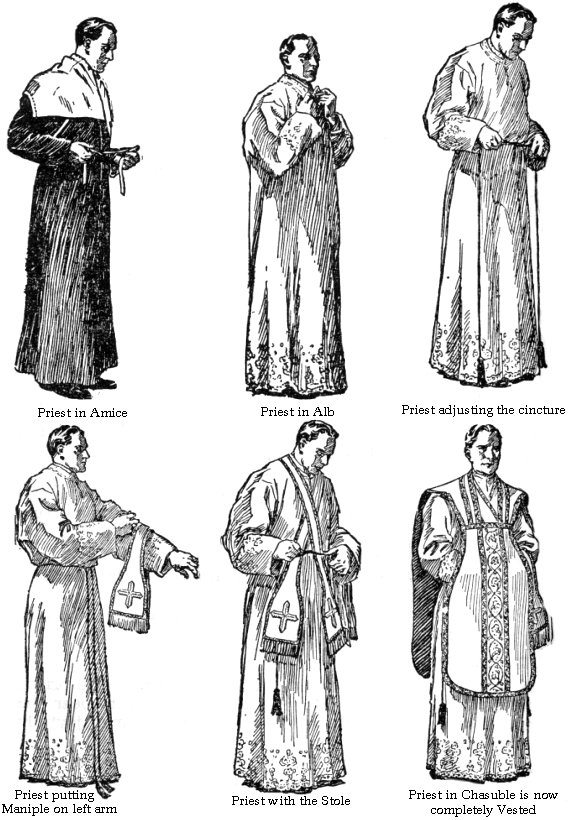
Priest Vesting for Mass“In essentials unity, in non-essentials liberty, in all things charity.” This aphorism has been variously attributed to St. Augustine of Hippo, to Menno Simons the spiritual father of the Mennonites and the Amish, to Richard Baxter of the Moravians, and various others.

To the best of my knowledge, it has never been attributed to an Anglican or an Episcopalian. And with good reason! Witness a current dust-up over the cassock-alb.

Yesterday, a colleague and fellow ecclesiastical blogger posted a humorous but serious entry entitled Cassock Albs Are Destroying the Church. Cassock-albs are a modern bit of liturgical vesture which combine the virtues of two medieval garments (the cassock and the alb) and permit the abandonment of a third (the amice), which is rendered unnecessary. They have become ubiquitous since their introduction several decades ago; nearly every church supply company offers one or more versions of the garment. They are what I wear and what our altar servers and liturgical assistants wear, as well.

My colleague’s opinion piece argues that the cassock-alb symbolizes sloppiness, laziness, haste, and lack of care in preparation for worship; calling it “the strip mall of vestments,” he decried the cassock-alb as “an innovation for the sake of comfort that too much resembles other short-cuts we might take in our spiritual and devotional life.” His Facebook notice of this essay resulted in a slurry of posts either agreeing with him (most did since he seems to be followed mostly by a high church Anglo-Catholic crowd many of whom cherish many things about the ritual of an earlier era in the church) or arguing the merits of the cassock-alb (not many modernists, however).

I considered writing a humorous point-by-point rebuttal, but decided not to for a variety of reasons including lack of time and my conviction that debating things like vestments is one of the shortcomings of our tradition. As I have often said, we Anglicans and Episcopalians get our knickers in a twist over really very silly things; there was a time when members of this church excommunicated each other because one or the other either put candles on the altar or didn’t. (In the 1800s, at least one bishop-elect — James DeKoven — failed to receive sufficient canonical consents because of his support of candles and other elements of catholic ritual in the celebration of Holy Communion.)

In the past four decades we have fought about the rather more serious issues of prayer book revision, ordination of women, and the full inclusion of homosexual and transgendered persons, but we have also wrangled over such ridiculous issues as which direction clergy should face while leading worship, whether communicants should stand or kneel, and what position a person’s hands should be in while at prayer. It occurred to me that if anything is “destroying the church,” it is our inability to agree to disagree, to treat as irrelevant and unworthy of debate those minor things on which we differ and concentrate on those matters central to the faith on which we agree. So, I decided not to write in the cassock-alb’s defense.

Indeed, even though I posted a comment or two on my colleague’s Facebook entry, I simultaneously thought what that string of remarks about the merits or demerits of a bit of priestly vesture would look like to a non-church member. If I were a non-Christian (or even a non-Episcopalian) happening upon that conversation (and I’m sure each of the participants has non-Christian friends who might have taken a look at it; I know I do), I would have shaken my head in disbelief at the pettiness of it. If this is what Episcopalians consider important enough to argue about vehemently, I would want nothing to do with those people! So I determined to add nothing further to the evidence that Episcopalians fail to allow liberty in non-essentials and certainly do not practice charity in all things (especially not in regard to vestments and ritual).

Then I came upon today’s Daily Office gospel lesson and I am encouraged to say at least one more thing about the cassock-alb debate. In this lesson from Matthew, Jesus tells his followers, “Do not worry about your life, what you will eat or what you will drink, or about your body, what you will wear.” (Mt 6:25) Jesus goes on to assure his hearers that God will provide. I’m not convinced, however, that Jesus is referring simply to concern about food and clothing, in general. Certainly, I don’t believe that he is telling them to do nothing about taking care of their own health and well-being; on several occasions he advised his disciples to attend to preparations, to be alert, to take care of that which God has entrusted to them, so this is not a man to instruct people to abandon common sense self-care! What I think he is referring to are the ritual concerns about food and clothing in the Law of Moses, rituals that had become overly important in the teachings of the Pharisees, for example.

Most non-Jewish people are aware of kosher restrictions on diet which derive from the Torah: not to eat pork or shellfish, not to eat red meat with dairy, and so forth. Many may not be aware that there are ritual rules regarding clothing, as well. For example, “You shall not wear clothes made of wool and linen woven together.” (Dt 22:11) Some of these rules came to be applied specifically to ritual clothing, the tallit (prayer shawl), for example: “Speak to the Israelites, and tell them to make fringes on the corners of their garments throughout their generations and to put a blue cord on the fringe at each corner.” (Num 15:38)

I believe it is overweening concern for these ritual niceties of food and clothing that Jesus is criticizing in his admonition not to worry about what one will eat or what one will wear. Sometime later, Jesus did so explicitly, condemning the scribes and Pharisees because “they do all their deeds to be seen by others; for they make their phylacteries broad and their fringes long.” (Mt 23:5) Cassocks, albs, amices, surplices, and cassock-albs are the tallits, the phylactories, and the fringes of our tradition. Our concerns about them are very much the same as the Pharisees’ concerns, and I suspect that Jesus is just about as impressed with our vestment debates as he was with theirs.

So I’m done with the cassock-alb. I’m still going to wear them and provide them for my liturgical staff and volunteers; I believe they are a perfectly acceptable modern alternative to medieval garments that are no longer convenient, meaningful, or necessary. But I’m done debating about it, and about whether and when to wear eucharistic vestments versus choir garb, whether and when to kneel, whether and when to raise one’s hands, whether and when to use candles, and all the rest of that.

It is not the cassock-alb that is destroying the church! It is public disagreement over vesture and other equally silly things that is doing so. Let’s stop it, shall we?

(By the way, the aphorism about unity, liberty, and charity most likely was first penned by Rupertus Meldenius, a 17th Century Lutheran, during the Thirty Years War.)

====================

A request to my readers: I’m trying to build the readership of this blog and I’d very much appreciate your help in doing so. If you find something here that is of value, please share it with others. If you are on Facebook, “like” the posts on your page so others can see them. If you are following me on Twitter, please “retweet” the notices of these meditations. If you have a blog of your own, please include mine in your links (a favor I will gladly reciprocate). Many thanks!

====================

Father Funston is the rector of St. Paul’s Episcopal Church, Medina, Ohio.

The Scapegoat – From the Daily Office – May 20, 2014

From Book of Leviticus:

When he has finished atoning for the holy place and the tent of meeting and the altar, he shall present the live goat. Then Aaron shall lay both his hands on the head of the live goat, and confess over it all the iniquities of the people of Israel, and all their transgressions, all their sins, putting them on the head of the goat, and sending it away into the wilderness by means of someone designated for the task. The goat shall bear on itself all their iniquities to a barren region; and the goat shall be set free in the wilderness.

(From the Daily Office Lectionary – Leviticus 16:20-22 (NRSV) – May 20, 2014)

ScapegoatThe scapegoat! One of the little-known but very often mentioned figures of the Old Testament is the scapegoat. If I were a betting man, I would bet that very few people actually know the origin of this term that nearly everyone has used at some time or another. Well, here it is in Israel’s ancient ritual of atonement.

The scapegoat is one of two that Aaron has taken from the flock for the atonement ritual. Part of yesterday’s Old Testament reading explained how he was to make the choice between the two:

He shall take the two goats and set them before the Lord at the entrance of the tent of meeting; and Aaron shall cast lots on the two goats, one lot for the Lord and the other lot for Azazel. Aaron shall present the goat on which the lot fell for the Lord, and offer it as a sin-offering; but the goat on which the lot fell for Azazel shall be presented alive before the Lord to make atonement over it, so that it may be sent away into the wilderness to Azazel. (Lev 16:7-10)

Who or what “Azazel” may be, or even what the word means, is a matter of debate and has been for centuries. Azazel is identified in the Talmud as a demon, and this understanding repeated in the pseudepigraphic apocalypse, the Book of Enoch. (Some elements of the recent Russell Crowe movie Noah, particularly “the Watchers” who assist Noah, were taken from this book.) But some scholars of the Hebrew language suggest that, instead, the word is an emphatic form of an ancient root, azel, which is believed to mean “to remove.” It may be what is called a “reduplicative intensive” meaning not merely “to remove,” but “to remove completely.”

If the goat is sent off into the desert to be eaten by a demon, that’s one thing. That means the innocent scapegoat, although set free, dies because of someone else’s wrong doing. But if there is no demon, if the goat is just set free “to remove completely” another’s fault, what does that mean? It occurs to me that (if there’s no demon to catch and destroy it) the goat gets away.

“You got away with it!” I remember childhood friends saying that to one another when we thought we had pulled the wool over our parents’ or teachers’ eyes, when we had committed some discretion and it apparently had gone unnoticed because no one was punished. “He got away with murder,” people said of O.J. Simpson. When someone “gets away” with something, we human beings both celebrate and revile that fact — I guess it depends on how flagrant the misdeed is.

The scapegoat, on Israel’s behalf, gets away with Israel’s sin (assuming no devouring demon). The sins aren’t actually removed, except in the sense that the goat carries them into the desert; what happens is that God choses not to notice them. In fact, God’s detailed directions for this ritual mean that God actively conspires with the People to let them, through the scapegoat, get away with their wrong-doings.

Rick Warren, author of The Purpose Driven Life, has suggested that, when we are baptized into the body of Christ, Jesus wraps us with his love, and that when God looks at us, God sees Jesus, sees Jesus’ perfection and, therefore, doesn’t see our sins. I’ve come to a rather different belief. I think God sees us in all our glorious imperfection; God is aware of our indiscretions and our short-comings. But God chooses to overlook them, just as God chose to let the Hebrews “get away” with their iniquities through the setting free of the scapegoat.

As an adult, I look back on the childhood misbehavior of me and my friends, and I now know perfectly well that we hadn’t fooled anyone. Our parents and our teachers knew what we were up to; they let us get away with it. They hoped (rightly, I hope) that we would grow up and put aside such behavior. I believe that that was God’s hope with respect to the Hebrews and is God’s hope with respect to human beings in general. God hopes we’ll grow up.

But the fact that we still create scapegoats sometimes makes me wonder.

====================

A request to my readers: I’m trying to build the readership of this blog and I’d very much appreciate your help in doing so. If you find something here that is of value, please share it with others. If you are on Facebook, “like” the posts on your page so others can see them. If you are following me on Twitter, please “retweet” the notices of these meditations. If you have a blog of your own, please include mine in your links (a favor I will gladly reciprocate). Many thanks!

====================

Father Funston is the rector of St. Paul’s Episcopal Church, Medina, Ohio.

What Is Joy? – From the Daily Office – May 19, 2014

From Book of Psalms:

The pastures of the wilderness overflow,
the hills gird themselves with joy,
the meadows clothe themselves with flocks,
the valleys deck themselves with grain,
they shout and sing together for joy.

(From the Daily Office Lectionary – Psalm 65:12-13 (NRSV) – May 19, 2014)

Joy Carved on StoneWhat is joy? A bible study group at church grappled with that question recently and I’m still thinking about the question, so these concluding verses of today’s evening psalm got my attention. It’s not just a matter of defining emotion. Joy is a religious attitude, a stance toward God mentioned numerous of times in the Holy Scriptures; according to St. Paul, it is one of the “fruits of the Spirit.” (Gal 5:22) It’s important to know what we mean when we name it.
In the bible study discussion, I found it amazing that, although “laughter” was mentioned as we tried to answer this question, the common synonyms “happiness,” “mirth,” “giddiness,” and the like (even “gladness”) were not. We wrestled with the issue by exploring such questions as: “When do you feel it?” “Who are you with?” “Where does it come from?” “Where are you when you know joy?” and a really tough one “How do you feel when you experience it?”

That question almost seems redundant, doesn’t it? But as we tried to answer that in some meaningful way another question was asked, “Did Jesus feel joy on the cross?”

Catholic philosopher Peter Kreeft says that joy “is more than happiness, just as happiness is more than pleasure. Pleasure is in the body. Happiness is in the mind and feelings. Joy is deep in the heart, the spirit, the center of the self.” If he’s right, and I think he is, then the answer to our question about Jesus must be “Yes.” Jesus felt joy on the cross!

Consider Christ’s “seven last words”:

“Father, forgive them; for they do not know what they are doing.” (Lk 23:34)
“Truly I tell you, today you will be with me in Paradise.” (Lk 23:43)
“Woman, here is your son” . . . “Here is your mother.” (Jn 19:26-27)
“My God, my God, why have you forsaken me?” (Mk 15:34; Mt 27:46)
“I am thirsty.” (Jn 19:28)
“It is finished.” (Jn 19:30)
“Father, into your hands I commend my spirit.” (Lk 23:46)

Read in this, the traditional order in which they are presented in Good Friday meditations, only one simply cannot be read or understood as containing any joy: Mark’s and Matthew’s report of his cry of despair, “Why have your forsaken me?”

Jesus had told his disciples that joy is the result of a relationship with God:

I am the true vine, and my Father is the vinegrower. He removes every branch in me that bears no fruit. Every branch that bears fruit he prunes to make it bear more fruit. You have already been cleansed by the word that I have spoken to you. Abide in me as I abide in you. Just as the branch cannot bear fruit by itself unless it abides in the vine, neither can you unless you abide in me. I am the vine, you are the branches. Those who abide in me and I in them bear much fruit, because apart from me you can do nothing. Whoever does not abide in me is thrown away like a branch and withers; such branches are gathered, thrown into the fire, and burned. If you abide in me, and my words abide in you, ask for whatever you wish, and it will be done for you. My Father is glorified by this, that you bear much fruit and become my disciples. As the Father has loved me, so I have loved you; abide in my love. If you keep my commandments, you will abide in my love, just as I have kept my Father’s commandments and abide in his love. (Jn 15:1-10)

He concluded this discourse saying to them, “I have said these things to you so that my joy may be in you, and that your joy may be complete.” (v. 11)

In the Psalms, the hills, the sheep, the trees, all of nature is described as experiencing and giving voice to joy. This makes sense only if joy is a relationship with God. On the cross, only once, only in that cry of “why have you forsaken me,” do we find Jesus unable to sense that connection. In fact, the “seven last words” in their traditional order evince the very human journey every person has experienced at one time or another during a time of trouble, a journey from trust in God (“Forgive them”) into the valley darkness where God seems absent and back out again with a renewed sense of kinship with God (“Into your hands, I commend my spirit”).

What is joy? A connection with God, a relationship in which we are fulfilled not by our own efforts, not by the circumstances in which we find ourselves, not by anything other than the Presence and grace of God. Even in the hardest and most troubling of situations, even hanging on a cross, we can know joy.

====================

A request to my readers: I’m trying to build the readership of this blog and I’d very much appreciate your help in doing so. If you find something here that is of value, please share it with others. If you are on Facebook, “like” the posts on your page so others can see them. If you are following me on Twitter, please “retweet” the notices of these meditations. If you have a blog of your own, please include mine in your links (a favor I will gladly reciprocate). Many thanks!

====================

Father Funston is the rector of St. Paul’s Episcopal Church, Medina, Ohio.

So Many Martyrs – Sermon for the Fifth Sunday of Easter, RCL Year A – May 18, 2014

====================

This sermon was preached on the Fifth Sunday of Easter, May 18, 2014, at St. Paul’s Episcopal Church, Medina, Ohio, where Fr. Funston is rector.

(The lessons for the day were: Acts 7:55-60; Psalm 31:1-5,15-16; 1 Peter 2:2-10; and John 14:1-14 . These lessons can be read at The Lectionary Page.)

====================

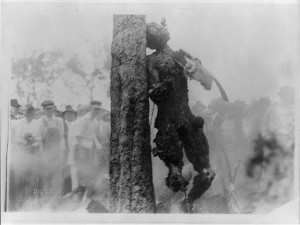
Lynching of Jesse WashingtonDoes the name “Jesse Washington” mean anything to you? It’s unlikely that it does. If I tell you that Jesse Washington died in 1916 in Waco, Texas, would that spark any memory? Have you ever been taught about the incident in which Washington was killed? Have you ever heard of what came to be called “The Waco Horror?”

Probably not. It’s not one of the incidents of American history that gets regularly taught in our schools. If I hadn’t taken a course in African American history when I was a college sophomore in 1970, I wouldn’t know anything about the death of Jesse Washington on May 15, 1916. It’s not the sort of story that makes a white person comfortable. But I do know about it, and the fact that its anniversary falls during the week when I was preparing a sermon on, among other passages from Scripture, Luke’s description of the martyrdom of Stephen in the Book of Acts struck me as significant. Both Stephen and Jesse Washington were murdered by mobs because they were different.

Jesse Washington was a 17-year-old African American farmhand. On May 8, 1916, he was accused of raping and murdering Lucy Fryer, the wife of his white employer in Robinson, Texas, not far from Waco. Jesse and his entire family (his parents and a brother) were questioned; the others were released, but Jesse was not. He was taken to Dallas, where he eventually signed a confession which some legal historians believed was coerced. There was little, if any, evidence that he was actually guilty.

Washington was tried for murder in Waco, in a courtroom filled with locals who had been provoked by local newspaper reports which included lurid, and demonstrably false, details about the crime. His defense counsel entered a guilty plea and Washington was quickly sentenced to death, but he had no opportunity to appeal.

After his sentence was pronounced, the teenager was dragged out of the courtroom and lynched in front of city hall. Over 10,000 spectators, including city officials and police, gathered to watch. Members of the mob castrated the boy, cut off his fingers, and hung him (still alive) over a bonfire. He was repeatedly lowered into the fire and raised again to prolong his agony and death. After he finally succumbed, the fire was extinguished and Jesse Washington’s charred torso was dragged through the town; parts of his body were actually sold as souvenirs. A professional photographer took pictures as the lynching progressed; these were printed and sold as postcards in Waco.

As a Christian society, we remember Stephen as the first Christian martyr and as a hero of our faith; his is a unique story told in the Book of Acts. As a Christian society, we don’t remember Jesse Washington, at all; he’s just one of thousands who were lynched. Historical reports indicate that between 1882 and 1968 there were over 4,700 lynchings in the United States. One history text estimates that between 1882 and 1930 in America at least one black person was lynched every week. (Tolnay, S., & E.M. Beck, A Festival of Violence, University of Illinois Press, 1992, p. ix) We know the numbers, but we don’t know their names.

We Americans, however, aren’t even in the minor leagues when it comes to martyring people for being different. Writing about Stephen’s death, Professor Daniel Clendenin reminds us that there have been so many more martyrs, that martyrdom is not ancient history. It is a very contemporary and present reality:

Millions more have been martyred for reasons other than religion — for their ethnicity (Jews, Armenians, Tutsis), for economic ideology (farmers, land holders), social prejudice (intellectuals, artists), race (American blacks), and gender (women around the world like the inspirational Malala Yousafzai of Pakistan).

Christians are just one group among many that honors their martyrs. Very few times, places or peoples have been spared mass murder.
If you can bear to read it, I recommend the book by Daniel Jonah Goldhagen, Worse Than War; Genocide, Eliminationism, and the Ongoing Assault on Humanity (2009). Goldhagen estimates that between 127–175 million people were “eliminated” in the last century.

These people came from all regions of the world, and from all social, economic and political groups. The vast majority of these victims were killed in their own countries, by their fellow citizens, by willing and non-coerced murderers, and almost never with any substantial dissent. Eliminationism is thus “worse than war.”

The numbers are mind-numbing, and therein lies our challenge. They bring to mind the infamous remark by [Joseph] Stalin in 1947 about the famine in Ukraine that was killing millions: “If only one man dies of hunger, that is a tragedy. If millions die, that’s only statistics.” (The Stoning of Stephen)

Clendenin concludes, “The martyrdom of Stephen disabuses us of a sentimental gospel. It roots us in the real world of industrial scale slaughter. The one man Stephen helps us to remember the individual humanity of the millions of people we might otherwise forget.”

Now I want to draw our attention away from mass murder and martyrdom, and focus instead, for a moment, on one another. I’d like you for just a few seconds to look around the room, and just take note of who and what you see here. (A short, silent pause)

What did you see? A bunch of living stones? The members of a holy priesthood? A chosen race? A royal priesthood? A people chosen and named by God? This is what Peter says we should see, the building material for a spiritual house, eternal in the heavens, not made with hands, that mansion in which there are many rooms where Jesus assures his disciples there is a place for all of us. But is that how we see one another?

Philip asked Jesus to show them the Father and Jesus replied, “Have I been with you all this time, Philip, and you still do not know me? Whoever has seen me has seen the Father. How can you say, ‘Show us the Father’?” I sometimes wonder if Jesus’ answer would perhaps have been different if Philip had asked, “Show us God.”

In the creation story in the first chapter of Genesis we are told, “God created humankind in his image, in the image of God he created them; male and female he created them.” (Gen 1:27) If Philip had asked Jesus, “Show us God,” might Jesus not have said, “Look around you, Philip.” Archbishop Desmond Tutu is fond of reminding people of those words from Genesis and suggesting that we should genuflect to one another! In a paper entitled Religious Human Rights and the Bible, he wrote:

The life of every human person is inviolable as a gift from God. And since this person is created in the image of God and is a God carrier a second consequence would be that we should not just respect such a person but that we should have a deep reverence for that person. The New Testament claims that the Christian person becomes a sanctuary, a temple of the Holy Spirit, someone who is indwelt by the most holy and blessed Trinity. We would want to assert this of all human beings. We should not just greet one another. We should strictly genuflect before such an august and precious creature. The Buddhist is correct in bowing profoundly before another human as the God in me acknowledges and greets the God in you. This preciousness, this infinite worth is intrinsic to who we all are and is inalienable as a gift from God to be acknowledged as an inalienable right of all human persons. (Emory International Law Review, Vol. 10 (1996): 63-68)

Which brings me back to Stephen and Jesse Washington, and to a strange little short story by the author Shirley Hardie Jackson entitled The Lottery that was first published in The New Yorker in June, 1948.

Set in a small, contemporary American town, a small village of about 300 residents, the story concerns an annual ritual known as “the lottery” which is practiced to ensure a good harvest; one character quotes an old proverb, “Lottery in June, corn be heavy soon.” As the story opens, the locals are excited but a bit anxious on the eve of the lottery. Children are gathering stones as Mr. Summers and Mr. Graves make the paper slips for the drawing and draw up a list of all the families in town.

When they finish the slips and the list, the men put them into a black box, which is locked up in the safe at a local coal company. The next morning the townspeople gather at 10 a.m. in order to have everything done in time for lunch. First, the eldest male of each family in town draws a slip; there’s one for every household. Bill Hutchinson gets the one slip with a black spot, meaning that his family has been chosen. In the next round, each member of the Hutchinson family draws a slip, and Bill’s wife Tessie gets the black spot. Each villager then picks up a stone and they surround Tessie, and the story ends as Mrs. Hutchinson is stoned to death while the paper slips are allowed to fly off in the wind.

Shortly after it was published, Ms. Jackson said of her story that she had hoped that by setting the particularly brutal ancient rite of stoning (the same thing that was done to Stephen) in the present she would shock her readers with “a graphic dramatization of the pointless violence and general inhumanity in [our] own lives.” (San Francisco Chronicle, July 22, 1948.) Her story suggests that we human beings are more capable of honoring our rituals and our preconceptions than we are of honoring one another.

I think the true stories of Stephen of Jerusalem, of Jesse Washington of Waco, Texas, and of those millions of martyrs who have been “eliminated” amply demonstrate that she was right. Not only are we more capable of honoring our rituals and prejudices that we of honoring one another, we are demonstrably willing to murder one another to protect them.

We are because when we look around at our fellow human beings we do not see one another as divine; we do not see living stones; we do not see members of a royal priesthood. Blinded, or perhaps just numbed, by familiar ritual, by preconception, by the simple human need to conform, we do not appreciate one another as fellow citizens of a holy nation, “chosen and precious in God’s sight,” as bearing the image of God.

“Have I been with you all this time, Philip, and you still do not know me?” Jesus asked. I’m not the least bit surprised in Philip, however; we human beings, made in the image of God, have been with each other for a long, long time, and we still do not know each other. Dr. Clendenin suggested that the martyrdom of Stephen helps us to remember the individual humanity of the millions of unnamed martyrs we might otherwise forget; may it also help us to remember the divinity of each of them and of each other.

Let us pray:

O God, you made us in your own image and redeemed us through Jesus your Son: Look with compassion on the whole human family; take away the arrogance and hatred which infect our hearts; break down the walls that separate us; unite us in bonds of love; and work through our struggle and confusion to accomplish your purposes on earth; that, in your good time, all nations and races may serve you in harmony around your heavenly throne; through Jesus Christ our Lord. Amen. (For the Human Family, Book of Common Prayer, Episcopal Church, 1979, page 815)

====================

A request to my readers: I’m trying to build the readership of this blog and I’d very much appreciate your help in doing so. If you find something here that is of value, please share it with others. If you are on Facebook, “like” the posts on your page so others can see them. If you are following me on Twitter, please “retweet” the notices of these meditations. If you have a blog of your own, please include mine in your links (a favor I will gladly reciprocate). Many thanks!

====================

Father Funston is the rector of St. Paul’s Episcopal Church, Medina, Ohio.

Psalms Are Not Science – From the Daily Office – May 17, 2014

From Book of Psalms:

For it was you who formed my inward parts;
you knit me together in my mother’s womb.
I praise you, for I am fearfully and wonderfully made.
Wonderful are your works; that I know very well.
My frame was not hidden from you,
when I was being made in secret,
intricately woven in the depths of the earth.
Your eyes beheld my unformed substance.
In your book were written
all the days that were formed for me,
when none of them as yet existed.

(From the Daily Office Lectionary – Psalm 139:13-16 (NRSV) – May 17, 2014)

Human FetusLet me make one thing clear: I do not want to get into the abortion debate! I never want to get into the abortion debate!

Whether and when to end a pregnancy is a personal and painful decision, one which I believe is ultimately to be made by one person, the pregnant one. Others may offer her advice and counsel, but when it comes right down to it no one other than her has any business making the decision. Abortion should not be a debate; it should be a private, medical decision by one person.

But I find myself rather frequently pummeled by those who do want to get into the abortion debate, beaten over the head by one side or the other with their particular arguments — most often, I must admit, by the so-called “Pro-Life” side. As a Christian pastor, I get mail, emails, and phone calls from (mostly) the anti-abortionists encouraging me to support their current efforts to restrict access to medically supervised termination of pregnancy.

And nearly every piece of literature they provide includes somewhere the assertion that “human life begins at conception.” And very often that statement is coupled with a citation to this part of Psalm 138.

So let’s make another thing clear: the psalms are not science. The Psalter is poetry and metaphor; the purpose of the psalms is primarily to praise God and secondarily to teach God’s people that the Almighty is to be praised because of the intimacy with which God loves us. These verses simply do not mean that God creates the inmost parts or the unformed substance of every fetus in every womb; nor do they address the issue of when human life begins! Even taken literally, all that this psalm is saying is that God made plans for David; it has nothing to do with when David’s, or any, life began or begins.

That is, basically, what the entire abortion controversy boils down to: when does human life begin? When does a fertilized ovum become a human person? That is a question with so many dimensions — theological, legal, moral, scientific, medical, spiritual, and more — that I’m not sure I can count them!

What I notice about these verses today is that all they name are the physical parts of the body: inmost parts, frame, substance. The spiritual aspect of human life is not mentioned; there is no thought given here to the soul, the spirit, the breath.

In Jewish and Christian theology a human person is only a human person when there is unity of the physical body with the spirit. In the Old Testament, the Hebrew noun nephesh is often translated as “soul,” but it is most often found in combination with adjective hayyah, meaning “living” or “alive.” In combination, the two are rendered “living being” or “soul alive,” but perhaps the best translation is “person.” There is human personhood only when there is both physical body and living spirit.

So when do they come together? The technical theological term is ensoulment. To ask “When does human life begin?” is to ask when ensoulment occurs.

In Jewish tradition, a baby is not considered to be a human person until its head emerges from the birth canal. According to the Talmud, “the fetus is the thigh of its mother,” which means that it is not considered an independent person until after birth. Indeed, some medieval Jewish sages held a child was not a bar kayyama or “lasting being,” i.e., a viable human being, until a month after being born. Obviously, traditional Jewish law and medieval Jewish wisdom did not give Psalm 138 the meaning our contemporary “Pro-Lifers” give it.

Christian tradition has been all over the board on the question.

Some sects (Mormons, for example — and another debate I don’t want to get into is whether members of the Latter-Day Saints are Christians) believe that the soul pre-exists the body, that God has parented or created numerous “spirit children” who await physical bodies in this world.

Some of the earliest theologians, e.g., Clement of Alexandria, Tertullian, and Gregory of Nyssa, taught that the egg and the sperm each carried a soul derived from the souls of the mother and the father, and that at conception these two proto-souls merged to form a new and distinct soul. This theory, called traducianism, is a direct and necessary development of the doctrine of Original Sin, which teaches that our sinful nature is passed from parent to child via concupiscence (sexual desire) and its (sinful?) satisfaction.

Interestingly, Augustine, who was responsible for much of the formulation of Original Sin, rejected traducianism; he favored what came to be known as Creationism, which is not the creationism which today does battle with evolutionary science.

Traducianism was rejected by the theologians of the Middle Ages — Thomas Aquinas, especially — and in favor of creationism. This view, based in part on Genesis 2:7 (“The Lord God formed man from the dust of the ground, and breathed into his nostrils the breath of life; and the man became a living being”) and Hebrews 12:9 (which distinguishes between our “human parents” and God who is the “Father of spirits”), holds that while the body is formed gradually the soul is directly created by God and enters the body when it is ready to receive it (a determination made by God).

Creationism was the accepted teaching of the church from the Fifth Century on . . . until recent times. In fact, from the late Middle Ages until the end of the 19th Century, the official teaching of the Roman Catholic Church (and the generally accepted position of most of Christianity) was that the soul enters the body of the fetus at the time of “quickening,” when the mother first feels movement.

So when does the soul enter the physical body? When does a fertilized ovum become a human person?

I don’t know.

Years ago I sat on a panel discussing abortion law and religion with an older colleague from the Eastern Orthodox tradition. He made this statement which I will never forget: “I would rather counsel a woman about legal abortion than bury a woman who’s resorted to an illegal one. And I’ve done both.” I have had to do the former, both before and after the procedure; that’s why I know so much (and so little) about this theology. Fortunately, unlike my colleague, I’ve not had to do the latter and I hope I never will.

I don’t know when “human life” begins, but I do know this: I do not want to get into the abortion debate, ever, even though I am often forced to. And I know this: abortion is a private, personal, and painful decision which is ultimately to be made by only one person, the pregnant one. And I know this: the psalms are not science.

====================

A request to my readers: I’m trying to build the readership of this blog and I’d very much appreciate your help in doing so. If you find something here that is of value, please share it with others. If you are on Facebook, “like” the posts on your page so others can see them. If you are following me on Twitter, please “retweet” the notices of these meditations. If you have a blog of your own, please include mine in your links (a favor I will gladly reciprocate). Many thanks!

====================

Father Funston is the rector of St. Paul’s Episcopal Church, Medina, Ohio.

Howling and Prowling – From the Daily Office – May 15, 2014

From the Book of Psalms:

Each evening they come back, howling like dogs and prowling about the city.

(From the Daily Office Lectionary – Psalm 59:6 (NRSV) – May 15, 2014)

Feral Dog PackI usually prefer the Prayer Book Psalter to the NRSV translation of the Psalms, but in today’s readings I find the latter rather more compelling. The NRSV makes it clear who the “they” is in this verse (which is repeated again at verse 14). “They” are “the nations,” which in the Hebrew bible always refers to ethnic groups other than the tribes of Israel. The BCP version refers to “the ungodly,” which is decidedly unclear; it could refer to individuals and, further, could refer even to persons from within the Jewish people, neither of which understandings would be accurate.
With regard to this specific verse (which is numbered 7 or 16 in the BCP), the notion of returning late in the day from some unspecified and perhaps unknown other location is lost: “They go to and fro in the evening; they snarl like dogs and run about the city.” They (whoever they are) could have been at rest within the city during the day, but the Hebrew shuwb ‘ereb is clear: “They return at sunset.” The nations have been somewhere else during the light of day, but where is unknown (at least, it is not stated in the psalm).

The NRSV text is also much more poetic than the BCP version (which is something of a surprise, frankly). The evocative rhyming of “howling . . . and prowling” is so much more effective than “snarl . . . and run about.” It casts a disturbing vision of a dog pack roaming, possibly hunting, through the darkened city streets.

Dogs, of course, are considered unclean in Judaism. They are scavengers which will eat any sort of refuse and carrion, even excrement. Although mothers do tenderly care for their young, dogs do not pair bond and have no sexual loyalty. They urinate and defecate wherever they wish. Left on their own and untrained, dogs are pretty unsavory characters!

They also have a social order that is decidedly not a human one. 21st Century research into the organization of packs of both canis lupus (wolves) and canis familiaris (dogs) has demonstrated that the “alpha male” aggression-dominance model of pack behavior is nothing more than a human projection. Dog packs are (I use the word very loosely) organized in a much more fluid and changing way, a way not easily appreciated by human observers. For all intents and purposes, dog packs mostly appear to us to be disorganized mobs.

So these are the ungodly (to use the BCP’s word): gone when it is light, showing up in the darkness, decidedly unclean in their habits, leaderless, disorganized, and dangerous. They are like feral, untamed dogs. And, yet, dogs have shown themselves not only willing but eager to give up these ways! Dogs are more than happy to associate with humans, to acknowledge humans as their leaders, to behave in ways humans deem acceptable. And we have been happy to accept them on those terms as pets, as friends, and as co-workers.

Last Sunday’s Gospel lesson was from John — Jesus declaring himself to be the good shepherd. Shepherds are nearly always assisted by dogs to whom none of the negative characteristics implicit in this psalm could be ascribed. My pastoral theology instructor (as I told my congregation in my extemporaneous children’s sermon) objected to the word pastor as a descriptor of clergy; pastor, he pointed out, means “shepherd” and there is only one shepherd. Clergy, he insisted, should be thought of as sheepdogs.

The good shepherd made a few other claims for himself. “I am the light of the world,” for example, and “I am the way.” (Jn 9:5, 14:6) For those who are leaderless, living in darkness, howling and prowling the night-time streets, Jesus offers an alternative of light and direction.

Years ago, when I was a college student in southern California, my friends and I would visit the border towns of northern Mexico. There always seemed to be plenty of ownerless, feral dogs running about. From time to time, I would notice that a feral dog would gingerly approach and befriend (possibly another human projection) a domesticated dog and, with and through that dog, would approach its owner. More often than not they were kicked and shooed away, but occasionally the human would be willing to share some food; perhaps this was the beginning of a longer relationship — I don’t know; I never stuck around or went back to find out.

Remembering those wild dogs seeking, through a domestic dog, the friendship and protection of a human being . . . thinking about the picture of dogs set out in the psalm today . . . and putting meat on the bones of my theology professor’s objection to pastor, I think there is a lesson for me and my fellow sheepdogs here. Or, more correctly, there is a question: are we in the right place?

Are we (and the flocks we are tending) in the places where the howling and prowling, the wild and feral, the leaderless, those in darkness and hunger, can gingerly approach and possibly, through us, meet the good shepherd?

====================

A request to my readers: I’m trying to build the readership of this blog and I’d very much appreciate your help in doing so. If you find something here that is of value, please share it with others. If you are on Facebook, “like” the posts on your page so others can see them. If you are following me on Twitter, please “retweet” the notices of these meditations. If you have a blog of your own, please include mine in your links (a favor I will gladly reciprocate). Many thanks!

====================

Father Funston is the rector of St. Paul’s Episcopal Church, Medina, Ohio.

God’s Butt – From the Daily Office – May 14, 2014

From the Book of Exodus:

The Lord said to Moses, “I will do the very thing that you have asked; for you have found favor in my sight, and I know you by name.” Moses said, “Show me your glory, I pray.” And he said, “I will make all my goodness pass before you, and will proclaim before you the name, ‘The Lord’; and I will be gracious to whom I will be gracious, and will show mercy on whom I will show mercy. But,” he said, “you cannot see my face; for no one shall see me and live.” And the Lord continued, “See, there is a place by me where you shall stand on the rock; and while my glory passes by I will put you in a cleft of the rock, and I will cover you with my hand until I have passed by; then I will take away my hand, and you shall see my back; but my face shall not be seen.”

(From the Daily Office Lectionary – Exodus 33:17-23 (NRSV) – May 14, 2014)

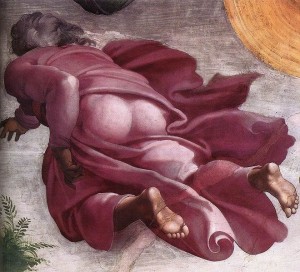
Detail of Sistine Chapel - God's backsideThe translators of the NRSV are a bunch of prudes; a better translation of the last verse of this section would be “. . . you shall see my butt.”

The term “my back” is a translation of the Hebrew term ‘achowr which, incidentally, is a plural noun; when this is used of an animal, the translation is usually “hindquarters” or something of that nature, which apparently is inappropriate with respect to God. In the 3rd Century Greek translation of the Old Testament, the Septuagint, it is translated into the odd construction ta hopiso mou, “the behinds of me.” When St. Jerome translated the Vulgate Latin version in the 4th Century, he also retained the plural, posteriora mea, “my posteriors.” The translators of the Authorized version of 1611 did so, as well, “my back parts.” In other words, my backside, my ass end, my buttocks!

So the NRSV editors are just a bunch of prudes! Or maybe they are just being prudish for a contemporary American audience which has become obsessed with . . . what? sex? nudity? titillation?

Recently there was a news article about an attractive 17-year-old young woman who was expelled from a homeschoolers’ prom event because, although her dress met the dress code requirements, it was considered to titillating for the fathers watching the dancers from the balcony! I hesitate to say that this event was billed as a dance for “Christian” homeschoolers, because the published reports reveal a good deal of unchristian behavior from the leering of the fathers to the disrespect shown the young lady and her escort by the chief chaperone of the event. (The Cleveland Plain Dealer‘s report yesterday of the incident is here.)

And the question of respect is really what this episode between Moses and God raises for me.

I’m not sure when the “look at God’s face and die” notion arose among the Hebrews, but it isn’t there in the earliest stories of the bible. Adam and Eve seem to carry on face-to-face conversations with God with no ill effect and, when God shows up in the guise of three strangers at the oaks of Mamre, Abraham sits and talks with them over a lamb dinner and does not succumb. But, in any event, the Hebrews somehow got the idea that one shows greatest respect for God by averting one’s gaze and thus this story and, later, Isaiah’s fear that he will die because of his experience in seeing a vision of God in the heavenly throne room: “Woe is me! I am lost, for I am a man of unclean lips, and I live among a people of unclean lips; yet my eyes have seen the King, the Lord of hosts!” (Isa 6:5)

Human cultures differ on how to show respect to elders. Some adopt this averted-gaze position; others (my forebears among them) insist on looking people in the eyes. I can remember quite vividly both of my grandfathers forcefully insisting that I look them squarely in the face when in conversation; looking away even briefly was considered either as disrespect or as possible evidence of untruthfulness.

What this suggests to me is that we humans don’t actually know how to respect one another! The story of the really (in my opinion) bad treatment of the young woman at the prom is simply more evidence of that. And, if we don’t know how to respect another human being, we certainly do not know how to respect God.

Respect requires maturity; showing proper respect to another person, human or god, is a mark of adulthood. Perhaps that is the point of today’s story of Moses and God, neither Moses nor the Hebrews (nor, for that matter, any of humanity) were yet mature enough to have a respectful face-to-face relationship with the Almighty, so God did what God could.

Moses is permitted to see God’s butt because God was lowering God’s self to develop a relationship with Moses and, through him and the Hebrews, with all humanity, a relationship that hopefully would grow and mature. In giving Moses this vision, God revealed both a special affection for his favorite and a hope for the eventual adulthood of the human race. The gaze of those lustful old men in the balcony focused on the young prom-goer’s butt suggests we still have a long way to go!

The indecorous nature of God’s backside reveals the extent to which God is willing to humble God’s self out of respect for human beings; someday, perhaps, we’ll learn to show respect as well.

====================

A request to my readers: I’m trying to build the readership of this blog and I’d very much appreciate your help in doing so. If you find something here that is of value, please share it with others. If you are on Facebook, “like” the posts on your page so others can see them. If you are following me on Twitter, please “retweet” the notices of these meditations. If you have a blog of your own, please include mine in your links (a favor I will gladly reciprocate). Many thanks!

====================

Father Funston is the rector of St. Paul’s Episcopal Church, Medina, Ohio.

I Don’t Know – From the Daily Office – May 13, 2014

From the Book of Exodus:

Moses said to Aaron, “What did this people do to you that you have brought so great a sin upon them?” And Aaron said, “Do not let the anger of my lord burn hot; you know the people, that they are bent on evil. They said to me, ‘Make us gods, who shall go before us; as for this Moses, the man who brought us up out of the land of Egypt, we do not know what has become of him.’ So I said to them, ‘Whoever has gold, take it off ‘; so they gave it to me, and I threw it into the fire, and out came this calf!”

(From the Daily Office Lectionary – Exodus 32:21-24 (NRSV) – May 13, 2014)

Golden Calf“I threw it into the fire, and out came this calf!”

I chuckle every time I read this story and get to this point. In fact, when the story of the golden calf has been read in church and the reader gets to Aaron’s disclamation of responsibility, I’ve been known to laugh out loud.

Once, years ago, in a bible study group reading Exodus, I asked, “How old was Aaron?” No one knew, but we were all pretty certain that Moses and his brother were not young children at the time of this story. Nonetheless, a young child is exactly what Aaron sounds like: “I threw the gold in the fire, and out came this calf!” No mention of his forming the mold, pouring the molten the gold, breaking the mold, polishing the casting, and all the rest that goes into the making of a metal statue. The calf just “came out.”

There was a phantom in our house when my children were very young. We’d find that someone had opened the orange juice and not only taken some, but also spilled a good deal on the kitchen counter and floor. “Who did this?” we would ask. “I don’t know,” would be the answer. The contents of my wife’s purse were spilled there was lipstick smeared on things. “Who did this?” we demanded of the little girl with red all over her face. “I don’t know,” she told us. Someone once tried to make sand castles in the cat box. “Who did this?” we asked the little boy with sand fingers. With a straight face he replied, “I don’t know.”

We never caught I Don’t Know doing any of these things (or many others), but there was plenty of evidence of his (or was it “her”?) existence. I Don’t Know was a very active sprite! Apparently, I Don’t Know was much older than we thought. He or she appears to have been with the Hebrews in the desert. — “Who made this golden calf?” — “I don’t know. I threw the gold in the fire and out came this calf!”

In the modern adult world, I Don’t Know has gotten more adapt at hiding his or her identity. “Who made that decision?” we ask. The answer is often one of I Don’t Know‘s alter egos: a committee, the vestry, the (unnamed) higher-ups, the council, management, the administration. Could it be that I Don’t Know is being scapegoated?

Imaginary friends are a healthy part of maturing. Research shows that children with imaginary companions tend to be less fearful, laugh more, smile more, engage more with peers, and are better able to imagine how someone else might think. An imaginary friend can aid a child to handle fear, explore ideas, or gain a sense of competence, but children with imaginary friends will sometimes blame them for misbehavior in an attempt to dodge the displeasure of adult authority. I Don’t Know is not exactly an imaginary friend, but disclaiming responsibility and deflecting blame is certainly child-like (if not childish) behavior.

“When I was a child, I spoke like a child,” wrote St. Paul, “I thought like a child, I reasoned like a child; when I became an adult, I put an end to childish ways.” (1 Cor 13:11) Jesus once told a story about someone who decided to stop blaming I Don’t Know. The man in the story “put an end to childish ways” and said to himself, “I will get up and go to my father, and I will say to him, ‘Father, I have sinned against heaven and before you.'” (Lk 15:18)

We human beings of all ages when challenged still seem invoke I Don’t Know to avoid personal responsibility on a pretty regular basis. Christian maturity, coming (as Paul said) “to the measure of the full stature of Christ,” (Eph 4:13) no longer laying things at the feet of I Don’t Know is something for which we all need to strive. We need to give up being like Aaron; we need to put an end to childish ways.

Is that going to happen on a general basis any time soon?

I could answer, “I don’t know.” But the truth is, I think I do.

====================

A request to my readers: I’m trying to build the readership of this blog and I’d very much appreciate your help in doing so. If you find something here that is of value, please share it with others. If you are on Facebook, “like” the posts on your page so others can see them. If you are following me on Twitter, please “retweet” the notices of these meditations. If you have a blog of your own, please include mine in your links (a favor I will gladly reciprocate). Many thanks!

====================

Father Funston is the rector of St. Paul’s Episcopal Church, Medina, Ohio.

« Older posts Newer posts »