From the Gospel according to Mark:
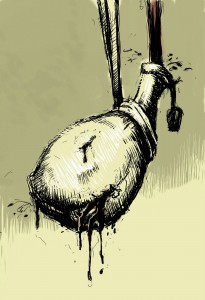
Jesus said, “No one sews a piece of unshrunk cloth on an old cloak; otherwise, the patch pulls away from it, the new from the old, and a worse tear is made. And no one puts new wine into old wineskins; otherwise, the wine will burst the skins, and the wine is lost, and so are the skins; but one puts new wine into fresh wineskins.”
(From the Daily Office Lectionary – Mark 2:21-22 (NRSV) – January 18, 2013.)
 For the past few years, I’ve been reading some of the folks who are writing about “emerging Christianity,” primarily Brian McLaren and Phyllis Tickle, but others as well. So last weekend I went to an event called an “Emergence Christianity conversation,” which was really a kick off for Ms. Tickle’s latest book. I was one of 400 or so participants, many of whom had been to earlier “emergence” events or are members of “emerging church” communities or both. Since I have not and am not, I was at most a johnny-come-lately to the conversation and at least an outsider. Nonetheless, I took part as I hoped to learn more about this (as Ms. Tickle put it) new tributary in the river that is Christianity.
My reason for doing so was, frankly, practical. What, I wanted to know, is happening on the ground in those places where “emerging Christianity” has taken the form of viable communities and working ministries? What might we in the historic, institutional church (what the emergent community calls “the inherited church”) learn from them?
I got fewer answers to those questions than I had hoped. The major presentations of this conversation were more about “framing the discussion” of the emerging church than about the practical ministries of emerging congregations. However, in smaller gatherings and in private conversations, I did pick up some ideas.
The practical question is how one can incorporate these new ways of being Christian into the life of an established, institutional congregation with a nearly 200-year history: how to, in the words of Jesus’ metaphors today, sew new cloth onto an old garment, how to pour new wine into an old wineskin. The emerging church conversation yields no answers to these questions because most of these experiments in doing new things (or old things a new way) are “start ups” outside of traditional church structures. Those few that are within older institutions are from less structured denominations with fewer restrictions (real or perceived) than our Anglican/Episcopal tradition, and even they show the signs of strain Jesus’ parable suggests.
Of course, we’re not dealing with old cloth or old leather . . . we’re dealing with people and, unlike cloth or leather, people can make the conscious decision to change, to be more flexible, to give up old ways and old notions. Henry Ford has been quoted (probably inaccurately) as saying, “I’m looking for a lot of people who have an infinite capacity to not know what cannot be done.” That’s the kind of people who aren’t old cloth or old leather. People who won’t say, “Oh, it can’t be done,” or “We’ve never done it that way,” but who will say, “Hey, anything’s possible. If the Lord is with us, let’s give it a shot.” The cloth wouldn’t tear and the wineskin wouldn’t burst if they were able to think like that.
Although I’m also thinking that maybe bursting the old wineskin of the church wouldn’t be a bad thing . . . .
====================
A request to my readers: I’m trying to build the readership of this blog and I’d very much appreciate your help in doing so. If you find something here that is of value, please share it with others. If you are on Facebook, “like” the posts on your page so others can see them. If you are following me on Twitter, please “retweet” the notices of these meditations. If you have a blog of your own, please include mine in your links (a favor I will gladly reciprocate). Many thanks!
====================
Father Funston is the rector of St. Paul’s Episcopal Church, Medina, Ohio.
 For many years, I have rather liked Paul’s citizenship metaphor for our participation in the household of God. It made sense . . . but I’m not sure it makes sense any longer because I’m not sure we understand any longer what citizenship is!
 Does it bother anyone else that as soon as Mrs. Simon’s mother is healed by Jesus she gets up from her sick bed and “begins to serve them”? That has always bothered me. I don’t know why it should. After all, if she’s healed (and one assumes that when Jesus healed someone they were really healed), then there’s no reason for her not to do what she would have done if she’d not been sick in the first place. But . . . it has bothered me. Why, I have thought, should this poor woman who’s been sick have to get out of bed and serve these men?
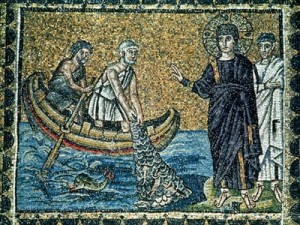 “I don’t know if this story happened, but I know it is true.” One of my favorite stories begins this way. The Gospel accounts do not, but they could . . . .
 At the emergence Christianity conversation I took part in at St. Mary’s Cathedral in Memphis, Tennessee, this past weekend a distinction was made between “emergence Christianity” and “inherited Christianity”. Paul’s thesis that “in Christ we have obtained an inheritance” and that this inheritance is “redemption as God’s own people” has brought this to mind. (For the details of this movement and some of its history, the book to read is
  Well! Here we are . . . just a few days ago I mentioned this text in regard to another lectionary reading. I am attending a conference on “emerging Christianity” this week and this text (having come up in that meditation) has been on my mind. There are many among the participants in this conversation who are quite passionate about the “emerging church” movement; they are definitely not “lukewarm”.
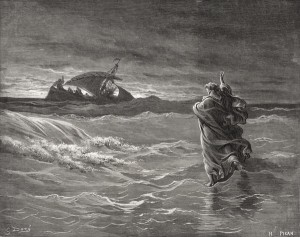 Jesus walking on the water has always struck me as a very funny story. “Funny” in the sense of “oddly out of place”, although it also has a certain Monty-Python-esque quality to it as well. The fact that it is reported in three of the Gospels – in the synoptic Gospels of Mark and Matthew and here in John – attests to its importance for the early church. John’s version of the story is the simplest, but it contains all the elements – a storm, rough seas, disciples’ fear. Like Mark, John leaves out Matthew’s addition of Peter trying to join Jesus on the surface of the lake.
  “I was ready to be sought . . . I said, ‘Here I am, here I am’.” Almost more than anything else in Scripture, these words speak to me of God as not just wanting but needing to be in relationship with creation. I have written elsewhere about my understanding of God as the God who communicates; here is the God who seems almost desperate to be in relationship with his people. God speaks and everything comes in to being; in the beginning was the Word. But what good is speaking, what good is a word, if no one hears it, no one answers it? “Here I am, here I am” seems like a plea to be heard, to be recognized, to be answered. But in our modern society, very few people seem to be answering. Many claim to be seeking, many claim to be “spiritual but not religious,” but few are finding God in the traditional faiths and faith communities.
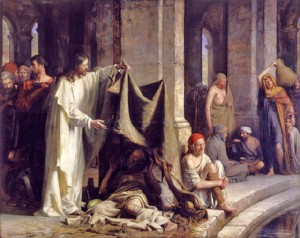 This is an old and familiar story, this tale of Christ healing the paralyzed man a the pool at Bethesda. We all know it well. The story continues with a confrontation between the man who has been and the Jewish religious authorities. This healing took place on the Sabbath. The confrontation is over whether it is proper for the man to carry his mat (i.e., perform work) on the Sabbath. The man’s defense is that the person who healed him told him to do so, although he doesn’t know (at the time) who the healer was. Later he learns it was Jesus and identifies him to the priests and scribes.
 I am fascinated by this picture of God arming for battle, putting on his breastplate, his helmet, and his mantle, donning the “garments of vengeance.” It is, of course, injustice and evil against which God is arming. St. Paul picked up on the picture painted here by Isaiah when he admonished the Christians in Ephesus:

