From the Book of Genesis:
God said to Abraham, “As for you, you shall keep my covenant, you and your offspring after you throughout their generations. This is my covenant, which you shall keep, between me and you and your offspring after you: Every male among you shall be circumcised. You shall circumcise the flesh of your foreskins, and it shall be a sign of the covenant between me and you. Throughout your generations every male among you shall be circumcised when he is eight days old, including the slave born in your house and the one bought with your money from any foreigner who is not of your offspring. Both the slave born in your house and the one bought with your money must be circumcised. So shall my covenant be in your flesh an everlasting covenant. Any uncircumcised male who is not circumcised in the flesh of his foreskin shall be cut off from his people; he has broken my covenant.”
(From the Daily Office Lectionary – Gen. 17:9-14 (NRSV) – January 1, 2013.)
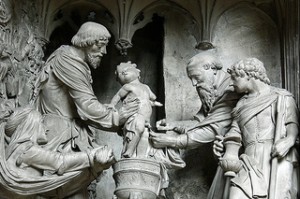 Today, people all over the world go all sort of crazy making resolutions about how we will improve our lives in the coming year – it is New Year’s Day! But on the calendar of the church it is the Feast of the Holy Name, also known as the Feast of the Circumcision.
The law of Moses (as this bit of Genesis shows) required that newborn boys be circumcised on their eighth day of life. So on this eighth day after Christmas Day, we commemorate Jesus’ early submission to the law as recorded in Luke 2:21: “After eight days had passed, it was time to circumcise the child; and he was called Jesus, the name given by the angel before he was conceived in the womb.” (This verse also explains the first alternative title of this day.)
It seems to me appropriate that this feast day of the beginning of a new covenantal relationship between God and one of God’s children falls on the day the secular world also celebrates a new beginning. It reminds me of Carl Sandburg’s famous statement that “a baby is God’s opinion that life should go on.” The coincidence of New Year’s Day and Holy Name Day reminds us that life in relationship with God should go on. Here’s Sandburg’s full comment:
A baby is God’s opinion that life should go on. A book that does nothing to you is dead. A baby, whether it does anything to you, represents life. If a bad fire should break out in this house and I had my choice of saving the library or the babies, I would save what is alive. Never will a time come when the most marvelous recent invention is as marvelous as a newborn baby. The finest of our precision watches, the most super-colossal of our supercargo plants, don’t compare with a newborn baby in the number and ingenuity of coils and springs, in the flow and change of chemical solutions, in timing devices and interrelated parts that are irreplaceable. A baby is very modern. Yet it is also the oldest of the ancients. A baby doesn’t know he is a hoary and venerable antique – but he is. Before man learned how to make an alphabet, how to make a wheel, how to make a fire, he knew how to make a baby – with the great help of woman, and his God and Maker. (Remembrance Rock, Harcourt Brace:1948)
The coincidence of the Feast of the Circumcision with New Year’s Day is a reminder that, first day of the new year it may be, we know “as of old” how to live the life it presents us. Every year we make resolutions, new covenants perhaps, to do the things we’ve always known how to do, the things we’ve always known we should do. St. Paul wrote to the Romans that “real circumcision is a matter of the heart – it is spiritual and not literal.” (Rom. 2:29) John Wesley taught that this implies humility, faith, hope, and charity. Let us resolve, let us covenant to live out these qualities in the year ahead.
Happy Holy Name Day!
====================
A request to my readers: I’m trying to build the readership of this blog and I’d very much appreciate your help in doing so. If you find something here that is of value, please share it with others. If you are on Facebook, “like” the posts on your page so others can see them. If you are following me on Twitter, please “retweet” the notices of these meditations. If you have a blog of your own, please include mine in your links (a favor I will gladly reciprocate). Many thanks!
====================
Father Funston is the rector of St. Paul’s Episcopal Church, Medina, Ohio.
 New Year’s Eve and our epistle lesson in the Daily Office lectionary focuses on the old passing away and everything becoming new. It’s purely serendipitous, but what an opportunity to affirm our faith in God’s on-going and constant re-creation of the world.
 “No matter how big and bad you are . . . when a two-year-old hands you a toy telephone, you answer it.” That piece of wisdom showed up on my Facebook newsfeed recently and I will return to it in a moment, but first I want to share some more Christmas poetry with you.
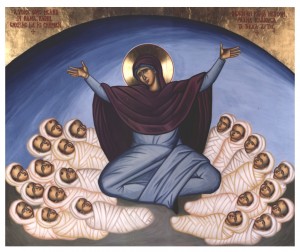 Today is the Feast of the Holy Innocents and the Daily Office Lectionary again chooses lessons that underscore the day’s commemoration. In the midst of Christmas joy, we are reminded of the little children killed by Herod’s soldiers in the king’s attempt to do away with a perceived rival. I am not the first nor the only preacher or pastor to have thought of this story when, two weeks ago, gunman Adam Lanza opened fire at Sandy Hook Elementary School in Newtown, Connecticut. The wanton murder of children at any time makes the country where it occurs desolate and devastated. So today, again, we pray for the repose of the souls of those who died:
 On the third day of Christmas the church calendar directs our attention to St. John the Evangelist and, again, the Daily Office lectionary falls in line. John is the gospeller whose wonderful prologue serves as the Gospel lesson at the Eucharist on Christmas Day (1:1-14) and on the first Sunday after Christmas (1:1-18). It is for me a much more meaningful Gospel of the Incarnation than Luke’s sweet story of innkeepers, shepherds, angels, and the virgin birth: “In the beginning was the Word, and the Word was with God, and the Word was God.” (v. 1)
 On the second day of Christmas the church remembers a murder, the martyrdom of Stephen, and our Daily Office lectionary won’t let us forget it. Often the readings of the Daily Office seem to have nothing to do with the season and they seldom are tied to a saint’s commemoration, but today the morning and evening readings tell the whole story in gruesome detail.
 I was born and raised in the desert. The image of wilderness and dry land blossoming is one that touches my heart and excites my imagination. I love the desert. I love its stark and barren beauty, when the rains of spring kiss it and it blossoms . . . there’s nothing like it anywhere else.
  I want to ask you to read along as I re-read the collect for the day, the particular prayer of the Fourth Sunday in Advent: “Purify our conscience . . . . ” That’s enough, just those three words: “Purify our conscience . . . . ” Don’t you think that’s asking a lot of God? I mean really . . . purify the human conscience, that place in ourselves where we know all the wrongs we have done. Tall order, purifying that! But that’s what the prayer asks and in doing so it draws on the language of the Letter to Hebrews from which our second lesson today is taken.

