From Peter’s First Letter:
In your hearts sanctify Christ as Lord. Always be ready to make your defence to anyone who demands from you an account of the hope that is in you; yet do it with gentleness and respect.
(From the Daily Office Lectionary – 1 Peter 3:15-16 (NRSV) – November 25, 2012)
 Today is the last Sunday after Pentecost called “the Feast of Christ the King.” A relatively new feast on the calendar of the church, it was instituted by a 20th Century pope and originally set in late October as a response to the Protestant celebration of “Reformation Sunday” on the Sunday closest to October 31, the anniversary of Luther’s posting on the Wittenburg chapel door. The latter, I would suppose, started with the Lutherans but has spread throughout American Protestantism; I know of Presbyterian, Reformed, UCC, and Methodist churches that mark it. I know of no Episcopal congregations that do so. Episcopalians did take to Christ the King, however, and since Paul VI moved it to the last Sunday of the Christian year, every congregation I’ve been a part of has celebrated it. With the adoption of the Revised Common Lectionary, it is now an official part of our tradition.
Today, my congregation will be celebrating it without me. My spouse and I have taken a break and, since Friday, have been staying in a retreat facility not that far away from our home geographically, but mentally, emotionally, and spiritually a very, very long distance separate this place from that. We spent yesterday indulging our hobby of “antiquing” – wandering aimlessly through several of the amazing collections of junk one finds in the abandoned supermarkets, retired barns, and former garages now called “antique malls.” There are several in the Amish Country of Ohio, where we are.
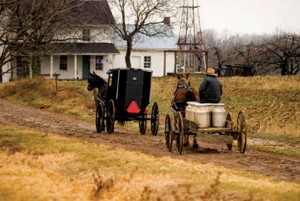
The Amish are an interesting people. They quietly and steadfastly maintain a traditional way life hundreds of years old, one dating back to their formation as a Protestant sect in German-speaking Switzerland. Eschewing automobiles, they drive boxy black buggies down the state highways and country roads. Claiming not to use electricity, they have gas lights or kerosene lanterns in their homes and businesses, except when they don’t – I admit to being befuddled by this; I can’t figure out when it is OK to use electricity and when it isn’t. And then there is the use of batteries by those who “have no electricity” (as one shopkeeper put it); batteries power buggy lights and sometimes business lighting (but “we have no electricity”). I don’t get it it, but that’s OK – that’s not what this meditation is about.
What makes the Amish most interesting is that they go about this odd, set-apart way of life “with gentleness and respect.” I nearly wrote above that they maintain their traditions “unobtrusively,” but that really wouldn’t have been accurate. They are obtrusive! Come upon a horse-drawn farm cart plodding along a 55-mph-speed-limit highway or a buggy on a 35-mph country lane, roads which are winding and hilly and have limited visibility, and (believe me) it’s an obtrusion! Often a deadly one for the Amish if the automobile driver doing so is not paying attention or has poor reactions.
In stores, the Amish men with their broad-brimmed hats, long beards, and plain rugged clothing, and the Amish ladies with their long skirts, dark sweaters, and hair done up in buns under starched linen caps, are very noticeable, whether they are service personnel or are themselves customers. In restaurants, which they rarely but occasionally patronize, their large families pausing to say grace in antiquated German before eating are a reminder that while they are sanctifying the Lord, we are not. That’s obtrusive . . . but oh so gentle and respectful.
That is the nature of the King whom we sanctify today on this special day of remembering his lordship. He gave vent to flashes of anger, of course, and there are plenty of hints throughout the Gospels that he was, rather often, frustrated and unhappy with this followers, but we mostly remember him as gentle and reverent. “Gentle Jesus, meek and mild” is a phrase I remember from a hymn we learned in my Methodist Sunday School days of long ago.
The Gospel lesson for today’s celebrations of the Holy Eucharist is from John: Pilate questioning Jesus before his crucifixion. Jesus, the epitome of gentleness and respect, answers Pilate calmly, or stands silently, when he could have taken complete control of the situation, called down the wrath of God, and established an earthly kingdom right then and there. Instead, he takes complete control of the situation in another way, the way of gentleness and peace.
I think that’s what I find most compelling and oddly attractive about the Amish. They are in complete control of their lives, as narrow and confined as they may seem to a modern outsider like myself. They go about their traditional ways in the midst of the madness around them, the speeding cars, the frantic shoppers, the hurried diners too busy to say grace; they don’t give in to modern pressures. They just keep plodding along like the horses pulling their carts and buggies, doing faithfully what they know they are called to do. They are a Protestant’s Protestants, children of the Reformation started when Martin Luther nailed those theses to the Wittenburg door, but more than any Solemnity declared by pope or any dictate of the lectionary, they stand testimony to the power of gentleness and respect, a potent reminder of Christ the King.
====================
A request to my readers: I’m trying to build the readership of this blog and I’d very much appreciate your help in doing so. If you find something here that is of value, please share it with others. If you are on Facebook, “like” the posts on your page so others can see them. If you are following me on Twitter, please “retweet” the notices of these meditations. If you have a blog of your own, please include mine in your links (a favor I will gladly reciprocate). Many thanks!
====================
Father Funston is the rector of St. Paul’s Episcopal Church, Medina, Ohio.
 Although from a modern perspective, the prayer of the Pharisee is rather bigoted, but we should try to see it from his perspective and from within his culture, which Jesus shares. When we do so, we can see that Jesus is not criticizing the individual, but rather condemning an entire system of religion which divides and categorizes people. Jesus is denouncing any system, religious, social, or political, which separates people on the basis of bigotry and fear.
 It may be the United States’ holiday of Thanksgiving Day, but the Daily Office continues at this time of year delivering its message of repentance rather than encouraging thanksgiving. The Old Testament lesson is another from Malachi in which the Lord speaking to the priests says that he has spread dung on their faces and put them out of his presence! The gospel lesson from Luke has Jesus predicting the end of the world. And then there’s this epistle lesson which condemns the wealthy. Just not a lot of giving thanks!
 Several years ago I served in a small parish which had a very tight budget. Among its many cost-saving efforts was the reuse of altar flowers. Arrangements would be purchased and used on one Sunday, then quickly put away in the refrigerator in the basement kitchen to be used again the next week. Of course, they didn’t last as well as they might have been wished to (and some varieties of flower fared worse than others), so it was noticeable that they’d been around for awhile. In addition, if there’d been any sort of parish dinner in the interim so that food had been stored in the same refrigerator, they would often have taken on a bit of the odor of fried chicken or garlic or cheesy tuna surprise.
  Giving thanks at a time privation, that’s what these two verses from Habakkuk’s prophecy are about. Habakkuk describes a situation in which he (and all the people of Jerusalem) have lost everything. Just look at what he lists in verse 17: figs, grapes, and olives, the year-round fruit crops of the area; the fields, which is to say the annual crops, the grains and staple foods; flock and herd, which means sheep and cows. All their their produce is gone, all their livestock are dead.
  There are two passages of Scripture that I always think of when vestries or other church governing boards begin to discuss a vision for the church’s mission and ministry. One is the King James version of Proverbs 29:18a – “Where there is no vision, the people perish.” – the other is this passage from Habakkuk. I really like the image of the vision being written so large that someone running by can read it and make sense of it; the church’s vision needs to be as big, expansive, and attention-getting as a billboard.
 The “valley of decision” is probably another name for the Valley of Jehoshaphat referred to in an earlier verse of this chapter of the Prophet Joel. Jehoshaphat (a Hebrew name pronounced “yeh-hoh-shah-faht”) is a compound word of two other Hebrew terms, Yahweh (one of the names of God) and shaphat (meaning “to judge” or “to decide”). Jehoshaphat, therefore, means “God will judge” or “God will decide”. Geographically, the valley of Jehoshaphat, the valley of decision, lies between the city of Jerusalem and the Mount of Olives.
 I suppose I take issue with Scripture more often than I should, but this is one of those bits that I just can’t agree with. I vehemently disagree with James’s equation of “doubt” with what he calls “double-mindedness”. The Greek word translated “double-minded” is dipsuchos , from dis , meaning “twice,” and psuche , meaning “mind.” James use of it to describe someone who has doubts suggests that such a person is divided in his or her interests or loyalties, wavering, two-faced, and half-hearted.
 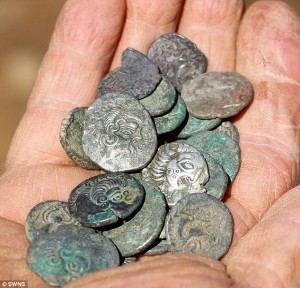 This story of the woman seeking her lost coin follows on the heels of the parable of the lost sheep in which the shepherd leaves the ninety-nine to seek the lost one. That story is much more familiar and, I suppose, is more popular because of romantic notions of some emotional bond between sheep and shepherd, supported no doubt by those lovely Sunday School images of Jesus carrying a lamb on his shoulders. As we modern (and now post-modern) 21st Century urban Christians have moved further and further from agrarian reality, those romantic misconceptions deepen and the less-palatable aspects of the parable’s metaphor are forgotten.

