From the Book of Acts:
Paul stood in front of the Areopagus and said, “Athenians, I see how extremely religious you are in every way. For as I went through the city and looked carefully at the objects of your worship, I found among them an altar with the inscription, ‘To an unknown god.’ What therefore you worship as unknown, this I proclaim to you.”
(From the Daily Office Lectionary – Acts 17:22-23 (NRSV) – September 22, 2012)
 Every Sunday I stand in front of a stained-glass window depicting this scene, the altar window of St. Paul’s Episcopal Church in Medina, Ohio. St. Paul stands magisterially among a group of attentive Athenians, his right arm raised, his index finger pointing to heaven; the Parthenon is scene in the background; a banner lost amidst Victorian decoration declares (in good King James English), “Whom therefore ye ignorantly worship, him declare I unto you.” (v. 23)
The contrast between the modern (New Revised Standard) and older (King James) translations is absolutely striking! In verse 22 of the text as translated above, Paul praises the Athenians as “extremely religious.” In the KJV translation, he condemns them as “too superstitious.” In the translation of verse 23 above, they worship God as “unknown”; in the KJV, they worship “ignorantly.” In the modern translation, Paul is respectful of the Athenians; in the Authorized version, he addresses them with contempt.
In the Greek, the first term is deisidaimonia which can have either affirmative (“religious”) or negative (“superstitious”) meanings. The second term is agnoeo which is related to our English word agnostic; it directly translates as “not knowing”. Paul uses it frequently in his letters to mean such things as “unaware,” “uninformed,” or “not recognizing.” Like the first term, it can have either affirmative or negative meanings depending on context.
How should we read it? Like the good bishops and scholars who translated the Authorized Version under warrant of King James in the early 17th Century, or like the modern scholars who translated the NRSV in the late 20th Century? And which version ought we to emulate in our dealings with non-Christians?
It should come as no surprise to anyone that my preference is for the later translation. Although Paul is often forceful in his rhetoric, neither his letters nor Luke’s portrait of him in the Book of Acts suggests that he was ever deliberately rude. He was, rather, respectful of his audiences; I believe we should give him the benefit of the doubt and translate his conversation with the Athenians in that light. I believe, also, that as we engage those who are not of the Christian faith it is that same attitude of respect and courtesy that we should adopt.
The Athenians of our day are our neighbors, our friends and co-workers, who have adopted a new version of agnosticism, who say, “I am spiritual but not religious.” It is these “SBNRs” (as some current writers of church literature have labeled them) to whom we are commissioned to present the Gospel. Several months ago, I read a blog post by an author I like and respect which, I’m sad to say, takes the KJV attitude towards such folks. The post is entitled Spiritual but Not Religious? Please Stop Boring Me. In it the author, a clergy person, describes the experience many of us ordained have had of sitting next to an SBNR on an airplane; she complains that she finds such persons, these folks who “find God in sunsets,” simply uninteresting:
Being privately spiritual but not religious just doesn’t interest me. There is nothing challenging about having deep thoughts all by oneself. What is interesting is doing this work in community, where other people might call you on stuff, or heaven forbid, disagree with you. Where life with God gets rich and provocative is when you dig deeply into a tradition that you did not invent all for yourself.
Thank you for sharing, spiritual but not religious sunset person. You are now comfortably in the norm for self-centered American culture, right smack in the bland majority of people who find ancient religions dull but find themselves uniquely fascinating. Can I switch seats now and sit next to someone who has been shaped by a mighty cloud of witnesses instead? Can I spend my time talking to someone brave enough to encounter God in a real human community? Because when this flight gets choppy, that’s who I want by my side, holding my hand, saying a prayer and simply putting up with me, just like we try to do in church.
Now, as I said, I like and respect this author, but I can’t applaud the attitude betrayed by this particular comment. This is the attitude of the KJV Paul condemning the Athenians as superstitious and ignorant! This attitude is not going to win any converts. I sympathize with the author; I know how dull and boring those on-board conversations can be. I know what it’s like to get onto an airplane hoping for a little “down time” only to have to do the work of being a “professional Christian”. It’s hard work, but guess what? It’s the work we were baptized to do (not ordained to do, baptized); it’s the work to which all Christians are called – to love our neighbor as ourselves, to spread the Gospel, to make the faith attractive to others. We do that when emulate the NRSV Paul; we fail if we follow the example of the KJV Paul.
====================
Father Funston is the rector of St. Paul’s Episcopal Church, Medina, Ohio.
 Today’s evening Psalm is ascribed to Asaph who, according to the genealogies in the Books of Chronicles, seems to have been one of King David’s chief musicians. His sons, we are told, were assigned by David to “prophesy with lyres, harps, and cymbals” (1 Chr 25:1). Asaph seems to have been something of a psychologist, for in these two verses he draws the connection between anger and stupidity – being embittered and “wounded in heart” leads to lack of understanding and brutish behavior. Was there ever a truer observation?
 This is one of my favorite images from Scripture, God as strong rock, castle, crag, and stronghold. In fact, during my sabbatical last year this verse kept coming to mind as I explored the ruins of castles and monastic foundations in Scotland, England, and Ireland. My fondness for this metaphor today dovetails with my thoughts the past couple of days about the nature of sovereignty (see yesterday’s meditation on praying Psalm 72 in modern America) and God’s reign (the day before, considering the modern political implications of Christ’s triumphal entry in John 9).
  It’s a puzzlement!
  We are living through a presidential election campaign in the United States. It seems to have been going on for ever, and the political ads and the news coverage of the candidates are increasing in intensity and in frequency. Pollsters take the public’s political pulse; commentators analyze the polls; the public reacts to the analysis; the pollsters re-poll the public. It’s a system of pendulum swings that feeds upon itself and oscillates back and forth. Flip-flopping candidates are matched by a flip-flopping electorate, and the candidates, their surrogates, and the commentators all decry the fickleness of the crowd.
 My father-in-law died a week ago; he will be laid to rest later today. His ashes will be interred next to those of my mother-in-law, his first wife, who passed away sixteen years ago. Marge was a Christian and an active church member; Paul was not. I’m not sure he was ever baptized but, if he was, he left that behind long ago. (Yes, I know the theology of baptism – once baptized, always baptized – and that may true from the church’s point of view, perhaps even from God’s perspective, but that was not Paul’s reality.)
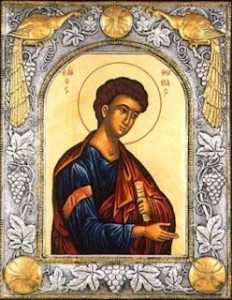 Commentaries insist that all John is doing in identifying Thomas as having been “called the Twin” is translating his Semitic name into its Greek equivalent, Didumos meaning “two-fold, twain, or twin”. But I wonder why he does this? A strain of Christian gnosticism insisted that Thomas was Jesus’ twin brother! Wouldn’t that have been interesting? How would we explain the Incarnation if the “power of the Holy Spirit” which came over Mary and produced a child with no earthly father had actually resulted in twins? Only one of them would be the Incarnation? Would that even make sense? No, I don’t think the gnostics got that one right, at all. But still, I find it intriguing that John throws in this little tidbit that Thomas was called “the Twin.” (He does it three times! He must have thought it important! See also John 20:24 and 21:1.)
 I love this Psalm – it’s about liturgy and worship, something dear to my heart!

